The Rise of the Ottoman Empire
The greatest Cossack triumphs of the late 16th and early 17th centuries in Europe were achieved during sea campaigns against the Ottoman Empire. Following the fall of Constantinople to the Fourth Crusade in 1202 the GreekEastern Roman Empire was restored under the Palaeologus dynasty when the Roman Catholics were driven out of Constantinople in 1261.
However, only Thrace, Macedonia, Thessaly in Greece, some Aegean islands, and Philadelphia (Alashehir) the last city in Asia Minor returned to Imperial possession, and the sack of the great capital had opened the door to the Muslim invasion of Greece and the Balkan Peninsula. It also left Christianitymore deeply divided than ever. In the words of a contemporary historian:From the start, the Latin Empire of Constantinople had been a monstrosity. In the 57 years of its existence it had achieved nothing. But the dark legacy that it left behind affected all Christendom—perhaps all the world. For the Greek Empire never recovered from the damage, spiritual as well as material.... For centuries before and after the Great Schism, the differences between the Churches had been essentially theological. After the sack of Constantinople this was no longer true.... Future attempts to force them (the Greek Orthodox) into union could never succeed for long.”39
The restored Graeco-Roman Empire was also no longer viable. Not even a century later the EmperorJohn VI Can- tacuzenus turned to the Ottoman Turkish Emir Orhan who agreed to provide him with ships and men in return for the hand of Johns daughter, and other concessions. In 1352 when John Palaeologus laid siege to Adrianople, then held by John VIs son Matthew, the Emir sent his son Suleiman to relieve the city. In return he was granted the fortress of Tsympe on the European side of the Dardanelles, as well as land to the west of the Bosphorus.
Two years later a great earthquake struck the region, destroying walls of cities such as Gallipoli and many towns in Thrace. Taking advantage of the disaster (which was clearly a sign from God) Suleiman proceeded to occupy and settle the affected areas with Muslims brought in from Asia Minor, to replace evicted Christians. Islam had established a beachhead in Europe.In November 1354 John Palaeologus entered Constantinople to cheering crowds and was crowned as John V, with John Vl Cantacuzenus deposed for his unpopular Muslim alliance. The once great empire was on its last legs and John V would preside over one that was financially and morally bankrupt. The coffers of the state were empty and society was ruled by wealthy nobles; most of the population was reduced to poverty and tenant farmers sank into serfdom. In the meantime Serbia was rising as a great power under King Dushan, described by a contemporary as “of all the men of this time the tallest, and terrible to look at.” What he lacked in good looks he made up in military skill and statesmanship. Rebelling against his father he was crowned in 1331 and began conquering all territory between the Danube and the Gulf of Corinth which included Albania, Bosnia, Serbia, Macedonia, and Thessaly in northern Greece. To unifyhis domain he convened a parliament of nobles which produced a unified and codified set of laws, the “Zakonik Tsara Dushana” (Lawbook of Tsar Dushan) in 1349. He had made the Serbian Church fully independent of Constantinople three years before, and on Easter Day of the same year the Serbian Patriarch crowned him “Tsar of the Serbs and the Greeks.” In 1355 he died at the age of 46 while preparing to lead a large army against Constantinople and his empire disintegrated into independent principalities and kingdoms. Seven years later Pasha Suleiman invaded Thrace with a consolidated and strengthened army and captured Adrianople. In all the occupied cities, towns, and villages the Christian population was expelled to Asia Minor and replaced by Muslims.
The sultans soon realized that they could not maintain the conquest of the Balkans, the Greek Peninsula, and other parts of the Roman Empire by relying entirely on ethnic Turkish troops. Christian units had already been used in Asia Minor and the practice of using non-Turkish troops continued during the offensive in Europe. The most well known unit was the 20,000 strong janissary corps, which consisted of enslaved boys taken from Christian families and raised as Muslims in spartan military camps. Ottoman sultans also hired Christian mercenaries such as Genoese crossbowmen, Catalans from Spain, and Greek Martolos irregular troops originally in the service of Constantinople. As the conquest of the Balkans continued more troops were provided by Serbian, Bulgarian, Wallachian, Moldavian, Macedonian and Albanian vassals, which at times formed the greater part of the Sultan’s army. The populations of the conquered regions remained Greek Orthodoxwith the exception OfAlbanianswho converted to Islam. “Heretics” also converted, as was the case in Bosnia where many had become Bogomils and were persecuted by the Greek Orthodox Church. In spite ofhostilities, trade and commerce continued between Christian Europe and Muslim Ottomans on a large scale even in weaponry and military equipment,40 and the Turkish conquest of the Balkans was greatly eased by the discord between the Christian Churches.
Bulgaria was invaded by the Hungarian King Louis I in 1365, who like other Roman Catholic rulers hated the Greek Orthodox Church more than Islam. When the northern province of Vidin was occupied he brought Franciscan missionaries to begin conversion of the population by force if need be.41 By 1371, however, King Louis I began to realize the Muslim threat and joined a coalition of Greek Orthodox Serbs and Wallach- ians to retake Adrianople. After a long march the Christian army halted by the Maritsa River for a rest and to celebrate the expected coming Victorywith a feast.
They had not met any resistance on their way through western Thrace since Adrianople was defended by an independent Turkish force of free-ranging bands or “ghazis,” under their own “begs” (chiefs). As the Christians lay sleeping off the cups of wine, on 27 September 1371 the Turkish defenders launched a surprise night assault. The result was a massacre, with few managing to escape across the river, and a great Christian army had been destroyed.The Christian defeat on the Maritsa marked the beginning of the end for the Greek Orthodox rulers of the Balkan Peninsula. Serbia had lost much manpower in the battle and began to break up into independent principalities. In 1373 John V (Palaeologus), now Emperor in name only, consented to become Emir Murad s vassal, who took the title of Sultan of Rum (Roman Empire). In 1385 a large part of Bulgaria was occupied with the surrender of Sofia, and in the following year Nish fell. In 1387 the seaport ofThessalonica (Salonica) capitulated after a 4-year siege when the citizens opened the gates to prevent a massacre of the population. Murad did not possess a strong fleet and had the Catholic powers send reinforcements and supplies, Greece might have been saved since the fall of the strategic sea port opened the way for a Muslim invasion of the whole peninsula and the Aegean islands. The following year the Turks were defeated by King Trtko of Bosnia and Lazar I of Serbia in the battle of Plochnik but this hardly made a dent in their advance. Both Bosnia and Serbia had rich silver mines and Sultan Murad decided to invade the mountainous kingdoms. Bynow he had Christian vassals including two Serbian princes and most of Bulgaria, and he no longer needed the independent Turkish “ghaz” bands.
The most famous battle in Serbia’s medieval history now took place at Kosovo Pole or the Field (of battle) of Kosovo. Sultan Murad demanded that King Lazar of Serbia (now diminished to half of its territory) re-accept Ottoman vassalage, which he refused.
Realizing an invasion was imminent, Lazar sought aid from Prince Tvrtko of Bosnia, who sent a large contingent under his commander Vlatko Vukovich, who had destroyed several Turkish bands at Biletsa, and his son-in-law the Serb Prince Vuk Brankovich who led his own force. The events of the battle are Usuallypieced together from Serbian epic ballads and from the writer Orbini who in 1601 published a book which used earlier material, now lost. InJune 1389 an Ottoman army, some 27,000-30,000 strong, led by Sultan Murad I entered Serbia and was met a few miles northeast of Pristina by the three Serb contingents with probably various units of Albanians, Hungarians and others, a force estimated at 12,000-20,000 men. The battle was preceded by the famous act of bravery by the Serb knight Milosh Obilich (Kobilich), who entered the Ottoman camp declaring himself to be a deserter bearing information about Lazar’s army and battle plans. He had concealed a dagger in his garment, and when brought before Murad he drew his weapon and stabbed the Sultan.The battle of Kosovo Pole began on 28 June 1389 by a charge of the Serb cavalry, which cracked the Ottoman left wing, but the Ottomans regained the advantage due to the supposedly (and unlikely) treachery of Vuk Brankovich who, as claimed by the Serbian epic poems, Withdrewhis cavalry force during the fighting. In any case Murad’s son Bayezid, who had replaced his father as commander, launched a counter-attack. During the battle the bulk of both armies perished in the bloody fighting, in which King Lazar was taken prisoner and the remaining Serb forces withdrew from the battle. Lazar and several of his nobles were brought before the dying Murad and were beheaded, and the Sultan himself died soon afterwards. Having lost most of their men the Ottomans also withdrew, and the battle of Kosovo Pole was in fact a draw. Lazar s widow. Queen Milica, did not offer her submission and it was only when Sultan Bayezid married Milica s daughter Olivera that Serbia became an Ottoman ally.
It remained as such (on and off) until 1459, when Serbian statehood was abolished by Sultan Mehmet II.Following the battle of Kosovo Pole, Sultan Bayezid turned his attention to Bulgaria. In 1393 the capital Trovo fell after a three-month siege, followed by the destruction of palaces and churches, and the infamous massacre of the nobility after they were invited to a conference. Alarmed at the rapid Muslim expansion, both Popes Boniface IX in Rome and Benedict XIII in Avignon issued a call for a Crusade. It was answered by Orthodox Wallachia, the Catholic Germans, Hungarians, Poles, Italians and Spaniards, as well as men from England, France and Bohemia. Bayezid had shown himself not to be invincible when a largely Turkish and Serbian force was defeated in Wallachia in the previous year. Now the assembled Christian force of some 60,000 men proceeded along the Danube valley and in August laid siege to Turkish held Nikopol(is), while the boats of the Knights of Rhodes, Venice and Genoa blockaded the delta of the Danube. On hearing of the Christian invasion, Sultan Bayezid began to advance from Asia Minor to relieve the siege and by September 1396, he was before Nikopol. When the two armies met, the battle began with a charge of the French knights against Bayezid s infantry, which had been placed in the front ranks. Cutting through the lines the knights were suddenly counter-attacked by the Ottoman cavalry and driven back with heavy losses. The Hungarians and Germans, however, were driving the Turks back, and the outcome hung in the balance. NowBayezids Serbian allies charged with their cavalry, drove through the Catholic ranks and put them to flight. The crucial battle of Nikopol was over, with many Christian prisoners falling into Bayezid s hands. The Ottoman army had suffered heavy casualties, and enraged by the rescued garrison s accounts of Turkish prisoners being killed by the Christians, Sultan Bayezid ordered some 10,000 prisoners put to death, confirming his reputation as a butcher. Following the battle, Bulgaria became a simple province of the expanding Ottoman Empire.
The Ottoman advance came to a sudden halt when Tamerlane invaded Asia Minor with a great army. Bayezid gathered an Ottoman and a Balkan Slav army and headed to defend Ankara where in 1402 he suffered a total defeat by Tamerlane. Bayezid was taken prisoner and his sons began a struggle for power from which Mehmet emerged a victor, but dying soon afterwards he was succeeded by Murat ILJagiello also died in 1434 and his young son Wladyslavbecame king of Poland as well as king ofHungary in 1440, following a two-year civil war when Pope Eugene IV interceded on his behalf. In return, Wladyslav promised to lead a Crusade against the Muslim Turks and began to gather a large army, which the 18-year-old king placed under the command of Janos Hunyadi, the governor of Transylvania. Hunyadi was an experienced commander whose fame had spread following his two victories over the Turks in 1442. In the following year the Crusaders entered Serbia, drove the Muslim forces and their allies out of Nish and advanced into Bulgaria capturing Sophia. Murad II dispatched an 80,000 man army, and not willing to confront a superior force, Hunyadi began to retreat through a narrow pass of the mountains. The Ottoman army followed, and trapped in the pass it was defeated with large casualties.
The Sultan was also fighting revolts in Asia Minor and, hemmed in on two fronts, decided to sign a peace treaty with King Wladyslav and his allies, agreeing to pay a large indemnity. The treaty was to hold for ten years with Wladyslav swearing on the Bible and Murad s envoys on the Koran. Having made his peace in Europe, the Sultan felt safe moving his 60,000-man army to Asia Minor to deal with the revolts. The Papacy now realized that the Italian navy, supported by the Knights of St. Johns, could trap the Ottoman army in Asia and prevent it from crossing into Europe. The Popes legate, Cardinal Giuliano Ce- sarini, announced that reinforcements would be arriving from the west, and this was a God-sent Opportunityto drive the Muslims from Greece and the Balkans. The Cardinal convinced King Wladyslav that a treaty with an infidel was not binding, even though it was sworn on the Bible, but his Serb allies refused to violate the pact, and Hunyadi advised against it. In 1444 Wladyslav decided to lead 20,000 men through Bulgaria to attack the port of Varna. The promised reinforcements from the west did not come. Sultan Murad managed to evade the Italian navy and the galleys of the Knights of St.John, and landed an army at Varna. The Catholic force UnderWladyslav suffered a crushing defeat at the hands of Murads 60,000 man army in which the young King was killed and Hunyadi survived to fight another day. He met his death of a fever, following his last victory in which he led a desperate sortie out of besieged Belgrade to defeat the large Turkish force besieging the city.
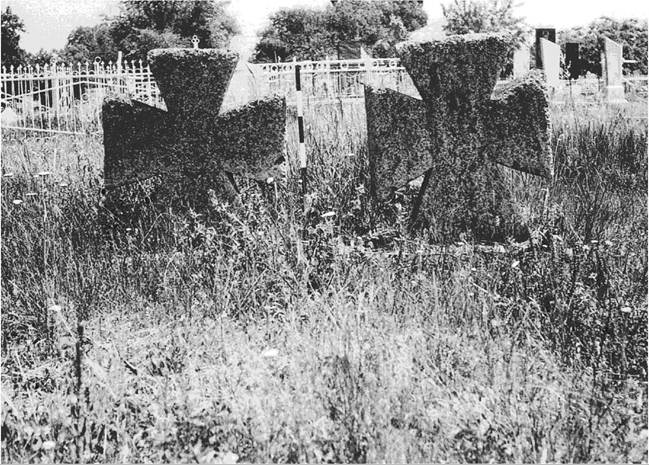
Cossack graves in the village of Usatove, southern Ukraine. The Maltese Cross was not common in Ukraine and could indicate the Cossacks were members of the famed Maltese Knights of St.John.
The Eastern Roman Empire still survived, confined to the walls of Constantinople, with an emperor who had become a vassal of the Turkish Sultan and a Greek Orthodox Church, which had entered into an official “union” with Catholic Rome. Sultan Murad died in 1451 and his 19-year-old son Mehmet (Mohammed) II decided to put an end to the city’s Christian rule. Although Emperor Constantine reminded him that he was breaking his oath the sultan decided to starve the city into submission. Then a German named Urban approached him with a proposal: he would cast a bronze cannon powerful enough to breach the great walls of Constantinople. His offer was accepted and when a cannon was tested on a passing Venetian ship it blew the vessel out of the water, and Mehmet commissioned Urban to cast another cannon twice as big. Completed in January 1453 it was apparently 27 feet long, with a barrel two and a half feet in diameter, not counting the 8 inch bronze walls. The monstrous gun fired a 13-hundredweight ball the incredible distance of one mile. It was brought within range of the walls by 30 pairs of oxen and 200 men, with the same number sent ahead to prepare the road and bridges.
The cannon opened fire on 6 April 1453, on the land-side of the city walls, which were defended by a small force of 4,983 Greeks and less than 2,000 foreigners. A smaller cannon was also brought into action and the bombardment continued for 48 days and nights. Nevertheless, Mehmet was meeting unexpected resistance and decided to attack the sea walls facing the Golden Horn. Seventy ships were hauled by oxen over the 200 foot hill of Galata on special cradles with cast iron wheels, and by 22 April all were in the waters of the Golden Horn. The city still held out as best it could, but by May bad omens began to sap the defenders’ morale. A day or two following a lunar eclipse the holy icon of the Mother of God slipped and fell from its platform during a religious procession, followed by a violent thunderstorm. The next day a thick fog descended on the city, something which had never occurred at the end of May as far as people remembered, and on the same night an Unearthlyred glow slowlybegan to creep up from the base of the great Cathedral of the HolyWisdom (St. Sophia) and slowly rose to the summit of the dome. The omen was clear. Just as Emperor Constantine had abandoned the Greek Orthodoxfaith, so the Spirit of God had left the city. It was also seen by Sultan Mehmet as an omen from God telling him to lift the siege, but he was quickly reassured by his astrologers that the glow was a sign from Allah the Merciful—the great Cathedral would soon be illuminated by the True Faith.
Mehmet decided to launch an all-out assault on the city walls and on 29 May at half-past one in the morning the attack began. For the first wave the Sultan sent the irregular “bashi- bazauk” volunteers who hurled themselves at the walls for two hours but without success. Next several crack regiments of Anatolian Turks followed, and fighting their way through a breech in the walls entered the city, only to be surrounded and decimated with only a few survivors managing to retreat back to the ditch. As a last resort Mehmet now threw in wave after wave of his elite Janissaries, and it was they who after five hours of fighting broke through into the city. Emperor Constantine was killed with his men in a last attempt at defense while others managed to escape in the few Venetian and Genoese galleys or fled through gates in the walls. Mehmet had promised his men the traditional three days of looting, but by the end of the day as the city fell on 29 May 1453, he called a halt to the sack. In all the Eastern Roman Empire had survived for a thousand years and would become the foundation of a new Islamic Empire.
It was Suleiman I (“The Magnificent”) who would gain much fame over a long reign. He was the Turkish Tsar, the Sultan referred to in the Ukrainian ballad OfBaidaVyshnevetsky, one of the abler Ottoman rulers who expanded the borders of his empire and made it the most powerful state in Europe, Africa and the Middle East. There was a military body of men who had become a thorn in the Turks’ side, the Order of the Knights of St.John, Commonlyknown as the Hospitalers. Theyhad survived the Crusaders’ expulsion from Palestine and the sack of Acres, and had established themselves on the Island of Rhodes. The island was located close to Asia Minor and allowed the Knights to make a handsome income by raiding Muslim shipping and disrupting their trade and lines of communication. Having captured the Hungarian King’s strongholds of Szabacs and Belgrade the following year Suleiman turned his attention to Rhodes in the summer of 1522 leading a large naval expedition against the island’s fortifications. The Turks had become masters of siege warfare, and after a 145 day bombardment the Knights capitulated and accepted the Sultan’s chivalrous conditions. Suleiman was impressed by the knights’ courage and offered the 70-year-old Grand Master Philippe de Villiers de LTsle-Adam and his men safe conduct, presenting the Grand Master with elaborate gifts as if to a head of state. On 1 January 1523 the Knights left the island, carrying their personal side-arms and taking with them the holy Greek Orthodox relics which they had acquired in Palestine.
Suleiman again turned his attention to the north, and in 1526 invaded the Kingdom OfHungarywith an army approaching 50,000 men and 160 cannons. He was met by King Louis II, with a force half the expected size since the Transylvanian and Croatian reinforcements failed to arrive. Outflanked, outgunned and Outmaneuvered, King Louis’ army was destroyed in the Battle of Mohacs, and the King himself was killed. Aid was also not forthcoming from other Christian States. The Protestant Luther had declared that the Turks were Gods punishment for the sins of Roman Catholicism, and the Polish- Lithuanian Catholic monarchy refused to send men. Local uprisings against the Hungarian monarchy also broke out in Serbia, Slovakia, and Croatia. In Greek Orthodox Serbia a religious leader known as Ivan the Black led a peasant revolt against the Catholic monarchy, while a year after Mohacs, Croatia accepted Austrian Hapsburg rule. Suleiman continued his advance and three years later he was before the gates of Vienna. This time Luther called for support, and facing a stiff defense and running out of supplies, Suleiman launched an all-out assault on the walls of the fortified city. The attack was thrown back with heavy losses, and the Sultan ordered a withdrawal. In 1533 Ferdinand I, who succeeded Louis II as King of Hungary and Bohemia, signed a treaty acknowledging Suleimans sovereignty over the south and central Hungarian possessions, while the same year witnessed the Ottoman conquest of Armenia, northern Iraq, and Algeria. In 1533 King Ferdinand acknowledged Suleimans sovereignty over much of Hungary, and in 1562 by the Peace of Prague he was forced to acknowledge Suleiman’s rule over Hungary and Moldavia with a payment of90,000 ducats and an annual tribute of30,000 ducats. In 1568 by the Treaty of Adrianople Hungarywas partitioned into a northern kingdom under the Hapsburg Emperor Maximilian II, central Hungary under Ottoman rule, with Transylvania recognized as an independent principality under Ottoman suzerainty. Suleiman I also arrived at an understanding with Franςois I of France, which gave French merchants access to Ottoman ports on the same terms as Muslim shipping.
While most rulers sought to pacify the Sublime Porte,42 the Knights of St.John were demonstrating that a small force of well-trained and dedicated men could challenge an empire. After being forced out of Rhodes, the Knights found a new home on the island of Malta in 1530, which, together with the smaller islands of Gozo and Camino, formed a strategic archipelago between Sicily and Africa. Theywere offered the islands by Charles V of Spain as a welcome addition to his defense of the western Mediterranean since his domain included parts of southern Italy and the islands of Sardinia, Corsica, and Sicily. Malta was little more than a barren rock jutting out of the sea, but what drew the Order s attention was the magnificent harbor and the fortified settlement of St. Angelo. New forts of St. Elmo and St. Michael were added giving the Order a fortified island domain with the Grand Master as the sovereign under the guidance of the Pope. As a symbolic payment of rent, every year the Grand Master presented Charles V with a hunting falcon.
Once installed on the island the Knights of Malta as they were now known continued to attack Muslim shipping and interfere with Ottoman lines of communication. With their extensive intelligence networks they were aware of vessels carrying valuable cargo or bearing important messages, and their activities were beginning to draw the ire of the Sublime Porte. The straw that broke the camels back concerned Suleimans daughter Mirmah, who was born to his favorite wife Roxolana.43 Togetherwith members of the harem she had invested heavily in a venture to import luxury goods from Venice, organized by the chief eunuch. The ship was captured by the Order s Admiral the Chevalier Romegas with its cargo valued at 80,000 ducats, a very large sum for the time.
The enraged 70-year-old Suleiman reacted by sending a naval expedition against Malta, consisting of200 vessels under admiral Piali, carrying 40,000 troops commanded by the 70- year-old Mustafa. The flotilla began to land on Malta on 19 May 1565. The divided command structure and the loss of the 80- year-old Muslim pirate-raider Dragut, who was killed by the defenders’ artillery soon after the landing, would contribute to the eventual defeat of the Ottoman expeditionary force. The other major factor was the determination of the 71-year-old Grand Master, Jean Parisot de la Valette, and the high morale of700 knights and 8,500 soldiers supported by the hardy local Maltese population. The knights had been informed by spies that the Turks were coming and had prepared for the long siege that would follow. It lasted four months, before a relief force of 10,000 men landed from Sicily on 6 September. Informed incorrectly by an "escaped” Moslem prisoner who had "overheard” that the force was much larger than it was, the Ottoman commander Mustafa ordered a complete withdrawal to the waiting ships. Realizing that he was misled, Mustafa sent a part of the army back to the island to face the Christian relief force, but by now his men were totally demoralized and suffered defeat. A determined group of men had held off a greatly superior army during the whole summer without any help from a Christian state, a feat that would earn them fame for centuries to come.
The Maltese disaster for the Turks was followed by a naval defeat at the great sea battle of Lepanto. In 1570 at the initiative of Pope Pius V, the so-called Holy League anti-Ottoman alliance was formed by Venice, Spain, the Papacy, and other Italian city-states such as Genoa. Sultan Selim II, who followed Suleiman, was a dissolute idler, who left the affairs of state in the able hands of his Vizier Mohammed Sokalli. After the conquest ofArabia in 1570 he decided to clear the Aegean Sea of all Venetian presence from Cyprus and several other islands from where the Venetians were harassing Ottoman shipping. A 60,000 man army was dispatched to Cyprus, and after a 45- day siege the capital Nicosia fell, followed by a massacre of its 20,000 inhabitants. Famagusta resisted for almost a year without outside help; but it, too, fell in August 1571. The brave commander Marc Antonio Bragadino was skinned alive, his skin stuffed with straw and sent to Constantinople as a trophy. Clearly the age of chivalry was over.
An Armada was finally gathered by the HolyAlliance consisting of 207 galleys, 6 extra-large Venetian galleys known as galleasses which could mount extra heavy and powerful guns, and 30 smaller vessels. In all, there were 1,800 cannons, 30,000 soldiers, 12,900 sailors and 43,000 rowers, Usuallyslaves. The Christian armada sailed into the Gulf of Corinth on 7 October 1571, where it was met by the Ottoman fleet off the port of Lepanto with 222 galleys, 60 smaller ships, 750 cannons and carrying 34,000 troops, 13,000 sailors and 41,000 rowers, also slaves. Attacked by the Ottoman fleet the right wing of the Holy Alliance Armada began to collapse, but led by the heavy fire of the Venetian galleasses the admiral DonJuan ordered his galley to attack and board the flagship of the Ottoman admiral, Muesi- nade Ali. The Ottoman commander was killed in the action and his head exhibited on a pike. The rest of the demoralized and outgunned Ottoman fleet disengaged from the battle and only 40 vessels managed to flee to safety. Some 10,000 enemy were taken prisoner and distributed amongst the victors as slaves, while 12,000 Christian slave rowers were rescued from the Ottoman vessels and set free. The Christian Armada also suffered heavy losses with 7,500 killed and an equal number wounded. One of the greatest sea battles in history, it failed to reduce the power of the Ottoman Empire since within a year their entire navy was rebuilt. The war ended in 1573 with the Sublime Porte in possession of Cyprus and Venice was forced to pay an indemnity to cover the Sultans costs of conquering the island.