Socioeconomic Developments in Dnieper Ukraine
The structure of Ukrainian society within the Russian Empire during the nineteenth century was essentially the same as it had been during the eighteenth century. The composition of the various social estates and their relative size were to change, however, in some cases substantially.
The status and evolution of the social estates also varied according to the four regions of Dnieper Ukraine. This variation was due to the fact that each of the four historical regions - the old Hetmanate (Chernihiv and Poltava provinces); Sloboda Ukraine (Kharkiv province); Zaporozhia and the Crimea (Kherson, Katerynoslav, Taurida provinces); and the Right Bank and western lands (Kiev, Podolia, and Volhynia provinces) - had been acquired at a different time by the Russian Empire, and each had its own distinct social structure. The social strata in question were the nobility, the Cossacks, the peasantry (state peasants and serfs), the townspeople, and the clergy.Social estates before the 1860s
The noble estate in Dnieper Ukraine consisted of Russian hereditary nobles (Russian: dvoriane; Polish: szlachta), whether Russians, Poles, or russified or polonized Ukrainians, as well as members of the Cossack gentry (starshyna) and Crimean Tatars who were granted noble status. The process whereby noble status was granted to the Cossack gentry in the Hetmanate was especially complex. Initially, as part of Catherine Il’s Charter of the Nobility (1785), the Cossack elite was itself allowed to determine who was qualified to belong to the Russian nobility (dvo- rianstvo). Locally elected functionaries made recommendations to the governorgeneral of Little Russia, Petr Rumiantsev, who happened to be very accommodating with respect to the claims put before him. As a result, by the early 1790s the number of recognized nobles (dvoriane) in the Hetmanate had reached more than 30,000.
Most of these new nobles had been members of the Cossack officer class (starshyna) in the former Hetmanate. After 1790, however, Little Russia’s new governor-general, Mikhail Krechetnikov, became suspicious of the large number of claimants to the nobility and removed 22,702 of them (the so- called taxed nobles) from the rolls. This left only 12,597 who could be considered “nobles without any doubt.” Not surprisingly, Krechetnikov’s action prompted numerous litigations and petitions, with the result that in 1803 the imperial government issued a decree allowing a certain number back into the noble estate. By the beginning of the nineteenth century, there were approximately 24,000 nobles in Left Bank Ukraine.In Right Bank Ukraine and Volhynia, access to the Russian imperial nobility (dvoriane) depended on one’s previous status. Members of the Polish szlachta, who numbered over 260,000 in those regions in 1795, were immediately given the status of Russian nobility. More problematic were those individuals, mostly ethnic Ukrainians, who based their claims on having belonged to the Cossack elite. Since the Cossack social structure in the Right Bank Ukraine and Volhynia was dismantled much earlier, that is, in the second half of the seventeenth century, it was very difficult to determine who among them over a century later might qualify for acceptance into Russian nobility. Although as many as 104,000 Ukrainians in the Right Bank claimed they were nobles, the Russian imperial authorities dismissed over 87,000 claims outright and put another 22,000 claims under consideration. Things were a bit more straightforward in the Sloboda Ukraine, where the Cossack officer stratum (starshyna) in each of the region’s five regiments was given noble status. Also, in the former Crimean Khanate, a good portion of the Tatar elite (clan leaders and lower nobility - mirza) accepted induction into the ranks of the Russian nobility.
Those individuals from Ukrainian lands who were accepted into the noble estate eventually were to enjoy all the privileges outlined in Catherine’s 1785 Charter of the Nobility.
These included inviolability of person and property; the right to trial by one’s peers; exemption from state service, from taxes, and from the quartering of troops; and legal ownership of the serfs on one’s estates. Such privileges were undoubtedly attractive to Dnieper Ukraine’s elite, and those individuals who obtained them became fully integrated into the imperial social structure. The vast majority of nobles from Dnieper Ukraine staffed the region’s new administrative structure and took part in imperial political life. A few came to play leading roles in the Russian Empire as a whole. For instance, Prince Aleksander Bezborod’ko became imperial chancellor under Catherine II and Paul I, and the princes Viktor Kochubei, Petr Zavadovskii, and Dmitrii Troshchinskii and the sons of Hetman Kyrylo Rozumovs’kyi - Aleksei Razumovskii and Andrei Razumovskii - all served as ministers under Alexander I. These individuals were the latest examples of a strong tradition begun during the second half of the seventeenth century whereby natives of Ukraine, while continuing to be Little Russians, made excellent careers in the imperial Russian world.By 1835, the long and complicated process of deciding who was and who was not a noble in Dnieper Ukraine finally came to an end. In the Hetmanate, all holders of former Cossack military and civil officer rank (except the lowest) were recognized as hereditary nobility. This meant that the rank-and-file Cossacks (176,886 in 1764) and Cossack helpers (198,295 in 1764) were excluded. While some of the rank and file, who by 1803 numbered about 200,000, were to remain part of a distinct Cossack social estate, others, together with the former Cossack helpers
Social Estates in Dnieper Ukraine
| Eighteenth century | Nineteenth century |
| 1 Nobility Russian dvoriane Polish szlachta Tatar mirza | 1 Nobility |
| 2 Cossacks officers rank and file helpers | 2 Military residents (1866) |
| 3 Peasants state peasants proprietary serfs | 3 Peasants state peasants serfs (to 1861) proprietary peasants (after 1861) |
| 4 Townspeople | 4 Townspeople |
| 5 Clergy | 5 Civil servants government functionaries clergy 6 Cossacks Kuban Black Sea Azov |
became state peasants.
The Cossack rank and file who did not become state peasants emigrated to towns and cities to become merchants and artisans, or to frontier areas like the Kuban River valley. Between 1805 and 1850, about 57,000 chose emigration. Eventually, the government tried to close off entry into the Cossack estate, whose members by the 1860s had become indistinguishable from state peasants.In Sloboda Ukraine, rank-and-file Cossacks became military residents (viiskovi obyvateli), a group which continued to exist until 1866 and was similar to the state peasants. Their duty to the state was to provide soldiers for the five imperial regiments in the area (four hussars and one ulan). The fate of the Cossacks in Zapo- rozhia was quite different.
Following the destruction of the sich in 1775, traditional Cossack military social structures ceased to exist. Some Cossacks were drafted into the imperial army; others were left in Zaporozhia as free homestead farmers. Still others were allowed to function as Cossacks with their own military formations in the service of the Russian Empire (see map 23). Among the latter were: (1) the Katerynoslav Cossack army (together with regiments of the Buh Cossack Army) settled in 1787 just north of Mykolaiv along the Russia’s borders with what was still Ottoman- held Yedisan; and (2) the Black Sea Cossacks formed in 1788 and settled in the southern Yedisan with their center in Slobodzeia. These formations were, however, short-lived. In 1796 the Katerynoslav Cossacks were disbanded and they followed the Black Sea Cossacks who even earlier (1792) had been resettled to the Kuban’ region east of the Sea of Azov.
Those Cossacks who opposed Russia’s destruction of Zaporozhia and its sich fled southward to the Ottoman Empire, which in 1775 allowed them to settle in the delta of the Danube River, with their center (Zadunais’ka Sich) at Verkhnii Dunavets’. It was not long, however, before some elements within this Danube Cossack Host became displeased with Ottoman hegemony and sought a possibly better existence, whether in the Austrian Empire (in the Banat Region along the lower Tisza River, 1785-1812), or back once again in the Russian Empire.
When some did indeed return in 1828, the Ottomans responded to what they considered betrayal by destroying the Danubian Host’s sich at Verkhnii Dunavets’. The sometimes dramatic, but more often prosaic, plight of the Danube Cossacks under Ottoman protection was later immortalized in the nineteenth-century Ukrainian opera by Semen Hulak-Artemovs’kyi, Zaporozhets’ za Dunaiem (The Zaporozhian Cossack Beyond the Danube, 1863).In the Kuban region the tsarist government allowed the Black Sea Cossacks a degree of autonomy, and during the first half of the nineteenth century their units were steadily replenished by rank-and-file Cossacks migrating from the central Ukrainian lands of the former Hetmanate. The Black Sea Cossacks were joined by the neighboring Frontier, or Border Army, based along the upper Kuban and Terek Rivers and made up primarily of Russian Don Cossacks, and from the 1860s on these units became known as the Kuban Cossack Army (Kubans'ke Kozache Viisko). In 1865, the Azov Army, that is, Cossacks from beyond the Danube who returned from the Ottoman Empire in 1828 and who were settled north of the Sea of Azov, also joined the Kuban Cossacks. Thus, the Kuban Cossacks were an amalgam of various Cossack groups that had served the Russian Empire in its struggle against the Ottoman Empire. From their center at Ekaterinodar (today Krasnodar), they were able to maintain a degree of autonomy until the demise of the Russian Empire in 1917.
The next major social stratum, and by far the largest in nineteenth-century Dnieper Ukraine, was the peasantry. As late as 1897, peasants still accounted for 93 percent of all Ukrainians. Until the reforms of the 1860s, this stratum consisted of two distinct and legally differentiated groups - the state peasants and the serfs. The state peasants derived from a variety of disparate groups (including lowerechelon Cossacks), although most had lived on land that originally belonged to the state, including former properties of the Polish crown.
In return for the use of state land, they were obliged to pay various taxes and perform duties such as building and maintaining roads. At the beginning of the nineteenth century in the Right Bank, certain state-owned lands were leased to the local gentry, and the state peasants attached to them were required to perform labor duties for the gentry. The imperial government, however, made several attempts to improve the status of state peasants: from 1801, they could buy land from the state with full property rights; in 1837, work duties to the gentry were abolished; and after 1839, those who were leased to the gentry were gradually returned to the jurisdiction of the state, to whom they paid taxes.The serfs, on the other hand, were proprietary peasants who had lived on lands owned by landlords (whether nobles, Cossacks, or the church) and who were required to perform various kinds of duties for their landlords. Although the number of the duties increased over the course of the eighteenth century, the proprietary peasants still enjoyed freedom of movement. With the abolition of the Hetmanate by Catherine II during the 1780s, however, the local Russian nobility together with the Cossack gentry asked for complete control over their peasants. Their request was granted in a decree issued by Empress Catherine II on 3 May 1783, which introduced the poll tax and gave the nobility the responsibility for seeing that it was paid by the peasants. To ensure that the tax would be paid, the peasants were forbidden all freedom of movement.
It is interesting to note that nowhere in Catherine’s decree did the words serf or serfdom appear. The text simply stated that “to ensure the regular receipt of the assessed taxes... and to prevent any flight and further difficulties for landlords and other rural inhabitants, every peasant is required to remain in his/her place of residence and work.”1 A little over a decade later, in 1796, Tsar Paul I (reigned 1796-1801) extended serfdom to New Russia, or the Steppe Ukraine, and to the Caucasus region, arguing that the exemption from serfdom in those areas was a menace to the welfare of serf owners in neighboring provinces. As for the Right Bank and Volhynia, the serfdom that had already existed was simply continued when the Russian Empire acquired these territories from Poland in 1793 and 1795. Thus, by the beginning of the nineteenth century, all peasants in Dnieper Ukraine who were not living on state lands became fully enserfed.
Within the peasant social stratum, there was a marked variation from region to region in the proportion of state peasants to serfs. Serfdom was most strongly entrenched in the former Polish palatinates west of the Dnieper, where in 1858, serfs made up three-quarters of the peasantry. In contrast, state peasants outnumbered serfs two to one in the former Hetmanate, and three to one in Sloboda Ukraine. The proportion of serfs was lowest in Taurida, the southernmost province of the Steppe Ukraine, where in 1858 they formed only 5.8 percent of the population.
It is also interesting to note that while the total number of serfs increased between 1803 and 1858, it did so by only 273,000. This figure by no means reflects a natural demographic increase, which would have seen at least a doubling in the number of serfs during this fifty-five-year period. In fact, their numbers remained stable, especially during the last twenty years of the period (1838-1858), despite continuing demographic increases and the influx of serfs from elsewhere in the empire onto estates in Dnieper Ukraine owned by Russian landlords. The main reason for the stable number of serfs in Dnieper Ukraine is the mass flight to the Don and Kuban regions, where instead of direct control of the imperial government or local landlords there was a degree of Cossack autonomy. It is as a result of this migration that the Kuban and parts of the Don region became ethnically Ukrainian.
What did serfdom mean for the peasants in the Russian Empire upon whom it was imposed? Aside from the right to own their own tools, serfs really had no rights. A serf was little more than human chattel and often was worth even less than an animal. A male or female serf could be and was bought and sold as property. During the first half of the nineteenth century, the imperial government attempted to improve the lot of the serfs by prohibiting their sale without land (1808) or without their immediate families (1833). In the end, however, the serfs remained the property of their landlords, who had judicial authority over them, often determined how and if they could marry, and in practice set the amount of their obligation.
The duties of serfs usually took two forms: labor dues (Russian: barshchina; Ukrainian: panshchyna) and monetary rents (obrok). In Russia, the relative unproductivity of serf-based agriculture led nobles to encourage their serfs to provide monetary rents (with the money often earned as a result of their hiring themselves out as wage laborers in industry or as artisans and petty traders). In Dnieper Ukraine, however, the opposite occurred. The high fertility of Ukraine’s black soil and closer access to revenue-earning foreign markets through the Black Sea ports made it profitable for the nobility to exploit serf labor on their manorial domains. It is not surprising, therefore, that before the 1860s, 83 percent of serfs in the former Hetmanate and Sloboda Ukraine and 99 percent in the Right Bank and Volhynia fulfilled their obligations in the form of labor dues. The amount of dues varied from landlord to landlord, but could be anywhere from three to six days per week. Some serfs were also assigned by their landlords to work in plants and factories, with the result that there evolved a social stratum of landless peasant serfs, who in some areas made up as much as 25 percent (in the Left Bank in the 1840s) of the total population.
The remaining two social strata were the townspeople and the civil servants, including clergy. By Catherine II’s charter on cities issued in 1785, townspeople were subdivided into six groups: (1) property owners, (2) merchants, (3) artisans, (4) non-residents and foreign merchants, (5) distinguished citizens (bankers, former officials, intellectuals), and (6) unskilled workers and small tradespeople. In all categories, particularly the first five, the urban dwellers were made up almost exclusively of Russians and Jews, along with Poles in the Right Bank and Greeks in the Black Sea coastal cities. The proportion of ethnic Ukrainians among townspeople was small, and those who lived in cities for any length of time usually became russified or polonized. Russian served as the lingua franca for all townspeople, with the result that the cities in Dnieper Ukraine became islands ethnically and culturally divorced from the surrounding countryside.
The civil servant group included governmental officials at all levels and the clergy. The clergy began to lose its separate social status between 1786 and 1788, when the Russian imperial government secularized the church estates in the Het- manate, where its holdings were particularly extensive in land, mines, and small factories. The clergy consequently became dependent exclusively upon the state. As an integral part of the imperial civil service, the Orthodox Church also became an instrument of russification in the former Hetmanate, Sloboda Ukraine, and Zaporozhia.
The reforms of the 1860s
The most important change in the socioeconomic development of Dnieper Ukraine came as a result of the reforms implemented throughout most of the Russian Empire during the 1860s. By the middle of the century, it had become obvious to the leading circles in St Petersburg that the country was economically backward and that the institution of serfdom was a liability with respect to social progress. Russia’s loss to Britain and France in the Crimean War of 1853-1855 seemed to underline the message that the empire was backward vis-à-vis Europe. The pressure of public opinion, stifled under the repressive regime of Tsar Nicholas I, was released after his death in 1855, and demands were put forth for some kind of change. The new tsar, Alexander II, was convinced that revolution would occur unless there were reforms, and in 1856 he called on the nobility to take the initiative. When the nobility procrastinated, the central government itself took the lead. On 19 February 1861, Alexander II, who came to be known as the reforming tsar, issued a manifesto abolishing serfdom. As a result of the “great emancipation,” as this act came to be known, the serf was liberated from his or her personal and legal subjection to the landlord. The former serf could engage in trade, buy and sell property, and marry at his or her own volition.
The economic status of the former serfs, now proprietary peasants, was not necessarily improved by emancipation. On the one hand, each peasant was allowed to keep the land he or she had used as a serf; in Dnieper Ukraine in 1863, that meant an average of between 7 and 16 acres (between 2.8 and 6.6 hectares) per household. On the other hand, the proprietary peasant had to pay for the land. According to the regulations, the government reimbursed the landlord outright 80 percent and the peasant was to pay the remaining 20 percent. The proprietary peasant was expected to make so-called redemption payments to the government for its 80 percent over a period of forty-nine years.
The government knew it would be difficult, if not virtually impossible, for the former serfs to make the redemption payments. It decided, therefore, to give a significant portion of the land not to individual proprietary peasants but rather to the village commune ( obshchina). This meant that the land became the property of the commune, which in turn would divide it among or redistribute it to individual households for their temporary use. The basis of division was the number of persons in a family. Any changes in a household’s size would be compensated for in periodic redistribution or by reassignment of land from other households. The communal system also allowed for implementation of the principle of communal liability, or collective responsibility. In other words, the government and former landlords would be more easily assured of taxes and repayments once these became the responsibility of the entire community.
The idea of the commune was attractive to Russian thinkers of various political persuasions. Among these were the Slavophiles, conservative mid-nineteenth century Russian thinkers who believed in the superiority of Russian civilization to European. They argued that the commune, prosaically described as the mir, was the original social unit in medieval Rus’, that it was one of the superior features of Russian civilization, and that it was therefore best suited for revival throughout the countryside. The leftist populists (narodniki) also welcomed the commune, believing that collective land ownership would in any case be the general pattern in a future socialist society.
In Ukraine, communal property existed before the reform era, but was limited to pastures and forests. On the other hand, while the commune (obshchina) as applied to arable land may have been the norm in Russia, it was completely foreign to Ukraine. Nevertheless, in the early 1860s the imperial Russian government introduced communal landholding patterns among the former serfs. Of the 2.8 million households in eight Ukrainian provinces that received land, 58 percent of the allotments were given with individual property rights and 42 percent with communal rights. The commune pattern was especially widespread in certain regions, representing over 90 percent of households in Kharkiv, Katerynoslav, and Kherson provinces. The central government believed, therefore, that over two-fifths of all households in Dnieper Ukraine were functioning as communes.
Reality was much different, however, because over 80 percent of the communes did not comply with the rules of repartition. Land initially allotted to individual households on a temporary basis in practice was used as if it were the property of the family. Nonetheless, while it is true that rules were violated in this respect, two- fifths of Dnieper Ukraine’s rural households were still legally within communes, and this was to have a negative impact on agriculture and on the status of those who worked the land. Aside from encouraging inefficient agricultural practices (irrational land distribution, involuntary crop rotation), the formal existence of the communes made it impossible for individuals to prove that they owned the land assigned to them.
The situation was somewhat better for the state peasants. In 1863, those living in the Right Bank were reclassified as proprietary peasants and were therefore liable for forty-nine-year redemption payments. Legislation passed in 1866 allowed state peasants in other parts of Dnieper Ukraine, however, to purchase their allotments with full legal rights of ownership or to pay rent to the government. Most chose individual ownership, and aside from purchasing former state lands many were able to expand their holdings with new acquisitions. This opportunity came about because many landlords were unable to adjust to the new socioeconomic system and began to sell their lands, especially during the 1870s. In Dnieper Ukraine alone between 1861 and 1914, nobles sold 25 million acres (10.1 million hectares) of land, 17 million acres (6.9 million hectares) of which were purchased by state peasants, and the remainder by merchants. In effect, the social system put in place by Catherine II at the end of the eighteenth century, whereby the agriculture-based economy of the country was in the hands of landlords with their enserfed peasants, was now being reversed. The nobles were again leaving the land and entering state service and the administration.
Tsar Alexander’s abolition of serfdom was followed by other reforms, among the more important of which was the establishment of the zemstvos (see chapter 26), which provided a limited form of local self-government and local control over education and social services. The zemstvos were introduced in the Left Bank and the Steppe Ukraine between 1864 and 1870, but it was not until 1911 that they were set up in the Right Bank. The nearly half-century delay before their introduction in the Right Bank reflected the government’s concern that even a small increase in local self-government might enhance the position of the Polish nobility, who still dominated the socioeconomic life of the region and who only recently (1863-1864) had revolted against Russian imperial rule. Another significant reform was in the law courts. After 1864, all male citizens, regardless of social origin, became equal before the law; trials were made public; the jury system was introduced; courts were made independent of the administration; and judges became irremovable and were properly compensated. As a result, the Russian judicial system compared favorably with the systems of other European countries governed by the rule of law.
The post-reform era also witnessed a profound demographic change in Dnieper Ukraine as a result of the rapid growth of towns and cities. Between 1863 and 1897, the urban population more than doubled, reaching over 3 million inhabitants living in 130 towns and cities. Most of these urban centers remained small in size, so that in 1897, only twelve of them, each with more than 50,000 inhabitants, could properly be classified as cities. The five largest cities - Odessa, Kiev, Kharkiv, Kat- erynoslav (Dnipropetrovs’k), Mykolaiv - each at least tripled or quadrupled in size between 1863 and 1897, and then doubled again during the next decade and a half before the outbreak of World War I (see table 27.1). Yet the marked urban growth in
TABLE 27.1
Population of Dnieper Ukraine’s largest cities, 1860-1914
| ca. 1860 | 1897 | 1914 | |
| Odessa | 113,000 | 404,000 | 669,000 |
| Kiev | 65,000 | 248,000 | 626,000 |
| Kharkiv | 50,000 | 174,000 | 245,000 |
| Katerynoslav/Dnipropetrovs’k | 19,000 | 121,000 | 220,000 |
| Mykolaiv | 32,000 | 92,000 | 104,000 |
Dnieper Ukraine largely passed by the ethnic Ukrainian population. By 1897, only in the smallest towns (under 15,000 inhabitants) that were linked to the agrarian economy of the nearby countryside did ethnic Ukrainians make up a slight majority (50 percent). In the rapidly growing eight largest cities, which dominated the urban economy and accounted for more than three-quarters of Dnieper Ukraine’s industrial production and work force, ethnic Ukrainians made up only 18 percent of the population.
Commentators have frequently explained this phenomenon by attributing to Ukrainian peasants a profound and almost mystic attachment to the land that somehow provided a psychological barrier to residence in urban areas. Others, like the Ukrainian-Canadian political economist Bohdan Krawchenko, have suggested more prosaic reasons. Because agriculture proved profitable to landlords in Dnieper Ukraine, peasants were required to pay their dues in labor rather than in monetary rents. Consequently, they did not migrate to the cities as peasants were encouraged to do in Russia. Thus, as more and more Russians became members of a skilled or semiskilled labor force, as many as 93 percent (ca. 1900) of Ukrainian migrant laborers remained unskilled manual workers. When industrial development finally began in eastern Ukraine during the last decades of the nineteenth century, factory owners found it more efficient to “import” already-skilled Russian workers than to depend on local, unskilled Ukrainian labor.
Despite the administrative and judicial reforms of the 1860s and the subsequent growth of cities, the basic problem of the Russian Empire - its backward economy and the poverty of the vast majority of its inhabitants, the peasantry - went unresolved. The peasant’s livelihood depended on land, and for many access to that commodity had become more difficult. Some state peasants did improve their status following the reforms of the 1860s, but many state and, in particular, proprietary peasants still had huge redemption payments to make as part of the emancipation settlement, while others, who had been serfs employed in factories or mines, received no land at all. As a result, more and more peasants became indebted and/or propertyless.
Moreover, for those who initially held land, the traditional practice of dividing plots among male offspring, a practice that was intensified by population growth, tended to increase the number of the landless. As for those who continued to hold land, their plots became smaller and smaller. For instance, in eight Ukrainian provinces the average size of peasant landholdings decreased by 55 percent between 1863 and 1900 (see table 27.2) To place these figures in a more
TABLE 27.2
Average size of peasant landholdings in Dnieper Ukraine, 1863-1900 (in acres [hectares])2
| Province | 1863 | 1900 | Percentage of decrease |
| Volhynia | 11.4 (4.6) | 4.7 (1.9) | 51.5 |
| Podolia | 7.2 (2.9) | 3.2 (1.3) | 53.8 |
| Kiev | 7.9 (3.2) | 3.2 (1.3) | 58.5 |
| Chernihiv | 9.1 (3.7) | 5.4 (2.2) | 41.2 |
| Poltava | 6.9 (2.8) | 4.2 (1.7) | 40.0 |
| Kharkiv | 12.3 (5.0) | 5.2 (2.1) | 57.6 |
| Katerynoslav | 17.2 (7.0) | 6.2 (2.5) | 61.6 |
| Kherson | 16.6 (6.7) | 5.9 (2.4) | 63.9 |
meaningful context, it should be noted that on the basis of a comprehensive statistical analysis of peasant landholdings in the Russian Empire (by lurii lanson), it was estimated that in Dnieper Ukraine 13.6 acres (5.5 hectares) of land at the very least were needed to support a peasant household. Such a plot was significantly larger than the average holding in 1900. Another way to look at the land squeeze is to compare the number of people living on arable land in Dnieper Ukraine with the number in other European countries. At the beginning of the twentieth century, for every 250 acres (100 hectares) of arable land there were 79 rural inhabitants in England, 84 in France, and 107 in Germany. In six of the nine Ukrainian provinces in the Russian Empire, however, there was an average of 150 rural inhabitants for every 250 acres (100 hectares) of arable land.
These conditions in the Ukrainian countryside had two simultaneous results: (1) the growth of a large class of agricultural day-laborers who, because of their lack of skills, were not absorbed by the growing industrial sector; and (2) a significant emigration to the east, where land was more plentiful. During the second half of the nineteenth century, large numbers of Ukrainians emigrated not only to the Don and Kuban River valleys, but to Central Asia, Siberia, and the Far East along the Chinese border and Pacific coast. During the less than two decades between 1896 and 1914, as many as 1.6 million Ukrainian peasants (especially from Poltava, Chernihiv, Kiev, and Kharkiv provinces) sought to improve their lot by going east.
In an attempt to ameliorate the condition of the peasantry, a new era of reform was begun in the Russian Empire after the Revolution of 1905. The minister of the interior at the time, Petr A. Stolypin, felt that new reforms were needed to avert revolutionary disturbances in the countryside in the future. He was convinced that the root of Russia’s economic backwardness lay in the communal system of land ownership. Accordingly, he instituted two laws, in 1906 and 1910, aimed at replacing the village commune system with a stratum of prosperous peasants. In Dnieper Ukraine, more than 226,000 peasants withdrew from the communes landholdings that amounted to 4.7 million acres (1.9 million hectares). Again, the percentages varied from region to region. In the Right Bank and Volhynia, 48 percent of the peasants left the communes; in the Steppe Ukraine, 42 percent; in the former Hetmanate and Sloboda Ukraine, only 16.5 percent. As a result, the landholdings in most of Dnieper Ukraine on the eve of World War I were in the form of what was known as either the khutir or the otrub.
The khutir was like an individual North American farmstead surrounded by land received in an allotment from the commune as private property to farm, expand, or sell. Successful homesteaders who increased their holdings by purchasing other khutory eventually became known as kulaks. The otrub consisted of a household in the village and the strips of land (otruby) beyond the village center that were given to it. At least three-quarters of the land reorganized in all the Dnieper-Ukrainian provinces except Kiev and Chernihiv was in the form of otruby; in Kiev and Chernihiv, an average of 55 percent of the land had khutory.
Economic developments
The Ukrainian lands in the Russian Empire continued to function as a supplier of agricultural products or industrial raw materials. In agriculture, grain production continued to expand, especially after the opening up of vast tracts of arable land in the steppe region - some 2 million acres (800,000 hectares) in the early nineteenth century and another 15 million acres (6 million hectares) by the 1860s. This expansion helped transform Dnieper Ukraine into the most important agricultural land in the Russian Empire. A few statistics will confirm its significance. Wheat was the empire’s major crop, and Dnieper Ukraine accounted for more than 75 percent of all wheat exports from Russia every year except two between 1812 and 1859. By the second decade of the twentieth century (1909 to 1913), Dnieper Ukraine’s agricultural production had increased further, to account for 98 percent of Russia’s wheat exports, 84 percent of its corn, 75 percent of its rye, and 73 percent of its barley. Even more impressive was the region’s ranking vis-à-vis other countries: between 1909 and 1913, Dnieper Ukraine produced 43 percent of the world’s barley, 21 percent of its rye, 20 percent of its wheat, and 10 percent of its corn. The nineteenth century also saw the growth of the sugar beet crop, especially on the Right Bank.
Most of the grain exports left via the Black Sea ports, in particular Odessa. Founded in 1794 on the site of a small Turkish fortress, Odessa in 1817 was given duty-free status by the imperial government. Commerce flourished, with the result that by 1847 Odessa accounted for more than half of all exports from the Russian Empire. Almost all the exporting firms in Odessa were in the hands of Greek, Italian, and Jewish merchants who had settled in what became an international trading emporium.
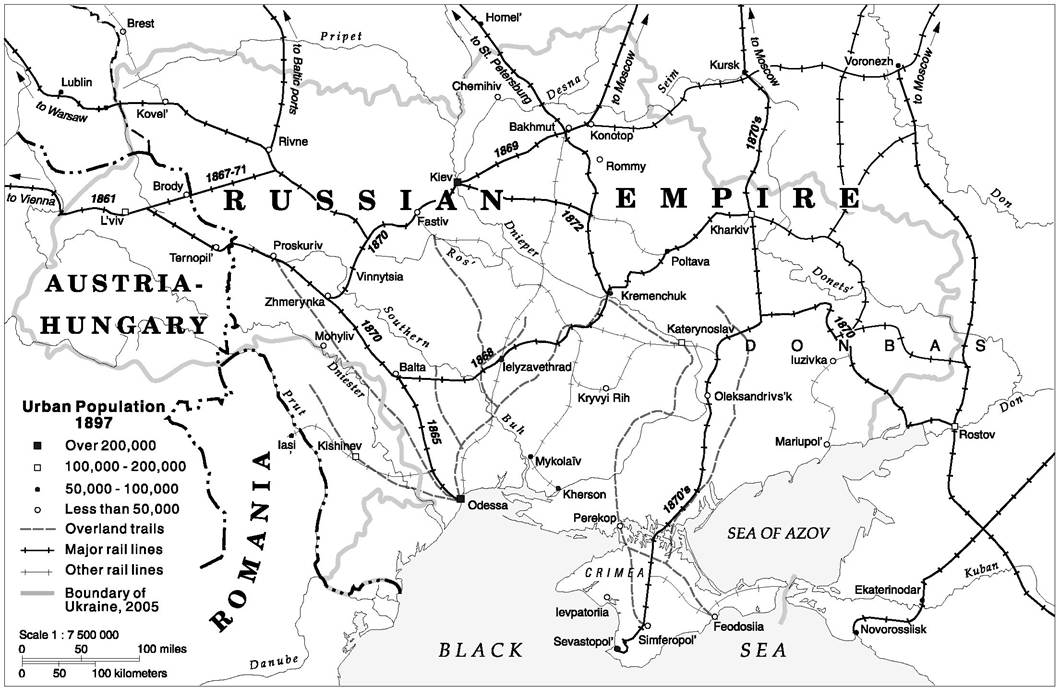
The phenomenal growth of agricultural production and its role in Russia’s international trade also increased the need for a better transportational infrastructure. Until the 1860s, all grains as well as salt and fish were transported from the Ukrainian hinterland to Odessa by river barges and overland by the so-called chumaky - groups of wagon drivers who banded together in caravans to transport goods across the steppe. By the second half of the nineteenth century, the chumaky and river barges had begun to be replaced, although by no means entirely, by railroads. Given the value of agricultural products, it is not surprising that the first railroad in Dnieper Ukraine was constructed in 1865 to cover the distance of 137 miles (222 kilometers) between Odessa and Balta, a town on the southern border of the province of Podolia within the grain-producing area of the steppe. Between 1868 and 1870, this first line was extended in two directions to connect Balta with Kiev (via Zhmerynka and Kremenchuk). The 1870s witnessed the construction of several new lines, connecting Dnieper Ukraine with Moscow, St Petersburg, and ports along the Baltic Sea from which grain was exported. This same period also saw the opening of the first railroads in the Dnieper-Donbas region (the Donets’ and lower Dnieper River basins), which was to become the center of Dnieper Ukraine’s industry. Thus, before 1914 Dnieper Ukraine had a railroad network that covered 10,500 miles (16,000 kilometers).
Less developed was the road system and river transport. Some concrete roads were constructed in the late eighteenth century, but this means of transportation received less attention after railroad construction began. Consequently, by 1914 there was only 0.5 mile of road for every 40 square miles (0.8 kilometer of
OVERLAND ROUTES AND RAILROADS BEFORE 1914
MAP 27
Copyright © by Paul Robert Magocsi
road for every loo square kilometers) of Ukrainian territory. River transport fared somewhat better, especially after the introduction of the steamship in 1823. The Dnieper River remained the busiest river. Its value was enhanced by the construction of canals, which together with various tributaries made possible connections with the Neman River in the north (as early as 1765-1775) and, via the Pripet River, with the Buh and Vistula Rivers in the west (1846-1848). The total freight traffic on the Dnieper and Southern Buh Rivers (primarily lumber and grain) more than doubled during the late nineteenth century - from 1.7 million tons (1.6 million metric tons) in 1884 to 2.6 million tons (2.4 million metric tons) in 1914.
Although agriculture played the dominant role, Dnieper Ukraine had its own industrial enterprises as well. The kinds of industry changed during the first half of the nineteenth century, however, largely as a result of the mercantilist policy of the Russian Empire, in which Ukrainian performance was made to serve imperial economic interests. During the eighteenth century, the government in St Petersburg began to limit the traditional Dnieper-Ukrainian exports of saltpeter, potassium, and tar, since these competed with similar products from Russian lands. For instance, the Hetmanate’s large linen factory at Pochep, founded in 1726, was dismantled and rebuilt in Russia, and the important porcelain works in Hlukhiv were closed. The textile industry survived in Dnieper Ukraine, but its growth was limited owing to unfavorable tariffs. In the Kiev region alone, sales decreased by 44 percent between 1842 and 1847.
Factories which produced distilled alcohol, soap, and metallic and leather wares and which processed sugar and tobacco, however, continued to flourish. Moreover, the number of industrial enterprises continued to grow steadily during the nineteenth century, both before and after the 1860s era of reforms. If in 1793 there were 200 industrial plants in Dnieper Ukraine, by 1832 that number had risen to 779, and by i860 to 2,329? Also, contrary to the practice in the previous century, most of the new factories were established not by noble landowners, but by enterprising capitalists. These new entrepreneurs reintroduced into Dnieper Ukraine glass, paper, and, especially, textile factories which before long were competing with factories in Russia. Of the factory proprietors, in 1832, 47 percent were Russian, 29 percent were Ukrainian, 17 percent were Jewish, and 4 percent were foreigners.4
The organizational structure of industry also changed. In general, between 1800 and 1861 the number of factories owned by landowning nobles and employing serfs decreased, whereas the number of factories owned by capitalist entrepreneurs and employing hired laborers increased. For instance, in 1828, 54 percent of all factories were owned by landowners, and as much as 74 percent of the work force in all factories were serfs. Certain industries, especially distilling and sugar processing, with plants located in the countryside, employed serf laborers almost exclusively. This state of affairs changed, however, with the growth in the number of factories and the willingness, especially during the 1850s, of landowners to allow industrial enterprises in the cities to hire serfs from the countryside. Accordingly, by 1861 the figures were the reverse of those three decades earlier.
Now, 94 percent of the factories were owned by capitalist entrepreneurs, and 74 percent of the work force were hired laborers.5 Throughout the period before the era of reforms, the size of the factories remained modest. The largest were the sugar refineries, which averaged between 150 (in 1848) and 305 (in 1857) workers per plant. Textile factories averaged 100 workers per plant. The total number of workers in all industries increased substantially, however, from 15,000 in 1825 to 81,800 in i860.6
Industry in Dnieper Ukraine expanded at an even faster rate after the era of reforms and the rapid growth of the urban population during the last decades of the nineteenth century. If in i860, there were 2,300 industrial enterprises, by 1895 that number had risen to over 30,000. The size of the work force followed suit, increasing from 82,000 employees in i860 to over 6.3 million in 1914. In terms of production, the most important industries were sugar refining, coal mining, iron and steel production, and metallurgy and machine building.
The sugar industry was particularly well developed in the provinces of Kiev and Podolia, where the largest proportion of the sugar beet crop was grown. Until mid-century, production was carried out on the estates of Polish magnates (the Bobrzynskis, Branickis, Potockis); thereafter, the industry was dominated by a few large-scale firms owned by family dynasties like the Brodskiis, lakhnenkos, Symer- enkos, and most especially, the Tereshchenkos, who were able to take advantage of new technical developments and thereby to improve output. For example, between 1863 and 1890 a smaller number of refineries (152 instead 188) produced twelve times as much sugar. By 1914 Dnieper Ukraine accounted for 85 percent of the Russian Empire’s crystal sugar and 75 percent of its refined sugar.
Coal mining was centered in the Donbas region. By 1880, Dnieper Ukraine had over 250 mines and was the leading coal producer in the Russian Empire, accounting for 43 percent of its total production. Hand in hand with coal mining arose the metallurgical industry. From its beginnings in the 1870s until 1902, twenty-three blast furnaces producing pig iron came into operation in the Dnieper-Donbas region, as well as several metallurgical and locomotive factories in the provinces of Kharkiv and Katerynoslav.
Despite the expansion in sugar refining, coal mining, metallurgy, and machine building, as well as in other industries such as alcohol distilling and textile and glass manufacturing, agriculture continued to be the dominant element in Dnieper Ukraine’s economy before 1914. Because the entire economic structure of Dnieper Ukraine remained subordinate to the needs of the Russian Empire as a whole, it should come as no surprise that despite its abundance of agricultural products the majority of Ukraine’s rural population enjoyed a subsistencelevel existence at best. This is because Dnieper Ukraine’s agricultural produce, in particular its grain, was used to supply the large export trade which helped Russia meet its international payments. In effect, grain exports became the basic source of foreign currency that the Russian Empire needed to purchase machinery abroad and to accumulate capital for further industrial investment at home.
In other words, it was the imperial treasury, the foreign merchants in Odessa, and western European investors (French, Belgian, English) in the Dnieper-Don-
Socioeconomic Developments 349 bas region who gained the most from the economic structure of nineteenth-century Dnieper Ukraine. As for the largely ethnic Ukrainian peasantry, the steady increase in their numbers could not be absorbed by the agricultural sector - or, for that matter, by the industrial sector, because Dnieper Ukraine’s new factories were filled with immigrant workers from Russia brought in by foreign entrepreneurs anxious to have immediate access to a skilled industrial work force. Accordingly, to improve their economic status ethnic Ukrainians had to leave their homeland. The Russian Empire did, of course, have seemingly unlimited expanses of land farther east, and it is to these territories - especially the relatively closer Don and Kuban valleys, as well as to Central Asia, southern Siberia, and the Pacific maritime provinces - that ethnic Ukrainian peasants moved in the hope of improving their economic lot.