The Peoples of Dnieper Ukraine
Like most parts of Europe, Dnieper Ukraine was inhabited by peoples of various national and religious background. Ethnic Ukrainians, who represented nearly three-quarters of the total population, were by far the numerically largest group living in eight of the nine provinces that made up Dnieper Ukraine.
But there were also significant numbers of Russians, Poles, Jews, Germans, Crimean Tatars, and others (see table 28.1).TABLE 28.1
Nationality composition of Dnieper Ukraine, 18971
| Nationality | Number | Percentage |
| Ukrainians | 17,040,000 | 71.5 |
| Russians | 2,970,000 | 12.4 |
| Jews | 2,030,000 | 8.5 |
| Germans | 502,000 | 2.1 |
| Poles | 406,000 | 1.7 |
| Belarusans | 222,000 | 0.9 |
| Crimean Tatars | bgcolor=white>220,0000.9 | |
| Romanians/Moldavians | 187,000 | 0.8 |
| Greeks | 80,000 | 0.3 |
| Bulgarians | 68,000 | 0.3 |
| Czechs | 37,000 | 0.2 |
| Others | 71,000 | 0.3 |
| TOTAL | 23,833,000 | 99.9 |
Peoples other than ethnic Ukrainians were not geographically distributed evenly.
Some lived primarily in certain regions, others were concentrated for the most part in cities. In general, the rapidly growing cities in nineteenth-century Dnieper Ukraine were islets of non-Ukrainian culture (see table 28.2).Irrespective of their numbers and geographic location, some of these other peoples maintained distinct ways of life, with their own laws, schools, customs, and cultural forms, in some instances completely divorced from and even alien to
TABLE 28.2
Nationality composition of Dnieper Ukraine's urban population, 18972
| Nationality | Number | Percentage |
| Russians | 1,050,000 | 34.0 |
| Ukrainians | 937,000 | 30.3 |
| Jews | 830,000 | 27.0 |
| Others TOTAL | 268,000 3,085,000 | 8.6 99.9 |
that of their ethnic Ukrainian neighbors, whether in the countryside, the towns, or the cities. Nonetheless, these peoples had in some cases for centuries inhabited Dnieper Ukraine, and together with ethnic Ukrainians they were part of what had become in the course of the nineteenth century a rich multicultural civilization.
The Russians
Russians first began to enter Ukrainian territories in substantial numbers during the second half of the seventeenth century. This first wave was composed primarily of military officers and soldiers (as many as 11,600, according to an agreement signed in 1663), who were stationed in the Hetmanate and Sloboda Ukraine after the incorporation of these territories into the tsardom of Muscovy. After 1709, when the gradual elimination of Cossack autonomy began, numerous Russian nobles (such as Rumiantsev, Golitsyn, Dolgorukii, Menshikov, and lusupov) were granted large estates, to which they often brought enserfed Russian peasants.
It was not uncommon to find that after a generation or two the Russian peasants would become assimilated to the local ethnic Ukrainian population. This did not happen to the nobility, however. They maintained a social and cultural distance from ethnic Ukrainians and from all others who were not of their rank, through their aristocratic way of life and use of the imperial language, Russian, or, even more often, foreign languages like French and German. Nevertheless, as landowners, several nobles developed a sense of local patriotism toward “Little Russia,” whose particular rights and privileges they at times defended against the encroachment of the central government, especially when the latter wanted to introduce new taxes. Such “economic patriotism” was particularly marked during the eighteenth century.
There was still another group of Russian settlers in Ukrainian territories who maintained a distinct identity from the rest of population. These were the Old Believers, or Old Ritualists (starovery/staroobriadtsy), religious traditionalists who opposed the reforms introduced into the Russian Orthodox Church in the midseventeenth century. To escape persecution in Muscovy for their beliefs, Old Believers fled to the tsardom's borderlands, including the Hetmanate in Ukraine, where from the 1660s they were allowed to settle in “schismatic free settlements,” especially in what later became the northern districts (especially Starodub) of
THE PEOPLES OF UKRAINE, circa 1900
MAP 28
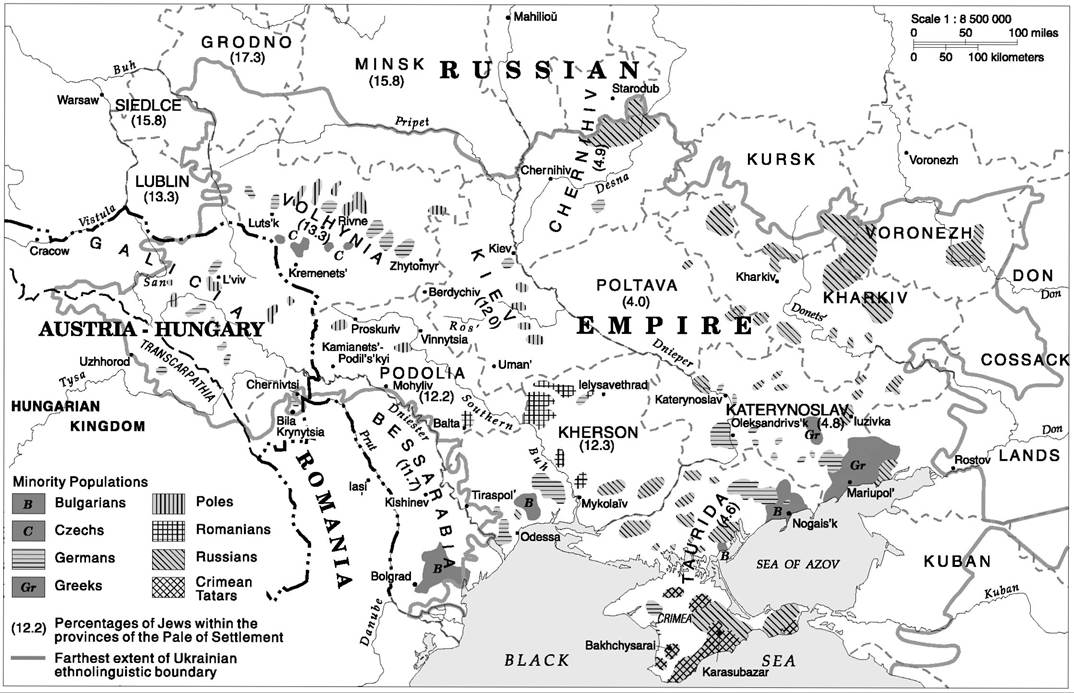
Copyright © by Paul Robert Magocsi
Chernihiv province. It was not long, however, before the newcomers clashed with the Hetmanate’s authorities, who tried unsuccessfully to reduce their economic privileges. As a result, in the second half of the eighteenth century many Old Believers moved farther south into the steppeland of what later became the Kherson and Taurida provinces.
By the mid-nineteenth century, 10 percent of all Old Believers in the Russian Empire lived in the nine “Ukrainian” provinces, and by 1904 their number had reached 167,000.
Old Believers also settled in the southern part of Bessarabia province and in neighboring Moldavia and Walachia, where they were known as Lipovany. In the 1760s and 1780s some Lipovany moved to the Austrian province of Bukovina, where their major settlement at Bila Krynytsia became the metropolitan see for local Old Believers as well as for those in the Russian Empire (until 1905). In keeping with their religious convictions, the Old Believers, wherever they lived, considered outsiders unclean and did not mix with “fellow” Russians, ethnic Ukrainians, or any of the other peoples among whom they lived. As part of their lifestyle, Old Believers refused to serve in the military, wore traditional dress, and used only Russian in their daily lives and church services.It was during the nineteenth century that large-scale immigration of Russians to Dnieper Ukraine took place. Initially, rural areas in the southern provinces of Kherson and Taurida were the primary goals of settlement, but with the industrialization of the Dnieper-Donbas region after the 1880s it was to industrial cities of the Donets’ and lower Dnieper River valleys that Russians flocked. By 1897, Dnieper Ukraine had 2.9 million Russian inhabitants, making up 12.4 percent of the total population. The Russians were particularly well represented in Ukraine’s urban areas. In the first half of the century (1832), they comprised a disproportionately high percentage of factory owners (44.6 percent), merchants (52.6 percent), and city dwellers (35.5 percent). The proportion of Russians in cities continued to increase, with the result that by the end of the century (1897) they made up more than half the population of Mykolaiv (66.3 percent), Kharkiv (63 percent), and Kiev (54.4 percent), and a substantial percentage of that of Odessa (49.1 percent) and Katerynoslav (41.8 percent). In all urban areas in Dnieper Ukraine considered as a whole, Russians accounted for 34 percent of the inhabitants.
As a result, most cities in Dnieper Ukraine were Russian in flavor, not simply because they were part of the Russian imperial framework, but because they were in fact inhabited to such a substantial degree by ethnic Russians and russified Ukrainians.
The holders of the highest administrative and governmental posts, the owners of factories and other enterprises, and the workers in mines and factories (68 percent in Katerynoslav in 1897) in Dnieper Ukraine were Russians. Several Russians, russified Ukrainians, and russified Jews who had been born or who worked in Dnieper Ukraine played an outstanding role in the region’s intellectual and scholarly life as university professors in the humanities and social sciences (Izmail Sreznevskii, Timofei Florinskii, Vladimir Ikonnikov, Stepan Golubev, Ivan Vernadskii, Vladimir Peretts, Mikhail Rostovtsev), and in the natural sciences and engineering (Sergei Reformatskii, Iosef Kosonogov, Aleksander Fomin, Vladimir Vernadskii, Igor Sikorskii). The empire’s cultural life was enriched by several creative artists who were either born or who worked in Ukraine, and who, regardless of their origins (perhaps ethnic Ukrainians, or of nationally mixed parentage, or not Russian at all) were - and continue to be - associated with some of the greatest achievements of Russian culture in the nineteenth and early twentieth centuries. Among the best known were the writers Nikolai Gogol’, Kondratii Ryleev, Aleksei Tolstoi, Vladimir Korolenko, and Nikolai Leskov; the philosopher Nikolai Berdiaiev; the enormously popular naturalistic painters Ilia Repin and Ivan Aiva- zovskii; the radical modernist painter and founder of the Supremacist movement Kazimir Malevich; the Symbolist painter and designer Mikhail Vrubel’; the sculptor Aleksandr Archipenko; and the composers Reinhold Gliere and Sergei Prokofiev. Kiev was also the home of the conservative political activists Vitalii Shul’gin and Vasilii Shul’gin, who on the pages of their newspaper Kievlianin (1864-1919) tried to protect what they considered to be the best interests of the Russian Empire. Many of these scholars, scientists, writers, artists, and political activists expressed a deep love for and appreciation of their Little Russian homeland. With few exceptions, however, they were unsympathetic to the Ukrainian national movement if not openly opposed to the idea that a distinct Ukrainian nationality even existed.The Poles
While Russians played a dominant role in the Left Bank and steppe regions of Dnieper Ukraine during the nineteenth century, Poles continued to be the most important group in the Right Bank, or so-called Southwestern Land (Volhy- nia, Kiev, and Podolia provinces). The total number of Poles in the Right Bank increased from approximately 240,000 in 1795 to 322,000 in 1897. Their relative numerical strength declined, however, slipping from 10 percent of the population in 1795 to 3.5 percent in 1897.
Despite the relative smallness of their group, the Poles played a particularly influential role in the Right Bank, because when the area was incorporated into the Russian Empire, the Polish and polonized Ukrainian szlachta was immediately granted the status of nobility (dvorianstvo). Initially, in 1795, this meant that as many as 260,000 persons - as much as 7.7 percent of the area’s population - were nobles. Despite their legal status, the vast majority of Polish nobles held no land and, in many cases, were economically at the same level as or worse off than townspeople and state peasants. In effect, only 30,000 could actually be considered part of the Right Bank’s elite, that is, nobles who had both hereditary status and a sufficient amount of land to allow them voting rights in noble assemblies. This smaller elite, however, enjoyed numerous privileges. They retained title to their estates and control over the serfs living on them, and they came to dominate the administration, courts, and schools in the Right Bank, all of which remained Polish.
It was the Roman Catholic Church, however, that was most successful in maintaining a sense of Polishness among the broadest segment of the population, even after the group’s intellectual and social elite had been weakened or driven into exile following the periodic failure of its conspiratorial and revolutionary activities. At the hierarchical level, the church suffered losses following the Partitions of Poland (1772-1795). Over the course of nearly a century, Roman Catholic dioceses were abolished, restored, transferred, and abolished again by the Russian government. Beginning in 1798, all Roman Catholics east of the Congress Kingdom came under a single Latin-rite archdiocese with its seat in the Belarusan town of Mahiliou. In Dnieper Ukraine, several Roman Catholic dioceses (Kiev, Kam’ianets’-Podil’s’kyi, Volodymyr, and Chernihiv) were abolished, with the result that by 1866 only the dioceses of Luts’k-Zhytomyr (with its seat at Zhytomyr) remained to serve primarily the Poles in the Right Bank. In the interim, a new Roman Catholic diocese was established at Tiraspol (1847) with jurisdiction over southern Ukraine and Bessarabia, where most of its faithful were recent German colonists. Although its hierarchy was weakened, in local Roman Catholic parishes the Polish language continued to be used and functioned as an important means of preserving Polish identity in the Right Bank.
In effect, the Right Bank, together with the Russian Empire’s other “Polish” provinces, located farther north than Dnieper Ukraine - Vilna, Grodno, Vitebsk, Mogilev, and Minsk - became a stronghold of Polish national feeling. This character was due largely to the educational system, which from 1803 to 1823 was under the direction of Prince Adam Czartoryski. As curator of schools in the empire’s “Polish” provinces, Czartoryski had a free hand in managing education. As a result, Polish culture among younger generations was preserved by the Polish university at Vilnius (in Polish, Wilno) and by the lyceum in a town which Poles dubbed their “Volhynian Athens” - Kremenets’ (in Polish, Krzemieniec). Consequently, the Polish nobility was not russified, and the whole area was filled with Polish patriots who became involved in several underground societies, such as the Kiev branch of the Society of the United Slavs (Towarzystwo Zjednoczonych Slowian, est. 1823) and the Southern Society (est. 1821), a republican group which called for the emancipation of the serfs. More conspiratorial in nature were the branches in Kiev of the Association of the Polish People (Stowarzyszenie Ludu Polskiego), founded by Polish students at the University of St Vladimir in the wake of the abortive 1830-1831 revolt, and the Provincial Committee in Rus’ (est. 1862), which was responsible for planning an uprising in the Right Bank as part of the 1863 Polish revolt against tsarist rule.
In the economic sphere, the Polish nobility was active in Dnieper Ukraine’s textile, porcelain, glass, metallurgy, and, especially, sugar processing industries. In agriculture, there were negative repercussions following the abortive Polish revolts of 1831-1832 and again 1863 (which led to the confiscation of many Polish estates). Polish-owned industries also felt the loss of serf labor in factories both before and after the era of reforms. Nevertheless, the Polish nobility continued to be one of the most influential social estates in the Right Bank until the outbreak of World War I. Indicative of this influence was the landholding pattern: in 1909, 46 percent of private landholdings (representing 15 percent of all land in the Right Bank) was still owned by Poles.
The socioeconomic changes during the second half of the nineteenth century also contributed to an increase in the number of Poles in Right Bank cities, especially Kiev, whose population by 1874 was 8.2 percent Polish. As a result,
What Ukraine Means for Poland
As well as an inspiration for literary works, Ukraine became for many Poles the very place where the spiritual regeneration of Poland was to take place. For that reason, the Ukrainian people were worthy of respect and even emulation, although the lands they inhabited - in particular the Right Bank - could not be imagined in any other way than as an integral part of Polish territory. This point of view was summed up best in 1842 by Seweryn Goszcynski, a member of the “Ukrainian school” of Polish literature, in a critique of the poetry of another member, Jozef Bogdan Zaleski.
The part of Poland called Ukraine received a calling which within the general [Polish] national calling has not yet been fully understood or explained; it has, along with its history, unique spiritual features which distinguish it and elevate it above the other parts [of Poland]; in short, it is there that the spirit of freedom of the Polish people abided and showed itself most energetically in battle with oppression, and immortalized with bloody features both its wrongs and its protestation against them. If we look at the entire life of the Polish people we will not find this phenomenon existing anywhere else with such force, tenacity and consequences so decisive and terrible for the Fatherland. ...
This feeling of freedom among the Ukrainian people showed itself in a guise that is perhaps too wild for the present age; it led to fratricidal crimes... we do not justify this.... Nevertheless, despite all the charges that Poland can make against Ukraine, it is certain that its Cossack life afforded beautiful deeds for the nation’s glory, and even in its horrors, it was a historical, palpable warning for the nation of the sources of its downfall. It also foretold in its bright, Polish aspect the future which our regeneration will develop, and which we are already entering in spirit. It is for this reason that we have such poetry about Ukrainian history and its land, and it is for this reason that the heart of the [Polish] nation has such love and admiration for it. Yes, the spirit of the Polish people sensed the truth in the idea of Ukraine; in the sufferings [of the Ukrainian people] it saw the apotheosis of its own martyrdom, and in the spectre of its past it saw its foe to whom it now pays its respect through its love. In this homage the [Ukrainian] people and the [Polish] gentry are united.
source: George G. Grabowicz, “The History and Myth of the Cossack Ukraine in Polish and Russian Romantic Literature” (unpublished PhD dissertation, Harvard University 1975), pp. 107-108.
Polish culture continued to flourish throughout the region. Kiev (Polish: Kijow) in particular had its Polish schools, theater, newspapers, publishing house, cultural organizations, sports clubs, and legal and illegal political societies. On the eve of and during World War I the city proved to be a formative influence on the outstanding twentieth-century Polish poet Jaroslaw Iwaszkiewicz and the world renowned “Russian” painter of Polish origin Kazimir Malevich.
But Polish culture was not limited to urban areas. Throughout much of the nineteenth century the rural areas of the Right Bank were not only the home but also the source of literary inspiration for the leading Polish Romantic poet and dramatist Juliusz Slowacki and for members of the so-called Ukrainian school of Polish literature (Michal Czajkowski, Jozef Bogdan Zaleski, Seweryn Goszczyn- ski, and others). Within the Right Bank’s tranquil environment of rural manorial estates owned by a privileged landed gentry, several other leading Polish creative artists of that era began their lives. Among them were the musicians and composers Juliusz Zarebski, Ignacy Jan Paderewski, and Karol Szymanowski; the historical novelist Jozef Kraszewski, who spent over three decades as a landowner and tenant farmer in Volhynia; and the architect Leszek Dezider Gorodecki/Vladyslav Horodets’kyi, whose buildings still grace the streets of Kiev. It was also on one such manorial estate in Podolia, owned by Polish poet and playwright Apollo Korzen- iowski, where his son, Jozef Teodor Konrad Korzeniowski, spent the first five years of his life before moving on and eventually becoming one of the greatest English- language novelists of the nineteenth century - Joseph Conrad.
It was another Polish author, however, the Nobel Prize laureate Henryk Sienkiewicz, who, although not a native of the Right Bank, was to have the greatest impact on the mind-set of Poles in the Russian Empire and elsewhere. In 1884, Sienkiewicz published the initial volume of what became his enormously popular trilogy on seventeenth-century Poland. Entitled Ogniem i mieczem (With Fire and Sword), this first novel of the trilogy was a panegyric to Polish civilization, which was depicted as threatened in the “wild steppes of Ukraine,” where the defender of the Commonwealth and “magnate of steel” on his white stallion, Prince Jeremi Wisniowiecki, was pitted against the “cunning” and often “drunkenly enraged” Cossack hetman Bohdan Khmel’nyts’kyi. Because the trilogy subsequently became required reading for Polish schoolchildren (and remains so to the present day), Sienkiewicz’s powerful if distorted stereotypes are what generations of Poles most readily remember when they think about Ukraine and Ukrainians.
The Jews
Although Russians and Poles represented a numerical minority in Dnieper Ukraine, members of these groups occupied the leading strata in the political and socioeconomic life of both the Left and the Right Banks. There were, however, other peoples who enjoyed neither numerical nor political strength in nineteenthcentury Dnieper Ukraine. Historically, the Jews were the most important in this category.
Since the late sixteenth century, the Jews had enjoyed municipal self-government within a framework known as the Council of Lands, and in the countryside they became an integral part of the arenda economic system that was established throughout Ukrainian territory under Polish rule (see chapter 11). As middlemen in the arenda system between the Polish landlords and the Ukrainian peasants, the Jews before long were perceived by Ukrainians as their oppressors. The result was that during periods of social upheaval such as those in the mid-seventeenth
century (the Khmel’nyts’kyi revolution) and the second half of the eighteenth century (the haidamak revolts), Jews often suffered material and physical destruction at the hands of the rebellious peasants. With the slow disintegration of the Polish state in the eighteenth century, the self-governing Council of Lands ceased to exist; then, in 1844, the tsarist government abolished the kahal (Yiddish: kehile), or Jewish self-government at the local level.
Despite the decline of their self-governing status and their loss of life and property during the haidamak revolts, the Jews remained an integral part of Poland’s economy on the Right Bank. Their numbers, moreover, grew steadily in Dnieper Ukraine, from over 300,000 at the end of the eighteenth century and over 900,000 in the middle of the nineteenth century to over 2 million in 1897. The last figure represented 8.5 percent of the total population in the nine provinces (including the Crimea) of Dnieper Ukraine.
Although Jews were found in all parts of Dnieper Ukraine, nearly three-fifths (1.2 million) lived in the Right Bank. Their continued high concentration in the Right Bank was due to the Russian imperial government’s restriction on their movement farther eastward. The tsars generally preferred that Jews living under their rule remain on territories that had been acquired from the partitioned Polish-Lithuanian Commonwealth. These territories, which came to be known as the Pale of Settlement, included the tsarist provinces in what is today Poland, Lithuania, and Belarus as well as all provinces of Dnieper Ukraine with the exception of Kharkiv.
Within this so-called Pale of Settlement, the vast majority of Jews lived in small towns and cities. According to the 1897 census, 27 percent of the urban population throughout Dnieper Ukraine consisted of Jews. In the Right Bank alone, 72 percent of the Jews lived in towns with over 1,000 persons; in three-fifths of those towns they represented at least 40 percent of the population. In the Left Bank, 65 percent of the Jews lived in towns with over 1,000 persons, and in the Steppe Ukraine the figure was 76 percent. In Dnieper Ukraine as a whole, 26 percent of all Jews lived in twenty cities, each of which had over 10,000 Jews.
Being an urban population, the Jews engaged primarily in trade, banking, industry, and in operating small shops and businesses. By 1832, they comprised 17 percent of the factory owners and 21 percent of the merchants in Dnieper Ukraine, although in the Right Bank, where Jews were concentrated, the percentages were significantly higher (93 percent of factory owners and 96 percent of merchants in Volhynia).3 Jews were especially well represented in certain industries, and by 1872 they owned 90 percent of the distilleries, 57 percent of the sawmills, and 49 percent of the tobacco industry. A fewJewish-owned companies based in Ukraine came to play a dominant role in the empire as a whole. Among them was the Aleksander Sugar Refinery, founded in 1876 in Kiev by Izrail Brodskii. Before the end of the century, Kiev became the base for numerous other Brodskii refineries that accounted for about one-quarter of the entire sugar production in the Russian Empire. Following in the industrial and philanthropic interests of his father, Brodskii’s son Lazar expanded the company and made donations to several Jewish and non-Jew- ish cultural and welfare institutions. In his will, Lazar left funds for the construction
Memories of the Shtetl
The shtetl was the epitome of Jewish life not only in Dnieper Ukraine but also in the western Ukrainian lands under Austro-Hungarian rule - Galicia, Bukovina, and Transcarpathia. The following description by Joachim Schoenfeld, who grew up before World War I in the Ukrainian town of Sniatyn in far southeastern Galicia, reveals the hold the shtetl continued to have on the imagination of those who grew up in it.
I was born and raised in the shtetl of Sniatyn. Since the life of the Jews in all the shtetls of Galicia, and indeed throughout eastern Europe, was, with slight deviations, more or less the same, my picture of life in Sniatyn reflects that in hundreds of other shtetls as well and can be taken as an approximate description of all of them.
Although I never returned to my shtetl after the First World War, all my love and my most fervent feelings go back to that era. Even today, although thousands of miles away from it, after having fought in many trenches on different battlefields during the First World War, after having survived Hitler’s concentration camps, and after having traveled through many countries, happiness overcomes me when I think back to those days and manage to recapture some of the tableaus of former years.
This happiness, however, is soon overshadowed by sadness and sorrow that this, our past, doesn’t exist anymore. With affliction and grief I mourn the desolation of the Yiddish shtetl.... Actually it may be wrong to call the place a shtetl, and not a city as it really was. However, having in mind the core of the city, where the Jews lived on a kind of isle, surrounded by a sea of Gentiles, I call it the shtetl.
The degree to which the shtetl, while economically and physically inseparable from its surroundings, still functioned in a spiritual world of its own, is summed up in the following description of a young Jewish child growing up in the late nineteenth-century Russian Empire.
He could not tell you a thing about Russia, about Poland, about Lithuania and its people, laws, kings, politicians.... But you just ask him about Og, King of Bashan, and Sihon, King of the Emorites, and Nebuchadnezzer, King of Babylon! Ask him about the Euphrates and the Jordan. He knew about the people who lived in tents and spoke Hebrew or Arabic.. He knew nothing concerning the fields about him, nothing about rye, wheat, potatoes, and where he got his bread from.. But he knew about vineyards, date palms, pomegranates, locust-trees... he lived in another world?
Joachim Shoenfeld, ShtetlMemoirs: Jewish Life in Galicia under the Austro-Hungarian Empire and in the Reborn Poland, 1898-1939 (Hoboken, N.J. 1985), p. 1.
^Meyer W. Weisgal and Joel Carmichael, eds., Chaim Weizman: A Biography by Several Hands (London 1962), p. 68. in Kiev of the still-functioning Bessarabian Covered Market (the Bessarabka, 191012), the income from which was originally intended forJewish charities.
Despite the achievements of individual Jews in the uppermost echelons of Dnieper Ukraine’s economy, the vast majority lived a modest existence that often bordered on poverty. They were spread throughout villages and small towns, each of which had its own sub-community, known in Yiddish as the shtetl or shtetele. The shtetl had an atmosphere of its own that was governed by two basic values: (1) humaneness (Yiddish: menshlikhkeyt), which made it an environment in which economic and psychological support could be found in times of crisis as well as on an everyday basis; and (2) Jewishness (Yiddish: yidishkeyt), a religious environment, both at home and on the streets, that provided daily spiritual sustenance in the midst of an otherwise alien Christian world. Daily life in the shtetl revolved around the synagogue, the home, and the market, which was also the place where Jews interacted with their non-Jewish neighbors (goyim). The attractiveness of smalltown life in the nineteenth- and early twentieth-century shtetl has been immortalized by numerous writers and artists, among the most famous of whom was the Ukrainian-born Sholem Aleichem (Shalom Rabinovitz), whose stories were later used as the basis for the popular American musical Fiddler on the Roof In fact, it was the psychological comfort afforded by shtetl life that made many Jews reluctant to leave their centuries-old homes in Dnieper Ukraine and other parts of eastern Europe even in times of economic hardship and physical danger.
Dnieper Ukraine, especially the Right Bank, also became a fertile ground for Jewish culture. It was there that some of the most important cultural and political movements in all of modern Jewish history arose. These movements may have begun as the direct result of catastrophe in the community. Thus, after suffering the destruction of the Khmel’nyts’kyi era, Jews throughout Ukraine - and, for that matter, in other parts of Europe - began to believe that their only hope lay in the imminent arrival of the Messiah. This belief produced a cultural environment that allowed for the widespread acceptance of Sabbatianism, that is, the belief that the Messiah had actually come in the person of Shabetai Tsevi.
Sabbatianism reached Ukraine and other eastern parts of Poland-Lithuania during the late seventeenth and early eighteenth centuries, and there it became part of the largest messianic movement in Jewish history since the second century ce. The eighteenth century, with its haidamak and peasant disturbances in the Right Bank, produced a social and psychological instability within Jewish communities that in turn set the stage for the birth of Hasidism in Podolia. Founded by Yisra’el ben Eli’ezer, the Baal Shem Tov (usually referred to by the initials BeShT), Hasidism was a mystical movement which stressed the mercifulness of God and encouraged joyous religious expression in music and dance. While following Jewish law, the movement represented a reaction to the academic formalism and rigidity of the rabbinical Talmudists, who placed a much greater emphasis on intensive study of the Talmud (the authoritative book of Jewish law and tradition) than on other, less intellectual forms of religious expression. Because of its popular appeal, Hasidism spread rapidly, and it would remain the dominant variety of Judaism among Ukrainian and other central and eastern European Jews until the twentieth century. At about the same time that Hasidism appeared in Podolia, this region also witnessed the appearance of Jacub Leib, known as Jacub Frank, who, following in the tradition of Shabetai Tsevi, proclaimed himself the Messiah. Later, however, he converted to Roman Catholicism, and his followers, known as Frankists, eventually rejected Judaism entirely, and some became leading members of the Roman Catholic Church.
The nineteenth century produced new movements which had emigration as their goal. The desire to emigrate was a direct result of the upheaval in Jewish communities in the wake of pogroms in 1881-1883 and 1903-1906. The first pogroms were prompted by a rumor that the Jews had assassinated the “reforming” tsar Alexander II in March 1881, and that as a result the government supposedly had authorized attacks on Jews. The pogroms at first received the support of some Russian revolutionary circles, including the People’s Will (Narodnaia Volia) organization. It was this organization that actually had carried out the assassination of the tsar, in the hope that its action would awaken the masses to revolt, destabilize society, and eventually bring down the tsarist regime. For their part, the Russian governmental authorities, at least during the initial pogroms of April and August 1881, did not interfere, but permitted the violence and robbery to take place. The “Russian pogroms” of 1881-1883 were concentrated in Dnieper Ukraine, first in lelysavethrad (today Kirovohrad) in Kherson province, and then in all provinces of Dnieper Ukraine except Volhynia and Kharkiv. The perpetrators primarily confined their actions to beatings and the looting of property, although some reports suggest several dozen killed. When the imperial government finally got around to the matter, it blamed the pogroms of the early 1880s on the inept reaction of provincial governors, who subsequently intervened with force to stop further pogroms.
Two decades later, at the beginning of the twentieth century, a more serious wave of pogroms began, in 1903, at Chisinau (in Russian, Kishinev), in the empire’s far southwestern province of Bessarabia. These outbreaks were much more violent, and in addition to the widespread material damage an estimated 800 Jews were killed in pogroms reported to have occurred in over 600 towns and villages throughout Dnieper Ukraine and Bessarabia. Among the most violent were those of 1905 in Zhytomyr (May), Odessa (October), and Katerynoslav (October). This latest wave of pogroms, between 1903 and 1906, was directly related to the tsarist government’s struggle against the growing revolutionary movement. The right-wing press blamed the revolutionary activity on the Jews, and the authorities stood aside as monarchist organizations, popularly known as the Black Hundreds, moved throughout the countryside instigating disturbances and inflaming the passions of the local population against the Jews.
Although not part of a pogrom, the most infamous manifestation of antiSemitism occurred in 1911, when Black Hundred pressure led to the arrest in Kiev of a Jew named Mendel Beilis. Many Christians believed the myth that Jews needed human blood for ritual purposes, and Beilis was therefore accused of having carried out the ritual murder of a twelve-year-old Christian boy. When Beilis’s trial finally took place, in October 1913, it attracted attention around the world.
Pogroms
In the most general sense, the term pogrom refers to an attack on the persons or property of the members of any religious or ethnic minority group by the members of the presumed or actual dominant group in a society. The attacks may include some or all of the following: looting, the destruction of personal, religious, and business-related property, beating, rape, and murder. Although pogroms have been - and still are - committed against minority populations in various parts of the world, the term is associated primarily with attacks against Jews living in the western regions of the Russian Empire (the so- called Pale of Settlement, including Dnieper Ukraine), especially between 1881 and 1921.
Historians still debate several questions concerning the pogroms, including (1) how much physical and material damage was done; (2) whether the pogroms occurred primarily in urban areas or in the countryside; and (3) whether they broke out spontaneously, reflecting pent-up anti-Semitic attitudes on the part of the local population, or were the result of organized efforts on the part of local officials, national governments, or specific political groups who often used outsiders (such as migrant Russian workers) to carry out their destructive work. Regardless of the ongoing debate about motivation and damage, for the potential and actual Jewish victim the very term pogrom awakened an instant fear and sense of helplessness at the prospect of danger to life and limb. The following passage provides an insight into what a pogrom meant for an ordinary Jew in early twentieth-century Dnieper Ukraine:
The pogrom began with us Tuesday night. The first looting took place then. On the next morning we learned that six were slain. The whole day of Wednesday robberies continued in the town. On Thursday again five or six people were killed, but the most terrible day for our town [Slovechno] was Friday, when the most fiendish murders and atrocities took place. On Friday morning we came out of our house and fled wherever our legs took us. Wherever we went we were met with shots. The peasants encompassed the town with firing and drove the fleeing Jews into one place. Several hundred of us found ourselves in the house of Avrum-Ber Portny, and there we were all piled and heaped up on one another. It was close in the house, and terror and anguish reigned among us. When a certain peasant (Kosenko, from Slovechno) appeared and declared that he was the head of the insurgent forces, we began to entreat him and offered him money. He answered that since we had disobeyed his orders to leave the town he had decided to kill us all. Immediately the firing began through the windows of the place where we were gathered. Then the peasants began to beat us up; they beat us with whatever came handy, trampled on us with their feet, and threw bombs. How many killed, it is hard to be sure at present, but very many.
Many corpses remained at home and in the streets. The summer heat caused a stench of putrefaction from the bodies. Everywhere were pools of human blood. At evening we hid again, since looting and killing were still going on. All the Jews hid, and cowering each in his hole in a cellar or garret or in the bushes, expected death.
source: Elias Heifetz, The Slaughter of the Jews in the Ukraine in 1919 (New York 1921), pp. 382-383.
After a month of deliberation, the jury found the defendant not guilty.
Both waves of pogroms had a profound effect on Jewish life, in forcing secular leaders in particular to reassess the future of their people in the Russian Empire. Was there a future for Jews in Russia? Or was emigration the only sensible option? Following the pogroms of the early 1880s, Dnieper Ukraine saw the rise of some of the earliest movements to propagate the idea of emigration (alzyah) for Jews to Palestine (Eretz Israel). Two of these movements that predated the worldwide Zionist movement - and which also had as its goal emigration to Palestine - were the Hibbat Zion (Love of Zion) and the BILU organization. BILU, an acronym for the biblical phrase “House of Jacob, come, let us go,” was founded in 1882 by Jewish students in Kharkiv and was the first Zionist pioneering movement. Its goals were undermined, however, by opposition from the Ottoman government, which controlled Palestine at the time. Another movement which began in Dnieper Ukraine was Am Olam (Eternal People), which urged Jews to become agriculturalists in preparation for their return to Israel. However, Am Olam succeeded only in establishing a few Jewish farming colonies in the United States (New Odessa, Oregon, 1883, and two settlements in South Dakota, 1882). After the 1880s, the opposition of the Ottoman government, combined with the uncertain hardships of becoming pioneer farmers in Palestine, prompted those Jews who decided to leave Dnieper Ukraine to go instead to the rapidly expanding industrial regions of the northeastern United States. By the end of the nineteenth century, Jews were emigrating to the United States in large numbers. For instance, during the two decades between 1894 and 1914, which marked the height of the immigrant flow from eastern Europe to the United States, Jews made up as much as 59 percent of all immigrants from the Russian Empire.
Most Jews, however, did not leave their centuries-old homes in Dnieper Ukraine, but remained and continued to play an important role in the economic, the cultural, and, eventually, the political life of the country. In many ways, educated Jews faced the problem of multiple identities, as did educated ethnic Ukrainians (see chapter 29). Attracted by the possibilities for social and economic mobility, many Jews assimilated into Russian culture and in certain cases even rejected entirely their Jewish heritage. Such rejection was quite common among those who joined the socialist movement, such as the Ukrainian-born Marxist Pavel Aksel’rod and two activists destined to play leading roles in the Russian Revolution and civil war: Evgeniia Bosh, a Bolshevik official in the first Soviet government in Ukraine, and Lev Bronshtein, the political ally but longtime ideological opponent of Lenin (and then Stalin) and the theoretician of the idea of “permanent revolution” who is better known to the world as Leon Trotskii.
Many others remained loyal to their ancestral heritage and worked to promote Jewish culture in Dnieper Ukraine. It was not long, however, before a debate arose over the form in which, and the language in which, Jewish culture should be propagated. The native spoken language of virtually all Jews in Dnieper Ukraine and elsewhere throughout the Russian Empire was Yiddish. Since it was not yet a standard literary language, this Germanic form of speech (heavily mixed with Slavic elements) was often subjected to denigration and scorn by intellectuals, who felt that Hebrew or Russian would be the appropriate medium for Jewish secular as well as religious culture. It was often the Zionists who favored Hebrew, and in Dnieper Ukraine the most active figures were the essayist Ahad Ha-Am (Asher Hirsh Ginsberg) and the outstanding Hebrew poets Hayim Nachman Bialik and Sha’ul Tsh- ernichowsky. While not necessarily, eschewing Hebrew, other Jewish activists were concerned to ensure that the rich Yiddish culture and language be preserved for future generations. Important work on behalf of Yiddish in Dnieper Ukraine was carried out before World War I by the ethnographer S. An-ski (Shloyme Zaynvl Rapaport) and the writers Sholem Yankev Abramovitsh (Mendele Moykher-Sforim) and Sholem Aleichem. The debate as to whether Hebrew or Yiddish was the more appropriate language for secular J ewish culture was to continue into the 1920s.
The Germans and Mennonites
German colonization in Dnieper Ukraine began when Empress Catherine II (herself of German origin) issued the first of several imperial manifestos (1763) inviting Germans to settle in underdeveloped and sparsely inhabited lands in the European part of the Russian Empire. They included the recently acquired southern Ukrainian steppe lands known at the time as New Russia. To encourage immigration, the Russian government offered the German newcomers several incentives: land gratis or at a nominal fee, guarantees for freedom of religion (including the right to proselytize among the Muslim population), the right to local self-government in agricultural communities, exemption “in perpetuity” from military and civil service, and exemption from taxes for a period of up to thirty years. Initially, only a few Germans took advantage of Catherine’s decrees to settle in Dnieper Ukraine. They included about 1,100 Mennonites, who settled in 1789-1790 near Khortytsia Island, the former Zaporozhian Cossack stronghold in the lower Dnieper River opposite the new town of Oleksandrivs’k (today Zaporizhzhia). Most of the early German colonists instead went farther east to the steppe land along the middle Volga River.
It was as a result of a new decree, issued by Tsar Alexander I in 1804, that the largest number of Germans began to settle in Dnieper Ukraine. These immigrants came primarily from the German states of Baden, Württemberg, and the Palatinate, and from the Germanic province of Alsace in France - that is, those areas near the Rhine River which had suffered most during the Napoleonic Wars - as well as from the area around Danzig in West Prussia. Most settled in the steppelands north of the Black Sea and Sea of Azov, which had only recently been acquired from the Ottoman Empire, that is, the southern Kherson and Bessarabia provinces between the Dnieper and Danube Rivers, the areas along the Dnieper River south of Katerynoslav, the territory north of the Sea of Azov (especially along the Molochna River, where 1,200 Mennonite families settled), and the Crimea. These German colonists in the Steppe Ukraine came to be known as Black Sea Germans (Schwarzmeerdeutsche). According to the 1897 census, they numbered 283,000, representing 4.6 percent of the population of the provinces of Kherson, Taurida, and Katerynoslav. By 1911, German sources put their number at 489,000, of whom 43 percent were Protestants (Lutherans), 37 percent Roman Catholics, and 20 percent Mennonites.
Other concentrations of Germans were found in Volhynia, where they arrived in large numbers between the 1860s and the 1880s. Local Polish landowners were deprived of part of their serf work force after the emancipation act of 1861, and they were economically undermined following anti-Russian revolt of 1863. Consequently, they invited German colonists to run their estates or sold them their land outright. If in i860 there were at most 5,000 Germans in Volhynia, by 1897 their number had risen to 171,000. Almost all the Volhynian Germans were Evangelical Lutherans.
By the outbreak of World War I, there were close to three-quarters of a million Germans living in Dnieper Ukraine, concentrated primarily in the steppe area near the Black Sea and in Volhynia. They lived in compact rural colonies that in 1914 numbered 966. They were engaged almost exclusively in agriculture, and their villages were regarded as models of farming and husbandry techniques. Although the well-to-do farmers hired household servants and farmhands from among the local inhabitants, in general the Germans kept a certain distance from the Slavic (ethnic Ukrainian and Russian) inhabitants that surrounded them. For that matter, Germans maintained little contact with co-ethnics of different religious backgrounds. In other words, Catholics, Protestant Lutherans, and Mennonites lived in separate communities. Each community had its own local self-governing body and even regional assemblies, and its own German-language schools and churches (often built in the Gothic style). Many also had their own newspapers and journals, the most important of which was the Odessa daily Odessauer Zeitung, which appeared uninterruptedly for over half a century (1863-1914). These privileges stemmed from the tsarist decrees of 1763 and 1804 that were originally intended to attract new colonists to settle in the empire. During the reform era, however, which attempted to respond to public criticism against the special status of certain sectors of tsarist society, many of the privileges given to the original colonists were rescinded. The new decrees passed between 1871 and 1884 were related to land administration, the tax system, education, and military service. All Germans were now required to pay new taxes, to study Russian in their previously all-German- language school system, and to perform military service. The abolition of what had been “perpetual” privileges was resented by many Germans, who in the 1870s began emigrating to the United States and Canada.
The Mennonites, in particular, were troubled by the imposition of the military service requirement, since they viewed the previous exemption not as a privilege but as a right corresponding to their religious commitment to pacifism and nonviolence. Driven by what they considered a violation of their religious beliefs, nearly one-third of Dnieper Ukraine’s Mennonites (18,000) emigrated abroad in the 1870s. Those who stayed behind eventually worked out an accommodation with the tsarist government, whereby their young men would perform four years’ service in special forestry camps.
The Mennonites were distinguished from other German-speaking peoples in Dnieper Ukraine on the basis not only of their religious beliefs but also of their origins. Almost all had come from territory known as West Prussia near the Baltic city-state of Danzig, to which their ancestors had immigrated from the Netherlands in the mid-sixteenth century. They spoke a distinct language known as Low German or Mennonite Platt (Plaut-Dietsch), which was used in writing and taught in their schools along with standard literary German (Hochdeutsch). After West Prussia was annexed by Prussia following the First Partition of Poland in 1772, the Prussian government placed certain restrictions on the Mennonites. It is not surprising, therefore, that they were attracted by the privileges offered by Catherine II and her successors to settle in the Russian Empire.
In their new homes, which in New Russia (southern Ukraine) were centered in the “Old Colony” around Khortytsia Island and along the Molochna River north of the Sea of Azov, the Mennonites established a series of flourishing agricultural communities which, thanks to the creative ideas of Johann Cornies, achieved a well-deserved reputation throughout the Russian Empire for innovations in soil cultivation, stock raising, afforestation, and related trades such as wagon building, tool making, and, especially, the milling of flour. To sustain their agricultural prosperity, they operated their own banks and mutual credit associations. Taking advantage of the right of self-government, the Mennonites established an extensive system of compulsory education for boys and girls (an exception at the time in the Russian Empire). These included German-language private secondary schools, although by the late 1880s government regulations required that all courses be taught in Russian, with the exception of religion for which German continued to be used.
Mennonites believed that their successes were due to the favorable policies of the Russian imperial government and to their own ability to avoid interacting - except in the most formal sense - with ethnic Ukrainians and other peoples, including the German Catholics and Lutherans who lived in their midst. By practicing what they called Absonderung (avoiding associating with people not of their faith), the Mennonites were able to preserve an exclusive group identity. Tsarist governmental practices before and, to a degree, even after the reform era contributed favorably to Mennonite self-maintenance, with the result that the community in Dnieper Ukraine, despite the emigration of the 1870s, had grown to nearly 70,000 strong by World War I. Not surprisingly, later Mennonite historians have looked back with great fondness on life in tsarist Russia, which enabled this distinct religious community to build “a state within a state” - a virtual “Mennonite Commonwealth.”4
The Crimean Tatars
In contrast to other peoples in Dnieper Ukraine, the Crimean Tatars had a unique history with their own state structures on Ukrainian territory. The rise of Crimean Tatar statehood was related to the disintegration of the Golden Horde. In the midfifteenth century, the Tatars created their own state, or khanate, which after 1475 was closely allied with and eventually became a vassal state of the Ottoman Empire (see chapter 14). When Ottoman influence north of the Black Sea progressively waned in the eighteenth century, the Crimean state became subject to tsarist rule and was fully incorporated into the Russian Empire in 1783 (see chapter 22). For many centuries before that, however, Muscovy and Ukraine were at the mercy of nomadic Tatar raiding parties, with the result that a long heritage of friction developed between the Muslim Tatars and the Christian Slavs (ethnic Ukrainians and Russians). Not surprisingly, when the Russian Empire finally acquired the Crimean Khanate, it was anxious to liquidate the Crimean Muslim heritage as an unwanted reminder of the former “Tatar yoke.”
Fearing the impending consequences of tsarist rule and desiring to live in an Islamic state, Crimean Tatars began to emigrate en masse to the Ottoman Empire, with the result that by the end of the eighteenth century an estimated 100,000 had left the lands of the former khanate. It seems that the majority of these early emigrants were not from the Crimean peninsula itself, but rather Nogay Tatars from the southern Ukrainian steppe. Despite this initial wave of emigration, it should be stressed that at least initially the Russian imperial government attempted to reach an accommodation with its new subjects. Catherine II considered Crimea “the pearl in the tsarist crown” and was herself known to be sympathetic to the last khan, §ahin Giray, and to the Muslim faith. In her 1783 decree proclaiming annexation, Catherine pledged on behalf of herself and her successors “to preserve and defend the... property, temples, and ancestral faith” of the Crimea’s inhabitants.5 Indeed, the khanate’s clan leaders (beys) and scores of lower nobles (mirzas) were granted the status of Russian nobility (dvorianstvt)) and allotted large swaths of land (with their peasant inhabitants) that had previously belonged to the khan. At the same time, towns like Bahyesaray and Karasubazar were to remain Tatar enclaves and the peasantry was not transformed into serfs but remained legally free. Catherine’s tolerant policies toward the Crimean Tatars and their cultural heritage were continued by Prince Mikhail Vorontsov when he served as governor-general of New Russia (1828-1854), which included the Crimea.
By the mid-nineteenth century, however, Russian policy toward the Crimea and its Tatar inhabitants changed markedly. The small Crimean Tatar town of Akmescit was greatly expanded and transformed into the imperial administrative center of Simferopol’, where Russian administrators from the north gradually directed the transfer of Tatar landholdings in the peninsula to Russian nobles. It was, however, the Crimean War, which began in late 1853, that proved to be the crucial turning point in Russian-Tatar relations. The otherwise liberal tsar-reformer, Aleksander II, who ascended the throne in early 1855 just as the Crimean conflict ended, adopted a policy intended to rid the peninsula of its Crimean Tatar inhabitants. Reacting to the new attitude of the Russian imperial authorities, during the next decade, no less than 200,000 Crimean Tatars emigrated to the Ottoman Empire. They were replaced by an ever increasing number of Slavic (Ukrainian and especially Russian) in-migrants whose new permanent presence changed the face of Crimea’s human and cultural landscape. Whereas at the outset of Russian rule in 1783, Tatars made up 90 percent of the Crimea’s population, by 1854 their percentage dropped to 60 percent, and by 1897 to only 34 percent. Tatar culture also suffered. Many monuments constructed under the Crimean Khanate were destroyed or left in ruins. Mosques, in particular, were demolished or remade into Orthodox churches.
In part as a reaction to such developments, the Crimea became the birthplace of a Tatar national revival that began in the 1880s under the leadership of Ismail Gaspirali/Gasprinskii. Under his direction, the nationalist movement rejected the traditional clerical aspects of Crimean Tatar society and sought to introduce reforms into the antiquated Muslim-controlled educational system and social structure, including the emancipation of women. He also tried to stem the tide of Crimean Tatar emigration to the Ottoman Empire. The historic Crimean capital of Bahyesaray was the center of activity for Gaspirali, and it was there that he founded the newspaper Tercuman (The Interpreter, 1883-1914), which he hoped would serve not only the Crimean Tatars but other Tatars and Turkic peoples in the Russian Empire as well. With this goal in mind, his newspaper and other publications were written in Ottoman Turkish, although in a simpler form in which florid Arabic and Persian vocabulary and phrases were omitted and vernacular Crimean Tatar added.
Despite Gaspirali’s innovative and extensive cultural achievements, he was criticized by conservative religious leaders (mullahs) who opposed his secular orientation and New Method schools, while his views on national identity were challenged by some who otherwise supported the Crimean Tatar revival. Debates centered on a few key issues. Did the Crimean Tatars form a distinct nationality that should have its own literary language? Or, did the adoption of Turkish imply that they were only a branch of a single pan-Turkic entity?
By the beginning of the twentieth century, a new generation of intellectuals known as the Young Tatars (Geny Tatarlar), centered in Karasubazar (today Bilohirs’k) instead of Bahyesaray/Bakhchysarai, moved beyond Gaspirali’s primarily cultural interests to more social and political concerns. They also made Crimea and its Tatars, instead of all Turkic peoples of the Russian Empire, their primary focus, although the language of their publications, including the newspaper Vatan Hadimi (Servant of Fatherland, 1906-), favored the idea of Turkish linguistic unity through the medium of Ottoman Turkish. One of their leaders, Abdure^id Mehdi, was elected to the Second Duma (1906) on a program committed to regaining lands lost by Crimean Tatars over the past century. The question of Crimean Tatar particularism versus pan-Turkic unity and the related issues of an appropriate literary language and national identity remained unresolved until the 1920s.
The Romanians
The Romanian presence in southwestern Ukraine dates back long before the nineteenth century. In addition to the province of Bessarabia, the region between the Prut and Dniester Rivers where Romanians traditionally formed the vast majority of the population, they inhabited lands east of the Dniester (in Romanian, Nistru) River, which they called Transnistria. Ninety-three percent of the 187,000 Roma- nians/Moldavians recorded in Dnieper Ukraine (1897) lived in the provinces of Kherson and Podolia, primarily along the eastern bank of the Southern Buh River.
Traditionally, the Romanians were known either as Moldavians or as Vlachs, names which derived from their homeland territories, the Danubian principalities of Moldavia and Walachia. By the nineteenth century, the term Romanian had replaced Vlach, while the term Moldavian in both Romanian and East Slavic sources continued to be used in the sense of a Romanian from Moldavia.
Relations between Ukraine and the two Romanian principalities were traditionally very close, both when Moldavia and Walachia were independent entities and after the early sixteenth century, by which time they had become vassal states of the Ottoman Empire. One important reason for the good relations was the fact that Romanians and Ukrainians were Orthodox, and that although the Romanians spoke a Romance language, it had many Slavic borrowings and was written in the Cyrillic alphabet until the mid-nineteenth century. Romanians from Transnistria were among the many peoples who joined the Zaporozhian Cossacks, some of whose otamans and hetmans - Ioan Nicoara Potcoava (Ivan Pidkova), Ioan Grig- ore Loboda (Hryhorii Loboda), Ioan Sircu (Ivan Sirko), Dumitru Hunu (Dmytro Hunia), and Danila Apostol (Danylo Apostol) - were of Romanian origin.
Moldavian-Ukrainian relations were particularly close during the seventeenth century, the time when Petru Movila (Petro Mohyla), the son of Moldavia’s ruler, in 1632, became metropolitan of the Orthodox Church in Kiev and when the Zaporozhian hetman Bohdan Khmel’nyts’kyi and his son Tymish during the 1640s and 1650s tried to forge an alliance with their neighbor to the southwest. It was also during the last three decades of the seventeenth century that large numbers of Romanians began to migrate from Moldavia to Transnistria. The movement of people began when the Ottoman Empire controlled Podolia and the southern Right Bank (see map 19), and was initiated during the short-lived rule (16811685) of Gheorghe Ducu, the voevoda of Moldavia whom the Ottomans designated as their “Hospodar of Ukraine.”
Romanian migration to Transnistria continued during the eighteenth century and was directly related to the many wars between the Russian and Ottoman empires. For example, in the wake of the war of 1735-1739, tsarist troops returning from their invasion of Ottoman Moldavia brought with them nearly 100,000 Romanians. At the end of the century, when Russia acquired Yedisan (Ottoman territory between the Dniester and Southern Buh Rivers), a new wave of Romanians settled that area, this time as peasant-serfs on the large landed estates awarded by the Russian government to several Moldavian boyars (nobles) of the Cantacuz- ino, Sturdza, Catargiu, and Rosetti families.
Initially, Romanians were allowed to use their own language in public affairs, in the few schools that existed, and in their Orthodox churches, which until 1828 were under the jurisdiction of a Romanian metropolitanate at Ia$i. That same year, however, the Romanian parishes in Dnieper Ukraine were placed under the authority of local bishops of the Russian Orthodox Church, and the Romanian language was replaced by Russian. Effectively, for the rest of the nineteenth century there was no organized Romanian cultural life in Dnieper Ukraine. Nevertheless, most Romanians did not lose their national identity, largely because they remained illiterate and therefore “protected” from assimilation to a foreign language (Russian) they could not understand.
It was not until the first decade of the twentieth century that Romanians in Dnieper Ukraine became interested in the cultural survival of their people. The early stages of a national revival took the form of discussions among university student groups and more popular efforts to have Romanian reintroduced into parishes of the Orthodox Church where they predominated. This was the so-called Movement from Balta, led by a monk from that town in southern Podolia, lerom- onah Inochentie. Despite these efforts, the status of Romanians and their language in Dnieper Ukraine had not changed by the time World War I broke out in 1914.
Other peoples
There were also several other peoples living in Dnieper Ukraine. Numerically, the most prominent were the Belarusans, followed by Bulgarians, Greeks, and Czechs. Somewhat exceptional among these groups were the Belarusans. Nearly 70 percent lived in northern Chernihiv province near Belarus; and the remainder were spread throughout the new industrial cities in the eastern and southeastern provinces of Kharkiv and Katerynoslav. Despite their relatively large numbers (222,000 in 1897), Belarusans did not develop a distinct cultural life in Dnieper Ukraine. This is because for the most part they had a low, or non-existent, sense of their national distinctiveness; moreover, being of the Orthodox faith, they tended to blend easily with the linguistically related ethnic Ukrainians and Russians among whom they lived.
The number of Bulgarians was actually larger than the 68,000 indicated in table 28.1, since Bessarabia is not one of nine provinces considered as part of Dnieper Ukraine. It was, however, precisely in the southern part of Bessarabia, which today is within Ukraine, where a significant number of Bulgarians lived (38,000 in 1897). Together with the Bulgarian settlements in Kherson province (north of Odessa) and in Taurida province (both in Crimea and along the northern shore of the Sea of Azov), the total number of Bulgarians in Ukraine at the end of the nineteenth century was 116,000.
Most Bulgarians arrived in the Bessarabia and Kherson provinces between the 1780s and 1830s. For the most part they were fleeing the disruptions in their homeland (still part of the Ottoman Empire) that resulted from the periodic Russian- Ottoman wars during those decades. In the 1860s, after southern Bessarabia was for two decades lost by Russia to Romanian-ruled Moldovia, large numbers of Bulgarians left the region in order to live again under Russian rule, this time resettling in Taurida province along the northern shores of the Sea of Azov in the town of Nogais’k (today Prymors’k) and in several nearby villages. The Bulgarians were especially attracted by favorable tsarist decrees that provided them with free land and exemptions for an initial period of time from military service and taxes. Most settled in the rural countryside, where they were engaged primarily in animal husbandry (especially sheep raising) and agriculture (grains, vegetables, fruits, grapes for wine, and tobacco). In the absence of their own Bulgarian Orthodox Church (a distinct jurisdiction did not come into being in their ancestral homeland until 1870), Bulgarians went to Dnieper Ukraine’s Russian and Greek Orthodox parishes. For this reason many Bulgarians, such as those who were part of the merchant community in Nizhyn, were known as “Greeks.” Efforts were taken, however, to preserve Bulgarian identity in Dnieper Ukraine through education. By the second half of the nineteenth century, Bulgarian was taught in at least fifty elementary schools and at a gymnasium in Bolgrad (est. 1859) in southern Bessarabia, and training was provided at a Bulgarian teacher’s college at Preslav near Nogais’k. Odessa was of particular importance to Dnieper Ukraine’s Bulgarians, because it was there that many cultural activists received their training at the Orthodox Theological Seminary and at the city’s gymnasium, among whom was the influential journalist, teacher, and leader in the Bulgarian liberation movement, Hristo Botev.
The presence of Greeks on Ukrainian territory goes back to the sixth century bce, when colonists created Greek city-states along the northern shores of the Black Sea and the Sea of Azov, and in the Crimea (see chapter 3). Greeks continued to play an important role in the economy of urban Ukraine and in particular its Orthodox religious and cultural life during the medieval period of Kievan Rus’ and during the sixteenth and seventeenth centuries (see chapters 12 and 13). It was the Greeks of Crimea who had the longest continuous existence as a distinct community, and by the end of the eighteenth century they had evolved into two distinct groups: the so-called Tatar Greeks (urumi) and the Hellene Greeks (rumei). The first group consisted of Greeks who, in the course of two millennia had integrated with the various Turkic peoples and Goths of the Crimea and who spoke a Turkic language similar to Crimean Tatar. The Hellenes were the descendants of colonists from the Byzantine Empire and the Ottoman-ruled Balkans (Rumelia), who continued to speak modern Greek. Both these groups continued to be represented in the Crimea as well as in a region north of the Sea of Azov. It was there, during the period of the independent Crimean Khanate (1774-1783), that over 18,000 Tatar Greeks (urumi) were forcibly resettled and where they founded the port city of Mariupol’ and nearly two dozen villages in the nearby hinterland.
From the mid-i77os to 1812, there was a steady flow of Greeks eastward. This was a time when the Russian Empire prided itself as a safe haven for fellow Orthodox believers fleeing conflict with their Ottoman rulers in the Balkans. Aside from the Crimea and the Azov region around Mariupol’, this latest wave of Greeks settled in imperial Russia’s several new Black Sea ports: Mykolaiv, Kherson, and most especially Odessa. The settlers came from all social strata including farmers, merchants, and artisans, as well as aristocratic landowners and displaced governmental officials, such as Ypsilantes, Cantacuzino, and Caragea families who had been part of the Phanariote Greek ruling stratum in the Ottoman vassal states of Moldovia and Walachia. There were also older Greek communities in many urban areas of central Ukraine, including Katerynoslav, Pereiaslav, and Kiev. By 1897, about 80,000 Greeks lived throughout Dnieper Ukraine, although the vast majority were concentrated in Azov region around Mariupol’.
Dnieper Ukraine’s Greeks maintained their cultural and inner-directed community life through the creation of brotherhoods, which in turn supported their Greek Orthodox churches, Greek-language elementary schools, cultural institutions, and printshops. It was the community in Odessa, however, that had the greatest impact on Greek life, not only in the Russian Empire but on the Greek homeland as well. Odessa’s Greeks were especially influential in international trade, and certain family-owned commercial dynasties (the Serafino, lannopulo, Marazli, Paleologos, and Raili) operated throughout most of the nineteenth century some of the wealthiest firms of their kind in the entire Russian Empire. The city also became an important center in the early stages of the Greek national independence movement. In 1814, the Philike Hetaira (Society of Friends) was founded in Odessa, and six years later the city’s wealthy Greek merchants arranged for a visit by the national patriot Alexander Ypsilantes, whose anti-Ottoman activities were encouraged by the tsarist Russian government.
Among the numerically smallest groups in Dnieper Ukraine were the Czechs (37,000 in 1897), almost all of whom were concentrated in rural areas in central and western Volhynia near Rivne and Luts’k. They arrived in the late 1860s and early 1870s at the invitation of the post-reform tsarist government, which offered them exemptions from taxes and military service as well as administrative selfgovernment at the village level. The Czechs fulfilled the expectations of the Russian authorities by operating efficient farms and local plants (especially breweries). There were also several thousand Czechs living in Kiev, where they worked in (or in some aces owned) some of the city’s industrial enterprises and where they set up Czech cultural organizations (Comenius Society), sport’s clubs (Sokol), and newspaparers (Rusky Cech, Cechoslovan). It was the Kiev community which made the city an important center of the Czechoslovak liberation movement during World War I (see chapter 39).
The cultural diversity of the cities in Dnieper Ukraine was increased as a result of industrialization during the second half of the nineteenth century. The new industrialists and some of their managers in places like Kharkiv, Ielysavethrad (today Kirovohrad), Katerynoslav (today Dnipropetrovs’k), and Iuzivka (today Donets’k) came from England, Wales, France, Belgium, and Germany. For example, the new city of Iuzivka, founded in 1869, was named for its primary benefactor, the Welshman John Hughes. The business practices and cultural attitudes of these well-to- do newcomers may have influenced a small segment of the indigenous economic and social elite. Most, however, did not establish long-lasting roots in Dnieper Ukraine and therefore did not have a cultural impact on their imperial Russian surroundings.
Odessa was the exception. There, even some of the smallest groups made their cultural presence felt. French culture, for instance, flourished in the uppermost echelons of Odessa society, not because of the presence of a few thousand French residents in the city, but because of the generally positive attitude of imperial Russian society toward French culture and specifically because of institutions like the Richelieu lycee (secondary school), founded in 1817 and named after the former governor-general of New Russia who was later prime minister of France, Armand- Emmanuel de Richelieu. The Italians, who by mid-century numbered around 30,000, left an even greater mark on Odessa: Italian opera, a Roman Catholic Church, and popular cafes where Italian had once been spoken remained long after the Italians themselves, who numbered less than a thousand in 1897, had left the city.
Thus, Dnieper Ukraine was the homeland not only of ethnic Ukrainians who made up the vast majority of the population, but also of several other peoples. They included the Russians and Poles, who played a disproportionately influential role in the political, social, and economic life of the country, as well as Jews, Germans, Crimean Tatars, and other smaller groups, who for the most part followed rather distinct paths of economic and cultural development largely oblivious to the mass of ethnic Ukrainians among whom they lived.
More on the topic The Peoples of Dnieper Ukraine:
- Christianity in Ukraine
- Theme 10. The National Revival and Economic Modernization of the Ukrainian Lands under the Austrian (Austro-Hungarian) Monarchy of Habsburgs and the Russian Empire from the Middle 19th to the Early 20th Centuries
- THE PEOPLE’S MUSIC
- The West Ukrainian National. Republic
- DOCUMENTS PERTAINING TO THE TREATY NEGOTIATED BETWEEN HETMAN PYLYP ORLYK AND KHAN DEVLET GIREI IN 1710-1711
- Background
- The Red Word ofIvan Kulyk
- Chapter 8 The Cossacks
- Yakiv de Balmen
- CHAPTER ONE The New Jerusalem: Kiev