Background
With the dissolution of the Habsburg Empire in late October, 1918, Galician Ukrainians, like most other nationalities (and branches of nationalities) in Austria-Hungary, created national councils, declared their independence, and then set out to achieve in fact what they had declared in word.
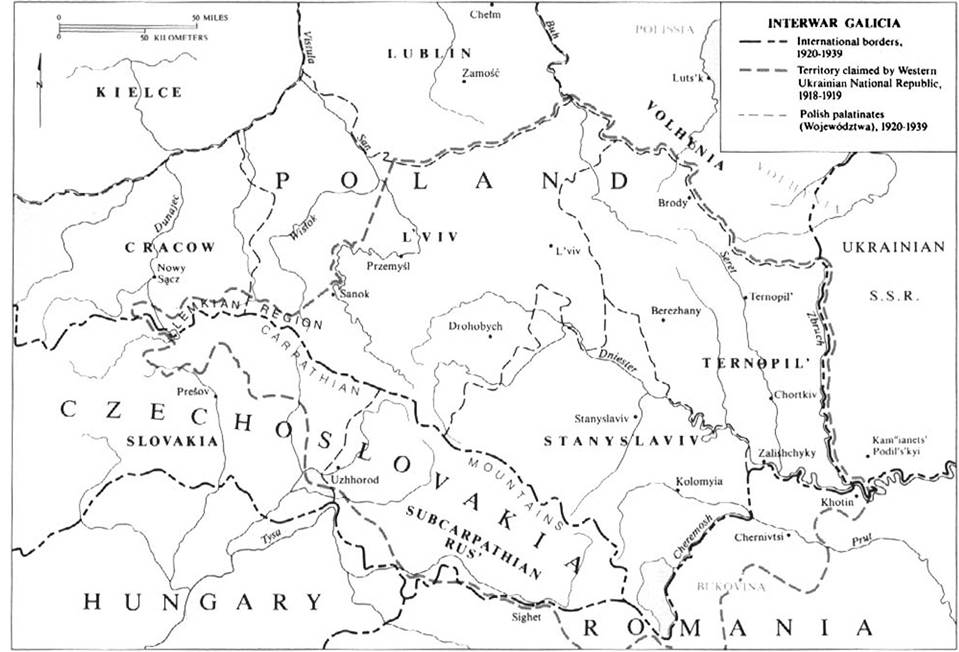
Ukrainian military and political preparations for the imminent collapse of the Habsburg state had already begun with the establishment in L’viv of a Central Military Committee at the end of September and a Ukrainian National Council (Rada) headed by parliamentarian levhen Petrushevych on October 18. Prepared militarily and politically, the Galician Ukrainians took the initiative on November 1 by seizing the Austrian government buildings in L’viv and by establishing a Western Ukrainian People’s Republic (Zakhidno-Ukrains’ka Narodna Respublika).The next two decades in the history of Ukrainian Galicia-1919 to 1939-can be divided into three phases. The first lasted from November 1918 to July 1919, when the Ukrainians struggled to establish an operative government and to fight off a Polish invasion. The second lasted from July 1919 to March 1923, a period when Poland’s control of the area was made secure and was eventually recognized by the Western Powers. The third lasted from 1923 to 1939, when Poland tried to integrate the region and its inhabitants into the administrative and social structure of the Polish state.
The first period was marked primarily by military campaigns between Polish and Ukrainian forces. By November 21-22, 1918, the Poles had driven the Ukrainians out of L’viv. The Ukrainian government moved first to Ternopil’ and then at the end of December to Stanyslaviv. Despite a rapidly changing military situation, the Ukrainians managed to establish a government administration and to set up diplomatic representation abroad. The Galicians made known their intention to unite with the Ukrainian National Republic in the Dnieper Ukraine, and did so by a solemn act in Kiev on January 22, 1919.
Despite this act of union, the Western Ukrainian People’s Republic maintained its own administration and a well-equipped Ukrainian Galician Army. They were no match, however, for the Polish army of General Jozef Haller (1873-1960). Sent from France in April 1919 (ostensibly to fight the Russian Bolsheviks), Haller entered Galicia and by July 1919 drove the Ukrainian army and government across the Zbruch River and into lands of the former Russian Empire.The second historical phase, lasting until 1923, was marked by the establishment of Polish control over all Galicia. The Poles considered all of former Austrian Galicia to be part of their age-long Polish patrimony and were intolerant of any views to the contrary. Thus, despite Poland’s acceptance of the provision on minorities in the treaty signed at Versailles on June 28, 1919, the new Polish administration in Galicia instituted a policy of retaliation against Ukrainians who had fought against them. This resulted in the arrest and deportation of several thousand Ukrainians and in restrictions placed on Ukrainian political, cultural, and educational activity. The Ukrainian reaction took the form of strikes, election boycotts, patriotic demonstrations, and acts of sabotage carried out by the newly founded Ukrainian Military Organization (UVO) headed by Colonel levhen Ko- novalets’ (1891-1938). Also, some Ukrainians in the eastern extreme of Galicia (around Ternopil’) lent their support to the short-lived Galician Soviet Republic set up under the protection of Bolshevik armies between July and September 1920.
Forced out of its homeland, the Ukrainian Galician Army first fought alongside the forces of the Ukrainian National Republic and thereby became embroiled in the Ukrainian struggle for independence and the civil war that was raging on lands of the former Russian Empire. Acting without the consent of the Western Ukrainian government, the Ukrainian Galician Army joined in November 1919 the antiBolshevik White Russian Army of General Anton Denikin (1872-1947), only later to switch sides and become the Red Ukrainian Galician Army (January 1920), a unit that operated with Bolshevik forces until its final dissolution in April 1920.
For its part, the Western Ukrainian government set up an administration in exile, first in Kamianets’-Podil’s’kyi (July-November 1919), then in Vienna (to March 1923), where under the leadership of levhen Petrushevych it tried to convince the Entente Powers of the need to guarantee the existence of an independent and neutral Galician-Ukrainian state in the face of Polish aggression. In the end, the Council of Ambassadors of the Associated and Allied Powers accepted (on March 14, 1923) the incorporation of eastern Galicia into Poland.
With no practical access to outside aid, Galician Ukrainians were faced with the prospect of being ruled directly by the Poles; moreover, they had no recourse to higher authority, such as was possible with the central government in Vienna during the prewar Habsburg days. Basically, the Ukrainian leadership and the vast majority of the population considered the Poles as representing a regime of occupation. None of the plans for autonomy that were proposed in either Polish or Entente diplomatic circles between 1919 and 1923 were ever put into effect, and the new regime in Warsaw attempted to make all of Galicia an integral part of Poland. By 1920, the former Austrian crownland of Galicia (with its local diet and educational administration) was abolished and divided into four Polish provinces (wojewodztwa): Cracow, L’viv, Stanyslaviv, andTernopil’. The last three of these provinces, comprising the core area of pre-1772 historic Galicia and inhabited predominantly by Ukrainians, were renamed Eastern Little Poland (Matopolska Wschodnia). Not only were Ukrainians denied autonomous status in Eastern Little Poland, they were also deprived of the achievements in political, cultural, and educational affairs made previously under the Austrians, even to the degree of replacing the name Ukrainian with the Polish term Ruthenian (Rusini, rusiriski, ruski) in official matters.
The Ukrainian reaction ranged from participation in the political process (although election or economic boycotts were frequent), to an outright rejection of Polish rule resulting in sabotage, so that by the 1930s a virtual state of war existed between the Polish authorities and large segments of the Ukrainian population.
After the Entente decision of 1923, when it became clear that Poland was to rule eastern Galicia, these two basic approaches to the new situation prevailed. Beginning in 1925, the largest political parties united into the Ukrainian National Democratic Union (Ukrains’ke Natsional’ne Demokratychne Ob”iednannia- UNDO), which, carrying on the tradition of the prewar Ukrainian National Democratic party, followed the model of organic work adopted under Austrian rule and attempted to improve the status of the Ukrainian population through rational political, social, and economic action. This group included both older politicians (Kost’ Levyts’kyi, Dmytro Levyts’kyi, Stepan Baran) and younger leaders (Vasyl’ Mudryi, Liubomyr Makarushka, Ostap Luts’kyi). There were also several other Galician parties that participated in interwar Polish political life. Among them were the old prewar Ukrainian radical, later Ukrainian SocialistRadical party and the Ukrainian Social Democratic party, as well the Ukrainian Catholic National party, several Russophile parties, and finally the Communist party of the Western Ukraine.The second approach, that of revolutionary activity and military action, was represented by the Ukrainian Military Organization (UVO), which by 1929 provided the initiative for the formation of the Organization of Ukrainian Nationalists (OUN). Led by Colonel Konovalets’ and sharing many of the ideological tenets of
the integral nationalism developed by Dmytro Dontsov (1883-1973), the OUN demanded strict discipline from its members and advocated a Ukrainian national ideal that would embrace all aspects of Galician society. The isolated acts of terror, assassinations, bombings, and sabotage directed by the UVO during the 1920s against Polish authority prompted acts of government retaliation that reached their most intense pitch during the so-called pacification campaign, carried out by the Polish army and gendarmerie between September 16 and November 30, 1930. Pacification took the form of beatings and arrests leveled against Ukrainians especially in villages, and the sacking and closing of Ukrainian reading rooms, cultural centers, newspaper offices, and cooperatives.
As a result of the pacification campaign, Polish and Ukrainian societies became totally polarized, so that the more moderate tactics of the UNDO were rapidly superseded by an increase in the number of violent acts carried out by the OUN. There still were attempts at Polish-Ukrainian political compromise during the mid-1930s (the so-called period of “normalization”), but this resulted in no real change in the situation. By 1938, both Ukrainian and Polish societies were wracked by anxiety over the imminent outbreak of armed conflict in Europe. On Steptember 1, 1939, that conflict did come and within a few weeks Polish control of Ukrainian Galicia came to an end.
More on the topic Background:
- Background Context
- The Iconoclastic Controversy
- KARAITES
- Introduction: Repurposing an Extant Constitution
- Conclusions
- NIGERIA: PLURALISM AND THE POLITICS OF ISLAMIZATION
- Conclusion
- In speaking of “African constitutionalism” throughout this book, I am neither implying that there is a specific type of constitutionalism that is peculiarly African, nor suggesting that the experience or feature I am discussing is true or applicable for the whole continent.
- Introduction
- EAST AFRICA