The West Ukrainian National. Republic
From the very beginning of World War I in August 1914, the western Ukrainian lands, in particular Galicia and Bukovina, were in the center of military activity along the eastern front.
As a result, Galician and Bukovinian political life was restricted largely to the activity of its leaders, who spent most of the war years in the imperial Habsburg capital of Vienna. When the Austrian parliament was reconvened in May 1917, the Ukrainian Parliamentary Representation led by luliian Romanchuk refused flatly any future political status that would place the Ukrainians of Galicia in the same province with the Poles. Hence, the old call for the division of Galicia was reiterated once again, although now it was the minimal demand of the Ukrainian leaders. The Austrian response was the same as before - procrastination. The Habsburg government continued to argue that no internal structural changes to the empire could be made until the end of the war. In February 1918, at the negotiations which led to the Treaty of Brest-Litovsk, the Austrian government did promise that a law outlining the division of Galicia would be drawn up by July of that year. Nothing came of the promise, however. Nevertheless, many Galician Ukrainians continued to hope that their political needs could be met within the context of the Habsburg Empire.Austria’s Ukrainians prepare for their postwar future
By the fall of 1918, when it became obvious that the Central Powers had lost the war, certain Galician and Bukovinian Ukrainians began to prepare for the inevitable change in the status of the Austro-Hungarian Empire. By late 1918, the international situation had altered radically. The Allied Powers had already adopted as their war aim the so-called Fourteen-Point Peace Program issued in January 1918 by the United States president Woodrow Wilson, with its proclamation that a future peace should be governed by the principle of national self-determination.
One of Wilson’s Fourteen Points proposed independence for a restored Poland. Another called for autonomy for all the peoples of Austria-Hungary, although many in the empire understood “autonomy” to mean national self-determination or independence. The Ukrainians, like other Habsburg peoples, took the Allies’548 World War I and the Struggle for Independence proclamations seriously. The first to respond to the new political environment were Ukrainian officers in the Austro-Hungarian Army, who in September 1918 organized in L’viv the Central Military Committee to coordinate plans with the Ukrainian Sich Riflemen (then stationed in Bukovina) for the eventual seizure of power.
Realizing that the old order was doomed, on 16 October 1918 Emperor Charles (reigned 1916-1918) issued a manifesto proposing that the Austro-Hungarian Empire be transformed into a federal state and calling upon the nationalities to organize themselves for that transformation. Once again, Vienna was responding to a pressing political crisis with a solution that was too little too late. Federalism was hardly an acceptable proposal for national movements that already had embarked on separate paths toward independence and were acting as if the empire already had ceased to exist. The Ukrainians, however, ever hopeful of a Habsburg solution, responded.
A week before the 16 October manifesto, Galicia’s best-known Ukrainian leaders - levhen Petrushevych, luliian Romanchuk, and Metropolitan Andrei Sheptyts’kyi (back home after his release from detention in a Russian monastery) - had met to make plans to convoke a Ukrainian constituent assembly. The emperor’s manifesto now seemed to confirm the legality of such an assembly. With the cooperation of other political and religious leaders from Galicia and Bukovina, the Ukrainian National Council (Ukrains’ka Narodna Rada) was constituted in L’viv on 18 October. The new council chose Ievhen Petrushevych as its president and, invoking the principle of national self-determination, proclaimed the existence of a state on all Ukrainian lands within Austria-Hungary.
Transcarpathia was also included in the proposed Ukrainian state, even though no representatives from that region were present at the L’viv national council. Despite the proclamation of Ukrainian statehood, there was no mention of secession from Austria-Hungary. This meant that the Ukrainians left open the possibility of belonging to a federation within the Habsburg Empire and, therefore, acted within the “legal” guidelines of the 16 October imperial manifesto.West Ukrainian independence and war
The Ukrainian National Council did, however, claim the right to rule over the territories it considered its own, and on 1 November 1918 it demanded that the viceroy in Galicia (Karl Huyn) surrender his authority. Faced with pressure by Ukrainian units of the imperial army, the last Habsburg viceroy turned over his governmental offices to the Ukrainians. That same day, the National Council proclaimed that the state, which had first been called into being on 19 October, was henceforth an independent country. Thus, 1 November 1918 became the “second” Ukrainian independence day. A week later, the new state was given the name West Ukrainian National Republic (Zakhidn’o-Ukrains’ka Narodna Respublika).
Blossoming out of a dying empire, western Ukrainian independence seems to have been achieved with ease. But appearances are frequently deceiving. The
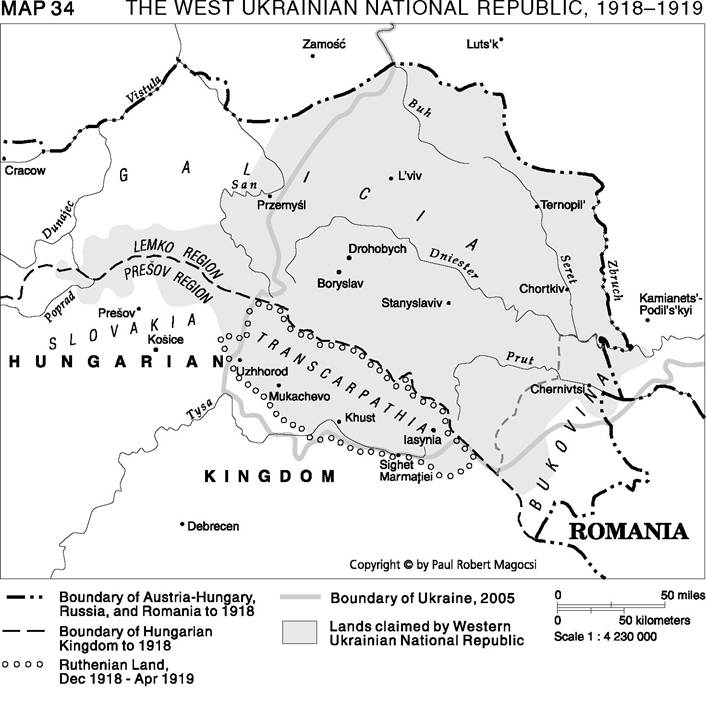
Poles were not about to let the Ukrainians take over what they considered their own national patrimony, Galicia - both the heavily Ukrainian-populated eastern half and the Polish western half. Several Polish organizations in L’viv armed themselves, and on 1 November, the same day the Austrians surrendered the reins of government, the Ukrainians found themselves engaged in a war with the local Poles. Initially, the Ukrainians held L’viv and other cities in eastern Galicia, but by 21 November they had been driven from their new capital, and they were forced to move their government, first to Ternopil’ and in early January to Stanyslaviv.
In the midst of war with the Poles, the Ukrainian National Council passed a law on 13 November 1918 that formally created an independent West Ukrainian National Republic with a regular force called the Ukrainian Galician Army. The new state was to include the Ukrainian-inhabited lands of Galicia (primarily east of the San River), of Bukovina, and of Transcarpathia (parts of seven counties in northeastern Hungary). It was only in eastern Galicia, however, that the Ukrainians were able, at least for a while, to set up an administration, because Bukovina
had already been occupied by Romanian troops on 11 November, and with the exception of the short-term presence of a few troops Transcarpathia never came under West Ukrainian control.
Until the convocation of a parliament (Soim), to which elections were planned for June 1919, the supreme authority of the West Ukrainian National Republic rested in the National Council headed by Petrushevych. To administer the lands under its control, the National Council set up the Provisional State Secretariat on 9 November 1918, which was headed first by Kost’ Levyts’kyi and then, beginning with the new year, by Sydir Holubovych. The proposed parliament, which never came into existence, was to have 226 members, 66 of whom were to be from national minorities (33 Poles, 27 Jews, and 6 Germans). Also, as early as 10 November 1918 the Galicians made plans to unite with their fellow Ukrainians in Dnieper Ukraine. These plans were formalized on 3 January 1919, when the National Council, meeting by then in Stanyslaviv, passed a law approving the unification of the West Ukrainian National Republic with the Ukrainian National Republic in Dnieper Ukraine. The Galicians sent a delegation to Kiev, where, on 22 January 1919 (the “third” Ukrainian independence day), a great national manifestation before the Cathedral of St Sophia proclaimed, “From this day the two parts of a single Ukraine - the West Ukrainian National Republic (Galicia, Bukovina, and Hungarian Rus’ [Transcarpathia]) - that have been separated from each other are merging together.”1 In theory, the West Ukrainian National Republic became the Western Province (Zakhidnia Oblast’) of the Ukrainian National Republic.
In fact, the western Ukrainians led a rather separate political, military, and diplomatic existence.By the spring of 1919, that existence was becoming more and more threatened. The Ukrainian Galician Army, at the time under Brigadier-General Mykhai- lo Omelianovych-Pavlenko, had proved itself an effective fighting force that by February 1919 managed to push back the Poles and surround L’viv. Their efforts, however, were soon to be undermined by the military and diplomatic superiority of their enemy.
In the world of international politics, Ukraine had a serious problem. Both Dnieper Ukraine and eastern Galicia were relatively unknown in the West. Poland, in contrast, had strong support among the Allied Powers, which by early 1918 had made Poland’s independence one of its war aims. As in the old Austrian Galician days, in crucial moments, the Habsburg government had favored Polish over Ukrainian interests, so in 1919 the victorious Allies allowed Polish interests to prevail over those of the relatively unknown and therefore unimportant Galician Ukrainians.
Not that the Galician Ukrainians were completely unknown. The leading Allied Powers, already meeting at the Paris Peace Conference in early 1919, all had “Eastern experts.” Some were not only aware of but even sympathetic to Ukrainian demands. The Ukrainians, for their part, sent delegations which prepared memoranda in Paris, while immigrants in the United States and Canada lobbied their respective governments to recognize the cause of Ukrainian independence, whether in Galicia or in Dnieper Ukraine. After all, President Wilson’s inspiring principle of self-determination for nations could certainly be applied to the Ukrainians in eastern Galicia.
But whereas the Ukrainians (who had no diplomatic status) were limited to issuing memoranda and proclamations, the Poles had official representation at the Paris Peace Conference and could make their case known directly, especially through their popular (in western circles) spokesperson, the concert pianist and at the time Poland’s premier and minister of foreign affairs, Ignacy Jan Paderewski.
Since the beginning of 1919, Paderewski had been suggesting in a rather demagogic fashion that any ideas of Ukrainian statehood only reflected the bankrupt political aims of the German and Austrian enemy, who had hoped to divide and rule the western regions of the former Russian Empire. Those areas, he argued, should rightfully become the eastern regions of a restored Polish state. As for the Ukrainians, according to Paderewski (himself a native of Right Bank Ukraine), they were all Bolsheviks, an epithet implying they were a great danger to the Allies and to European stability in general. Not all the peacemakers in Paris were taken in by Paderewski’s flowery rhetoric, however, and on several occasions during the spring of 1919 there were attempts to establish an armistice between Ukrainian and Polish armed forces, which would have left at least some of eastern Galicia in Ukrainian hands. But such intervention was of no avail.Finally, in April 1919 the well-trained and well-equipped Polish Army, consisting of 100,000 men under General Jozef Haller, arrived in Poland. Haller’s army had experience fighting alongside the Allies in France, and among its ranks as advisors were several French officers who came to serve in Poland. The Allied Powers expected the Polish Army from France to be deployed against any westward advance by Soviet Russia. Stopping the Bolsheviks was certainly something the Allies would welcome. Instead, the Polish government sent Haller and his troops to Galicia together with French military advisors, among whom was a young captain named Charles de Gaulle. Despite stiff resistance on the part of the Ukrainian Galician Army (especially during the Chortkiv offensive in June), by 16-18 July 1919 the Poles had succeeded in driving the Ukrainians and their government out of Galicia.
And as for Wilson’s principle of the right of nations to self-determination? It was sacrificed in the face of what at the time was considered an even greater danger - Bolshevism. That danger was outlined in a cable, dated 25 June, from the Allied Powers in Paris to the government of Poland in Warsaw:
With a view to protecting the persons and property of the peaceful population of eastern Galicia against the dangers to which they are exposed by the Bolshevik bands [sic], the Supreme Council of the Allied and Associated Powers have decided to authorize the forces of the Polish Republic to pursue their operations as far as the river Zbruch.... This authorization does not in any way affect the decisions to be taken later by the Supreme Council for the settlement and political status of Galicia.2
Despite the cable’s qualifications, Poland was in effect given an imprimatur from the victorious Allies to occupy all of Galicia.
The West Ukrainian government-in-exile
In the midst of the deteriorating military situation, the National Council of the West Ukrainian National Republic invested its president, levhen Petrushevych, with the title of dictator. This gave him full authority to determine the political and military policies of the West Ukrainian National Republic. After the defeat at the hands of the Poles, Petrushevych left Galicia, going eastward across the Zbruch River to nearby Kam’ianets’-Podil’s’kyi, where the Ukrainian National Republic under Petliura’s leadership was itself trying desperately to survive a Bolshevik offensive that was rapidly bringing under its control most of Dnieper Ukraine.
In theory, according to the January 1919 declaration of Ukrainian unity, Petrushevych and his government were a part of Petliura’s Ukrainian National Republic. In Kam’ianets’-Podil’s’kyi, the Galician and Dnieper Ukrainians had a chance to test their proclaimed unity. Their failure to cooperate could not have been greater. Chapter 39 outlined how, given the situation, Petliura favored an alliance with Poland as a means of repelling the Bolshevik and White Russian advances from the east. Fresh from a brutal military defeat, Petrushevych would have nothing to do with the Poles, and some of his supporters (especially the military) favored an alliance with one of Petliura’s archenemies - the White Russian general, Anton Denikin.
Besides these tactical differences, there were other reasons why the Galician Ukrainians were reluctant to cooperate with the Dnieper Ukrainians. Petrushe- vych and his entourage felt that Galicia was the most developed region of Ukraine in terms of national culture and, most important at the moment, in terms of effective military strength. The old Piedmont theory was still uppermost in their minds. In other words, Galicia should first be made into a strong, independent Ukrainian state, and then other Ukrainian lands would follow its lead. Finally, the Galicians continued to have great faith in the Allies and in the Paris Peace Conference, from which they expected a confirmation of their national rights. Little did they realize that the political maneuvering which had brought some successes in pre-1914 Austria meant nothing in 1918-1919, when only military strength and diplomatic leverage with the Allied Powers carried any weight. On both counts, the Galicians, and, for that matter, all Ukrainians, were sorely wanting.
These are some of the reasons for the complete failure of cooperation between Galicia’s West Ukrainian National Republic and the Ukrainian National Republic. By the end of 1919, both republics were in disarray. Petliura fled to Poland to prepare, with Polish help, for one last confrontation with the Bolsheviks; Petrushevych fled to Vienna to carry on what proved to be a vain diplomatic struggle in western and central European capitals on behalf of his Polish-occupied homeland.
Bukovina and Transcarpathia
Although since its establishment in late 1918, the West Ukrainian National Republic had claimed sovereignty not only over eastern Galicia but also over Bukovina and Transcarpathia, these two territories followed decidedly other paths in the immediate postwar era. Bukovina’s Ukrainian political leadership had worked together closely with the Galicians in Vienna during the war years and then participated with them in the Ukrainian National Council in L’viv, which proclaimed independence (1 November) for all Ukrainian lands within the disintegrating Austro-Hungarian Empire. Parallel with developments in Galicia, the Ukrainian Committee was set up in Bukovina’s administrative center of Chernivtsi on 25 October 1918, under the leadership of a Ukrainian deputy to the Austrian imperial parliament, Omelian Popovych. Two days later, Romanian deputies from the Austrian parliament and the Bukovinian diet established their own Romanian National Council. It was also at this time that Austrian army units of Ukrainian Sich Riflemen stationed in Bukovina and commanded by Archduke Wilhelm Habsburg (Vasyl’ Vyshsyvanyi) were called by the Ukrainian National Council to L’viv on 1 November, leaving Bukovina’s Ukrainians without any serious defense force.
Members of Bukovina’s Ukrainian Committee headed by Popovych tried to negotiate with their Romanian counterparts but only succeeded in reaching an agreement with the parliamentary deputy, Aurel Onciul. As it turned out, he had only limited influence among Bukovina’s Romanians. On 6 November, Austrian officials surrendered their authority to Popovych and Onciul, who were respectively acting in the name of the Ukrainian Committee (now National Council) and the Romanian National Council, each of which was to administer that part of Bukovina where its nationality was in the majority. These developments, however, proved to have no real impact over subsequent events, because most of Bukovina’s Romanian leaders had other plans.
The Romanian National Council was actually led by lancu Flondor, and he opposed any ideas of power-sharing with Ukrainians. This is because the council’s leaders expected that all of Bukovina would soon be “reunited” with Romania. Therefore, when the Austrians surrendered on 6 November 1918, Flondor’s response was to call on Romania to send troops. Five days later, a Romanian force entered Chernivtsi. The Ukrainians who had no serious armed force to back them, did not resist and all of Bukovina was annexed to Romania.
In Transcarpathia, the situation was much more complex. Following the example of other groups within the disintegrating Habsburg Empire, the Transcarpathian Rusyns/Ukrainians set up several national councils in late 1918 to discuss the fate of their homeland. The Hungarians, too, were not idle. On 31 October politicians led by Count Mihaly Karolyi formed a revolutionary government in Budapest, which two weeks later (12 November) was transformed into the independent republic of Hungary. The new republic laid claim to all territories under the former jurisdiction of the Hungarian Kingdom, including Transcarpathia.
Hungary’s national minorities were displeased with this turn of events and made plans to dissociate themselves from their former rulers. Among the several national councils that met in Transcarpathia in November and December 1918, three political orientations evolved. One council (Uzhhorod) favored remaining with Hungary; the other two councils looked elsewhere - the Presov council favored joining the new state of Czechoslovakia, the Sighet council an independent Ukraine. In an attempt to head off moves in either of the latter two directions, the new Hungarian Republic passed a law on 21 December 1918 creating an autonomous province called the Ruthenian Land (Rus’ka Kraina). As an autonomous part of Hungary, the Ruthenian Land was endowed in February 1919 with its own governmental minister (Oreszt Szabo) and local governor (Agoston Stefan), and in March it held elections to a Ruthenian diet based in the town of Mukachevo.
While the Hungarian Republic was trying to assert its control over Transcarpathia, two local leaders from that region traveled to Galicia, where on 3 January 1919 they asked for help from the West Ukrainian National Republic. Then, on 21 January more than 1,200 Rusyns/Ukrainians met in the small town of Khust to proclaim their desire to join a united Ukraine (Soborna Ukraina). One part of Transcarpathia, the far-eastern Hutsul region, even declared an independent Hutsul Republic in early January and accepted aid from the West Ukrainian National Republic. The Hutsul Republic managed to survive for the next six months until its government was driven out by Romanian troops.
Neither the Hungarian nor the Ukrainian orientation, however, was to prevail in Transcarpathia. An unexpected source was to make a crucial difference in the political future of the region. This source was the United States, in particular immigrants from Transcarpathia. Known at the time as Uhro-Rusyns (i.e., Rusyns from Hungary), in July 1918 the group chose a young Pittsburgh lawyer, Gregory Zhatkovych, to represent them in finding a solution for the fate of their homeland. Zhatkovych first favored the idea of an independent Rusyn state (Rusinia), but after meeting with President Woodrow Wilson and the Czech leader Tomas G. Masaryk (who was in the United States working on behalf of a future independent Czechoslovakia), the Rusyn-American leader came to favor the Czechoslovak solution. He arranged a plebiscite among immigrants in the United States, who in December voted overwhelmingly (66 percent) to join the Czechoslovak republic.
Armed with the Rusyn-American decision, the new government in Prague, by then headed by President Masaryk, dispatched troops in late December 1918 to occupy Transcarpathia. By January, the Czechoslovak forces had gotten only as far as Uzhhorod (on the present-day Ukrainian border with Slovakia), because the rest of the region was being administered by the pro-Hungarian government of the autonomous Ruthenian Land. Then, in March, when Hungary became a Soviet state (under Bela Kun), the autonomous region was taken over by a Bolshevik regime. This Communist threat to the Danubian Basin prompted war between a Hungarian Soviet army on the one hand and Czechoslovak and Romanian forces on the other. The Hungarian Communists were eventually defeated, and by the summer of 1919 Czechoslovak and Romanian forces were occupying all of Transcarpathia. On 8 May 1919, Uzhhorod became the site of the convocation of the Central Ruthenian National Council, which accepted the decision of the Rusyn immigrants in the United States and declared its voluntary union with Czechoslovakia, although with the understanding that all Rusyn-inhabited territories south of the Carpathians would be granted political as well as cultural autonomy.
By the summer of 1919, each of the three Ukrainian territories in the former Austro-Hungarian Empire had found itself in a new country. Eastern Galicia was held by Poland, northern Bukovina by Romania, and Transcarpathia by Czechoslovakia. Only in the case of Transcarpathia was the new political situation supported by the local population. None of these territorial arrangements, however, was internationally recognized as yet. That recognition had to await the decisions of the Peace Conference in Paris, where leaders of the victorious Allied Powers had been sitting since early 1919 in an effort to redraw the map of Europe.
With the de facto incorporation of western Ukrainian lands into Poland, Romania, and Czechoslovakia by mid-1919, and with the establishment of Bolshevik rule in Dnieper Ukraine in early 1920, the efforts to create a sovereign state that incorporated all territory inhabited by ethnic Ukrainians and that would be independent of the surrounding powers effectively came to an end. Faced with this result, most non-Marxist writers have subsequently considered the Ukrainian revolutionary era a failure. Their reasoning? Ukrainians were unable to achieve the supposedly ultimate goal of national movements - independent statehood. Accordingly, the record of those revolutionary years, 1917-1920, has been searched in detail for what went wrong.
Many reasons are given for the failure of the revolution: (1) political inexperience that resulted in destructive in-fighting and a lack of firm leadership; (2) the total breakdown of cooperation between Galician and Dnieper Ukrainians; (3) submission to foreign powers, especially Germany; (4) invasions by the White Russians and the Bolsheviks; (5) the refusal of any of the Allied Powers to aid the Ukrainian cause; (6) the failure to resolve the land question and the reluctance of the peasant masses to support their “own Ukrainian” governments, and their tendency to join destructive marauding bands instead; and (7) the opposition of the many minorities on Ukrainian territory to the idea of Ukrainian independence. Finally, the most important reason given for the perceived failure is that Ukrainians as a people were not sufficiently conscious of their national identity in 1917-1920 to want to struggle and sacrifice themselves for Ukrainian statehood.
Looked at in another way, however, the Ukrainian revolutionary era was a success. One might well wonder why so many ethnic Ukrainians did in fact struggle and sacrifice their lives for the idea of independence. This was particularly remarkable in the formerly Russian-ruled Dnieper Ukraine, where the Ukrainian national movement was virtually non-existent or, at best, limited to a handful of individuals. Then suddenly, after 1917, energy and sacrifice on behalf of the national cause burst forth, in the political, social, cultural, and military spheres. And even if these efforts did not bring about the hoped-for independence, the revolutionary experience itself instilled in ethnic Ukrainians a firm sense of national purpose - achieved, moreover, not after several generations of peacetime cultural work, but in less than half a decade. From such a perspective, the Ukrainian revolution was a remarkable success.
On the other hand, this period was never viewed as a failure by apologists for the Ukrainian Soviet Socialist Republic. After all, it was the revolutionary era that gave birth to the Soviet Ukrainian government, which, after three attempts, finally established its authority over a large portion of Ukrainian-inhabited territory. In Soviet Ukrainian terms, therefore, independence was indeed achieved for most of Dnieper Ukraine between 1917 and 1920. All that remained was for subsequent generations to bring that achievement to all Ukrainian lands. The next six chapters will explore the impact of Soviet and non-Soviet rule on all Ukrainian- inhabited territories, where the differing heritages and goals of the revolutionary era would be kept alive.