The Postwar Treaties and the Reconjiguration. of Ukrainian Lands
The autumn of 1918 witnessed the end of World War I, as one by one the Central Powers - Bulgaria (29 September), Ottoman Turkey (30 October), Austria-Hungary (3 November), and finally Germany (11 November) - accepted armistices to end hostilities.
For their part, the victors, known officially as the Allied and Associated Powers - Great Britain, France, Italy, the United States, and Japan - agreed to meet in Paris in order to draw up formal peace treaties. In January 1919, the heads of state of the four Allied Powers concerned with the European theater of war - Prime Minister Lloyd George of Great Britain, Premier Georges Clemenceau of France, President Woodrow Wilson of the United States, and Premier Vittorio Emanuele Orlando of Italy - arrived in Paris in order to participate in the work of the peace conference.Although World War I had ended by late 1918 and peace negotiations were under way by the beginning of 1919, hostilities had not yet ceased in eastern Europe. On Ukrainian lands, they were to last at least another two years, until late
1920. Although some of the decisions reached by the peacemakers in Paris had a direct impact on Ukrainian territories, especially on those within the former Austro-Hungarian Empire, the diplomatic proposals that came out of Paris generally followed military faits accomplis over which the peacemakers had little or no control. For instance, because the Allied Powers claimed supreme authority over lands formerly part of the Austro-Hungarian Empire, they felt obliged to intervene in the Polish-Ukrainian war that raged in eastern Galicia between November 1918 and July 1919. Their efforts to impose an armistice, however, were ignored by both the Poles and the Ukrainians. Thus, the June 1919 decision of the Allied Powers to allow Polish troops to occupy Galicia as far as its eastern boundary along the Zbruch River was little more than recognition of what in fact had already taken place.
In other words, neither the goodwill of some Allied leaders in Paris, who were legitimately concerned and even appalled by the Polish seizure of eastern Galicia, nor the protestations of the diplomatic mission of the West Ukrainian National Republic directed at the peacemakers really had any impact on events in Ukraine. When its work was finally over, the Paris Peace Conference merely confirmed on paper what had already been decided in the field - namely, the division of western Ukrainian (former Austro-Hungarian) territories among the new states of Poland and Czechoslovakia and the expanded Kingdom of Romania.MAP 35
UKRAINIAN LANDS, 1923
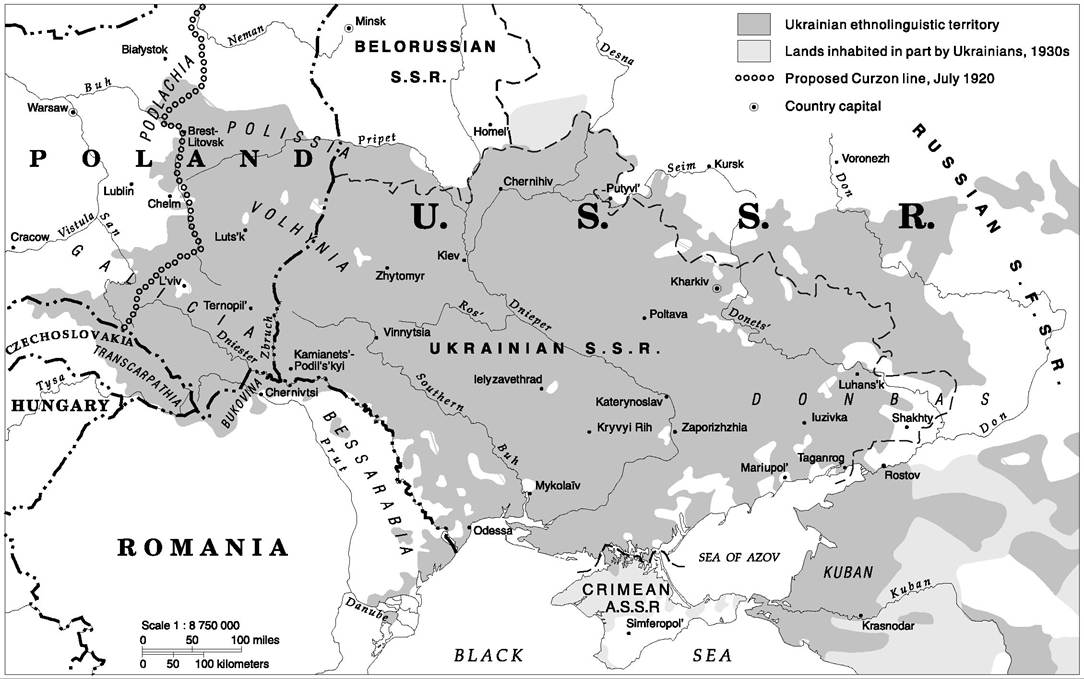
Copyright © by Paul Robert Magocsi
The Paris Peace Conference
The instruments through which the new political realities were recognized consisted of a series of peace treaties, signed at various palaces just outside the French capital, between the victorious Allies and Associated Powers and the defeated Central Powers, is known as the Paris Peace Conference. The first and ultimately the most controversial of these treaties was signed with Germany on 28 June 1919 at Louis XIV’s former palace of Versailles. The Versailles treaty had no direct bearing on Ukrainian lands except that it noted - but postponed - a decision on the eastern frontiers of Poland, which would be “subsequently determined by the principal Allied and Associated Powers.”1 Poland was obliged, however, to accept at Versailles a treaty which guaranteed full rights and numerous religious, educational, linguistic, and other privileges to minorities living within its borders.
The next treaty was signed with Austria on 10 September 1919 at the palace of St Germain-en-Laye. The St Germain treaty did have a direct bearing on northern Bukovina and Transcarpathia. All of Bukovina, including Chernivtsi and the northern Ukrainian-inhabited portion of the old Austrian province, was recognized as part of the Kingdom of Romania.
Similarly, all the “Ruthene territory south of the Carpathians” was recognized as part of the new republic of Czechoslovakia, and it was to be endowed with the “fullest degree of self-government compatible with the unity of the Czecho-Slovak state.”2 The St Germain decision on Transcarpathia was later reconfirmed in a separate treaty signed with Hungary at Trianon on 4 June 1920.As for eastern Galicia, the Treaty of St Germain did not award this territory to Poland, as is frequently but incorrectly assumed. Rather, article 91 of the treaty stated that with regard to Galicia as a whole, Poland was merely its military occupant and that the region’s actual sovereign remained the Allied and Associated Powers. Because of Galicia’s unsettled international status, which was related to the whole question of Poland’s eastern boundary, the Paris mission of the West Ukrainian National Republic (headed by Vasy Paneiko and, later, Stepan Vytvyts’kyi) lobbied hard for a favorable resolution regarding the eastern half of the former Habsburg province. The Peace Conference’s Commission for Polish Affairs on the Council of Ambassadors even submitted a proposal, in September 1919, for an autonomous province of eastern Galicia, but three months later this idea was rejected by the Poles.
In 1921 and 1922, the Galician question was discussed at the newly established League of Nations in Geneva and at several international conferences in western Europe (Genoa, Prague, London). By 1923, the Council of Ambassadors, overwhelmed with more pressing international problems in western Europe, had grown tired of the Galician question. In March of that year, it simply relinquished its theoretical authority over the region and awarded to Poland all of Galicia from Cracow to the Zbruch River. Only then did it become clear that the almost unwavering faith placed in the Allied Powers by the leaders of the West Ukrainian National Republic had been entirely unwarranted. After 1923, Galicia was internationally recognized as Polish territory.
Soviet Ukraine and the Soviet Union
If the authority of the peacemakers in Paris was at best tenuous in western Ukrainian lands, in Dnieper Ukraine it was non-existent. One example was a proposal of the Allies (signed by then British foreign minister, Lord Curzon) submitted in July 1920 at the height of the Polish-Soviet war as an armistice line and potential boundary between the warring powers. Although of great importance later, the Curzon Line, as it came to be known, was at the time of its formulation completely ignored. Instead, decisions on boundaries were to be determined by the outcome of the war between Poland and Soviet Russia (in which the latter’s ally, Soviet Ukraine, was also involved). As a result of an armistice reached in October 1920 and a final treaty signed at Riga on 18 March 1921, Poland agreed to recognize both Soviet Russia and Soviet Ukraine; however, the final Polish-Ukrainian boundary was much farther east of the Curzon Line, leaving Ukrainian-inhabited eastern Galicia, southern Podlachia, western Volhynia, and western Polissia all within Poland.
As for Soviet Ukraine, in theory it was independent and linked with Soviet Russia (officially the Russian Soviet Federated Socialist Republic) only by a treaty of alliance concluded on 28 December 1920. It is significant to note, however, that this treaty of alliance between two ostensibly independent states actually made both the Ukrainian military and the Ukrainian economy (including domestic and foreign trade) subject to decisions made in Moscow by the All-Russian Communist (Bolshevik) party. Initially, this left only foreign affairs, agriculture, justice, and education under Soviet Ukrainian jurisdiction. In spite of its technical status as an independent state, Soviet Ukrainian diplomatic activity ceased almost immediately. Then, in February 1922, the diplomatic prerogatives of Soviet Ukraine were, like those of other “sovereign” Soviet republics, delegated to Soviet Russia.
In essence, Soviet Ukraine and its governmental apparatus, led by the Communist party (Bolshevik) of Ukraine - which owed its own existence to the presence of the Red Army - became completely subordinate to the All-Russian Communist (Bolshevik) party and the Soviet government in Moscow. The relationship of Ukraine and other Soviet republics to Soviet Russia was clarified in the months following the formation of the Union of Soviet Socialist Republics in December 1922. The new Soviet Union was nominally a federal state made up of four Soviet socialist republics: the Russian Soviet Federated Socialist Republic, the Ukrainian S.S.R., the Belorussian S.S.R., and the Transcaucasian S.F.S.R. Subsequently, three new republics were carved out of the Russian S.F.S.R. - the Turkmen S.S.R. (1925), the Uzbek S.S.R. (1925), the Tadzhik S.S.R. (1929) - and the Transcaucasian S.F.S.R. was divided into the three separate republics of Azerbaijan, Armenia, and Georgia. This meant that by 1929 the Soviet Union consisted of nine republics.According to the Soviet Union’s first constitution, promulgated on 31 January 1924, governmental authority was nominally divided between the federal level in Moscow and the constituent republics, including Soviet Ukraine. The authority left to the republics, however, was steadily reduced. The December 1920 treaty of alliance between Soviet Russia and Soviet Ukraine, for instance, had already
Treaty of Union between the Russian Soviet Federated Socialist Republic and the Ukrainian Soviet Socialist Republic
The governments of the Russian Socialist Federated Soviet Republic (S.F.S.R.) and the Ukrainian Socialist Soviet Republic (S.S.R.), proceeding from the declaration on the rights of peoples to self-determination as declared by the Great Proletarian Revolution, and recognizing the independence and sovereignty of each other as well as the need to consolidate their power for purposes of self-defense and of economic reconstruction, have decided to conclude the present workers’ and peasants’ treaty of union for which they have nominated the following representatives:
For the Soviet Russian government - the chairman of the Council of People’s Commissars, Vladimir Il’ich Lenin, and the People’s Commissar for Foreign Affairs, Georgii Vasilevich Chicherin; for the Soviet Ukrainian government - the chairman of the Council of People’s Commissars and the People’s Commissars for Foreign Affairs, Khristiian Georgievich Rakovskii.
The aforementioned representatives, with the powers invested in them, have agreed to the following:
1. The Russian S.F.S.R. and the Ukrainian S.S.R. agree to a military and economic union.
2. Both states consider it necessary to declare that the obligations which they are taking upon themselves in relationship to each other can only serve the general interests of the workers and peasants, inclusive of the present union treaty between the two republics, although the fact that the territory of the Ukrainian S.S.R. previously belonged to the former Russian Empire does not imply any obligations on the part of the Ukrainian S.S.R. toward that former entity, whatever such obligations might be.
3. For the better realization of the goals set out in paragraph 1, both governments declare the formation of the following joint commissariats: (1) defense; (2) national economy; (3) foreign trade; (4) finances; (5) employment; (6) transportation; (7) postal and telegraph services.
4. The unified people’s commissariats of both republics are part of the Council of People’s Commissars of the Russian S.F.S.R. and they have in the Council of People’s Commissars of the Ukrainian S.S.R. their own authorized representatives who have been approved and are responsible to the All-Ukrainian Central Executive Committee and Congress of Soviets.
5. The procedure and form of internal administration for the joint commissariats will be decided upon by mutual agreement between the two governments.
6. The leadership and control of the united commissariats will be determined by the All-Russian Congress of Soviets of Workers,’ Peasants,’ and Soldiers’ Deputies as well as by the All-Russian Central Executive Committee, to which the Ukrainian S.S.R. will send its representatives on the basis of a decision of the All-Russian Congress of Soviets.
7. The present treaty is subject to ratification in compliance with the highest legal authorities of both republics.
The original text is presented for signature on two copies in the Russian and Ukrainian languages in the city of Moscow, 28 December 1920.
source: Radians’ke budivnytstvo na Ukraini v roky hromadians’koi'viiny,i9i9-i920: zbirnyk dokumentiv i materialiv (Kiev 1957), pp. 182-183.
placed military and economic affairs entirely in the hands of Moscow. The 1924 Soviet constitution reduced further Soviet Ukraine’s powers, giving to the central government (1) authority to lay down general principles controlling education, justice, and health; (2) control over the exploitation of natural resources, including the use of surface land; (3) power to annul decisions of the union republics; and (4) authority to handle the foreign affairs of each republic. Thus, by the beginning of 1924, Soviet Ukraine and the other Soviet republics had become little more than regional entities within the Moscow-dominated Union of Soviet Socialist Republics. Still, at least during the first few years of the Soviet Union’s existence Soviet Ukraine managed to maintain a degree of control over its own economic, political, and, especially cultural destiny. It is these aspects of Ukrainian development that will be addressed next.