45 Soviet Ukraine after World War II
Although World War II did not end in Europe until the capitulation of Nazi Germany in May 1945, Soviet armed forces had by October 1944 already taken control of all ethnolinguistic Ukrainian territory, most although not all of which was to be incorporated into Soviet Ukraine.
In contrast to the last years of World War I, when the Russian Empire had collapsed and the victorious Allied Powers did not even recognize Bolshevik Russia, as World War II was coming to a close the Soviet Union was a highly respected ally of the western powers and main participant in the joint struggle to defeat Hitler’s Germany. Moreover, the Soviet leader, Iosif Stalin, together with Great Britain’s Prime Minister Winston Churchill and U. S. President Franklin Delano Roosevelt, was one of the Big Three wartime leaders who were to determine the political landscape of postwar Europe. Stalin’s main concern was not only to extend the Soviet Union’s borders farther westward (for contrast with the interwar years, see Map 36), but also to gain political control over its western neighbors—Poland, Czechoslovakia, Hungary, Romania, and Bulgaria—in order to create a buffer zone against any future expansion on the part of what at that moment was a defeated and militarily occupied Germany.
45.1 The most famous international gathering ever held in what is today Ukraine—Generalissimo Iosif Stalin, President Franklin Roosevelt, Prime Minister Winston Churchill, and their staff at the Yalta Conference in the Crimea, February 1945.
MAP 45 SOVIET UKRAINE, 1945

This was the geopolitical context in which Soviet Ukraine expanded its borders. In fact, the territorial configuration of present-day Ukraine is largely the result of the successful foreign policy implemented by Stalin at the close of World War II.
Crucial to that policy was the new Soviet-Polish border, agreed by Churchill, Roosevelt, and Stalin at their wartime conference held in Crimean resort of Yalta (February 4-11, 1945). The border basically followed the old Curzon Line A, proposed by Great Britain at the close of World War I (see Map 35) and which gave to Soviet Ukraine western Volhynia as far as the Buh River and eastern Galicia almost as far as the San River. Farther south the western powers accepted the inclusion within Soviet Ukraine of northern Bukovina and a small portion of southern Bessarabia taken back from Romania. The rest of Bessarabia formed the restored Moldavian Soviet Socialist Republic. From the Soviet perspective these were territories that had already been “re-united” with Soviet Ukraine in 1939-1940 and only “temporarily lost” as a result of Nazi German invasion.
45.2 Stalinist policy helped to raise Ukraine’s prestige, if only symbolically, on the international front; the delegates of Soviet Ukraine, a full member state of the United Nations, at the first session of the General Assembly in London, 1946.
An entirely new territory was also added to Soviet Ukraine. This was Transcarpathia, or historic Subcarpathian Rus’, which had been part of Czechoslovakia during the interwar years. The Soviet Union, together with its allies, Britain and the United States, agreed in 1943 that Subcarpathian Rus’ should again be part of a postwar restored Czechoslovak state. But Stalin decided in October 1944 that this territory, by then in the hands of the Red Army, should instead become part of the Soviet Union. The Soviets justified their geopolitical decision by arguing that the local East Slavic population was Ukrainian, even though only a portion of the inhabitants believed that to be the case. Consequently, the Soviet Union was simply carrying out another territorial “re-unification,” however long delayed since medieval times and regardless of the fact that Subcarpathian Rus’ was never part of Kievan Rus’.
Backed by the presence of Soviet troops, on November 26, 1944, a peoples’ congress met in the Transcarpathian town of Mukachevo (just east of Uzhhorod) and called for “re-unification with the Soviet Ukrainian motherland.” The Soviets had no real difficulty convincing the postwar Czechoslovak government to cede its far eastern province to Soviet Ukraine, which formally took place by a treaty signed on June 29, 1945. As a result of these “re-acquisitions” and “re-unifications,” Soviet Ukraine increased its territory by one-quarter, adding 64,500 square miles (165,300 square kilometers) with population of eleven million persons.
45.3 Unenthusiastic delegates at the First Congress of People’s Committees in Mukachevo, which called for the “re-unification” of Transcarpathia with Soviet Ukraine, November 1944.
Another aspect of these last months of World War II was the policy of population exchange. In an attempt to make postwar states ethnically homogeneous and therefore to avoid future national minority problems, a series of treaties with neighboring states on population transfers were signed by the Soviet Union. Consequently, between 1945 and 1948, over 810,000 Poles from Volhynia and eastern Galicia went to postwar Poland, in exchange for 418,000 Ukrainians and 100,000 Lemkos resettled in Soviet Ukraine. At the same time, 40,000 Czechs from Volhynia and about 4,000 Czechs and Slovaks from Transcarpathia left for postwar Czechoslovakia in return for 12,000 Rusyns from northeastern Slovakia resettled in Volhynia. Finally, there were the Ostarbeiter (Eastern workers), Soviet prisoners-of-war, and survivors of concentration camps who were in Germany and Austria. Stalin demanded their repatriation, and by mid-1945 about 2 million of these Ukrainian citizens were sent home, in many cases forcibly, by the Allied military authorities stationed in central Europe. Almost all of the Ukrainians who avoided repatriation eventually emigrated to the United States and Canada under the category of displaced persons—DPs.
The last territorial change to affect Soviet Ukraine came somewhat later. In 1954 Soviet Russia, for no apparent reason other than “affirming great fraternal love and trust of the Russian people for Ukraine,” ceded the Crimean A.S.S.R. to Soviet Ukraine. As a result, Soviet Ukraine increased its territory by another 17,600 square miles (44,000 square kilometers) and 268,000 inhabitants. Most were either Russians (71 percent) or Ukrainians (22 percent), since the nearly 200,000 Crimean Tatars who had lived on the peninsula until World War II were deported en masse after the arrival of the Red Army in May 1944. At that time, by order of Stalin, the Crimean Tatars were accused collectively of wartime collaboration with the enemy and as punishment they were banned from Crimea and resettled in Siberia and Central Asia.
Despite the postwar territorial changes and population exchanges, Soviet Ukraine did not become ethnically homogeneous, nor did all Ukrainians live within its borders. In comparison with the interwar years, the percentage of ethnic Ukrainians in Soviet Ukraine actually decreased from 80 percent in 1926 to 76.8 percent in 1959. During that same period, the absolute and proportional numbers of several other peoples (Jews, Poles, and Germans) also decreased, while a few others increased in size (Moldavians/Romanians, Belarusans, and Bulgarians). The largest increases were recorded by Russians, from 9.2 percent in 1926 to 16.9 percent in 1959, which represented an absolute increase from 2.6 million to 7.1 million persons (see above, Table 45.1). Such a growth can be explained not only by natural demographic trends, but also by: (1) the influx of Russians from other parts of the Soviet Union, especially into the newly acquired western Ukrainian territories; and (2) by the tendency of Ukrainians in urban areas to intermarry with and/or identify as Russians.
TABLE 45.1 Nationality composition of Soviet Ukraine, 1959
| Number | Percentage | |
| Ukrainians | 32,159,000 | 76.8 |
| Russians | 7,091,000 | 16.9 |
| Jews | 840,000 | 2.0 |
| Poles | 363,000 | 0.9 |
| Belarusans | 291,000 | 0.7 |
| Moldavians | 242,000 | 0.5 |
| Bulgarians | 219,000 | 0.5 |
| Hungarians/Magyars | 149,000 | 0.4 |
| Greeks | 104,000 | 0.2 |
| Romanians | 101,000 | 0.2 |
| Tatars | 61,000 | 0.1 |
| Czechs and Slovaks | 28,000 | 0.1 |
| Armenians | 28,000 | 0.1 |
| Germans | 23,000 | 0.1 |
| Gagauz | 23,000 | 0.1 |
| Others | 145,000 | 0.3 |
| TOTAL | 41,867,000 | 100.0 |
As for contiguous Ukrainian-inhabited ethnic territories, there were still an estimated 1.8 million Ukrainians living beyond the borders of Soviet Ukraine. Nearly half were in the Russian S.F.S.R.
along the middle Don valley, the eastern Donbas, and the Kuban’ region east of the Sea of Azov. The next largest ethnic Ukrainian population living outside Soviet Ukraine was in the Moldavian S.S.R., especially its small strip of territory along the eastern bank of the Dniester River. As for Poland’s 250,000-strong Ukrainian population (see Table 45.2), they were actually no longer in their ancestral homelands in the Chelm Region, along the San River, and the Carpathian Mountains, since Ukrainians and Lemkos who did not emigrate to the Soviet Ukraine in 1944-1946 were in 1947 forcibly deported by the Polish government to the northern and western (formerly German) territories of post-1945 Poland.TABLE 45.2 Ukrainians beyond Soviet Ukraine (on contiguous ethnolinguistic territory), 1959
| Location | Number |
| Russian S.F.S.R. | 900,000 |
| Moldavian S.S.R. | 421,000 |
| Poland | 250,000 |
| Belarussian S.S.R. | 133,000 |
| Czechoslovakia | 90,000 |
| Romania | 62,000 |
| TOTAL | 1,856,000 |
The postwar Soviet regime was faced with enormous human and material losses caused by World War II. Soviet Ukraine alone had suffered 4.1 million civilian deaths and 1.4 million military personnel killed in action or taken as prisoners of war. Urban areas, industrial sites, and farmlands were dismantled or destroyed by the eastward retreating Soviet troops in 1941, and then destroyed again by the German troops retreating westward in 1943-1944, with the result that 28,000 villages and 714 cities and towns were in total or partial ruin. All this had to be rebuilt. In 1945, Soviet Ukraine’s industrial production was only 26 percent and agricultural productivity only 40 percent of its prewar level (1940).
In Soviet Ukraine’s newly acquired territories, the regime nationalized all private property and industry, collectivized agricultural landholdings, and introduced the centralized command economy that had been the rule in the rest of the Soviet Union since 1928.
The overall recovery in the industrial sector was remarkable, so that at the end of the Fourth (1946-1950) and Fifth (1951-1955) Five-Year Plans Soviet Ukrainian industry was producing 2.2 times more than in 1940. The agricultural sector was markedly less successful, so that productivity in 1955 was actually less than in 1940. Poor harvests combined with a greater need for foodstuffs because of demographic increase (from 31.7 million inhabitants in 1938 to 41.8 million in 1959) resulted in severe food shortages in Soviet Ukraine throughout the entire decade following World War II.It is true that by the eve of World War II the Soviet regime had ended its Ukrainianization program, eliminated the leading lights of the Ukrainian national intelligentsia, and neutralized the national activists who were still in the country. On the other had, Soviet territorial expansion after World War II brought into the country the most nationally conscious portion of the population—the ethnic Ukrainians of eastern Galicia. In an effort to integrate the Galicians with the rest of Soviet society, many were resettled in eastern Ukraine.

45.4 In the wake of the proportionally higher loss of males during World War II, large numbers of women were mobilized in postwar reconstruction efforts, as at the Dnieper River hydroelectric station near Zaporizhzhia.
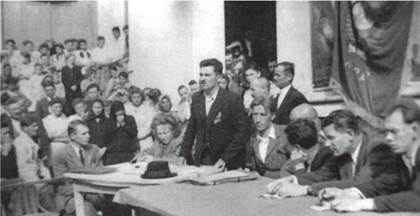
45.5 A public meeting in Transcarpathia urging villagers to join a new cooperative farm (kolhosp), 1948.
In Galicia itself, it took until 1950 to eliminate the last sabotage activity carried out by the remaining supporters of the underground Ukrainian Insurgent Army (UPA). Finally, like the tsarist government before World War I, the Soviets were determined to abolish the Greek Catholic Church, which indeed was a stronghold of Ukrainian national and antiSoviet sentiment. Again “re-unification” was the slogan, this time for Greek Catholics who were encouraged “voluntarily” to “return to Orthodoxy.” In 1946 the Greek Catholic Church was abolished in eastern Galicia, in 1949 in Transcarpathia, and for good measure in 1950 in neighboring Czechoslovakia, which by then had became a Soviet satellite. The Greek Catholic hierarchs, priests, nuns, and laity who did not accept “voluntary re-unification” were arrested and sentenced to long prison terms.

45.6 A unit of Ukrainian Insurgent Army in the Carpathian mountain borderland between Soviet Ukraine, Poland, and Czechoslovakia, 1947.
The abolition of the Greek Catholic Church was undertaken by the Soviet state but with the cooperation of the Russian Orthodox Church under the Moscow Patriarchate. Already during World War II, as part of mobilizing the Soviet population against the German invader, Stalin had reached an accommodation with the Russian Orthodox Church, allowing the appointment of a new patriarch and the church’s further functioning in the absence of state-sponsored persecutions. After the war, churches belonging to the outlawed Greek Catholic Church were given to the Russian Orthodox Church, and those priests who agreed to renounce allegiance to the pope and “return to Orthodoxy” were welcomed into its ranks. Since Ukrainian nationalism was the main concern of the Soviet authorities, the Ukrainian Autocephalous and Ukrainian Autonomist Orthodox churches, which had been allowed to function during the Nazi German occupation, were also outlawed, with their property reverting to the Russian Orthodox Church. Hence, by the end of the 1940s the Moscow Patriarchal Orthodox Church was the only Eastern-rite Christian church legally permitted in Soviet Ukraine. Numerous Polish Roman Catholic churches and Jewish synagogues were also destroyed or put to secular use during this period.

45.7 The opening of the L’viv Church Council (Sobor), under the chairmanship of the recent Greek Catholic “returnee” to Orthodoxy, archpriest Havryïl Kostel’nyk (center), March 8, 1946.
Despite—or perhaps because of—its harsh measures, within a decade after the end of World War II the Communist leadership in Moscow and its subordinates in Kiev succeeded in integrating both the old and new territories of the Soviet Ukraine, so that they were fully compatible with the economic and ideological norms throughout the rest of the Soviet Union.
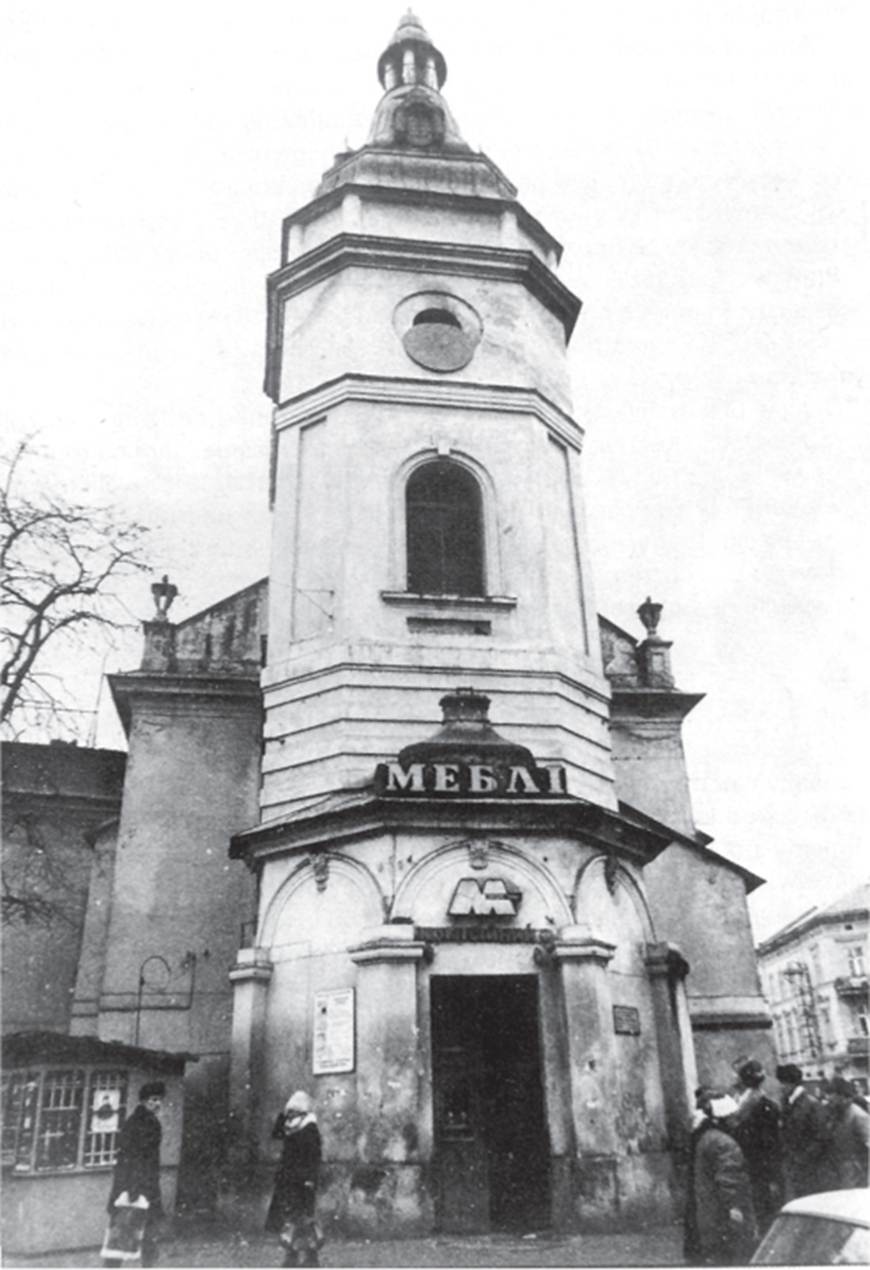
45.8 The Polish Roman Catholic Church of Saint Anne in L’viv, transformed after World War II into a furniture store, restored in the 1990s as a Greek Catholic parish church.