44 World War II: The Military struggle for Ukrainian Lands
Resistance to the invasion launched by Nazi Germany began soon after Hitler’s forces broke into the Soviet Union on June 22, 1941. The resistance was to continue until the autumn of 1944, when the last German troops were driven from Ukrainian lands.
In Soviet Ukraine, resistance took three basic forms: (1) spontaneous efforts at self-defense among the country’s rural inhabitants; (2) organized forces connected with the anti-Soviet Ukrainian nationalist movement; and (3) the Soviet partisan movement.
44.1 Roman Shukhevych (nom de guerre Taras Chuprynka, 1907-1950), Galician-Ukrainian nationalist revolutionary, from 1943 supreme commander of the Ukrainian Insurgent Army (UPA).
Organized resistance began as early as the summer of 1941 among guerilla forces based in Volhynia and Polissia that claimed allegiance to the government-in-exile of the Ukrainian National Republic (UNR). The pro-UNR unit first directed its attacks against the retreating Soviet forces and then against the German invaders. By early 1942 the unit was renamed the Ukrainian Insurgent Army (UPA), and during the following months it was joined by other units formed from among Banderite and Melnykite factions of the Organization of Ukrainian Nationalists (OUN). This rather loose coalition of underground forces (some of which often fought against each other as well as against the common enemy) was in November 1943 brought under the control of the Banderite faction of the OUN. By 1944 the UPA had upwards of 100,000 soldiers under its command, and in July it established the Ukrainian Supreme Liberation Council, which was to function as a provisional government until both German and Soviet troops were driven out and an independent Ukrainian state was established. That summer the UPA moved the center of its military operations from Volhynia to Galicia, where it fought against both retreating German and the advancing Soviet troops.
MAP 44 THE ADVANCE OF THE RED ARMY

A Soviet partisan movement was called into being within one week of the June 22, 1941 German invasion. The Soviet partisans did not, however, have any significance for Soviet Ukraine until mid-1943. Based in the far eastern city of Voroshylovhrad/Luhans’k (which was taken back by the Red Army as early as February 1943), by the end of the year the movement had 43,000 Soviet partisans. They led attacks first against the retreating Germans and then against the Ukrainian nationalists (UPA).

44.2 Units of the Soviet Ukrainian partisan commander, Sydir Kovpak, during a daring raid into the Carpathian Mountains, June 1943.
The military struggle for control of Ukrainian lands was not to be determined by either Ukrainian nationalists (UPA) or the Soviet partisans, but rather by the Red Army. One of the goals of Nazi Germany’s Operation Barbarossa was the destruction of the Soviet military. The Red Army was forced to retreat and several hundred thousand of its soldiers were captured, but Soviet armed forces did survive. By November 1942 they slowly began to take the offensive, although the turning point did not come until January 30, 1943, when after three months of fierce fighting at the Battle of Stalingrad, the German Sixth Army surrendered. From their position in that city on the lower Volga River, Soviet forces began their drive westward.
By April 1943 the front had reached the upper Donets’ valley, so that far eastern Ukraine (Voroshylovhrad/Luhans’k, Stalino/Donets’k) was in Soviet hands. From then until the end of 1943, battles raged throughout Left Bank Ukraine as the Germans were gradually pushed out that area’s major cities (Kharkiv, August 23; Zaporizhzhia, October 25; Chernihiv, November 21; Poltava, November 23), culminating with a Soviet victory and capture of Ukraine’s capital of Kiev on November 6. By the end of December 1943, the front was just to the west of the Dnieper River.

44.3 Red Army units prepare for the final assault on Kiev, November 1943.
The year 1944 saw the Red Army’s military campaign focused on the Right Bank and steppe regions west of the Dnieper River. The year began with a Soviet victory at a major battle around Korsun’ (January 24 to February 17, 1944), followed by a rapid retreat of German forces from the Right Bank. In April the Soviets captured the Crimea (Sevastopol’, April 13) and they drove the Germans and their Romanian allies out of Transnistria (Odessa, April 10), northern Bessarabia, and Bukovina (Chernivtsi, March 29). By mid-July 1944, the front cut through Galicia. It was during the subsequent campaign for that region that the Galicia Division, comprised of Ukrainians fighting on the side of Germany, was virtually destroyed at the July 18 Battle of Brody (of the 11,000 troops in the division more than 8,000 were killed or taken prisoner). L’viv fell to the Red Army on July 27 as did Przemysl on the San River. In September, the Soviet forces crossed the Carpathian Mountains and by the end of October they had taken all of Transcarpathia as part of operations against German and Hungarian forces defending the Danubian Basin. This meant that by the autumn of 1944, the Soviets had taken possession of all territory that after the war was to form an expanded Soviet Ukraine.
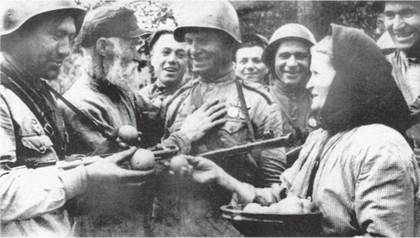
44.4 Villagers in the Sumy Region of northeastern Ukraine, welcoming the Red Army, whom they considered their liberators, September 1943.
While German-Soviet battles were raging throughout Ukrainian lands, a lesser-known conflict was underway, largely in northernwestern Ukraine. Beginning in April and continuing until the end of 1943, various units that claimed to be part of the as yet-not-unified Ukrainian Insurgent Army carried out attacks against Polish villages in Volhynia.
Whether this was in response to the death of Ukrainians in the Lublin region at the hands of Polish guerillas, or whether it was in fulfillment of the OUN’s goals to create an ethnically homogenous independent Ukrainian state, the result was escalating violence perpetrated by both sides. The victims were more often than not innocent civilians, as entire villages inhabited by Poles were destroyed by the UPA. In 1944, the conflict spread to the Chelm region and Galicia, Ukrainian villages were attacked by various anti-Soviet Polish self-defense units. The results of this dirty underground war, whose aims coincided with what later came to be known as ethnic cleansing, was the flight of several hundred thousand refugees (especially Poles from Volhynia) and a death toll that is estimated to be about 50,000 Poles and 20,000 Ukrainians.
44.5 Refugees returning home to their village in Kharkiv region, September 1943.
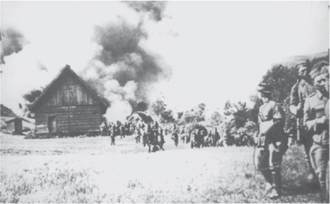
44.6 A mainly Polish-inhabited village in Volhynia burned down by the Ukrainian Insurgent Army, summer 1943.
In September 1944, by which time the Germans had been driven out of Ukrainian lands, the UPA called for an end to anti-Polish attacks and in some cases even cooperated with nationalist Polish underground forces against their common enemy, the Soviet Union. Nonetheless, attacks aimed at ethnic cleansing continued to be perpetrated by both sides contributing to lasting enmity among those elements in Polish and Ukrainian societies at home and abroad who continue to propagate the historical memory of this little-known but no less brutal Polish-Ukrainian conflict during World War II.

44.7 A mainly Ukrainian-inhabited village in Volhynia burned down by Polish guerilla forces, summer 1943.