Soviet Ukraine: Economic, Political, and Cultural Integration
The period of transition in Soviet Ukrainian society that began in 1928 reflected a general shift in policy throughout the Soviet Union commonly referred to as Stalinism or as the “Stalinist revolution.” The policy changes were inspired by Iosif Stalin, who, as general secretary of the All-Union Communist (Bolshevik) party, continued to consolidate and increase his power.
In the 1930s, he became a virtual dictator, in a sense the new tsar of a Soviet empire. The changes introduced after 1928 were directed primarily at the Soviet economy, although they inevitably had profound implications in the political, national, and cultural spheres as well.War communism and the New Economic Policy - NEP
The emphasis placed on the economy was not surprising, since it was through economic transformation that Marxist-Leninist ideologists promised to create an egalitarian society. In the new society, the means of production would be in the hands of the working proletariat represented by a state ostensibly of their own making and led by a revolutionary elite whose legitimacy derived from the principle of the “dictatorship of the proletariat.” The workers’ state would create a rational structure of economic production and distribution to fulfill the individual needs of all workers. As early as June 1918, a little more than half a year after the Bolsheviks came to power, an attempt was made to transform Russian society, or at least those areas of the old tsarist empire controlled by the Bolsheviks, into an ideal, classless, communist state. All industries were nationalized, that is, taken over by the state and run by paid technical experts responding to the central government’s directives from Moscow. Nationalization applied to small-scale as well as to large-scale industries, to transportation and communication facilities, and to rural areas, where the large landed estates were not broken up but preserved in the form of state-owned farms and collectives.
The use of money was prohibited and, instead, barter relations were established among industries and between industry and the agricultural sector. This radical approach to the economy was known as “war communism.”The results of war communism were catastrophic. It brought about almost complete paralysis in the industrial sector, a dramatic increase in inflation, and peasant resistance to forced grain requisitioning and state expropriation of the land. It was not long before the Bolshevik leadership realized that the war communism approach had failed. Consequently, in March 1921, at the 10th Congress of the Communist party of the Soviet Union, Lenin decided to make what he called a “strategic retreat” in the revolution. This did not mean that nationalization of industry or communalization of land was abandoned as the ultimate goal, but that that goal was put off until the new Soviet society was ready. Lenin’s famous dictum, One Step Backward to Make Two Steps Forward, was thus to be implemented. The symbolic step backward was the return to a market economy that came to be known as the New Economic Policy, or NEP for short.
NEP was introduced in 1921, following an end to forced grain requisitioning and the introduction instead of a tax in kind. Soon other measures followed that permitted the peasants to dispose of their surplus produce freely, allowing thereby for the development of a thriving local agricultural market and trade. Also, smallscale industries were denationalized, resulting in the rise of a new class of small businessmen, the so-called Nepmen. The New Economic Policy, which was to function from 1921 to 1928, was dubbed by its opponents “state capitalism.” Whatever it was called, NEP placed the Soviet economy on the road to recovery, with the consequence that by the mid-i92os production levels that had existed in the Russian Empire on the eve of World War I had been reached once again.
NEP in Soviet Ukraine
In Soviet Ukraine, economic policy followed a pattern similar to that in other lands under Bolshevik control.
A variation of war communism was introduced during the second period of Bolshevik rule in 1919 (February-August) and then restored after the third and final Soviet advance in early 1920. The land question was the most problematic. Whereas in 1919 the land confiscated from the large estates was not given to the peasants but rather redistributed as agricultural communes and state farms, the Soviet Ukrainian government that returned to Kiev in February 1920 adopted a new policy. The government immediately passed a law embodying the principle that all land should belong to those who work it. In practice, this meant that peasants had the right to hold land from former estates for a period of up to nine years.The government also encouraged the poorer peasants and landless agricultural day-laborers to compete with the more prosperous peasants for the acquisition of land under the new system. At times, the result was one that Bolshevik ideologists hoped for: friction and, eventually, clashes reflecting a “class struggle” between rich and poor peasants. Subsequently, the Soviet Ukrainian government felt obliged to intervene and restore order. The authorities did so and then eliminated the “anti-revolutionary” peasants by issuing a law in October 1920 that authorized the seizure of land owned by so-called kulaks (Ukrainian: kurkult). At the time, kulaks were defined as those who owned in excess of 80 acres (32.5 hectares). Although the peasants received about 30 million acres (12 million hectares) of redistributed land, they were displeased with the corrupt manner in which the process took place. Their anger, however, was aroused particularly by the continued war-communism policy of requisitioning. According to this policy, peasants were expected to turn over most of their grain to the state (beyond 30 pounds [ 14 kilograms] per month) without compensation. And to ensure delivery, armed detachments (usually consisting of Bolshevik Russian or russified industrial workers) were sent from the cities to carry out the requisitioning.
The introduction of NEP in 1921, with its encouragement of local markets and putting an end to requisitioning, did not initially produce the hoped-for positive results in the Ukrainian countryside. This is because requisitioning was replaced by a complex tax in kind (prodnalog), whereby peasants had to pay the government in foodstuffs that frequently totaled half their harvest. “Revolutionary courts” were set up throughout the countryside to punish those who did not pay the tax. The tax burden and the government-instigated class warfare against the kulaks resulted in a new “peasant war” against the Soviet authorities that broke out spontaneously or was led by “armies” like those of Nestor Makhno which had continued to be active since the period of civil war. As late as April 1921, as many as 102 armed bands roamed the Ukrainian and Crimean countryside. Added to the onerous taxes, class warfare, and armed uprisings was a severe drought that struck in 1921 and destroyed half the harvest. The result was a famine that lasted nearly two years, claiming between 800,000 (official reports) and an estimated 1.5 to 2 million lives. As for Bolshevik promises of a rational and egalitarian workers’ state, a popular jingle summed up the real view of the Ukrainian masses: “In tsarist times there was bread and oatcakes [khlib i palanytsi] / Now with the Communists there is nothing to eat [nema shcho isty].”
It was not until 1923, when the tax in kind was abolished, that conditions in the Soviet Ukrainian countryside began to stabilize. NEP, with its agrarian markets and the reintroduction of capitalism in the small-scale industrial sector (resulting in competition, free trade, and fluctuating prices, as well as unemployment), made possible the recovery of the Ukrainian economy. By 1927, the gross national product of Soviet Ukraine had finally reached its prewar level.
The end of NEP
Despite its successes, the New Economic Policy was never meant to be more than a temporary measure to get the economy - disrupted since 1914 by World War I, civil war, and the misguided extremes of war communism - back on its feet.
NEP, the proverbial one step backward, had yielded positive results. Now, it seemed the time had come to take the first of the proverbial two steps forward. Lenin, who died in 1924, was no longer around to lead in taking them. That task was left to his successor, Iosif Stalin.Stalin’s economic revolution was in large measure related to his struggle to attain uncontested political power. Accordingly, calls for change in economic policy were often issued as a means to discredit Stalin’s political opposition. The methods used in eliminating those he considered rivals or a threat to his power were often brutal, and the process of elimination was to continue at least until the
outbreak of World War II. It began in 1926, when all the Old Bolshevik leaders, starting with Lenin’s close colleagues Trotskii and Grigorii Zinov’ev, were removed from office, put on trial, exiled, or executed.
In the economic sphere, in 1928 Stalin introduced the concept of a planned command economy. All decisions were to be made at the center in Moscow and implemented throughout the Soviet Union, which was treated as a single economic unit. This comprehensive, supposedly more rational approach to economic development meant the immediate end to NEP. In its stead, the first so-called Five-Year Plan was introduced, setting for all aspects of Soviet agriculture and, especially, industry, production schedules and goals which were to be met by the end of five years. The new approach spelled the end not only of NEP, but also of any individual prerogatives the constituent republics still had over their economies according to the 1924 Soviet constitution.
In 1927, the State Planning Commission (Gosplan) was established to oversee the economy. To ensure coordination, between 1927 and 1932 certain structural changes were introduced in the relationship between the republics and the central government.
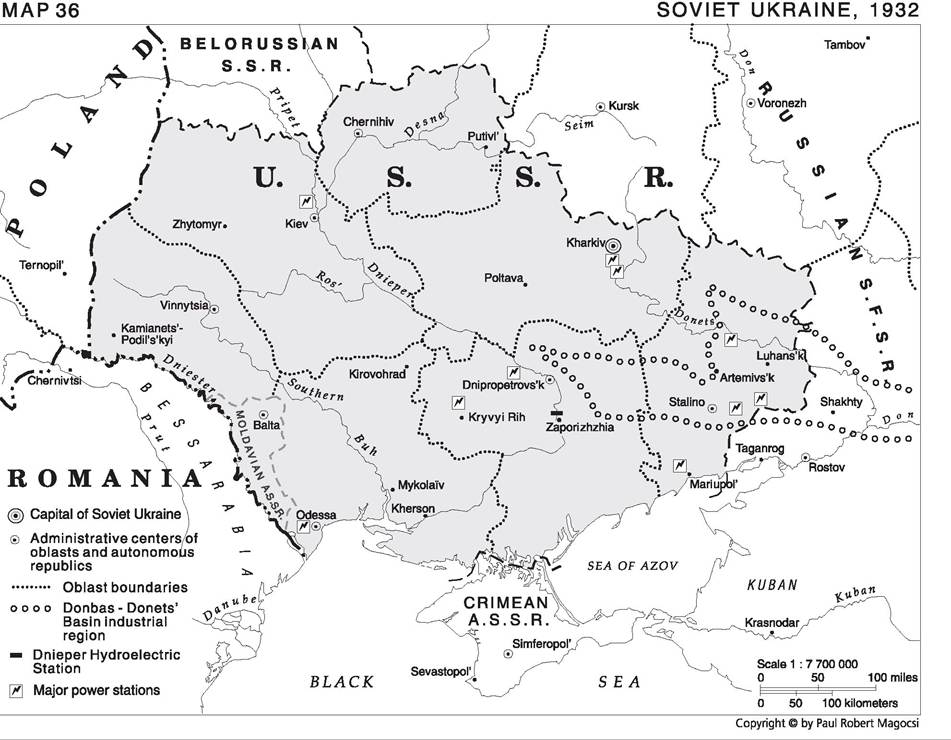
Title to all land was assumed by the central government (1928); republic commissariats for agriculture were made subordinate to the central commissariat for agriculture (1929); all heavy industry, forest, and forest produce industries were separated from republic control and put under central commissariats (1932); technical and scientific schools and public health facilities, including hospitals and sanatoriums, were put under central commissariats; and finally, throughout the country, new economic regions (or oblasts) were established over which Moscow had direct control, without being required to go through the individual Soviet republics in which they were located. In Soviet Ukraine, this administrative reorganization coincided with the abolition in 1932 of the smaller okruhy and their replacement with seven larger oblasts - Kiev, Kharkiv, Vinnytsia, Dnipropetrovs’k, Odessa, Chernihiv, and Stalino. By taking direct control of these oblasts, the central Soviet government in Moscow effectively revived the administrative practice that had prevailed during tsarist times and during the early years of Soviet rule (until 1925).The overall goal of the First Five-Year Plan (1928-1932) was rapid industrialization. In order to find the monetary resources (capital) to pay for industrialization, the central government decided to end NEP by nationalizing all remaining sectors of the economy and to collectivize the agricultural sector, income from which would accrue to the state. Through this otherwise simplistic or primitive accumulation of capital, the government would have the means to invest in industrialization. Abolishing NEP was relatively easy; collectivizing agriculture would be the real challenge. Given the generally backward state of the Soviet economy and the ingrained traditional habits of the country’s rural inhabitants, the implementation of full collectivization would require a leadership of unbending purpose, one willing to carry out the task whatever the cost. And even if Stalin could not live up to the meaning of his self-chosen revolutionary name as a leader of steel will, he could legitimize his actions by using political argumentation based, if ever so tangentially, on the “iron laws” of Marxist-Leninist ideology.
Central planning and industrialization
With regard specifically to Soviet Ukraine, the First Five-Year Plan put greatest emphasis on the development of heavy industry. The goal was to transform the country into the Soviet Union’s leading industrial center for coal extraction and metallurgy as well as its primary source of grain, sugar, and fats. The Second Five- Year Plan (1933-1937) was designed to complete the technological reconstruction of industry, transportation, and agriculture by perfecting collective farming and centralized control over industry. The Third Five-Year Plan (1938-1941, cut short by World War II) was devoted in large measure to developing Soviet Ukraine’s chemical and machine building industries.
Centralized planning did transform Soviet Ukraine, in part, into an industrialized society. The transformation was concentrated, however, in certain areas, in particular the lower Dnieper urban triangle (Dnipropetrovs’k-Kryvyi Rih- Zaporizhzhia) and the Donets’ Basin (Donbas), whose industrial base had already been established during the last years of tsarist rule. While the Soviets expanded upon that base, most of the rest of the country remained what it had always been - an agriculture-based society.
Even after the decision to initiate the First Five-Year Plan was agreed to in 1927 and its final text approved in April 1929, controversy within the highest ranks of the All-Union Communist party continued. At first, a fierce political struggle developed between Stalin and Trotskii’s supporters over the plan’s general contents. Even after the Trotskyists were defeated, there was still debate over what Soviet territories would be favored for heavy industrial investment. Finally, in May 1930 the All-Union Communist party Central Committee decided on Soviet Ukraine as one of the two areas in which to concentrate investment.
Assured of investment from Moscow, Soviet Ukraine proceeded to create the necessary infrastructure for heavy industry. Several power stations were completed, primarily in the eastern and southern parts of the country, including the massive Dnieper Hydroelectric Station just north of Zaporizhzhia (begun in 1927), several in the Donbas-Donets’ Basin, and others near the industrial centers of Kharkiv, Kiev, Dnipropetrovs’k, Kryvyi Rih, Mariupol’, and Odessa. These stations accounted for a nearly tenfold increase in electric power production in Soviet Ukraine between 1928 and 1940. Nearly 400 large-scale tractor, combine, and mining-machinery plants were constructed, although most of the machines had to be imported from abroad.
The transportation system was also expanded, with nearly 2,480 miles (4,000 kilometers) of new railroad track being laid during the interwar years, especially in the Donbas-Donets’ Basin and the lower Dnieper industrial triangle. Although paved highway construction lagged behind during the 1920s, it more than tripled in extent after the introduction of central planning, from 2,400 miles (3,900 kilometers) in 1928 to 8,500 miles (13,700 kilometers) in 1940. The number of motor vehicles rose even more dramatically, from 11,400 in 1932 to 84,300 in 1937 (three-fourths of which were trucks used in collectivized agriculture).
What were the results of centralized planning in Soviet Ukraine? Whether one accepts Soviet statistical data or revised, non-Soviet data, the results are still impressive. At the end of the first two five-year plans, in 1937, Soviet Ukrainian industrial output was either 5.5 times (Soviet data) or 3.4 times greater than it had been at the beginning, in 1928. As for the pattern of industrial production, it remained the same. There was an increasing emphasis on the areas of heavy industrial producer goods (iron, steel, coal, building products), particularly machine building, at the expense of consumer products and food for human consumption.
For instance, between 1928 and 1937 the output in machine building and metalworking increased by 6.1 times, and in industrial producer goods by 3.1 times, while that in food processing increased by only 1.4 times. The greatest increases were in the production of mineral fertilizers (17.7 times), electric power (9.8 times), and industrial lumber (5.2 times). In food processing, there was only one significant increase: the production of raw spirits nearly quadrupled during the first two Five-Year Plans.
In the context of the Soviet Union as a whole, Ukraine’s industrial output between 1928 and 1940 decreased in most areas of heavy industrial producer goods, with the exception of machine building and metalworking, in which Soviet Ukraine’s share of production actually increased, from 17.5 percent to 19.6 percent. Yet even for several products which experienced a relative decrease, Ukraine’s percentage of production still remained nearly half or more the output of the entire Soviet Union (see table 44.1).
TABLE 44.1
Ukrainian industrial output in selected categories, 1928-1940 (percentage of total Soviet output)1
| Product | 1928 | 1940 |
| Coke | 95.7 | 74.5 |
| Soda ash | 81.6 | 81.0 |
| Iron ore | 77.0 | 67.6 |
| Pig iron | 71.9 | 64.7 |
| Coal | 69.9 | 50.5 |
| Rolled steel | 58.1 | 49.7 |
| Steel ingots | 56.7 | 48.8 |
The collectivization of agriculture
Stalin’s “revolution from above” and the introduction of the First Five-Year Plan in 1928 meant an end to the relatively free-market system that prevailed in the Ukrainian countryside during the period of the New Economic Policy. The step backward represented by NEP was to be compensated for by two steps forward - industrialization and collectivization. The theoretical justification for collectivization was that it would correct the shortcomings of NEP. According to Soviet ideologists, these shortcomings were that NEP (1) sustained a pattern of low productivity and capital formation on small farms; (2) made impossible the application of new technological inventions; (3) stood in the way of integration into a planned economy; and, perhaps of most concern, (4) promoted a capitalist market economy that inherently constituted a major threat to the building of socialism and communism. Aside from theory, the government needed food at low cost and right away to feed the rapidly growing urban work force, as well as an excess in grain production that could be sold for export to pay for the machinery being bought abroad and installed in the country’s new industrial enterprises. To solve these concerns and meet these needs, Soviet central planners decided that agricultural lands should be collectivized as quickly as possible and by whatever means necessary.
Although collectivization had never been abandoned as an ideal goal, during the NEP period it had depended solely on voluntary action. Consequently, by October 1928 only 3.4 percent of farms (representing 3.8 percent of arable land) had been collectivized in Soviet Ukraine. Faced with this stark reality and in serious doubt that a significant number of other peasants would voluntarily give up their land, the economic planners added to the First Five-Year Plan the goal of 12 percent, later revised to 25 percent, of arable land to be collectivized by 1932. But even these ambitious goals seemed too restrained for Moscow. Accordingly, in February 1929 the Central Committee of the All-Union Communist party called for the implementation of forced collectivization. By March 1930, 65 percent of farms and 70 percent of livestock in Soviet Ukraine had been forcibly collectivized. In many cases, even household wares and the family cow and chickens were expropriated for the collective. There was a brief respite in 1930, when peasants were allowed to leave the collectives if they wished (and a majority did so), but before the end of the year the pace was accelerated even further, with the result that by the close of the First Five-Year Plan (1932), 70 percent of farms had been collectivized. Despite claims about success back in early 1930, it was not until October 1935 that 91.3 percent of farms in Soviet Ukraine (representing 98 percent of arable land) were collectivized.
Essentially two entities came into existence on arable lands: state farms and collective farms. State farms (Ukrainian: radhosp; Russian: sovkhoz) were managed by the government with the help of hired labor and were hailed by Soviet leaders as the ideal in agricultural establishments. They were usually large in size (over 5,000 acres [2,000 hectares]) and well endowed with farm machinery. Collective farms (Ukrainian: kolhosp, Russian: kolkhoz), in contrast, were ostensibly voluntary cooperatives in which the peasants worked on property with machinery owned by the collective. Collective farm workers fulfilled quotas on crop production set by the state and received whatever was left over. The manner of distributing the remaining foodstuffs was calculated on the basis of the number of (labor) days an individual worked.
To equip the state and collective farms with machinery, beginning in 1929 the so-called Machine and Tractor Stations (MTS) were established throughout the countryside. Each MTS was supplied with between thirty and sixty tractors and other farm machines produced by Soviet Ukraine’s rapidly growing machine building industry. Between 1930 and 1940, the number of MTS in Soviet Ukraine rose from a mere 47 to over 1,000 (with 85,000 tractors, 50,000 trucks, and 31,000 combines). By 1938, the MTS supposedly serviced 99 percent of all land under cultivation. Aside from their intended purpose, the MTS also became centers of Communist party authority and propaganda in the midst of an often hostile rural environment.
Despite the regime’s preference for state farms, it was collective farms that actually made up the vast majority in Soviet Ukraine. According to data from 1938, 79 percent of the land was in collective farms, while only 9.7 percent was in state farms (including experimental stations). As for the remainder, 8.3 percent comprised state forests, and only 0.4 percent individual households.
What were the results of the rapid collectivization of the early 1930s in terms of agricultural production? Using data before and after the period in question, that is, for 1928 and 1940, what effect, if any, did collectivization have in comparison to NEP? We might look at data from 1940, the end of the period, and from 1913, the last normal year of tsarist rule. These figures reveal that between 1913 and 1940 there was actually a decrease in the area of land producing food grains (wheat, rye, corn, barley, oats, millet, buckwheat, vegetables), from 61 to 53 million acres (24.7 to 21.4 million hectares). The most dramatic drop was an 85 percent decrease in the production of spring wheat, which was only partially offset by twofold increases in winter wheat, millet, and legumes. The overall decrease in food grains was matched, however, by a more than two-and-one-half times increase in industrial and livestock crops (sugar beets, flax, hemp, sunflower, cotton, castor beans, winter rape, tobacco), from 2.2 to 6.7 million acres (0.9 to 2.7 million hectares) between 1913 and 1940. So the collectivization of Ukrainian agriculture was accompanied by gains in productivity, especially in industrial crops. But at what cost?
Aside from statistics, there was the human element. Ukrainian peasants - and, for that matter, Russian and other peasants in the Soviet Union - did not look with favor on the prospect of having to give up what was almost a mystical part of themselves, the land. Nor did the peasants give up their land without a fight. Their protests took different forms: the slaughter of livestock, the burning of fields, the driving out of the new collective farm officials (acts often led by women - the so-called babs'ki bunty, “women’s revolts”), and, finally, armed insurrection. When all these measures failed, peasants fled to what rapidly became overcrowded cities. The flight became so serious that in December 1932 the authorities implemented a system of internal passports. The new document was available only at one’s original place of residence and had to be shown in order for one to reside elsewhere. The internal passport system not only helped stem the tide of internal migration, but also allowed the secret police to track people’s movements more easily.
Yet despite the various forms of protest, collectivization continued. After all, collectivization, like industrialization, was part of “The Plan” being made in Moscow allegedly for the greater good of a socialist or communist society. If, to implement The Plan, the bond between the peasant and his or her land had to be broken, it would be. And if the tie could not be broken “voluntarily,” then in the interests of the “greater good” - fulfillment of The Plan - recalcitrant peasants could be eliminated. At this point, theory became practice.
Dekulakization and the Great Famine
Marxism-Leninism had always preached class war as an expression of the historical dialectic leading inevitably to world socialist revolution. Class war was now to become part of the Soviet drive toward collectivization. In Soviet Ukraine as elsewhere in the Soviet Union (especially the rich agricultural regions of the Don, lower Volga, and Kuban River valleys, and the lowlands north of the Caucasus Mountains), the relatively well-to-do peasants who had expanded their landholdings after the pre-revolutionary tsarist reforms of 1906 were called kulaks (kurkuli). Now, because they were opposed to collectivization, they were branded by the Soviet regime “enemies of the people” and presented throughout the 1920s in government propaganda as wealthy land-grabbing exploiters of their fellow villagers. In lieu of such inflammatory but vague rhetoric, the Soviets attempted to provide a concrete definition of who qualified as a kulak. Accordingly, a decree in May 1929 defined a kulak as someone who had a minimum income of 300 rubles (or 1,500 rubles per household) and who used hired laborers and owned any kind of motorized farm machinery. According to these criteria, at the time of the decree there were 71,500 kulaks, representing a mere 1.4 percent of all households, in Soviet Ukraine. With respect to the so-called wealth of the kulaks, it should be kept in mind that the average income of an urban worker was the same as or greater than (300 to 500 rubles) the kulak minimum and included social security benefits not available to rural agriculturalists. Moreover, most of the farmsteads that used hired labor were headed by war invalids or widows, not well-to-do peasant entrepreneurs. In short, the term kulak and the even vaguer category of kulak henchmen (pidkuirkul’nyky) had less to do with actual wealth than with the need of the Soviet authorities to have an all-purpose term with which to brand whomever they considered their enemy in the countryside.
The authorities set out to eliminate the kulaks. Beginning in 1927, they were made to pay heavy taxes. The following year, they were deprived of their franchise, as priests, former policemen, and other declared anti-Soviet elements had been deprived previously. The kulaks were also increasingly harassed by members of the local youth organization (Komsomol) and the so-called Committees of Poor Peasants, a state of affairs contributing to the “historically inevitable” class warfare. Finally, in January 1930 the Central Committee of the All-Union Communist party in Moscow ordered “the liquidation of the kulaks as a class.” They were physically rounded up - men first, women and children later - and shipped off to Central Asia, Siberia, and the Soviet Far East. During the forced transport and as a result of exposure to the elements at their place of exile where they had no shelter, thousands died. This did not seem to matter to the Soviet authorities, since the elimination of a despised “class” was achieved. By March 1930, nearly 62,000 kulak households, or an estimated quarter million people, had been eliminated from Soviet Ukraine during the period known as dekulakization.
The kulaks were gone, but there remained the mass of the peasants. They proved especially problematic in the course of 1931 and 1932. These were years marked by resistance to collectivization in the form of refusals to deliver grain to the collectives and state farms. In the end, the collective farms themselves became centers of opposition, as their administrators argued that it was impossible to fulfill The Plan’s unreasonable crop quotas. This meant little, however, to Stalin and the central authorities, who were concerned only with the industrialization of the country. Neither he nor the All-Union Communist party hierarchy would tolerate either the ineffectiveness of local officials or the stubbornness of the peasantry, whose only value, as they perceived it, was to provide food for urban industrial workers - the true vanguard of the revolution. Accordingly, the party in Moscow called on urban workers to go into the countryside to implement the government’s decisions. These were the so-called 25,000 “best sons of the fatherland,” 7,000 of whom came from Soviet Ukraine itself. Between 1929 and 1931, there were as many as 10,000 of these “twenty-five thousanders” at work in the Ukrainian countryside, where they played a leading role in expropriating kulak property, organizing collectives, and supervising grain shipments. Backed by soldiers and the secret police, these party functionaries simply ordered that grain be seized. Anyone who protested was declared a kulak or kulak henchman and therefore an enemy of the revolution. Many such “new” kulaks were exiled to Siberia and other remote parts of the Soviet Union. Others were imprisoned or killed, or fled to the cities to hide. The actions of the twenty-five-thousanders accounted for the removal of approximately one million men, women, and children from the rural areas in 1931 and 1932.
The forced removal of the kulaks and a return to the policy of forced collectivization during the second half of 1930 had a negative effect on the harvest. The 1930 grain harvest of 21.1 millions tons (18.4 million metric tons) dipped in 1931 to 18.3 million tons (16.7 million metric tons), of which 30 to 40 percent was lost in the harvesting process because the new collective farms were poorly administered and were staffed by peasant laborers reluctant to work on land not their own. At the same time, the central government’s quota for grain deliveries remained the same in both 1930 and 1931 - 7.7 million tons (7 million metric tons), over twice the figure demanded in the mid-1920s, when sociopolitical conditions in the countryside were relatively stable.
Government policy had indeed produced the “class war” the Bolsheviks had always predicted. This was a war in which poor peasants led by party officials and backed by the army were pitted against opponents of collectivization and requisitioning, who now were all lumped together under the opprobrious term kulak. The result was that by 1932, Ukrainian villages were in dire straits. Famine broke out in the spring, the grain harvest dropped to only about 15 million tons (13.7 million metric tons), and there was little seed to be planted for the next season. The situation continued to worsen, with the result that in the winter and spring of 1933 starvation in the countryside became the norm.
For their part, officials in Moscow argued that the peasants were simply hiding grain. Accordingly, a law on the inviolability of socialist property was passed in
UKRAINE’S HOLODOMOR: Death by Famine
Not only did the Soviet authorities deny there was a famine in Ukraine at the time it was happening, they continued for decades thereafter to claim that any talk of famine in 1933 was part of an international conspiracy, aided by Ukrainian emigres in the “imperialist West,” to besmirch the good name of the Soviet Union. On the eve of the fiftieth anniversary of the famine in 1983, scholars and publicists in North America (Robert Conquest, James Mace, Marco Caryn- nyk) began to uncover the reality of the human catastrophe. Subsequently, the United States Congress created a Special Commission on the Ukraine Famine, which in 1990 published its findings in a multivolume work. Following the Gorbachev revolution in the mid-1980s, Soviet Ukrainian scholars (Stanislav Kul’chyts’kyi, Volodymyr Maniak, among others) were also able to assert openly for the first time that indeed there had been a famine in the early 1930s. The new research conducted during the late 1980s uncovered a wealth of often gruesome data, including estimates that ranged from 4.5 to 5 million deaths in 1933 alone to 10 million deaths during the rest of the 1930s attributable to the famine.
We will probably never know how many people died directly or indirectly as a result of the Great Famine (Ukrainian: Holodomor). In any case, numbers themselves fail to convey the real meaning of the tragedy, particularly to citizens of the twentieth century, who have been virtually numbed by the knowledge of humankind’s ability to inflict death and destruction upon itself. In lieu of further statistics, the view of one eyewitness might help us comprehend more fully how the famine affected the lives of the ordinary man, woman, and child. The following description is included in a posthumous novel, Forever Flowing (1970), by a Ukrainian-born Russian writer of Jewish descent, Vasilii Grossman. It is an account, given later, by a Russian woman and Communist party activist who was sent to Soviet Ukraine in 1928 to help implement collectivization.
As a Party activist, I was sent to Ukraine in order to strengthen a collective farm. In Ukraine, we were told, they had an instinct for private property that was stronger than in the Russian Republic. And truly, truly, the whole business was much worse in Ukraine than it was with us. I was not sent very far - we were, after all, on the very edge of Ukraine, not more than three hours’ journey from the village to which I was sent. The place was beautiful. And so I arrived there, and the people there were like everyone else. And I became the bookkeeper in the administrative office....
How was it? After the liquidation of the kulaks, the amount of land under cultivation dropped very sharply and so did the crop yield. But meanwhile people continued to report that without the kulaks our whole life was flourishing. The village soviet lied to the district, and the district lied to the province, and the province lied to Moscow.... Our village was given a quota that it couldn’t have fulfilled in ten years! In the village soviet even those who weren’t drinkers took to drink out of fear. It was clear that Moscow was basing its hopes on Ukraine. And the upshot of it was that most of the subsequent anger was directed against Ukraine. What they said was simple: you have failed to fulfill the plan, and that means that you yourself are an unliquidated kulak.
Of course, the grain deliveries could not be fulfilled. Smaller areas had been sown, and the crop yield on those smaller areas had shrunk. So where could it come from, that promised ocean of grain from the collective farms? The conclusion reached up top was that the grain had all been concealed, hidden away. By kulaks who had not been liquidated yet, by loafers! The kulaks had been removed, but the kulak spirit remained. Private property was master over the mind of the Ukrainian peasant.
Who signed the act that imposed mass murder? I often wonder whether it was really Stalin.... Not the tsars certainly, not the Tatars, nor even the German occupation forces ever promulgated such a terrible decree. For the decree required that the peasants of Ukraine, the Don, and the Kuban be put to death by starvation, put to death along with their tiny children. The instructions were to take away the entire seed fund. Grain was searched for as if it were not grain, but bombs and machine guns. The whole earth was stabbed with bayonets and ramrods. Cellars were dug up, floors were broken through, and vegetable gardens were turned over. From some they confiscated even the grain in their houses - in pots or troughs. They even took baked bread away from one woman, loaded it onto the cart, and hauled it off to the district. Day and night the carts creaked along, laden with the confiscated grain, and dust hung over the earth. There were no grain elevators to accommodate it, and they simply dumped it out on the earth and set guards around it. By winter the grain had been soaked by the rains and began to ferment - the Soviet government didn’t even have enough canvas to cover it up!
... So then I understood: the most important thing for the Soviet government was the plan! Fulfill the plan! Pay up your assessment, make your assigned deliveries! The state comes first, and people are a big zero.
Fathers and mothers wanted to save their children and tried to hide at least a tiny bit of grain, but they were told: ‘You hate the country of socialism. You are trying to make the plan fail, you parasites, you subkulaks, you rats.’
Incidentally, when the grain was taken away, the party activists were told that the peasants would be fed from the state grain fund. But it was not true. Not one single kernel of grain was given to the starving.
Who confiscated the grain? For the most part, local people: the district executive committee, the district party committee, the Komsomol, local boys, and, of course, the militia and the NKVD. In certain localities army units were used as well. I saw one man from Moscow who had been mobilized by the party and sent out to assist collectivization, but he didn’t try very hard. Instead, he kept trying to get away and go home. And again, as in the campaign to liquidate the kulaks, people became dazed, stunned, beastlike..
Well, then came an autumn without any rain, and the winter was snowy. There was no grain to eat.... No bread.... They had taken every last kernel of grain from the village. There was no seed to be sown for spring wheat or other spring grains. The entire seed fund had been confiscated. The only hope was in the winter grains, but they were still under the snow. Spring was far away, and the villagers were already starving. They had eaten their meat and whatever millet they had left; they were eating the last of their potatoes, and in the case of the larger families the potatoes were already gone.
Everyone was in terror. Mothers looked at their children and began to scream in fear.... The children would cry from morning on, asking for bread. What could their mothers give them - snow? There was no help. The party officials had one answer to all entreaties: ‘You should have worked harder; you shouldn’t have loafed.’ And then they would also say: ‘Look about your villages. You’ve got enough buried there to last three years.’
... It was when the snow began to melt that the village was up to its neck in real starvation. The children kept crying and crying. They did not sleep. And they began to ask for bread at night, too. People’s faces looked like clay. Their eyes were dull and drunken. They went about as though asleep. They inched forward, feeling their way one foot at a time, and they supported themselves by keeping one hand against the wall. They began to move around less. Starvation made them totter. They moved less and less, and they spent more time lying down..
No dogs and cats were left. They had been slaughtered. And it was hard to catch them, too. The animals had become afraid of people, and their eyes were wild. People boiled them. All there was were tough veins and muscles. From their heads they made a meat jelly.
The snow melted, and people began to swell up. The edema of starvation had begun. Faces were swollen, legs swollen like pillows; water bloated their stomachs.... And the peasant children! Have you ever seen newspaper photographs of children in the German camps? They were just like that: their heads like heavy balls on thin little necks, like storks, and one could see each bone of their arms and legs protruding from beneath the skin, how bones joined, and the entire skeleton was stretched over with skin that was like yellow gauze. And the children’s faces were aged, tormented, just as if they were seventy years old.... And the eyes. Oh, Lord!
Now they ate anything at all. They caught mice, rats, snakes, sparrows, ants, and earthworms. They ground up bones into flour and cut up leather, shoe soles, and smelly old hides to make noodles of a kind, and they boiled down glue. When the grass came up, they dug out the roots and ate the leaves and buds. They used everything there was: dandelions, burdocks, bluebells, willowroot, sedums, nettles, and every other kind of edible grass and root and herb they could find.. And no help came!
source: Wasyl Hryshko, The Ukrainian Holocaust of 1933, translated by Marco Carynnyk (Toronto 1983), pp. 92-96.
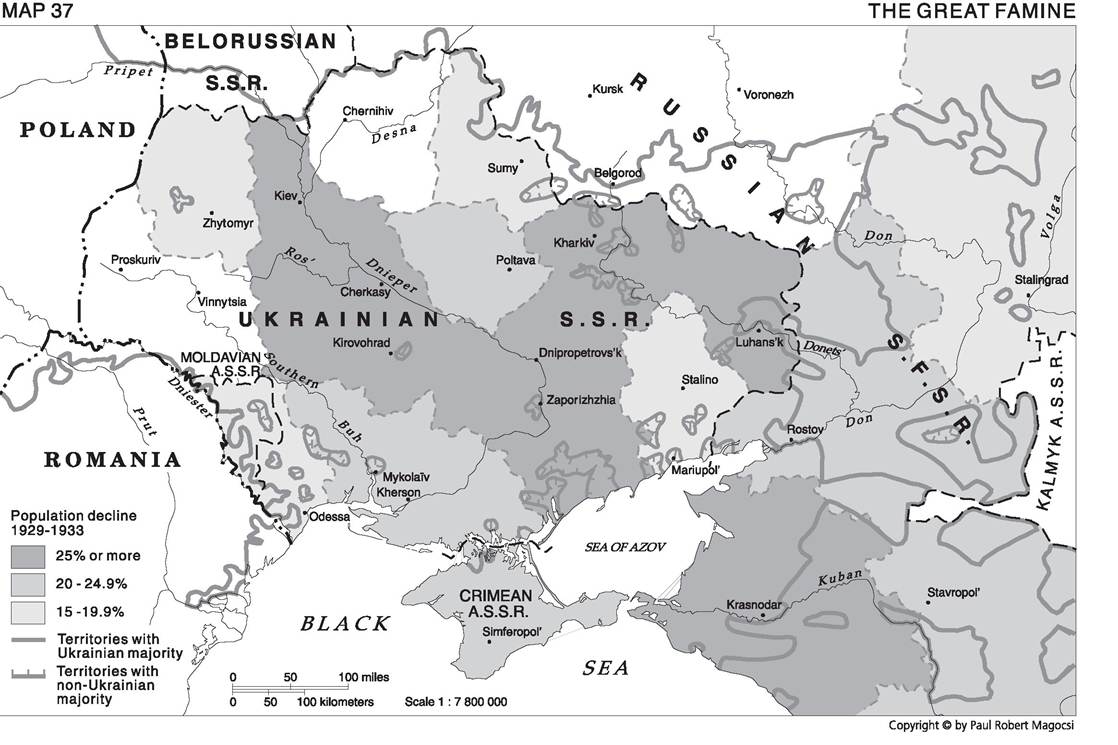
August 1932, whereby the act of taking anything from the collectives - even an ear of wheat or the broken root of a sugar beet - could and often did result in confiscation of property, a ten-year prison term, and even execution. Yet at the same time that famine was raging throughout the country’s agricultural heartland - Dnieper Ukraine as well as the neighboring Kuban and northern Caucasus regions - the Soviet Union was exporting grain abroad. Put another way, officially a famine never occurred. This makes it impossible to know with even relative accuracy the exact cost in human lives. There is, moreover, great disagreement as to the cause of the famine. Was it the result of bureaucratic bungling during the collectivization campaign? Was it part of an explicit policy against recalcitrant peasants, regardless of nationality? Was it an attempt to eliminate nationalist opposition in all areas deemed critical to the Soviet Union (the famine occurred in the Kuban, in the Don Cossack-inhabited northern Caucasus, and in the German-inhabited middle Volga regions as well as in Soviet Ukraine)? Or was it an act of genocide directed specifically against ethnic Ukrainians?
Although conclusive answers regarding causation continue to elude researchers of the period, there is agreement that several million deaths did occur in Soviet Ukraine during the Great Famine of 1933. The most conservative estimate of the number of famine victims, either from starvation or from disease related to malnutrition, is 4.8 million people. This figure represents 15 percent of Soviet Ukraine’s population at the time. Even according to such a conservative figure, this meant that during the spring and summer of that fateful year of 1933, 25,000 people died every day, or 1,000 people every hour, or 17 people every minute.
The apogee and the decline of Ukrainianization
The enormous changes brought about by the Stalinist revolution of 1928 culminated in 1933 with the introduction of the Second Five-Year Plan and the virtual elimination of private landholdings in the agricultural sector. The transitional years 1928 to 1932 also provided an answer to the dilemma of whether Soviet Ukraine would become a truly distinct republic orjust another subordinate entity within the Soviet Union. In an era of ideological absolutes, there seemed to be no middle ground. By 1933, it was clear that total integration in the Soviet Union was to be Ukraine’s fate.
Nonetheless, the period 1928 to 1932 was a transitional one. This meant that two conflicting developments were taking place simultaneously. The Ukrainiani- zation of cultural life, a process begun in earnest in the mid-1920s, was by the early 1930s witnessing some of its greatest successes. At the same time, the nonCommunist and, later, Communist intellectual cadres who had made Ukrainian- ization possible were systematically being removed from power and, eventually, imprisoned and/or killed.
The transitional period began with personnel changes in the Soviet Ukrainian government and the CP(b)U. Kaganovich was replaced by the Polish-born Stanislav Kosior (or Kossior) as head of the party. The real power and influence in both the party and the government, however, was Mykola Skrypnyk, the Old Bolshevik originally sent to Dnieper Ukraine by Lenin himself during the revolutionary period. Formally, Skrypnyk took the demoted Shums’kyi’s post as commissar of education. In fact, Skrypnyk became what one writer has called a “sort of commissar of the nationality question”2 and the ultimate authority on Ukrainianization, Ukrainian culture, and Ukrainian political life in general. The years 1928 to 1933 can be characterized, then, as the Skrypnyk era in Soviet Ukrainian history.
Skrypnyk’s goal was simple. He was never a Ukrainian nationalist. Rather, as a proletarian internationalist and a firm believer in Bolshevik ideology, he held that a distinct Soviet Ukrainian state should be created as an equal to Soviet Russia, to be joined after the “world revolution” by other future soviet states like Germany and France. It was in preparation for such an eventuality that Skrypnyk continued to promote Ukrainianization and, therefore, Ukrainian “national” interests.
With Skrypnyk given free reign to promote his views, Ukrainianization during the Skrypnyk era continued to attain new successes. The program of adult education continued to reduce illiteracy, with the result that by 1938, 98 percent of the population of Soviet Ukraine had been declared literate. Whether that figure is accepted or, what is likely to be more reliable (80 to 85 percent) is less material than the fact that instruction in the adult literacy schools was almost entirely in Ukrainian. The Ukrainianization of the regular school system also reached its height in 1932-1933, by which time 88 percent of all students in Soviet Ukraine were receiving their instruction in Ukrainian. Publishing in the Ukrainian language also attained its highest level at this time: by 1930, nearly 80 percent of all books published were in Ukrainian, and by 1932 nearly 92 percent of all newspaper circulation was in Ukrainian.3
Yet at the very same time that Ukrainianization was flourishing, Ukrainian cultural institutions and individual activists were being undermined. The year 1928 was a harbinger of things to come. In February, the Marxist economist Mikhail Volobuev, who argued that Soviet Ukraine could prosper only if the republic had control over its own economic development and national budget, was denounced in public for his “heretical” views until forced to recant. In March, the Soviet Union’s first major show trial was held in Shakhty, a mining town in Russia’s part of the Donbas which until 1925 was within Soviet Ukraine. Over fifty engineers and technicians were denounced as “bourgeois specialists,” accused of cooperating with foreign interests in order to “wreck” industrial production, and in general held up as symbols of the “internal opposition” - real or imagined - that the regime was determined to uncover and prosecute. Also suspected of anti-Soviet opposition was the Ukrainian intelligentsia. It is not surprising, then, that before the end of 1928 the head of the Ukrainian Institute of Marxism-Leninism, the historian Matvii lavors’kyi, was denounced. The cause given was his description of the coming into being of the CP(b)U as owing to indigenous conditions, along with the inference that the Ukrainian party was itself worthy of continuing to lead the country along a distinct path toward socialism. Such a view was a “deviation” from the accepted Soviet wisdom of the time.
Volobuev and lavors’kyi were Marxists by conviction. Both had by 1930 been denounced for “nationalist deviation,” soon after arrested, and sent to labor camps in Siberia (where they eventually died). Now it was time to turn to the non-Marxist intellectual elite, especially those centered in the All-Ukrainian Academy of Sciences. The technique was for the secret police to proclaim the existence of counterrevolutionary organizations and then to find their agents. In November 1929, the fictitious Union for the Liberation of Ukraine (Spilka Vyzvolennia Ukrainy, or SVU) was “uncovered,” and the following month the Ukrainian Autocephalous Orthodox Church was linked to the alleged conspiracy. As a result of its “involvement,” the Autocephalous Church was forced to dissolve itself in January 1930.
As for the All-Ukrainian Academy of Sciences, its ranks were decimated during the trial held in the spring of 1930 against the SVU. Half of the forty-five defendants were associated the Academy of Sciences, including established scholars like the historians Osyp Hermaize and Mykhailo Slabchenko; the linguists Vsevolod Hantsov, Hryhorii Holoskevych, and Hryhorii Kholodnyi; and the supposed head of the SVU conspiracy, the vice-president of the academy since 1923, Serhii lefre- mov. All the defendants were convicted, and although (in Soviet terms) they were given relatively lenient sentences, within the next few years almost all were rearrested and never returned from their incarceration. As for the Autocephalous Orthodox Church, any efforts by its clergy to continue functioning after its “selfliquidation” on the eve of the SVU trial were suppressed by Soviet security forces. During the next eight years, 2 metropolitans, 26 bishops, and 1,150 priests were arrested and/or disappeared in labor camps. Even the 300 parishes allowed to reconstitute themselves as a new organization called simply the Ukrainian Orthodox Church were progressively eliminated until the last was suppressed in 1936.
Leaving aside all consideration of the personal tragedies of the SVU defendants, this first political “show” trial, held ostentatiously and lasting for over a month in the Kharkiv Opera House, proved a convenient means of warning others that contact with Ukrainians in Poland and with emigres elsewhere, as well as criticism of the government’s policies of industrialization and collectivization, must cease. The SVU trial also served to equate Ukrainian national aspirations with treason, an equation reiterated over the next few years, during which an estimated fifteen other counterrevolutionary organizations were “uncovered.” Some of these uncoverings also ended in trials that allowed the authorities to drive home their message to the public: “bourgeois nationalism” was one of the greatest dangers to Soviet society. Just as a peasant became a “counterrevolutionary kulak” if he or she did not agree with collectivization and the forced requisitioning of grain, so too did an intellectual become a “counterrevolutionary bourgeois nationalist” if he or she did not favor the party’s ever-changing approach to the nationality question.
Arguing that “bourgeois nationalists” were the enemies of the people, between 1931 and 1934 the Soviet authorities removed from their positions the leading lights of the Ukrainian intelligentsia, whether or not they were Communists. Their subsequent fate was often imprisonment, exile, even execution. There was no question that non-Communists had to be replaced, beginning with Mykhailo Hrushevs’kyi. In 1931, he was removed from his post in the All-Ukrainian Academy of Sciences and exiled to Russia, where he died in 1934. Hrushevs’kyi at least was not imprisoned. Many of his colleagues were not so lucky. Several prominent linguists (O. Kurylo, Ie. Tymchenko, O. Syniavs’kyi, M. Sulyma), historians (V. Bazylevych, F. Ernst, O. Hrushevs’kyi, V. Miiakovs’kyi, F. Savchenko), writers (S. Pylypenko, V. Pidmohyl’nyi, V. Pluzhnyk, M. Semenko, B. Antonenko-Davy- dovych), and non-Bolshevik politicians, including all the old Borotbists and Uka- pists who later joined the CP(b)U (O. Shums’kyi, A. Richyts’kyi) as well as nonCommunists who returned from exile (M. Chechel’, M. Shrah, P. Khrystiuk), were arrested and, whether executed or sent to Siberia, were never heard from again. At the organizational level, the Institute of Marxism-Leninism was abolished (1931); all the independent writers’ associations were liquidated, with only one, the Association of Soviet Writers of Ukraine, being permitted to continue (1934); and the All-Ukrainian Academy of Sciences was completely reorganized, its humanistic branches thenceforth required to work exclusively on proletarian themes.
Skrypnyk was not particularly disturbed by the “ideological cleansing” and purges of the non-Communist intelligentsia. He even spoke publicly during the SVU trial, attacking those individuals accused of “nationalist deviation” in Ukrainian language matters, although carefully avoiding comment on the substance of what they were doing. What they were doing was, after all, supported by Skrypnyk himself, who remained committed to expanding Ukrainianization in the belief that this expansion would preserve the achievements of the Bolshevik Revolution.
Although the policy of Ukrainianization was still officially supported by the CP(b)U, the “internationalist” elements in the party now made the protection of national minorities their primary issue. They argued that Russians should remain the dominant demographic force in urban and industrial areas (their position assisted, if necessary, by the russification of incoming ethnic Ukrainians from the countryside) and that limitations should be placed on the Ukrainianization program. The justification given by the internationalists in the party was that Ukrainian nationalism was associated with kulaks and the peasant question. It therefore posed an even greater threat than Great Russian chauvinism. Skrypnyk responded to the internationalists’ arguments by calling for more investment in Soviet Ukraine from the all-union budget and for an intensification of Ukrainianization in the areas of education, publication, and governmental administration. His ideological justification remained straightforward: socialism could be achieved in Ukraine only after the creation of a firm national-cultural base, and any attempt at the russification of ethnic Ukrainian urban dwellers would only exacerbate the national issue. Throughout these debates, Stalin pretended to remain aloof, even reiterating at the 16th Congress of the All-Union Communist party in June 1930 the party’s commitment to the existence of the national republics and its continued concern over the danger of Great Russian chauvinism.
The end of Ukrainianization
By 1933, however, the social and political instability in Soviet Ukraine warranted increased attention. In January 1933, in response to the complaints of the CP(b)U leadership that the grain quotas and forced collectivization were having a disastrous effect on the country, Stalin dispatched to Soviet Ukraine Pavel Postyshev, a Russian- born Bolshevik who had served for a while as head of the CP(b)U in Kharkiv before being recalled to Moscow. Although designated second secretary of the CP(b)U and theoretically subordinate to Kosior, Postyshev was in fact given free reign to root out from the party all persons suspected of “nationalist deviation.” The object was to crush whatever opposition to Stalin still existed within the Ukrainian party.
The scapegoat for all the CP(b)U’s difficulties was found in Skrypnyk. Within one month of his arrival in Soviet Ukraine, Postyshev had Skrypnyk removed as commissar of education, and in June he attacked him by name at the party plenum for having filled his commissariat with “wrecking, counterrevolutionary nationalist elements.”4 Since language was traditionally equated with the survival of national distinctiveness, it is not surprising that among Skrypnyk’s greatest sins was his promotion of Ukrainian language reforms, including linguistic purism and a new orthography (popularly known as the skrypnykivka) approved in 1928. Seemingly esoteric academic issues took on profound political significance: the revised Ukrainian alphabet and the search for a “pure” Ukrainian vocabulary offered clear evidence, in the words of one critic, that “Comrade Skrypnyk... had taken the path of alienating the Ukrainian language from Russian and bringing it closer to Polish.”5
Unlike many other Ukrainian Marxists accused of “nationalist deviation,” Skrypnyk refused to recant. Instead, he committed suicide in July 1933, just one month after another “national deviationist,” the writer Mykola Khvyl’ovyi, shot himself. With the death of Skrypnyk, the process of Ukrainianization and any possibility of creating a Soviet Ukraine distinct from the rest of the Soviet Union came to an end. By the very beginning of 1933, the transitional period that had begun in 1928 was over, and it was clear that in the coming years all efforts would be made to transform Soviet Ukraine into a land economically, politically, and culturally an integral part of the Soviet Union.
Purges and integration
The large-scale purges of the CP(b)U and governmental institutions in Soviet Ukraine initiated in 1933 under Postyshev were in one sense a prelude to what would take place throughout the rest of the Soviet Union. Stalin had become obsessed with the need for total control, which he felt could be achieved only by the elimination of all whom he perceived as disloyal. In 1934, the so-called Great Purge began, which brought the arrest, exile, or death of millions of persons - mainly Communists and officials in Soviet government and industry. Almost all the Old Bolshevik leaders were forced to confess in bizarre show trials between 1936 and 1938, and on the eve of World War II the Red Army’s leading generals were shot. Fear and suspicion became the norm in these years of Stalin’s Soviet Union, characterized by one western specialist (Robert Conquest) as the era of the Great Terror. No one could be sure that a neighbor, a co-worker, even a family member was not a secret police informer ready to accuse him or her of being a counterrevolutionary, because of some offhand comment or joke about daily life, or - absurd as it may sound - such things as favoring use of the letter g (the Ukrainian Cyrillic letter r that does not appear in Russian) in the “Skrypnyk alphabet.” During the first year of Postyshev’s presence in Soviet Ukraine, nearly 100,000 persons were purged from the CP(b)U. The process continued,
The Purges
In March 1938, the last of the major show trials against Stalin’s presumed or actual political enemies took place in Moscow. Its defendants were twenty-one members of the so-called Right Opposition, who had opposed Stalin’s policies of rapid industrialization through central planning and forced collectivization. Aside from their views on the direction of Soviet society, the accused were charged as well with espionage on behalf of Germany and Japan, attempted dismemberment of the Soviet Union, and conspiracy to eliminate the entire Soviet leadership. The best-known defendant, Nikolai Bukharin, was also accused of conspiracy to kill Lenin and Stalin as early as 1918.
Among the defendants were two who had played leading roles in Soviet Ukraine during the 1920s, the former head of government before Ukrainianization, Khristiian Rakovskii, and the former commissar for state planning during the early years of Ukrainianization, Hryhorii Hryn’ko. Both subsequently held high posts in the central Soviet government and party hierarchy in Moscow. In his last statement before being sentenced to death, Hryn’ko told the court what the Soviet authorities wanted their public to know about the supposedly “nefarious” period of Ukrainianization. Stalin and his remaining supporters were so pleased with the information that “came out” at the trial that its entire proceedings were translated into and published in English so that the world would know to what degree the Soviet Union was threatened internally as well as externally. In his last public confession, Hryn’ko provided Soviet propagandists with a useful script about the so-called dangers of Ukrainian nationalism.
In order that the path may be clear by which I arrived at committing the enormous chain of crimes against the Soviet power and the country, and at treason against the country, I must recall that I joined the Communist party as one of the Borotbists - the Ukrainian nationalist organization. A large group of the leaders of the Borotbists: Shums’kyi, Poloz, Blakytnyi, I - Hryn’ko, Liubchenko, and others who merged with the Communist party of Ukraine, continued to adhere to and later intensified our bourgeois-nationalist position.
I can enumerate the main stages in the development of the nationalist, conspiratorial, counter-revolutionary work of this Borotbist nucleus.
The first stage was the period approximately of 1925-26. This is what is called the period of Shums’ky-ism. Already at that time Shums’ky-ism was in all essentials a program of severing Ukraine from the U.S.S.R., a program of bourgeois-nationalist restoration in Ukraine. Already at that time it was a sort of large-scale political reconnoitring by the nationalists, a trial of strength, the demand to discredit Russian towns in Ukraine, to discredit Russian cadres, etc.
Shums’ky-ism was crushed politically and undermined organizationally.... When this nationalist organization [the Borotbists] was smashed, only fragments of it remained. But about 1929, a nationalist organization revived again in Moscow, consisting of Shums’kyi, myself, Poloz, Maksymovych, Solodub and a number of others. This organization approached its program and its tactics differently from the way it did in the first period....
In this period the nationalist organization gave its members instructions to collect forces and wage an active struggle, mainly against collectivization, and even to go so far as to organize insurrection. In this struggle we already had connections with certain circles in a certain state which is hostile to the Soviet Union. These allies of ours helped us. To assist the partisan struggle they intensified the smuggling of diversionists and Petliura emissaries, and arms, etc., into Ukraine..
This period came to an end at the beginning of 1933 owing to the arrest of nearly the whole of this group. I was the only one not arrested. But I did not lay down my nationalist arms in my fight against Soviet power..
At the beginning of 1935 I heard from Liubchenko about the creation in Ukraine of a national-fascist organization, the object of which was to sever Ukraine from the U.S.S.R.... When I learned about this organization I agreed to join it....
In 1935 and the beginning of 1936, I had, in the main, carried out the tasks entrusted to me by the Ukrainian organization. I had established connections with the Right and Trotskyite centre..
I am making my last plea not in order to defend myself before the Supreme Court. I have nothing to say in my defence. Nor shall I make use of this plea in order to ask for a mitigation of the sentence. I have no right to a mitigation of the sentence. I am wholly and completely in agreement with the description and political evaluation, both of our crimes in general and of my crimes in particular, as given in the speech of the Prosecutor of the U.S.S.R....
I face the court as a Ukrainian bourgeois nationalist and at the same time as a participant of the ‘bloc of Rightists and Trotskyites.’ This is no chance combination. The hunting after bourgeois nationalists and the political corruption of unstable political elements in the national republics are the old-established and stubbornly conducted tactics of the Trotskyites and the Right Oppositionists....
As one of the organizers of the Ukrainian national-fascist organization, I operated particularly in Ukraine, that is to say, at the main gates through which German fascism is preparing its blow against the U.S.S.R..
This Ukrainian national-fascist organization - including Liubchenko, Poraiko and others - completes the last link in the long chain of criminal deeds committed against the Ukrainian people by various factions of Ukrainian bourgeois-nationalism from the very beginning of the revolution.
The Prosecutor of the U.S.S.R. was right when he said that under the leadership of the Bolshevik party and the Soviet government the Ukrainian people, advancing along the road of the national policy of Lenin and Stalin, have been raised to such a high level as never before in all its previous history. The Bolshevik party and Soviet power have created the Ukrainian state, they have made Ukraine a very rich industrial and collective farming country, they have raised Ukrainian national culture to an unprecedented high level. And this Ukrainian national fascist organization, which it is my sad lot to represent before the court, was, by resorting to bogus slogans of national ‘independence,’ leading the Ukrainian people to the yoke of German fascists and Polish gentry....
The party raised me from the petty-bourgeois mire, it placed me in a high post in the government, a high station, entrusted me with state secrets and with control over the state finances of the U.S.S.R....
And to all of this I replied by betrayal, by darkest betrayal, of the party, the fatherland, and Stalin.
And it is in conditions like these, members of the Supreme Court, that I must tell you of my remorse. I very well understand with what scorn and contempt every Soviet person will meet these words of repentance coming as they do from me. Nevertheless, I must say this because it corresponds to the truth, because there is no one else to whom I can address these words..
I will accept the most severe verdict - the supreme penalty - as deserved. I have only one wish: I wish to live through my last days or hours, no matter how few they may be, I wish to live through and die not as an enemy taken prisoner by the Soviet government, but as a citizen of the U.S.S.R. who has committed the gravest treachery to the fatherland, whom the fatherland has severely punished for this, but who repented.
source: Report of Court Proceedings in the Case of the Anti-Soviet “Bloc of Rightists and Trotskyites” Heard Before the Military Collegiun of the Supreme Court of the U.S.S.R., Moscow, March 2—13,1938: Verbatim Report (Moscow 1938), pp. 67-71 and 718-721.
and between 1934 and 1938 the party lost another 168,000 members, or another 37 percent of its total membership. Many higher-level party positions were filled by Stalinist faithful from other parts of the Soviet Union, while new and often younger-generation party functionaries were drawn from Soviet Ukraine itself, where the party had become rooted as a result of indigenization. Once set in motion, the purges seemed to take on a life of their own, confirming the general observation that revolutions often devour their own children. Postyshev himself was removed from his post in early 1937 (he was later shot), and within a year the entire hierarchy (politburo and secretariat) of the CP(b)U was purged. In order to rebuild the party, Stalin dispatched to Soviet Ukraine Nikita S. Khrushchev, but he had to be appointed to the position as Ukraine’s first secretary by the all-Union Communist leadership in Moscow because there was no one left in the CP(b)U Central Committee to elect him.
With regard to cultural life, a new policy was adopted throughout the Soviet Union. The era of experimentation and the generally permissive atmosphere that had characterized artistic creativity in the 1920s (including avant-garde and abstract works) was replaced by Stalinist-inspired guidelines known as “socialist realism.” The Communist party was now called on to be more vigilant and to exercise increasing control over all creative endeavors in order to insure that cultural works became instruments of education and political propaganda with the goal of depicting the positive achievements of Soviet life. Whether in literature, the visual arts, or cinema, the party-approved style was expected to be simple, direct, and accessibly “realistic,” in order to make the socialist message intelligible to the broad masses.
Aside from socialist realism in the cultural sphere, there was socialist competition in the workplace. Soviet policy makers became increasingly preoccupied with the need to refashion popular attitudes toward labor, which in traditional imperial Russian society had generally been considered a burden imposed on workers by feudal landowners and capitalist factory and mine owners. But as industrialization took on increasing importance in Soviet society, so too did the need to imbue the citizenry with a proper work ethic that, in effect, functioned as a corollary to Soviet patriotism. In this regard, Soviet Ukraine became the site for the exploits of modern-day heroes that were to serve as the prototype for the new Soviet man - and woman. This was all part of a movement broadly defined as socialist competition whose goal was to increase worker productivity.
In the early 1930s, one Nikifor Izotov, a miner at Horlivka in the heart of Ukraine’s Donets’ Basin, became the focus of attention throughout the Soviet Union. He and those who wanted to follow his example, dubbed Izotovites, made it their goal to go beyond the production quotas set by the Five-Year Plans and at the same time to assist fellow workers who could not keep up with their expected daily quota in the mines and factories. In other words, it was not enough to fulfil The Plan, one should over-fullfill it. Even more remarkable than Izotov were the achievements of a native of Russia, Aleksei Stakhanov, who from 1927 worked in another coal mining town in Ukraine’s Donets’ Basin, Kadiivka (today Stakhanov). Stakhanov set his first production record in 1935 (extracting 102 tons of coal in a single six-hour work shift), thereby over-fulfiling his quota by a factor of 14.5. It was not long before Stakhanov became a poster boy for Soviet propagandists, who transformed him into a living legend whose labor exploits were lovingly depicted in countless newspaper articles, children’s books, and movies. His alleged (and often staged) feats served as the ideal for what became known as the Stakhanovite movement in which individual workers and workers’ brigades in mines and factories throughout the Soviet Union set over-fulfillment as their primary goal, that is, production results which were higher than those outlined in the state’s Plan. The movement also spread to the agricultural sector and included female Stakhanovites, like Mariia Demchenko from the Cherkasy region, who made her mark in harvesting sugar beets.
It is also somewhat ironic to note that at the very same time the intelligentsia who formed the backbone of the Ukrainianization program was being silenced and persecuted by the Soviet authorities, a self-taught plant breeder from a peasant household in central Ukraine was rapidly on his way to becoming a leading figure in the all-Soviet scientific establishment. This was the case of Trokhym Lysenko, renowned for his theories about inducting hereditary changes in plants (vernalization; Ukrainian: iarovizatsiia) by modifying their environment. Stalin became enamored with Lysenko whose agrobiological convictions influenced for decades - often with disastrous consequences - Soviet agricultural policy in its state-owned and cooperative farms and in its forests.
While promoting socialist competition in the workplace, from 1933 the Communist party’s goal in Soviet Ukraine’s cultural sphere was to reverse the policy of the previous years, in which Shums’kyi’s and Skrypnyk’s “nefarious” policies had brought about “forced Ukrainianization.” More and more emphasis was to be given to Russian culture and the Russian language, considered the medium through which the world’s “first socialist state” had been created. In 1933, the alphabet and language reforms instituted in 1928 and associated with Skrypnyk’s name were abolished, and decrees were passed requiring that in its alphabet, vocabulary, and grammar the Ukrainian language be brought steadily closer to Russian. By 1937, Soviet ideologists were proposing the intimate union of the two languages, and the following year a law was passed providing for a rigid system of language training designed to ensure that all Ukrainians, whether in the cities or the countryside, would have a fluent command of Russian.
For the new directives to be followed, the educational system could no longer be subjected to “forced Ukrainianization.” While it is true that the percentage of students studying in Ukrainian in general schools was even higher in the late 1930s than in the late 1920s, a new educational environment was inaugurated in March 1938, when the study of Russian was made obligatory in all non-Russian schools throughout the Soviet Union. In other areas too, Russian supplanted Ukrainian. Between 1932 and 1939, the circulation of Ukrainian-language newspapers published in Soviet Ukraine declined from 92 to 67 percent, while in half that time the number of Russian-language theaters increased from nine to thirty.6
The justification for this new approach was summarized in June 1938 in an address by First Secretary Khrushchev to the 14th Congress of the CP(b)U:
Comrades, now all the people study the Russian language because the Russian workers... helped to forward the flag of revolution. The Russian workers have set an example to the workers and peasants of the whole world..
People of all areas are studying and will study the Russian language in order to study Leninism and Stalinism and to be taught to destroy their enemies.... The bourgeois nationalists, the Polish and German spies, as they made their way into certain sections of the cultural front, understood remarkably well the force and influence of the teachings of Lenin and Stalin on the minds of the Ukrainian people. Because of this they drove the Russian language from schools. But the Ukrainian people, who in the course of many centuries have battled against their enemies alongside the Russian workers and peasants, are completely dedicated to the general aspirations of the workers’ class of the Soviet world. They are tied by vital bonds to the Great Russian people and will fight together with them under the banner of Lenin and Stalin for the complete victory of Communism.7
Henceforth, the Russian language was associated with survival in the only world which the future promised - a communist society according to the dictates of Marx, Lenin, and Stalin.
Thus, injust two decades the Communists had come full circle in Dnieper Ukraine. They had begun in 1919 with an attempt to create a socialist society without national distinctions and expressed only in Russian. Two decades later, they were back where they started. In one sense, this is not surprising, because Ukrainianization, like the economic experiment of NEP, was for the Bolsheviks never more than a temporary solution. The proverbial one step backward had been made; two giant steps forward now seemed possible. The year was 1939, however. New clouds hovered over Europe. And before long war was to engulf most parts of the world. In response, Soviet leaders would have to take more steps backward than even the ultimate pragmatist himself, Lenin, would ever have dreamed necessary.