Other Peoples in Soviet Ukraine
With the establishment of Soviet (Bolshevik) rule in Dnieper Ukraine, ethnic Ukrainians were recognized as a distinct nationality. This change in status was a product of Lenin’s attempt to resolve the nationality problem in the former Russian Empire by providing its numerous peoples with various kinds of territorial and administrative entities.
The relatively complex and hierarchical administrative system actually adopted was developed after the creation of the Soviet Union in December 1922. Initially, the Soviet Union consisted of four constituent republics (one of which was Soviet Ukraine), whose number rose to nine by 1929. The name of each was intended to reflect the state, or titular, nationality living within a given republic. In addition to the national republics, there were other administrative subdivisions, also based in principle on criteria of nationality; namely, autonomous republics, autonomous oblasts, autonomous regions, nationality districts, and nationality village/town soviets.Whereas ethnic Ukrainians were the numerically dominant element in Soviet Ukraine, 20 percent of the country’s inhabitants comprised several other peoples, who after 1924 were formally designated as national minorities (Ukrainian: natsional'ni menshyny).
TABLE 45.1
Nationality composition of Soviet Ukraine, 19261
| Nationality | Number | Percentage |
| Ukrainians | 23,219,000 | 80.0 |
| Russians | 2,674,000 | 9.2 |
| Jews | 1,574,000 | 5.4 |
| Poles | 476,000 | 1.6 |
| Germans | 394,000 | 1.4 |
| Moldovans | 258,000 | 0.9 |
| Greeks | 105,000 | 0.4 |
| Bulgarians | 92,000 | 0.3 |
| Belarusans | 76,000 | 0.3 |
| Tatars | 22,000 | 0.1 |
| 16,000 | 0.0 | |
| Others | 109,000 | 0.4 |
| TOTAL | 29,018,000 | 100.0 |
The Moldavian A.S.S.R.
and the MoldovansSoviet Ukraine created for its various national minorities some of the above-mentioned administrative subdivisions. The highest category among them was the Moldavian Autonomous Soviet Socialist Republic (Moldavian A.S.S.R.), created in 1924 on a strip of territory along the eastern bank of the Dniester River, which at the time formed the Soviet border with Romania. The creation of the Moldavian A.S.S.R. was part of the Soviet Union’s larger strategic goal to acquire the former tsarist province of Bessarabia, located just to the west between the Dniester and Prut Rivers, which at the time was part of anti-Soviet “bourgeois” Romania. The Soviet claim to Bessarabia was based not only on historic grounds (tsarist Russia had held the region for a century before World War I), but also on the claim that Romanian speakers on both sides of the Dniester River, in historic Moldavia, formed a distinct Romance people called Moldovans. Therefore, the Romanian speakers in Soviet Ukraine’s Moldavian A.S.S.R. were proclaimed to be a distinct Moldovan nationality, which one day would be “re-united” with their co-nationals when the Soviet Union would extend its borders westward.
Despite being a titular nationality, the Moldovans were, in fact, a statistical minority, numbering only 172,000, or 30 percent of their “own” republic’s population. The rest of Soviet Ukraine’s Romanians - now reclassified as Moldovans (89,000) - lived farther east, mostly in the rural steppe region near the banks of the lower Southern Buh River. As part of its longer-term “Bessarabian” strategy, the Soviet authorities supported a policy of Moldovanization. Moldovan national village soviets were created within the Moldavian A.S.S.R. (63 by 1931) and just to the east in steppe Ukraine (17), as were Moldovan-language elementary schools. By the 1930-1931 school year, there were 121 of these schools, in which nearly two-thirds of all children in the Moldavian A.S.S.R. were enrolled.
If the Moldovans were a distinct nationality, Soviet policy dictated that they should have their own language.
Therefore, the autonomous republic’s capital of Balta became the seat of the Moldovan Scientific Committee, headed by Pavel Chior, who together with the linguist Leonid Madan created a grammar book (published in 1929) for a Moldovan standard literary language. Books and newspapers were published in this new standard using the Cyrillic alphabet. Historically, Cyrillic was not uncommon for Romanian-language publications in Bessarabia, although for a short period (1932-1938), when the Moldovanization program was under attack for ideological deviation, the autonomous republic’s authorities adopted the Roman/Latin alphabet and language norms that were not very different from literary Romanian. By 1937, the experiment in creating a distinct nationality and culture seemed to run its course, so that most of Moldovan high culture was little more than Romanian in disguise.Nationality administration in Soviet Ukraine
While Soviet Ukraine had within its borders only one autonomous republic, more widespread were other nationality administrative subdivisions that began to be set
TABLE 45.2
Nationality subdivisions in Soviet Ukraine, 19312
| Nationality | Districts | Village/Town soviets |
| Russian | 8 | 388 |
| German | 7 | 252 |
| Jewish | 3 | 158 |
| Polish | 1 | 157 |
| Bulgarian | 3 | 46 |
| Greek | 3 | 30 |
| Moldovan (outside Moldavian A.S.S.R.) - | 17 | |
| Czech | - | 12 |
| Belarusan | - | 4 |
| Albanian | - | 3 |
| Swedish | - | 1 |
| TOTAL | 25 | 1,068 |
up in 1924.
These included nationality districts (raiony), town soviets (selyshchni rady), and village soviets (sil’s’ki rady), all designed to serve the interests of those peoples who formed the majority of the population in a given locale. The number of nationality districts and village/town soviets continually fluctuated throughout the 1920s and 1930s, although at their height they numbered between 1,000 and 1,200.Within each of these administrative entities the national minority was allowed to use its own language in education (generally in elementary schools), in government-funded cultural institutions and publications, and in local courts and state administrative offices. Some village and town soviets were located within a given group’s nationality district, but most were isolated entities spread throughout the country (see map 38).
Not surprisingly, the status of the various minority peoples during the interwar years was directly influenced by the policies adopted by the Soviet Ukrainian government and the CP(b)U toward the state’s titular nationality, the ethnic Ukrainians. Hence, when Ukrainianization was implemented, policies with similar goals were introduced among some of the minorities - Moldovanization, Yiddishization, Polonization, Tatarization, Hellenization. The evolution and fate of those policies also largely paralleled the evolution and fate of Ukrainianization.
The Russians
Of all the national minorities in Soviet Ukraine, the Russians continued to maintain a special status. Their number alone - nearly 2.7 million in 1926 - guaranteed that they would play an important role in Soviet Ukrainian society. This was particularly the case in those geographic areas where they were most densely concentrated, specifically the northeastern industrial and southern steppe regions. In 1930, Russians had eight nationality districts and as many as 388 village and town soviets in which schools, courts, and other administrative bodies operated only in Russian.
It is nonetheless interesting to note that although Russians had the high-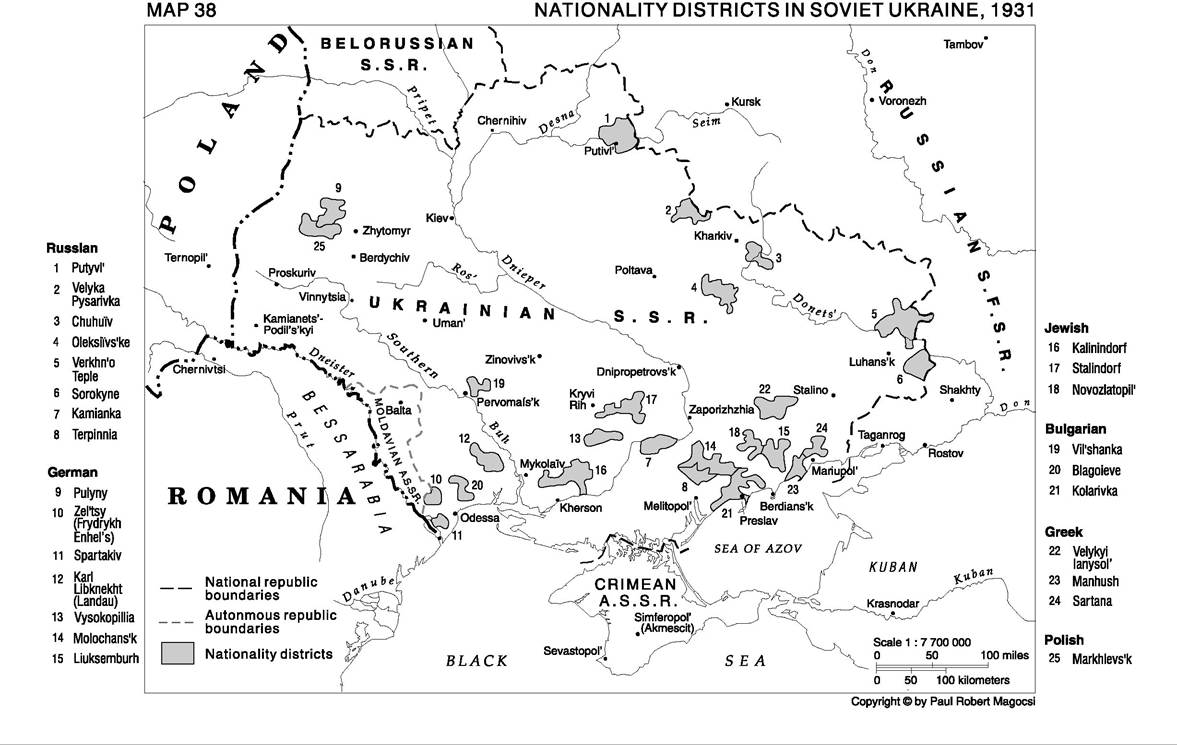
est number of national minority schools (1,539 in 1929-193°), nearly one-fifth of the students from this group had no access to Russian-language schools and attended Ukrainian ones instead.
Regardless of numbers and administrative status, Russians never regarded themselves as a minority. They continued to perceive themselves as representatives of the dominant culture and language in what remained their “Little Russian” homeland. If the Russian language and culture was already dominant during tsarist days, under the Bolsheviks its status was raised to an even higher level as the medium in which the worldwide socialist revolution was unfolding. The revolution was to be led by an industrial proletariat, and this forecast seemed to fit well with the social status of Russians in Soviet Ukraine, 37 percent of whom were urban dwellers. Aside from the Russian industrial workforce, a high percentage of governmental bureaucrats and intellectual elite, especially in the universities, were Russians or russified Ukrainians and Jews who continued to function in terms of language and cultural preferences as if the Bolshevik Revolution had never taken place.
It is not surprising that, furnished with such attitudes, many Russians found the linguistic aspects of Ukrainianization bothersome at the very least. Moreover, many felt confident that the decrees could be ignored until the Ukrainian “social experiment” had run its course. When, by the second half of the 1930s, the course had indeed been run and the Soviet Ukrainian government and CP(b)U were repudiating the policy of “forced Ukrainianization,” Russians seemed to regain in Soviet Ukraine the privileged position they had held in tsarist times. There were, however, some Russians who actively supported the idea of greater recognition for Ukraine and its culture.
Among the best known was the economic theoretician Mikhail Volobuev, who in the 1920s argued that Soviet Ukraine should control its own economic development, and Nikolai Fitilev, better known as Mykola Khvyl’ovyi, the prominent Ukrainian-language writer who argued that modern Ukrainian culture must break “away from Moscow” and re-orient itself toward “progressive” Europe.The Jews
Numerically, the second-largest minority living in Soviet Ukraine during the interwar period were the Jews. The Soviet theory on nationalities, as formulated by Lenin and Stalin, recognized the need to protect national minorities, but on theoretical grounds, the Jews did not qualify for such treatment. This is because Jews lacked their own territory, one of the four essential characteristics (alongside language, economic life, and community of culture) which, according to Stalin, determined the existence of nationalities. Before the Bolshevik Revolution, for instance, Lenin had argued: “The Jews in Galicia and in Russia are no longer a nation; unfortunately, they remain a caste.”3 Castes such as the Jews, argued Lenin, should become assimilated.
While in theory assimilation seemed the ideal solution, when the Bolsheviks took over the reigns of government, they were faced with the reality that several million Jews spoke a distinct language (Yiddish), lived a unique mode of life, possessed their own culture, and even lived in compact masses on certain territories, especially along the western frontiers of the former Russian Empire. Therefore, as early as 1918, the Soviet state recognized Jews as a nationality. By 1926, Jews numbered nearly 1.6 million inhabitants, or 5.4 percent of the population of Soviet Ukraine. Although they were most densely settled on the Right Bank and the Black Sea littoral (especially around Odessa), they were also found in large numbers in all parts of the republic. Almost three-fourths lived in urban areas, with especially high percentages in Odessa (36.5 percent of the urban population), Kiev (27.3 percent), Dnipropetrovs’k (26.7 percent), and Kharkiv (19.5 percent).
When, during the early years of Soviet rule, private enterprise, even on a small scale, was abolished, Jews experienced widespread unemployment and poverty. In 1924, in an attempt to alleviate the conditions created by Soviet policy, the AllUnion government established special organizations (KOMZET and OZET) whose purpose was to encourage Jews to move to rural areas. Between 1924 and 1930 alone, 162 new Jewish agricultural colonies were established in Soviet Ukraine’s countryside, which together with previous ones brought the total to 210. There were also another 40 Jewish agricultural colonies in the Crimea. This movement from towns and cities to the land, which by 1931 accounted for 172,000 Ukrainian Jews engaged in agriculture, was the result of both Soviet governmental policy and private initiative assisted by organizations in the West such as the American Jewish Joint Distribution Committee. Some Soviet enthusiasts even thought a Jewish national homeland could be created on the steppes of southern Ukraine.
The status of the Jews under Soviet rule varied greatly during the interwar years and was directly related to the government’s and party’s changing attitudes toward the nationality question. Initially, during the period of “war communism”( 19181921), the Bolsheviks were convinced they could create immediately an internationalist or nationality-less society. Armed with such ideological selfconfidence, they adopted a negative attitude toward traditional close-knit Jewish communities (Yiddish: shtetlakh) under rabbinic leadership. Hence, most community organizations were abolished, synagogues were closed, Hebrew-language religious education was banned, and the popular grass-roots Yiddish organizations known as Kultur-lige (Culture Leagues) were taken over by the Communist party. Large numbers of Jews, in particular shop owners and small-scale entrepreneurs, also suffered economic hardship during these early years when free-market commerce was outlawed and private businesses nationalized.
As individuals, however, Jews were given full equality alongside all other peoples under Soviet law. For those who continued or chose to adapt to the new social and political conditions, there were, indeed, certain advantages. Many joined the CP(b)U, which, like other republic Communist parties, set up a special Jewish Section (Ukrainian: Tevsektsiia) whose task was to attract new party members and to struggle against traditional religious-oriented Jewish life. As part of this rejection, the head of Soviet Ukraine’s levsektsiia at the time, Moyshe Altshuler, argued against promoting Yiddish (other than in primary grades) and that instead higher-level Jewish schools should teach only in Russian. Although the proportion of Jews in the CP(b)U (13.6 percent in 1922) was higher than their proportion in Soviet Ukraine’s population (5.4 percent in 1926), the percentage of Jews who became Bolsheviks remained minuscule - less than 1 percent of the group as a whole. It is also true, however, that Jews (or more properly atheists of Jewish background - “non-Jewish Jews”) were very prominent in the highest levels of the Bolshevik party. For instance, in 1917, Jews comprised 20 percent of the delegates at the Bolshevik party congress and 6 of 21 members of the party’s Central Committee. Their continuing presence in the early years of the Soviet regime gave rise to the popular image of the zhydokomuna, or “Jewish-Communist conspiracy,” that allegedly made it possible for the Bolsheviks to rule Ukraine. The stereotypical belief in “Jewish Bolshevism” (zhydo-bolshevyzni) continued for decades to dominate attitudes among the ever increasing number of people in Ukraine who became opposed to Soviet rule.
Some of the more traditionalist forms of Jewish life experienced a rebirth when the internationalist and war-communist phase of the revolution ended. For instance, with the introduction of NEP in 1921, Jewish business activity was revived. By 1926, 13 percent of all Jews were involved in some form of business, which included ownership of 78 percent of all private factories. Nevertheless, while NEP proved advantageous to some Jews, it did not alleviate the unemployment problem among thousands of Ukraine’s Jews.
As a national (not religious) minority, however, Jews were entitled to self-government. By 1930, they had in Soviet Ukraine three nationality districts (Kalinindorf, Novyi Zlatopil’, and Stalinodorf) located in the steppe region that were founded in conjunction with the movement of Jews to the land. Subsequently, two more Jewish nationality districts were established in the neighboring Crimean A.S.S.R. (Freidorf, 1931, and Larindorf, 1935). By the early 1930s, within as well as beyond the nationality districts, Jews had 158 nationality village and town soviets and forty- six Jewish divisions of Soviet courts throughout Soviet Ukraine. In the Kalinindorf district (the only one where Jews actually formed a majority of the population) as well as in the village and town soviets, Yiddish was the principal language of the local administration, schools, newspapers, and rural theaters.
Yiddish, in particular, was to experience a renaissance after 1923, when the policy of indigenization was implemented in Soviet Ukraine. In keeping with the Communist party’s new emphasis on promoting local languages, yet continuing to reject Hebrew because of its intimate association with the Jewish religion, Bolshevik ideologues promoted the Yiddish language (in 1926 the self-declared mother tongue of 76 percent of Soviet Ukraine’s Jews) as the instrument through which a new Jewish proletarian culture could be created. To create new “Soviet” Jews, a Yiddish-language school system was established with four pedagogical institutes and an Institute of People’s Education in Odessa; by 1931, the high point was reached with 1,096 schools at all levels, serving nearly 95,000 students. This last figure represented approximately one-third of all Jewish students in Soviet Ukraine’s schools. At the more advanced level, scholarship about the Jews of Ukraine was encouraged within the All-Ukrainian Academy of Sciences in Kiev. Already in 1919 a Jewish Historic and Archeographic Commission was set up; it lasted for a decade until encouraged to disband by a rival body, also in the academy. This was the Department (which became the Institute in 1929) ofJewish Proletarian Culture, whose main task was to conduct a struggle against “bourgeois Jewish nationalist ideology and science.”
Other institutions were founded that not only preserved Jewish culture, but also made its achievements available to the larger public. Among these were the All-Ukrainian Museum ofJewish Culture in Odessa and the Central Jewish Library in Kiev. Particular attention was given to the theatrical world in Soviet Ukraine, which was the site of several components of the Soviet State Yiddish Theater system, including the Ukrainian division of the Central State Yiddish Theater in Kharkiv (after 1935 in Kiev), regional Yiddish theaters in Odessa, Vinnytsia, and Zhytomyr, and the Central State Yiddish Children’s Theater in Kiev. Yiddish poetry and prose flourished, especially during the 1920s with the appearance of works by Leyb Kvitko, Itsik Fefer, Pinkhes Kahanovitsh (pseud. Der Nister), and others. Several Jewish authors from Ukraine made their mark in Russian literary circles, the most outstanding of whom was the prose writer Isaak Babel, whose short stories about his native Odessa and popular novel The Red Calvary (1926) were both set in Ukraine. Jewish intellectuals also took an active part in the Ukrainian cultural renaissance, including the writers Illia Hurevych (pseud. Leonid Pervomais’kyi) and Abram Katsnel’son; the literary historian Iarema Aizenshtok; the historian Osyp Hermaize; and the linguist Olena Kurylo. Finally, there was a vibrant Yiddish-language Jewish press with numerous journals and, by 1935, ten newspapers, the largest of which was Der Shtern (1925-41), the Kharkiv daily organ of the Central Committee of the CP(b)U.
Following the Stalinist revolution of 1928 and the transition to a more centralized and integrated Soviet Union, Jewish cultural achievements like those of the Ukrainians began to be dismantled. Jews who owned small businesses and factories were deprived of their livelihood with the end of NEP. At the same time, forced collectivization and the liquidation of the kulaks put an abrupt halt to the movement into rural areas. Of the Jewish agriculturalists who survived collectivization and the famine, many returned to live in the cities. Although the nationality districts and village/town soviets continued to exist until 1941, the number of Jews residing in them declined, in most cases below the 50 percent minimum of the population which in theory they were required to have.
In political and cultural life, Jewish activists were persecuted at the same time and in the same way as other intellectuals in Soviet Ukraine who were suspected of “nationalist deviation.” In 1930, the Jewish Section (levsektsiia) of the CP(b)U was dissolved, and most of its leaders were purged from the party. The following years witnessed the closing or curtailment of manyJewish institutions, with the result that by the late 1930s there were only five Yiddish newspapers, only four theaters, and a decrease by nearly half in the number of students in Yiddish schools. Thus, the favorable environment for Jewish culture in Soviet Ukraine that prevailed in the 1920s - albeit in a secular, anti-religious, Yiddish form - had been largely undermined by the end of the following decade.
During the Soviet period, the Poles of Dnieper Ukraine not only decreased in number, but experienced as well a sharp decline in socioeconomic and cultural influence. The revolution, civil war, and Polish-Soviet war of 1920 prompted a large-scale exodus of Poles from their traditional stronghold, the Right Bank and the city of Kiev. Wealthy landowners and urban intellectuals in particular fled westward to the new Polish state. For instance, whereas in 1919 there were 685,000 Poles, by 1926 their number had declined to only 476,000, in Soviet Ukraine. As before, as many as 86 percent lived in the Right Bank.
The traditional Polish political, cultural, and social organizations as well as the newer ones created during the revolutionary years were abolished by the Soviet authorities, who were intent on creating a new proletarian framework for the Polish minority. The Poles were given their own sections (bureaus) in the Central Committee of the CP(b)U, as well as in party organizations at the regional and village levels where Poles predominated. By 1931, there existed 1 Polish nationality district (the Markhlevs’k/Marchlewski district, just west of Zhytomyr in Volhynia), 157 Polish village soviets, and 6 Polish-language courts.
The greatest challenge for the Soviet authorities was to undermine the traditionally strong adherence of the Polish minority to the Roman Catholic Church. Such inbred attitudes, Communist policy makers thought, might best be changed through educational and cultural institutions. Hence, a network of 381 Polishlanguage elementary schools was set up, which by 1929-1930 encompassed 42 percent of eligible students of Polish nationality. Kiev, in particular, became a center of the group’s institutional life and home to the Central Polish Library, the Polish Theater, and a short-lived Institute of Polish Proletarian Culture within the framework of the All-Ukrainian Academy of Sciences. Soviet ideology was propagated through these institutions and through seventeen Polish-language newspapers published at various times, including the daily Sierp (The Sickle), later GiosRadziecki (The Soviet Voice), which appeared between 1922 and 1941.
By 1933, the Poles, like the Ukrainians and most other peoples in Soviet Ukraine, were feeling the negative effects of Stalin’s drive toward greater centralization and conformity. Leading Polish Communists in the CP(b)U were purged, their nationality district and village soviets were abolished in 1935, and much cultural activity ceased - among other things, the number of Polish schools had dropped to 134 by 1936. There was even a show trial against purged CP(b)U party members accused of belonging to the so-called Polish Military Organization, which supposedly was plotting to overthrow Soviet rule in Ukraine in favor of the “reactionary” Polish state. Numerous Polish peasants on the Right Bank also fell victim to the collectivization of agriculture in 1929, and the recalcitrant Polish kulaks, like their Ukrainian counterparts, were deported. The most widespread suppression, however, took place in 1937-1938, during so-called Polish Operation directed by Soviet security services (NKVD) against alleged supporters of what was dubbed the fictitious Polish Military Organization. By mid-1938, nearly 135,000 Poles (over half from Ukraine and Belarus) were arrested; of these, 67,000 were executed and the remainder sent to the Gulag or into exile in Kazakhstan.4
The Germans
As with the Poles, the number of Germans living in Dnieper Ukraine decreased as a result of World War I, the revolution, civil war, and emigration. Whereas in 1911 they numbered 489,000, by 1926 only 394,000 lived within the borders of Soviet Ukraine. The greatest decreases occurred in Volhynia. Consequently, more than half the group (206,000) lived in the steppe region, with as many as 91.3 percent residing in rural farming areas. Yet even in the steppe region there was a decrease in their number, especially among the Mennonites, who during the 1920s organized associations to help more than 20,000 of their co-religionists to emigrate, mainly to Canada.
Because of their concentration in rural areas, the Germans had a higher number of nationality districts (7) and village soviets (252) than the numerically larger Jewish and Polish minorities. Although efforts were made to find local leaders, most of the nationality districts were headed by Germans from Germany or Austria-Hungary who had found themselves in the Russian Empire during World War I and had joined the Bolshevik ranks. The Germans were also permitted to create their own socialist cooperatives and cultural organizations. A German press, albeit Communist in spirit, continued to appear, and at least during the 1920s the churches - Protestant, Roman Catholic, and Mennonite - were permitted to function and even experienced a certain revival. German-language education, the traditional preserve of the churches, was placed in governmental hands, however. Training for teachers was provided at the state-run German Pedagogical Institute in Odessa. Although in general the Germans remained distanced from the Ukrainian revival of the 1920s, one author, Oswald Burghardt, writing under the pseudonym Iurii Klen, became an important Ukrainian-langauage poet, translator, and literary scholar.
After the revolution, a modus vivendi developed between the Soviet government and the Germans living in rural areas which allowed them an existence that was not substantially different from that of tsarist times. The situation was radically altered, however, as a result of the socioeconomic changes that began with collectivization in 1929. Since the Germans were for the most part well-to-do agriculturalists, especially in comparison with their Slav neighbors, a proportionately larger number of Germans were labeled kulaks. About 10 percent of the Black Sea Germans were deported during dekulakization, and thousands more died during the famine of 1932-1933.
The second half of the 1930s witnessed the almost complete destruction of German religious life in Soviet Ukraine. Protestant and Roman Catholic ministers and bishops were arrested, and many of the Gothic-style churches on the steppe were made into warehouses or used for other non-religious purposes. At the same time, German intellectuals - teachers, clerics, writers - were arrested, and in the uncertain atmosphere many agriculturalists fled to the cities. Nor did the cities prove to be safe havens for ethnic Germans. From 1934 onward, in many industrial areas of the Donbas, “fascist German spy rings” were uncovered among workers and eliminated by the secret police. Thus, even before the end of the interwar period, the distinct German life in Soviet Ukraine had been substantially undermined.
The Crimean Tatars
Among the numerically larger national minorities living on Ukrainian territory during the interwar years, the Crimean Tatars held a unique position. Most of them lived in the Crimean peninsula, which at the time was not even part of Soviet Ukraine. In October 1921, when the post-revolutionary political situation in the Crimea was finally clarified (see chapter 40), the peninsula became the Crimean Autonomous Soviet Socialist Republic (Crimean A.S.S.R.) within the Russian S.F.S.R. The Crimean A.S.S.R. was administered by the Republican Council (Soviet) of Workers, Peasants, and the Black Sea Fleet, which in turn elected an executive organ, the Crimean Central Executive Committee. The government was directed by a twelve-member Council of People’s Commissars chosen by the Central Executive Committee.
Despite the Crimea’s centuries-long association with the Tatars, by the 1920s they actually made up only one-quarter of the region’s population (see table 45.3). Although a numerical minority, the Tatars at least for a while were the dominant political and socioeconomic force in the Crimean A.S.S.R. Not unexpectedly, the leadership role of the Crimean Tatars in many facets of public life caused resentment and friction with the East Slavic inhabitants (especially Russians), who comprised over half of the population of the autonomous republic. Crimea’s government even attempted to stop the continued influx of Russian, Ukrainian, Jewish, and other settlers from other parts of the Soviet Union as part of an effort to make possible the “re-Tatarization” of the peninsula’s steppeland. In a further effort to reverse what was from the Crimean Tatar perspective a demographic imbalance,
TABLE 45.3
Nationality composition of the Crimean A.S.S.R., 19265
| Nationality | Number | Percentage |
| Russians | 301,000 | 42.2 |
| Crimean Tatars | 179,000 | 25.1 |
| Ukrainians | 77,000 | 10.8 |
| Germans | 44,000 | 6.1 |
| Jews (Ashkenazi) | 40,000 | 5.6 |
| Greeks | 16,000 | 2.3 |
| Bulgarians | 11,000 | 1.6 |
| Armenians | 11,000 | 1.5 |
| Karaites | 8,000 | 1.1 |
| Jews (Krymchaks) | 6,000 | 0.8 |
| Others | 20,000 | 2.8 |
| TOTAL | 714,000 | 100.0 |
Tatars who had fled mostly to Turkey during Russia’s Civil War and the initial Soviet period of war communism (1919-1921) were granted amnesty and encouraged to return home. It is therefore not surprising that for subsequent generations of Crimean Tatars, the period 1923 to 1928 was to be remembered as the “golden age” of the Soviet Crimea.
The “golden age” was in large part due to the activity of Veli Ibrahimov, a former member of the Crimean Tatar National party (Milli Firka), who by 1920 had become a committed Bolshevik and nationalist Communist. Moscow entrusted Ibrahimov with the political and social reconstruction of the Crimea, which during the period of war communism and an accompanying famine (1921-1922) had suffered a 21 percent loss in its population. As chairman of both the Crimean Communist party Central Committee and the government’s Council of People’s Commissars, Ibrahimov oversaw the introduction of NEP throughout the peninsula and, on the political and cultural front, the local version of indigenization (korenizatsiia), known as Tatarization.
Ibrahimov achieved his goals in several ways. As part of the policy of indigeniza- tion, he brought Tatars into all levels of the Crimean A.S.S.R. Within a few years the Crimean Tatars (who comprised only 25 percent of the population) made up from 30 to 60 percent of the members in governmental and party organs. Most of the new officials were, like Ibrahimov himself, former members of Milli Firka, the non-Communist Crimean Tatar nationalist party outlawed in 1921. In the economic sphere, he facilitated the return of land to its former owners, whether large landowners or peasant villagers, and the return of industrial enterprises to whatever former management was still around. Finally, in the cultural sphere, he promoted the policy of Tatarization.
Tatarization took different forms. Elementary schools were established in which the Crimean Tatar language (still using the Arabic alphabet) was made the language of instruction. The very question of what the Crimean Tatar literary language is - or should be - was finally resolved. Soviet linguists, together with the Crimean Tatar writer Bekir Qobanzade, created a common Crimean Tatar grammar based on the peninsula’s central mountain dialect, which had evolved during the era of the Crimean Khanate. It was considered the Orta Yolak, or Middle Road; that is, a common Crimean Tatar language based on the hybrid of Kipyak Turkic and Oghuz (the core of modern Turkish), which became the spoken language of the Tats. Four teacher’s colleges were set up (in Feodosiia, Bakhchysarai, Yalta, and Simferopol’) to train instructors in the new literary language.
In the autonomous republic’s capital city, Simferopol’ (now also called by its historic Tatar name Aqmescit), Taurida University was opened in 1918. Of particular importance for Crimean Tatar nationality-building was the university’s Oriental Institute. Beginning in 1925, the institute trained a large number of anthropologists and linguists who systematically recorded the Crimean Tatar cultural heritage (language, folklore, music) and, with the support of the central Soviet government, carried out extensive archaeological research at pre-historic and medieval sites throughout the peninsula. The Crimean State Publishing House was set up to make available scholarly studies and literary works in the Crimean Tatar language.
The wide range of published scholarship contributed to a revised understanding of the ethnogenesis of the Crimean Tatar people. No longer were they associated solely with the Mongolo-Tatar nomadic invaders and Turkic Kipyak steppe peoples; rather, they were presented as an amalgam descended from the Scythians, Sarmatians, Alans, and coastal Greeks, who together with the Kipyak nomads formed a unique Crimean Tatar ethnos. Not only were the Crimean Tatars different from other Turkic-speaking peoples, even more importantly they were considered the indigenous inhabitants who, therefore, had a historic right to the Crimean peninsula.
The Tatarization of the Soviet Crimea changed with the coming of the Stalinist revolution in 1928. In January of that year, Ibrahimov was arrested, ostensibly for disagreeing with Moscow’s decision to settle a few thousand Jews from Belarus in the Crimea. Four months later, he was executed on charges of “bourgeois nationalism,” and his policies and programs were totally discredited. The regimentation of Stalinism thus started even earlier in the Crimean A.S.S.R. than in neighboring Soviet Ukraine. The results, however, were the same. In 1928-1929, dekulakization brought the removal from the Crimea of between 35,000 and 40,000 peasants. The forced collectivization and grain requisitioning which followed led to scattered armed resistance and refusals to sow crops. The drastic reduction in agricultural production combined with governmental confiscations of grain resulted in a prolonged famine between 1931 and 1933 and the loss by starvation of an estimated 100,000 lives - about 60 percent were Crimean Tatars, the rest Russians, Ukrainians, and other inhabitants of the peninsula. As in Soviet Ukraine, the authorities refused to acknowledge the famine or provide the starving with any relief.
Ibrahimov’s downfall was also followed by a wide-scale purge from government, schools, and other institutions of all Crimean Tatars suspected of being “tinged with Veli Ibrahimovism.” Upward of 3,500 Crimean Tatar government and party officials and intellectuals (including Bekir Gobanzade and §evki Bektore) were either exiled or executed. Between 1931 and 1935 the religious facet of Crimean Tatar identity was virtually eliminated with the closure of hundreds of mosques and the exile to Siberia of most of the peninsula’s Islamic clergy (mullahs).
In an effort to distance the Crimean Tatars even further from their traditional heritage and to bring them more in line with “modern socialist” currents, the face of their language was changed; from 1929 the Arabic alphabet was replaced in all Crimean Tatar publications and public signage with the Roman/Latin alphabet, then from 1938 with the Cyrillic. While it is true that the number of Crimean Tatar-language books and the size of their print runs continued to rise (153 titles in a total of 830,000 copies in 1939 alone), the number of newspapers and journals in Crimean Tatar dropped precipitously (from a high of 23 in 1935 to only 9 in 1938). The new linguistic trends even saw Russian words and grammatical rules introduced into the Crimean Tatar language. The result of such radical linguistic change over such a short period of time was pedagogical confusion and the eventual isolation of a new generation of Crimean Tatars from the wealth of pre-revolutionary and early post-revolutionary literature in the traditional Arabic script. Finally, the efforts to improve the demographic status of the Crimean Tatars were never realized, since Soviet policy continued to promote the “slavicization” of the Crimea. If, by 1938, the absolute numbers of Crimean Tatars increased to 218,000, at the same time their proportion to the rest of the peninsula’s inhabitants decreased further, to 19.3 percent. In short, by the end of the 1930s all the achievements of the era of Tatarization led by Veli Ibrahimov until 1928 had been effectively dismantled.
The Greeks
Nearly 90 percent of the 108,000 Greeks recorded in 1926 lived in the far southeast corner of Soviet Ukraine. Most were farmers who lived in compact settlements in the rural steppe just to the west of the industrial city of Stalino (today Donets’k) and in the area surrounding the port city of Mariupol’. There were another 16,000 Greeks who lived in the Crimean A.S.S.R. The Greeks had 30 village soviets, some of which were on the territory of, the others scattered in between, the three Greek nationality districts. The village soviets were divided according to the two historic waves of Greek colonists in Ukraine: sixteen were comprised of Hellene Greeks originally from Walachia (present-day Romania), who initially migrated to the area around Odessa; fourteen others were made of mostly “Tatar Greeks,” that is migrants from Crimea who settled around Mariupol’. In contrast to the last century of tsarist rule, when a high percentage of Greeks became russified, the Soviet regime during the interwar years encouraged individuals to identify their ancestral heritage through a program known as Hellenization.
The Hellenization program in Soviet Ukraine witnessed the establishment of sixteen Greek-language elementary schools by 1929, although only a small percentage of ethnic Greek students were enrolled in them. Teachers were trained in a pedagogical college in the city of Mariupol’, which from 1930 was also the home to several Greek-language newpapers (Kolektovistos, Bolsevikos, Kokinaskapnas/Komunistis), a publishing house (Kolehtivistis), and a theater. These institutions published and performed the works of a small group of Greek writers in Ukraine, led by Georgii Kostoprav, who in 1931, after having written in Russian, returned to the language of his ancestors.
Despite the concerted efforts at a Greek cultural revival in Ukraine, the results, at least in terms of language retention, were minimal. Three-quarters of all Greek children continued to attend Russian-language schools, and even graduates of the Greek pedagogical college reportedly did not have a mastery of their “own” language. Yet even the minimal progress under Hellenization came to an end during the Stalinist political repression of the 1930s. The short-lived nationality districts were abolished, all Greek schools were closed, and leading members of the newly emerging Greek intelligentsia, including Kostoprav, were arrested and sentenced to long prison terms for “nationalist subversion” of Soviet society. The Greek agricultural colonies in the Mariupol’ region were, like many other agricultural areas of Soviet Ukraine, hard hit by dekulakization, forced collectivization, and famine. The Bulgarians, numbering 92,000 in 1926, were primarily agriculturalists who specialized in cultivating vegetables, fruits, and grapes for wine. Ninety percent of the group resided in forty-five village soviets, most of which were within three nationality districts: along the Sea of Azov between Melitopol’ and Berdians’k; in the area just north of Odessa; and near the town of Pervomais’k along the valley of the Southern Buh River. Bulgarians were allowed schools in their language already under tsarist Russian rule, and this policy was continued by the Soviet regime which increased their number. By the 1930-1931 school year there were seventy-three Bulgarian-language schools where 85 percent of all students of Bulgarian background studied.
The Soviet state created several institutions to train functionaries that could serve in Bulgarian nationality districts and village soviets. These included a Bulgarian Communist party school in Dnipropetrovs’k and later Odessa, a Bulgarian teacher’s college at Preslav, and a medical college in Odessa. Language and culture were also promoted through the Dmitrov Bulgarian Theater which operated for seven seasons in Odessa (1934-1941) and a Bulgarian-language press, the most important organ of which was S'rp i chuk (The Sickle and Hammer), first renamed S’vetsko selo (The Soviet Village) and finally Kolektivist (The Collective Farmer). Bulgarian nationality districts, village soviets, cultural institutions, and publications were permitted to last somewhat longer than those of other nationalities, but by 1937 most ceased to exist, except for elementary school classes in the Bulgarian language and the theater in Odessa, which still were allowed to function for a few more years.
Thus, with the partial exception of the Russians, all the national minorities in Soviet Ukraine as well as the Tatars of the Crimean A.S.S.R. experienced a similar fate during the interwar period. From 1924, the Soviet regime permitted a rather high degree of unhindered cultural and small-scale economic development that encouraged the national development of all the peoples of Soviet Ukraine and the Crimean A.S.S.R. But when the Stalinist revolution began after 1928, with its emphasis on central planning, the collectivization of agriculture, and the general administrative regimentation of all aspects of Soviet life, the national minorities were required to fulfill the demands of the Communist party’s directives from Moscow or suffer the consequences. Change came at different times for different peoples, earlier for the Crimean Tatars and Jews, somewhat later for the Greeks and Bulgarians. In the end, however, the consequences were more or less the same for all (with the possible exception of the Russians) - the destruction of the groups’ secular and religious leadership and the deportation of large numbers of their rural agriculturalists.
More on the topic Other Peoples in Soviet Ukraine:
- THE PEOPLE’S MUSIC
- Kulyk’s National-Communist Utopia
- Writers’ Licence
- Christianity in Ukraine
- Ranking Friends and Brothers
- The NKVD Pollsters
- Chapter 24 The Second Soviet Republic
- Rudnytsky Ivan L. (ed.). Rethinking Ukrainian History. University of Alberta Press,1981. — 278 p., 1981
- The City of Glory
- The West Ukrainian National. Republic