Ukrainian Lands in Interwar Poland
As a result of the settlements reached by the Paris Peace Conference and the Treaty of Riga, the restored state of Poland between July 1919 and March 1921 was able to obtain territories inhabited by as many as 4 to 5 million Ukrainians.
By 1931, according to official statistics, Ukrainians numbered 4.4 million persons, or 14 percent of Poland’s population. Unofficial estimates placed their number at between 5 and 6 million. As a national minority, Ukrainians were guaranteed equality before the law, the right to maintain their own schools, and the right to use Ukrainian in public life and in elementary schools. These rights were outlined in the treaties of Versailles (28 June 1919) and Riga (18 March 1921) as well as in the Polish constitution (Articles 108 and lo9) promulgated on 17 March 1921.The administrative status of Ukrainian-inhabited lands
Ukrainian territories within Poland consisted of (1) the eastern half of the old Austrian province of Galicia, including the Lemko region along the crests of the Carpathian Mountains in “western” Galicia; and (2) the so-called northern Ukrainian-inhabited regions, of western Volhynia, southern Podlachia, Polissia, and the Chelm/Kholm region, all of which had been part of the Russian Empire before 1914. Because the eastern half of former Austrian Galicia became the West Ukrainian National Republic in late 1918, and because according to international law that territory was not considered part of Poland until 1923, eastern Galicia continued throughout the interwar period to undergo a development that was in many ways distinct from that of Poland’s “northern” Ukrainian lands.
The reconstituted state of Poland was a republic governed by an elected bicameral legislature consisting of a House of Deputies (Sejm) and Senate, which together chose the president for a term of seven years. Poland was a centralized state, administratively divided into palatinates (Polish: wojewodztwa), which were subdivided into districts (powiaty) made up in turn of communes (gminy).
The palatinates had no relationship to any historical units, and none, with the exception of Silesia, had any autonomous status.Even before eastern Galicia was internationally recognized as a part of Poland,
MAP 39
UKRAINIAN LANDS IN POLAND, circa1930
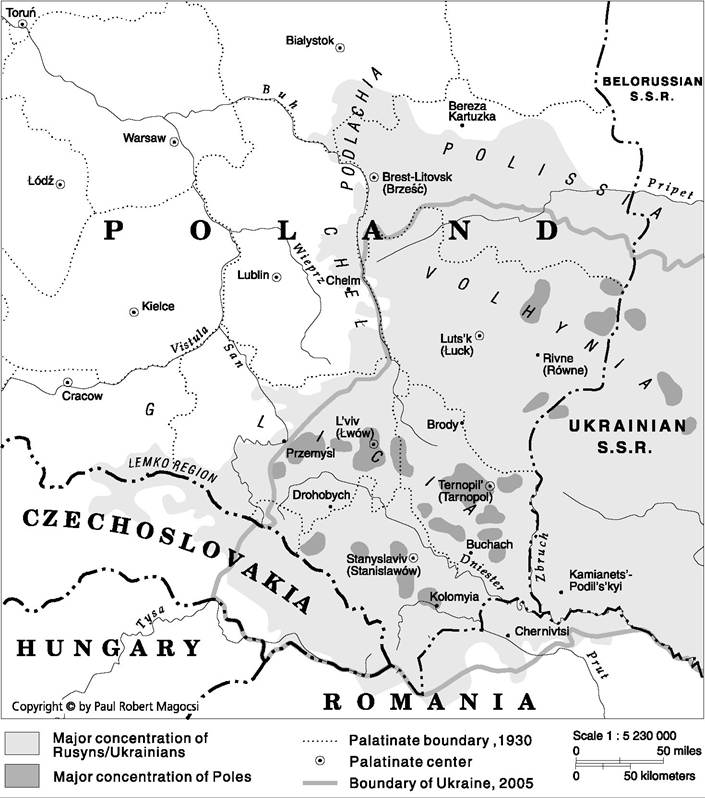
its territory was divided into three palatinates: Lwow/L’viv, Stanislawow/Stanysla- viv, and Tarnopol/Ternopil’. Initially, the Polish government considered Ukrainian-inhabited eastern Galicia a distinct territorial entity, and from March 1920 it was referred to by the Polish name Mafopolska Wschodnia, or Eastern Little Poland. Eventually, in September 1922, the Polish Sejm approved a law that proposed selfgovernment for each of the three Ukrainian-inhabited palatinates. This law, however, was never ratified by the Polish government. The other Ukrainian-inhabited lands - historic western Volhynia, western Polissia, southern Podlachia, and Kholm - were divided among the Polish palatinates of Luck/Luts’k, BrzeSc/Brest, and Lublin.
The economic status of Ukrainian-inhabited lands
The socioeconomic development of Ukrainian lands within interwar Poland evolved in a manner that was in stark contrast to the situation in neighboring Soviet Ukraine. Eastern Galicia and the other Ukrainian territories in Poland essentially remained what they had been before 1914 under Austrian and Russian rule. In other words, they continued to be treated as territories from which raw materials could be obtained and in which products from the more industrial western and central parts of Poland could find a market. In general, however, the entire Polish economy was agrarian in nature; it remained weak and unstable throughout the interwar period; and it was especially hard hit by the world economic crisis of the 1930s. In these circumstances, there was little hope that the Polish government could make any substantial improvement in the economy of its “peripheral” eastern regions (kresy) inhabited by Ukrainians.
Thus, by 1939 eastern Galicia, with over 5 million inhabitants, had a mere 44,000 workers, employed in 534 industrial enterprises. This small industrial sector consisted primarily of woodworking mills (35.2 percent), food processing plants (20.9 percent), building-material factories (14 percent), and metalworking shops (12.5 percent). The oil-producing regions in eastern Galicia (around Boryslav and Drohobych), which had made remarkable progress on the eve of World War I (producing almost 4 percent of world production), never again reached their prewar levels. The highest output under Polish rule (737,000 tons [670 thousand metric tons] in 1923) was only one-third the highest prewar level. Then came the world economic depression and a decline in the traditional foreign investments, which, together with the gradual exhaustion of the oil deposits, reduced the output. By 1938, the eastern Galician fields were producing less than half what they did in 1923. Even less industrial development took place in the northern territories of Volhynia, Podlachia, and Polissia, where there were at most 8,000 industrial workers with steady employment and another 11,000 seasonal workers in basalt and granite factories and in the lumber industry.
Since agriculture was the dominant element in the economy of Poland’s Ukrainian lands, the agrarian question was most pressing. The peasants in Poland, notwithstanding their nationality, all expected to benefit from the new political situation and to obtain land. In July 1919, the provisional Polish parliament (Sejm) called for agrarian reform. Within a year, the parliament considered a law providing for compulsory partition of the large landed estates, which at the time accounted for 47 percent of the country’s arable land. The proposed law was blocked by its opponents, however, and it was not until December 1925 that the Polish parliament succeeded in passing a law that indeed called for the partition of the large estates, but only on a voluntary basis.
Despite the voluntary nature of the reform, the land was partitioned, and by 1938 nearly two million acres (some 800,000 hectares) had been redistributed within Ukrainian-inhabited areas. The redistribution did not necessarily help the local Ukrainian population, however. For instance, as early as 1920, 39 percent of the newly allotted land in Volhynia and Polissia (771,000 acres [312,000 hectares]) had been awarded as political patronage to veterans of Poland’s “war for
TABLE 46.1
Landholdings in interwar eastern Galicia, 19311
| Size of farms | Percentage |
| Under 5 acres (2 hectares) | 45 |
| 5-12 acres (2-5 hectares) | 34 |
| 12-25 acres (5-10 hectares) | 8 |
| Over 25 acres (10 hectares) | 2 |
| No data given | 11 |
| TOTAL | 100 |
independence,” and in eastern Galicia much land (494,000 acres [200,000 hectares]) had been given to land-hungry Polish peasants from the western provinces of the country. This meant that by the 1930s the number of Poles living within contiguous Ukrainian ethnographic territory had increased by about 300,000. Looked at in another way, ethnic Poles comprised 40 percent of the urban population and 21 percent of the rural population in eastern Galicia, and 29 percent of the urban population and 20 percent of the rural population in the “northern” Ukrainian lands. These increases were owing not only to the influx of Poles into the area, but also to a decrease in the number of Ukrainians due to emigration abroad. During the interwar period, approximately 150,000 Ukrainians left Poland, the vast majority - in consequence of United States immigration restrictions after 1924 - going to Canada, Argentina, and France.
The size of individual Ukrainian landholdings in both eastern Galicia and the northern territories remained small (see table 46.1). Size, moreover, was crucial to the welfare of the individual farmer. Contemporary observers concluded that properties less than twelve acres (five hectares) in size were generally inadequate to sustain a single family. Not only were such farms incapable of producing a sufficient amount of food to support the family, but sales in a local market from the surplus of any one crop would not produce enough cash to buy foodstuffs that were not produced at home. Nor could animals belonging to the small landholder make up the shortfall. This meant that farmers who owned less than twelve acres (five hectares) of land - and they made up 79 percent of landholders in eastern Galicia - were forced for at least part of the year to seek supplemental employment elsewhere just to survive.
Leaving aside the problem of small landholdings, Ukrainian farmers in Poland also suffered, at least initially, as a result of the damage caused during World War I. For instance, 20 percent of the rural population lost their homes and farm buildings during the war, and 38 percent of the horses, 36 percent of the cattle, and 77 percent of the hogs were destroyed.
Poland’s initial policies and Ukrainian reactions
At the close of World War I, Poland signed international treaties respecting equality for its national minorities and entered guarantees for them into its 1921 constitution. Such agreements might have been acceptable to a group that had developed a perception that they were a national minority. Ukrainians in eastern Galicia, however, had virtually reached a stage of equality with Poles under Austrian rule during the first decades of the twentieth century. Then, when the Habsburg Empire fell, they had created and fought for an independent western Ukrainian state (1918-1919). Even the victorious Allied Powers themselves initially (at least officially, until 1923) held to the possibility of some kind of self-rule for the Ukrainians in eastern Galicia.
In this environment, the Ukrainians of Poland, most especially those of Galicia, were not about to accept the status of a national minority in what they considered their own homeland. That would be tantamount to turning back the historical clock. And that is exactly what Poland tried to do.It is true that some Polish leaders, including the country’s legendary national liberator Marshal Jozef Pilsudski, at times considered the possibility of recreating a tripartite federated Polish state as a variant of the pre-partition Polish-Lithuanian Commonwealth, which until the eighteenth century had united under one sceptre Poles, Lithuanians, and Ukrainians. Visions based on past models would, of course, require that Poland’s boundaries reach at least as far as Kiev and take in Belarus and Lithuania as well. But the inconclusive results of the Polish-Soviet war in 1919-1920 and the creation of the Belorussian and Ukrainian Soviet republics shattered any prospect of a revival of the old Commonwealth on a tripartite federative basis. Moreover, Poland was restricted to smaller frontiers and Pilsudski’s expansive federative approach with its tolerance toward national minorities was discredited. It turned out that the most influential political force in the new postwar state was the National Democratic movement, or the Endeks (Polish: Endecja), headed by the increasingly extremist nationalist leader Roman Dmowski. He and the interwar political parties that the Endeks supported promoted the idea of a unitary nation-state in which peoples other than Poles - including Lithuanians, Belarusans, and Ukrainians in the country’s eastern borderlands (kresy) - should be assimilated into the Polish nationality.
Not surprisingly, many Ukrainian leaders, especially from Galicia, reacted to the new situation as if a state of war still existed. In fact, the Polish forces which took over the province in mid-July 1919 interned, during the first months, several thousand Ukrainians who had fought (or were suspected of having fought) against them. Ukrainian charges of brutality and executions were countered by Polish accusations of Ukrainian sabotage and allegations of Ukrainian terror in Galicia. Indeed, Ukrainians initiated an underground war, especially after the brief return to eastern Galicia in 1921 of Ievhen Konovalets’. Konovalets’ had been the leader of the Galician-Bukovinian Battalion of Sich Riflemen, which until its dissolution in early 1920 had fought with the forces of the Ukrainian National Republic in Dnieper Ukraine. In “occupied” eastern Galicia, Konovalets’ established the Ukrainian Military Organization (UVO), which during 1921 and 1922 undertook a campaign that included the burning of Polish estates; the destruction of Polish governmental buildings, railroads, and telegraph lines; and political assassinations. Among these was an unsuccessful attempt to shoot Marshal Pilsudski during the chief of state’s visit to L’viv in September 1921, and the successful assassination in October 1922 of a Ukrainian political leader (Sydir Tverdokhlib) who favored cooperation with the Poles and participation in elections to the new Polish parliament.
Because of the tense situation on the international front, most Galician-Ukrainian political leaders followed the instructions of the West Ukrainian governmentin-exile, headed by levhen Petrushevych in Vienna. The result was a boycott of the first elections to the Polish parliament, held in November 1922. In the northern, non-Galician lands, however, Ukrainians did go to the polls and elected twenty representatives to the House of Deputies (Sejm) and five to the Senate. Although these first Ukrainian deputies and senators to the Polish parliament affirmed that their ultimate goal was an independent Ukrainian state, they declared that in the interim, until such a goal became a reality, they were willing to cooperate with the Poles in return for Warsaw’s non-interference in their own national life.
The early years of Polish rule also had a negative impact on Ukrainian cultural life in Galicia. The Polish administration closed many of the popular Prosvita Society reading rooms, an action which, combined with the devastation brought about during the war years, produced a marked decline in the number of reading rooms, from 2,879 in 1914 to only 843 in 1923.
As for the educational system, the provincial school administration from the Austrian era, which was based in L’viv and had separate Ukrainian representation, was abolished in January 1921. All decisions were subsequently to be made by Poland’s central government in Warsaw and to be implemented by administrators in local school districts. Ukrainians now found themselves within six different Polish school districts (L’viv, Volhynia, Polissia, Cracow, Lublin, and Bialystok), although at least initially the Ukrainian school system itself, especially at the elementary level, was left undisturbed.
At the higher levels, Ukrainian education fared much worse. Under prewar Austrian rule the Ukrainians may have expressed dissatisfaction, but their demands for Ukrainian-language university departments (katedry) were at least fulfilled. Their constitutional demands for a separate Ukrainian university were also finally met with a promise by the Habsburg authorities that one would be created by 1916. Now, under Polish rule, a parliamentary recommendation for a Ukrainian university was disregarded, and in 1919 all the Ukrainian departments at L’viv University save one were abolished. The one remaining was the old 1848 Department of Ruthenian (Ukrainian) Language and Literature, but even its chair was left vacant until 1927, when it was filled by a Pole, the respected linguist Jan Janow. Faced with this situation, Ukrainians founded an illegal university known as the Ukrainian Underground University, which, with three faculties and at its height 1,500 students, functioned from 1921 until 1925, when it was pressured by Polish authorities to cease operations. Many of its students, as well as other young Galician Ukrainians who had been denied admission to L’viv’s Polish university because they had not fought for Poland during the Polish-Ukrainian war, went abroad instead. Neighboring Czechoslovakia was the most popular destination, where they attended either the Ukrainian Free University or the renowned Charles University in Prague.
By 1923, it was clear that the diplomatic activity of the West Ukrainian government-in-exile and the underground sabotage work of the Ukrainian Military Organization had failed to dislodge Polish rule in eastern Galicia. As a result, Ukrainian leaders were forced to adapt to the new political realities. During the fifteen-year period until the outbreak of World War II in 1939, the different responses to their situation on the part of Ukrainians in Poland found expression in essentially three approaches: (1) the cooperative movement, which acquiesced to Polish rule and worked within it to create a solid economic and cultural foundation for the Ukrainian minority; (2) active participation in Polish civic life by political parties, which lobbied through legal means on behalf of Ukrainian cooperatives, schools, and churches; and (3) armed resistance by paramilitary groups, which from the outset rejected Polish rule and strove in whatever way they could to destabilize society.
The cooperative movement
The rather dismal state of agriculture in the Ukrainian lands within Poland was made tolerable only by the remarkable advances of the cooperatives and credit unions. On the eve of World War I, the Ukrainians in Galicia had a total of 609 cooperatives. Although the number of these declined because of World War I (579 in 1921), the following years witnessed a revival, with the result that by 1939 there were 3,455 cooperatives spread throughout the whole region and united by an umbrella organization known as the Audit Union of Ukrainian Cooperatives. Initially, the Audit Union also founded cooperatives in Volhynia and Polissia, but in 1934 the Polish government passed a law requiring Ukrainian cooperatives outside eastern Galicia (the Twow, Stanislawow, and Tarnopol palatinates) to unite with local Polish cooperatives.
The cooperatives in eastern Galicia, which by 1923 had a total of 600,000 members, promoted the use of modern techniques and machinery in farming. Most important, they provided financing and marketing services. The most influential of all Ukrainian cooperatives was the Maslosoiuz, or Dairy Union, set up already before World War I. The Maslosoiuz expanded steadily during the interwar years, and by 1938 it included 136 district dairies supplied by over 200,000 farms producing enough butter to dominate the Galician market as well as to export to neighboring Czechoslovakia and Austria. Also of importance were the Sil’s’kyi Hospodar, or Village Farmer Association - with sixty branches, over 2,000 local units, and 160,000 members (1939) - whose primary concern was to provide farmers with practical and theoretical training in agriculture; and the Tsentro- soiuz, or Union of Cooperative Unions, whose goal was to coordinate the activity of the various cooperatives. By 1938, the Tsentrosoiuz represented 173 central, regional, and individual cooperatives, to whom it sold consumer goods, agricultural machinery, and building materials at wholesale prices, and for whom it marketed Ukrainian agricultural products throughout Poland and abroad.
Ukrainian women in eastern Galicia had their own Ukrainian Folk Art Cooperative, which functioned as part of the Soiuz Ukrainok (Union of Ukrainian Women). Founded in 1921, the Soiuz Ukrainok grew rapidly and by 1936 included 45,000 members, in nearly 1,200 urban and village branches. Aside from courses for women on how to operate cooperatives and nursery schools, the group established its own cooperative with the express purpose of popularizing and selling folk art items produced at home.
Each of the cooperatives also had its own Ukrainian-language publications, and
Women and the Ukrainian National Ethos
For stateless peoples like the Ukrainians, whose culture and language for much of the nineteenth and twentieth centuries was suppressed or, at best, tolerated, and who for the most part lacked access to a formal educational system that could preserve and promote their national distinctiveness, the role of the family as a carrier of the national ethos took on special importance. It was in the family that the Ukrainian language and legends about the national past were passed on to younger generations. Since women were at the center of domestic life, it was mothers and grandmothers who for much of the nineteenth and early twentieth centuries became the primary carriers of the Ukrainian national ethos.
It is not surprising, then, that many of the literary images associated with the survival of the Ukrainian language and, by implication, a Ukrainian national identity invoke the relationship of mothers to their children. So many poets have repeated, like a refrain, that as children they “sucked in the Ukrainian language with milk from their mother’s breast.”
Grandmothers, too, have taken on almost mythical proportions as carriers of the national soul. They seem to have been particularly important for grandsons who went off to school and then remained in the towns or cities. For those grandsons who retained a Ukrainian identity and who may even have taken part in the national revival, grandmothers became larger-than-life symbols. They became, at least in the minds of patriots living in a nationally alien urban environment, repositories of the Ukrainian language and culture who were preserving them for future generations in an allegedly pristine rural environment. The urbanized - and sometimes urbane - nationalist intellectual could periodically recharge his or her patriotic batteries by returning for a weekend or summer holiday to mothers and grandmothers who still presided over the family homestead in the rural village. It is therefore not surprising that among the most common images used to describe the country is Ukrai'na-maty, or Mother Ukraine.
Aside from exercising this all-important role within the family, Ukrainian women assisted in the national movement through the creation of formal structures and organizations. For instance, in late-nineteenth-century eastern Galicia, when Ukrainian national organizations first took on massive proportions, women became active members in the popular Prosvita and Kachkovs’kyi societies. Beginning in the late 1870s, the first specifically women’s organizations, both informal groups in Dnieper Ukraine and legally registered organizations in Austrian Galicia, came into being. Among the latter were the Society of Ruthenian Ladies (est. 1878), the Club of Ruthenian Women (est. 1893), and the Women’s Hromada (est. 1909), all based in L’viv with branches throughout eastern Galicia. Galicia was also the home of Nataliia Kobryns’ka, a late-nine- teenth- and early-twentieth-century short-story writer who today is generally considered Ukraine’s pioneering feminist.
Kobryns’ka’s views did not, however, have much popular appeal. In part, this is because in contrast to women’s movements in other parts of Europe and North America, which at the time were concerned primarily with the liberation of women, the right to vote, philanthropy, or the struggle against prostitution, the movement among Ukrainian women activists had more general goals. They directed their energy to the needs of the existing nationalist movement and, both within male-dominated organizations and in separate women’s organizations, worked to raise the status of all Ukrainians by trying to eliminate social ills caused by alcoholism, illiteracy, and economic disparities. Instead of philanthropy, Ukrainian women’s organizations actively participated in the selfhelp or cooperative movement.
The Ukrainian women’s movement did not really come into its own until after World War I. The largest and most successful of the women’s organizations was the Union of Ukrainian Women (Soiuz Ukrainok), which functioned in eastern Galicia from 1921 until its abolition by the Polish authorities in 1938. Two of the union’s leading activists were Milena Rudnyts’ka, who was elected twice to Poland’s House of Deputies, and Olena Kysilevs’ka, who was elected twice to the Polish Senate. From their elected posts, both women were able to initiate programs that helped to improve the status of all Ukrainians in interwar Poland.
At the same time, the women’s movement in Soviet Ukraine was following a different path. With the establishment of Bolshevik rule, all previously existing informal and formal women’s organizations were abolished. In their stead, the Women’s Section (Zhinochyi viddil, or Zhinvid) of the Communist party (Bolshevik) of Ukraine was created in 1920 and headed for its first four years by Lenin’s close associate and expert on women’s issues throughout the Soviet Union, Aleksandra Kollontai. Activists in the party’s Women’s Section worked to eliminate illiteracy and to educate women in the countryside about the advantages of socialism. Members of the Women’s Section, which was an arm of the Communist party - CP(b)U - also acted as informers against peasants who did not readily accept Soviet socioeconomic policy. The informers did not discriminate on the basis of gender, so that women equally with men accordingly suffered the often fatal consequences of dekulakization, forced collectivization, and famine.
By 1930, the Soviet Union had declared that there was no women’s question and that consequently there was no need for the Women’s Section of the CP(b) U. After all, according to Soviet law, women were equal to men and therefore had equal access to educational facilities, social services, employment, and participation in the Communist party. Such equality turned out to be a doubleedged sword, however, especially with regard to the workplace.
In rural Ukrainian society, women had always worked the fields and tended farm animals alongside men. In rapidly industrializing Soviet Ukraine, women were not only given equal access to employment, but were expected to work full time, just like the men. There seemed, moreover, to be no distinction between the kinds of jobs available to and expected of men and women. Accordingly, it was common in Soviet Ukraine to find women employed as construction workers doing heavy manual labor such as hoisting concrete or laying railroad tracks. In the last years of Soviet rule women made up 52 percent of Ukraine’s entire work force (at the time the highest percentage among all developed countries worldwide), and they made up 80 percent of all workers engaged in heavy physical and often low-paying and dangerous labor.
Not much has changed in post-Communist independent Ukraine. Granted, at the outset of the twenty-first century some women have been catapulted to fame throughout the country and abroad, among them the popular singer Ruslana, and, in particular, the successful businesswoman and highly influential political leader luliia Tymoshenko. Modern social realities have not, however, changed traditional attitudes in the relationship between men and women. Women are still expected to raise children, cook, wash, and in general maintain the household. This means, effectively, that women are saddled with the double burden of working outside the home in order to contribute to the family budget and working inside the home in order to address the daily needs of the family.
there is no doubt that the movement as a whole was inspired by national patriotism. In approaching the nationality question, however, the cooperative movement and its leaders were aware that political and military action, as undertaken during the immediate post-World War I period, had been unsuccessful. Accordingly, they argued that a period of organic growth and a strengthening of the economic base of Ukrainian society was necessary. There were others in Galician-Ukrainian society, however, who felt that political or even military action would be a more appropriate response to their situation under Polish rule.
Ukrainian political parties, schools, and churches
By the mid-ig2os, several Ukrainian political parties had come into existence. The most important was the Ukrainian National Democratic Alliance (Ukrains’ke Natsional’ne Demokratychne Ob’iednannia), best known by its Ukrainian acronym, UNDO. Founded in 1925, UNDO included some of the leading figures in prewar Galician-Ukrainian life, whose political experience had been formed under the Habsburg Empire (Kost’ Levyts’kyi, Volodymyr Bachyns’kyi, Volodymyr Zahaikevych), as well as younger activists who began their political work under Polish rule (Dmytro Levyts’kyi, Ivan Kedryn-Rudnyts’kyi, Vasyl’ Mudryi). In a sense, UNDO was a continuation of the prewar Ukrainian National Democratic party, and, like its ideological predecessor, it looked forward to a future independent Ukrainian state. In the interim, however, UNDO hoped to obtain positive changes for Poland’s Ukrainians through legal means. Aside from its own party organ Svoboda (Freedom, 1897-1939), UNDO was supported by several other newspapers, including the influential Galician-Ukrainian daily newspaper Dilo (The Deed, 1880-1939).
More to the left in the political spectrum was the Ukrainian Socialist-Radical party (led by Lev Bachyns’kyi and Ivan Makukh), a continuation of the prewar Ukrainian Radical party. The Socialist-Radicals favored the secularization of Galician-Ukrainian life and the introduction of socialism, although not of the Marxist variety. On the far left was the Communist party of Western Ukraine (KPZU). Formed in 1921 as the Communist party of Eastern Galicia, it was ordered by the Comintern to join the Communist party of Poland, of which it became an autonomous branch. When, in 1924, the party was declared illegal by the Polish government, the Communists went underground. Subsequently, the KPZU was racked by internal controversy over the direction of events in Soviet Ukraine. One faction, led by Osyp Vasyl’kiv and the theoretician Roman Rozdol’s’kyi, favored the policy of “national communism” as carried out by Oleksander Shums’kyi in Soviet Ukraine before his demotion in early 1927. Another faction accepted the idea of internationalist party loyalty and acceptance of guidelines set in Moscow. The matter came to a head with a purge of the Galician “Shums’ky-ites” in 1928. Internal dissension nevertheless continued within the KPZU, largely because of friction with the Polish Communist party apparatus and displeasure among some members with the ever-changing Soviet policy regarding Ukrainianization. Moscow retorted that the Galicians were guilty of “bourgeois-nationalist deviation,” until finally, in 1938, the Comintern decided to dissolve the KPZU.
The problem of Soviet Ukraine affected many more Ukrainian leaders in Poland than just the Communists. During the height of the Ukrainianization policy of the mid-i92os, a special West Ukrainian Institute was set up in Kharkiv, and it attracted several left-wing emigres from Galicia. Even the head of the West Ukrainian government-in-exile, Ievhen Petrushevych, thought cooperation with the Soviets might help the Galician-Ukrainian cause against Poland. Several other Galician intellectuals, including Mykhailo Lozyns’kyi, Antin Khrushel’nyts’kyi, luliian Bachyns’kyi, Stepan Rudnyts’kyi, and Oleksander Badan-Iavorenko emigrated to Soviet Ukraine, although subsequently they were swept up in the purges of the 1930s and perished.
The Russophiles, at least in eastern Galicia, remained a political force during the interwar years, although on the national-cultural front they were completely outdistanced by the Ukrainians. Their parties, the Russian Peasant party (Russkaia Selianskaia Partiia) and Russian Agrarian party (Russkaia Agrarnaia Partiia), which merged in 1931, drew their support from the Old Ruthenian and Russophile cultural institutions like the Stauropegial Institute and the National Home, as well as from those villages, especially in the westernmost Lemko region, where the Kachkovs’kyi Society and the Orthodox movement were the strongest. There was also a group of Galician Russophiles who joined the Volhynian and Chelm-based Peasant Union (Selsoiuz), which was Communist in orientation. After splits within this group, some Russophiles (Kyrylo Val’nyts’kyi and Kuzma Pelekhatyi) joined the KPZU, and even though the latter was Ukrainian in orientation they continued to promote their Russophile views on national identity.
These and other non-Communist Ukrainian political parties participated in some or all of the elections to the Polish parliament held in 1928, 1930, 1935, and 1938. The strongest Ukrainian party in both the Sejm and the Senate was UNDO, which opposed the settlement of Poles in traditional Ukrainian-inhabited territo-
TABLE 46.2
Ukrainian-language and bilingual schools in interwar Poland, 1922-19382
| Ukrainian schools | Polish-Ukrainian schools | |||
| 1922 | 1938 | 1928 | 1938 | |
| Galicia | 2,426 | 352 | 1,635 | 2,485 |
| Volhynia | 443 | 8 | 652 | 520 |
| Polissia | 22 | 0 | - | - |
ries and made demands concerning the status of Ukrainian schools, the Ukrainian language, the Greek Catholic and Orthodox churches, and the reaction of the Polish government to Ukrainian terrorist activity.
During the 1920s, the Polish government increased the total number of schools in Ukrainian areas, especially in the formerly Russian-ruled northern territories of Volhynia and Polissia, where the number of elementary schools rose over threefold, from 1,000 in tsarist times (1912) to 3,100 during the last full year of Polish rule (1938). In eastern Galicia, the number of elementary schools rose from 4,030 to 4,998 during the same period. The Polish administration could also take credit for a decline in illiteracy among people over ten years of age, from 50 percent in 1921 to 35 percent in 1931.
Polish educational policy, however, had a negative impact on Ukrainian language use. In 1924, the government of Prime Minister Wladyslaw Grabski passed a law (known as the lex Grabski), over the objections of Ukrainian parliamentary representatives, which set up bilingual Ukrainian and Polish schools. The result was a rapid decline in the number of unilingual Ukrainian schools together with a sharp increase in Polish-Ukrainian bilingual schools in Galicia and Polish schools in Volhynia (1,459 in 1938) (see table 46.2).
Ukrainians viewed bilingual schools as a first step toward the national assimilation of their children. Their concerns were not unjustified, since Polish soon became the primary language in bilingual schools. The response of the Ukrainians was to establish private schools, especially at the secondary level. This effort was undertaken in large measure by the prewar Ukrainian Pedagogical Society (est. 1881), renamed the Native School Society (Ridna Shkola) in 1926. By the 1937-1938 school year, 59 percent of all Ukrainian gymnasia, teachers’ colleges, and technical schools, with approximately 40 percent of Ukrainian students at those levels, were privately operated.
Since Ukrainians in Poland had only limited control over the formal education of their children, the Plast scouting movement took up the challenge of inculcating youth with a Ukrainian national identity. Plast scouts came into being on the eve of World War I on Ukrainian lands in both the Russian and the Austro-Hungarian Empires, but it was during the interwar years in western Ukraine (in particular Galicia and Transcarpathia) that they had their greatest success. By 1930, the organization had over 6,000 male and female members in branches affiliated with secondary schools in Galicia and with Prosvita societies in western Volhynia. Concerned by Plast’s general popularity and the fact that many of its “graduates” after age eighteen joined clandestine Ukrainian nationalist organizations, Poland’s authorities increased restrictions on the movement until banning it entirely after 1930. It nonetheless continued to operate underground or through other organizations for the rest of the decade.
The status of Ukrainians was also affected negatively by another law passed in 1924, which excluded Ukrainian language use in governmental agencies. Moreover, the Polish government never referred to the Ukrainians and their language by the modern name Ukrainian; instead, it used the historical name Rusyn (Polish: Rusin), thereby inadvertently contributing to a disliking on the part of many Ukrainians, especially Galician Ukrainians, for their original national designation. Finally, in the 1930s, the Polish government adopted a policy of tribalization, which gave support to the idea that various ethnographic groups (Lemkos, Boikos, Hutsuls) as well as the Old Ruthenians and Russophiles were somehow distinct from the Ukrainian nationality as a whole. This policy was implemented especially in the westernmost Lemko Region, where state schools offered instruction in the Lemko vernacular and where in 1934 a jurisdictionally separate Greek Catholic Lemko Apostolic Administration was established.
The Ukrainian nationality question in Poland was involved with developments in the church as well as in politics and education. These developments were complicated by the fact that Ukrainians belonged to two churches. In eastern Galicia, they were primarily Greek Catholic; in the northern areas formerly part of the Russian Empire, they were Orthodox.
According to an agreement (concordat) between Poland and the Vatican signed in February 1925, the jurisdiction of the Greek Catholic Metropolitanate of Ha- lych, with its seat in L’viv, was reaffirmed, although its activity was restricted to its three eparchies (L’viv, Przemysl, and Stanyslaviv) in eastern Galicia. With regard to internal developments, the interwar years witnessed a sharpening in the debate within the Greek Catholic Church between those elements (Bishops Hryhorii Khomyshyn of Stanyslaviv and losafat Kotsylovs’kyi of PrzemySl, and the Basilian Order), who favored the adoption of a more Western religious model, including celibacy, and those (Metropolitan Sheptyts’kyi, Bishop Nykolai Charnets’kyi, and the Studite Order), who preferred the preservation of the Eastern rite and spirituality. Quite often in the course of the debates, the “Easterners” would present themselves as patriots defending Ukrainian national traditions in opposition to the Western-oriented (critics would say pro-Polish) “Latinizers.”
In more general terms, the intellectual life of the Greek Catholic Church was allowed to flourish in interwar Poland. A wide variety of theological and scholarly journals were published, and the Greek Catholic Theological Academy was established in L’viv in 1928. The Academy, headed by the Reverend losyf Slipyi, was the only Ukrainian institution of higher learning in Poland. Finally, the Greek Catholic Church’s status was upheld throughout the interwar years because it remained under the leadership of Metropolitan Sheptyts’kyi, the “patriarch” of the Ukrainian movement who was respected by the highest Polish ruling and social circles.
In contrast, the Orthodox Church, with over two million Ukrainian adherents in the northern territories (Volhynia, Polissia, and Chelm), was in a less favorable position than the Greek Catholic Church in Galicia. Although historically associated with the tsarist government and its policy of russification, the Orthodox Church in Poland attempted to break with the past, obtaining independence (autocephaly) in 1924 and its own metropolitan see (headed by Metropolitan Dionizy) in Warsaw. The Russophile character of the church also changed as the Orthodox seminary at Kremenets’, in Volhynia, and the Orthodox theological department at Warsaw University (after 1924) began to teach in Ukrainian, and liturgical materials were published in Ukrainian. Nonetheless, the Polish authorities especially at the local level remained ill disposed to what was considered a “schismatic” church with roots in Russia. Such attitudes resulted in the so-called revindication campaigns in 1929-1930 and again in 1938, whose goal was to deprive the Orthodox of those churches that had once been Greek Catholic (that is, before Orthodoxy was imposed by the prewar tsarist Russian government). This policy was particularly detrimental to Orthodoxy in the Chelm and Podlachia regions, where in 1929 and 1930 alone, 111 Orthodox church buildings were closed, 59 were destroyed, and 150 were converted into Roman (not Greek) Catholic churches. Physical destruction was particularly rampant in 1938, when within a few months almost 150 church buildings were destroyed in the Chelm and Podlachia regions, prompting protests by Ukrainian deputies in the Polish parliament against what was described as wanton cultural discrimination.
Armed resistance and pacification
Given the generally unfavorable attitude of the Polish government toward its Ukrainian minority, especially evident in educational policy, in the restrictions on the official use of Ukrainian, and in anti-Orthodox discrimination, and given what seemed an inability on the part of the Ukrainian cooperative movement and legal political parties to counteract Polish policy, it is not surprising that for some people armed resistance presented itself as the only viable course of action. Throughout the 1920s, the Ukrainian Military Organization (UVO) continued its policy of political assassination, bomb attacks on governmental buildings, and sabotage against railroad and telegraph installations.
Such activity on the part of the UVO was sporadic, and in any case it was increasingly unpopular among the Galician-Ukrainian public after 1923. To improve the reputation and effectiveness of the underground, a more strictly disciplined and ideologically determined organization seemed necessary. Such a movement arose among Ukrainian emigre youth and student groups in central and western Europe, where the UVO leader Konovalets’ had been functioning in exile since 1922. At a meeting held in Vienna in 1929, representatives of several emigre groups founded the Organization of Ukrainian Nationalists (OUN). The UVO leader Konovalets’ was made head of the new organization, which before long had branches throughout Ukrainian emigre centers as well as in the western Ukrainian lands of Galicia, Bukovina, and Transcarpathia. Initially there was conflict over the respective roles to be played by the OUN and the older UVO, but by 1932 the latter had been merged with the Galician branch of the OUN and thus had ceased to exist as an independent organization.
The OUN was a highly disciplined underground revolutionary movement dedicated to the overthrow of Polish, Romanian, and, eventually, Soviet rule in Ukrainian territories. The movement drew its ideological inspiration from Dmytro Dontsov, a native of Dnieper Ukraine who in 1908 had fled to Galicia and then gone to Vienna to study. After the war, he settled in L’viv, where he edited the leading Galician-Ukrainian journal of public affairs, the Literaturno-naukoiyi vistnyk (Literary-Scholarly Herald, 1922-32), and its successor, Vistnyk (The Herald, 1933-39). Despite his influence among many OUN members, Dontsov never became a member of the organization and, in fact, remained openly critical of some of its policies.
Dontsov espoused integral nationalism, the theory that the nation, as embodied in an independent state, was the supreme ideal. To achieve this ideal, an aggressive will and the ability to take action, preferably under the direction of a strong leader, were necessary. Such views were common at the time in many parts of Europe, in particular in Italy, Germany, and Spain. By the 1930s, if not before, those countries were being led by all-powerful leaders (Mussolini, Hitler, Franco) who allegedly embodied the will of the nation-states they represented. The OUN translated Dontsov’s version of integral nationalism into terroristic activity aimed at overthrowing Polish and Soviet rule and eventually creating an independent Ukraine. By the 1930s, especially after news of the 1933 famine reached eastern Galicia, Soviet Ukraine had lost most of its sympathizers among Poland’s Ukrainians. This news, combined with Polish repression and the increasingly worsening economic situation caused by the world depression, made the OUN an attractive alternative for a large number of Ukrainian students and peasant youth whose futures did not look promising.
The OUN’s purpose was simple: to destabilize the situation in Poland until the government finally collapsed. Not surprisingly, the OUN opposed UNDO and other political parties which worked through legal channels, and it had little sympathy with the constructive work of the cooperative movement, which, according to OUN leaders, implicitly if not explicitly accepted Polish rule. Throughout the 1930s, the OUN in Galicia (led by figures like Bohdan Kravtsiv, Bohdan Hna- tevych, Bohdan Kordiuk, Stepan Bandera, and Lev Rebet) engaged repeatedly in acts of sabotage. These included the well-publicized assassination of a Soviet consular official in L’viv (1933) in protest against the famine in Soviet Ukraine and the assassination of the Polish minister of internal affairs Bronislaw Pieracki in June 1934. Despite its popularity among certain segments of the population, most legal Ukrainian political parties and other groups, as well as the still-prestigious Greek Catholic metropolitan Andrei Sheptyts’kyi, publicly denounced the terrorist activities of the OUN.
The Polish government tried to curb the OUN's activity. Its first extensive effort in this direction was the so-called pacification program carried out between 16 September and 30 November 1930. Imagining potential terrorists at every corner, detachments of Polish soldiers and police went through Ukrainian villages interning known activists and indiscriminately beating men and women in the process. While the pacification program did not result in much loss of life - and therefore is in no way comparable to collectivization in Soviet Ukraine, which began in earnest at the same time - it nonetheless deepened the hatred between Ukrainians and Poles. It also became a cause celebre for many liberals in the West, especially in Great Britain, where Poles were depicted by some members of the House of Commons as brutal oppressors. The Polish policy of pacification in 1930 and the subsequent arrests of Ukrainian activists (a detention camp was set up at Bereza Kartuzka in 1934) only helped to increase sympathy for the OUN and further to alienate Polish and Ukrainian societies.
There were some Poles, however, both inside and outside the government, who favored some kind of compromise with the country's Ukrainian community. Polish socialist deputies, for instance, tried in March 1931 to have the issue of autonomy for Ukrainians discussed in the parliament. More serious was the government's attempt at compromise with the UNDO, in an agreement reached in July 1935. Known popularly as “normalization,” this agreement assured Ukrainians of a total of nineteen seats in both houses of parliament, the election of the UNDO activist Vasyl' Mudryi as vice-marshal of the parliament, an amnesty for imprisoned nationalists, and credits to Ukrainian economic organizations. One result of normalization was a split in the UNDO between those who favored and those who opposed cooperation with the government. Owing to the split, the UNDO was never to regain the influence it once had among Poland's Ukrainians. Moreover, the whole policy of normalization failed within a few years. The failure was the result of continued dissatisfaction among most Ukrainians with Polish rule that included ongoing efforts to create an internally strong Polish nation-state and increasing intolerance of the demands of all national minorities.
Thus, political compromise between the Polish authorities and the country's Ukrainians was doomed. And this was exactly what OUN leaders wanted: to discredit the Polish government and especially those Ukrainians who favored an evolutionary political or an economic (cooperative) solution to the problem of their existence in Poland. In the end, the OUN got what it wanted - not only destabilization, but also the destruction of Poland. This destruction came about, however, not as a result of the OUN's efforts, but because of the outbreak of World War II on 1 September 1939.