SYMBOLIC ACTION: NATIONALIST OPPOSITION AND REGIME RESPONSE
Symbolic action is action the effect of which is other than the manifest, instrumental goal of such action. An election, when there is only one candidate, is an example; another is the conduct of a trial the purpose of which is not to determine the guilt or innocence of the accused, but to set an example or publicly to discredit the defendant and others like him.
Similarly, an appeal or a petition by a dissident to an official instance when there is no hope of redress is an action intended not to obtain remedy, but graphically to confront officials with the contradiction between articulated and actual policy.The dialogue between Ukrainian nationalist dissenters and the regime has been largely in terms of actions which are to varying degrees symbolic in this sense. This is the result of severely restricted communications, highly controlled channels of interest articulation, and the sanctions applied to the expression of demands the content of which are uncongenial to the state. An increase in such symbolic actions signifies a move away from the "subject-participant" political culture that has characterized Soviet society. To the degree to which such actions break the pattern of acquiescence and external consensus, they present a challenge to the regime. The existence of dissent itself is embarrassing to a state which bases its legitimacy on a claim to unanimity of societal goals. The desire to suppress dissent without unduly publicizing its existence forces the state to resort to forms of action which can also be classified as symbolic within our meaning.
In this chapter, we shall examine the phenomenon of Ukrainian nationalist dissent with regard to the structure of the movement, its demographic bases, its systems of communications, and the strategies and tactics it has employed in its search for effective means of interest articulation.
Likewise, we shall examine the response of the regime, paying attention to the use of the judicial and penal systems, and to symbolic means by which the regime attempts to discredit the dissenters publicly and detract from the legitimacy of their demands for greater Ukrainian cultural and political autonomy.STRUCTURAL AND PROGRAMMATIC CHARACTERISTICS OF UKRAINIAN NATIONAL DISSIDENCE
Structurally, the dissent movement in the Ukraine in the post-Stalin period has been inchoate, not coordinated as a whole. The most notable instances of opposition have been the acts of individual intellectuals, acting with the moral support of other dissidents, but rarely as an organized group.
Organized Clandestine Groups
Organized clandestine groups, when they have existed, have been small, and apparently easily subdued by the state. Not all of the organized groups have been outright secessionist organizations prepared for armed struggle; those that have, however, have appeared exclusively in the West Ukraine. The organization of groups outside the sponsorship of the Party (even apart from their programmatic goals) is discouraged, so it is not surprising that clandestine groups are more extreme in their aims than the ad hoc cultural opposition. Samvydav sources provide information on ten such organized groups with nationalist programs in the Ukraine in the period under study; we shall briefly discuss each one.
1. United Party for the Liberation of the Ukraine.
This was a group of workers who formed an organization in Ivano-Frankivs'k in the late 1950s, devoted to the liberation of the Ukraine and the creation of an independent state. It is not known whether the group advocated violent means to this end. The members of the group were arrested in December, 1958 and sentenced in March, 1959.1
2. The Ukrainian Workers’ and Peasants’ Union.
This was a group of intellectuals and workers in L'viv, arrested at the end of 1960 and tried in May, 1961 for attempting to form a party along Marxist-Leninist lines and advocating the legal and non-violent secession of the Ukraine from the Soviet Union - a right specified in Article 17 of the 1936 USSR Constitution and Article 14 of the Constitution of the Ukrainian SSR - subject only to a popular
2
referendum.
In addition to the advocacy of secession, Ivan Kandyba, a defendant in the case, listed the grievances of the Ukrainians on the nationality issue; these included the bans on Ukrainian cultural figures, the restriction of Ukrainian political and economic rights, the denial of the Ukraine’s right to relations with other countries, discrimination against the Ukrainian language, and the "removal of 2/3 of her wealth" from the Ukraine.Kandyba states that there were numerous such organized groups in the West Ukraine in the 1950s, but there is no information on them.^Ivan Kandyba, ’’List Pershomu Sekretarevi TsK KPU Shelestovi P. lu:
Za pravdu i spravedlisvist’AS 904, SDS Vol. XVIII.
2
For a discussion of the programmatic aims of the group, see AS 904 and AS 906. On Lukianenko, see ’’Anonimnoe soobshchenie ’’Lukianenko Lev Grigorevich,” AS 2301. For a general discussion of the ’’Lawyers’ Case,” see Ukraine’ki iurysti pid sudom KGB (Munich: Suchasnist’, 1968). Many of the documents relating to the case are translated in Michael Browne, ed., Ferment in the Ukraine (London: MacMillan, 1971), pp. 31-93.
3
AS 904, SDS Vol. XVIII.
4Jhid.
Many of the members of the Ukrainian Workers1 and Peasants' Union were Party members and held responsible positions in Party and government in L'viv, and they were relatively open in their activities. For this reason, their arrests and trials were significant as an object lesson for the nationalist movement: they demonstrated the futility of resort to constitutionally protected measures in pursuit of constitutionally guaranteed rights.
3. Ukrainian National Committee
This was a group of twenty young workers in factories and state farms in L'viv oblast, who formed an organization the aim of which was to demand realization of the legal right of the Ukraine to secede from the Union. They were tried and sentenced in December, 1961. Two of the participants, Ivan Koval and Bohdan Hrytsyna, were shot.[21]
4.
OUN CellsWhile the Organization of Ukrainian Nationalists (OUN) was almost completely routed within five years after World War II, some isolated cells apparently escaped attention. Among the last of these was a complete cell discovered in a bunker in Ternopil' oblast in 1961. Although the samvy- dav account implies that the group had lived in the bunker continuously, it seems unlikely that they could have escaped attention in such a hideout for twelve years. In all likelihood, the bunker was used only occasionally. The participants forcibly resisted arrest, and shot themselves before surrendering. The self-inflicted wound of one of the participants, Mariia Pal'chak, was not fatal, and she was tried and condemned to death after complex surgery; on
6Levko Lukianenko also refers to several organized groups, including a group of six from Khodoriv raion in L’viv oblast, the Mykola Apostol group of five sentenced in Ternopil’ in 1961, and the Bohdan Hohus group of five sentenced in Ternopil’ in 1962. See AS 906, SDS XVIII. appeal, the death sentence was commuted to fifteen years in prison camps.Her brother, Stepan Pal’chak, although not a participant, was sentenced to ten years for failing to re- g
port the cell to the authorities.
Another cell, calling itself OUN-North (OUN-Pivnych), was organized among former prisoners of the Vorkuta prison camp still living in the town of Vorkuta (north of the Arc- Q
tic Circle in Komi ASSR). The group, including Bohdan
Khrystynych, Volodymyr Leoniuk and laroslav Hasiuk, adopted the OUN philosophy, and engaged in propagandistic work, particularly the distribution of OUN literature via couriers in the Ukraine. All members were sentenced to fifteen year terms.10
5. Serbenchuk Group
Little is known of this group; samvydav sources report only that Rostislav Serbenchuk was released in March, 1972, after having served 8 years 5 months for attempting to create an anti-Soviet organization in Odesa.11
6.
Democratic Union of SocialistsThis was a small Marxist group formed by Mykola Drahosh (b. 1932), a mathematics teacher and headmaster of a working 7Ukrains ’kyi visnyk 3 (Smoloskyp, 1971), p. 88.
^Ukrains ’kyi visnyk 4 (Smoloskyp, 1971), p. 175.
9
Many former OUN and UPA participants were interned at Vorkuta. In May, 1954, the Vorkuta labor camp was the scene of a mass uprising of Ukrainian and other prisoners, numbering seven thousand, led in part by former OUN member Mykhailo Soroka. The entire camp administration was driven from the camp and held at bay until the uprising was quelled by the army on June 26. The Ukrainians, believing that war with the United States was imminent, were certain that they would be slaughtered rather than permitted to remain on territory occupied by the enemy. See Ukrains’kyi visnyk 6 (Smoloskyp, 1972), pp. 168-77.
Ukrains ’kyi visnyk 3 (Smoloskyp, 1971), p. 87.
11
Khronika tekushchikh sobytii, 25:36. youths’ school in Odesa. Two other teachers at the school, one a Russian, and three Moldavian students in Kishinev, were also members of the group. All were tried and sen-
12 fenced in Kishinev in September, 1964.
7. Ukrainian National Front
This group was active in Ivano-Frankivs'k oblast from 1964 to 1967. According to the samvydav account, events surrounding the arrest were sensational. There are indications that the group regarded itself as a successor to early post-war OUN groups. The group circulated OUN pamphlets dated 1947-49; one of the members of the group had found 7,000 of these pamphlets in three crates in the Carpathians. The group also produced its own samvydav journal, Volia i bat ’kyvshchyna (Liberty and the Fatherland), about fifteen issues of which are reported to have appeared. The journal emphasized propaganda, not terror or forcible seizure of power, as a tactic. The journal also included an open letter to the 23rd Party Congress - reportedly actually sent to Party leaders and the press - and a statement regarding the case of a former OUN member, Dzhuhalo, who had allegedly been parachuted into the Ukraine in the 1950s.
The members of the group were sentenced in November,13
1967 to five and six year prison terms, followed by exile.
8. The Creative Youth of Dnipropetrov s rk
Three prominent members of this group, whose only organized action was to sign a letter protesting Russification and the capaign against Oles' Honchar’s novel Sober in
1968 (see Chapter 3), were arrested and tried in 1969 and 1970; these were Ivan Sokul's'kyi, the drafter of the letter, N.G. Kul'chyn's'kyi, and V.V. Savchenko. They were
12
Khronika tekushchikh sobytii, 15:32, 18:8, 20:26-27, and 23:16.
13
Khronika tekushchikh sobytii, 17:26-28; also see The Ukrainian Review, Vol. XVI, No. 2(1969), pp. 9-12, for reports on this group. The trial received wide publicity in the USSR.
sentenced to terms ranging up to seven years plus exile.
Very little is known of the group outside of the letter, and it is likely that the group’s sole raison d'etre was the drafting of the letter. Information in the letter concerning activities in the Dnipropetrovs'k obkom, however, suggests that members of the group had connections with
14
elite circles. The type of nationalism exhibited by this group is autonomist, not secessionist: a defensive, protective activism aimed against excesses of Russian chauvinism and violation of civil rights, rather than ethnic nationalism. Consequently, the Creative Youth of Dnipropetrovs'k, as well as the Democratic Union of Socialists, have more in common programmatically with the larger all-Union civil rights movement than with secessionist groups, although their small size made them as vulnerable as the latter.
9. Initiative Committee of Ukrainian Communists
Very little is known of this group as an organized entity outside of the contents of a letter sent to foreign communist parties in its name in December, 1964, protesting the violation of "Leninist norms in nationality policy" through Russification of Ukrainian science, culture and politics, and the revival of Stalinism.The letter is written from a Marxist standpoint, and cannot be classified
14
See ’’List tvorchoi molodi Dnipropetrovs’koho,” AS 974, SDS Vol. XVIII; an English translation app’ears in The Ukrainian Review^ XVI, No. 3(1969), pp. 46-52. For a discussion of the events surrounding the letter, see ’’Russification and Socialist Legality in the Dnepropetrovsk Area,” Radio Free Europe Research Paper USSR/39, March 10, 1969; an informative comment on the case by a dissident is Mykola Plakhotniuk, "Za nami - pravda," Ukrains'kyi visnyk 2 (Smoloskyp, 1970), pp. 7-21; also see Ukrains'kyi visnyk Nos. 2 (Smoloskyp, 1970), pp. 22-29, 31-32, 29-31, and 6 (Smoloskyp, 1972), pp. 117-118. Information on the fates of those involved is in Ukrains'kyi visnyk 1 (Smoloskyp, 1970), pp. 26-39, and Khronika tekushchikh sobytii3 7:25, 8:41, 10:39, 11:51-57, 12:13-14, 17:62 and 27:26.
l5”Zvernennia do vsikh komunistiv narodno-demokratychnykh i kapital- istychnykh krain, do kerivnykh organiv komunistychnykh i robitnychykh partii svitu" (1964), AS 912, SDS Vol. XVIII. as separatist, but rather as autonomist. It is exceptional if indeed, as it claims, it represents the viewpoint of a large number of Ukrainian Communist Party members, but this cannot be verified as no names are included, and none of our informants were able to shed light on the composition of the group, although they were familiar with the existence of the letter.16 while the group may, therefore, be little more than a lofty signature to a document representing only a few opinions, the possibility that the views reflected in it may represent the feelings of portions of the elite lends it some significance, particularly in light of such statements as "...we painfully believe that, sooner or later, blood will flow as a result of the egoistic, chau-
17
vinistic policy of the CPSU."
10. Union of Ukrainian Youth of Galicia
This group, on whose activities we have no information, was tried in the late 1960s in Ivano-Frankivs’k. Its members included Dmytryi Hryn'kov (b. 1948), N.N. Motriuk, la. V.
18
Shovkovoi, D. la. Demidov, and R.V. Chuprei.
Organized clandestine groups such as those discussed are important primarily for their mere existence in a society which severely sanctions formal associations outside the aegis of the Party. They attest to the existence of perspectives and demands radically at odds with regime goals, and the willingness to run risks to achieve them. Groups such as these, however, have tended to be small, isolated, and to hold forth little hope for effective opposition.
■^This includes Plyushch, Nekrasov, Koshelivets and others.
17.
AS 912, SDS Vol. XVIII. A Russian translation appears in Natsional’- nyi vopros v SSSR: sbomik dokumentov (Munich: Suchasnist’, 1975).
18
Khronika tekushohikh sobytii, 33:49, 65-66.
Intellectual-Cultural Dissent
Considerably more important than clandestine groups, both in terms of numbers and the attention they have received, has been the inchoate, unorganized intellectual-cultural dissent movement. We have discussed in Chapter 3 the ambiguous dividing line between establishment intellectuals who occasionally voice disapproval of regime policies, and the dissidents. We are concerned here with dissidents, who have been or who expect to be persecuted for their outspoken views.
It is fruitless to attempt to make a rigorous distinction between civil rights activists and nationalist dissenters in the Ukraine, as the overlap between the groups is very extensive. The Ukrainian dissidents, even when initially or primarily concerned with civil rights, have a concern for the national question that is missing - or at least is not very prominent - among the concerns of civil rights activists in the RSFSR, and this concern colors all dissent to a greater or lesser degree. The failure of Ukrainian nationalist dissenters to form an effective common front with the civil rights movement in the RSFSR and with the Union-wide movement for Jewish emigration is undoubtedly partly due to fear that their national concerns will be buried under civil rights concerns.
Other factors as well, however, have prevented such united action: a generalized distrust of Russians on the part of many Ukrainians; the fact that dissent at the periphery, away from foreign correspondents and under a more vigorous KGB, is more dangerous and difficult; and a conscious regime policy to prevent a coalescence of the Moscow groups with republican nationalist groups.
Ivan Koshelivets attributes the distance and lack of coordination between the Ukrainian and the Russian oppo-
19 sition to the Russians, not to the Ukrainians. Koshelivets 19.
Ivan Koshelivets, "Khronika ukrainskogo soprotivleniia,” Kontznent^ No. 5(1975), p. 192. undoubtedly has in mind the same criticism of the Russian movement that the Ukrainians themselves have made, namely, that Russian dissidents are insufficiently sensitive to the nationality problem. It cannot be said, however, that Russian dissidents have ignored the Ukrainians. The Chronicle of Current Events (Khronika tekushchikh sobytii) has reported consistently on both civil rights and nationalist dissent in the Ukraine, and frequently publishes reviews of Ukrainian samvydav. In 1970, almost petulantly, Ukrazns 'kyi vzsnyk carried a sharp rebuttal to the authors of the "Program of the Democratic Movement of the USSR" - a document that was signed anonymously by "The Democrats of Russia, the Ukraine, and Baltic States" - denying that this organization had the right to speak on behalf of the Ukrainians, and asserting "with confidence" that no Ukrainian dissident had taken part in the formulation of the
20
Program. Representatives of the Democratic Movement responded in the underground journal Demokrat, pointing out that when the Program was written, Ukrazns 'kyi vzsnyk did not exist, and that the section of the Program on national problems had in fact been written exclusively by Ukrainians 21
and Balts. Ukrazns 'kyi vzsnyk similarly criticized a letter of the RSFSR Initiative Group for the Defense of 22
Human Rights to the UN Commission on Human Rights, for its concentration of attention on oppressions in Russia; the same article criticized several Russian dissidents, including Sakharov, for "lack of clarity on the nationality 23 problem and its solution." The Chronicle reprinted in
20
Ukrazns'kyz vzsnyk 3 (Smoloskyp, 1971), p. 76. The ’’Program” is AS 340, SDS Vol. V. Also see Khronika tekushchikh sobytii3 10:34.
21
Demokrat, No. 5(1971); reported in Khronika tekushchikh sobytii3 25:40-41, and 14:37-38.
22
AS 126, SDS Vol. II; reported in Khronika tekushchikh sobytii, 8:24.
23
Ukrazns'kyz vzsnyk 1 (Smoloskyp, 1970), pp. 12-13.
1971 an editorial from Ukraine ' kyi visnyk 5 (No. 5 has not reached the West), criticizing the Moscow-based Committee
24 for Human Rights for ignoring the national question. The lengthy editorial also raised the interesting problem of internal passports, criticizing the Committee’s demand for the abolition of the nationality entry; the authors wished to see the entry retained as an institutionalized
25 protection of national identity.
Not all Russian dissident groups, however, have been sympathetic to the Ukrainian nationalist dissenters. The Political Diary (Politicheskii dnevnik), a remarkable Russian samizdat document thought to have circulated among Party officials, expressed alarm in 1965 at the increasing nationalist tendencies in the Ukraine, particularly among Party officials and the intelligentsia, although the Diary blamed these tendencies on the "chauvinistic policies of Khrushchev and Stalin."26
In addition to its failure to unite effectively with the all-Union civil rights movements, the Ukrainian nationalist dissent movement also failed to make common cause with Jews in the Ukraine agitating for the right to emigrate to Israel. While it is tempting to attribute this to the traditional hostility of Ukrainians to Jews, there is no evidence that modern Ukrainian nationalist dissidents are anti-Semitic. Two more immediate reasons probably account for this failure to unite. The first is, as with the civil rights movement, the fear of submergence of national concerns under Jewish concerns. Secondly, Soviet Jews in the Ukraine tend to be Russified, and they have a deeply ambiguous relationship to symbols of authentic Ukrainian
^Khronika tekushchikh sobytii, 22:33:35.
25
Ibid. Also see a letter from a group of Ukrainian citizens to the Committee, describing arrests in the Ukraine: Khronika tekushohikh sobytii, 25:10-11.
26
"Usilenie natsionalisticheskikh techenii i tendentsii na Ukraine,” Politicheskii dnevnik. No. 9(June, 1965), AS 1002, SDS Vol. XX.
identity such as Khmelnytsky, who is widely reputed to have 27
instigated anti-Jewish pogroms. Modern Jews probably have not forgotten the fascist connections of the OUN, nor the anti-Jewish rhetoric and violence of some of the early Ukrainian nationalists. In spite of this, an anomalous development of the last decade has been the appearance in the emigration of strong Ukrainian nationalists of Jewish origin. These Ukrainian Jews identify with the nationalist movement, however, not as a search for ethnic authenticity, but as a movement for the national rights of the Ukrainians that have been violated by the Soviet regime; that is to say, they see the national movement as a human rights
29
problem.
On the other side of the coin, the Jewish movement for emigration has been more successful than has the nationalist movement in achieving its aims, and it is not in the Jews’ interest to compromise their own movement by association with the nationalists, or to associate with themselves the much more hostile symbols that the regime is able to bring to bear to discredit the nationalist dissidents.
In spite of thier failure to pursue effective common action with the Russians and the Jews, the Ukrainian
27
This is another example of mythmaking through anachronism. It is inaccurate to ascribe to Khmelnytsky responsibility for pogroms of the type of the early 20th century (the monarchist Black Hundreds, for example). The 17th century was a violent period to begin with (witness the Thirty Years War), and religious violence was widespread; Catholics slaughtered Protestants and vice-versa, and Jews, too, were slaughtered by Russian Orthodox Christians. The Jews in Eastern Poland (now Western Ukraine), as agents and tax collectors for the Polish landlords, were particularly vulnerable to violence at the hands of Ukrainian peasants, from among whom the Cossacks were recruited. None of this, however, justifies regarding Khmelnytsk/ as the instigator of the violence.
28
On Ukrainian-Jewish relations under Communism, see Stefan T. Possony, ’’The Ukrainian-Jewish Problem: A Historical Retrospect,” The Ukrainian Quarterly, XXXI, No. 2(Summer, 1975), pp. 139-51; and Zvi Gitelman, ’’The Social and Political Role of the Jews in Ukraine," in Peter J. Potichnyj, ed., Ukraine in the Seventies (Oakville, Ontario: Mosaic Press, 1975), pp. 167-86.
29
Personal conversations with John Basarab, Mykola Hoffman and Israel Kleyner, Munich, June-July, 1976.
nationalist dissidents frequently iterate that they bear other nationalities no malice, and that Russian "colonial" policies are as harmful to the Russians themselves as to the Ukrainians.3° An article entitled "Our Relationship to the Russian People," written in 1949 by Osyp Diakov (pseudonym 0. Hornovoi, d. 1950), a member of the OUN, has recently circulated in samvydav. Diakov, too, distinguished between Russians as people and Russians as oppressors:
In principle, our attitude to the Russian people in no way differs from our attitude to all other peoples. It stems from our basic ideological and political principles - peace to peoples; peace to men. All notions of chauvinism, still more of imperialism, are alien and hateful to the Ukrainian national revolutionary movement, which has arisen out of the soil of the national and colonial oppression of the Ukrainian people, and which expressed the people’s desire for national liberation. 1
Concerning the relationship of the nationalist dissident movement with the Jews and other national minorities within the Ukraine, Ivan Dzyuba, in a speech on September 29, 1966 at Babyn Yar (in which he explicitly identified Soviet with Nazi totalinarianism), called for cooperation among all 32 oppressed peoples, but particularly Ukrainians and Jews.
In 1976, the Ukraine did see the emergence of a human rights organization with significant links to the all-Union dissent movement. This was the Ukrainian Public Group to Promote the Implementation of the Helsinki Accords, one of
SO
See, e.g., AS 198, SDS Vol. Ill, and Ukrains Tkyi visnyk 7-8 (Smolo- skyp, 1975), p. 86.
"Nashe otnoshenie k russkomu narodu," Natszonal rnyi vopros v SSSR: sbornik dokumentov, p. 11.
32
"Vystup u Babynomu laru,” AS 946, SDS Vol. XVIII. Dzyuba points out that the great Ukrainian writers - Shevchenko, Franko, Lesia Ukrainka, Hrinchenko, Vasylchenko and others opposed anti-Semitism, and that prominent Ukrainian Jews defended Ukrainian national aspirations. of five Soviet Helsinki Monitoring Groups - the other four are located in Moscow, Georgia, Armenia and Lithuania. As of this writing, the Kiev group has issued 18 Memoranda documenting violations of the CSCE Final Act, relating to human rights.33 In 1977-78, the Soviet regime prosecuted the leading members of the Helsinki Monitoring Groups, handing out especially severe sentences - up to fifteen years - to the Ukrainian participants.
At the height of the dissident movement in the 1960s and early 1970s, the closest linkages of the Ukrainian nationalist dissidents with the all-Union civil rights movement were through Viacheslav Chornovil, Leonid Plyushch, and Sviatoslav Karavans1kyi.
Chornovil (b. 1938 in Kiev oblast), a journalist and a former komsomol official, entered the civil rights movement after having witnessed the 1965-66 trials of Ukrainian intellectuals. He compiled a collection of materials on violations of legality in these trials, along with the biographies of twenty of the individuals involved, and sent them as a petition of protest to government and Party
34
authorities. Chornovil was arrested in November, 1967 and served half his term before being released on general amnesty, but was re-arrested in January, 1972 under suspicion of having been the editor of Ukrains'kyi visnyk. Chornovil pleaded "not guilty" to all charges, including that of
35
editing the Visnyk,
33
The founding members of the Ukrainian Helsinki Monitoring Group were Mykola Rudenko, Oles’ Berdnyk, Petro Hryhorenko (General Petr Grigorenko), Ivan Kandyba, Levko Lukianenko, Oksana Meshko, Mykola Matu- sevych, Myroslav Marynovych, Nina Strokata and Oleksiy Tykhyi. See the Group's Declaration and Memorandum No. I, published in English and Ukrainian for the Ukrainian National Association by Svoboda Press, 1977; the document is available in Russian as AS 2839 (November, 1976).
34
These items, AS 927 and AS 941, have been published in English as The Chornovil Papers (New York: McGraw-Hill, 1968).
35
See his statements in "My Trial," Index on Censorship, V, No. 1 (Spring, 1976), pp. 57-69.
Like most Ukrainian civil rights activists, Chornovil could not remain separate from the nationalist dissent movement. A friend of Dzyuba, he wrote and circulated in samvydav a lengthy point by point refutation of "Bohdan
36
Stenchuk's" polemical argument against Dzyuba's Inter-
37 nationalism or Russification? Chornovil’s refutation is a meticulously documented and tightly argued attack on "Stenchuk's" manipulation of the statistics on Russification and his tendentious interpretation of history.
Plyushch, well-known for his imprisonment in the Dnepropetrovsk Psychiatric Hospital and final release and emigration in January, 1976 as a result of foreign, mainly French, pressure, was a member of the Moscow-based Initiative Group for the Defense of Human Rights. Plyushch, as his first act of defiance, wrote a letter in 1968 to Komsomol 'skaia pravda challenging the veracity of its report of the Ginzburg-Galanskov trial, comparing it to similar violations of legality he had observed in Kiev in 1966. He became a member of the Initiative Group in 1969, signing its letter to the United Nations. His only polemical article to escape confiscation by the KGB was "Ethical Orientations," in which he compared the simultaneous victory and defeat of communism to the victory and defeat of Christ, and lamented the "drowning of the revolution in the blood of all its best representatives in internecine
3 8 factional struggle."
^"Bohdan Stenchuk" is thought to be a pseudonym for a collective of wrtiers. The booklet, Shcho i iak obstoiue I. Dzyuba?, was issued in July-August, 1969 by the Association for Cultural Relations with Ukrainians Abroad, and was not intended for Soviet readers.
37...
"Iak is shcho obstoiue Bohdan Stenchuk?" Ukraine 'kyi vienyk 6 (Smol- oskyp, 1972), pp. 12-56..
38
See an English translation of this article in George Saunders, ed., Samizdat: Voices of the Soviet Opposition (New York: Monad Press, 1974), pp. 268-72. On his early activities, see Plyushch's autobiography, History's Carnival: A Dissident's Autobiography. Edited, translated and with an introduction by Marco Carynnyk (New York: Harcourt, Brace Jovanovich, 1979).
Plyushch, born in 1939, graduated from the University of Kiev in Mathematics in 1962, and worked in the Cybernetics Institute of the Academy of Sciences of the Ukrainian SSR until his involvement in civil rights activities in 1966. Even after his emigration, Plyushch counts himself a
39
Marxist and a communist. Asked by the author if he considered himself a Ukrainian "nationalist," Plyushch responded that he prefers the term "patriot," as "nationalism" connotes an exclusivist orientation to the rights of other nations, and that it is unfair and inaccurate to impute such orientations to the Ukrainian dissidents of the 1960s and 1970s.40
Plyushch relates that before 1966, he himself was a "Russian chauvinist," (although he is Ukrainian), in that he considered Russification a desirable phenomenon, as he had been taught. A thorough and conscientious intellectual, his experiences in 1966-68 caused him to re-examine his views. He was apparently also influenced by non-Soviet thinkers: among the items taken from his apartment during a search, for example, was a copy of Rabindranat Tagor's
41
NationaItsm. Plyushch's Jewish wife, Tatiana Zhytnykova, affirmed her husband's remarks, but added that in the Western use of the term, "nationalism" is appropriate because, to her mind, a nationalist is a person who loves his nation and is above all concerned with the fate of its people. To Mme. Plyushch, this does not imply that the nationalist does not respect the rights of other nations, despite the latter pejorative use of the term in the Soviet Union. Mme. Plyushch commented that, if nationalists are people who disrespect the rights of other nations, then the real bourgeois nationalists are not the Ukrainians, but
Le Monde, April 16, 1976, p. 2.
40
Personal interview with Leonid Plyushch and Tatiana Zhytnykova, Paris, July 6, 1976.
41
Ukraine ’kyi visnyk 2 (Smoloskyp, 1970), p. 67. rather the Russians in the Ukraine who display contempt for 42 the language, culture and civil rights of Ukrainians.
Among the most noted and prolific of the Ukrainian civil rights and nationalist dissidents has been Sviatoslav Kara- vans’kyi, born in Odesa in 1920. Karavans'kyi joined the OUN in the summer of 1941 while his native city was occupied by Rumanian troops. He was sentenced to a 25 year term in February, 1945, and served 16 years until his release on amnesty in December, 1960. Returning to Odesa, he worked as a calculator repairman, writing in his spare time for the magazine Ukrazna and doing free-lance translations; he ultimately completed translations of Jane Eyx>e3 Byron, Shakespeare, Kipling and Shelley into Ukrainian, and compiled a 1,000 page Dzctzonary of Rhymes in the Ukrainian Language. In 1961, he married Nina Strokata, a microbiologist, and enrolled in the correspondence department of the Faculty of Philology at Odesa University.
Karavans'kyi began writing petitions, complaints and publicistic works in 1965. We have already mentioned two of his protests against Russification in Chapter 4. He also wrote a number of petitions to Shelest, and one to
43
Gomulka of Poland. Rather than putting him on trial again, the Soviet General Prosecutor, Rudenko - presumably on the advice of the KGB - revoked Karavan'kyi's pardon and sent him back to prison camp to serve the remaining eight years and seven months of his original 25 year sentence. The legality of this was arguable, as Khrushchev had re-
44 duced the maximum allowable sentence to fifteen years.
The tempo of Karavan'kyi's work, if anything, increased
42
Plyushch interview.
43
AS 900, AS 915, AS 916, AS 919, AS 942, AS 954 in SDS Vol. XVIII, and AS 198, SDS Vol. Ill, and others.
44
Khronzka tekushohzkh sobytzz3 7:6-7. Karavans'kyi protested the illegality of his sentence, to no avail, and in the same document protested the illegal treatment of a number of other prisoners. See AS 942, SDS Vol XVIII. in prison. He has addressed over 20 petitions to various official instances, not only protesting his own treatment, but speaking out in defense of other prisoners, and of minority nationalities such as the Jews, Chechens, Ingush, Kalmyks, Karachays and others. A scholarly study while in prison of the 1941 mass execution of Polish officers by Soviet security police at Katyn Forest earned him an additional five years in confinement. Karavans’kyi’s wife, Nina Strokata, refused to denounce him and, engaged in samvydav and civil rights activities herself, was sentenced in 1972 to four years in prison camps.
Perhaps the two most important figures in Ukrainian nationalist intellectual dissent have been Ivan Dzyuba (b. 1931) and Valentyn Moroz (b. 1936). Both have made major contributions to the program and ideology of modern Ukrainian nationalism. Dzyuba, a literary critic and a historian, was the author of the celebrated Internationalism or Russification?, a thoroughly researched and meticulously documented indictment from a Marxist-Leninist standpoint of Soviet violations of "Leninist nationality policy" through Russification of Ukrainian social, cultural and political life. Dzyuba’s nationalist ideology can be described as representing a "Mykola Skrypnyk" position, i.e., calling for the full-fledged development of the Ukraine within the Soviet federation. Dzyuba's specific grievances and his program can be summarized as follows;
Grievances
1. The gradual but progressive loss of territorial sovereignty through "mass resettlement... of the Ukrainian population to Siberia, to the North, and other regions, where it numbers millions, but is quickly de-national- ized."
2. The loss of a common historical fate, "as the Ukrainian nation is being progressively dispersed over the Soviet Union, and as the sense of historic national tradition and knowledge of the historical past are gradually being lost due to a total lack of national education in schools and in society in general."
3. The maintenance of Ukrainian national culture in a "rather provincial position," its treatment as "second- rate," and the situation whereby "the Ukrainian language has been pushed into the background and is not really used in the cities of the Ukraine."
4. The circumstance that "during the last decades the Ukrainian nation has virtually been deprived of the natural increase in population which characterizes all present-day nations." 45
Speerfie Program
1. The correction of the actual inequality or lagging behind of the smaller nations in various spheres of material and spiritual life.
2. Concessions from the larger nations of the USSR to the smaller ones.
3. The inadmissability of any one nation, language or culture being more highly privileged than others within the USSR.
4. Observance of the sovereignty of the republics and their protection from encroachments of centralizers on no matter what grounds.
5. The maximum national-cultural development of all republics on the basis of national languages, cultures and traditions.
6. A resolute struggle against Russian chauvinism as the main threat to communism and internationalism.
7. The development of communist self-awareness in all nations.
8. Internationalist education in the spirit of brotherhood and mutual assistance.^6
Dzyuba, harassed and ill, partially recanted in 1969, after having been expelled from the Kiev Writers' Union. His recantation permitted him to remain a member of the Ukrainian Writers' Union. Because of his outspoken defense
45...
Ivan Dzyuba, Internationalism or Russification? 3rd Edition. (New York: Monad Press, 1974), p. 14.
46
Ibid.3 pp. 212-13.
of intellectuals arrested in 1972, however, Dzyuba was expelled from the Union in March, 1972, and arrested a month later. He was sentenced to five years but, suffering from incurable tuberculosis and agreeing to a total repudiation of his book, he was released in late 1973.
Moroz, while not a member of the Party and not explicitly Marxist-Leninist in his outlook, is not hostile to socialism per se. He maintains, however, in common with MarxistLeninist dissidents, that Russian chauvinism and violation of civil rights retards the development of true socialism. During his first imprisonment in 1965-69, Moroz wrote and circulated in samvydav an analysis of the situation of Soviet society under the unbridled rule of the security organs, describing in unflattering terms the mentality of 47
rulers and ruled alike in modern Soviet society.
Following his release in 1969, Moroz wrote and circulated another article, one of three for which he was sen- 48
fenced to another prison term, in which he articulated and defended the necessity for martyrdom and personal
.. 49
scanfice on the part of the nationalist dissidents. The stimulus for writing the article was Dzyuba's December, 1969 recantation. Ironically quoting Dzyuba's own words at a 1965 literary "evening" devoted to Symonenko, Moroz insisted that what is necessary to restore value to the "devalued word" is indeed "a living example of heroic civic conduct." It is not enough, he argued, to make statements;
47
"Reportazh iz zapovidnyka imeni Berii," AS 957, SDS Vol. XVIII.
48
Moroz was sentenced in Ivano.-Frankivs'k in November, 1970, to a total of fourteen years deprivation of freedom, under Article 62 of the Ukrainian Criminal Code ("Anti-Soviet Agitation and Propaganda"). For petitions by Moroz and others on his behalf, see Ukraine 'kyi visnyk^ Nos. 3(1970), pp. 1-28; 4(1971), pp. 31-61; and 6(1972), pp. 84-109. Moroz was released in a prisoner exchange with the U.S. on April 27, 1979, and now resides in the United States.
"Sredi snegov," (Russian translation of the Ukrainian original), AS 596, SDS Vol. VIII.
it is also necessary to live for them. A total emotional this:
by them and be ready to perish commitment is required for
The essence of the
matter is the degree
of emotionality with which a person looks at this or that truth. One man simply knows it. Another lives by it...a verity warmed in one's soul to a certain temperature becomes a true value....Lesia Ukrainka termed this psychological state "obsession." {oderzhimost}. 0
It serves the regime best, Moroz urges, to have recantations from dissidents, so as to neutralize the legends that grow up about them. For Moroz - and this is the essence of his martyrdom creed - in the gray and contrived world of a totalitarian society, values are determined and cemented symbolically, and in the absence of the conditions for a mass armed insurrection, the only weapon the dissidents have against the regime is the symbolic one. Therefore, the "obsessed" must never recant: they must never grant the regime that symbolic concession, for any reason. It is not only immoral to do so, it is immoral to enter the arena of dissent in the first place if one is not prepared to sacrifice all other values - including family, friends, and one's own life - to defending the cause of which one has become a symbol, because the symbolic gain to the regime from a recantation is far greater than any harm done the cause by passiveness.
fray, and became one of the foremost Ukrainian spokesmen with his book - to the point, Moroz that for many people, to study Ukrainian was to study Dzyuba. Having done so, Dzyuba
It is this that Moroz holds against Dzyuba. The latter entered the nationalist points out, nationalism took upon himself an obligation, not necessarily to continue the struggle, but not to permit all his efforts to
50., Ibid. redound to the advantage of the regime through his own repudiation of it. Moroz is contemptuous of the defenders of Dzyuba's statement who make the argument that by recanting he was able to remain in the Writers' Union and exert further influence. This kind of "realism," for Moroz, merely perpetuates the status quo·, accused of "Don Quixotism," Moroz points to the "Don Quixotes" of the past who have changed history.^1
The influence of Lenin's early belief that the Russian Revolution would catalyze the latent revolutionary potential of the European workers is clearly reflected in Moroz's creed of martyrdom. This call for total commitment and self-sacrifice, if necessary, to galvanize the popular consciousness, has its roots in Sergei Nechaev's austere "Revolutionary Catechism," and in the culture of the Russian revolutionary tradition, it has a component of virtue which lends it a certain symbolic potency. We will discuss below the symbolic counter-measures to which the regime must resort to counter the potency of the dissidents' aura of martyrdom. The strategy and the counter-measures both, however, are predicated on the assumption that large numbers of people share the national myth of the dissenters, but are afraid to articulate it for fear of reprisals, or that they are ambivalent about it but are subject to arousal.
In the previous chapter, we briefly discussed how Moroz contributed to the myth of national moral patrimony. As Moroz is perhaps the foremost ideologist of modern Ukrainian nationalism, we shall flesh out here his concept of the nation.
In an article criticizing the Belorussian poetess Evdokia Los for her praise of Russia, Moroz maintains that only with a "deep consciousness of nationality" can universal human values be built. His conception of the value of
S^For other explicit statements of Moroz’s martyrdom creed (he does not so label it), see ’’Otryvki iz pis'ma sem'e," AS 2083, and "Zamist' ostann'oho slova," Ukrazns 'kyi visnyk 6 (Smoloskyp, 1972), pp. 93-97, in which he warns that persecution of him will "boomerang." national particularity is strongly reminiscent of that of Herder, with its emphasis on the value of diversity for its own sake:
Nationality is a truth as concrete as goodness, truthfulness and beauty. It is universal, but with a million facets, and every facet is assigned to a specific nation. The mission of a nation is to find that one side which no other nation can find, and to enrich mankind with it.52
There is a strong romantic element in Moroz: for full spiritual development, the nation should be treasured above all else. While individuals should know, intellectually, that all people are equal, Moroz believes that emotional values are higher, and in that realm of evaluation, he is convinced that people must believe that "their nation has been chosen by God and their people are the highest product of history." And again:
Where sacred things are concerned, logic has no meaning....The nation is something most holy. The nation is the synthesis of everything spiritual in man's realm. The Christian Shevchenko placed the nation above God (the formal, dogmatic God; the real, living God is the nation).53
Moroz can also love Russia, he says, because he doesn’t feel inferior to Russians. Moroz ridicules the Russifying theory of the "inevitability of the fusion of nations," on the grounds that a doctrine of inevitability ignores man's autonomy and freedom of will. In connection with this, he goes on to argue that since history cannot be programmed,
52
"Moisei i Datan," AS 980, SDS Vol. XVIII. For years, only this anonymous summary of the article was available; the full article, however, was published in late 1978 by Smoloskyp.
^Hrid. These, of course, are extreme views even for a nationalist. They reflect, however, Moroz’s extreme emotional aversion to the de-nationalization of Ukrainian culture, and not chauvinism. there is no guaranteed progress:
There is no progress that automatically a nation the right to existence. A nation lives only when there are people ready to die for it.54
Thus, the ideology of Ukrainian nationalism articulated by Moroz is ethnic nationalism, with a romantic conception of the nation, and emphasis on the roles of religion, ritual and tradition. It is tempered by acceptance of the Enlightenment value of respect for diversity, and the decidedly non-Marxist thesis of the unprogrammability of history. There is, however, in Moroz's writings an optimism that national liberation for the Ukraine is in fact inevitable, but whether this will take a benign form or will involve stuggle and bloodshed will depend, in his view, on the willingness of the authorities to accept change.
DEMOGRAPHIC BREAKDOWN OF DISSIDENCE
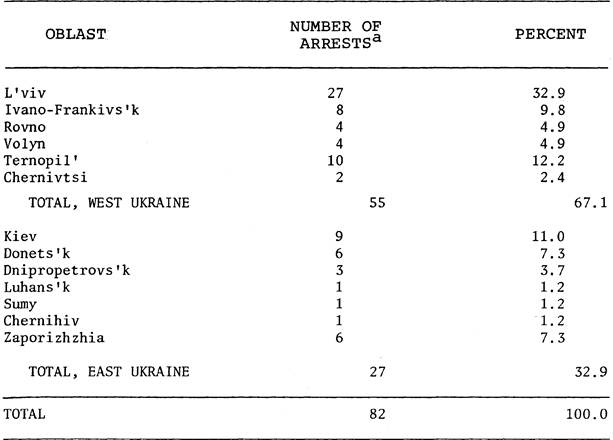
The traditional home of virulent, separatist national sentiment has been the West Ukraine; over the last twenty years, arrests in the West Ukraine for activities associated with nationalism have outnumbered those in the East Ukraine by about two to one. If we break down the geographical distribution of arrests, however, to those before and after the emergence of the shestydesiatnyki as a major force in opposition to the regime, some interesting variations beccme apparent. Table 5.1 presents the geographical distribution of arrests in the Ukraine for nationalist activity during the Khrushchev period.
54,
Ibid.
55"Zamist ostann'oho slova," Ukrains’kyi visnyk 6 (Smoloskyp, 1972), pp. 93-97.
Table 5.1
Place of Arrest or Scene of Activity of Political Crimesj 1956-1964
Sources: Ukraine'ke slovo, April 14-21, 1968, pp. 6,8; Beestr osuzh- dennykh Hi zaderzhannykh v bor'be za prava cheloveka v SSSR (Radio Liberty Research Handbook No. 78, February, 1971).
aSome may have been religious arrests.
The table shows that during the Khrushchev period, most of the arrests were in the West Ukraine, and of the total, the largest number were in L'viv oblast. Of the arrests during this period, 80% occurred in the period 1960-1962, that is, during the reversal of Khrushchev's earlier liberal nationalities policy.
With the exception of the Democratic Union of Socialists and the Creative Youth of Dnipropetrovs'k, which were civil rights rather than nationalist-oriented groups, all the organized groups espousing separatist ideologies discussed above were located in the West Ukraine. We have no information concerning any group or individual originating in the East Ukraine that has espoused a separatist ideology. Subsequent tables, therefore, are concerned with the cultural-intellectual opposition, representing the bulk of the unorganized, ad hoc dissident movement in the Ukraine in the 1960s and 1970s.
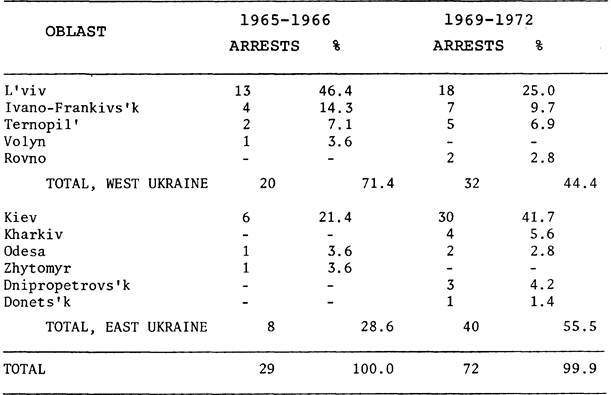
Table 5.2 presents comparative data on the place of arrest or scene of major activity of the individuals arrested in the major waves of 1965-66 and 1969-72. These data indicate that while in 1965-66, two-thirds of the nationalist dissident activity took place in the West Ukraine, there was a shift of activity by 1969-72, with more than half the activity in this period in the East Ukraine. Most marked was the shift from concentrated
Table 5.2
Place of Arrest or Scene of Activity of Political Crimes^ 1965-1966 and 1969-1972
Sources: The Chomovil Papers^ pp. 81-226; Ukraine rkyi visnyk Nos. 1:14,
18, 23-27, 63, 80; 2:1-5, 66-75, 110-117; 3:2, 29-32, 64-90; 6:7-11, 122-129; Khronika tekushchikh sobytii 17:57-69; 27:2-12.
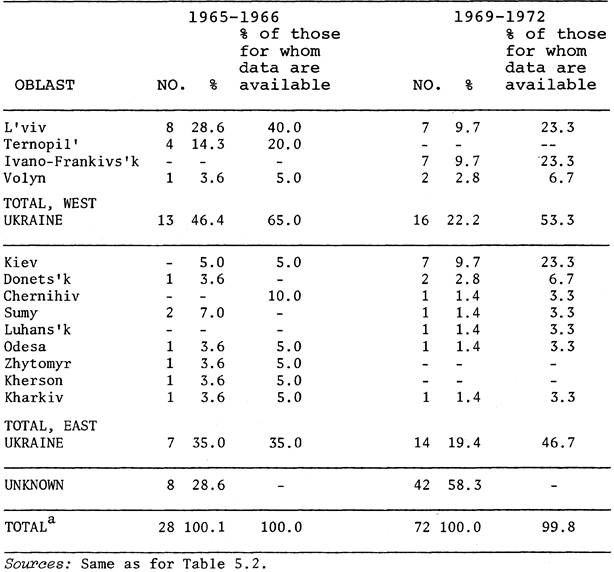
activity in L'viv to Kiev. The data also show a greater geographic spread of dissident activities in the late 1960s and early 1970s. Combined with the data in Table 5.3, these data support the inference that West Ukrainians, always the majority, have merely shifted their activity to the East Ukraine. The large "unknown" category, however, makes it risky to draw definite conclusions.
Table 5.3
Place of Birth of Individuals Arrested for Nationalist Activities3 1965-1966 and 1969-1972
Percentages do not total 100 because of rounding off.
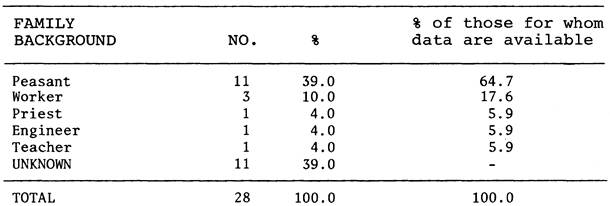
We have information on the family class background only for the individuals arrested in 1965-1966, information provided by Chornovil. These data show that the largest element of participants in these activities has consisted of the sons of peasants, born (and probably educated) in the West Ukraine.
Table 5.4 ■
Family Background of Individuals Arrested on Charges Related to Nationalist Activities, 1965-1966
Source: The Chornovil Papers3 pp. 81-226.
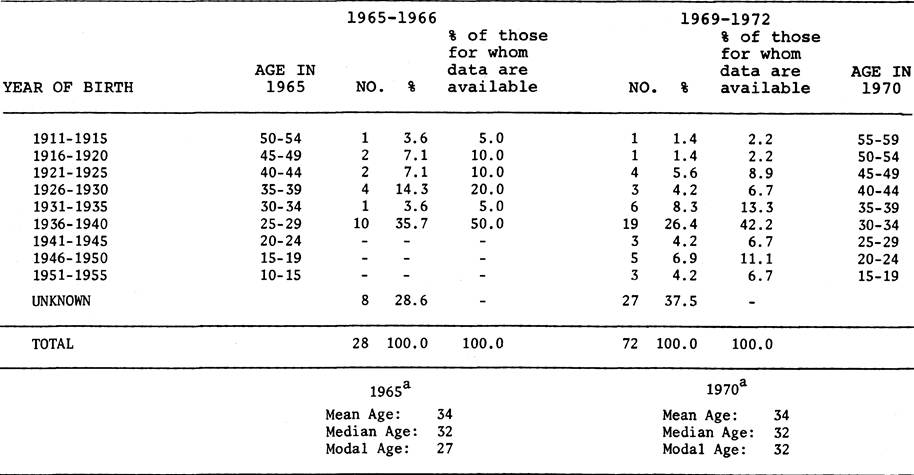
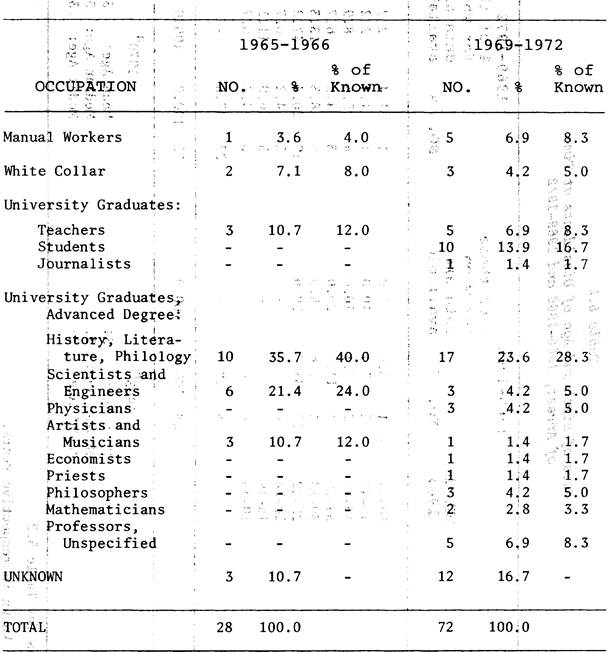
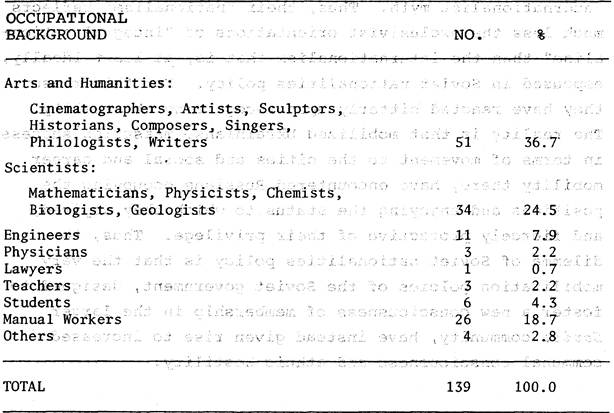
The age of dissidents (see Table 5.5) at the time of arrest has been quite stable between the 1965-66 and 1969-72 waves of arrests. The breakdown of the same sample in terms of occupation is shown in Table 5.6. There appears to be no differentiation in occupation between nationalist dissenters and individuals who have engaged solely in civil rights activities, as is evident from comparing Table 5.6 with Table 5.7, a breakdown by occupational group of the signers of a letter protesting the illegality of trials in the Ukraine in 1968. The explanation for this lies no doubt in the great overlap between these two groups.
We find, then, that the average nationalist dissident in the 1960s and early 1970s was in his early 30s, the son of a peasant or a worker in the West Ukraine, was at least a secondary school graduate, and most likely a university
Table 5.5
Date of Birth and Age of Dissidents at Time of Arrest, 1965-1966 and 1969-1972
Sources: Same as for Table 5.2 aBased on number known in respective years.
, ; Table 5.6 ;
Occupation of Individuals Arrested for Nationalist Activities, 1965-1966 and 1969-19'^2
Sources: Same as for Table 5.2.
Table 5i7
Occupational Backgrounds - of the 139 Petitioners: April, 1968
Source: ’’Appeal of the 139,” Ukraine ’kyi visnyk 1 (Smoloskyp, 1970), pp. 72-76. <
student or university graduate in the field of history, literature or philology,56 The caveat bears repeating, however, that the large "unknown" categories in many of these tables makes generalization hazardous.
The intensely romantic nationalist orientation of people in the liberal arts and the humanities in the USSR in the late 1960s is at least in part the. result of Party-tolerated (and in the early part of the period under study, Partyr encouraged) appeals for individuals trained in the arts: cinema, fiction-writing, graphic arts, and the calls discussed earlier for authenticity in the writing of history,
^^Chornovil arrived at a similar profile of the typical person arrested in 1965-66 for ’’Anti-Soviet Agitation and Propaganda.” See The.................................................
Chomovil Papers, pp. 80-81.
the presentation of authentic national forms in art, literature, and so forth. These individuals received an intensely idealistic Soviet education, and they internalized the internationalist myth. Thus, their "nationalism'' reflects much less the exclusivist orientations of "integral nationalism" than the internationalism that is, at least ideally, espoused in Soviet nationalities policy. For this reason, they have reacted bitterly upon recognizing the reality. The reality is that mobilized Ukrainians, measuring success in terms of movement to the cities and social and career mobility there, have encountered Russians occupying the positions and enjoying the status to which they aspired, and fiercely protective of their privilege. Thus, the dilemma of Soviet nationalities policy is that the very mobilization polcies of the Soviet government, designed to foster a new consciousness of membership in the larger Soviet community, have instead given rise to increased communal consciousness and ethnic hostility.
STRATEGIES AND TACTICS OF THE DISSIDENTS
The articulation of interests in the Soviet Union is circumscribed not only with respect to the channels of articulation, but with respect to the content of demands as well. Whereas in Western democratic societies, while the state may not meet the demands expressed, the articulation of demands uncongenial to the state is not punished, in the USSR the mere statement of certain demands is treated as itself a crime; this is particularly true of demands of a nationalist nature. Soviet nationalist dissidents, therefore, have been forced to make use of channels and methods of interest articulation that are of marginal utility (such as watered-down, Aesopic demands, as discussed in the previous two chapters, and efforts to exploit personal relationships with individuals close to the elite), and to seek entirely different principles of interest articulation, in order to overcome the impotence that the structure of the system imposes on them.
The principal strategy of the intellectual-cultural opposition has been symbolic behavior: the adoption of public behavior at variance with regime expectations or even in defiance of explicit rules. The goals of symbolic behavior are:
1. To point up to others, including, presumably, elites themselves, the possibility of alternatives to acquiescence; to make breaches in the popular regime-supportive consensus; and to galvanize popular support for the dissenters’ demands.
2. Graphically to point up the discrepancies between officially articulated nationalities policy and the reality, and to point up the discrepancies between legally guaranteed rights and the actual behavior of the authorities.
In a word, the apparent purpose behind the kind of resistance the Ukrainian nationalist dissidents have engaged in is to test the legitimacy of actual regime nationalities policies by evoking an official response to bdiavior which is technically legal, but which is tacitly known to be punishable; differently stated, its purpose is to make the contradiction between myth and reality public and undeniable.
These strategies have included the following:
1. The opening of alternative channels of communication.
Samvydav (in Russian, samizdat), meaning "self-publishing," consists of typewritten, and sometimes unofficially reproduced, manuscripts of writings that would not pass the censor, passed clandestinely from hand to hand. In this manner, dissidents to a degree able to circumvent the officially imposed "maximization of redundancy" in political communications. By providing alternative sources of factual information, alternative interpretations, and alternative modes of symbol manipulation, samvydav literature serves to re-socialize part of the population, to lend coherence and
and a sense of purpose to the opposition, to rally support, and to provide a means of mere expression.. The mere fact. of its existence is bound to reinforce awareness of dissent. Samvydav literature also.serves to inform the West of events in the Soviet Union which official news agencies do not report and, when rebroadcast back into the Soviet Union by international radio stations, to further the ends listed above..
The most important element of Ukrainian samvydav for several years was the Ukrains 'kyi visnyk..(The Ukrainian Herald), which first appeared in January,.1970, and of which eight issues have appeared. Modelled on the Moscowbased Khronika tekushchikh sobytii (Chronicle of Current Events), the Visnyk has been a relatively dispassionate chronicle of arrests, extra-judicial persecutions, and other manifestations of the repression of nationalist- oriented demands in the Ukraine. It is believed that Via'cheslav Chornovil was the editor of the first six issues 57 of the Visnyk, although he denies this.
Combined issues 7-8 of the Ukrains’kyi visnyk took an entirely different direction in terms of style and content from those issues which appeared prior to CHornovil's arrest. Gone was the non-editorial reporting of events, and in their place there appeared a virulent separatism, and articles written more in the style of emigre Ukrainian
5 8 nationalists than in the style of Soviet Ukrainians.
57 · Viacheslav Chornovil, ”My Trial,” Index on Censorship, V, No. 1
(Spring, 1976), pp. 57-69.
58 ·
Unlike all previous issues of the Visnyk, issue 7-8 employs language that is reminiscent of that of Ukrainians in the West: sovetskii rather than radians ’kyi; KGB rather than KDB; v Ukraini rather than na Ukraini, etc. (although it is true that in some parts of the West Ukraine, speakers do say v Ukraini). The tone of the issue, and the foreign policy issues raised, are also more characteristic of emigre Ukrainians than of Soviet dissidents. None of this, of course, constitutes proof that the issue originated in the emigration; in view of the additional fact, however, that the Moscow-based Khronika tekushchikh sobytii has noted the existence and reviewed all issues of the Visnyk
2. The conscientious -exhaustion df all.legal.approaches and remedies is a second strategy;
This strategy includes the lobbying of authorities at the local. level; the wife. of Ivan Rusyn, for. example, obr, ‘ tained an interview with Shelest in November, 1965 in *
59 connection with her husband’s trial. At least one of the organized secessionist groups mentioned above, the Ukrainian National Front', drew attention to itself by. sending, a signed memorandum to the 22nd CPSU Congress.60
A very large proportion of samvydav documents consists of/signed petitions and protests that have been sent to various official instances, in connection with the arrests and trials of dissidents.,6^ Similarly, petitions and appeals-are made to international tribunals * particularly the United Nations- with reference to international law and conventions signed.by the Soviet Union; frequently, too, such appeals are sent to Communist Parties in Eastern and
6 2
Western Europe.
3. Finally, there have been some instances Of individual direct action.
There have been at least two cases of self-immolation in the Ukraine for nationalist causes. on December 5, 1968, Vasylii E. Makukha, a 50 year old teacher, burned himself to death in downtown Kiev, shouting as he did so "Long live free Ukraine!" bn February 10, 1969, another teacher,
except this one, we feel that the authenticity of Ukraine rkyi visnyk 7-8 is at least open to reasonable doubt.
59
The Chornovil Papers^ p. 72.
The Ukrainian Review, XVI, No. 2(1969), p. 11.
6^In addition to those petitions included in the first six issues of Ukrainerkyi visnyk and in SDS Vol. XVIII, these include: AS 1990, AS 1948, AS 1949, AS 1989, AS 2006, AS 2082, and AS 2226.
62AS 261, SDS Vol. IV: AS 904, SDS Vol. XVIII; AS 919, SDS Vol. XVIII; AS 979, SDS.Vol. XVIII; AS 989, SDS Vol. XVIII; and AS 1724, AS·1818, AS 1948, AS 2092,. AS 2266, AS 2284, AS 2302, AS.2308, AS 2316, AS 2367,.
Mykola Breslavs’kyi, set fire to himself on the grounds of Kiev University in protest against Russification, but his life was saved and he was arrested.6^ Finally, some instances of spontaneous mass demonstrations over Russification have been recorded.6*
REGIME RESPONSE TO NATIONALIST DISSIDENCE
Judicial Mechanisms
The regime, by including all manifestations of Ukrainian aspiration for greater authenticity in culture and language, greater political autonomy, and opposition to Russification under the single rubric of "Ukrainian bourgeois nationalism," imposes a false unity of ends, rather than means, on the dissident movement, i.e., ultimate separatism, and has reacted to this largely chimerical end with judicial measures, rather than by attempting to respond to substantive demands. As a result, the regime has perhaps enjoyed short term success in quieting the most vociferous dissent, but no dialogue has been established, and the regime therefore has not responded in a constructive way to the challenge of nationalism. It has neither met the demands of the nationalists, nor taken steps to alleviate the conditions that give rise to nationalist discontent.
There is evidence that there were several years of hesitation and indecision at the highest levels over the appropriate means of dealing with growing Ukrainian dissent, in
^Khronika tekushchikh sobytii, Nos. 6:14, 8:15-16, 10:39; Ukrains'kyi visnyk 1 (Smoloskyp, 1970), p. 3.
64
Reports of spontaneous mass arousal are tantalizingly scanty. See, however, AS 1437 on riots in Dniprodzerzhins*k; Khronika tekushchikh sobytii 8:40 on a workers’ demonstration in Kiev; Khronika tekushchikh sobytii 18:28 on the distribution of leaflets in Uzhhorod asking voters not to vote for the official candidate for Supreme Soviet deputy, but for a local writer; Ukrains 'kyi visnyk 2 (Smoloskyp, 1970), p. 84, on the distribution of leaflets at Kiev Polytechnic Institute, protesting the persecution of Dzyuba. There surely have been others. the period following the 1965-66 wave of arrests in the Ukraine.65 western sources have mentioned a secret Central
Committee resolution of December 30, 1971, to silence dissent and quash the growing samizdat movement.
The removal of Vitalyi F. Nikitchenko from the post of KGB chief in the Ukraine in July, 1970, and his replacement by V.V. Fedorchuk, coincided with the initiation of the 1971-72 offensive against the Ukrainian nationalist intelligentsia. Nikitchenko had been a personal friend of Shelest, and quite possibly had been responsible for restraining the KGB from moving decisively against the dissidents in the period 1966-71. The replacement of Nikit-
67
chenko was apparently over Shelest’s head, and of course preceded the purge of Shelest by only a short period.
Unionwide, the KGB had increased in power under the
Brezhnev regime. The KGB in the Ukraine appears to be somewhat more autonomous in its operations, either because it is given fuller rein by the center, or possibly because there are simply fewer checks on police power in the periphery than in Moscow, under the eyes of foreign correspondents. Whatever the reason, Ukrainians - less than one fifth of the total USSR population - account by most reports
68 for as many as half the political prisoners in the camps.
^Christian Duevel, ’’Brezhnev at Odds with Podgorny: Development of Socialist Democracy vs. Secret Police Oppression,” Radio Liberty Research Paper CRD 231/70, June 22, 1970.
^The Economist, February 26, 1972, p. 149.
^"Ukrainian KGB Boss in Politburo?” Radio Free Europe Research Paper No. 1900, October 8, 1973.
68
Accounts vary. Andrei Amalrik reported to Anatole Shub in 1969 that more than half the prisoners in the camps are of ’’minority nationalities," International Herald-Tribune (Paris), March 31, 1969, p. 3. Mykhaylo Masiutko alleges that 60-70% of the prisoners in the Mordovian camps are Ukrainians; see AS 950, SDS Vol. XVIII. Other estimates are comparable; see A. Marchenko, "Moi pokazaniia,’’ AS 106, SDS Vol. I, and Ukrains'ka inteligentsiia pid sudom KGB (Munich: Suchasnist’, 1970), p. 170. The total number of political prisoners is equally uncertain, but must number several thousands; see the open letter of A. Kosterin,
The Soviet authorities do not recognize the category of "political prisoner, " ànd: prisoners who petition for the right to be treated as political, prisoners are-usually punished for this.69 instead, dissidents are tried and sentenced as criminals. Almost;all·nationalist dissidents are tried under either Article 62 of the: Ukrainian Criminal J Code ( "Anti-Soviet Agitation and Propaganda”) oir Article. 187-1 ("Dis hemination of de1ibe rate ly faise/fabri ca t i Ons which discredit the Soviet state and Social system")!
While the machinery of justice perhaps serves a didactic and socializing function in all societies, the use of the legal system to counter dissidence in thè Soviet Union appears to have almost entirely an educational function. It qualifies as symbolic behavior by our definition, insofar as the manifest purpose of trials to decide pn the guilt or innocence of the accused - is supèrfluous.: The evidence is overwhelming that the guilt of dissenters, brought to trial is decided politically, beforehand. The trials receive wide publicity, but unlike genuine criminal trials, they are usually not open to the public; they are frequently closed even to relatives and close friends of the defendants. · >
Besides the facade of legality which we may presume the authorities wish to cloak their repression of dissent, legal trappings reinforce the image of the dissidents as criminals pitted against society, rather than as speaking for the
L. Bogoraz, P. Litvinov and others to world communist leaders of February 24, 1968, in Problems of Communism, XVII, No. 4(July-August,..
1968), p. 69. Borys Lewytzkyj reports 670 persons arrested on political grounds in 1960-1971: Opposition in der Sowjetunion (Munich, 1972),. p. 39; this number would have to be increased by at least 100 more arrested in 1972 in the Ukraine: Khronika tekushchikh sobytii, 25:10.· Radio Liberty reports 3,000 political arrests from the death of Stalin to February, 1971: Reestr osuzhdennykh Hi zaderzhannykh v b'or’be za prava cheloveka v SSSR, Radio Liberty Research Handbook No. 78, February, 1971, p. 1.
69
See, e.g., AS 2087 and AS 2089.
70 '.
Vgolovnyi kodeks Ukrains’koi SSR: nauchno-prakticheskii kommentariz' society against the state. The image of the dissidents that the state seeks to foster through juridical persecution is of criminals, craven traitors, and moral degenerates in the pay of imperialists. This version of the dissidents as representing a form of deviance from which the state is protecting the society is also served by the practice of interning many political prisoners in psy-
71
chiatric hospitals. There is an overwhelming human tendency to equate authority with rectitude; people whom the state has jailed are assumed to be criminals, and people who are committed to asylums are assumed to be insane.
Symbols Employ ed by the Regime to Discredit the Rationalist Movement
7. Xenophobia: the Hostile West,
The image of a hostile and implacable bourgeois West, intent on subverting the Soviet regime, is perhaps the most widely used symbol in official Soviet channels. This theme, a descendant of Stalin’s encirclement theory, is so common in Soviet polemics that one need only pick up a newspaper, almost at random, to find several instances of it. Xenophobia - the fear and distrust of foreigners - is a major facet of Soviet political culture, and it extends in Russian culture far back into Tsarist times. The Soviet
(Kiev: Izdatel'stvo "Politicheskoi literatury," 1969), pp. 165-67, 403.
71 -
On the psychiatric internment of dissenters, see AS 1265, AS 1266, AS 1267, AS 1268; V. Bukovsky and S. Gluzman, ”A Manual on Psychiatry for Dissidents,” Survey, XXI, No. 1,2(Winter-Spring, 1974-75), pp. 180-99; Georg Mann, ’’Abuses of Soviet Psychiatry,” Dissent, Winter, 1975, pp. 90-92, 102; J.K. Wing, "Psychiatry in the Soviet Union," British Medical Journal,, I, No. 5905 (Saturday, March 9, 1974), pp. 433-36; Tatiana Khodorovich, Istoriia bolezni Leonida Pliushcha (Amsterdam: Alexander Herzen Foundation, 1975); Roy and Zhores Medvedev, A Question of Madness (New York and London: W.W. Norton, 1979); Leonid Plyushch, History rs Camival3 op. cit, Robert Bloch and Peter Reddaway, Psychiatric Terror (New York: Basic Books, 1977).
regime makes extraordinary efforts to link ideologically unorthodox positions with Western imperialism, either by making the frequent argument that ideological wavering plays into the hands of the West or, as we discuss below, that dissidents are outright paid agents of Western imperialism.
The regime pays inordinate attention to everything that is written in the West about the Ukraine, giving the strong impression that these works must be read, not only by the scholars who criticize them, but by elements of the public as well. Were it not so, it seems that such a large-scale public campaign to discredit them would be superfluous.
Periodically, polemics are carried on in public and in scholarly channels with Western specialists on the Ukraine, but the most vindictive rhetoric is directed against emigre Ukrainians in the West engaged in literary activity of any sort. Emigre Ukrainians are invariably characterized as Ukrainian bourgeois nationalists in the pay of West German or American fascists and imperialists. This device is reinforced in the popular mind by an extreme aversion in Slavic culture to the concept of emigration, although this aversion is less strong in the West Ukraine. Few Russians or Ukrainians leave their homeland with alacrity, even when aware of differential opportunities and many, when they do leave, frequently express a longing for the homeland (not, however, for the regime).
American activities also lend some credence to the myth of a hostile West; the sometimes inflamed rhetoric of the Cold War received good coverage in the Soviet press, as do the activities of Radio Free Europe/Radio Liberty in Munich, which broadcasts directly into the Soviet Union, and reportedly has a wide audience not only among the masses, but among higher Party officials, too. The fact that the broadcasters are themselves emigres undoubtedly reinforces the public perception - which the Soviet press constantly reiterates - that they are turncoats in the pay of imperialists.
The device of deliberate evocation of xenophobia as a means of countering the appeal of Ukrainian nationalist dissidents can be illustrated through the examination of three key applications of the device: the Symonenko Diary affair, the case of Dzyuba’s Internationalism or Russification?, and the remarkable "Dobosh affair." Each of these cases exemplifies one aspect of the manipulation of the symbol of the hostile West.
The Symonenko Diary affair was the first overt use of the evocation of xenophobia against Ukrainian dissidents. It preceded in time the 1966 Siniavsky and Daniel trial in the RSFSR, although whether it was part of the preparation for that trial, or was inspired by the investigation of Siniavsky and Daniel, or for that matter was unrelated to it, remains unknown. The affair can nonetheless be said to have established a Union-wide precedent of accusing dissidents of witting or unwitting collaboration with the West.
Ivan Svitlychnyi and Ivan Dzyuba were arrested in September, 1965 - although this was not reported in the Soviet press for some time - and charged with having "smuggled" the Diary of Vasyl Symonenko to the West. Symonenko, it will be recalled, was the young Ukrainian poet who died of cancer in 1963, and was subsequently lionized by the she s ty de siatnyki.
The Diary was published by Suchasnist’ in Munich in January, 1965, and the text was rebroadcast into the Soviet Union by Radio Liberty. Svitlychnyi and Dzyuba were held for several months, and subsequently released The background of the affair, as reconstructed in samvydav sources, is that in April, 1965, Radians 'ka Ukraina published a letter from Hanna Shcherban, Symonenko's mother, a peasant woman living on a collective farm in Cherkasy oblast, complaining that Svitlychnyi and the young literary critic Anatolii Perepadia had appropriated her son's Diary and some of his poems, rather than permitting them to be turned over to the Writers' Union as Symonenko allegedly had directed in his will. Hanna Shcherban, it is reported, is illiterate, and could not- have written the letter. Samvydav sources allege that it was in fact written by Mykoia Nehoda, a writer who had been incensed to learn that Symonenko had insulted him in the Diary. Nehoda wrote an open letter to Literaturna ■ Ukraina.·, expressing his indignation. A Central Committee Department head in Kiev, a certain Kondufor, forebade publication of the letter, but it found its way
72 into samvydav and received wide circulation anyway.
It is not known for certain whether or not Svitlychnyi and Dzyuba actually assisted in the transmission of the Diary, abroad, but it seems unlikely in view of Svitlychnyi’s later comments on the cas©«·^· Nonetheless, a CPUk Central Committee letter was prepared and read at the Writers1 and Artists' organizations’, justifying Svitlychnyi's release without trial on the basis of his confession and extreme
74
contrition. The Western press also reported that he had 75
confessed.
The case of the Symonenko Diary is instructive in being among the first applications of the time-honored theme of the "hostile West" against the nationalist dissidents, but it leaves open the question of why Svitlychnyi and Dzyuba were released. It has not been the pattern for the KGB to release individuals detained for political crimes unless their recantation can be made to serve a political purpose. Svitlychnyi did not recant publicly, and Dzyuba - in this case - did not recant at all, so far as is known. Two not altogether mutually exclusive explanations appear plausible.
The first is that Dzyuba was released - and therefore
72
Ukraine rkyi visnyk 4 (Smoloskyp, 1971), pp. 131-35.
73
AS 905, SDS Vol. XVIII.
^See The Chomovil Papers, p. 74.
75
New York Times, International Edition (Paris), June 2, 1966, p. 2; Neue Züricher Zeitung, June 3, 1966, p. 3; Le Monde, May 29-30, 1966, p. 3.
also^Svitlychnyi - because of the former’s close association with ‘intellectuals who were protected by Shelest; through the:intercession rof Shelest's friend;.the.Ukrainian KGB head.Nikitchenko.:...
A second explanation iis that the regime itself was unde^ cidedon how to deal.with the Symonenko cult. A concerted campaign had been underway to.co-opt the popularity of Symonenko, and it is not logically consistent that at that time the regime should persecute Dzyuba and'Svitlychnyi for sending abroad a work that was loudly proclaimed not to be anti-Soviet, and that the regime in fact praised. It will be recalled that the incident took place in.the shadow of the trial of Siniavsky and Daniel, who were being prosecuted for. publishing anti-Soviet works abroad.This interpretation is reinforced by the appearance in Visti z Ukrainy (a journal published in the Soviet Union exclusively for Ukrainians in the West) of a review by Svitlychnyi, praising Symonenko's Bereh chekan, and emphasizing that the 77 work was m no way anti-Soviet.
Public Party reaction to Dzyuba’s Internationalism or Russification?·-was so long delayed that * it.lends credence to hypotheses concerning Shelest's protection of Dzyuba, and high-level sympathy with at least some of the concerns that Dzyuba raised in the book. Public controversy over the; book began not with its submission to the CPUk Central Committee in 1964, but with its publication in the West four 78
years later.
76It was only later, with the controversy over Solzhenitsyn’s Cancer Ward, that publishing abroad came to be considered a crime without regard to content.
77..
Visti z Ukrainy3 No. 26(June, 1966),.and No.35(August, 1966). It can be presumed that no Soviet writer may publish in this newspaper without special clearance.
yg
The first publication in the West was by Weidenfeld and Nicolson, London, 1968. It was published in Russian in 1968 by Suchasnist’ (Munich), and in Ukrainian by the same publisher in 1973. The American (third) edition is published by Monad Press (New York, 1974).
Direct attacks on the book followed a year of indirect 79
criticism of Dzyuba m the press. Ukrainian samvydav alleges that Dzyuba was at first called before the KGB and asked to write a rebuttal to "bourgeois propaganda," but that Dzyuba refused, saying that the book in the first instance was Marxist, that he had had no part in its publication in the West, and that in any event the idea of writing a rebuttal based on KGB interpretations was not
8 0 congenial to him.
By 1969, the book was being openly attacked in the 81
press. At this time, "Bohdan Stenchuk’s" booklet also appeared, followed closely in samvydav by Chornovil’s rebuttal of "Stenchuk."
In the fall of 1969, the campaign against Dzyuba was carried to the Writers’ Union. A call for his expulsion from that organization was published in Molod Ukrainy on September 10. On December 26, 1969, a vote was taken to expel him from the Kiev section of the Writers’ Union, with the resolution that "a writer cannot be indifferent to whom he serves with his words, and why." Several members of the Writers’ Union, including A. Holovko, B. Panch (who had previously criticized him), lu. Smolych and I. Tsiupa, defended Dzyuba at the meeting, Tsiupa arguing that the whole affair be forgotten on the basis that ’’it is essential to pay attention to the international ramifications of an expulsion, so that Dzyuba not extend the problem, and the
82 problem not be allowed to extend Dzyuba." On December 26,
79
See, e.g., Vasyl Osadchy, ”0 mistere Stets’ko i velikomuchenits’ke liagushonke," Perets, No. 17(1966). See AS 905, SDS Vol. XVIII, for a letter to the editor of Perets from Chornovil and others protesting the inflamed rhetoric of the article.
80
Ukralns'kyi visnyk 1 (Smoloskyp, 1970), p. 6.
81
See Liubomyr Dmyterko, "Mistse v boiu: pro literatora, iakyi opynyvsia po toi bik barakady," Llteratwtma Ukralna, August 5, 1969. For a protest by Stus, see Ukralns'kyl visnyk 6 (Smoloskyp, 1972), pp. 7-8.
82..
Reported in Ukralns'kyl visnyk 1 (Smoloskyp, 1970), p. 11.
Literaturna Ukraina carried some remarks Dzyuba had made in his own defense before the Presidium (disclaiming connections with Ukrainian nationalists abroad), and termed them a partial recantation, urging that Dzyuba could be readmitted to the Writers’ Union if he recanted completely.
This shadowy evidence hints at disagreement between the Writers' Union and others (probably including Shelest) who wanted to tone down the cultural battle in the Ukraine, and those who wished to move decisively against the dissenters. This interpretation is reinforced by the fact that, after the fall of Shelest and the purge of his proteges, the Party and the KGB did move decisively against the cultural establishment and against the dissident movement, nearly silencing it.
There is significant evidence that the "Dobosh affair" was a provocation wholly concocted by the KGB in order to substantiate charges that the Ukrainian dissident intellectuals were acting in alliance with emigre nationalist groups abroad and their imperialist "bosses." By 1971, the KGB had intensified its efforts to intimidate, infiltrate, and isolate dissident circles in the Ukraine, particularly to seize control of their channels of communication with the West.83
Yaroslav Dobosh was a Belgian subject of Ukrainian ancestry (born in West Germany), and when he came to Kiev to study, was a third year sociology student at Catholic University in Louvain. Dobosh was arrested by the KGB at Chop on the Czechoslovakian border in early February, 1972, and
83
Secondary and news sources reported, for example, that at least two Soviet ’’nationality specialists” alleged to have KGB connections were dispatched abroad in 1971 to study emigre nationalist groups, in an effort to determine their connections with Soviet citizens, and to assess their influence with Western policy-makers. Ukrainian students from the West suspected of meeting with dissidents in the Soviet Union were interrogated and expelled, and at least one Ukrainian dissident in the Ukraine who had contacts with foreigners turned agent provocateur. See, e.g., Ukrains’ke slovo, March 25, 1973; Literatuma Ukraina^ July 7, 1972, and Rabitnycha hazeta,, July 8, 1972.
84 charged with being an agent of the OUN in the West.
Dobosh at once implicated five intellectuals, who were arrested and subsequently imprisoned: Ivan Svitlychnyi, Leonid Seleznenko, Anna Kotsurova (a Czech student believed to have been a KGB plant; she was not arrested, but de- 8 5 ported to Czechoslovakia, where she was not molested), Stefaniia Hulyk, and Zinoviia Franko, the granddaughter of the revered Ukrainian writer Ivan Franko (1856-1915). Franko was subsequently released upon public confession and a statement of self-criticism. Franko’s public recantation was followed by that of Seleznenko; both recantations further implicated the other defendants, and named other participants in illegal activities: Vasylyi Stus, Danylo Shumuk, levhen Sverstiuk, and Z. Antoniuk, all of whom received prison terms.
On June 2, 1972, Dobosh held a televised press conference 8 7
in Kiev, at which he confessed to being a paid agent of ZCh-OUN (Foreign Units of the OUN), sent to the Soviet Union by the organization to contact the individuals listed above, and pay them for information to be used against the Soviet Union in the West. Upon his return to Belgium, Dobosh held a press conference on June 12, at which he denied everything he had said at the Kiev press conference.
In 1975, Stus, one of the dissidents implicated in the affair, wrote an article in prison arguing that the entire
84...
Vechernyz Kzev3 February 11, 1972; reported in Khronzka tekushchzkh sobytzz, 24:9.
85
Ukrazns’kyz vzsnyk 6 (Smoloskyp, 1972), p. 11.
^Franko’s recantation is in Radians’ka Ukrazna, March 2, 1972; Seleznenko ’s appears in Rabztnycha hazeta3 July 8, 1972.
87
Undoubtedly in return for his freedom. He was later deported. For the text of the press conference, see "Ukrains'kie burzhuazhnye natsio- nalisty - naemniki imperialisticheskikh razvedok. Press konferentsiia v Kieve,” Pravda Ukrazny, June 3, 1972. The text is reprinted in Khronzka tekushchzkh sobytzz, 26:17-19, along with commentary on the case. affair had been fabricated, and comparing the trials of 1972 to those of the 1930s.88
Whether or not fabricated, the Dobosh affair illustrates the key role of the myth of hostile Western predators, willing to seduce or purchase any Soviet citizen who for a moment wavers from ideological vigilance, and use him to propagandize against the Soviet Union, with the ultimate object of tearing the Ukraine away and restoring capitalism, with all the unimaginable terrors that may be associated with in the popular mind. This myth is closely related to, and exploited in conjunction with, the very potent "condensation" symbol of Ukrainian bourgeois nationalism.
2. Ukrainian Bourgeois Nationalism
Ukrainian bourgeois nationalism is the prime symbol employed by the Soviet regime to discourage nationalist dissidence and criticism of Soviet nationalities policies. However, it is crucial to observe that the concept of nationalism, as it is presented by the regime, is itself a mythical construct: the regime does not address the cultural plur- alists on their own grounds, arguing the merits or demerits of cultural and political autonomy. Ukrainian bourgeois nationalism is made into an all-encompassing "condensation" symbol, embodying all the sometimes chimeric and sometimes real bogeymen of recent Soviet history. It is in the use of Ukrainian bourgeois nationalism to describe any effort at preservation of Ukrainian culture and language that we find the best examples of "metaphoric transfer": the transfer of the evils associated in the popular mind with "nationalism" by association to individuals or activities the regime wishes to discourage or discredit.
The word "nationalism" in the Soviet media nearly always means "integral nationalism" - the exclusivist ideology of
S^Vasylyi Stus, ”Ia obvyniaiu” (1972), AS 2307.
nationalism that is historically associated with fascism. For this reason, Ukrainian dissenters frequently object to being described as Ukrainian "nationalists," many preferring instead the term "patriots," so as to escape the ingrained pejorative connotation of the word in the Soviet usage.
The source for the symbolic content of Ukrainian bourgeois nationalism is the activity of the Organization of Ukrainian Nationalists (OUN) and the Ukrainian Insurrectionary Army (UPA) during and after World War II, when these groups, espousing an integral nationalist ideology and sometimes actively collaborating with the German armies, resisted by force of arms the incorporation of the West
89 Ukraine into the Soviet Union.
The victory over the Nazi invaders and the liberation of the Ukraine are among the more potent symbols that legitimate Soviet rule today; the memory of the devastating war against the fascists is deliberately kept alive for that reason. A second connotation of the term Ukrainian bourgeois nationalism is, therefore, its association with fascism. Numerous books and pamphlets are published to
90 reinforce this association. Works and articles such as these never fail to mention the collaboration of the OUN with the Nazis, and rarely fail to describe in detail the crimes which members of the organization are alleged to have committed against Soviet citizens during and after the 91
war. Radio broadcasts and television documentaries also periodically remind the citizen of the OUN's alleged atrocities.
The effect of this is accentuated and made immediate by
89...
John A. Armstrong, Ukrainian Nationalism^ 1939-1945, 2nd Edition (New York: Columbia University Press, 1963), passim.
90
See, e.g., V. lu. Evdokymenko, Krytyka ideinykh osnov Ukrains 'koho burzhuazhnoho natsionalizmu (Kiev: ’’Naukova dumka,” 1967), and Vitalyi Maslovs’kyi, Zhovto-blakytna mafiia (L’viv: "Kameniar," n.d.).
91
See, e.g., Ikhne sprazhne oblichchia (Kiev: Tovaristvo "Ukraina," 1975). the continuous trials of individuals periodically "uncovered" as having been connected in one way or another with the OUN, or guilty of crimes during the war that can plausibly be attributed to OUN connections or sympathies. These trials receive conspicuous publicity and, unlike the trials of dissidents, are always open to the public. Unlike dissident activities, these are crimes of violence, usually murders or mutilations. Our sample of the Soviet press includes reports of twelve separate trials of individuals or groups for crimes committed during the war, and
92 directly attributed to the OUN connections of the accused.
Second only to its efforts to link nationalism to fascism, the Soviet official press attempts to tie bourgeois nationalism to the West. In this sense, the analytically distinct symbols - Ukrainian bourgeois nationalism and the hostile West - are linked. Ukrainian bourgeois nationalism as a symbol can be made to evoke not only suspicion and distrust through the association with fascism, but through xenophobia as well. This theme is so ubiquitous that extensive quotation will serve no purpose; a single example will suffice. A review of a book published in L'viv on the occasion of the 40th anniversary of the revolution defines the purpose of the book as follows:
The material in this book unmasks Ukrainian bourgeois nationalists as disgusting traitors, agents of foreign imperialism, and condemned enemies of the Ukrainian people.^3
92
Pravda Ukrainy, October 29, t1957; ViUna Ukraina, June 1, 1958; Radians 'ka Ukraina, March 8, 1959 and Molod Ukrainy, March 8, 1959 (the same trial); Vil’na Ukraina, July 17, 21-23, 1959; Rabitnycha hazeta, No. 925(1959); Trud, December 11, 1959; February 4, 1960, and February 19, 1960 (separate trials); Radians’ka Ukraina, February 2, 1967; Vii’ne zhyttia, July 3, 1968. Trials were also reported in Visti z Ukrainy, March 12, 1967. In samvydav, such trials are reported in Ukrains rkyi visnyk 3 (Smoloskyp, 1971), and Khronika tekushchikh sobytii, Nos. 5,6 and 8. In the Western press, see Le Monde, December 6, 1959, and The Ukrainian Review, XIII, No. 3(1966), p. 80.
93
Literaturna hazeta, May 24, 1957.
The language is this quote is typical and instructive. Enemies of the people are always "unmasked;" their tactics are contemptuous* in the parlance of propaganda. They do not openly proclaim their hostility but rather, having been rejected and beaten in open battle, "lurk" behind their moneyed protectors, the imperialists, and seek to undermine the Soviet order by devious means. This further evokes unknown fears: a "lurking" enemy is doubly dangerous, for he can appear in any guise; it is only the Party to whom the unsuspeqting people can turn for protection.
The third element with which Ukrainian nationalists as a symbol are often associated is the Uniate Church. Countless articles, pamphlets, films and radio programs detail the alleged activities of Metropolitan Sheptyts'kyi, the 94 head of the West Ukrainian Church during the war. Sheptyts 'kyi is portrayed in the worst possible light: as an Austrian spy, as a fascist, a plunderer of Ukrainian cultural relics, and as committed to Polonization and Germanization of the Ukraine, and as "probably" one of those 95 responsible for the arrest of Lenin at Poronino.
Beginning in the 1970s, the long propaganda battle against Zionism was also linked to Ukrainian bourgeois nationalism The negative connotations inherent in popular anti-Semitism can be transferred to the nationalists, and no doubt, vice-versa. The link here is again the alliance of anti-communist forces under imperialist protection. In Shelest's words:
94
Klym Dmytruk, Bezbatchynky (L’viv: n.p., n.d.), and Pid chornymy autonomy (Kiev: Tovaristvo ’’Ukraina,” 1975). According to samvydav sources, "Klym Dmytruk" is the nom de plume of KGB Major Klimentyi Evhenovych Hals’kyi, a Russified Pole from Zhytomyr, now living in L'viv, and a specialist on Ukrainian bourgeois nationalism. Aged about fifty, he is reputed to have been active in the Soviet security forces during and after World War II. His writings are characterized by gruesome details of alleged OUN crimes, and nearly hysterical condemnation of the Uniate Church. Ukraine *kyi visnyk 6 (Smoloskyp, 1975), p. 164.
95
Vitchyzna^ No. 7(1964). On recent persecutions of the Church, see Ukraine'kyi vienyk I (Smoloskyp, 1970), pp. 45-62, and 7-8, pp. 140-47. The imperialist ideologists place their main wager on anti-Sovietism.... On these positions all forces of reaction have joined hands, beginning with aggressive American imperialism and rabid Zionism, and ending with the White Guard remnants, the bourgeois nationalist riff-raff, and all sorts of opportunists and traitors.96
Jews are accused of "spreading insinuations regarding the intensification of the nationalities question in the Ukraine," of providing money to emigre Ukrainian nationalist 97
organizations, and of racism and fascism. In a polemical discussion of the Judenrat, Zionists are accused of having been collaborators with the Nazis in the invasion of the
9 8
Ukraine. Jews who had served in the Petlura government
99 are prominently ridiculed.
Finally, beginning with the Ussuri River crisis of 1969, Ukrainian nationalism is portrayed as hand-in-glove with revisionist Maoism. During the fiftieth anniversary celebrations, Radio Peking apparently began broadcasting in Ukrainian to Soviet troops in the Far East, detailing the faults of Soviet nationalities policy, and informing its listeners that the "lion’s share" of the inmates in Soviet prison camps are Ukrainians. Literaturna Ukraina published on March 12, 1969, a photograph of a plaque erected at the graves of Soviet soldiers who fell in the Ussuri
Radians rka Ukraina, April 1, 1971.
97
Radiansrka Ukraina, January 6, 1971; Rabitnycha hazeta, December 1, 1965; Radians fka Ukraina, September 30, 1971.
9&Ibid.
99
For example, Professor Sholom Goldman, now in Israel; Pravda Ukrainy, September 29, 1971. On the ’’unmasking" of Zionism, see the openly anti-Semitic Ostorozhno! Sionizm! (Moscow: "Politizdat," 1972). Anti-Zionism (a euphemistic anti-Semitism) is probably a powerful symbol with regard to the Russian and Ukrainian masses.
lOORoman Rakhmanny, "Peking raises Ukrainian problem in war with Moscow enemies," The Montreal Star, May 10, 1969.
River clashes, in which about 50% of the names were Ukrainian; presumably the intent was to demonstrate that Ukrainians had died in defense of a Soviet cause. The Peking boradcasts continued, and increased in hostility over the next several years; the Chinese beamed broadcasts to Ukrainians in the Soviet Army in the Khabarovsk region, advocating separation of the Ukraine from the USSR and the formation of a "Ukrainian Socialist People's Republic.
Presumably in retaliation, the Soviet press began to carry harsh criticisms of Chinese nationalities policy, accusing the Chinese of Sinofication (kitaizatstia) of languages, colonization of national territories, destruction 102 of the autonomy of national minorities, etc.
From 1972, the "alliance of the bankrupt with the bankrupt" of Ukrainian nationalists abroad and both Nationalist China and the Maoists of the People's Republic of China has received wide coverage in the Soviet press. As with the supposed collusion of Ukrainian nationalists with other ideological enemies, the purpose is represented as fundamentally anti-Soviet: the goal of the collusion is to 103 destroy Soviet power in the Ukraine.
As with most such symbols, there is a grain of truth underlying it. The emigre Ukrainian press has, as the Soviet press accuses, discussed the relationship of the Sino-Soviet split to the Ukrainian problem, although not in 104 the hysterical manner that the Soviet press alleges.
There is also a historical basis for the concern with
^^Neue Zur-icher Zeitung, July 14, 1971.
102
See, e.g., Pravda Ukra-iny3 June 17, 1973.
Rabi, tny aha hazeta, February 27, 1972; Radians rka Ukraina3 February 26, 1972; Literatuma Ukraina, June 13, 1972.
l^see, e.g., M. Prokop, "Rosiia, Kytai, i Ukraina,” Suchasnistr, No. 12(1971); Anatol Kaminsky, "Za suchasnu kontseptsiiu Ukrains’koi revoliutsii,” Suchasnist'No. 2(1970).
Chinese-Ukrainian relations. Ukrainian nationalists in 1917 adopted a resolution to strive to incorporate heavily Ukrainian populated areas in the Far East - the former Ussuri, Amur, Transbaikal and Primorskaia oblasts, and other territories along the Trans-Siberian railway^^^ - into the Ukrainian National Republic, although this had no relation to "collusion" with the Chinese. Similarly, the OUN sent some troops to Khabarovsk and elsewhere in the Far East after the invasion of Manchuria by the Kwangtung Army. Historical incidents such as these serve to strengthen the regime image that Ukrainian nationalists, whatever their demands, are fundamentally anti-Soviet, and are hirelings of the regime’s most viciously despised enemies.
The effect of Soviet manipulation of the symbol of Ukrainian bourgeois nationalism in its various incarnations is to make it into a very potent "condensation symbol." Non-dissident informants relate that it is the worst label that can be applied to someone, and that individuals living outside the Ukrainian SSR will avoid the use of Ukrainian and report their nationality as Russian out of fear of being branded with the label. The availability of such a potent symbol makes it possible for the regime to discourage activities much less threatening than Ukrainian nationalism, such as concern over Russification, idealization of the national past, and enthusiasm for elements of Ukrainian culture such as folk art or music. Even simple nepotism, should an enterprise manager hire a Ukrainian in preference to a local Russian who wants the job, for example, can be labelled "Ukrainian bourgeois nationalism," according to our informants.
l^The so-called Zelenyy and Siryy Klyn.
CONCLUSIONS
We have argued in this chapter that symbolic action has been the dominant mode of interaction between the Soviet regime and its critics on nationalities policy. Nationalist dissidents have been obliged to resort to symbolic action because of the lack of open channels for the voicing of their demands, and because the substantive content of their demands evokes severe sanctions. The regime has resorted to symbolic action partly because of unwillingness openly to discuss the problems of Soviet nationalites policy, and partly to shape the thinking of people to accept the official myth of proletarian internationalism, and not to give serious consideration to the grievances and demands of the nationalist intelligentsia.
For the short term, it appears that the regime has been successful in quashing nationalist dissent through coercion and symbolic action; it cannot, of course, be judged what success it has enjoyed in terms of mass resocialization.
Although, as we have emphasized, we do not have the data to make a definitive judgment, the information we do have suggests that it may well have been the intercession of Shelest that hindered th0 regime in moving against the Ukrainian dissenters, especially before the dismissal of Nikitchenko. The trimming of Shelest's khvost ("tail," or following, or proteges), and the fall of Shelest himself, followed closely upon the dismissal of Nikitchenko. In subsequent years, Moscow severely curtailed the autonomy of the Ukrainian apparat.
The dissent movement has been muffled, although not silenced. The regime has not, however, moved to alleviate the conditions that gave rise to it, hoping, perhaps, for the sake of stability in the present, to pass the problem on to a future generation of leaders.
VI SUMMARY AND CONCLUSIONS
By way of summary and conclusion, we may now assay to answer the five broad questions which we set forth in Chapter One.
1. What is the substantive content of the competing myths and meaning-sets associated with nationalism and proletarian internationalism in the Ukrainian and Soviet context?
The officially articulated content of the myth of proletarian internationalism is that the citizens of the Soviet Union identify with the proletarian class as an increasingly relevant reference group, and that identification with the nation, while it may persist for some time, will decline in salience as the society approaches the stage of communism. National languages and cultural peculiarities are to be tolerated among the non-elite, but are not to be encouraged. Bilingualism is to be encouraged, and the role of the Russian language as a lingua franca - a rational medium to facilitate inter-republican scientific and administrative communications - is also to be encouraged.
We have seen, however, that the myth of proletarian internationalism is informed, and interpreted through the lens of, an unarticulated myth of Russian primacy - the belief that, for reasons largely to be found in historical experience, the Soviet Union is a Russian enterprise, and that the prerogative of rule belongs to Russians and to national elites that are unambiguously Russified. All-Union economic and foreign policy interests clearly take precedence over the parochial interests of any republic, but the primary value that is protected by the myth of Russian primacy is the integrity of the Soviet Union as a political entity, centrally governed from Moscow. Our findings support the conclusion that this is the first and most important (although not necessarily the only) criterion applied to any policy proposal - whatever the substantive content - originating with non-Russian national cultural and political elites.
The myth of national moral patrimony holds that particularistic national cultural and linguistic heritages are worth preserving for their own sake. So stated, the myth of national moral patrimony is not totally inconsistent with the proletarian internationalist myth as the latter is embodied in Leninist nationality policy, as is amply illustrated by the arguments of dissidents such as Ivan Dzyuba, who have criticized the Russification of Ukrainian language and culture from a strictly Marxist-Leninist viewpoint. Challenges to the official political myth such as Dzyuba’s are "reformist" challenges: they maintain that proletarian internationalism has been corrupted by the myth of Russian primacy. To restore legitimacy and to serve the ends of justice, the myth must be restored to its original pristine purity. Dzyuba thus represents a "Mykola Skrypnyk" tradition: the full development of the national potential of the Ukraine, but fully within the Soviet federation, according to the original vision of Lenin, as the reformists interpret it. There is impressionistic evidence, although we have not assayed in this work to evaluate it, that this is a popular position among the Ukrainian political elite.
A second version of the myth of national moral patrimony holds that not only is the nation at the present stage of historical development the only repository of human spirituality, but that in order to preserve this spiritual inheritance, a nation must be governed only by itself. This is a "revolutionary" challenge to the proletarian internationalist myth, because it rejects not only the myth of Russian primacy, but the principle of the political integrity of the Union as well. This position appears to be an incarnation, however, not of the integral nationalism of the OUN, but of the principle of "national self-determination" prevalent in the world today. We have examined the philosophy of Valentyn Moroz in detail as the foremost exponent of this ideology of modern Ukrainian nationalism. This is a highly demotic form of ethnic nationalism, which does not set the nation up as superior to all others, nor necessarily destined by history to fulfill some mystic mission, but rather as an entity necessary to the spiritual health of its people, and deserving an equal place among the other nations of the world.
2. How have the proponents of each major myth attempted to inject elements of these respective myths into the official ideology, so as to legitimate policies favorable to their interests, and how successful have these efforts been?
Cultural pluralists and assimilationists who have attempted to articulate their demands through ideological discourse have tried to demonstrate that the policies they prefer - either expanded cultural expression or aggressive de-nationalization - follow logically from tenets of the ideology that have become enshrined in official policy, as represented by the resolutions of Party Congresses. They have attempted to extrapolate from official policy stances to policy recommendations that may or may not have been envisioned by the original spokesmen of the ideological line.
Statements by top Party spokesmen are watched closely, and seemingly innocuous terms such as edinstvo (unity), or splochennost ' (solidarity) are frequently raised to ideological status. They thus become symbols, because they come to evoke one or another of the major myths we have discussed, and become an indicator - whether intended or not, and whether accurate or not - of the policy predispositions of the individuals employing such terms. Often, their mythic content is ambiguous, and efforts are made to interpret them in one way or another, as in the effort of cultural pluralists to interpret "unity" in class terms, rather than ethnic (and thus assimilationist) terms. The dramatic recent example of such disputation over ambiguous concepts, which we have discussed at length, is the widespread discussion of the "Soviet narod" as a "new historic community of people."
The extended controversy over the new Constitution, and the fact that the 1977 Constitution makes no alterations in USSR federal arrangements - as many, the author included, expected it would - seems to indicate that for the time being, at least, the cultural pluralists have been more successful than the assimilationists in translating their demands into concrete policy. Likewise, the insistence of Brezhnev that both elements of the dialectic of national relations - "flowering" and "drawing together" - are operative, strongly suggests that the Party leadership is eager not to come to terms with the nationality problem at present, either in the hope that it will go away or, more likely, as a calculated decision to defer a seemingly insoluble problem to a future generation of leaders. It is understandable that Brezhnev, who has articulated his desire to retire with honor, may be unwilling to climax his tenure by unleashing the full fury of nationalistic hostilities and resentments.
3. How have symbols of the national and the proletarian internationalist myth been employed in Soviet cultural and linguistic policy to legitimate the expansion or contraction of the expression of national distinctiveness?
We have examined the ways in which symbols of the continuity of Ukrainian history and culture have been employed in order to accentuate the authentzezty of the Ukrainian national moral patrimony. Particularly important in this regard have been emphasis on the independent origins of Ukrainian culture, as a form of resistance to the officially approved thesis that all national cultures developed under the tutelage of the Russians, and emphasis on the heritage of great men who are at least nominally also praised by the regime: foremost among these has been Taras Shevchenko.
Symbols of entrenched Ukrainian distinctiveness, however, such as monuments of antiquity and folk choral societies, have been singled out by the regime for particularly severe repression.
We have argued that the vitality of the Ukrainian language among both the rural and urban populations of the Republic does not appear to be as direly threatened as Ukrainian dissidents argue that it is; there is significant linguistic Russification of the Ukrainian population only in a half dozen or so of the historically most Russianized cities and oblasts of the East Ukraine. All other areas have shown, if anything, gains in adherence to the Ukrainian language. There does appear to be, however, some deterioration of the quality of the culture of the Ukrainian language in urban areas due to the adoption of caiques and Russicisms, and that at least in the areas of science and technology, this trend is actively encouraged by the regime. The status, or prestige, of the Ukrainian language is also low; in addition, there is evidence of discrimination against the language in broadcasting and publishing. Ukrainian intellectuals concerned with the purity of the Ukrainian language appear implicitly to base their concerns on the symbolic function that language serves of ethnic differentiation.
4. How have Ukrainian nationalist dissenters employed symbolic action to circumvent closed communications channels and the proscription of the articulation of nationalist demands in the Soviet Union, and what symbolic devices has the regime at its disposal to counter the dissidents' appeal?
Both dissenters and the regime are forced to employ symbolic action and symbolic discourse in their dialogue, because the restricted communications system of the Soviet Union discourages open discussion of many substantive policy areas.
Ukrainian nationalist dissenters have attempted to exhaust all legal means of redress before resorting to symbolic action. The types of strategies that they have pursued which fall into this category have included petitioning for the realization of rights that are constitutionally guaranteed, but known to be punishable; this type of activity graphically confronts officials with the discrepancies between officially articulated policies and the more dismal reality, pointing up the illegitimacy of the government's actions by the government's own standards. Whether the officials or the masses actually see the discrepancies or civil disobedience remains a lonely exercise in irony remains undetermined.
A second strategy has been the opening of alternative channels of communications, or samvydav {samizdat in Russian), in order to circumvent the structurally imposed maximization of redundancy in Soviet political communications. Ukrainian samvydav has operated under more severe restraints than has the underground movement in Russia, because Kiev is more isolated from constraining influences such as international press correspondents, and because the KGB appears to be given greater rein at the periphery than at the center.
We have discussed the inchoate structure of the Ukrainian dissident movement, and the failure of the Ukrainian nationalist dissenters to form a common front with civil rights dissenters in Moscow, and with Jews in the Ukraine agitating for the right to emigrate. Although this is in part because the regime has gone to extra lengths to prevent just such a coalescence of dissident movements, it is also because all of these groups fear the submergence of their concerns under the concerns of the others.
The principle weapon that the regime has employed against the nationalist dissenters in recent years has been the judicial system. Dissenters are tried and convicted as criminals (and some are treated as mentally ill), detracting from the appeal of their arguments in the popular mind, and no doubt deterring the growth of the movement because of fear. In addition, the regime is able to discredit the demands of nationalist dissenters by associating these demands with symbols which evoke fear or xenophobia in the popular mind, based on previous socialization or on historical experience. The regime thus makes every effort to associate the nationalist dissenters with the OUN, with fascism, with Western imperialism, and even with improbable symbols such as Zionism and Maoism. We have identified the operative symbolic mechanism here as "metaphoric transfer."
5. What are the political uses of the mythology and symbolism of nationalism and internationalism in the struggle for political mobility and power of elites, and can conflict with its source in nationalism per se be separated from conflict arising out of federalism and regionalism, i.e., the natural desire of republican elites to further their regions' interests, and to protect their decisional autonomy from encroachments from the center?
While Petro Shelest was certainly not a Ukrainian "nationalist," he was an "autonomist." In his efforts, however, to protect his decisional autonomy from encroachments from Moscow, he built a power base in the Ukraine that included large numbers of people who can be considered to have leaned in the direction of Ukrainian nationalism. He thus made himself vulnerable to charges of nationalism, and indeed, the attack on Shelest opened with a criticism of his book Ukraine nasha radians rka (0 Ukraine, Our Soviet Land, Kiev, 1970). The book, a light-weight, traveloguetype popular celebration of the Ukraine (and probably largely ghost-written), was attacked on the grounds of its
emphasis on the Ukraine out of the context of the general development of the USSR as a whole, and for idealization of certain aspects of Ukrainian history.· While Shelest may have - without, perhaps, intending to do so - placed himself in a position of "tolerating bourgeois nationalism,” and while there was certainly a desire on the part of Moscow to limit Ukrainian autonomism, both these considerations are probably secondary to considerations of power politics: Shelest was removed because he lost a power struggle with Shcherbitsky. Shcherbitsky's rise was facilitated not only because of his association with the Brezhnev patron-client network (the so-called "Dnipropetrovs'k mafia"), but also because Shcherbitsky was able to bring to bear against Shelest the full force of the mythology and symbolism of nationalism and proletarian internationalism. In short, Shelest fell victim to a power struggle, and the principal weapon used against him was the polemics of the proletarian internationalist myth.
Shelest was not ignorant of ideology, nor of the myths that inform it. Our surmise, rather, is that he invoked elements of the myth of national moral patrimony, adding to his power-base the nationalist intelligentsia, in order to strengthen his position in the Ukraine, taking the calculated risk that the strategy would not back-fire in Moscow.
A corollary of this interpretation is that the Ukrainian nationalist dissent movement in the late 1960s and early 1970s went as far as it did only because of this unique constellation of factors in the Ukraine during this period. Fragmentary evidence regarding Shelest's personal relationships, both with the former Ukrainian KGB head Nikitchenko, and with the Ukrainian intelligentsia - particularly through his son Vitalyi and the chemist qua ideological secretary Ovcharenko - lends credence to the tantalizing thesis that l"Pro seriozny nedoliky ta pomylky odniiei knyhy," Komunist Ukrainy, No. 4(April, 1973), pp. 77-82. Translation in Digest of the Soviet Ukrainian Press, Vol. 1973, No. 5, pp. 1-6. Shcherbitsky himself may have written the article.
there was indeed some protection of outspoken dissidents from above. This hypothesis is strengthened by the fact of the rapidity with which the nationalist dissenters were oppressed after Shelest's fall.
On the other hand, some of our informants, most notably Plyushch and Nekrasov, scoffed upon being apprised of this hypothesis, arguing that Shelest was little more than a political opportunist, and more emphatically that the Ukrainian nationalist dissent movement was an independent force in its own right, dependent least of all on Shelest and the KGB. If this is correct, it suggests that the post-1972 dissidents have themselves co-opted Shelest as a symbol - the latter is described in Ukraine 'kyi visnyk 7-8 as a nationalist sympathizer - in order to give the illusion that sympathy with their concerns reaches higher into the Ukrainian Party than in fact it does.
Whether Shelest, in a search for political support, in fact purposely included the Kiev intelligentsia as part of his power base, or whether he has been co-opted as a symbol by the dissidents, the phenomenon of Shelest deserves considerably more research. This should include the degree of his dependence, if any, on the Kiev intellectuals, and their dependence, if any, on him; the extent of his interests in and contacts with foreign communist parties; and the relationship between the demise of Shelest and factional struggles among the Dnipropetrovs'k, Donets'k, and other patronage groups. Unfortunately, our own research experience convinced us early that the data for such an investigation is still too scanty to be rewarding.
If our preferred interpretation of Shelest's personal influence on developments in the Ukraine is correct, however, it implies that the personalistic power of individual elites in the Soviet system - particularly that of Republican First Secretaries - is still very great. Furthermore, if Shelest was indeed largely responsible for the success, however short-lived, of the nationalist dissent movement, that is cause for optimism it would imply that individuals can make a difference in the Soviet system, and that on the eve of a generational change in the leadership, the direction of systemic change is not a foregone conclusion.
Further research should also be done - and innovative methods sought to accomplish it - on the problem of meaning and the transmission and persistence of entrenched meanings. This will involve research in socialization and primary education, as well as in ideological polemics. It has often been noted, for example, that the care of small children in the Ukraine, as in Russia, is frequently entrusted to babushkas, which may go far to reinforce symbols of the national patrimony (or even of the pre-Soviet patrimony) in children's attitudes long before they enter the school system. There are implications here, obviously, of the biologically-mandated gradual disappearance of babushkas, and of increasing state responsibility for the pre-school care of children. We urge research into the problem of meanings in culture and language in other Union Republics, comparison of Union Republics at various levels of development, and comparison with the experience of national minorities in other communists states, and outside the communist sub-system.
It is fitting to conclude as we began, by emphasizing that the nationalities problem in the Soviet Union has not been solved. Ukrainian nationalism has a respectably long history, and it is a contemporary and ongoing problem. Grand conclusions and confident predictions, therefore, are inappropriate, beyond noting that it is unlikely that the issue has been finally decided.