SYMBOLISM AND STATUS: THE UKRAINIAN LANGUAGE
Language is an important elemental symbol of national identity. In the Soviet Union, conflict over the symbol displaces conflict over the substance of nationality rights and privileges, and much of this conflict occurs in the area of "language planning."
Joshua Fishman has defined language planning as the "organized pursuit of solutions to language problems."^ Jonathan Pool, in an article on the problems of language planning in Soviet Central Asia, sees language planning as consisting of two types: "language status planning," referring to efforts to fix the status, role and functions of languages (and thus, he notes, the choices among languages that users make); and "language corpus planning," involving intervention in "the content and structure of languages themselves: vocabularies, sound systems, word structures, sentence structure, writing systems, and stylistic reper- 2 toires."
Our concern in this chapter is with language planning in the Soviet Ukraine, and with the perceptions that Ukrainian intellectuals hold of the role of their language.
Ukrainian nationalist dissenters have articulated the belief that the Ukrainian language is a crucial part of the Ukrainian national moral patrimony, and there is indirect evidence that this belief is shared by many establishment figures.^Joshua A. Fishman, Language and Nationalism: Two Integrative Essays (Rowley, Mass: Newbury House Publishers, 1973), p. 55.
2
Jonathan Pool, "Developing the Soviet Turkic Tongues: The Language of the Politics of Language,” Slavic Review, Vol. 35, No. 3(September, 1976), p. 406.
This concern with the Ukrainian language is connected with the belief that: a) the language is threatened in various ways with dilution or extinction, and b) it merits state- sponsored efforts to alleviate these threats, both for its own sake as a medium of communication, and as a symbol of Ukrainian identity and the bearer of Ukrainian culture.
As a symbol of ethnic identity, a national language fulfills three symbolic functions. First, it serves as a symbol of authenticity: like the cultural forms and expressions discussed in the previous chapter, it authenticates the myth of a historic communal bond. Aside from physical features when these are relevant, language is the most obvious and the most tenacious bond linking the members of a community to one another and - through literatureJ written records and the oral tradition - it authenticates the myth of a common past and a common fate.
Secondly, language serves as a symbol of differentiation of the ethnic community from other groups. The differentiation function of language becomes particularly relevant when, as in the case of the Ukrainians who are culturally and religiously relatively close to the Russians, there are few other unambiguous symbols of differentiation available.
The third symbolic function of language is in the distribution of status. Among large parts of the urban population of the Ukraine, the Russian language enjoys higher prestige than the Ukrainian, many Russians being openly contemptuous of Ukrainian as a "vulgar peasant dialect." The status-distribution function of language comes into play expressively and instrumentally, in that the use of Russian serves to lend prestige - or at least acceptance - to the speaker in highly Russianized areas of the Ukraine, and also seems to be a necessary condition of social mobility. A side of this question which merits further research is the differential prestige of the Russian and Ukrainian languages in less Russianized cities, and among non-Russian and non-Ukrainian national minorities in the Ukraine.
After briefly considering the language question in the official ideology and some concrete aspects of the status of the Ukrainian language, we shall examine controversy generated by Soviet language planning efforts in two areas: language and education, and language culture and purity.
The first is an aspect of "language status planning," the second of "language corpus planning." Our focus in both instances is upon conflict relating to the symbolic functions of language, as defined above.THE LANGUAGE QUESTION IN OFFICIAL NATIONALITIES POLICY
In the official ideology, one of the important concomitants of the eventual merger (sliianie) of nations in the USSR is to be the adoption of the Russian language as at least the 7' lingua franca throughout the Soviet Union, and at best, as the "native language" of the minority nationalities. Meanwhile, officially articulated policy stipulates that national languages are to be allowed to develop, and guarantees "full freedom for every citizen of the USSR to speak and educate his children in any language, without permitting any privileges, limitations or compulsions in the use of one language or another.
Throughout the interwar period, it had been believed that the final "merger" of nations would be accompanied by the "merger" of languages, with a new language emerging after the victory of communism. This doctrine was associated with the theories of N. la. Marr (1864-1934), who held that there were no language groups or families, only class languages arising out of the economic bases of societies. The position of Russian as the "language of international discourse" rests upon Stalin's rejection of
3
"The Program of the Communist Party of the Soviet Union,” Pravda and Izvestiia, November 2, 1961, pp. 1-9; translation in Charlotte Saikowski and Leo Gruliow, eds., Current Soviet Policies IV (New York and London: Columbia University Press, 1962), p. 26.
Marr’s theories. Stalin pronounced that language is not, as Marr had maintained, part of the "superstructure,” but rather a classless attribute of nations and peoples which can be utilized by bourgeois and proletarian classes alike. The result of "merger," therefore, will not be a new, amalgamated language; rather, one will come out on top, its grammatical and lexical corpus intact.
In the process, national languages will give way to "zonal languages," and these will eventually give way to a single, international language, although Stalin conceded that this process might4
take centuries. The suggestion was very strong in Stalin’s writing that Russian would be a zonal language in the Soviet Union and Eastern Europe.
Stalin’s theses on linguistics were significant for the Ukrainians on practical grounds for two reasons. First and favorably, they recognized that national languages, intact and undiluted, were legitimate media of communications; this legitimized language planning efforts for the preservation and even enrichment of the Ukrainian language. Secondly and ominously, Stalin's pronouncements legitimized the exceptional claim of Russian to be the language of international discourse. The ambiguity inherent in Stalin’s dialectic provided the leeway for conflict over language policy and appropriate language planning efforts.
Justifications for Russian as the lingua franca, rather than any other national language, are of three types: 1) It is spoken as a native language by a majority of the inhabitants of the Soviet Union - up to 60% - as well as by more people than any other language; 2) it is close to the other two Slavic languages, Belorussian and Ukrainian, and the East Slavs comprise up to 75% of the population of the USSR; and 3) "subjective factors." One author defines "subjective factors" as follows:
J.V. Stalin, Marxism and Linguistics (New York: International Publishers, 1951), pp. llff.
As far as subjective factors are concerned, they include the fact that the Russian socialist nation has achieved the heights of worldwide science and culture, that the Russian language has created a completely unique... repository of the achievements of civilization... that the Russian language is itself an unusually rich and beautiful language, and finally, that Russian^was the language of Vladimir Illich Lenin.
The Soviet regime at the current time strongly promotes a policy of bilingualism, rather than one of complete linguistic assimilation. The emergence of diglossia patterns has not threatened native languages in areas of the world where speakers of small languages do not feel that their language is threatened. Where the native language is insufficient (for social intercourse and/or mobility), but people feel that the native language is threatened, however, bilingualism emerges accompanied by linguistic nationalism. This has been the pattern in the Ukraine in the period under study.
V. Kuznetsov, ’’The Language of International Discourse,” Pravda Ukrainy, September 12, 1972, p. 2; translation in Digest of the Soviet Ukrainian Press, Vol. 1972:11:21-23. Proclamations of the love of minority nationalities for the Russian language are commonplace in the republican and all-Union press. For other explicit discussions of Russian as the lingua franca3 see Current Soviet Policies IV, p. 27, and lu. Desheriev and M. Melikiian, ’’Development and Mutual Enrichment of the Languages of the Nations of the USSR,” Ukrains ’ka mova i literature v shkoli3 No. 12(December, 1965), pp. 3-13; translation in Digest of the Soviet Ukrainian Press, Vol. 1966:2:23-25.
Joshua A. Fishman, ’’National Languages and Languages of Wider Communication in the Developing Nations,” Anthropological Linguistics, No. 11 (1969), pp. 111-135.
PRESENT STATUS OF THE UKRAINIAN LANGUAGE
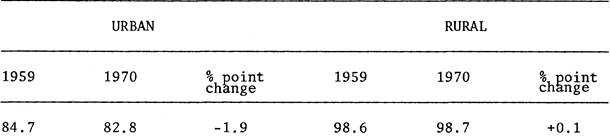
The threat to the vitality of the Ukrainian language is perhaps overestimated by Ukrainian dissidents. Ukrainian was claimed as the native language by 91.4% of Ukrainians in the 1970 census, down 2.1 percentage points from the
7
1959 census. A slightly different picture emerges when these data are grouped according to urban and rural residence of the respondents:
Table 4.1
Percentage of Ukrainian Population of Ukrainian
SSR Reporting Ukrainian as Native Language
Sources: Itogi vsesoiuznoi perepisi naseleniia 1959 g.
Ukrainskaia SSR.(Moscow: "Gosstatizdat,” 1963), pp. 174-91; Itogi vsesoiuznoi perepisi naseleniia 1970 g.s Vol. IV (Moscow: "Statistika,” 1973), pp. 170-91.
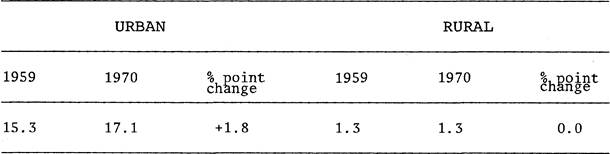
Table 4.2
Percentage of Ukrainian Population of Ukrainian SSR Reporting Russian as Native Language
Sources: Same as for Table 4.1.
Itogi vsesoiuznoi perepisi naseleniia 1959 g., Ukrainskaia SSR (Moscow: ’’Gosstatizdat,” 1963), pp. 174-191; Itogi vsesoiuznoi perepisi naseleniia 1970 g.y Vol. IV (Moscow: "Statistika,” 1973), pp. 152-53.
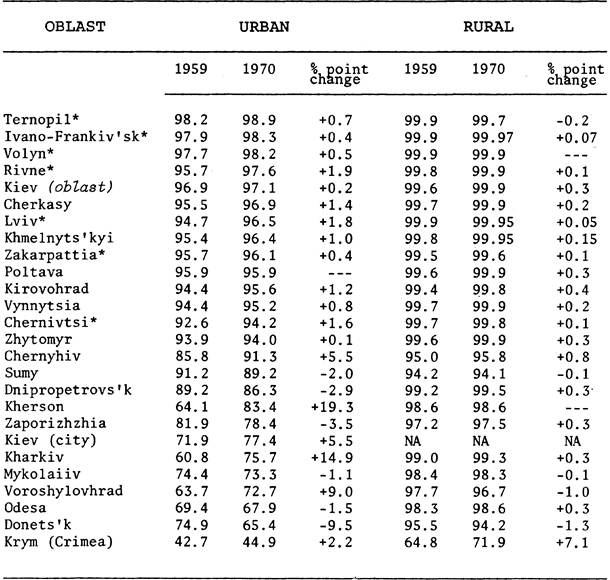
Table 4.3
Percentage of Ukrainian Population of Ukrainian SSR Giving Ukrainian as Native Language: by Oblast
*=West Ukraine
Sources: Itogi vsesoiuznoi perepisi naseleniia 1959 g.9 Ukrainskaia SSR (Moscow: "Gosstatizdat," 1963), pp. 174-91; Itogi vsesoiuznoi perepisi naseleniia 1970 g,^ Vol. IV (Moscow: "Statistika,” 1973), pp. 170-91.
Tables 4.1 and 4.2 show that the Ukrainian language gained slightly in the countryside, and its losses in the cities, taking the Republic as a whole, were modest. Table 4.3 illustrates that the stability of the Ukrainian language is strongest in the oblasts of the West Ukraine. Ukrainian also made dramatic gains in the urban areas of Kherson, Kharkiv and Voroshylovhrad, and moderate gains in Kiev city and Chernihiv oblast. The most important fact illustrated in Table 4.3, however, is that the losses to the Ukrainian language in cities - net Russification - have occurred in only six out of the 25 oblasts: Sumy, Dnepropetrovsk, Zaporizhzhia, Mykolaiiv, Odesa and Donetsk. All other oblasts showed a net gain in adherence to the Ukrainian language.
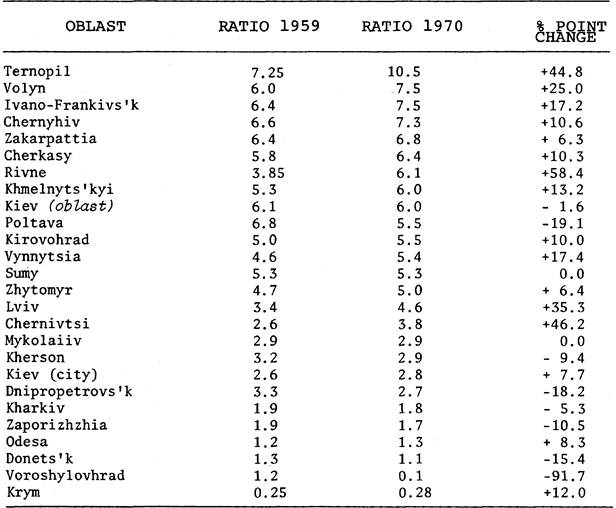
Of the oblasts that exhibit net Russification in the cities, only Dnipropetrovsk has shown a significant decrease in the ratio of Ukrainians to Russians (net Russian- ization). In the other five, the ratio in the 1970 census is comparable to that for 1959, as shown in Table 4.4.
Table 4. 4
Ratio of Ukrainians to Russians by Oblast
Sources: Same as for Table 4.3.
Table 4.4 also reveals other anomalies in the relationship of Russification to Russianization. There was dramatic (twelvefold) Russianization of Voroshylovhrad oblast between the two censuses, accompanied, however, by a dramatic gain for the Ukrainian language. Equally significant gains in adherence to Ukrainian occurred in Kherson and Kharkiv, and to a lesser extent in Chernihiv and Kiev city, where there were no substantial changes in the ratio of Ukrainians to Russians. Similarly, a number of oblasts in which the ratio of Ukrainians to Russians has increased g have shown no dramatic gains for adherence to Ukrainian.
The policy of promoting bilingualism has been rather more successful. In 1970, 48.5% of the urban and 25.1% of the rural Ukrainian population of the Republic reported fluency in Russian as a second language, although we have no way of gauging the quality of this fluency. Ukrainian is also strong as a second language, however. Between 52.4% and 52.5% of those Ukrainians who declared Russian as their native language also declared Ukrainian as a second lan-
9 guage. To the extent that this group can be supposed to be equally fluent in Russian and Ukrainian, having declared Russian as native out of deference or social pressure, it reduces the extent of actual Russification; this, of course, can only be a supposition. Unambiguous linguistic assimilation can only be attributed with certainty to those Ukrainians who speak Russian but not Ukrainian; only 8.2% of the urban Ukrainian population falls into this more restricted category.
g
Statistical analysis yields no significant correlation of these variables.
9..
Itogi vsesoiuznoi perepisi naseleniia 1970 g3 Vol. IV, pp. 158-59. Data on the declaration of a second language are not available for 1959. "^Calculated from data in Itogi vsesoiuznoi perepisi naseleniia 1970 g.3 Vol. IV, pp. 158-59. 8.2% is that percentage of the urban population
speaking a native language other than Ukrainian (for 99.8% of whom that language is Russian), who do not declare Ukrainian as a second language; i.e., they speak Russian, but not Ukrainian.
Minority nationalities in the Ukraine - other than Jews and Russians - which come from other republics, tend to adopt Russian rather than Ukrainian as a native or a second language, when declaring a language other than their own: this is probably explainable simply in terms of migration, as they learned Russian before they migrated to the Ukraine. Czechs and Poles, however, who have lived on Ukrainian territory for generations, tend to assimilate to Ukrainian rather than to Russian.11 Finally, 25.9% of Russians and 39% of Jews living in the Ukraine report Ukrainian as a second language. The adoption of Ukrainian as a second language by Russians living in urban areas (27%) is higher 12
than by those in rural areas (20%). At first gloss, one might expect the reverse, as Ukrainian is more necessary for dwellers in rural areas; perhaps the explanation is that Russians in the villages are frequently itinerant officials, while those in the cities are relatively settled.
The data we have presented attest that rampant linguistic denationalization is not taking place in the Ukraine; except for a few urban areas in the East Ukraine, the Ukrainian language is in fact gaining. There was a net decline for the Ukraine as a whole, but a very modest one.
But the figures also show that Ukrainians are speaking Russian as a second language. This aspect of Soviet nationalities policy is showing success. Brian Silver has argued that bilingualism may be viewed as "a stable form of accommodation between ethnic groups," but for the long term, he is not confident that bilingualism will not threaten the maintenance of the native tongue for some Soviet nationalities, such as the Ukrainians, for whom factors that
^Itogi vsesoiuznoi pereplsi naseleniia 1970 g.3 Vo. IV, pp. 152-53.
For a more sophisticated statistical treatment, though Union-wide and not by oblast, see Brian Silver, "Ethnic Identity Change among Soviet Nationalities: A Statistical Analysis," PhD Thesis, Department of Political Science, University of Wisconsin-Madison, 1972.
12..
Radians’ka Ukraina, April 25, 1971; also, Itogi vsesoiuznoi perepisi naseleniia 1970 g.3 Vol. IV, pp. 152-53, 158-59, 164-65. reinforce the native language are weak.*1·3 But while officially-sponsored or encouraged discrimination against the Ukrainian language certainly exists, it is not reflected in any significant decline in adherence to the language overall.
Discrimination against the Ukrainian language is in part the result of social processes, particularly in highly Russianized areas, and in this case is to be attributed to the differential prestige of the Russian and Ukrainian lan-
14
guages. State policy can be said to discriminate against the Ukrainian language when (to use Joseph Gusfield's concept) policies pursued by the state tend to favor one side of a “status” issue.official Soviet policies in the Ukraine have tended to reinforce the prestige of Russian over Ukrainian, and to encourage the adoption of Russian by Ukrainians seeking upward mobility. These policies have generated significant controversy on the language question. The entire period, for example, has been marked by demands for greater use of Ukrainian in the mass media and the arts, and there is considerable documentation - both Soviet and Western - of the fact that publishing and broadcasting in Ukrainian is not proportional to the percentage of Ukrainian speakers in the Republic.
Both establishment intellectuals and dissidents have taken part in the controversy over language. Commitment to the preservation of the Ukrainian language is the clearest
13
Brian Silver, ’’Bilingualism and the Maintenance of the Mother Tongue in Soviet Central Asia,” Slavic Review, No. 35, No. 3(September, 1976), p. 424.
14
Russian contempt for the Ukrainian language has been well-documented. See, for example, John Kolasky, Two Years in Soviet Ukraine, passim; Yaroslav Bilinsky, The Second Soviet Republic, pp. 156ff; and dissident writings, especially Ivan Dzyuba, Internationalism or Russification? (New York: Monad Press, Inc., 1974), pp. 149ff.
^Joseph R. Gusfield, Symbolic Crusade (Urbana: University of Illinois Press, 1963), p. 11.
substantive link between establishment intellectuals, dissidents, and even some Ukrainian Party officials. We turn our attention to an examination of controversy over state policies affecting language as they relate to two issues: language and education, and language culture. As they concern the symbolic role of language in the maintenance of ethnic identity, the former is particularly a question of differentiation and status, the latter primarily of authenticity.
CONTROVERSY OVER LANGUAGE IN THE SOVIET UKRAINE
Language and Education
In the field of education, state policy effectively discriminates against the Ukrainian language. It does so directly, by requiring the study of Russian in primary schools (since 1972, also in kindergartens) and by conducting instruction in Russian, and indirectly through the structure of incentives: because the better institutes of higher education conduct much, if not most, of their instruction in Russian, parents wishing to provide their children with the best opportunities for upward mobility do well to send their children to Russian schools.^ The education system thus produces bilingualism, which is an articulated goal of state policy, but it is inescapable that early socialization on this pattern will lower still further the prestige of the Ukrainian language; education is a prime medium for the transmission of symbols, and symbols are the vehicles of values.
The education system works against the Ukrainian language as a symbol of differentiation and status in three
16The 1977 Constitution (Article 45) limits the guarantee of native language instruction to schools, excluding any right to its use in higher education (except, of course, for native Russian speakers). ways: 1) by retarding the pupils' facility with the language; 2) by communicating, largely through example and nuance, negative symbolic associations with Ukrainian and positive ones with Russian; and 3) by making an irresistible appeal to the students' self-interest, as they learn that there is a premium attached to the mastery of Russian, and a social stigma attached to speaking Ukrainian in some contexts.
Khrushchev's 1958-59 school reforms abolished the compulsory instruction of children in both the republican language and in Russian, leaving the choice of sending their 17 children to national or to Russian schools to the parents. Seemingly innocuous, the decree in fact meant that most parents would opt for Russian schools, mainly to enhance their children's prospects, but also perhaps because of social pressure, and because Russian schools have better facilities. Opposition to the change was great. The Kiev Writers' Union passed a resolution against implementation 18
of the reform, and a number of Ukrainian Party officials
19 are said to have pleaded that the reform not be instituted.
Sviatoslav Karavans'kyi wrote and circulated an article somewhat later, describing the decree as "fundamentally discriminating" in its intent and effects, and demanding
l^See Section 9 of the ’’Decree on strengthening ties between school and life, and continued development of public education in the Ukrainian SSR," Radians fka Ukraina, April 19, 1959, pp. 2-3; translation of excerpts in Digest of the Soviet Ukrainian Press, 3:6:1. For a discussion of the reforms, see Yaroslav Bilinsky, "The Soviet Education Laws of 1958-59 and Soviet Nationality Policy," Soviet Studies, Vol XIV, (October, 1962), pp. 138-57; and "Education of the non-Russian Peoples of the USSR," Slavic Review, Vol. 27(September, 1968), pp. 411-37; also see Harry Lipset, "The Status of National Minority Languages in Soviet Education," Soviet Studies, Vol. XIX (October, 1967), pp. 181-89.
18
Literatuma hazeta, December 19, 1958.
19
V. Borysenko, "Ukrainian Opposition to the Soviet Regime," Problems of the Peoples of the USSR, No. 6(1960), p. 40. The reform dropped the requirement of education in the national language, and was therefore probably not perceived as coercive in the minds of most parents. it be rescinded.20
Many of the feared effects of the reform were in evidence before it was instituted, however. Considerable concern had been publicly expressed in the period 1957-1959 over the quality of mastery of Ukrainian language and literature on the part of applicants to universities. Summarizing the results of admissions examinations to Shevchenko Kiev State University, one educator concluded that the lowest levels of mastery of Ukrainian were shown by those who finished city schools with Russian as the language of instruction, and in particular, schools for working youth. These applicants tended to think in Russian and then translate their sentences into Ukrainian, making frequent syn-
21 tactic errors and employing a large number of Russicisms. Similar generalizations were made about applicants to the
22 University of Chernivtsi in 1960.
It is therefore difficult to gauge the extent to which the reforms were actually responsible for the effects feared for them. There was, however, an increase in the number of Russian schools in the Ukraine, and articles began appearing urging parents to send their children to Russian schools. Travellers and emigres report that considerable social pressure is brought upon parents not to send their children to Ukrainian schools.
Statistics on the number of Ukrainian schools and Russian schools are frequently published, along with the percentage
20
Sviatoslav Karavans’kyi, "Po odnu politychnu pomylku,” (September, 1965), AS 916, SDS Vol. XVIII.
21
A.M., ’’About Admissions Examinations in Ukrainian Language and Literature at the T.H. Shevchenko Kiev State University,” Ukrains rka mova V shkoti, No. 6(1958), pp. 91-93; translation in Digest of the Soviet Ukrainian Presss 3:4:19.
I.I. Slynko, ’’Results of Entrance Examinations in the Ukrainian Language to the University of Chernivtsi,” Ukraine rka mova v shkotij No. 5(1960), pp. 90-93; translation in Digest of the Soviet Ukrainian Presss 4:12:23. Numerous articles of this type appeared during this time period. of schools in the Ukraine these represent. It was reported in 1958, for example, that there were 25,000 Ukrainian
23
schools in the Republic, constituting 83% of the Ukraine’s 30,236 schools of general education, with a total enrollment
24
in all schools of 5,468,000 pupils. Rarely published, however, are figures for the percentage of pupils attending
. 25
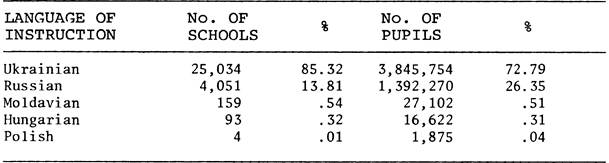
Ukrainian schools. Although the majority of schools are Ukrainian schools, many of these are located in rural areas and small towns, and are smaller than average. The last time, to our knowledge, that such figures on enrollments were published with official approval for the entire Republic was for the 1955-56 school year:
Table 4.5
Language of Instruction^ 1955-1956
Ukrainian SSR
Source: L.V. Cherkashyn, Zahal *ne navchannia v Ukrainefkii RSR v 1917-1957 (Kiev, 1958), p. 61. Cited by John Kolasky, Education in Soviet Ukraine: A Study in Discrimination and Russification (Toronto: Peter Martin Associates, Ltd., 1968), p. 51.
It is clear from these figures that Russian schools,
with an average of 344 pupils per school, are larger than
23
Radians'ka osvita, No. 18(May 4, 1957).
l^Radians'ka osvita, No. 22(June 1, 1957). The figures do not include 372,600 youths in 3,915 schools for working and farming youth.
25
Dissidents, too, have complained about the scarcity of data on this subject; see Ukrains'kyi visnyk 6 (Smoloskyp, 1972), p. 63. The presumption is that the regime considers the information sensitive.
Ukrainian schools, with an average of 154 pupils per school. Later figures are fragmentary, but the number of Russian schools had increased by 1964-65 to over 4500, or over 15%
2 6
of the total, while, by 1967, the percentage of Ukrainian
27 schools had declined to 81.1%.
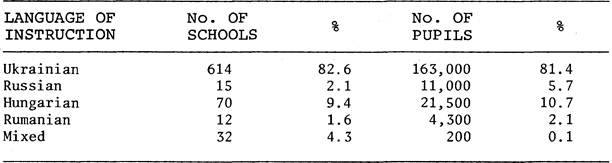
In an unusual exception to the rule, figures were published in 1970 for enrollment in Ukrainian schools in Zakarpattia. The following figures are for general schools in the oblast:
Table 4. 6
Language of Instruction in Zakarpattia, 1970
Source: A.M. Ignat, "Zdiisnennia lenins'koi polityki v shkolakh Zakarpattiia,” Radians rka shkola, No. 6(1970), pp. 43ff. The figures do not include 482 middle and eight-year schools with unknown attendance
The exceptional publication of these statistics may well have been designed to counter charges of the Russification of education, as the figures show an unusually low percentage of enrollment in Russian schools. Zakarpattia is, however, a largely rural oblast with a low Russian presence and a large Hungarian and Rumanian presence. Nationality controversy in the city of Uzhhorod is less concerned with Ukrainian-Russian relations than with relations with the East European nationalities, and the control of contacts of
26
^Radiansrka Ukraina, December 5, 1964.
27 M
P.P. Udovychenko, Rastsvet narodnogo obrazovaniia, nauki, i kul’tury," Sovetskaia pedagogika, No. 10(1967), pp. 38-48.
28 the latter with the neighboring home states.
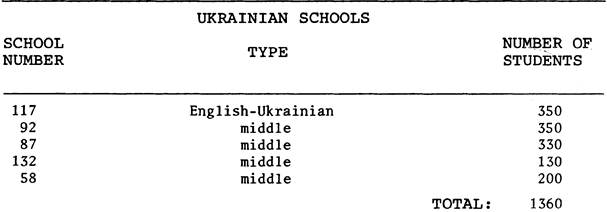
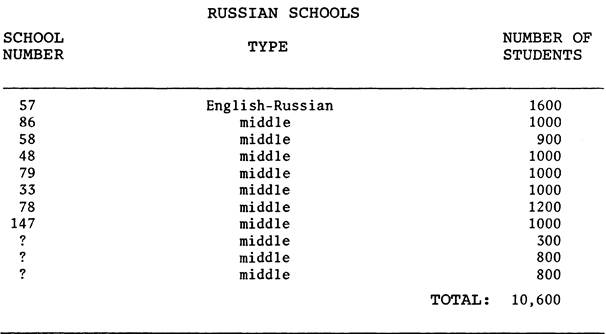
In 1969, there appeared a samvydav document with interesting statistics on relative Ukrainian and Russian school attendance in the centrally-located Lenins ’kyi district of the city of Kiev:
Table 4.7
General Education Schools in Lenins 'kyi Raion - KieVj circa 2969
Source: Η.H., "Pid shovinistychnym presom,” Ukraine 'kyi visnyk 6 (Smoloskyp, 1972), pp. 66-67.
28
Confidential interview.
It can be seen from Table 4.7 that, while 31.3% of the schools in the razon are Ukrainian schools, they are attended by only 11.4% of the students in the district. We do not have information on the ratio of Ukrainians to Russians in the razon, but we have the samvydav author's assurance that the percentage of students in Russian schools is considerably higher than the percentage of Russians in the razon. This source also notes that School No. 57 is a "Central Committee" school, attended by the children of Shelest, Shcherbitsky, Drozdenko, Paton and other elites. The children and grandchildren of Podgorny and other elites
29 attend School No. 78.
Data in the same document for Kurenivka razon in Kiev show five Russian schools attended by 5,000 students, and
30 five Ukrainian schools attended by 4,945 students in 1969. These data are even more revealing, because the population of Kurenivka, a working class district, was almost 100% Ukrainian in 1969. Thus, Approximately 50% of the Ukrainian pupils in this razon attend Russian schools. The same source reports that facilities in the Ukrainian schools are poor compared to those in Russian schools, and that there are few Ukrainian kindergartens.^
The quality of instruction in the Ukrainian language in both Ukrainian and Russian schools is also an issue that has drawn criticism. School textbooks in the Ukrainian language have been found to contain Russified spellings and grammatical forms, which persist edition after edition. Similarly, the culture of the teachers' language comes under frequent attack; the most frequently cited shortcoming is
29
H.H., "Pid shovinistychnym presom," Ukrazns fkyz vzsnyk 6 (Smoloskyp, 1972), pp. 66-67.
30
™Ibzd., p. 70.
^Tbzd. Also see the samvydav document "Tovaryshi bat'ky shkoliarev,” (1964), AS 909, SDS Vol. XVIII, a complaint signed by 17 mothers of kindergartners to the Ukrainian SSR Minister of Health, protesting the use of Russian in the kindergartens. the so-called surzhyk (hodgepodge) - the mixture of Russian and Ukrainian words. This problem is greater in the East Ukraine than in the West Ukraine; there have been some complaints, in fact, about the quality of teaching Russian in
32 the West Ukrainian schools.
Part of the general difficulty has been poor training of teachers. The peculiarities of teaching Ukrainian, it is complained, are not properly taught in pedagogical institutes. A samvydav document, written in Russian but with numerous misspellings and grammatical errors, by the Chairman of the State Examining Committee of the Crimean Pedinstitute, complains that courses in the Ukrainian language at the Institute are taught in Russian, often by teachers
33 who do not know Ukrainian themselves.
Higher education in the Ukraine is conducted for the most part in Russian. luryi Nikolaevych Dadenkov, Ukrainian Minister of Higher and Secondary Education (February, 1960- November, 1973), proposed far-reaching Ukrainization of higher education in a speech before the rectors of a number of institutions in August, 1965; he subsequently submitted his proposals to the CPSU Central Committee. Dadenkov's proposals, illuminating for what they reveal about the state of higher education in the Ukraine, were described by Viacheslav Chornovil in a samvydav document which reached
34 the West in late 1972.
Dadenkov informed the conference of rectors that 317,529 students were enrolled in the 50 institutions of higher
32..
V. Raukov, "Sreda zaela," Uchitel1 skaia gazeta, December 24, 1966, p. 2; B. Khandros, "Chtoby sreda ne zaela,” Uchitel1 skaia gazeta, February 21, 1967, p. 2; "Luchshe uchit’ russkomu iazyku vo vsekh shkolakh strany,” (editorial), Narodnoe obrazovanie, No. 7(1970), pp. 125-27.
33
V.N. Skrypka, "Pro stanovyshche ukrains’koi movy v Kryms'komu Ped- institutu,” Ukrainefkyi visnyk 6 (Smoloskyp, 1972), pp. 73-78. Although the title is in Ukrainian, the article is in Russian.
34
Viacheslav Chornovil, "lak i shcho obstoiue Bohdan Stenchuk?” Ukrains^yi visnyk 6 (Smoloskyp, 1972), pp. 12-56. education under the Ukrainian Ministry for Higher and Secondary Technical Education, of whom 177,050, or 55%, were Ukrainians. Since, in 1965, 1.3 million students were
33 enrolled in higher and secondary schools in the Ukraine, approximately 982,471, or 75.6%, of the students in the Ukraine were enrolled in institutes under the authority, not of the Ukrainian government, but of various USSR ministries. Dadenkov’s figures thus apply to only 24.4% of students in institutes in the Ukraine.
In the 50 institutes, Dadenkov reported that 8,832, or 48.7%, out of the total teaching staff of 18,132 were Ukrainians. At the eight universities in the Republic, 45,954 (61%) of the 75,207 enrolled students were Ukrainians; of the teaching staff of 4,400, 2,475 (56%) were Ukrainians. However, only 34% of the teaching staff delivered their lectures in Ukrainian; at Odesa, 10% did; and at Uzhhorod University, where 71% of the student body was
3 6 Ukrainian, 43% delivered lectures in Ukrainian.
Further, according to Dadenkov, the language of instruction is Russian at the Kiev Institute for National Economy and the Kharkiv Legal Institute, the only schools in the Ukraine educating personnel in these fields for the Republic. Finally, of 36 specialized technical schools under Dadenkov’s authority, the language of instruction was Russian in 30, and both Russian and Ukrainian in the remaining six.37
Dadenkov then made ten proposals, the effect of which would have been to shift the language of instruction to Ukrainian in stages, to require all professors to learn Ukrainian, to require the publishing houses of Kiev, Kharkiv and L’viv Universities and "Radians rka shkota" to
35.
Radians 'ka Ukraina, February 5, 1966, p. 4.
3^Chornovil, op. cit., pp. 25-27.
Ibid.3 p. 26.
publish texts primarily in Ukrainian, and that all administrative business in universities and institutes be shifted 38 from Russian to Ukrainian.
Chornovil reports that the CPSU Central Committee was inundated with protest letters from Russians and Russified Ukrainians in Kiev, and that Moscow was displease with the proposals in any event; under pressure from Moscow, they were filed away and forgotten.
As Chornovil argues, it is unlikely that Dadenkov would have made the proposals without Shelest’s knowledge and
39 support. Shelest’s interest is quite credible; it was at this time that his contacts with nationalist-oriented intellectuals were becoming noticeable, and in subsequent years he called for publication of college textbooks in Ukrainian, and openly defended the Ukrainian language at
40 the 5th Congress of the Ukrainian Writers' Union in 1966.
A few months prior to Dadenkov's speech before the rectors, Sviatoslav Karavans'kyi filed a lengthy complaint with the State Prosecutor of the Ukrainian SSR, demanding that Dadenkov, as Minister of Higher Education, be brought to trial for violation of the law, for having permitted the Russification of higher education. Karavans'kyi based his complaint on Article 66 of the Criminal Code of the Ukrainian SSR ("Violation of National and Racial Equality") and Article 167 (relating to violation of Leninist norms in the 41
organization of higher education). The complaint did not, of course, produce an indictment, and it was intended graphically to bring the problem to public attention in legalistic form. A copy of the complaint did, however, reach
3&Ibid., pp. 28-29.
ZQ
Ibid., p. 30.
40
Literatuma Ukraina, September 6, 1968, and November 17, 1966.
41 · Sviatoslav Karavans’kyi, ’’Klopotannia prokurorovi URSR pro seriozni
pomilky i progoloshennia rusyfikatsii ministrom vyshchoi ta sred’noi osviti URSR lu. M. Dadenkova," (February 24, 1964), AS 915, SDS Vol. XVIII.
Dadenkov and Shelest, and they are reported to have been
42 immensely disturbed by it. If this is true, it is significant evidence of effective interest articulation outside normal channels.
Language Culture and Purity
Language planning, as Joshua Fishman has emphasized, is not inherently a nationalist activity; in pre-nationalist times, both opponents and proponents of language planning, in Fishman’s words, "reveal a typical lack of central concern for the ethnic, the authentic, the indigenously unique
43 spirit and form." Instead, the concern was primarily with "dimensions such as beauty, parsimony, efficiency,
44
feasibility...." Nationalist language planning, however, is concerned with the pursuit of ethnic authenticity and differentiation through the effort to exclude external linguistic influences: the pursuit of linguistic purity. But while nationalist-oriented language planners, in the effort to reconcile modernization and authenticity, are usually reluctant to admit foreign words into the language (attitudes toward caiques vary), they are not averse to borrowing modern - and often foreign - concepts and ideas. What they seek to protect, therefore, is the vehicle in which such concepts are couched, precisely for its value as a symbol of authenticity, unity and differentiation.
In the Ukraine, the external influence against which Ukrainians wish to protect the language is, of course, Russian. Because the two languages are etymologically
42
Viktor Nekrasov, personal interview, Paris, June 27, 1976; corroborated by Leonid Plyushch, personal interview, Paris, July 6, 1976.
43
Joshua A. Fishman, Language and Nationalism: Two Integrative Essays (Rowley, Mass: Newbury House Publishers, 1973), p. 72.
44
Ibid., p. 73. closely related, and because Ukrainian enjoys a lower status than does Russian, the Ukrainian vernacular is often characterized by lexigraphical and grammatical Russicisms, and in science and technology the tendency is simply to borrow Russian terms for new concepts rather than to base new words on Ukrainian roots. The extensive introduction of Russicisms into the Ukrainian language (and, indeed, into all Soviet languages) is in fact a part of official policy. At an All-Union Conference on Problems of Terminology in Moscow in 1959, it was emphasized that supplementation of lexicons of national languages is to be guided by the principle of "minimal differences" - that new words for new scientific and technological concepts in national languages should be based on the same roots (either Russian, or the foreign word borrowed by Russian) - to facilitate inter-
45 republican scholastic communications.
Following the 20th Party Congress, Ukrainian intellectuals sought to revive interest in and respect for the Ukrainian language among the urban population. Among the intellectuals who were concerned with popular language culture and outspoken in their defense of the language were Mykyta Shumylo, Maksym Ryls'kyi, Ivan Dzyuba, Valentyn Moroz and Sviatoslav Karavans'kyi. Among the most outspoken and prolific of the defenders of the language, how- 46 ever, has been the linguist Borys Antonenko-Davydovych. He has sometimes been explicit, and astute, in his analysis of the psychological basis of reactive linguistic nationalism. He writes of his high school days:
45
Literatuma hazeta, May 21, 1959. Also see Vitalii Rusanivs’kyi, •'New Prospects for the Development of National Languages," Literatuma hazeta3 July 28, 1959, pp. 1-2; translation in Digest of the Soviet Ukrainian PresSj 3:9:20; and I.K. Bilodid, in Radians rka Ukraina, August 31, 1963, p. 3
46
See his lak my hovorymo (Kiev: "Radians’kyi pysmennyk," 1970). Also see articles in Zmina, March, 1964; Dnipro, No. 9(1960), pp. 142-52; Literatuma Ukraina, January 19, 1965, and March 5, 1965. For criticisms of Antonenko-Davydovych, see Literatuma Ukraina^ March 30, 1965.
There was something odd: the more the authorities of the high school relegated the Ukrainian language from use, the deeper it penetrated not only into our usage, but into our hearts as well. Moreover, when we were in the higher grades and became acquainted with the foremost Russian literature... using the Ukrainian language among ourselves became a badge of our nationality, democracy, almost a revolution.
Perhaps because of his age, his concerns, and his position in the establishment, Antonenko-Davydovych is venerated by nationalist dissidents. He published, for example, an article in 1968 in which he advised putting back into the alphabet the letter " " which had been
dropped in the standardization of Soviet Ukrainian orthography in the early 1930s.The old letter " was a voiced, plosive back-palatal consonant, equivalent to the Russian ’T" (both transliterated "g"), and used in relatively few words. The Ukrainian " f,” however, is a voiceless, fricative back-palatal consonant (transliterated "h"). Antonenko-Davydovych's argument was that Russians and even many Ukrainians pronounce the Ukrainian T" like the Russian "r," mistaking the identical orthography for identical pronunciation and saying, for example, "Grushevs’kyi," rather than the correct "Hrushevs’kyi." Restoration of the "rz” might help eliminate the confusion, he believed. Also, we may note, the distinctive Ukrainian pronunciation of ’T" is an element of differentiation, and its preservation a matter of authenticity.
Antonenko-Davydovych's article produced only mild rebuffs and good-natured ridicule from establishment critics
47
Drnpro, No. 11(1961), pp. 135-45.
48
’’Litera, za tokoiu tuzhat’," Literaturna Ukrai-na, November 4, 1969. The use of the letter was continued in the Polish Ukraine until its annexation by the USSR. such as V. Rusanivs'kyi. The suggestion was not criticized on ideological grounds. It is reported, however, that the proposal prompted a lively debate in samvydav channels over the intra-linguistic effects of Russification, and a number of petitions asking that Antonenko-Davydovych’s suggestion be put into effect.50
As against intellectuals who have defended the Ukrainian language, I.K. Bilodid deserves brief mention as the Ukrainian champion par excellence of Russification. Bilodid was the Ukrainian Minister of Education who presided over the implementation in the Ukraine of Khrushchev's 1958-59 education reforms and, in his capacity as a philologist and head of the Ukrainian Academy of Sciences' Instytut movo- znavstva (Institute of Linguistics), he has championed the Russian language and opposed language planners' efforts to 51 preserve the language.
Protest against Russification has from time to time been registered a various official forums. A Republican Conference on the Problems of the Culture of the Ukrainian Language, held in Kiev February 11-15, 1963, for example, produced numerous unscheduled speakers protesting, to great applause, the Russification of education, public business and government transactions, scholarly works, and the arts. Apparently, the participants sent a list of their demands 52
to the Central Committee. Similarly, Koshelivets reports outspoken protest at a Republican Conference of Teachers in
49..
V. Rusanivs’kyi, "Za chym tuzhyty?” Literaturna Ukraina, November 28, 1969, p. 2.
^For a survey of the samvydav discussion, see Ukrains rkyi visnyk 3 (Smoloskyp, 1971), pp. 92-95.
^See Kolasky’s graphic description of Bilodid in Tu)o Years -in Soviet Ukraine, pp. 66-71.
52
See S. Dobhal, ”A Fight for the Language,” Problems of the Peoples of the USSR, No. 18(June, 1963), p. 47. Also see Kolasky, Education in Soviet Ukraine, pp. 193-94. The events at the Conference were not reported in the Soviet press, but a participants report was published
Kiev in 1963.53
Kolasky reports having witnessed an argument at a meeting of the Presidium of the Ukrainian Writers’ Union in 1964, between V. Rechmedin and Andrii Malyshko on the one hand, and A.D. Skaba, CPUk CC Secretary for Ideological Affairs, on the other. He reports that Skaba directed them to write up their complaints and submit them to the Central Commit- 54
tee. This is significant; Skaba is widely reputed to have directed Dzyuba, too, to write out his complaints and submit them.5^ it suggests that during his tenure, Skaba was either screening intellectual protest from Shelest, or deliberately evading a confrontation in which he, Skaba, did not feel intellectually competent. The former interpretation is reinforced by Shelest’s appointment of F.D. Ovcharenko to replace Skaba as ideological secretary in March, 1968. The outstanding qualification of Ovcharenko, a chemist by profession, was his extensive close personal friendships with Kiev intellectuals.5^
Other aspects of the "intra-linguistic" effects of Russification have also been of concern. Intellectuals have complained, for example, about distortions in Ukrainian onomastics. As the study of the origins of proper names, onomastics preserves in the popular memory names, usages, and dialects, and the emotional connotations that go with them, which are historically rooted and therefore crucial to the national myth. Under the Soviet regime, Russified in Nasha kultura (Warsaw), March, 1963, pp. 5-6.
53
Ivan Koshelivets, "Khronika ukrainskogo soprotivleniia,” Kontvnent^ No. 5(1975), p. 188.
54
Kolasky, Education in Soviet Ukraine3 p. 194.
^Although Nekrasov and Plyushch, both of whom knew Dzyuba well, told us that this piece of conventional wisdom is false: that Dzyuba wrote and submitted his manuscript without directive or invitation.
^ivan Koshelivets, personal interview, Munich, June 11, 1976. The information was corroborated by Nekrasov, Paris, June 27, 1976. and Sovietized versions of Ukrainian place names have come into common usage: Rovno instead of Rivne, Severodonetsfk rather than Pivnichnodonets 'k. In some cases of Sovietization, the result is incongruous. Krasnyi in Russian means "red" and is strongly suggestive of bolshevism; in Ukrainian (as in Old Russian), kras'nyi still means "beautiful;" the appropriate translation of "red," as in "Red Army," "Red Guards," etc., would be chervonyi. Yet the Ukraine is studded with place-names like Krasnyi Lyman, Krasnoloka,
57
Krasnoarmiyske, and the like.
The underdeveloped nature of Ukrainian linguistics and the role of Ukrainian linguistics and slavistics have been another area of concern. Demands for a special Ukrainian linguistics journal were voiced at a conference on lin-
58
guistics in Kiev, May 27-31, 1958. This demand was not satisfied until the creation in January, 1967 of the journal Movoznavetvo (Linguistics), devoted to such problems as the connection between thought and language, contacts among languages, and the structural peculiarities of language.
The creation of the journal was not accompanied, as had been demanded, by the establishment of a special department of language culture in the Institute of Linguistics of the
59
Ukrainian SSR Academy of Sciences.
Considerable controversy over the publication of Ukrainian dictionaries marked the entire period. Publication of a six-volume Ukrainian-Russian dictionary, several technical and scholastic Ukrainian-Russian dictionaries, and a ten-volume "explanatory" dictionary of the Ukrainian language were held up for many years, drawing numerous protests
$7Literaturna Ukraina, October 1, 1963. In Kiev, however, the thoroughfare is popularly called Chervonoarmiisfka.
58
Ukraine rka mova v shkoli, No. 5(1958), pp. 90-94.
59
Literatuma Ukraina, September 27, 1966. The subject was officially considered too narrow to justify a special department.
from intellectuals.60
Delays in the preparation of dictionaries are the result of controversy over the question of "minimal differences" versus authenticity, and over which literary works are appropriate as standards of usage; there has been controversy as well over the extent of inclusion of passive vocabulary: obsolete words, archaisms, rarely used words, and colloquialisms. The viewpoint of spokesmen for proletarian internationalism is that such emphasis on authenticity and differentiation artificially impedes internationalization and "drawing together" (sbZizhenie), and is thus ideologically faulty.61
Finally, there has been considerable controversy in recent years over language culture in science. This is an important aspect of language as a vehicle and as a symbol of national distinctiveness. Intellectual, and particularly scientific, excellence on the part of representatives of a nationality can serve as a displacement symbol for more
6 2
explicit symbols of national greatness. The same, we may note parenthetically, is true of sports. It is especially disconcerting to persons conscious of their Ukrainian nationality that Ukrainian achievements in science and technology are classified with and subordinated to Soviet
^Literaturna hazeta3 August 15, 1961; Literatuma Ukraina3 October 5, 1962; September 17, 1963; and February 2, 1968.
61I.K. Bilodid, ’’The Role of Native Language in the Development of Education and Culture of a People,” Ukraine 'ka mova i Ziteratura v ehkoZi3 No. 6(1967), pp. 1-8; translation in Digest of the Soviet Ukrainian Preee3 Vol. 1967, 9:18-20; I.K. Bilodid, "Flowering of Language in the Ukrainian Soviet Nation,” Ukrainsfka mova i Ziteratura v shkoZi3 No. 12(1967), pp. 5-11; translation in Digest of the Soviet Ukrainian Preee3 Vol. 1968, 4:20-21; L.L. Humets’ka, ’’Fifty Years of Linguistics in the Ukraine," Ukrainefka mova i Ziteratura v shkoZi3 No. 5(1968), pp. 85-87; translation in Digest of the Soviet Ukrainian Preee3 Vol. 1968, 7:23-24; and Andrii Buriachok, "Concerning the Selection and Treatment of Words in the Explanatory Dictionary of the Ukrainian Language," Literaturna Ukraina3 May 30, 1972, p. 4; translation in Digest of the Soviet Ukrainian Prese3 Vol. 1972, 7:15-16.
6^This is particularly true of Ukrainian nationalistically-oriented
achievements. Such Ukrainians perceive this Russian cooptation of Ukrainian achievements to be particularly strong in international scientific interaction.^
64
Most Ukrainian scientists speak and write in Russian. Higher education is conducted in Russian, and many scientists are trained in the RSFSR. The necessity for communication with colleagues, not only Union-wide but in the Ukraine, and the desire to gain Union-wide recognition, make fluency in Russian essential for Ukrainian scientists, and for scholars in general.
Ukrainian scientists are particularly concerned over the tendency to adopt Russian or other foreign words for technical concepts, rather than Ukrainian or "Ukrainian- sounding" terms. The field of cybernetics, which is highly developed in the Ukraine, has shown, they argue, that the Ukrainian language is quite adequate for conveying complex technical ideas.65
A samvydav article written in 1969 argues that Ukrainian science is undergoing a "crisis" in regard to scientific intellectuals. We propose (but do not attempt to demonstrate) as a general hypothesis that any activity which carries status will be employed as a displacement symbol of national greatness when direct symbols of national distinctiveness are oppressed.
^^See, for example, the extensive debate sparked by the criticisms of Ukrainian and Soviet science made by Vitalii P. Shelest, an atomic physicist and the son of Petr Shelest, in an article entitled "Arkh- imedy prosiatsia za party,” Literatuma Ukraina, May 5, 1970, p. 1. For a summary of the debate, see "The State of Soviet Basic Sciences: An Unusual Criticism by Ukrainian Academicians,” Radio Liberty Research Paper CRD 335/70, September 16, 1970. Petr Shelest is thought to have been influenced by his son, who was a link between the former First Secretary and the Kiev intellectuals: John Basarab, personal interview, Munich, June 7, 1976.
64
John A. Armstrong notes that everywhere he travelled in the Ukraine and Belorussia, scholars conversed among themselves in Russian rather than in their native language; ’’The Soviet Intellectuals: Observations from Two Journeys,” Studies on the Soviet Union, Vol 1(1961), pp. 30-33.
G^Serhii Plachenda, "A Genre Awaiting its Flowering,” Literatuma Ukraine^ April 5, 1968; translation in Digest..., Vol. 1968, 5:16-18. use of the Ukrainian language. The author alleges that the Ukrainian Academy of Sciences is acting in an "unpartylike" manner in permitting the Russification of the language through science, insofar as it is the Party's policy to promote the "flowering" of national cultures. He also directs his complaints to the "Naukova dumka" publishing house, 212 of whose 375 books (57%) published in 1969 were
6 6
in Russian. The document is a letter - written, ironically, in Russian - addressed to the CPUk Central Committee, the Presidium of the Supreme Soviet, the partkom of the Ukrainian SSR Academy of Sciences, and to a number of newspapers.
CONCLUSIONS
Attachment to ethnic identity undoubtedly can and will persist even after a group has been linguistically assimilated, as the ethnic experience in America has demonstrated. But the native language, while it persists, is the most prominent badge of nationality. Soviet Ukrainian intellectuals conscious of and placing importance on their distinct Ukrainian identity have encouraged language planning efforts that will enhance the Ukrainian language as a symbol of ethnic authenticity and differentiation, and are concerned about the status of the language. Many consider the prestige, the purity, and even the existence of the Ukrainian language to be imperiled by official policies and attitudes, of which Russification is the effect, whether intended or unintended.
Regime policies, despite the officially articulated policy of promoting national languages, have fostered the erosion of the Ukrainian language, in large part through
G^v.I. Kumpanenko, ’’Pis’mo s razmyshleniiami po voprosu o glubokom krizise v primenenii Ukrainskogo iazyka v publikatsii nauchnykh issledovanii i nauchnykh rabot AN USSR v 1969 g.," Ukraine 'kyi vienyk 3 (Smoloskyp, 1972), pp. 94-109. influencing the distribution of prestige attached to the use of Russian, as opposed to Ukrainian. These policies and their effects, however, along with increasing bilingualism, have not significantly affected the vitality of the Ukrainian language inside the Republic. Except in a very few highly Russianized and urbanized areas of the East Ukraine, adherence to the language between 1959 and 1970 increased, and the losses in the aforementioned Russianized areas were modest. In addition, increased Rus- sianization of Ukrainian oblasts in the intercensus period appears to have had no effect on the rate of Russification.
Modernization and mobilization in the Ukraine have no doubt created great pressure for Russification, insofar as the path of upward mobility depends on mastery of Russian. Modernization and its effects are probably irreversible; the social processes generated by modernization will continue to exert pressure for the erosion of the Ukrainian language. In spite of this, however, the language has shown an encouraging vitality, and an articulate segment of the Ukrainian intelligentsia has been vocal in its defense.
V
More on the topic SYMBOLISM AND STATUS: THE UKRAINIAN LANGUAGE:
- Language and Script
- SYMBOLIC ACTION: NATIONALIST OPPOSITION AND REGIME RESPONSE
- Ivan Lysiak-Rudnytsky, Scholar and “Communicator”
- Democracy, Revolution and Terrorism
- Ukrainian History through Literature
- Constructing the Ukrainian Shtetl
- Modern trail-blazers, 1950s-1990s: The slow Renaissance of science
- 12 The Grand Duchy of Lithuania, Rus’, and Samogitia to 1569
- The Donbas: A Region and a Myth
- Kyiv and Jerusalem