The Agricultural Society
The Great Drought was a turning point in the development of Cornies’s world view. It forced him to reassess the Molochna Mennonite economy and brought him face to face with the fact that, given prevailing agricultural techniques and land allocation practices, Mennonites could not support themselves through a prolonged crisis.
In the autumn of 1833 Cornies wrote to Aleksandr Fadeev, Chairman of the Guardianship Committee: ‘This is a year of testing in many respects. Even though the total crop failure this year will set the settlers back for several years, we will also reconsider many things, deal with them and carry them out better, in order to prevent similar disasters in the future.’45The next summer Fadeev proposed extending the authority of the Forestry Society to the entire Molochna economy. Cornies, confronted with both the knowledge of the previous year’s economic disaster and the resulting strong resistance within the Mennonite community to the Forestry Society, advised against this.46 Two years later, however, in February 1836, Cornies reminded Fadeev of his proposal, suggesting that the timing was now ‘expedient’ for such reorganization.47 He assured Fadeev, somewhat disingenuously given ongoing opposition to the Forestry Society, that ‘until now, the society has been able to take pleasure in the punctual compliance to its orders by the members of the community and hopes that the same will also occur in the future.’ Nevertheless, Cornies went on to recommend: Tt would be very much to the purpose if His Excellency, the Chief Guardian [i.e., Inzov] were to be so kind as to release a communication to the combined local church conference, in which all ministers were emphatically admonished that, as possessors of 65 desiatinas of land, they must act as an example to the members of the community through their orderly industry in the
Johann Cornies and a New Mennonite World View 119 plantations and are obligated to support the society in cases that occur by admonishing the community members to obey and follow the orders of the society punctually.’48
Cornies’s growing impatience with resistance to reforms was rapidly leading him to break with the traditional division between secular and congregational authority in Mennonite society.
In future years he would turn more and more to the state for support in his attempts to oblige Mennonites to deal systematically and effectively with the economic problems they faced.The Guardianship Committee created the Agricultural Society in 1836. Its proper name, the Society for the Improvement of Agriculture and Trade, indicates the breadth of responsibilities it was expected to take on, while Cornies’s appeal to Fadeev for support (quoted above) suggests the weight of authority he wanted it to carry. The new society, like the old, did not have its own enforcement mechanisms. It was still formally an advisory body, reliant upon the cooperation of district, village, and congregational authorities. However, the Agricultural Society was to be far more important and controversial than the Forestry Society. The Forestry Society’s jurisdiction extended to a part of agricultural activity that was always secondary; tree plantations never occupied more than a tiny proportion of Mennonite land and labour. The Agricultural Society ‘advised’ on all the principal economic activities of Mennonites, and indeed, on the very activities that defined the Menno- nite world view. AsJames Urry explains, ‘Ownership of land, or at least access to it, lay at the core of Mennonite life. The ethos of religious community was symbolised in agrarian imagery. '49
With the establishment of the Agricultural Society, Cornies entered the most important phase of his campaign to transform Mennonite society. He focused his activities on three principal themes: (1) more efficient allocation of limited Mennonite resources, (2) more efficient exploitation of those resources, and (3) rural industrialization. These were explicitly economic goals, but it would be incorrect to assume that they were a product of a strictly secular world view. To Cornies, efficiency, prosperity, and morality were inextricably linked. He confidently believed that if the Agricultural Society ‘steadfasdy directed its own business and tended to the well-being of its brothers,’ the end result could only be ‘morality, industry and love of orderliness...
upon which prosperity must follow.’50Cornies still operated within the congregational system in 1836. Bernhard Fast, Peter Wedel, and other leading figures in the Old Flem-
ish congregation remained his close allies, and he relied on their support to implement the policies of the Agricultural Society. However, it was Cornies and not the congregational elders who now provided leadership.
More efficient allocation of Mennonite resources was bound to be a controversial issue. As explained in Chapter 3, Mennonites had no control over the allocation of their surplus land, while the reserve land not yet allocated was primarily useful only as pasture. Thus, the society looked to reallocate existing farms more efficiently. Forestry Society regulations threatened that people who disobeyed society orders would be dispossessed of their land, and their farms would be given to young families willing to follow directives. On this basis, in at least one instance, Cornies apparently succeeded in convincing the district administration to evict a householder, seventy-year-old Cornelius Fast, from his farm.51 Comiesjustified the eviction on the grounds that ‘Fast could not have maintained himself further on his farm, even without the [matter of] his not fulfilling the plantings, in that he is a man of almost 70 years without means.’ A second important factor in the decision was that ‘a good, industrious farmer came along,’ willing to take over the farm and work it properly.52 At the heart of this policy was Cornies’s belief that the welfare OfMennonites as a community had to supersede the welfare of individuals. This policy grew out of his understanding that the supply of land was not limitless, so only by its efficient allocation and use could the prosperity of the whole community be maintained.
Individual and community rights had always balanced uneasily in Mennonite theology. Sixteenth- and seventeenth-century lessons of martyrdom had taught Mennonites the need to stand together, and in many of its manifestations Anabaptism is a communitarian theology.
Mennonites had never shared a belief in community of goods with other Anabaptists, like the Hutterites, but the duty of the individual to the welfare of the community remained (and still remains) an important element of Mennonite belief. Although Cornies is often represented as an opponent of traditional Mennonite values, and indeed as the very symbol of secularizing trends in nineteenth-century Mennonite society, his policies clearly placed the welfare of the Mennonite community above the welfare of individuals.Once the Agricultural Society was created, Cornies expanded his efforts to evict inferior farmers from their land and replace them with younger families that promised to abide by society policies. Farmers who failed to keep up the condition of their farms, whether as a result of alcoholism, marital problems, sloth, disease, or age, were pressured to turn over their land to younger families. These, it was expected, would be better able to meet the demands of Mennonite society as expressed by the Agricultural Society.53 Cornies drafted contracts defining the duties of families taking over farmsteads and pressed congregational officials to insist that such families sign them. When the Guardianship Committee placed Cornies in charge of establishing the new villages OfWaldheim and Gnadenfeld (1835) and Landskrone (1839), he used the opportunities to rigorously apply his new standards to the new villages, modelling village plans on those he had already conceived for Akkerman.54
Cornies’s moral imperative that the limited supply of land be used efficiently was accompanied by a concerted effort to develop more efficient agricultural methods. As chairman of the Sheep Society in the 1820s, Cornies had learned the value of improving the quality of agricultural production. When he turned his attention to other branches of agriculture, he carefully experimented with improved crops, improved implements, and improved techniques.
Better ploughs and harvesting machinery, more wells, and irrigation dams to flood hay fields all received his close attention. Two agricultural changes marked a crucial turning point in Molochna Mennonite agriculture: the introduction of a four-field cropping system and black fallow.Traditional arable husbandry in New Russia employed a long-fallow system, with fields cropped for several consecutive years and then left fallow for several more. This minimized the intensive labour of breaking new ground. However, because the long cropping period exhausted the soil, fields had to be left fallow for extended periods. As population density increased, cropping periods lengthened, fallow periods shortened, and productivity on the increasingly exhausted soil inevitably dropped.
In January 1837 Cornies ordered all Mennonite villages to implement a four-field cropping system in combination with manuring.55 At first Cornies had intended to use the fallow field to plant potatoes, but he soon ordered the use of black fallow instead.56 Most Molochna farmers used to allow their fallow fields to reseed with native grasses by invasion, thus providing grazing for livestock while the land lay fallow. The disadvantage of this was that grasses used up soil nutrients, as well as moisture, and retarded soil recovery. The Agricultural Society ordered householders to prevent livestock from grazing fallow fields and to plough them regularly throughout the summer to prevent the growth of grass and weeds.57 This permitted fallow fields to recover more quickly and thus made land use more efficient, although at the expense of far more labour.58 As Cornies described it in 1839, ‘Occupation with field cultivation now binds everyone to his house and his soil; there are few easy, comfortable days which occurred so frequently with sheep-raising, and it is literally fulfilled here that man must eat his bread by the sweat of his brow.’59
As a result of these new methods, output/seed ratios in the Menno- nite settlement increased significantly - wheat ratios, for example, averaged 4.75:1 from 1828 to 1835 and 7.08:1 from 1836 to 1848 - but the truly dramatic increase in production came as a result of increased yields per desiatina.60 The four-field system put a greater proportion of the arable land under crops, while black fallow resulted in increased retention of moisture in the soil so that more seed could be planted per desiatina.
On one Miinsterberg farm this resulted in an average annual increase in wheat output from 131 Chetverts per desiatina in the period 1828 to 1835 to 309 chetverts per desiatina in 1836 to 1848 (see Figure 5.1). All this, combined with a steady increase in sown land after 1836, produced an almost fourfold increase in the average gross wheat output OfMennonites between 1835 and 1848 (see Table 5.1).Among Cornies’s many accomplishments, none was more important for his ability to steer the Molochna economy than his close attention to markets. Cornies read a wide range of European and Russian agricultural periodicals. His most important source for keeping abreast of markets, however, was the Moscow wool merchant T.S. Bluher.61 Cornies met Bltiher in Moscow in 1824 while en route to St Petersburg to buy breeding stock for his sheep farm. The two men developed a fast friendship and corresponded on a broad range of subjects, but wool markets were always at the forefront. Comies shipped his wool directly to Blither, bypassing the middlemen who bought up most wool produced in Ukraine. He frequently sent Bliiher samples of various kinds of wool, asking the merchant to explore marketing possibilities. He also asked Bliiher’s advice on silk marketing.62 As a result of such contacts, when international wool markets began to decline in the late 1830s Cornies was among the first to recognize the trend. This decline, coupled with the growing European demand for grain, was an important motivating factor in the increased attention Cornies and the Agricultural Society paid to arable husbandry in the late 1830s.
Figure 5.1 Average wheat harvest per desiatina on one Miinsterberg farm, 1808-1861
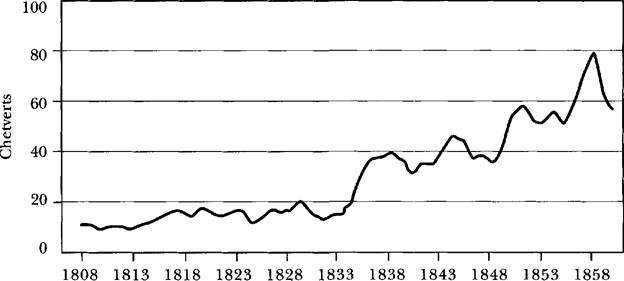
Source: ‘Vypiska iz praviΓnoi Rhoziaistvennoi tetradi otsa I syna Menonistov Neiman v kolonii Munsterberge na Molochne, о poseve I urozhae khleba,’ PJBRMA, n.d., file 1308. A five-year running average has been employed.
Arable husbandry used to be a marginal commercial proposition in the Molochna region because the lack of a local port meant that grain had to be hauled overland to distant markets. Grain’s low ratio of value to weight and problems of spoilage discouraged commercial production. In 1836 the state opened a port at Berdiansk, just sixty-five kilometres east of Molochna. This transformed the regional economy, opening the way to explosive economic growth. Where once every commercially minded farmer who could afford it would invest in sheep, suddenly grain became an important option. Already in 1837 Cornies observed that ‘a few landowners are even expressing the opinion that field cultivation would be more worthwhile than sheep breeding. The plough, which formerly belonged to the lower classes, is rising appreciably to become an honourable implement, as has long been desired.’63
More on the topic The Agricultural Society:
- Legal Maxims
- Justice as Equity, the Primacy of the Community, and the Subordination of Individual Rights
- Conclusion
- Youth in Sri Lanka
- THE THEORY AND PRACTICE OF EMPIRE-BUILDING
- North Korea's Cultural Revolution in 1972
- Some Forerunners of Classical Political Economy
- Ahmed Hilal, Mishra R.K.. Rethinking Muslim Personal Law: Issues, Debates and Reforms. Routledge India,2022. — 187 p., 2022
- FIVE COMPONENTS OF LEGAL COMPETENCIES
- REVIEW OF FORENSIC ASSESSMENT INSTRUMENTS