The Directory, Civil War, and the Bolsheviks
With the fall of Skoropads'kyi’s Hetmanate government and the reestablishment of the Ukrainian National Republic under the leadership of the Directory, Dnieper Ukraine entered the third and final phase of its revolutionary era.
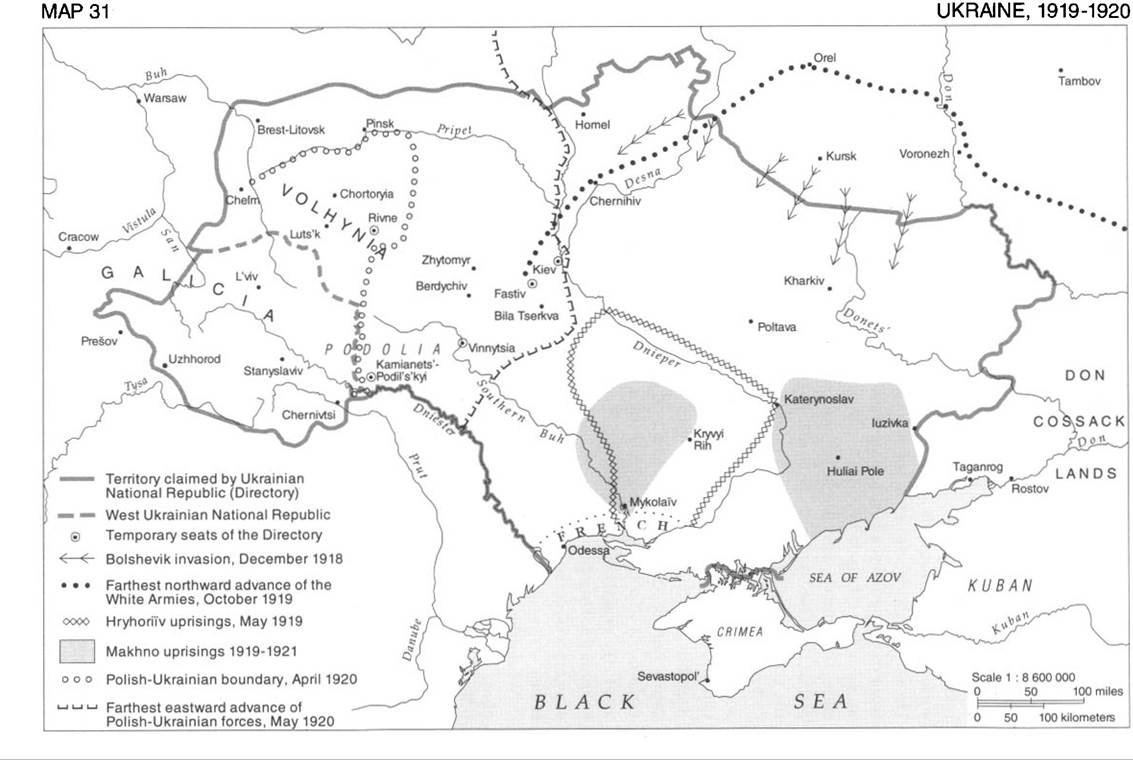
It was to last from the very beginning of 1919 until October 1920, when the Soviet government finally established itself throughout the country. The events of this period were highly complex and have probably been summarized best by the American historian of Russia Richard Pipes.The year 1919 in Ukraine was a period of complete anarchy. The entire territory fell apart into innumerable regions isolated from each other and the rest of the world, dominated by armed bands of peasants or freebooters who looted and murdered with utter impunity. In Kiev itself governments came and went, edicts were issued, cabinet crises were resolved, diplomatic talks were carried on - but the rest of the country lived its own existence where the only effective regime was that of the gun. None of the authorities which claimed Ukraine during the year following the deposition of Skoropads'kyi ever exercised actual sovereignty. The Communists, who all along anxiously watched the developments there and did everything in their power to seize control for themselves, fared no better than their Ukrainian nationalist and White Russian competitors.1
This description of 1919 also can be applied to most of 1920, although that year the internal anarchy was made even worse by external invasions by Soviet Russian, White Russian, and Polish forces. Because of the complexity of this third and last phase of the revolutionary era in Dnieper Ukraine, it would be difficult to provide a straightforward chronological survey of events. A thematic approach therefore seems preferable. Although the following themes or factors unfolding during this period are interrelated and impinge upon one other, for purposes of discussion each will be treated separately and in isolation from what is an extremely complex historical mosaic.
Among the factors to be considered are (1) the Directory of the Ukrainian National Republic; (2) the Bolshevik, or Communist, party in Russia and in Dnieper Ukraine; (3) the peasant revolution; (4) the anti-Bolshevik White Russians; (5) the Entente; (6) the West Ukrainian National Republic; and (7) Poland.Their consideration will be followed by a discussion of how peoples other than Ukrainians fared during the revolutionary era in Dnieper Ukraine.
The Directory of the Ukrainian National Republic
The Ukrainian National Republic which came to power in Kiev under the leadership of the Directory had few concrete plans for governing the country. Volodymyr Vynnychenko, the Directory’s leader and at his best a Ukrainian writer, was a socialist sympathizer who talked vaguely about a state based on workers’ councils. He was symbolic, however, of a sociopolitical disposition that had swung away from Skoropads'kyi’s Hetmanate back to the left. The Directory initially attracted mass support, largely because it called for the expropriation of lands held by the state, the church, and the large landowners and for their distribution among the peasantry. The Ukrainian National Republic found legitimization for its actions at the congress of workers which convened in Kiev on 22 January 1919.
From the standpoint of Ukrainian nationalism, the Directory’s most important act was the declaration of union with the West Ukrainian National Republic. Chapter 39 will elaborate on the fate of the independent West Ukrainian National Republic, which came into being in October 1918 in Austrian Galicia. Of significance here is that the Galicians and Dnieper Ukrainians proclaimed the unity (sobomist') of all Ukrainian lands in a solemn ceremony held in Kiev on 22 January 1919, exactly one year after the original declaration of Ukrainian independence in the Dnieper-Ukrainian lands. This act was confirmed six days later by the workers’ congress in Kiev, which had taken on the character of a Ukrainian parliament.
While the 22 January 1919 declaration of Ukrainian unity may have been solemn, it was little more than that. The Galician and Dnieper Ukrainians were to follow distinct and, often, conflicting political and military policies. Even more ominous was the fact that the Directory was surrounded on all sides by enemies, and within two weeks it was to be driven out of Kiev. The most serious of these enemies were the Bolsheviks.
The Bolsheviks
Chapter 37 showed how the Bolsheviks initially cooperated with the Central Rada in November 1917. Soon after, they formed a Soviet Ukrainian government and, with Bolshevik Russian help, drove their erstwhile Rada ally out of Kiev. Their control of the city lasted for only three weeks in February 1918, until the German Army forced them out of Kiev and, shortly after, out of Dnieper Ukraine entirely. Now, one year later, the scenario was to be repeated. This time it was the Directory that cooperated with the Bolsheviks in driving out Skoropads'kyi. As soon as that was accomplished, the Ukrainian Bolsheviks and their Russian Bolshevik supporters prepared to invade Dnieper Ukraine a second time and to unseat their short-lived Directory ally.
Since their first efforts at ruling Dnieper Ukraine in February 1918, the Ukrain-
ian Bolsheviks had had time to reassess the situation. No consensus ever developed, however, and the party remained divided into several conflicting factions. The basic division concerned the relationship of the Ukrainian Bolsheviks to the all-Russian Bolshevik party. One Ukrainian faction favored an independent party policy, the other preferred subordination to the all-Russian leadership, which in March 1918 had moved the capital to Moscow and had renamed the party the AllRussian Communist (Bolshevik) party.
Internal factionalism came to a head soon after the Ukrainian Bolsheviks were pushed entirely out of Dnieper Ukraine by the German Army and its ally, Hetman Skoropads'kyi.
They regrouped in Taganrog, on the shores of the Sea of Azov, where on 18 April they dissolved their own Soviet Ukrainian government and replaced it with a coordinating committee that was to direct the struggle against the German occupier. The varying factions now clashed over long-term policy as well as short-term tactics. The left-wing ‘independentists,’ mostly from Kiev (Georgii Piatakov, Mykola Skrypnyk, Volodymyr Zatons'kyi), called for the creation of a separate Ukrainian Bolshevik party, while the right-wing ‘internationalists,’ mostly from Kharkiv and Katerynoslav (Emmanuil Kviring and lakiv Epshtein), opposed any idea of a separate Ukrainian party. In the end, the two groups compromised. On 19-20 April 1918, the distinct Communist party (Bolshevik) of Ukraine - (CP(b)U) was established, although it was to become increasingly subordinate to the Russian Communist party. The factions still remained divided over tactics: the left-wing ‘independentists’ favored an alliance with the peasantry and an immediate uprising against Skoropads'kyi and the Germans; the right-wing ‘internationalists’ preferred to depend on the leadership of the industrial proletariat and to wait for the supposedly imminent world revolution while in the meantime following the directives of the all-Russian Communist party.In addition to the two factions within the Communist party (Bolshevik) of Ukraine, there were other, non-Bolshevik Ukrainian Communists. These were former Ukrainian Socialist-Revolutionaries, who in May 1918 formed the nonBolshevik Ukrainian Socialist-Revolutionary party of Communist Fighters, or the Borotbists for short, and who rejected the idea of the monolithic party governmental system demanded by the Bolsheviks. The Borotbists remained in Dnieper Ukraine throughout 1919 and even formed a separate government with support from the peasant army of Otaman Matvii Hryhorii’v.
The Communist party (Bolshevik) of Ukraine virtually ceased to exist on Ukrainian territory: it had only 4,300 members by mid-igi8.
The leadership moved its place of exile from Taganrog to Moscow. There, in the Soviet capital, Lenin put pressure on the various factions until the CP(b)U for all practical purposes became subordinate to the Russian Communist party. Internal dissension nonetheless continued between the left- and right-wing Ukrainian Bolsheviks, and it became especially critical after the fall of Skoropads'kyi in mid-December 1918. The left-wing Ukrainian Bolsheviks were ever anxious to act, independently of instructions from Moscow if necessary. They were in fact already close to the Ukrainian border at Kursk, where on 28 November 1918 they secretly formed a ‘provisional’ Soviet Ukrainian government (Tymchasovyi Robitnychno-Selians'kyi Uriad Ukrainy) with the intention of marching into Dnieper Ukraine. These plans were unfolding at the very time Soviet representatives from Moscow (Khris- tiian Rakovskii and Dmytro ManuiTs'kyi) were assuring Vynnychenko that they would cooperate with the Directory and recognize its authority in a post- Skoropads'kyi Ukraine.In the end, the Ukrainian Soviet government in Kursk launched an attack (apparently without the knowledge of Lenin) on the Directory. The invasion began in mid-December and proceeded rapidly, with the result that by February 1919, less than two months after it had come to power, the Directory was driven out of Kiev. The Bolsheviks installed in Kiev a ‘provisional’ government, which was soon renamed the Ukrainian Soviet Socialist Republic (Ukrains'ka Radians'ka Sotsialistychna Respublyka). This second Bolshevik presence in Kiev proved to be longer than the first, lasting from February to August 1919, and it was more successful than its predecessor in establishing its authority.
The Ukrainian Soviet Republic was Ukrainian in the territorial, not the national, sense. It was headed by Khristiian Rakovskii, a Russophile of Bulgarian- Romanian origin, whose administrative apparatus was dominated for the most part by Russian or russified Ukrainian Bolsheviks with little or no sympathy for Ukrainian cultural aspirations.
Even more problematic for the Bolsheviks was the crude approach the Ukrainian Soviet government took to the volatile land question. Instead of distributing land to the peasants, which project had been enshrined in a Bolshevik slogan from the time of Lenin’s return to Russia in April 1917, the Ukrainian Soviet government confiscated all landed estates and then undertook to transform them into communally held state farms. This policy provoked deep displeasure among and uprisings on the part of the peasantry, which grew into what has been called the ‘green revolution’ or Ukrainian peasant jacquerie.The peasant revolution
Despite all the political concerns of the numerous social and national factions, the land question remained the major issue in Dnieper Ukraine as well as throughout much of the former Russian Empire. During Ukraine’s revolutionary era, each of the governments in power - the Ukrainian National Republic, the Hetmanate, and the Bolsheviks - attempted to resolve the land question. But in an era of revolutionary change and the general breakdown of authority, the peasants were not about to wait long for their land hunger to be satisfied. When, in April 1918, the liberal government of the Central Rada was replaced by the more conservative Hetmanate, the peasants reacted immediately to what they saw as an attempt to turn back the social clock in favor of the large landowners. Between April and June 1918 alone, numerous peasant uprisings, especially against the Germans, broke out and were responsible for an estimated 15,000 deaths among the German military. The peasants were committed to removing Skoropads'kyi and his German protectors, and they joined en masse the 100,000-strong army
The Directory, Civil War, and the Bolsheviks 499 that backed the Directory in its revolt against the Hetmanate. This army, while clearly the largest of any in Dnieper Ukraine at the time, was hardly a united force responsible to orders from the Directory’s military chief, Symon Petliura. Rather, it was a motley assortment of peasants and some village elders and schoolteachers, led by self-proclaimed leaders (otamany) and officers whose only real common bond was opposition to Skoropads'kyi’s rule. Subsequently, when the peasants thought the Directory incapable of fulfilling their needs, they deserted it and joined the advancing Bolsheviks in the early months of 1919.
It was in fact Ukrainian peasants, under their chieftains Matvii Hryhoriiv and Nestor Makhno, who made up the vast majority of the so-called Red Army that was led by the Bolshevik commander Antonov-Ovseenko and launched against Kiev in late 1918 by the Bolshevik government, then based in Kursk. Despite their cooperation with the ‘Reds,’ the peasant commanders {otamany), let alone the masses of recruits, had little sense of what Bolshevism really was. Instead, the commanders perceived themselves as descendants of the Zaporozhian Cossacks and haidamaks who had a duty to liberate the people from all those they considered their oppressors, whether landowners, Russian nationalists, Ukrainian nationalists, Jews, or even Bolsheviks. More often than not, local commanders were little more than marauders who, taking advantage of the anarchic conditions in Dnieper Ukraine, pillaged and robbed at will the wealthy landowners, the merchants and artisans, and even the poor peasants whose villages happened to be along their ‘military’ route.
If the peasants were displeased with the Central Rada and, in particular, with Skoropads'kyi’s Hetmanate, it was not long before they came to scorn the Bolsheviks as well. The Ukrainian Soviet Republic’s policy of rule by Bolshevik- controlled councils (soviets), the creation of communal farms, and the forced confiscations of grain for Soviet Russia’s Red Army quickly alienated the peasantry. By April 1919, peasant uprisings were again common, and the following month both Hryhoriiv and Makhno, who had fought along with the Bolsheviks, now turned against them. Murders of Bolshevik officials, pogroms against Jews, Germans, and other well-to-do elements (1,236 pogroms were recorded in 19181919), and attacks on towns became the order of the day. Anarchy pure and simple reigned throughout the Ukrainian countryside.
In a real sense, it was the peasantry, or, more precisely, the various peasant armies, who by the summer of 1919 controlled most of Dnieper Ukraine. At best, Bolshevik rule was limited to the cities, but even there it was to be challenged. In August, the Bolsheviks were driven a second time out of Kiev and once again entirely out of Dnieper Ukraine. Unlike in early 1918, when the German Army pushed out the Bolsheviks, it was White Russians from the east and forces loyal to the Ukrainian National Republic from the west who did the job this time.
The White Russians
Who were the White Russians, and what relationship did they have with Dnieper Ukraine? Despite the conditions in Petrograd that gave rise to the February/
March 1917 revolution and the abdication of the tsar, large segments of the empire’s population were oblivious to political changes or actively opposed to the liberal-democratic orientation of the Provisional Government and, in particular, to radical socialism as proposed by the Bolsheviks. Among the most conservative forces (many of whom favored a return of the tsar) were generals in the former imperial army, which by December 1917 had ceased hostilities against the Germans.
During 1917, the size of the army was significantly reduced as recruits anxious to go home left its ranks, but by the spring of 1918 the numbers had grown once again. This time the army attracted an assortment of diverse elements who had one thing at most in common: opposition to the Bolsheviks. Because of their antagonism to the Bolsheviks, or Reds, they came to be known as the White Russians, or Whites. (This is a political term that should not mistakenly be associated with the ethnic Belarusans, who are also sometimes designated in English as White Russians.) In May 1918, White generals took control of most of the peripheral areas of the former Russian Empire and clashed immediately with the Bolsheviks’ newly organized Red Army under the direction of Lenin’s revolutionary collaborator, Leon Trotskii. The Russian Civil War had begun.
The strength of the Whites was based primarily in the Baltic region (General Nikolai ludenich), in Siberia (General Aleksander Kolchak), and in the Don Cossack Lands (General Anton Denikin). Wherever they were in power, the Whites established governments which claimed to be the legal representation for all Russia according to its former imperial boundaries. White influence reached its peak in the summer of 1919, when the movement almost succeeded in driving the Soviet government out of Moscow.
In Dnieper Ukraine, the most important White Russian movement was that led by General Anton Denikin, whose Volunteer Army, as it was known, was based in the neighboring Don Cossack Lands. The Don Cossacks themselves had enjoyed a favored position as a military caste with a high degree of self-rule during tsarist times. Their essentially autonomous status was abolished, however, by the Bolsheviks. The Don Cossacks responded by proclaiming an independent republic (10 December 1917) and by joining the White forces of General Denikin en masse. Moving north and west from his base in the Don Cossack Lands, Denikin’s Volunteer Army by September 1919 had driven the Red Army out of Dnieper Ukraine and was well on the way to Moscow.
The Entente
The growing success of the Whites in 1919 was related to another phenomenon - intervention in Russia and Ukraine by the Entente. While World War I was still in progress, the Entente powers landed troops in Russia (in at least one instance with the agreement of the Soviet government) in order to keep munitions from falling into the hands of the Germans. After the outbreak of civil war, however, the Entente decided to intervene. It clearly intended to give support to the Whites, whose generals had fought on the side of the Entente during the war and who were now fighting to rid themselves of what was already regarded in the West as the ‘plague of Bolshevism and world revolution.’ Accordingly, Britain, France, and the United States landed troops in northern Russia, and Japan and the United States did the same along the Pacific coast of far eastern Siberia. In December 1918, the French expeditionary force in Odessa, in cooperation with the local Whites, proceeded to control Dnieper Ukraine’s Black Sea coast between the mouths of the Dniester and Dnieper Rivers.
Meanwhile, the Directory of the Ukrainian National Republic, which had retreated from Kiev before the Bolshevik-led assault in February 1919, reconstituted itself in various cities - depending on the military situation - notably Podolia (Vinnytsia, Kam"ianets'-Podil's'kyi) and Volhynia (Rivne). Vynnychenko resigned and was replaced by Symon Petliura, who became simultaneously head of the Directory and commander of the Ukrainian National Republic’s armed forces. Petliura had three goals: (1) to continue the struggle against the Bolsheviks, (2) to reach an accord with the Entente, and (3) to cooperate with the Galicians from the West Ukrainian National Republic. In all three areas, he failed. In fact, in only one area was the Petliura government successful: it reached an accord with the new government of Poland.
In his negotiations with the Entente, the Petliura government soon learned that the western European powers, especially France, with its troops along the Black Sea near Odessa, remained committed to the idea of a unified Russia. The Entente was opposed, therefore, to an independent Ukrainian state and urged Ukrainians to cooperate with the anti-Bolshevik White Russians. This proved unacceptable, however, since General Denikin, like other White Russian generals, defended the idea of a unified Russia and was completely opposed to the aspirations of the nationalities. By August 1919, Denikin had gained control of most of Dnieper Ukraine’s Left Bank and had driven the Soviet Ukrainian government out of Kiev. During the next two months, White Russian political convictions were underlined by their actions: the arrest of Ukrainian nationalist and Bolshevik sympathizers, the return of property to large landowners, pogroms against Jews. These policies hardly endeared the Whites to the local population or made them acceptable allies for Petliura’s struggling Ukrainian nationalist government.
The West Ukrainian National Republic and Dnieper Ukraine
Relations between Petliura and the West Ukrainian National Republic, with which the Ukrainian National Republic had united on 22 January 1919, proved no better than relations with the Whites. The West Ukrainian National Republic, based in former Austrian Galicia and led by levhen Petrushevych, had its hands full. Since November 1918, the West Ukrainians had been engaged in a bitter war with the Poles for control of Galicia. Finally, in July 1919 the Galician-Ukrainian forces and government were driven from the province. With his well-trained Galician Ukrainian Army, Petrushevych joined forces with Petliura in Podolia. But the personalities and goals of the two leaders turned out to be diametrically opposed. The Galicians, who had expected to receive aid from the Entente, not unexpectedly favored cooperation with General Denikin, the White Russian ally of the West. Petliura, on the other hand, who anticipated no help from the Entente, favored cooperation with Poland - the mortal enemy of the West Ukrainian National Republic.
Petliura went ahead anyway in his negotiations with Poland. Within the space of a year, he signed an armistice (June 1919), agreed on provisional boundaries (December 1919), and approved a treaty of mutual cooperation signed in Warsaw (April 1920). For its part, the Galician Ukrainian Army, although without any authorization from Petrushevych, signed its own agreement in November 1919 with General Denikin. As a result, the Galician-Ukrainian forces became part of Denikin’s ‘Armed Forces of the South of Russia.’ Thus, the solemn declaration of union between the Galician and Dnieper Ukrainians reached at the beginning of
1919 proved meaningless once the two groups actually tried to work together. Internal controversies arising from policy differences and personality clashes, combined with an unfavorable constellation of international forces, brought about a complete breakdown in cooperation between Petliura’s Ukrainian National Republic and Petrushevych’s West Ukrainian National Republic.
Nonetheless, by the end of 1919 the tragic discord between the two Ukrainian nationalist bodies had become a moot issue. General Denikin’s administration had aroused the ire of Dnieper Ukraine’s population; peasant armies led by Makhno and Hryhoriiv were once again on the move; and by December 1919, the Red Army had returned and was rapidly taking over most of Dnieper Ukraine. Before the end of the year, General Denikin had retreated to the Crimea and the Black Sea coast; Petliura’s remaining Ukrainian National Republic forces had fled to the northwest corner of Volhynia (Chortoryia); and in January 1920, whatever was left in Podolia of the Galician Ukrainian Army, which had only recently fought on the side of the Whites, joined the Bolsheviks as the Red Galician Ukrainian Army. This chaos resulted in a political vacuum, which by February
1920 allowed most of Dnieper Ukraine to come under the control of the Red Army. Protected by the Red Army, the Ukrainian Soviet Socialist Republic under the direction of the Communist party (Bolshevik) of Ukraine was restored. This marked the final Bolshevik advance, because with the exception of some territory briefly ceded in a war with Poland, Dnieper Ukraine was from February 1920 to be ruled by a Ukrainian Soviet Socialist Republic in the closest alliance with Soviet Russia.
Poland and Dnieper Ukraine
On 11 November 1918, the very day the armistice ending World War I was signed, a Polish republic came into being. The new country’s eastern boundaries were not yet fixed, however. Poland’s leaders had different views on how to resolve the border problem. Many, including the country’s first head of state, General Jozef Pilsudski, hoped to incorporate lands at least as far as the Dnieper River, which had been part of Poland before the partitions that obliterated the old Commonwealth in the late eighteenth century.
By July 1919, the Poles had secured all of Galicia following a bloody war with the West Ukrainian National Republic (see chapter 39). Taking advantage of the civil war in Russia, Polish forces moved farther eastward and took much of Volhy- nia and Podolia as well. The beleaguered Ukrainian National Republic under Petliura, faced with a Bolshevik and, later, a White Russian advance from the east and a Polish advance from the west, decided to negotiate with the Poles. In April 1920, a treaty was concluded in Warsaw between Petliura’s government and Poland. Among other points, the Treaty of Warsaw recognized Poland’s control of all of Galicia as well as western Volhynia. This agreement completely alienated the West Ukrainian leaders from Petliura.
Soon after the Treaty of Warsaw was signed, Petliura’s troops joined the Poles in an invasion of Dnieper Ukraine. Their rapid advance brought them as far as Kiev within the first month (May) of what became a full-fledged Polish-Soviet war. The joint Polish-Ukrainian advance proved to be short-lived, however, because the Soviet Red Army, supported especially by its cavalry under Semen Budennyi, mounted a successful counteroffensive. On 11 June, the Red Army drove the Poles out of Kiev, and by August they had reached as far west as Warsaw. The Soviet Ukrainian government was back in power, and Soviet Russia signed an armistice with Poland in October 1920. Although some underground military activity on the part of forces loyal to Petliura’s Ukrainian National Republic continued until 1921, it posed no serious threat to the Ukrainian Soviet Republic.
Thus, by October 1920 the third and last phase of the Ukrainian revolution came to an end. It was marked by military invasions at various times by the Bolsheviks, the White Russians, the Entente, and Poland. Throughout the period, peasant uprisings and marauding anarchist forces dominated the countryside, while isolated in various cities the government of the Ukrainian National Republic tried in vain to reach accords with their Galician counterparts and, at times, with one or more of the foreign invaders. In the end, the country was exhausted, and only the Ukrainian Bolsheviks, backed by Soviet Russia, were able to establish a lasting government. The non-Bolshevik Ukrainians - whether supporters of the Rada, Skoropads'kyi’s Hetmanate, or Petliura’s Ukrainian National Republic - were forced into exile, where from countries in east-central and western Europe they continued to maintain the trappings of government (with cabinets, hetmans or presidents, and diplomatic missions) in the hope that some day they might return home to rule.
The revolutionary era and Dnieper Ukraine’s other peoples
How did the revolutionary era affect other peoples in Dnieper Ukraine, and what, if any, views did they have toward Ukrainian national aspirations? Like the Ukrainians, none of the national minorities formed a united political front. Each group was divided into diverse political factions, some of which, like the leftists, even denied the value of identification with their own nationality. In general, however, it is reasonable to conclude that with few exceptions most of the other peoples - whether Jews, Russians, or Poles - were opposed to Ukrainian independence and to separation from Russia.
Aware of such negative attitudes toward Ukrainian political aspirations, in 1917 the Central Rada implemented liberal policies and set up the Secretariat for Nationality Affairs in an attempt to attract support from Dnieper Ukraine’s other peoples. Adopting the nationality theories advocated by the Austrian socialists Otto Bauer and Karl Renner, the Central Rada enacted a law in January 1918 that provided for national-personal autonomy. National-personal, or national-cultural, autonomy meant that an individual was guaranteed certain rights with a view to the protection of his or her language and culture regardless of place of residence. This autonomy was different in kind from territorial autonomy, in which a specifically defined area was granted autonomous status. Among the rights guaranteed by national-personal autonomy were schools, cultural institutions, and religious societies. All would receive financial support from the central government, which in turn would establish tax revenues according to a fiscal plan devised by the nationalities themselves. Interestingly, only Jews, Russians, and Poles were singled out as eligible for national-personal autonomy; seven other groups (Belarusans, Czechs, Romanians, Germans, Tatars, Greeks, and Bulgarians) would first have to petition for and receive governmental approval in order to obtain autonomous status. Jews, Russians, and Poles were each given their own ministries and guaranteed a certain number of seats in the Central Rada and Little Rada.
The Jews had fifty deputies in the Central Rada (equally divided among five Jewish political parties) and five deputies in the Little Rada. Jews also received posts in the General Secretariat and, later, the ministerial council of the Ukrainian National Republic, in which the Ministry of Jewish Affairs was created (headed at various times by Moshe Zilberfarb, Wolf Latsky-Bertholdi, Avraham Revutsky, and Pinkhes Krasny). Yiddish was made an official language (it even appeared on some of the Ukrainian National Republic’s paper money); Jewish schools and a department of Jewish language and literature at the university in Kam''ianets'-Podil's'kyi were established; and plans were made to revive the historic Jewish self-governing communities (the kahals) that had been abolished by the tsarist government in 1844. Of Jewish political parties, the socialists were the first to cooperate with the Central Rada, and others, including the Zionists, eventually followed. All Jewish parties, however, strongly opposed the idea of an independent Ukraine and either abstained from voting on or voted against the Fourth Universal.
The promising atmosphere in Jewish-Ukrainian relations created by the Central Rada during the first phase of Dnieper Ukraine’s revolutionary era changed during the Hetmanate of the second phase and then dissolved completely during the anarchy and civil war of the third phase (1919-1920). Hetman Skoropads'kyi’s government effectively ended the experiment in Jewish autonomy, but it at least maintained social stability in the cities and part of the countryside. During the third phase of the revolutionary era, maintaining such stability proved well beyond the powers of the Directory, faced as it was with foreign invasion, civil war, and peasant uprisings. Even though the Ministry of Jewish Affairs was revived and Jewish autonomy theoretically restored, this meant little to Dnieper Ukraine’s
Petliura and the Pogroms
... Officers and Cossacks! It is time to know that the Jews have, like the greater part of our Ukrainian population, suffered from the horrors of the Bolshevist-communist invasion and now know where the truth lies. The best Jewish groups such as the ‘Bund’, the ‘Faraynigte’ (United Socialist Jewish Workers’ party), the ‘Poalei- Tsion’ [Workers of Zion], and the ‘Foikspartey’ [People’s party] have come out decidedly in favor of an independent Ukrainian state and cooperate together with us.
The time has come to realize that the peaceable Jewish population - their women and children - like ours have been imprisoned and deprived of their national liberty. They [the Jews] are not going anywhere but are remaining with us, as they have for centuries, sharing in both our happiness and our grief.
The chivalrous troops who bring equality and liberty to all the nationalities of Ukraine must not listen to those invaders and provocators who hunger for human blood. Yet at the same time they cannot remain indifferent in the face of the tragic fate of the Jews. He who becomes an accomplice to such crimes is a traitor and an enemy of our country and must be placed beyond the pale of human society....
... I expressly order you to drive away with your forces all who incite you to pogroms and to bring the perpetrators before the courts as enemies of the fatherland. Let the courts judge them for their acts and not excuse those found guilty from the most severe penalties of the law.·
The excerpt above is from an order by Petliura issued on 26 August 1919 to the troops of the Ukrainian National Republic. Despite this and other actions taken by him earlier in the year to assist the Jewish population, the relationship of Petliura to the pogroms of 1919 has remained a controversial issue. Subsequent literature on the subject differs greatly, according to whether the authors are of Jewish or Ukrainian background. The following are examples of the often extreme difference of opinion about Petliura.
In 1976, the Jewish writer Saul S. Friedman published a book about the assassination of Petliura with the provocative title Pogromchik, which concludes with ten reasons why Petliura was ‘responsible for the pogroms.’ Among them are the following:
1. Simon Petlura was Chief of State, Ataman-in-Chief, with real power to act when he so desired. No Ukrainian leader enjoyed comparable respect, allegiance or authority.
2. Units of the Ukrainian Army directly under his supervision (the Clans of Death) committed numerous atrocities. Instead of being punished, the leaders of these units (Oudovichenko, Palienko, Angel, Patrov, Shandruk) received promotions.
3. Insurgents dependent upon Petlura for financial support and war material committed pogroms in his name. Petlura maintained a special office to coordinate the activities of these partisans. Rather than punishing them, he received their leaders with honors in his capital.
6. There is good reason to believe that Petlura may have ordered pogroms in Proskurov and Zhitomir in the early months of 1919, and that the Holovni Ataman [Petliura] was in the immediate vicinity of these towns when pogroms were raging. Yet he did nothing to intervene personalty; nor did he command the expeditious punishment of the major pogromchiks.
7. Petlura’s famous orders of August 26 and 27, 1919, forbidding pogroms, were issued eight months too late, at a time when the Holovni Ataman had no real power. They were designed specifically for foreign consumption.
8. What funds were authorized for the relief of pogrom victims were a trifle compared with how' much was needed and how much had been stolen from the Jews. Like Petlura’s famed orders, they were too little and too late/
In 1969-1970, the American scholarly journal JewisA Social Studies published a debate about Petliura and the Jew's during the revolutionary years. The Ukrainian-American historian Taras Hunczak came to the following conclusions;
The frequently repeated charge that Petliura was antisemitic is absurd. Vladimir Jabotinsky, perhaps one of the greatest Jews of the twentieth century - a man well-versed in the problems of East European Jewry - categorically rejected the idea of Petliura’s animosity towards the Jews....
Equally absurd is the attempt on the part of some to establish Petliura’s complicity in the pogroms against Ukrainian Jewry. Particularly disturbing is the recent attempt by Hannah Arendt to draw a parallel between the case of Petliura and Adolf Eichmann, Hitler’s notorious henchman.
In view of the evidence presented, to convict Petliura for the tragedy that befell Ukrainian Jewry’ is to condemn an innocent man and to distort the record of Ukrainian-Jewish relations.*
•Pavlo Khrystiuk, Zamitky i materiiaty do istorii uhro'tns'hoi revolutsii, igty-iyzo rr„ Vol. IV (Vienna 1922), pp. 167-168.
’Saul S. Friedman, Pogromchik (New York 1976), pp. 372-373
‘Taras Hunczak, ‘A Reappraisal of Symon Petliura and Jewish-Ukrainian Relations, 1917-1921,’ Jewish Soda! Studies, XXXI (New York 1969), pp. 182-183.
Jews, who faced a wave of pogroms and so-called excesses (less violent attacks in which there was usually no loss of life) that intensified after May 1919. Of the 1,236 pogroms in 524 localities recorded between 1917 and early 1921 in Dnieper Ukraine, six percent occurred before 1919, and the rest after. Estimates of the number of persons killed in the pogroms during the entire period range from 30,000 to 60,000. Whether the pogroms and excesses were carried out by White Russian armies, by forces loyal to the Bolsheviks or to the Ukrainian National Republic, or by uncontrolled marauding bands and self-styled military chieftains (like Hryhoriiv and Makhno), the Directory of the Ukrainian National Republic and particularly its leader, Syrnon Petliura, have been blamed in most subsequent Jewish writings. The pogroms have so clouded the historical record that authoritative sources like the Encyclopedia Judaica have concluded that no Ukrainian government, neither the Central Rada, nor the Hetmanate, nor the Directory, was ever sincere about Jewish autonomy or about ‘really developing a new positive attitude toward the Jews.’2 Whoever or whatever is responsible for the pogroms of 1919-1920 in Dnieper Ukraine, there is no question that their occurrence poisoned Jewish-Ukrainian relations for decades to come both in the homeland and in the diaspora.
The Russian minority in Dnieper Ukraine invariably opposed the idea of separation from Russia. This applied across the political spectrum, from the left-wing Bolsheviks, who actually made up the majority of the members in the Communist party (Bolshevik) of Ukraine, to the right-wing monarchists, known as the Bloc of Non-Partisan Russians and represented by the ukrainophobic Russian-language daily newspaper Kievlianin (Kiev, 1864-1919), edited by Vasilii Shul'gin. When, in July 1917, the Central Rada was opened to national minorities, the Russians had fifty-four deputies. There were also eight Russians in the Little Rada and two ministers (Aleksandr Zarubin for postal services and Dmitrii Odinets for Russian affairs) in the General Secretariat. As the Central Rada moved increasingly toward autonomy and then independence for Ukraine, however, the Russian deputies began leaving the assembly until only four Socialist-Revolutionaries and the minister Odinets remained. With the establishment of the Hetmanate in April 1918, the majority of Russians, especially from the center and right side of the political spectrum, supported the new Ukrainian government. These same groups also welcomed the efforts of General Denikin’s Volunteer Army to restore Russian control over Ukraine in 1919.
The Russians’ attitude toward Ukrainian aspirations is not surprising. From their perspective, they lived in Little Russia, which for them was an inalienable part of the Russian homeland. As for Ukrainianism, most Russians considered it little more than a political idea concocted by a few misguided intellectuals or a byproduct of the anti-Russian designs of foreign powers, especially Austria-Hungary and Germany. According to such a scenario, the peasant masses were not Ukrainians, they were Little Russians. It was simply inconceivable to Russians (or, for that matter, russified Ukrainians) imbued with such attitudes that their beloved Little Russian homeland could ever be torn from mother Russia and transformed into an ‘artificial’ independent Ukrainian state.
Poles living in Dnieper Ukraine exhibited mixed reactions to the events that engulfed them during the revolutionary era. It was actually owing to World War I that the number of Poles in Dnieper Ukraine increased. This was the result of large numbers having fled eastward from the Congress Kingdom, the Russian Empire’s far-western Polish-inhabited entity, which for extensive periods of time was held by the Central Powers. Cities on the Right Bank received many Poles during this influx; their number in Kiev, for instance, reached 43,000, or 9.5 percent of the inhabitants, in 1917.
Following the February Revolution in the Russian Empire, the Poles in Dnieper Ukraine organized themselves essentially into two groups. The Polish Executive Committee in Rus' (Polski Komitet Wykonawczy na Rusi), led by Joachim Bar- toszewicz, primarily represented the landowning class and conservative National Democrats, who were sympathetic to the Polish liberation movement. The Polish Democratic Center party, headed by Mieczyslaw Mickiewicz, Roman Knoll, and Stanislaw Stempowski, represented more liberal political trends, although it too supported the interests of Polish landowners and shared their inclination for an independent Polish state. Leaders of the Polish Democratic Center party took advantage of the Central Rada’s invitation to participate in its administration, and it obtained places for twenty deputies in the Central Rada and two in the Little Rada. Then, following the Fourth Universal in January 1918, the Ministry for Polish Affairs headed by Mickiewicz was created as part of the ministerial council of the Ukrainian National Republic.
The Ministry for Polish Affairs ceased to exist following the fall of the Central Rada in April 1918. The Hetmanate cooperated instead with the Polish Executive Committee, which welcomed the conservative intention of the Hetmanate government to restore the large landed estates. The days of the Polish landlords and their hold over the Right Bank countryside were numbered, however. In response to the peasant revolts and anarchic conditions which dominated the 1919-1920 period, and following the establishment of Soviet rule in Dnieper Ukraine, large numbers of Poles fled westward to the new Polish state. Consequently, the number of Poles remaining in Dnieper Ukraine decreased by at least one-third, from 685,000 in 1909 to 410,000 in 1926.
The only sizable national minority entirely to avoid dealings with the Central Rada or with other non-Bolshevik governments in Dnieper Ukraine were the Germans. Maintaining the aloofness that had characterized them since tsarist times, the Germans remained in their rural communities and tried to keep as uninvolved as possible with both the Ukrainians and the Russians in their midst and in the urban centers. Because of the all-encompassing changes and cataclysmic events of the revolutionary era, however, the Germans were unable to remain unaffected for long. In relative terms, they perhaps suffered the most of all Dnieper Ukraine’s peoples.
Already during World War I, the Germans living in Volhynia and in the Chelm region, that is, in areas closest to the front, had been deported, in 1915, by the tsarist Russian government, primarily to Siberia. They were suspect in the eyes of Russian officialdom, who feared their collaborating with the advancing German Army. Then, during 1919 and the height of the peasant leader Makhno’s military ravages, many German villages, especially in Katerynoslav province, were attacked in destructive pogroms. Their inhabitants either were killed or, if they managed to escape, eventually reached Germany or the United States. The pacifist Mennonites and their prosperous rural farms proved especially easy targets for Makhno’s anarchist bands. As a result of the World War I deportations and the destruction wrought during the revolutionary era, the number of Germans in Dnieper Ukraine decreased by almost two-fifths, from 750,000 in 1914 to 514,000 in 1926.
Mennonites Caught in the Revolution
The reaction of Ukraine’s indigenous German, in particular Mennonite, inhabitants to the revolution and civil war is summed up by Dietrich Neufeld in a diary-like memoir from 1919-1920 later published under the title A Russian Dance of Death (1977). Of particular interest in the book are the Mennonites’ perceptions of their own place in the former Russian Empire, of the anarchist leader Makhno, of their Ukrainian neighbors, whom they refer to as Russians, and finally - because they are pacifists - of the difficult decision to take up arms in self-defense.
Even these peaceful Mennonite settlers who up till now have remained aloof from all history-making events are caught up in the general upheaval. They no longer enjoy the peace which dominated their steppe for so long. They are no longer permitted to live in seclusion from the world.
Makhno. Who doesn't quake at that name? It is a name that will be remembered for generations as that of an inhuman monster.... His professed aim is to put all ‘capitalists’ to the sword. Even the Bolsheviks - dedicated to the same cause but more sparing of human life on principle - are too tame for him. His path is literally drenched with blood.
Presumably, the Makhnovites despoiled our people because of their alleged sympathy for Denikin. It can’t be denied that our colonists, though professing neutrality, do not show much sympathy for the peasants. While the peasants opposed the re-establishment of the old regime, the [Mennonite] colonists remained loyal to that cause. They even allowed themselves to be enlisted in Denikin’s army. Actually, they were tricked into doing so by being assured that they would be organized into local Self Defence units only.
Many of our young men, who as a consequence of the German occupation had developed distinctly anti-Russian attitudes, were eager to avenge the looting and suffering inflicted on our people [in 1918, before the German troops arrived].... They supported the German army of occupation and, in some cases, had been foolish enough to inform against certain of the revolutionary leaders.
One can criticize the Zagradovka Mennonites for taking up arms instead of holding fast to the principle of non-resistance. As good Christians they had no right to show hatred toward their neighbor. Their duty was to love him even when he wronged them. Instead, they made common cause with a soldiery which plundered and murdered - even though we have no reason to supect any young Mennonites of a similar lack of restraint....
The Zagradovka Mennonites took up arms without hesitation. They are to be doubly blamed for that. First, it was politically unwise. Then again it was in glaring contradiction to their hitherto professed concept of non-resistance. The Russian peasants pointed out this contradiction and called them hypocrites. A bitter truth was held up to the [Mennonite] colonists: ‘When our Russia, our women and children, were threatened with attack in 1914, then you refused to take up arms for defensive purposes. But now that it’s a question of your own property you are arming yourselves.’ Certainly it was a crying shame that the [Mennonite] colonists’ actions were inspired neither by a desire to protect the state nor by a true Christian spirit.
We Mennonites are aliens in this land. If we didn’t realize that fact before the war we have had it forced upon us during and after the War. Our Russian neighbors look on us as the damned Nyemtsy [Germans] who have risen to great prosperity in their land. They completely ignore the fact that our forefathers were invited here [one hundred and thirty] years ago in order to cultivate the vast steppes which lay idle at the time. They refuse to admit that our farmers were able to achieve more than Russian farmers by dint of industry and perseverence, as well as through better organization and management, rather than through political means....
This is no longer our homeland. We want to leave! The magic word ‘emigration’ travels like a buran [winter wind) from place to place. Whenever two or three colonists get together the conversation is sure to be about emigrating. It is the one idea that keeps us going, our one hope.
source: Dietrich Neufeld, A Russian Dance of Death: Revolution and Civil War in the Ukraine, translated by Al Riemer (Winnipeg 1977), pp. 11, 18-19, 26-27, 63-64, 73, 79.
The Tatars were different from other peoples in Dnieper Ukraine in that they inhabited the Crimea, a territory claimed by the Hetmanate, but in which no Ukrainian government had any authority during the revolutionary era. Under tsarist rule, the Tatars suffered cultural discrimination and the persecution of their national leaders, many of whom were forced to flee abroad, especially across the Black Sea to the Ottoman capital, Istanbul. There they set up conspiratorial nationalist organizations, the most important being Vatan, whose goal was independence for the Crimea.
Following the February Revolution of 1917, several Tatar nationalist leaders returned from exile and in April joined with their Crimean fellows in forming the Muslim Executive Committee. Led by the recently returned nationalists Noman Qelebi Cihan and Cafer Seidahmet Kirimer, the Committee demanded cultural autonomy for the Tatars. By May, that demand had changed to territorial autonomy, and in July a Crimean Tatar Nationalist party (Milli Farka) was established to work toward the restructuring of the Russian Empire on a federal basis. Somewhat in the manner of the Ukrainian Central Rada, which was meeting at the same time in Kiev, the Crimean Tatars gradually broadened their goal from autonomy to complete independence. This process culminated in December 1917 with the creation of a constituent assembly (Kurultai) in Bakhchesarai with its own government, headed by Noman Qelebi Cihan.
Throughout 1917, the Crimean leadership maintained cordial relations with the Central Rada, which supported the Tatar demands for territorial and cultural autonomy. The Russians and Ukrainians living in the Crimea, however, were opposed to Crimean Tatar nationalist activity. It is also interesting to note that the Crimean Tatars encountered strong opposition from other Turkic groups in the Russian Empire, especially from the Volga and Ural Tatars. Following the Bolshevik accession to power in November 1917, Bolshevik-dominated soviets became an important politicapl factor in the Crimea, especially in the seaport city of Sevastopol'. The soviets, too, expressed firm opposition to the goals of the Tatar nationalists.
In January 1918, the Bolsheviks drove the recently created Tatar constituent assembly out of Bakhchesarai and set up a Soviet government. But it survived only until May, when German troops from Dnieper Ukraine arrived in the peninsula. Although the Germans had driven out the Bolsheviks, they refused to recognize the Tatar nationalists. Instead, they appointed a Muslim military official (actually a Lithuanian Tatar, Sulkevich) who served German interests. Following the departure of the Germans from Dnieper Ukraine in late 1918, the Crimea was ruled successively by (1) a pro-Russian liberal government (under the Crimean Karaite leader of the Kadet party, Solomon S. Krym), until April 1919; (2) a Soviet Crimean Republic in cooperation with the Crimean Tatar National party, until June 1919; and (3) White Russian armies under General Denikin and his successor, Petr Vrangel', who had retreated to the Crimea from the advancing Soviet Red Army.
When, in October 1920, the Whites were finally driven out of their last European stronghold, the Crimea, the Bolsheviks returned to the peninsula for the third and final time. They immediately branded their estwhile allies, the Crimean Tatar National party (Milli Farka), as counterrevolutionary and declared their own subordination to the Soviet government in Moscow. A year later, in October 1921, Moscow created the Crimean Autonomous Soviet Socialist Republic, which became an integral part of the Russian Soviet Federated Socialist Republic. Thus, by the fall of 1920, Dnieper Ukraine and the Crimea were both within the Soviet orbit ruled from Moscow.