The Empire Strikes Back; the Annihilation of the Polish Army at Batih
The nobility of the Polish and Lithuanian Commonwealth had decided to crush the Ukrainian revolution as reports continued to come in of peasant revolts in Poland and Lithuania- Rus.
Serfs in the Cracow Palatinate were rising against their landlords led by Leon Kostka-Napierski, who had issued a proclamation to rise against the nobility who were allegedly plotting to overthrow the King. In the meantime KingJan Casimir was assembling a new army in Sokal (Galicia), another army was being raised in Volodimer (Volin) under Hetman Potocki, and the remnants of Kalinowski,s forces were moving up from Kamianets. A call-up levy of the nobility was also announced which was to mobilize at an as yet undisclosed location. By the end of May 1651 most of the regular army units and mercenaries had been consolidated in Sokal where a roll call revealed 18,000 armored Hussars and Reiters with full body armor, 6,500 foreign infantry and cavalry, and 5,500 Polish and Hungarian troops. A key component was the German, French, and Spanish mercenaries, and for the first time there was a unit of 1,000Jewish volunteers as part of the regular army. The great magnates with their private forces, as well as the general call-up levy of the nobility, also continued to arrive in great numbers. Much to the amazement of the Cossacks—who tended to travel light—all were accompanied by endless wagon trains loaded with equipment and supplies. Gone was the display of opulent wealth and the sneering remarks of aCossack rabble” being dispersed by the lords’ whips and riding crops. Instead a Polish army of some 100,000 men was being gathered against the “schismatics.”13 Ironically two originally Greek Orthodox icons of the Immaculate Mother of God were brought along to secure Gods favor and raise religious fervor.14Much of the time was spent in skirmishes between advance patrols and other detachments of the two armies and setting up ambushes.
A Ukrainian force besieged the town of Olivka in Podilia and burned it down but refrained from attacking the central stronghold. Bohun was also sent with a cavalry regiment to take control of the crossing on the Ikva River and to ambush enemy reconnaissance units and foraging parties that were in search of food supplies. Several peasant and Cossack bands were also ambushed by Polish cavalry on scouting missions to capture prisoners for interrogation. The most successful Polish actions were led by a CaptainJasnoborsky a renegade Cossackwho had entered the King s service, and with “his usual courage” (and no doubt knowledge of Cossackways) was able to rout a Cossack detachment that had just defeated a strong Polish cavalry force.The area about Sokal where the great Polish army had gathered was deemed unsuitable by KingJan Casimir, who had taken over command, and a decision was made to move some 10 kilometers to the east, close to the small town of Berestechko in Volin, on the northern bank of the Stir River. To move the army was no minor feat and the chaotic and uncoordinated move took five days to complete as open fighting broke out between various units over the strategic river crossings.15 Jan Casimir was heard to curse loudly at his commanding officers, which did little to enhance his royal dignity. As for Hetman Khmelnitsky he appeared to be losing his touch. Not only had he allowed the Polish army to consolidate its strength at Sokal, but he failed to take advantage of its near helpless situation as it was strung out along the route to Berestechko. Had he attacked, even without Tatar support, he would have inflicted a crushing defeat on the great Polish Army, and effectively once again brought the kingdom to its knees. Instead, intimidated by the sheer size of the superbly equipped Polish and mercenary forces, he halted at Zbarazh and decided to wait for Tatar reinforcements. According to a translator with the Tatars, the Cossack camp was 1 ½ miles long and 1 mile wide and held no more than 30,000 Cossacks of the line, with several tens of thousands of irregular peasant bands roaming the countryside and 5,000- 6,000 Tatar cavalry.16 Many of the peasants had remained in Ukraine to bring in the harvest and avoid the near-famine conditions of the previous two years.
As noted in Polish correspondence at the time, while the army was still at Sokal: “He (Khmelnitsky) has twenty thousand troops, including rabble, and fifteen thousand men of the (Tatar) Horde.”17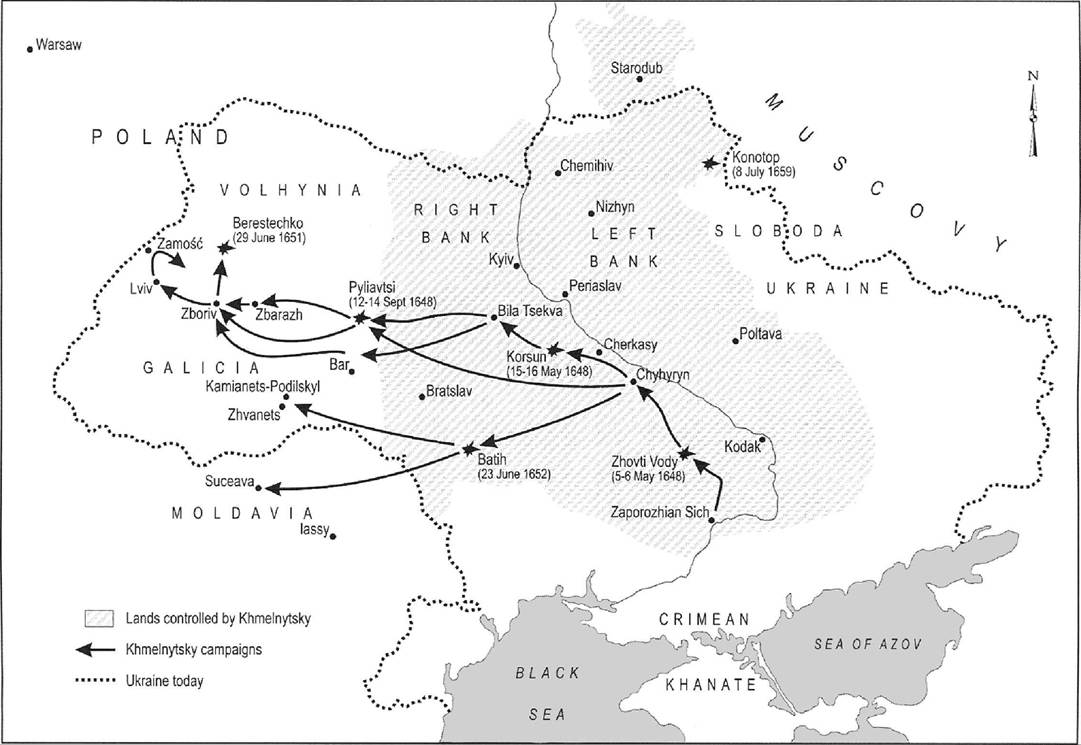
Hetman Bohdan Khmelnitsky’s victories against the Polish-Lithuanian kingdom during the campaigns of 1648-52. Berestechko, however, was a setback, and the battle of Konotop in northeastern Ukraine took place after Khmelnitsky’s death in which the elite Muscovite army was annihilated, IeavingMoscow defenseless.
The Polish army reached Berestechko without any major incidents and halted with its back to the town protected to the north, east and west by the Stir, Plashivka, and Sitenka rivers. The only access by dry land was to the south by a hilly plain dotted with woods, which made it very difficult to outflank its position. Khmelnitsky decided to establish a camp facing the enemy and on 27 June Jan Casimir received word of the Khans arrival, with panicked reports that he was at the head of a great army of at least 100,000 men. But when the Tatars arrived it was they who became unnerved by the size of the Polish army and the position of its camp. The usual Tatar tactic was to try to outflank an enemy on an open field, surround his main force and destroy it. At Berestechko they would have to meet the Polish army head on and take heavy casualties. The principal motive for Tatar involvement in war was booty, and dead men collected very few spoils.
There are several accounts of the З-day battle that followed, not all of them in agreement. Some Polish participants left personal diaries, and we have the account of the Cossack colonel of Kaniv, Semen Savich, who was in Moscow in September on an embassy visit. Although he was not a participant in the Berestechko battle he was on his way to reinforce Khmelnitsky and spoke to a number of participants. The Ukrainian encampment by the marshy Pliashivka River lay on the same side as the Polish camp with a perimeter of 7 “versts” or 4.5 miles.
Much of the space was taken up by the peasant detachments, which, contrary to Cossackpractice, had brought their families, probably for protection against marauding Tatar bands.The fighting broke out on 28 June as the Ukrainians were in the last stages of completing their camp defenses some 2-3 kilometers from the Polish positions. The main Ukrainian army was in the process of crossing the marshes of the Pliashivka River when the Cossack vanguard, sent to cover the crossing, was attacked by a Polish force. In the first major encounter the Polish side fared badly, with many casualties, “but God spared the Cossacks. Some were wounded and a few were killed— there is no battle in which someone does not fall,” as was commented by Colonel Savich. The first large-scale battle took place the next morning after Khmelnitsky s forces had crossed the marshy river, as again recounted by Colonel Savich:
Polish regiments—(mercenary) soldiers, lancers, (armored) reit- ers, infantry and all kinds of armed men—went into battle. One portion, both infantry and cavalry, was led aside to lie in ambush. Others went to the front line of battle against the Cossack camp. And a large number of Cossack troops moved to do battle, meeting them halfway (between the two camps). Another large formation of Cossacks and Tatars was positioned behind the hill. Still another large portion of the Cossack army was led aside to lie in ambush, a little above the Polish camp. When 38 cavalry troops (“banners”—some 5,000-6,000 men) charged the Cossacks, the Cossack force that had advanced near the Polish camp rushed from the flank, cut off that Polish force, and letting those men go forward, defeated them. As for the Polish force that lay in ambush for the Cossack army, the rearguard Cossacks also annihilated those Poles, not letting a single man escape. Twenty seven banners were captured and brought to the Hetman. The number of Polish troops killed in that battle was estimated at 6 or 7 thousand, whereas the grace of the Lord God protected the Cossack army, few were killed.18
A typical understatement of losses by the writer s own side followed.
The defeat is acknowledged in Polish diaries as well although not the number of casualties. These must have been high since Polish sources make a point to stress the large number of high ranking individuals who were killed, such as the castellan of Halich, the cousin of the Marshall of the royal court, Chancellor Ossolinski s nephew and many other prominent nobles. More telling, Hetman Potocki s entire escort troop of several hundred personal bodyguards—handpicked nobles—were taken prisoners by the Cossacks.Following the defeat the morale of the Polish army plummeted, but on the next day, on 30 June, KingJan Casimir ordered the bulk of his men to form up before the Polish camp. It was a misty morning as the Polish formations moved out and halted on the wide field to wait for the Ukrainian response. Many of Khmelnitsky s men were still in the final stages of fortifying their positions and the Tatars were entrusted to guard Khmelnitsky s left flank as the two armies faced each other exchanging artillery fire. Finally at noon Prince Wishniowiecki was given permission to attack the Cossack right flank with his cavalry. The charge of the armored lancers succeeded in breaking up the front ranks of the Ukrainian infantry but was unable to break through and strike at the Cossack rear. The Polish right flank held back until the King himself led a cavalry charge against the Khan, who turned tail and fled the field of battle. Jan Casimir abstained from pursuing the Tatars and the days fighting ended at this point. The King was clearly testing Khan Giray s assurances, sent by emissaries before the battle, that he had not come to fight but to bring Khmelnitsky to an agreement with him, the King.
Khan Islam Giray III had betrayed Khmelnitsky once again and for the same motives. Worse, when the Cossack Hetman and his general SecretaryVyhovsky followed the Khan to persuade him to stay and fight they were both detained in the Tatar camp. As related by Khmelnitsky to the Muscovite emissary Grigory Bogdanov a month later:
The Crimean Khan has now done a great injustice to me personally.
Having come to help, he gave no help, and he betrayed everything he had sworn. Having snatched me from the Cossack camp, he took me to distant places and did not let me return to the army. For some unknown reason he held me at his place for about a week. He obviously had evil designs against me.19With the Tatars gone, the Ukrainian army, outnumbered even at the outset, was left with some 16-17 regiments of both Cossack and peasant irregulars, and no longer had the numbers to challenge the Polish army in the open field. Also heavy siege guns had been brought up from Kalinowski s estate at Brody, which began to bombard the Ukrainian defenses, and it would be only a question of time until they were breached. Stalling for time, the newly elected Hetman Hladky sent emissaries to Potocki who were told that their only option was unconditional surrender. One of the Cossack emissaries, ColonelKrysa (“Rat”), decided to remain in the Polish camp and enter the King s service. He was well named since after the conflict he was rewarded for the betrayal by being elevated to a noble of the realm.
In the meantime Hladky was reinforcing his position, as described in a Polish record:
That traitor (Khmelnitsky) has given his camp a very good location. It lies as if within a fork (of two rivers) and must be starved to be conquered, and this cannot be done other than by encircling it with trenches.... They can hardly be conquered, owing to their defenses, vigilance, and courage. These are such that all the cavalrymen and footmen, rank-and-file and officers will fall one after the other (rather than flee). They guard one another.20
When the king s demand of unconditional Surrenderwas rejected, a royal council was held to decide on future action. A suggestion was made to pardon the rank-and-file and only put the leaders to death, but the prevailing view was to use the treachery perfected by Kalinowski; promise pardon “in word only,” and after all weapons has been surrendered to “mow them down to the last man, strip away their privileges, prohibit them from using weapons forevermore, destroy their religion, and abolish the very name of the Cossacks,”21 as was recorded by the participant Stanislaw Oshwiecim. A planned attack on 8 July, however, had to be cancelled due to the low morale of the troops, many of whom had lost their willingness to fight in the knowledge that even a victory would bring heavy casualties. The rank-and-file soldiers had also lost confidence in the command structure, as recorded by Oshwiecim who blamed the “laziness” and “egoism” of the nobility for the poor attitude that had yet again set in in the Polish army.
In the meantime the Cossacks had come to the decision to withdraw across the Pliashivka River, which formed the right flank of their defenses. The Polish engineers had dammed the river on Krisa s advice, and the Cossack camp was beginning to flood. Kalinowski s siege guns were also beginning to take their toll on the wagon defenses. The most important factor was a collapse in the fighting morale that also hit the Ukrainian army, particularly the Cossack regiments. The lack of effective leadership due to Khmelnitsky s abduction was beginning to be felt, but the most pressing worry was the Tatars. Unlike the peasants who were accompanied by their families, those of the Cossacks remained at home. Most of the regiments were at Bere- stechko and the Cossacks began to realize their families were unprotected and in danger from the Tatars, who were moving across Ukraine after their refusal to fight the King s army.
To prepare the retreat, Colonel Bohun took his 2,000-man horse regiment with some field artillery and crossed the Plia- shivka River. Scouts had informed the Acting Hetman Hladky that a large Polish cavalry detachment commanded by Lanck- oronski was threatening the rear of the Ukrainian camp. Led by Bohun, the Cossacks charged the Polish cavalry, which was driven off the field, and Bohun proceeded to secure a crossing. His sortie from the Ukrainian camp, however, had an unexpected and a fatal result. Knowing that the Cossack regiments were eager to return to Ukraine, the peasants interpreted Bohuns departure as the beginning of a general Cossack withdrawal. They and their families were being abandoned to the mercies of the Polish army, and on 10 July panic spread in the camp. Wagons began to be destroyed with other items thrown into the water to provide a makeshift crossing point as peasant mobs rushed to get across the river. The Cossack infantry regiments followed, helpless to hold the camp on their own with the cavalry trying to protect the fleeing peasants who were being cut down by the Polish cavalry. The rearguard defenses succeeded in slowing down the enemy troops who had paused to loot the Ukrainian camp but found slim pickings. All Cossack documents, however, with Hetman Khmelnitsky s foreign correspondence fell into Polish hands, which revealed much of Ukrainian foreign policy.
A single Cossack defensive action would leave a deep impression on the Kings men, which also provides us with a rare glimpse of what tough fighters the Cossacks could be. Two infantry companies of some 300 Cossacks had established a rearguard position on a strategically located island on the now swollen river marsh, blocking Polish troops from crossing in pursuit of the retreating Cossack and peasant units. Attacked by overwhelming forces they stood their ground and could not be dislodged... “so bravely and Selflesslythat Potocki ordered that they be promised their lives would be spared” if they surrendered.22 The offer was refused, and in full view of the Polish high command—including the King—they emptied their wallets into the water, as a signal that this would be a fight to the finish. The attack resumed and the fighting continued for the entire day, with heavy Polish losses. Seeing the Cossacks had run out of gunpowder Field Hetman Potocki ordered an infantry assault on all sides, and with heavy hand-to-hand fighting the Cossacks were slowly pressed into the marsh. There, waist- deep in the water the surviving Cossacks went down one by one, until a single man was left, but Potockis problem was not over. The solitary Cossack had found a boat, somehow resupplied himself with ammunition, and weaving his way between the marsh’s reeds and islands proceeded to pick off the King’s men “before the eyes of the king and the entire (Polish) army, gave a demonstration of bravery that was not that of a peasant!” recalled the Polish noble Stanislaw Oshwiecim. Then, having exhausted his ammunition:
For several hours he fought back from that boat with a scythespear totally ignoring the shooting that either somehow kept missing him or, because he was so tough, had no effect on him. Finally, one Mazovian from the country of Ciechanowiec, who undressed totally and waded into the water up to his neck, first hit him with a scythe and then a soldier pierced his torso with a lance or spear, thus finishing him off, to the great joy and satisfaction of the King, who had long been watching the course of that tragedy.23
Foreign mercenaries who had witnessed the engagement brought back accounts that would capture the admiration of all Europe. According to the French author Pierre Chevalier, he had been wounded by musket fire but, to everyone’s astonishment, continued to fight with some vigor until his strength gave out and he was killed with spears by a Mazovian noble and German infantrymen.24 It is not known how many men of the king the lone Cossack took down with him before he himself was killed.
The battle OfBerestechko during the summer of 1651 was a Polish victory; the Ukrainian army had retreated in haste and the Polish army technically gained control of the battlefield. But it was no longer the cocky force that had gathered on Ukraine’s doorsteps. For the next ten days the Polish army remained at Berestechko recovering from the fighting and the heavy losses. Many had lost their stomachs for another fight, particularly the call-up forces of the nobility, which refused to advance into Ukraine, pointing out that by law they were not required to remain in the field for more than two weeks, and the time had already passed. A bitter feud developed between Jan Casimir and the nobles, most of whom withdrew to their homes without even bidding the King farewell. Jan Casimir gathered the remaining 30,000 foreign mercenaries and Crown troops and decided to press on towards Ukraine.
The Ukrainian forces had been dispersed and were disorganized. As KingJan Casimirwas advancing into Ukraine, Hetman Khmelnitsky called a general “rada” at Pavoloch where he asked the assembled rank-and-file and the officers to swear and reaffirm their support of him as Hetman and for the continuation of the war. Such mass assemblies were common during the first year of the uprising when many issues had to be settled, but following the reorganization of the Ukrainian (“Zaporo- zhian”) army in 1649 such meetings were no longer held, and only an officers’ “rada” would be called for planning and advisory purposes. With thousands of new recruits becoming instant Cossacks such open meetings were no longer feasible and comprised security. The advancing Polish army was met with heavy rainfall not seen in living memory which continued without let-up, turning the Ukrainian black earth into a quagmire. The retreating Cossack units and peasant bands had turned southern Volin and Podilia into a scorched deserted wasteland, and crawling along at a snail’s pace the soaked Royal army began to run out of food and fodder. Shelter was also nowhere to be found except for the tents, which had to be pitched on the soaked ground. As noted in a diary of a Polish participant, dated 1 August 1651: “There are no towns and no villages, only fields and ashes. There are neither people nor live animals except birds in the air.” And three days later,
... a terrible wasteland everywhere. In terrible and unspeakable hunger, under ceaseless rains that keep falling for 5 or 6 days at a time, we are advancing barely a quarter of a mile (per day) on horseback; emaciated, hungry. Half or more of the infantry has fallen away, the rest walk like dried up mummies, and they eat dead horses. Not only roasted but even raw, something that I have never seen before in all my life.25
The army also was abandoned by its King, as Jan Casimir refused to go any further and returned to Warsawwhere he impressed everyone with his accounts and with celebrations of the great victory over Khmelnitsky and the Cossacks.
Eighteen days into the march, Potocki received reinforcements from the provincial govenors which brought his army up to strength. Theywere still 300 kilometers from Kyiv at a town called Liubarwhere they encountered well-stocked food supplies which were promptly looted by the hungry soldiers, and discipline had to be restored by courts-martial and executions. The army now began to be attacked by guerrilla bands led by Bohun, and Potocki ordered a halt to consolidate his forces, which were still dispersed throughout the area in search of provisions.
A second army was also advancing on Ukraine from the north. On 1 July 1651 a Lithuanian regiment under Mirski had crossed the Dnipro near Homel, easily driving back the Cossack border guards. Mirski was to draw the Cossacks’ attention, while Radziwill would cross with the main army, in a different location. Receiving word of Mirskis crossing, the Chernihiv regiment led by the impetuous Colonel Nebaba attacked the Lithuanian force which found itself with its back to the Dnipro River. The Cossack colonel had not bothered to send out scouts and did not realize that Radziwill had crossed the Dnipro further down at Loiv. Nebabas men were now struck in the flanks by two enemy forces and surrounded. Refusing to surrender, many Cossacks perished in the battle with some managing to breakthrough enemy lines. Colonel Nebaba (“No Old Woman”) lived up to his Cossack nickname: surrounded and fighting off several opponents with his saber he was wounded in his right hand and changing hands he went down fighting.26
The road lay open for the Lithuanian army whose next objective was Chernihiv. The city had been strengthened with new defenses and reinforced by survivors of Nebabas regiment and was under the command of Colonel Podobailo, an exdragoon officer in the service of Prince Kisil before joining Khmelnitsky. Not wishing to leave a strong Cossack force in his rear, Prince Radziwill ordered Chernihiv be surrounded and realizing the city could not be taken by storm without substantial losses of manpower, decided to march on Kyiv. To avoid encirclement Colonel Zhdanovich of the KyivRegiment abandoned his position on the Pripet River and began to withdraw towards the city, followed by his captain Harkusha. The retreat was marked by a series of rearguard actions, such as the bloody battle at Ovruch, and Lithuanian casualties began to rise. A major battle broke out on 16 July at Dimer on the Irpin River, as was reported by the Muscovite Undersecretary who had passed through Kyiv a few days later. “Polish (sic) men had marched toward Kyiv, and the Kyiv ColonelAntin (Zhdanovich)... encountered them at a distance of 15 versts (about 9.3 miles from the city). They fought the entire day and the Cossacks defeated the Polish....27
The author identified the Lithuanian army as “Polish,” perhaps due to the fact the entire kingdom had a common Polish monarch. Colonel Zhdanovich, however, decided to withdraw from Kyiv, on the pleas of the Metropolitan and the Archimadrite of the Caves Monastery, who feared a massacre of the population if the city resisted. He was ordered to return by Khmelnitsky, who promised reinforcements, but when none came Kyiv was abandoned for a second time. The Lithuanian army occupied Kyiv and began to loot and burn, plundering Orthodox monasteries and churches.
But Radziwill had overextended himself, and with much of Kyiv burned he was forced to vacate the city. Cossack units in the meantime, were regrouping and beginning to surround the main Lithuanian army with the garrison in Liubech completely encircled. The Lithuanian Hetman was at the point of no return and the only strategy left to him was to merge with Potockis Polish army, which had halted near Pavaloch some 180 kilometers southwest of Kyiv. Having by now left the Khans UnwantedhospitalityKhmelnitskywas issuing calls to the scattered Cossackunits to regroup in specified locations. The well armed and properly equipped men were to gather at Masliv Stavwhile others without good weapons and horses were to return home, form local defense units, and prepare food supplies. Khmelnitsky had already called an officers’ “rada” on 17 July where it was decided to continue the war. The situation was slowly improving for the Ukrainians. Bohun had by now gathered a force in Podilia and was harassing Polish rear-guard units and attacking the nobility who were following the army and trying to reoccupy their previous estates. Others in the vicinity of Bila Tserkva and Korsun were heading to the towns and reporting to local officers. Ukrainian units were also regaining some Tatar support after the Ottoman Sultan Mehmet IV instructed the Crimean Khan to provide Khmelnitsky with “all the necessary help.”
The Polish army had still not completely regained its confidence as indicated by an incident which occurred not far from Pavoloch. “Seven very good cavalry troops selected from the entire army,” as noted by a Polish officer, were sent to search for food supplies and other necessary items. The Polish detachment of some 1,000 men was intercepted by a Cossack patrol and 500 Tatars on the Rostavitsia River, and without giving battle the entire Polish cavalry force turned tail and fled, leaving behind hundreds of wagons Ioadedwith supplies expropriated from the surrounding villages. The Cossack and Tatar patrol was in turn attacked by Wishniowieckis strong cavalry forced to retreat but with the captured supplies retained in their possession. Similar skirmishes were becoming more common as the Polish and Lithuanian armies found themselves harassed by guerrilla-type warfare, and Potocki decided to move out and meet the Lithuanian army. The planned exodus was postponed for three days with Prince Wishniowiecki s death from dysentery in Pavaloch on 20 August. His death was greeted with great joy in Ukraine when the people learned that he who was hated, was no more. Khmelnitsky’s declaration expressed much of the popular sentiment: “God has fulfilled our wishes! The Lord’s strong right hand has shown itself! Clearly God’s grace is on our side! That Prince Wishniowiecki, who only recently wanted to rule all Rus is now occupying only 4i likti’ (ells) of space.”28
Following an elaborate ceremonial funeral, during which the Prince’s body was sent off to his official residence in a great procession, the Polish army set off to meet Radziwill, on the way attacking and destroying towns with Cossack garrisons. The fortified town ofTrilisy offered an exceptionally stubborn resistance in which the entire population took part including the women. After a few unsuccessful attempts at taking the town by storm the wooden palisades were breached by artillery fire and fierce fighting broke out as Polish troops poured in and overwhelmed the defenders. The entire town’s population was massacred as vengeance for the army’s losses, which included a captain killed by a female defender.
Receiving word that Potocki was approaching Kyiv Radzi- will moved out to meet the Polish army. The two forces met at Vasilkiv on 4 September in a timely manner, since when Colonel Zhdanovich attacked the Lithuanians with a strong force he was beaten back by the combined armies. Both Royal Hetmans had realized that they were in the midst of an armed and hostile population, and would not be able to occupy all of Ukraine, even the territory on the right-bank. As observed by Oswie- cim:
The Lords Hetmans saw how seriously the Commonwealth army’s strength was being undercut by constant battles with the enemy and the shortage of food, whereas fresh reinforcements kept coming to the enemy from the Cossacks and the (Tatar) Horde, so that for our men all roads were blocked, and there was no hope of help from anywhere, and they (the hetmans) used every means to conclude peace with the enemy....29
Not yet ready for battle and facing internal dissent, Khmelnitsky also saw little choice but to open peace talks. Ukraine was being ruined by the continuous fighting, which to many peasants seemed to be without issue; no sooner was a Polish army defeated than even greater forces were being raised to attack Ukraine. Many towns and villages had been devastated, croplands and pastures stripped of crops and animal herds. Peasants and rank-and-file Cossacks were becoming disillusioned with what they saw as a never-ending struggle and began to seek refuge in Muscovywhere land was being offered in the empty upper Donets River region in what became the Kharkov, Sumy and Voronezh provinces of Ukraine and Russia, respectively. The settlers were attracted by the fact they could set up “slobodas” or free villages exempt from serfdom or taxation. The more adventuresome Cossacks headed to the Don, where they could join the local Cossacks in the traditional Zaporo- zhian sea raids on the Crimea and the Ottoman Empire. The already meager population for the struggle against the Poland- Lithuanian kingdom was being reduced by war casualties and emigration. Khmelnitsky took advantage of the lull in the fighting to re-equip his forces and bring them up to strength. He also took time to celebrate his third marriage to Anna Zolotarenko, a widow and sister of the colonel of the Korsun regiment.
With the opening of talks Potocki decided to press his advantage one more time and march on Khmelnitsky s camp. The combined Polish-Lithuanian army was still a force to be reckoned with as observed by a Polish participant:
The Crown army’s wagons were moving across the extensive plain in 74 rows and the Lithuanian wagons in 40. The front of the army occupied a line like that from Warsaw to Wola (several miles) and the wagons were moving in perfect order, the length of a Podilian mile. Coming first were four regiments; behind them, the infantry and reiters (armored cavalry) also marched at the front with the artillery. Along the flanks, hussar and Cossack- type (light) cavalry troops surrounded the camp. Lithuanian lancers advanced at the front, and four regiments closed the rear of the camp.... Observing this sight—such a fine mounted, armored, impressive, seasoned and well-trained army—as we did from the high mounds....3°
Accounts of what transpired next differ between Polish and Ukrainian sources, and a report by a Muscovite agent, Ivan Judenovich, who had been sent to Khmelnitsky as an emissary, can probably be accepted as more factual. The Tsar s men were instructed to provide accurate information on the great conflict transpiring on the Muscovite doorsteps. The Royal army had approached Bila Tserkva on 23 September and pitched camp about half a mile from that of the Ukrainians. The battle soon began with skirmishing and lasted the whole day, with neither side prevailing. The conflict reopened early the next morning with a Polish artillery barrage with more forces thrown in but the day ended again in a draw, with many casualties on both sides. What was to be a decisive battle on 25 September never took place due to the heavy rains which began to fall and lasted for the next two days. The pause gave the warring parties occasion to take stock of the situation particularly the heavy casualties on both sides, and on 27 September 1651 an agreement was reached, and signed on the following day known as the Treaty of Bila Tserkva.
The contents of the peace treaty reflected the military stalemate which had occurred following Berestechko, and the 11 main points highlighted the concerns of both parties. Khmelnitsky conceded most points dealing with Polish rule in Ukraine, such as the right of return of the landed nobility and the right of the Crown army to be billeted in Ukraine except in the Province of Kyiv. Perhaps both sides realized that peace would only last until the spring, and the treaty was not worth the parchment on which it was written. The concessions to the Commonwealth, however, caused great discontent amongst the peasants and rank-and-file Cossacks, and Ukraine began to drift into a disorderly state of civil conflict where the prevailing wish was to continue the struggle against the tyranny of the nobility. Bythe Treaty of Bila Tserkva Khmelnitskywas also obligated to protect the returning nobility, and he now found his authority challenged by some Cossack officers such as Colonel Hladky of Mirhorod who had been elected as acting Hetman at Berestechko during Khmelnitsky s absence. A Greek merchant by the name of Andreas Athanasiou also reported that Colonel Bohun was assembling a force in the Bratslav region, and another colonel by the name of Pivtorakozhukha (“One- and-a-Half Furcoat”) was gathering men beyond the Dnipro to prevent the return of the nobility.
The Treaty of Bila Tserkva was also rejected by the Sejm in Warsaw, when a Lithuanian squire, exercising his right to a aIiberum veto” stood up and declared that he would not accept its terms. Khmelnitsky also called an advisory council (“duma”) to meet in Chihirin over the Orthodox Easter holidays in early May 1652, to be attended by the colonels, captains, aides-de- camp and other Cossack officials as well as several Tatar mirzas (nobles). The true purpose of the meeting, kept secret was to decide on war with Poland-Lithuania and to begin mobilizing men and supplies. A call to arms was issued on 24 March, which makes it clear that the objectives of the Ukrainian revolution had not changed in spite of the Treaty:
Bohdan Khmelnitsky hetman of the Zaporozhian Army Starosta of Chihirin.... I am making this known to everyone, and in particular to the colonels, aides-de-camp, captains, and all the brave warriors of the Zaporozhian Armywho are in the cities, small towns, and villages, and to the Liakhs who have fraternal relations with us. We note the certain and great vexations and injustices that the Liakhs have committed against us in the past and are committing today. They are torturing, tormenting and killing many of the Army’s warriors falsely and in the absence of guilt. They order people to work not only on ordinary days but also on holy days, which our faith cannot tolerate and does not allow... in all Ukraine every man enjoyed freedom, and it is difficult for him to forget that... in war he declared himself the equal of his lord. We are all unwilling to work in this way again. In order for our people to be able to wrench themselves from this servitude on this auspicious occasion, the like of which has never existed before.... I order that not only every Cossack but also every commoner make all needed preparations for war... they should not put off moving to the camp and going to the designated places.31
Here the Cossack Hetman makes an interesting reference to “the Liakhs who have fraternal relations with us,” the poorer Polish nobles who had been driven off their lands by the powerful magnates and who supported the Ukrainian anti-feudal war. We Icnowthat Khmelnitsky s extensive intelligence network included not only minor Polish nobles who were preparing a peasant insurrection in Poland proper but also men such as Jar- molovich who was one of Jan Casimir s counselors.32
Khmelnitskywas still without committed allies willing to provide military aid since the Tatars had lost most of their trustworthiness, and he decided to force the ruler of Moldavia into an alliance. Gathering a force of four Cossack regiments of some 12,000 men with several thousand free Tatar cavalry, Khmelnitsky’s son set for Moldavia with the declared purpose to claim his bride, the Moldavian ruler Lupus daughter Roxanda who had been promised to him by her father. Lupu was still on friendly terms with King Jan Casimir who had stationed a 30,000 man army on the Moldavian border in Podilia. When asked to give Timysh free passage, the Polish hetman refused, and Khmelnitsky decided to move out in support of his sons force. Kalinowski was also waiting for reinforcements and was looking forward to crushing the “rabble” and their “heathen allies.”
The battle began on 1 June 1652 close to a town called Batih between a Tatar regiment and Polish cavalry, which continued throughout the day at the end of which the Polish cavalry was driven off the field by the arrival of fresh Cossack units. Once again Khmelnitskywould prove to be the better strategist. His plan was to attack Kalinowskis Royal army before the arrival of Lanckoronski s reinforcements and to pin him down in his own camp, which had been pitched on the open prairie and easy to attack. Kalinowski had little choice for his location since he needed a wide field to deploy his sizeable force, particularly when Lanckoronski would arrive with cavalry and infantry reinforcements. But before besieging the Polish camp Khmelnitsky had to neutralize the powerful Polish cavalry which was to be lured out into the field, cut off from the infantry regiments, and destroyed.
On the second day, lured out of the fortified camp by a Tatar detachment, the armored hussars, reiters, and the light cavalry sortied and attacked the Tatars. The Polish cavalry was quickly surrounded in turn by Cossack cavalry, and began to take heavy losses. At the same time Khmelnitsky brought up artillery, and the Cossackinfantrybegan to advance on the Polish camp. After several hours of bombardment the Cossacks broke through the Polish line of defense—more than a mile in length—and in bloody hand-to-hand fighting the Polish infantry was annihilated. Kalinowski s elite Cavalrywas also destroyed with only a small number managing to escape. Among the Polish dead were Kalinowski himself, his son, and many members of prominent noble families such as Marek Sobieski, Jan Odrzywalski, and Juri Balaban. Most of the rich booty and the prisoners were turned over to the Tatars as payment for their support. Once again Warsawwas faced with not only the annihilation of the flower of the Polish Royal and noble armies, but also with the demise of its entire leadership. The Cossack army returned to Ukraine in triumph, and Khmelnitsky was once again greeted with praise and declarations of loyalty. The calamity OfBerestechko had been avenged and Ukraine was now free of foreign armies.