Border Battles and a Stalemate
Most of the Cossack officers’ corps seem to have accepted the return of the small hereditary nobles so long as they did not cause difficulties for peasant and Cossack settlements and homesteads, but the great magnates were barred from Ukraine and could only send their officials, provided they were Greek Orthodox Rusins.
Colonels Krivonos and Nechai, however, were disregarding the Zboriv Treaty and were leading rebellious peasant bands and Cossack detachments against the returning nobility, who still possessed enough wealth to hire their own armies. As reported by a Polish nobleman who was in Ukraine at the time:Around Chernihiv, Starodub, and Pochep all the populace has rebelled. Theyhave formed bands and have killed many of their lords—they are killing those who fought against the Cossacks. The nobility in its efforts to bring them to obedience, punishes them with death... and as for Bohdan Khmelnitsky, Krivons, son, (colonels) Hladky and Nechai all call him a traitor and a perjurer.”1
Aworse sign of the general discontent against Khmelnitskywas the election by the Zaporozhians of a new Hetman who, however, was soon arrested by the loyal Cossacks on Khmelnitsky’s orders and beheaded.
A new war was imminent, which became evident with the return of the Polish Hetmans Potocki and Kalinowski from Crimean captivity. Once again the khan broke faith with Khmelnitsky and released the Polish commanders, when their ransom was paid by the Moldavian ruler, Vasile Lupu, who also ensured their safe return to Poland. Both Hetmans were still smarting over their defeat at Zhovti Vody and Korsun, and were devastated by the loss of their large holdings in Ukraine. Upon his arrival Potocki did not waste any time writing KingJan Casimir to express the general mood of the nobility.
Why does he (Khmelnitsky) invite various monarchs and princelings to partnership in war?...
I believe that he, from an innate deceitfulness harbors evil plans... nothing can bring these Cossack-peasants to obedience, only the saber can drive them away from revolt... the longer we neglect the disease, the more difficult it will be to cure.2Potocki continued his letter by recommending that Jan Casimir seek the Sejms approval to raise a strong army and attack Ukraine, which by this time had become an armed camp. As noted in Polish records, "everyone is a Cossack: there is no register but a single popular movement.”
Potocki was right when he wrote that the Cossack Hetman was seeking allies. Following the Khan s betrayal, Khmelnitsky found himself in a difficult military and political situation. Educated by the Jesuits, he was well aware of the importance of international relations, particularly the concept of legitimacy. Foreign powers, even those who were not hostile such as the Venetians, recognized him simply as a supreme commander (“Signore Generale”) since he was technically still a subject of the Polish King, and was neither a hereditary monarch nor a noble Duke. Ukraine was surrounded by enemies, or by powers who could quickly turn into enemies since most had treaties with Poland. This was true even of Greek Orthodoxneighbors such as Moldavia and Muscovy, whose rulers and nobility were watching the growing Ukrainian revolution with unease—the Cossacks’ role during the “Times of Troubles” in Muscovywas still fresh in the minds of the Tsar’s government particularly as it was facing its own social unrest. When Michael Romanov died in 1645 his young 16-year-old son Alexei found the treasury empty, and taking advice he introduced cutbacks and new taxes, and as Khmelnitskywas launching his revolt violent riots erupted in Moscow and elsewhere. The last thing that the Tsar and his nobility wanted to see was another Cossack-Ied uprising. Khmelnitskyhad no intentions to antagonize Moscow, and when an imposter appeared claiming to be Tsar Shuisky s
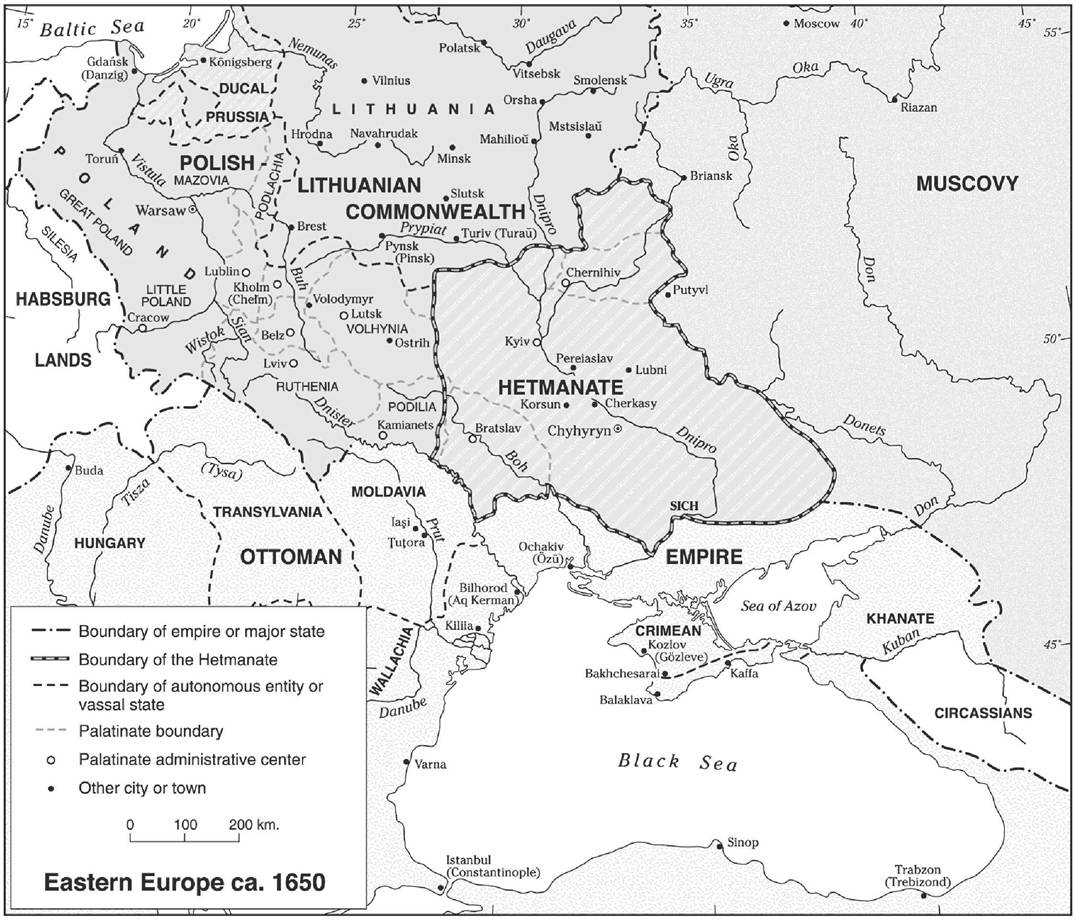
Eastern Europe ca.
1650. Map EyWendyJohnson of Johnson Cartographies (Edmonton, Alberta). Reprinted with permission from Mykhailo Hrushevsky, History of Ukraine-Rusf Volume 9, Book 2, Part 2. Edmonton and Toronto: Canadian Institute of Ukrainian Studies Press, 2010.The name “Hetmanate” should read “Ukraine”, a designation by which it was known at the time.
son, the Hetman had him expedited secretly to Prince Rakoczy of Transylvania. The young Sultan Mehmet IV on the other hand, who had ascended the throne two years previously, was having internal and external difficulties and was seeking an ally, particularly one who could provide support in the Black Sea region. The entire Ottoman fleet was facing the Venetian navy which had succeeded in blocking the southern Dardanelles, making the Black Sea poorly defended and open to attack by the Cossack tchaika boats.
Diplomatic contacts between the Cossacks and the Porte were opened by the Sultans envoy Osman Agha, a senior member of his household who was sent to Chihirin with the Bey of Ochakov, well known to the Cossacks. The Sultan proposed an alliance on condition That no harm be done by any of your army to our Emperor or his state, either at land or at sea... and from whatever side enemies might rise against you, notify us how many soldiers you need and we will provide our help that very hour.” Permanent envoys were exchanged and a palace in Constantinople was provided for the Cossack residents. The meetings were followed by an “alliance” between the two traditional enemies, finalized sometime in March 1651. Given that Khmelnitsky was a commoner, even though the commander
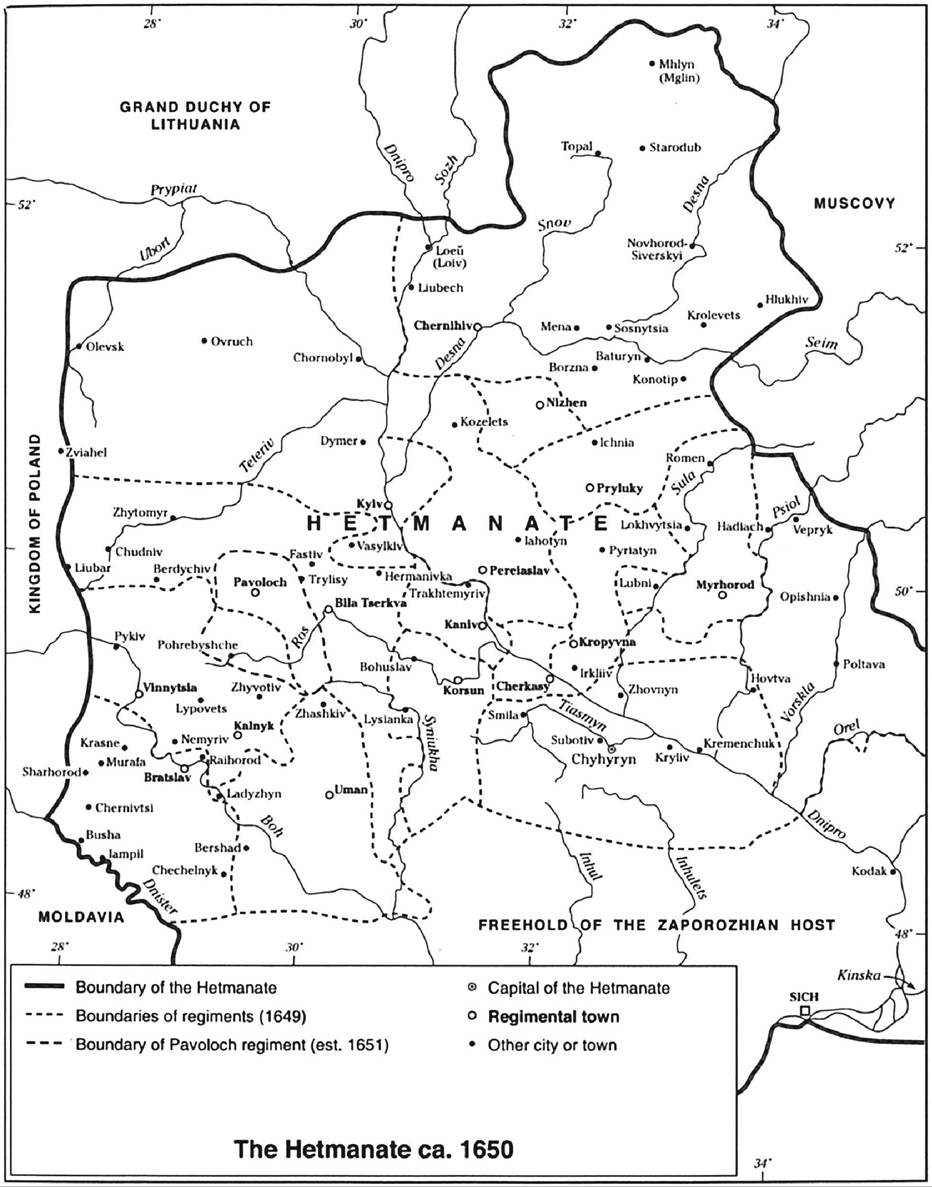
Cossack Ukraine ca. 1650. Map by WendyJohnson of Johnson Cartographies (Edmonton, Alberta). Reprinted with permission from Mykhailo Hrushevsky History of Ukraine-Rusf Volume 9f Book 2f Part 2. Edmonton and Toronto: Canadian Institute of Ukrainian Studies Press, 2010.
The Ukrainian Cossack administration system consisted of separate regimental regions. The term “Hetmanate” however, is not a contemporary designation and conceals the fact that it was precisely Hetman Bohdan Khmelnitsky7S Cossack system of 1650 that lay at the origin of Ukraine, its society and culture.
of the Cossack army a formal alliance was out of the question since it implied equality between an Emperor and a commoner. Instead, the Treaty took the form whereby Khmelnitsky accepted the Sultans vassalage and “protection/ and was proclaimed to be a Prince of the Ottoman Empire with granted privileges and without tribute. In return Khmelnitsky formally placed the CossackArmy at the Sultans disposal, and promised to secure the Black Sea region from his enemies.
The Cossacks were now in the Muslim camp, or so Khmelnitsky thought. His motives were strategic and sound. Surrounded by enemies (Polish and Lithuanian kingdom), possible but uncertain allies (Protestant Transylvania and Orthodox Wallachia), and a seemingly neutral Muscovywhich had a treaty with Poland and was at war with Khmelnitsky s unreliable allies the Tatars, he was looking for support anywhere he could find it and hoping to avoid a possible attack by the Turks. Khmelnitsky could now turn his attention to Moldavia, a nominal Ottoman vassal but with a pro-Polish ruler. The previous year Vasile Lupu had attacked and slaughtered a Tatar detachment as it was returning from Galicia loaded with booty, and the Crimean Khan was seeking revenge and an excuse to go in search of the lost loot. Moldavia was also a close ally of the Polish king and one of Lupus daughters was married to the Lithuanian Hetman Prince Radziwill. The Moldavian ruler was known for his learning and quick intellect, but gratitude was not one of his traits. In the previous year Hetman Khmelnitsky had sent his eldest son Timish with a detachment of Cossacks to support Lupu against his rivals. It seems Timishwas smitten by the beauty of Lupus other daughter Roxanda who would later become his bride.
Khmelnitskywas also maneuvering himself to be appointed by Sultan Mehmet IV as the “hospodar” or ruler of Moldavia, which would have given him a more firm international standing, a significant increase in the military strength, and greater legitimacy as a sovereign ruler of a state. As Potocki wrote to Lupu:If this traitor (Khmelnitsky), God forbid, had implemented his plans, a great burden would have fallen on the Commonwealth. In addition to his domestic forces, this enemy would have had the help of the Tatars, the Turks, and their vassals, and he could have caused such great trouble to the Commonwealth that it would have been difficult to get out of it! This traitor’s thinking was as follows: to besiege our royal army; to set Rakoczi (Prince OfTransylvania) with the hospodar of Wallachia and his 30,000 ready soldiers against Cracow; to exterminate the nobility; to take the Kingdom of your Royal Majesty away from you; and to install someone else on the throne of the Kingdom (Poland)— perhaps even that same Rakoczi.3
Potocki was well informed on all points, including the last: Prince Rakoczi was seeking the throne of Poland which he was to obtain with Khmelnitsky s help.
Towards the end of August 1650, Khmelnitsky assembled a strong force and with the Tatars invaded Moldavia, just as talks with the Ottoman Sultan were beginning. The campaign lasted 3-4 weeks and ended with the capture of the CapitalJassy, WhichVasile Lupu abandoned to seek refuge in the deep forests of Bukovina. Potocki was ordered by KingJan Casimir not to intervene fearing defeat and the loss of more Crown troops, and unsure of the Sultan s position Lupu decided to make peace with the invaders. The Tatar Commanderwithdrew on receiving a ransom of300,000 tallers plus booty for his men. According to the Cossack SecretaryVyhovsky, Vasile Lupu had
sent a charter in his own hand, with a seal and under oath, stating that he would give his daughter (Roxanda) in marriage to the hetmans son (Timish), would remain in permanent friendship and affection with the hetman, and would stand by him against any enemy....
He would not ally himself with the Liakhs... and now there is an agreement between him (Khmelnitsky) and the Moldavian hospodar.4Unable to secure the Moldavian throne for himself, Khmelnitsky succeeded in making his son a legitimate contender by marriage.
Relations between Ukraine and Poland were once again approaching a breaking point. The fundamental issue was peasant freedom and the refusal of the Ukrainian population to accept the return of the nobility with its demands for peasant “submissiveness.” A sociological and a political transformation was occurring in Ukraine which made peasant submission a pipe-dream. Virtually every able-bodied man was now armed and was beginning to enjoy a dual status—that of peasant and Cossack, with control over the land which he tilled. Communities under Cossack administration were springing up which were creating a society and culture in Ukraine so different from its neighbors. The Polish side was also not keeping to the Zboriv Agreement, which by now had been ratified by the Polish- Lithuanian Sejm and had the full force of a legal and binding treaty. The head of the Orthodox Church of Rus the Metropolitan Silvester Kosov of Kyiv, for example, was to have a seat in the Senate but the Roman Catholic prelates refused to sit in the same House as a “schismatic.”5 No one has the right, they maintained, to enter into treaties which offended the Roman Catholic Church. As the Metropolitan was humbly waiting in the anteroom, the Orthodox magnate Adam Kisil implored him to avoid riots and not insist on his right to sit in the Senate; and realizing he was wasting his time Silvester Kosov quietly returned to Kyiv. Ironically, the narrow-minded attitude of the Catholic prelates in the Senate was counter-productive since Kosovwas anti-Cossack and had been made Metropolitan largely by the efforts of the more wealthy Orthodox nobility headed by the magnate Adam Kisil.
On New Year s Day, 1651, the Cossack officers’ “rada” decided on war, which was seen as inevitable, and sometime between 15-20 January, KingJan Casimir also ordered Hetman Potocki and Field Hetman Kalinowski to prepare an invasion of Ukraine. Khmelnitsky and his second in command Secretary Vihovskywere still carrying on talks which the Polish commission headed by Kisil was again using as a stalling tactic to allow the King to raise another army and hire foreign mercenaries. The Polish Hetmans, after all, had a personal motive for war: “He (Field Hetman Kalinowski) was also stung that he, the lord of huge estates was not admitted to Ukraine, and that any scum could rule over his patrimony.”6
Prince Wishniowiecki also joined Kalinowski and was put in command of a regiment, he who had lost more land in Ukraine than any other magnate. The plan was to overwhelm the Ukrainian army by a three-pronged invasion. The Polish Crown army and mercenary forces were to launch an attack from Galicia in the west, a Lithuanian army was to move into northern Ukraine, and a Moldavian army was to come up from the southwest.
The fighting began with Field Hetman Kalinowski s strike against the border towns which had been reinforced by Cossack regiments. By this time the Polish nobility had developed a deep hatred for Ukrainians, as was made amply clear by Hetman Potocki himself: “There, in that place (Vinnytsia) I will be obliged to stand behind the army and wait for that Rusian- Scythian beast.... Perhaps the Lord Almighty will grant that he will fall, together with the monsters he has taken on to aid him, thanks to the great fortune of His Royal Majesty.”7 As the “starosta” of Bar, Nizhen and Oster in Podilia and Kyiv, Potocki had also lost much to the Ukrainian revolution. As commented by Khmelnitsky, in order to prevail, the nobility had to “efface any memory of us (the Cossacks) from the world.”8
Kalinowskis first target was a town called Krasne in Podilia, which had recently been reinforced by Colonel Nechai s Bratslav Cossack cavalry. A Companyunder Captain Shpakwas also stationed nearby to keep watch for the approaching enemy. During the night Kalinowski s soldiers noiselessly approached Shpaks company Cossack style (!) and surrounding his men launched a surprise attack. At the same time the Polish cavalry advanced stealthily to the outskirts of Krasne where Nechai and his men, not suspecting danger, were celebrating Orthodox Shrovtide (19 February) in Cossackstyle. Charging into town the Polish Cavalrycaught Nechais regiment Completelyby surprise, which, suffering losses, began to retreat. Nechai jumped on his ill-harnessed horse and with some Cossacks led a counter-attack. He was a powerful man and oral folk tradition describes him as cutting down the “Liakhs” before him “like sheafs of wheat.” At that moment his horse s harness came undone and plunging to the ground the great Nechai met his death. Many of Nechais regiment perished with him, but led by an officer called Krivenko the surviving Cossacks and the town burghers managed to lock themselves in the town stronghold. Others who could not get away were slaughtered, including women and children.
For the next three days Hetman Kalinowski threw his men against the walls of the stronghold but to no avail. All attacks were beaten back and Polish casualties began to mount. Finally, on the third day a Cossack captain by the name of Samiylo Janzhul, who had gone over to the Polish side in exchange for a nobleman s title, noticed a group of town burghers who were trying to escape through a breach in the walls. Leading his men inside the stronghold he opened a gate and as the Polish troops poured in, the outnumbered defenders fought and died where they stood. The civilians were also not spared and four priests and a monk, who were saying a liturgy over Nechai s body, were killed by German mercenaries. Krasne was then set alight and burned to the ground.
The fate ofNechais body is not known. Given the deep hatred that had developed between the two sides, it was probably desecrated and not given a Christian burial. Only four prisoners were taken for questioning but a Captain Stepko managed to escape to Khmelnitsky s main army to report the defeat. Nechais death left a deep impression in Ukraine. Not only was he a member of Khmelnitsky s family—his brother had married the Hetman s daughter—he was also one of the most popular Cossack and peasant leaders. His memory has become enshrined in Cossack “dumas” two of which have become well known: a sad lament, and a semi-humorous song in which Nechai is advised by a woman from Khmelnitsky s family to “keep (your) horse harnessed, for any eventuality.” The opposing themes no doubt reflected the politics of Nechai s loyal followers and those opposed to his refusal to abstain from supporting the peasantry and the poorer rank-and-file Cossacks.
Field Hetman Kalinowski had suffered heavy casualties in Krasne, but reinforced by fresh troops, he pushed on against other border towns without waiting for the arrival of Hetman Potocki s main army. This was his opportunity to show what he could accomplish by himself without having to share the glory with a senior commanding officer. To cover his flanks and rear before advancing into Ukraine, Kalinowskibegan to occupy other border towns as well as Chernivtsi on the Moldavian border. The latter city submitted without any resistance, but a different storywas encountered by an expedition led by Lancko- ronski against Stina on the Rusava River. The town was attacked by Polish cavalry and infantry, which drove the defenders into the inner castle from which they could not be dislodged by direct assault or artillery barrages. Notwishing to sustain further losses Kalinowski decided to retreat back to Chernivtsi, but not before concealing a cavalry detachment in a wooded valley nearby. When the townspeople came out to examine the Polish camp, part of which had been left intact, they were attacked by Polish cavalry, who with drawn sabers charged the unarmed burghers. Some 150 inhabitants of Stina were cut down as they attempted to flee to the safety of the castle and were followed by the horsemen who quickly secured the stronghold. The market town ofjampit was next. Kalinowskis army was running out of supplies and ammunition and during the night of 6-7 March several Polish regiments entered the town knowing it would be full of merchants. Early in the morning as the markets opened the merchants and their armed escorts were attacked by the troops and those who couldn’t flee were massacred. A great quantity of supplies fell into Kalinowski s hands and another town was secured.
After a three-day rest the main Polish army began to advance eastwards towards Ukraine. The Cossack town of Vin- nitsia lay in his path, which was garrisoned by Colonel Bohuns 3,000-man Kalnik regiment. Bohun was not expecting the enemy and on 10 March, leading his Cavalrythrough deep snow, Lanckoronski attacked the towns outskirts and quickly captured the castle, driving Bohuns men into the town. Bohun took up defensive positions along the banks of the Boh River, which separated the castle from the main town, and waited for the Polish attack. On the following day Lanckoronski led his armored hussars and dragoons in a charge across the frozen river, to deliver what he thought would be a knockout blow. Unbeknownst to the Poles, Bohun had his men chop holes in the ice, which were then covered with hay and light snow. As the hussars charged across the open river many plunged into the freezing water, including Lanckoronski himself who was pulled out by servants just before his heavy armor dragged him down. Those who managed to cross the river were met with musket fire, and suffering heavy losses Lanckoronski ordered a retreat to the castle pursued by Cossack cavalry. That same evening Kalinowski arrived with the main Polish army and on the next day, unable to hold Vinnitsia, the Cossacks set fire to the town and withdrew to nearby fortified grounds of the monastery. Not wishing to give Bohun time to dig in, for the next two days Kalinowski s men attacked the new Cossack positions, but each time were repelled by musket fire and hand- to-hand combat, giving the Cossacks and town burghers time to establish an impenetrable defensive perimeter.
Suffering heavy losses, the Poles opened negotiations with Bohun. The Cossacks were promised safe conduct if they agreed to withdraw from their defensive positions, but the offer hid a poisoned pill: they were to be attacked as they were leaving by the superior Polish force and annihilated. The stratagem fell through when Bohuns spies informed him of Kalinowskis treacherous intentions. The siege continued but daily assaults were unable to break through Bohuns defenses. Then startling news was brought to Kalinowski by a reconnaissance patrol. The crack Uman and Poltava Cossack regiments were only some 50 kilometers away and were advancing rapidly—and perhaps Khmelnitskys entire army was not far behind. Panic struck the Polish army as described by a participant of the winter campaign: “[The Cossack advance] resulted in terrible confusion, worse than at Piliavtsi! Some sped with their banners (squadrons) through the gate (of the castle), some went over the ramparts, some went on foot.”9
Field Hetman Kalinowski was informed that Khmelnitsky was at Bila Tserkva with three regiments, and all units of the Ukrainian army from beyond the Dnipro were being called up to the west bank. There were also 500 Tatars, and irregular peasant bands were joining Khmelnitsky s force, which in the meantime was advancing slowly, not wishing to move out of Ukraine too far, in case of another Lithuanian invasion from the north. The Hetman was waiting for reinforcements from the Crimean Khan, his onlyhope for support. The Ottoman Sultan was not sending help, but most worrisome was the Muscovite Tsar s renewal, in the autumn of 1650, of his treaty with Jan Casimir. The Tatars could not be trusted and Khmelnitskyunderstood that he could only depend on his Cossack and peasant army, some 30,000 strong.
Kalinowski now found himself in a dangerous situation as he faced the possibility of a coordinated attack on two fronts, by the approaching Cossack regiments as well as Bohuns men dug-in the monastery grounds. Bohun was not aware of a relief force closing in but Kalinowski was not taking any chances. He sent a force to attack the monastery, while his main army hurriedly withdrew over the only bridge still standing across the Boh River, which was already swollen by the spring thaw. A semblance of order had been restored amongst the infantry, many of whom were foreign mercenaries, but much of the supply train had to be abandoned, and fell into Bohuns hands. By 24 March the now reduced Polish army reached Bar, where Colonel Krisas regiment with several hundred Tatars was driven off, but feeling insecure so close to Ukraine, Kalinowski retreated further to Kamianets on the Moldavian border. As described by Colonel Sobieski, a Polish participant:
... all of these new detachments (voted on by the Sejm) are nowhere to be seen—only 16 have joined us and others approach at a snails pace.... The Lord Palatinate of Bratslav (Kalinowski)... had assured the King in his letters... that no army was needed any longer against the Cossacks... he promised to pacify Ukraine within a few weeks.10
Once again Hetman Kalinowski and the Polish nobility had underestimated the Ukrainian determination to fight for their freedom.
Kalinowski s soldiers began to desert in large numbers but the loss was made up when Koniecpolski arrived with fresh troops, and news came that KingJan Casimir was gathering a large army at Volodimer in Volin. Khmelnitsky began to move towards Kamianets to clear the Moldavian border of Polish troops in case the Sultan was going to honor the treaty and send help. On receiving news of the Cossack advance Kalinowski vacated Kamianets and headed north to join the king, narrowly missing the three regiments which Khmelnitskyhad sent ahead to prevent such a merger. Now all Podilia was in Cossack hands
and the main Ukrainian army set up camp at the Zboriv fortifications to wait for the decision of the Tatars, who were beginning to have second thoughts about a war with Poland and were carrying on peaceful negotiations. As reported to the king by a Polish envoy that was in Khmelnitskys camp at the time: “The Tatars apparently also want to abandon Khmelnitsky. They do not want to help him, on the contrary, they demand two years’ remuneration from him.”11
Bad news of a personal nature also reached Khmelnitsky. While investigating a missing barrel full of gold ducats which had disappeared from the Army treasury, Timish discovered that his father s faithless wife Helen was having an affair with the supervisor of the family estate, who had stolen the money. This was the last straw, and the enraged Hetman ordered both to be hanged, a sentence which was promptly carried out. No doubt the betrayal took on a symbolic importance in Bohdans mind; not only was he being abandoned by allies, but his own wife had deserted him as well.
The borders of northern Ukraine also continued to be the scene of military action. Remembering his costly encounter with Colonel Krichevskytwo years previously, Prince Radziwill had gathered a powerful Lithuanian army to attack Ukraine. The Ukrainian revolution had spread to southern Belarus and Cossack units had occupied Liubech and Starodub. Although a staunch Calvinist Protestant the Prince had become alarmed at the growing peasant uprisings encouraged and supported by Cossack units. It was time to nip the unruliness in the bud, which meant the invasion and subjugation of Ukraine. Sending Colonel Pavsha to guard the north shore of the Pripet River, Radziwill and his main force approached left bank Ukraine where the Chernihiv and Nizhen Cossack regiments were stationed to block any Lithuanian attack. Also on the right bank of the Dnipro, the Polinia and Kyiv regiments had been deployed against an enemy advance on Kyivbut at the end of May a Lithuanian raiding party took the small town of Jarilovichi by surprise, and most of the Cossack garrison was killed. On 9 June 1651 Prince Radziwillwrote to KingJan Casimir describing the general strategy:
having a report that ColonelAnton Zhdanovich (Kyiv regiment) has entrenched himself with a dozen or so thousand men four miles from Babicky so as to drive our people from that crossing point, the only one on the Pripet to which we have access... with Gods help the army will be able to attack them successfully at the crossing point. If this is successful we will have secured everything as far as Chornobyl, where they (the Cossacks) have a garrison of considerable size that keeps getting larger. What would then remain to be done would be to gather the army and march to join the armies of His Royal Majesty and to fulfill our duty in sight of His Majesty.12
Following the Lithuanian raid and destruction of Jar- ilovichi, the Chihirin Colonel Nebaba responded by attacking Homel in Belarus. After a week of unsuccessful attempts to penetrate the town walls the siege was called off when a letter arrived from Khmelnitsky ordering a ceasefire. Khmelnitsky was still hoping to secure Lithuanian neutrality to forestall an all-out Lithuanian invasion. Prince Radziwill had already decided to invade and seize Chornobyl, from where he would be in a position to occupy Kyiv and threaten the rear positions of the Ukrainian army. As he wrote to King Jan Casimir, “he (Khmelnitsky) fails to consider that the affairs of Lithuania and the Kingdom of Poland exist in common, that this is one nation, one Commonwealth.”
Before advancing into Ukraine, Radziwill realized that he had to secure his rear and left flank after receiving startling news that the hinterland of Lithuania was threatened and his army was being outflanked. While Nebaba was besieging Homel, a 4,000 man regiment under Colonel Tarasenko had advanced into the Smolenskregion having received free passage through Muscovite territory and had captured the Lithuanian-held town OfRoslavlwhich Surrenderedwithout resistance. A widespread peasant uprising had broken out and Radziwill had to send a Lithuanian corps under Mirsky to force Tarasenko to withdraw to suppress the serf revolt. Tarasenkos raid, however, had fulfilled its purpose which was to buy Khmelnitsky valuable time.
More on the topic Border Battles and a Stalemate:
- Border Battles and a Stalemate
- The triple stalemate
- Send in the Marines
- The Crusade of the Feudal Lords
- PESTIVIRUS OF CHAMOIS AND BORDER DISEASE
- Basilevsky Alexander. Early Ukraine: A Military and Social History to the Mid-19th Century. Jefferson, North Carolina: McFarland & Company, Inc., Publishers,2016. — 397 p., 2016
- Peasant Historiography
- The agreement concluded at Pereiaslav in 1654 resulted in an extension of Muscovy’s borders to include the Zaporozhian Cossacks and
- The 1967 June War
- The Eastern Empire and the Reconquest of the West