The Name Ukraine
The name Ukraine (Ukrainian: Ukraina) as a designation for a territory is both very old and relatively new. Etymologically, the term is of Slavic origin and is derived from the Indo-European root *krei ‘to cut’, with the secondary meaning of an edge (krai) or borderland (ukraina).
Some linguists, among them Jaroslav Rudnyckyj, have surmised that the name Ukraine is connected with the pre-Slavic past, and that the name Antes (the group which inhabited Ukrainian lands until about the seventh century ce) is the Iranian translation of the Slavic words for borderland and border people. While such views assist those who support the idea of continuity between the Antes, the Rus', and modern Ukrainians, they remain linguistic hypotheses unsupported by concrete evidence in written sources.The name Ukraine is first attested in written documents which date from a much later period but which describe events in the twelfth and thirteenth centuries. The oldest reference is 1187, the death of Prince Volodymyr of Pereia- slav, at which time, according to the Hypatian text of the Primary Chronicle (copied in the fifteenth century), ‘The ukraina groaned with grief for him.’* But neither in this instance of the term nor in others in the Primary Chronicle (Hypatian text), describing events in 1189, 1213, 1280, and 1282 in various Ukrainian lands (Ilalych, the Buh region, etc.), is the term ukraina ever used in reference to a specific territory. Rather, when it is used, ukraina simply means an undefined borderland. The term ukraina appears as well in other Rus' chronicles, describing non-specific borderland areas in the Pskov, the Polatsk, and other northern principalities.
It is not until the sixteenth century that the name Ukraine is used for the first time to refer to a clearly defined territory. At that time, Polish sources began to use the name in its Polish form, Ukrajina, to describe the large eastern palatinate of Kiev, together with Bratslav (after 1569) and Chernihiv (after 1619).
With the rise of the Cossacks as a political force in the seventeenth century, the name Ukraine was still used, but once again in a territorially less specific manner. The Cossacks referred to Ukraine as their ‘fatherland’ or their ‘mother,’ and western cartographers (Beauplan, Homman) often drew maps indicating that ‘Ukraine is the land of the Cossacks.’ In actual practice, however, the Cossacks used the name Ukraine in a poetic sense, to describe their generic homeland, but officially they called their state the Zaporozhian Host, or Lands of the Army of Zaporozhia.With the demise of Polish rule, the name Ukraine fell into disuse as a term for a specific territory, and it was not revived until the early nineteenth century. At that time, writers who promoted the national movement began to speak of Ukraine as the appropriate name for all territory in which Ukrainians lived. The term was once again non-specific, however, because in the context of Russian and Austrian imperial rule there was no possibility of a distinct territorial entity called Ukraine.
Not until the revolutionary period beginning in 1917 was the name Ukraine again used to refer to a specific territory. It was used by the Ukrainian National Republic, by the Hetmanate, and by the Bolshevik party. By 1920, the Bolsheviks had succeeded in creating the Ukrainian Soviet Socialist Republic, with specific boundaries largely encompassing the lands inhabited by ethnic Ukrainians.
Thus, as a term referring to a non-specific and even ethnically nonUkrainian territory, the name Ukraine dates from the twelfth and thirteenth centuries; as a name for a specific territory, it dates from the late sixteenth century; and as a name for lands inhabited by ethnic Ukrainians, it dates from the nineteenth century.
•Cited in Henryk Paszkiewicz, The Making of the Russian Nation (London 1963), p. 3050.293.
reached 36 inhabitants per square mile (14 inhabitants per square kilometer). Such demographic discrepancy did not begin to change until the second half of the sixteenth century, notably after 1569, when Poland annexed the Ukrainian- inhabited palatinates of Volhynia, Kiev, and Bratslav from Lithuania, and then in 1619, when it annexed Chernihiv from Muscovy.
By the end of the sixteenth century, Poland had become the granary of Europe. Its continuing economic well-being depended on the development of new sources of agricultural exploitation. Ukrainian lands became especially attractive, prompting local Rus' nobles, joined by their Polish counterparts farther west, to stake out claims to large tracts of land and setde them with peasants from the more populated palatinates of Galicia, Belz, and western Volhynia. The settlement eastward was gradual, beginning in eastern Volhynia and Podolia and then continuing into the palatinates of Kiev, Chernihiv, and Bratslav - three regions which in Polish sources came to be referred to collectively as Ukraine (Ukrajina). Nonetheless, along the southern fringes of these three palatinates, and beyond that along both sides of the lower Dnieper River, lay the open steppe - the Wild Fields (Dzikie Pole) in contemporary writings - which remained untouched by any sedentary agricultural population. Actually, the steppe was a kind of no-man’s-land separating the settlements within Poland-Lithuania farther north from another civilization found along the very southern fringes of Ukrainian territory, that of the Crimean Tatars.
The Crimean Khanate
Chapters 8 and 10 discussed the Crimea and northern shore of the Black Sea in the fourteenth century, by which time Genoese merchants had come to dominate commerce in this region under the protection of the Mongolo-Tatar Golden Horde. By the end of that century, the Golden Horde, based farther east at Sarai, on the lower Volga, had suffered internal political crises and foreign invasions (by Lithuanians from the north and Tamerlane from the east), with the result that by the fifteenth century the once-powerful Mongolo-Tatar state was disintegrating. In its stead, Tatar tribesmen established three new states, known as khanates. Two of these came into existence during the 1440s in peripheral regions of the Golden Horde: the Kazan' Khanate along the upper Volga River, and the Crimean Khanate in the Crimean Peninsula and the areas around the Sea of Azov.
The third state - the Astrakhan' Khanate, took over the remaining territories of the Golden Horde along the lower Volga River in 1502, when the Golden Horde finally ceased to exist. Each of the successor khanates continued the Mongol practice and exacted tribute from those states that held lands formerly part of Kievan Rus': the Kazan' and Astrakhan' khanates received payments from Muscovy, and the Crimean Khanate from Lithuania. The three Tatar successor states were formidable powers. Hence, much of the early history of both Lithuania and Muscovy was marked by the efforts of these states to rid themselves of what was considered the odious and humiliating heritage of the Golden Horde’s ‘Tatar yoke’ as maintained by the three Tatar khanates.It was the Crimean Khanate that had the most direct bearing on Ukrainian lands. Well before the final disintegration of the Golden Horde at the beginning of the sixteenth century, the Crimean Khanate had evolved into a distinct political entity. The Crimea had traditionally been a refuge for leaders who had failed in their bid for power in the Golden Horde, and their having fled there gave rise to the subsequent Crimean view that their rulers were direct descendants of Chingis Khan. One of these displaced leaders, Haci Giray, had formed an independent government during the first half of the fifteenth century. His successor, Mengli Giray I (reigned 1478-1514), effectively established the region’s first dynasty, the Girays. In the course of their rise to power, it was inevitable that the Crimean khans of the Giray family would clash with the rulers of the Golden Horde in Sarai (who still claimed authority over the Crimea), as well as with the still-dominant power in the south of the peninsula, the Genoese, whose control of trade and the coastal cities was particularly resented.
Then, in the midst of this three-way struggle for power among the Crimean Tatar leaders, the Genoese, and the Golden Horde, a new contender entered the field for control of the valuable Crimean Peninsula.
This was the Ottoman Turks. Following the fall of Byzantium in 1453, the Ottoman Turkic conqueror of Constantinople, Sultan Mehmet II (reigned 1451-1481), was determined to extend his realm north of the Black Sea, which thereby would be transformed into a ‘Turkish lake.’ The Ottoman sultan claimed he was the political heir of the Golden Horde, and in 1475, after a series of complicated alliances and counteralliances with various forces in the Crimea, the Turks put a decisive end to Genoese control of the Crimean coastal cities, which, like other cities north of the Black Sea and Sea of Azov, were placed under the direct administration of the Ottoman government. Place-name changes symbolized the Italian decline, as Moncastro (later captured from Moldavia) became Ottoman Akkerman, Taman became Yenikale, and Tana became Azov. Similarly, the most important Genoese center, Caffa, became Turkish Kefe. Its port was expanded and its population increased to the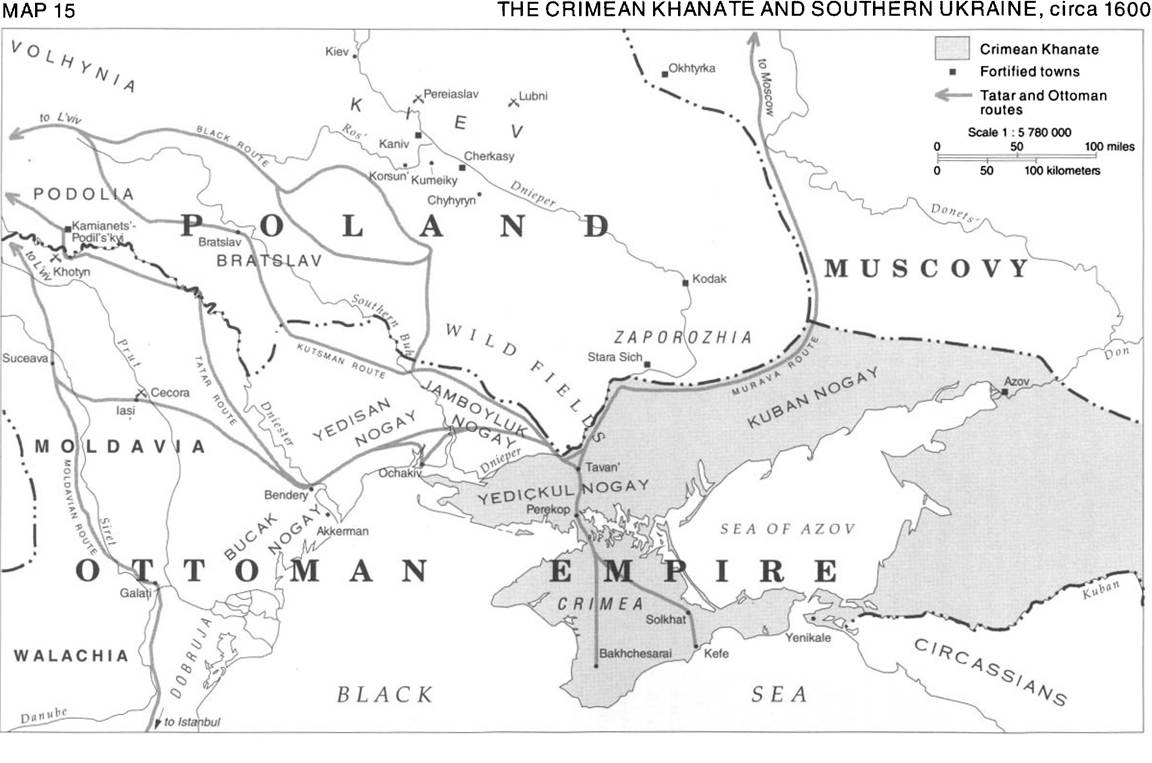
point that by the early seventeenth century Kefe was one of the largest cities in eastern Europe. The Ottomans eventually recognized Mengli Giray I, who was the dominant power in the region, as Crimean khan, and in 1478 Mengli was able to regain control of the peninsula from the Genoese with Ottoman military support.
The presence of Ottoman authority in the Crimea beginning in the last quarter of the fifteenth century prompted a new realignment of political power. It is true that the Ottomans respected their fellow Muslims, the Crimean Tatars, especially since the Giray dynasty seemed to have strong claims to descent from Chingis Khan (from whom the Ottomans also would have liked to make hereditary claims). In many ways, however, the Crimean Khanate became little more than a client state of the Ottoman Empire. The Crimean Tatars served as soldiers in Ottoman campaigns and protected the northern frontier of the Ottoman state.
In return, the ruling khans received an annual pension, landholdings in the Turkish provinces of Rumelia and Anatolia, and, later, the privilege of collecting tribute from Poland and Muscovy. It should be remembered, however, that although the Crimean Khanate was closely allied with the Ottoman state, at least during the sixteenth century it was rather independent, following a foreign policy of its own which was at times in conflict with the political and military objectives of the Ottoman rulers.Crimean socioeconomic life
Crimean society under Tatar rule consisted of the ruling khans (generally from the Giray family) and tribal clans who controlled most of the productive agricultural lands on the peninsula. Below these upper social strata were Tatar and Turkic herdsmen and peasants. By the sixteenth century, the khanate had become divided into twenty-eight jurisdictions, each headed by representatives of the khan, who governed according to precise codes relating to finance and jurisprudence. Under Mengli Giray I, the former administrative center of the Golden Horde on the eastern side of the peninsula, Solkhat (later, Eski Kirim/Staryi Krym), was made the capital of the Crimean Khanate and was suitably transformed into an impressive center of Islamic culture. The architectural beauties of Solkhat were later surpassed by those of Bakhchesarai/Bahf esaray, on the western side of the peninsula, which after the 1530s became the new Crimean capital.
While the Crimean Tatars were themselves basically sedentary, another element within their sphere of control was nomadic. This was the Nogay Tatars. The Nogay were originally one of many tribes within the Golden Horde, and since they lived north of the Caucasus Mountains, they later came under the rule of the Astrakhan' Khanate. But in 1556, when Muscovy finally conquered Astrakhan', the Nogays migrated westward to the steppe zone north of the Black Sea and Sea of Azov. The Nogays themselves were split into several tribal confederations: the Kuban Nogay (north of the Sea of Azov), the Yedickul Nogay (north of the Crimea), the Jamboyluk Nogay (between the Dnieper and Southern Buh Rivers), the Yedisan Nogay (between the Buh and Dniester Rivers), and the Bucak Nogay (between the Dniester and Danube Rivers).
These Nogay tribes, generically referred to as Tatars, are the subject of much attention in Ukrainian history. Theoretically, the various Nogay tribes were expected to recognize the authority of the Crimean khan, usually in the form of a representative sent from Bakhchesarai. In practice, however, they usually followed their own whims and often rebelled against the Crimean Tatars. ‘Yet,’ as the historian Alan Fisher has remarked, ‘the Nogays served a useful purpose for the Crimean Khanate: They prevented the establishment of solid Slavic settlements in the steppe and provided the Crimean slave markets with a never ending supply of captives.’1
The Crimean economy was based primarily on the slave trade. Slavery as such was illegal according to the law of Mohammed, but the prophet’s successors made one important exception. According to Islamic legal theory, captives taken in war might be enslaved. The Ottoman Empire, with its military forces and harems, was always in need of slaves, and before long its new vassal state in the Crimea became the primary source of this commodity. Interestingly, before the Ottoman presence in the Crimea beginning in the 1470s, the Tatars seem to have reached a modus vivendi along their northern frontier, where, like the Ukrainian inhabitants north of the steppe, they began to settle down to agriculture. But under the impact of Ottoman economic needs, the Tatars saw in the Ukrainian steppe a source of greater wealth than that produced by agriculture. Beginning with their first major recorded incursions in 1468 and 1474 and from then until the end of the seventeenth century, Tatar raiders made almost annual forays into Ukrainian agricultural communities in the north searching for settlers to capture and sell as slaves.
After the mid-sixteenth century, it was the various Nogay tribal confederations, especially the Yedifkul, who carried out the slave raids, while the Crimean Tatars acted as middlemen between their Nogay suppliers in the north and Ottoman purchasers in the south. It is also from this period, the sixteenth and early seventeenth centuries, that the anonymous lyrical epic tales known as dumy arose in Ukrainian society. The earliest dumy are primarily laments on the fate of young men coerced to serve in the armies of the Ottoman Turkish ‘infidel’ (Duma about the Lament of the Captives) or of young women forced to enter harems and serve the personal needs of the Ottoman rulers (Duma about Marusia from Bohuslav).
Thus, the Crimean and, later, Nogay Tatars represented the most recent in a long line of nomadic or sedentary civilizations (the Scythian, the Sarmatian, the Khazar, the Golden Horde) that came to dominate the southern steppes of Ukraine and that continued the symbiotic economic relationship between the coastal cities and the hinterland. Because captured slaves represented the most important resource from the hinterland in the Crimean economy, much of the area south of the Bratslav and Kiev palatinates from the Southern Buh to the Dnieper River and beyond became a sparsely settled or entirely uninhabited no- man’s-land, known as the Wild Fields. In effect, this part of the country became what the name Ukraine suggested: a borderland or frontier, not in the sense of the end of a civilized area, as is often assumed, but rather in the sense of a buffer zone between Poland-Lithuania to the northwest, Muscovy to the northeast, and the Crimean Khanate and Ottoman Empire to the south.
More on the topic The Name Ukraine:
- KARAITES
- Violence and the Family
- North Korea: the last Stalinist state
- Cossack Tatar Fighters
- Forms of Government