24 The Right Bank and Western Ukraine in the Eighteenth Century
In the course of the eighteenth century, while the Left Bank, southern Ukraine, and Crimea were becoming fully incorporated into the Russian Empire, the other “half’ of Ukraine remained under Polish rule.
Poland’s largely Ukrainian-inhabited territories included the Right Bank palatinates of Kiev (only the portion west of the Dnieper River and not including the city of Kiev) and Bratslav, as well as the palatinates of Podolia, Volhynia, Belz, and Galicia (Rus’).The Polish-Lithuanian Commonwealth managed to survive the Period of Deluge (1655-1661) and the first phase of the Great Northern War (1700-1714), but it was clearly no longer the dominant power in eastern Europe. That role was gradually but definitely being assumed by the Russian Empire. Whereas Poland-Lithuania continued to exist for most of the eighteenth century and was even able to restore control over its eastern borderland regions, including Ukraine, the country became closely linked and at times subordinate to Russian foreign policy interests.
Russian influence was most evident in the choice of Poland’s last three kings—August II (r. 1689-1733), August III (r. 1733-1763), and Stanislaw II Poniatowski (r. 1764-1795)—who in large part were elected because they were acceptable to the commonwealth’s powerful eastern neighbor. Also, in times of social upheaval marked by gentryled revolts against the Polish king, Russia did not hesitate to send its armies to crush the uprisings in Poland-Lithuania and to remain in the country for as long as the tsar deemed necessary.

24.1 Palace of the Potocki family of Polish magnates at Tulchyn (1781-82) and center of an extensive landed estate encompassing 240,000 inhabitants in the Bratslav palatinate.
MAP 24 THE RIGHT BANK AND WESTERN UKRAINE, 1750

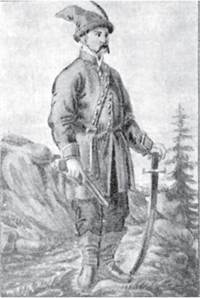
24.2 A Carpathain robber-bandit (opryshok) from an unknown line-drawing dated 1677.
The role of the king was increasingly that of a figurehead, reflecting a general breakdown of central authority throughout the Polish-Lithuanian Commonwealth. In effect, by the eighteenth century the traditional balance of power between the king, the magnates (represented by the upper house of the Diet—the Senate), and the gentry (represented by the lower house of the Diet) had broken down. The country was essentially being run by a group of economically and socially powerful magnates, who administered huge manorial estates protected by their own private armies. It was, in fact, the Polish magnates who reactivated Cossack-like military formations in the Right Bank specifically to serve their own interests.
The decades after 1714 were characterized by relative peace, during which Poland was able to restore some control over the Right Bank. Even earlier, in 1699, a treaty with the Ottomans had resulted in a return of the southern Kiev and Bratslav palatinates. There, in particular, the return of Polish rule was made possible for the most part by magnate families, who prided themselves on bringing back cultivation and civilization (understood to be Polish and Roman Catholic in form) to the “wild” steppes of Ukraine.

24.3 An 18th-century haidamak rebel carrying his weapon of choice, a lance or pike (kolii), from which the Koliivshchyna revolt derives its name.
In relatively more populated areas, the arenda system was put in place, whereby leaseholders (usually Jews) ran the landed estates and mills for their Polish noble owners. Whatever losses may have occurred during the Khmel’nyts’kyi era, a little over a century later (1760s) there were about 242,000 Jews living in more than eighty communities in Polish-ruled Ukrainian territories. In less densely populated areas, such as the eastern Bratslav and southern Kiev palatinates, Polish magnates encouraged the settlement of peasants from the more densely populated areas of Galicia, Belz, and western Volhynia.
In some parts of western Ukrainian lands, during much of the eighteenth century discontented peasants and sheep herders known as opryshky banded together and attacked property owned by landlords. The best known opryshky leader was Oleksa Dovbush, who operated in the Carpathian foothills of Pokuttia, a small region between southern Galicia and Bukovina. But Polish rule was never really threatened there or for that matter elsewhere in western Ukrainian lands. The peasants, whether Ukrainian or Polish, continued to be subjected to higher duties and work payments by their secular and church landlords. It is not surprising, therefore, that they could easily be attracted to the frontier areas of the Right Bank, where they were allowed to settle initially for what were called duty-free periods. This meant that they did not have to pay taxes or perform labor services for their new landlords for periods between five and fifteen years, or even longer.
24.4 Archimandrite Mel’khysedek Znachko-Iavors’kyi (ca. 1716-1809), from 1753 to 1768 head of the Motronyn Monastery and confidant of the haidamak leader Maksym Zalizniak.
The return of Polish rule also meant the return of the Roman Catholic Church to Ukrainian lands and, in particular, the restoration of the Uniate Church, which was of the Eastern rite but recognized the authority of the pope. Although Orthodoxy was not outlawed, its status was significantly undermined. One by one the remaining Orthodox eparchies on Ukrainian territory became Uniate: Przemysl in 1691, L’viv in 1700, and Luts’k in 1721. Even the very center of the late sixteenth-century Orthodox cultural revival, the Stauropegial Brotherhood in L’viv, became Uniate in 1709.
In the context of such political, socioeconomic, and cultural conditions, large segments of the Rus’-Ukrainian population continued to believe that farther east, beyond the Dnieper River in Orthodox Russia, conditions might somehow be better.
Certainly throughout the eighteenth century Russian-ruled Zaporozhia continued to attract discontented peasant refugees from Poland’s Right Bank. In fact, it was Right Bank lands bordering on Zaporozhia and the Hetmanate, that is, eastern Bratslav and the triangle below the Ros’ River in the southern Kiev palatinate, where the potential for serious social disturbances was the greatest. After all, it was there that the new peasant homesteaders were to be found in greatest numbers and where the duty-free settlement periods sooner or later were to run out. When this happened, revolts and attacks against the manors of the magnate landowners were likely to occur. What, in fact, developed was a kind of ongoing small-scale guerilla warfare that came to be known as the haidamak movement.The haidamak movement consisted of virtually spontaneous revolts by Orthodox peasants and Cossacks against Polish Catholic landlords and their Jewish arendars as well as against the Roman Catholic and Uniate clergy and faithful. Aside from attacks limited to specific manors or regions, more widespread uprisings occurred in 1734, 1750, and in 1768. It is true that in these three cases the uprisings were in the end crushed by Polish forces, but they did contribute to a further weakening of Poland-Lithuania and to an increase in Russia’s political and military influence in that country.

24.5 Maksym Zalizniak (ca. 1740-?), haidamak leader of the Koliivshchyna revolt.
The most famous of the haidamak revolts was the Koliïvshchyna of 1768. It began in the triangle of the far southern Kiev palatinate. In that region the peasants had become increasingly discontented, because in the 1760s their duty-free periods were running out. Unrelated, but simultaneously under way, was an Orthodox revival centered on the Motronyn Monastery, which received encouragement from the Zaporozhian Cossacks in neighboring Russia and, allegedly, from Empress Catherine II herself.
Also at the same time, far ther west in Podolia, discontented Polish nobles formed the Confederation of Bar with the goal of leading an insurrection to remove from power their country’s pro-Russian king. Within this context, the Zaporozhian Cossack Maksym Zalizniak, who was living temporarily at the Motronyn Monastery, organized a group of Cossacks to oppose the Confederation of Bar, which they believed was intent on destroying all Orthodox adherents in the Right Bank. Zalizniak’s forces moved westward, picking up numerous peasants supporters along the way, and they captured several towns in the southern Kiev palatinate before reaching the town of Uman’ in the Bratslav palatinate. At Uman’, on June 20-21, 1768, Zalizniak was joined by the local Cossack Ivan Gonta and his troops, who had defected from the Polish authorities that they were supposed to defend. Zalizniak and Gonta’s haidamaks limited their activity to the southern Kiev palatinate, but other disparate haidamak groups moved further into Bratslav, Podolia, and southern Volhynia. Wherever they went they killed Polish landlords and their families, Roman Catholic and Uniate clergy, and Jews.The Russian Empire certainly encouraged the Orthodox clergy in the Right Bank, but it was not about to allow political instability to get out of hand in neighboring Poland or among its own Cossacks in Zaporozhia (over whom Zalizniak had in the interim proclaimed himself hetman). Hence, Catherine II ordered a Russian army already stationed in Podolia to crush both the Polish noble-led Confederation of Bar and the Zalizniak-Gonta haidamak revolt. This was successfully accomplished by the end of June 1768.
Perhaps the most lasting impact of the short-lived haidamak revolt of 1768 was its impact on historical memory. The attack against Uman’ in particular took on a special, if quite contradictory meaning for subsequent generations of Ukrainians, Poles, and Jews. For Ukrainians, Uman’ became an inspiration for future peasant uprisings against social oppression. For Poles, Uman’ was either another example of Cossack “barbarism” against Polish civilization or an experience with no winners which revealed the need for future Polish-Ukrainian reconciliation. For Jews, Uman’ marked their “second Ukrainian catastrophe.” In the belief that the Jews who were killed in 1768 were unable to rise to heaven, the site has since become a major pilgrimage site for Hasidic Jews from all over the world.

24.6 Ivan Gonta (d. 1768), captain of the Cossack militia at Uman’ in the service of the Polish magnate, Franciszek Salezy Potocki.