23 Zaporozhia and Southern Ukrainian Lands inthe Eighteenth Century
In contrast to Sloboda Ukraine, Zaporozhia and Ukrainian lands farther south (including Crimea) were significantly larger territories that experienced a much more turbulent history.
Consequently, their incorporation into the Russian Empire was a complex process that did not reach completion until the last decade of the eighteenth century. First came Zaporozhia in 1775. Then, during the following decade, Russia was finally able to defeat the Ottoman Empire and to remove both it and the Crimean Khanate permanently from the northern Black Sea region. As a result southern Ukraine and the Crimean peninsula were between 1774 and 1791 incorporated into the Russian Empire.When, in 1649, Bohdan Khmel’nyts’kyi created a Cossack state, Zaporozhia was formally designated the Army of Lower Zaporozhia (Viis’ko Zaporiz’ke Nyzove) to distinguish it from the Army of Zaporozhia, the name adopted by the Cossack state farther north (the Hetmanate), whose government was under the direct authority of the hetman. Following the death of Khmel’nyts’kyi in 1657, the Army of Lower Zaporozhia functioned as an independent entity based at its sich (see Map 17) and headed by its own chief, the koshovyi otaman, who was elected on an annual basis. Also, in contrast to the Hetmanate, the Zaporozhians followed a consistently pro-Muscovite policy at least until the outset of the eighteenth century. By that time, however, Zaporozhia’s Cossacks had become fearful that Muscovy’s military campaigns would cut them off from their free-booting activities in Ottoman-ruled southern Ukraine and the Crimea.

23.1 Zaporozhian koshovyi otaman as depicted by the 19th-century painter Illia Repin.
It was this concern that prompted the Zaporozhian otaman, Kost’ Hordiienko, to break with Muscovy in 1709, to join the invading Swedish forces, and then after their defeat, to seek refuge in the Ottoman Empire.
For over two decades, from 1711 to 1734, about eight thousand Zaporozhians established their sich at Oleshky near the mouth of the Dnieper River under the protection of the Crimean khan. In such a situation, the Cossacks could not alienate their protectors by attacking the khan’s Crimean subjects. As a result, discontented individual Zaporozhians began to request permission to return home, which by then was part of the Russian Empire. Finally, after the death of Hordiienko in 1733—the very time Russia was preparing for a new campaign against the Ottomans—the tsarist government signed what became known as the Agreement of Lubny (1734).
23.2 Reconstruction of the Nova Sich as it appeared in the mid-18th century.
According to the Lubny pact, the Zaporozhian Cossacks regained all their former territory, now designated as the Free Lands of the Zaporozian Host (Vol’nosti Viis’ka Zaporiz’koho Nyzovoho) with its headquarters at a new sich, Nova Sich. The new sich was located along the Dnieper River not far from the Stara (Old) Sich destroyed in 1709 by the Muscovites in the wake of the Zaporozhian defection to the Swedes. Also, the Zaporozhians were permitted to govern themselves according to their traditional laws, and they were to serve under the command of the Russian imperial army stationed in the Hetmanate, for which they were given an annual payment. The number of Zaporozhians who returned from the Crimean Khanate in 1734 was at most twenty thousand, a very small number of people for the vast territory at their disposal. To overcome the demographic problem, the Zaporozhians decided to create a more formal administration and to invite colonists to settle in the region.
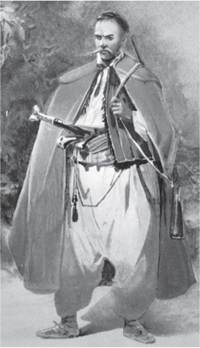
23.3 A Danubian Delta Cossack in military dress.
The Zaporozhian administrative structure consisted of eight districts (palanky): Boh-Hard, Kodak, Protovcha, Orel’, Samara, Kalmius, Inhul, and Prohnii.
Each district (palanka) was headed by a colonel, with limited authority, appointed by the chief (koshovyi otaman) of the sich. Most of the peasants whom the Zaporozhians were able to attract as settlers were refugees from the Polish-ruled Right Bank and Russia’s Left Bank Hetmanate. By 1762 Zaporozhia contained an estimated 33,700 Cossacks and 150,000 free peasant homesteads. The Russian imperial authorities had their own plans for Zaporozhia, however. They systematically increased their control over the area through a program of building fortifications and settlement of colonists from abroad who would remain under the direct authority of central government. Fortifications with imperial troops were built near the Nova Sich as early as 1734 and in the 1750s along the Syniukha and Southern Buh Rivers, that is, along Zaporozhia’s western borders with Poland and the Ottoman Empire.The Russian government then started to dismantle Zaporozhian territory. In 1746 it gave to the Don Cossacks a chunk of steppeland in far eastern Zaporozhia. Then, along Zaporozhia’s northern border, it coopted three strips of territory and settled them with Serbs and other peoples from the Balkans or with Cossacks from the Sloboda Ukraine and Hetmanate. These territories were called New Serbia (1751), Slavic Serbia (1752), and the Sloboda Regiment (1754), each of which was organized as a frontier military regiment with fortified centers respectively at Novomyrhorod, Bakhmut (today Artemivs’k), and Ielyzavethrad (today Kirovohrad). In 1764, the Serbian and Sloboda frontier regions were abolished and joined with fifteen Cossack companies in the southern Hetmanate to form an imperial province called New Russia (Novorossiiskaia guberniia) with its administrative center in Kremenchuk.
The Zaporozhian Cossacks resented such encroachments on their territory and they frequently clashed with Serb colonists. Nevertheless, they served loyally in Russia’s two major campaigns against the Ottoman Empire in 1734-1740 and 1769-1774.
Zaporozhia’s fate, however, was largely influenced by events just to the east. There the Don Cossacks and Iaik Cossacks were actively involved in what turned out to be the greatest internal uprising experienced by eighteenth-century Russia, the Pugachev rebellion of 1773-1774. When the rebellion was finally crushed, Empress Catherine II was determined to reorganize all the empire’s borderlands so that they would be under the direct control of the central government in St Petersburg.In this context, it made no difference that the Zaporozhian Cossacks had participated loyally in Russia’s latest victorious campaign against the Ottoman Empire, one which resulted in a favorable peace treaty (1774) and the acquisition of new territories. On their way home in 1775, Russian troops suddenly attacked and destroyed Zaporozhia’s Nova Sich. Some Cossacks were drafted into the imperial army; others were left in Zaporozhia as free homestead farmers. Still others were allowed to function as Cossacks with their own military formations in the service of the Russian Empire. Among these were the Katerynoslav Cossack Army (together with regiments of the Buh Cossack Army), settled in 1787 along Russia’s borders with what was still Ottoman-held Yedisan, and the Black Sea Cossacks, formed in 1788 and settled in the southern Yedisan with their center at Slobodzeia. These formations were, however, short-lived. In 1796, the Katerynoslav Cossacks were disbanded, while even earlier (1792) the Black Sea Cossacks were resettled to the Kuban’ region east of the Sea of Azov.
Those Cossacks who were opposed to Russia’s destruction of Zaporozhia and its sich fled southward to the Ottoman Empire, which in 1775 allowed them to settle in the delta of the Danube River. It was not long, however, before some elements within the Danube Delta Cossack Host became displeased with Ottoman hegemony and sought a possibly better existence in the Austrian Empire (in the Banat Region along the lower Tysa River, 1785-1812), or back once again in the Russian Empire.
When some did indeed return in 1828, the Ottomans responded to what they considered betrayal by destroying the Danubian Delta Host’s sich at Verkhnii Dunavets’ (today Dunavătu de Sus in Romania). The often dramatic plight of the Danube Delta Cossacks under Ottoman protection was later immortalized in the nineteenth-century Ukrainian opera by Semen Hulak-Artemovs’kyi, Zaporozhets’ za Dunaiem (The Zaporozhian Cossack Beyond the Danube, 1863).
23.4 Prince Grigorii Potemkin (1739-1791), from 1774 supreme commander, governor-general, and viceroy of New Russia, depicted as a Roman statesman in a monument erected in Kherson
As for Zaporozhia, its Cossack district/palanka administrative structure was dismantled and all its remaining territory annexed to the imperial province of New Russia. Farther south, as a result of the Treaty of Kuchuk Kainardzha (1774), Russia aquired small slices of territory from the Ottoman Empire near Mariupol north of the Sea of Azov and between the mouths of the Dnieper and southern Buh Rivers. Russia also extracted from the Ottomans their recognition of independence for the Crimean Khanate. Crimea’s independence was short-lived, however, because in 1783 Russia simply annexed the entire khanate. This was followed in 1791 by the annexation of Yedisan, another Ottoman territory farther west between the Southern Buh and Dniester rivers. All of southern Ukraine and the Crimea had now become part of the Russian Empire, and with this acquisition Empress Catherine II fulfilled the age-old dream of her Muscovite and Russian predecessors to extend the realm’s borders to the shores of the Black Sea.
The imperial province of New Russia—which came to include Zaporozhia (with its former territories of New Serbia, the Sloboda Regiment, and Slavic Serbia), the triangle between the Southern Buh and lower Dnieper rivers, Yedisan, the Crimean peninsula, and the steppeland home of the Nogay Tatars—was throughout its entire period of expansion under the governorship of Catherine’s favorite minister, Prince Grigorii Potemkin.
In this vast territory Potemkin immediately set out on a building and colonizing campaign. Among the cities constructed anew or developed from existing fortresses were: Ielyzavethrad (today Kirovohrad) and Katerynoslav (today Dnipropetrovs’k) in Zaporozhia; Sevastopol in the Crimea; Mariupol on the Sea of Azov; and Mykolaïv and Kherson near the mouth of the Southern Buh and Dnieper rivers. As for New Russia’s Ukrainian steppe hinterland, Potemkin brought Romanian settlers from neighboring Moldavia as well as a host of other peoples from the Ottoman Empire (including Bulgarians, Turks, and Albanians). The colonists were attracted by the offer of free land and tax exemptions—at least for two or three decades. Among the colonists most favored for their advanced technological skills were Germans from central Europe, both Catholics and Protestants (including Mennonites). Empress Catherine II issued special decrees (in 1763, 1789, and 1790) granting privileges to Germans who settled throughout the steppe regions of southern Ukraine (New Russia) and farther east along the middle Volga River valley.
23.5 Contemporary allegorical depiction of the empress of Russia, Catherine II, visiting the newly acquired lands in southern Ukraine and the Crimea.
Having secured firm control over Zaporozhia and southern Ukraine, Catherine was now ready to turn to Hetmanate, the last Cossack territory in Ukraine that had any kind of special autonomous status. In 1764 Kyrylo Rozumovs’kyi was easily convinced to retire with a substantial state pension. After Rozumovs’kyi’s departure, the Hetmanate was for the third—and last—time governed by a Little Russian Collegium headed by a president, Count Petr Rumiantsev. Rumiantsev was, in fact, commissioned by Catherine II to end the region’s special status. He carried out this task in several stages. In 1781 the Cossack regimental system was dismantled, the Little Russian Collegium was abolished, and the Hetmanate was divided into three imperial provinces with no special status: Novhorod-Sivers’kyi, Chernihiv, and Kiev. In 1783 the Cossack military structure was abolished and freedom of movement for peasants was restricted, thereby completing their transformation into serfs. Finally, in 1785 the highest level of the Cossack officers, the so-called Distinguished Military Fellows (Znachni viis’kovi tovaryshi), were recognized as members of the Russian nobility (dvorianstvo). This act assured them hereditary possession of their estates and exemption from state service. By 1791 all Ukrainian lands east and south of the Dnieper River had been annexed and made an integral part of the Russian Empire.