The Steppe Hinterland and the Black Sea Cities
The first period of Ukrainian history, or, more precisely, prehistory, lasted from about 1150 bce to ce 850. These twenty-one centuries of human development on Ukrainian territory witnessed the slow evolution from primitive agricultural and nomadic civilization to more advanced societies that attempted to create centrally organized state and socioeconomic structures.
During these millennia, Ukrainian territory was divided into two rather distinct spheres: (1) the vast steppe and forest-steppe zones of the hinterland, and (2) the coastal regions of the Black Sea and Sea of Azov. While in each of these spheres there were quite different socioeconomic and political structures, the two were closely linked in a symbiotic relationship based on a high degree of economic interdependence.In general, the hinterland was inhabited by sedentary agriculturalists ruled by different nomadic military elites who most often originated from the steppes of Central Asia. The Black Sea coast, on the other hand, was characterized by the establishment of Greek and, later, Romano-Byzantine cities that either functioned as independent city-states or joined in federations that had varying degrees of independence or that were dependent on the Greek, Roman, or Byzantine homelands to the south. In effect, the Black Sea coastal cities functioned for over two millennia as appendages or dependencies, whose economic, social, and cultural orientation was toward the classical civilizations of the Aegean and Mediterranean Seas.
The steppe hinterland
The earliest information about the steppe hinterland and its inhabitants comes from contemporary Greek, Roman, Byzantine, and Arab writers, who almost invariably painted negative descriptions of fierce barbarians from the east whose only purpose in life was to destroy the achievements of the civilized world as represented by Greece and, later, Rome and the Byzantine Empire.
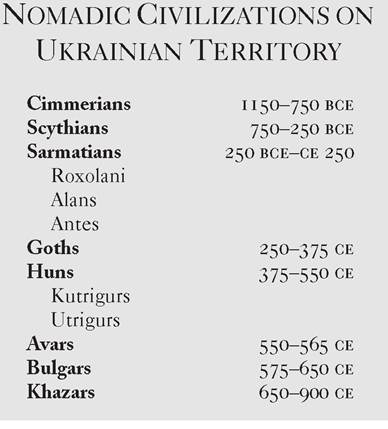
The few written sources from this early era give a general picture of an unending swarm of “barbaric” Asiatic peoples with strange-sounding names such as Cimmerians, Scythians, Sarmatians, Alans, Huns, Avars, Bulgars, and Khazars, who successively ruled the steppe hinterland before being driven out by the next nomadic invaders. Recent archaeological discoveries, especially during the twentieth century, have revealed that these nomadic peoples were neither as uncivilized nor as exclusively bent on destruction as the classical Greek and Romano-Byzantine writers made them out to be. In fact, the civilizations established by these nomads from the east were often directed to maintaining a stable environment that would allow their income from trade and commerce to increase.Before turning to the chronological evolution during these two millennia (1150 bce to ce 850), a few general caveats should be kept in mind. When considering the various nomadic groups and their invasions of the Ukrainian steppe, the reader may form the impression - and misconception - that the fierce warriors coming from Central Asia belonged to compact tribes each made up of a particular people. Moreover, it might seem that these nomads entered territory north of the Black Sea that was uninhabited, and that a particular tribe remained as the sole inhabitants until pushed out by another nomadic tribe, which, in turn, took their place and began the demographic cycle all over again. Such a scenario does not reflect what really occurred.
First of all, the Ukrainian steppe was never virgin uninhabited land into which nomadic hordes poured. Archaeological evidence has shown that the steppe and, for that matter, all Ukrainian territories were inhabited throughout the Stone Age, from its earliest (the Paleolithic, ca. 200,000-8000 bce) to its most recent (the Neolithic, ca. 5000-1800 bce) period. Stone Age settlements have been uncovered along the middle Dnieper River (the Kiev region and near the rapids of Zapo- rozhia) and the Middle Dniester River (near Bukovina); the oldest known site (about 1 million years old) is at Korolevo along the Tysa River in Transcarpathia.
The most important change during these hundreds of millennia occurred at the beginning of the Neolithic period (ca. 5000 bce), when the inhabitants of Ukraine, at least west of the Dnieper River, changed their means of livelihood from hunting and mobile food-gathering to the cultivation of cereals and the raising of livestock. This sedentary and agricultural way of life continued generally without interruption through the Neolithic period, which on Ukrainian territory largely coincides with the era of Trypillian culture (ca. 4500-2000 bce).Events during the late Neolithic or Copper Age were to upset the relatively stable and isolated existence of Trypillian sedentary communities in Ukraine. This change took place because during the second millennium bce, Ukrainian lands were exposed to the movement of peoples from central Europe, to the arrival of traders from the Aegean and Oriental lands, and, finally, to the disrupting invasions of steppe peoples from the east. Nonetheless, both before and during the period 1150 to 850 bce there were always fixed settlements throughout Ukrainian territory inhabited by people who derived their livelihood from agriculture and the raising of livestock and, secondarily, from hunting and fishing.
The other misconception about this period concerns the nomadic invaders. Despite the fact that authors from the Greek and Romano-Byzantine worlds gave names such as Cimmerians, Scythians, Sarmatians, and so on to these groups, none was ever composed of a culturally or ethnolinguistically unified people. Rather,
Trypillians and Ukrainians
Of all the archeological cultures in Ukraine, it is the Trypillian which has perhaps received the most attention by archeologists. More recently, and in particular since Ukraine gained its independence in 1991, the Trypillians have attracted the attention of popular writers and civic promoters who have used this pre-historic culture to propagate their own brand of modern Ukrainian patriotism.
The culture derives its name from a site uncovered in 1898 near the village of Trypillia, just southwest of Kiev, by the Czech archeologist active in Ukraine, Vikentii Khvoika (Chvojka). Subsequent archeological research determined the chronological and geographic extent of Trypillian culture. It lasted over two millennia from about 4500 to 2250 bce, and at its farthest extent covered, in modern-day terms, Ukraine west of the Dnieper River, most of Moldova, and Romania east of Carpathians. Western literature refers to the same phenomenon as the Cucuteni-Tripolye culture. Cucuteni, a village in present-day eastern Romania (near Ia§i) and the first site in the western portion of the Trypillian sphere, was discovered in 1884 and excavated during the first decade of the twentieth century by the German archeologist Hubert Schmidt. The greatest concentration of Trypillian sites have been found along the upper and middle Prut and Seret rivers (northeastern Romania and northern Moldova) and in Ukraine along the middle Dniester River (southeastern Galicia and western Podolia), the triangle between the middle Southern Buh (east of Vinnytsia) and Syniukha rivers, and the region surrounding Kiev.
Scholars point to three periods of the development of Trypillian culture, which are characterized by an increase in the size of population that practiced primitive agriculture and animal husbandry. It seems that the social structure was characterized by a matriarchal-clan order in which women were responsible for agricultural work, for the production of pottery and cloth, and for playing a leading role in social life.
In the early period, extended families shared a single dwelling, but later nuclear families had their own dwellings. The result was an enormous growth of large multi-roomed buildings as well as individual dwellings whose solid construction reflected a concern for maintaining good hygienic conditions. Concentrations of population could range from 500 to several thousand inhabitants.
During the middle and later periods, the Trypillians had large groundfloor workshops and they developed specialized manufactories for pottery and eventually for metal-working in copper. The most widespread artifacts that have come down to us are examples of ceramic pottery (with painted spiral and meander decorations of often high aesthetic quality) and small-scale stone figurines probably linked to an agrarian cult of fertility and prosperity.Since the 1990s several writers (and some professional archeologists) have elaborated further on the artifacts that date from the Neolithic period and that are connected with Trypillian culture. There is even a Kolo-Ra Society based in Kiev that organizes tourist visits and that carries out archeological research and projects for the reconstruction of Trypillian sites. The archeological finds connected with Trypillians are likened to those of pre-historic Troy and Mycenae. The Trypillian “people” are credited with creating a male-female egalitarian society, inventing the wheel, domesticating the horse, and producing highly advanced metallurgical products. Their large settlements, among the most extensive of which was Talianky near the upper Syniukha River (with 15,000 inhabitants living in 3,000 houses), are described as towns, or even proto-cities, with two-story apartment-like buildings larger than residences in the better-known ancient civilizations of Mesopotamia and Egypt.
An excess of enthusiasm has often gotten the better of those who are promoting the Trypillian “cause.” There are writers who are convinced of a direct connection between the Trypillians and modern Ukrainians and Ukraine. The archeologist Viktor Petrov is among the leading proponents of the view that Trypillians are the ancestors of ethnic Ukrainians. And even those skeptical of such claims seem willing to accept that the basic features of Trypillian culture are reflected in the way houses were built and decorated by ethnic Ukrainians in later times and in the symbology and designs still found in Ukrainian embroidery and on painted Easter eggs.
Some patriotic writers (lurii Kany- hin’s 1997 book Shliakh ariru/The Arian Way being the most widely read example) go further, arguing that the Trypillia zone coincides with the “state” of Arrata, mentioned in ancient Mesopotamian (Sumerian) records from the third millennium bce. Consequently, the earliest genealogy for modern Ukrainian statehood should begin not with ninth-century Kievan Rus’, nor even with the fourth-century Antaen tribal federation, but rather with the four- to five-thousand-year-old “state” of Arrata-Trypillia.these groups were made up of various nomadic tribes that were sometimes united under the leadership of one tribe that gave its name to (or had its name adopted by classical authors for) the entire group. The sedentary agricultural or pastoral settlers already living on Ukrainian lands were also subsumed under the name of the nomadic group that had come to rule over them. It is in this more complex sense that the names Scythian, Sarmatians, and Khazars must be understood.
The nomads of the steppe hinterland
The first of these nomadic civilizations on Ukrainian territory about which there is information, albeit limited, was the Cimmerian. The Cimmerians seem to have been an Indo-European group that came to dominate Ukrainian lands north of the Black Sea between 1150 and 950 все, a period that coincides with the late Bronze Age. Most of what we know about the enigmatic Cimmerians comes from archaeological finds consisting of bronze implements and the remains of bronze
foundries. The Cimmerian era lasted on Ukrainian territory about four centuries, and it is only from the last two of these centuries (900-750 все) that there exist archaeological remains, of bronze implements and weapons, along the lower Dnieper River near Nikopol’ (the Mykhailivka treasure) and from the region just south of Kiev (the Pidhirtsi treasure).
Around the middle of the eighth century (750 все), the Cimmerian era came to end. The Cimmerian leadership seems to have fled westward (across the Carpathians to Pannonia) and southward (to the Crimea and on to Thrace and Asia Minor) in the face of a new invasion of nomads from the east - the Scythians. The Scythians were known in the classical world for their fierceness as warriors, but this one-sided image has been tempered by archaeological discoveries which have unearthed numerous examples of finely wrought sculpture, ornamentation, and jewellery, primarily in gold. The Scythians actually formed a branch of the Iranian people - more specifically, that branch which remained in the so-called original Iranian country east of the Caspian Sea (present-day Turkestan), as distinct from their Medean and Persian tribal relatives, who established a sedentary civilization farther south on the plateaus of Iran.
Between 750 and 700 все, the Scythians moved westward toward Ukraine, and eventually they settled for the most part first in the Kuban Region and Taman Peninsula (700-550 все) and later along the Dnieper River in south-central Ukraine (550-450 все), where their civilization reached its peak between 350 and 250 все. Classical sources tell us that Scythian society was composed of four groups: royalty, notables (steppe nomads), agriculturalists (georgoi), and ploughmen (aroteres). Actually, only the first two groups - the royalty and notables - were made up of migrants from the east. This ruling elite, of nomadic origin and way of life, dominated the sedentary agriculturalists living under their control and the residents of the cities. Both these groups, together with their rulers, were known to the outside world as “Scythians.”
The mention of cities may seem confusing, since this discussion of the steppe hinterland has focused so far on nomads and the sedentary agricultural dwellers under their control. In fact, it seems that the Scythian ruling elite - the royalty and their notables - virtually lived on horseback, roaming the steppes while hunting for food or engaging in war with neighboring tribes. One might speak, however, of mobile Scythian cities, that is, huge caravans of tribes which moved from one place to another. Nonetheless, there were a few cities - or, more properly, fortified centers with permanent settlers engaged in activity other than agriculture - within the Scythian sphere. These were so-called Oriental-type cities, owned by Scythian royalty and notables and inhabited by remnants of the Cimmerians and other peoples, who paid tribute to their Scythian overlords. Among the more important Scythian hill-forts (horodyshche) were Kam’ianka on the lower Dnieper River, Bil’s’k (Gelonos/Helon) in the far northeast, and the later capital of Scythia Minor, Neapolis, in the Crimea.
The Greeks of the coastal region
The few Scythian settlements were in no way as important as the Greek trading cities along the shores of the Black Sea and Sea of Azov. Not long after the Scythians began to enter Ukraine from the east, in the eighth century bce, colonists fleeing civil strife in Greece arrived from the south, especially from Miletus, in Asia Minor. As a result, between the seventh and fifth centuries bce several prosperous Greek cities came into being along the shores of the Black Sea, the Straits of Kerch, and the Sea of Azov. Among the first to be established were Tiras at the mouth of the Dniester River and Olbia at the mouth of the Southern Buh, then Chersonesus at the southwestern tip of the Crimean Peninsula and Theodosia farther east on the Crimean Peninsula, and Panticapaeum (Bospor) and Phanagoria on the west and east banks respectively of the Straits of Kerch.
The Greek homeland along both shores of the Aegean Sea was composed of individual city-states, each of which jealously guarded its independence. By the fifth century bce, however, they had come to form a united civilization whose achievements set a standard for culture in the civilized world that was to outlast the city-states themselves. Like the Aegean homeland, the Greek colonies along the northern Black Sea coast at least initially remained independent of each other, though they were economically and politically dependent on the city-state which founded them - generally either Miletus, along the Aegean coast in Asia Minor, or Megara, just west of Athens. There were also periods when the Black Sea colonies were completely independent, or when they united into federations or states.
The most important instance of a federation came into being about 480 bce, when the Greek cities near the Straits of Kerch began to unite under the leadership of Panticapaeum in what became known as the Bosporan Kingdom. The Bosporan Kingdom became independent of the Greek homeland, and under its
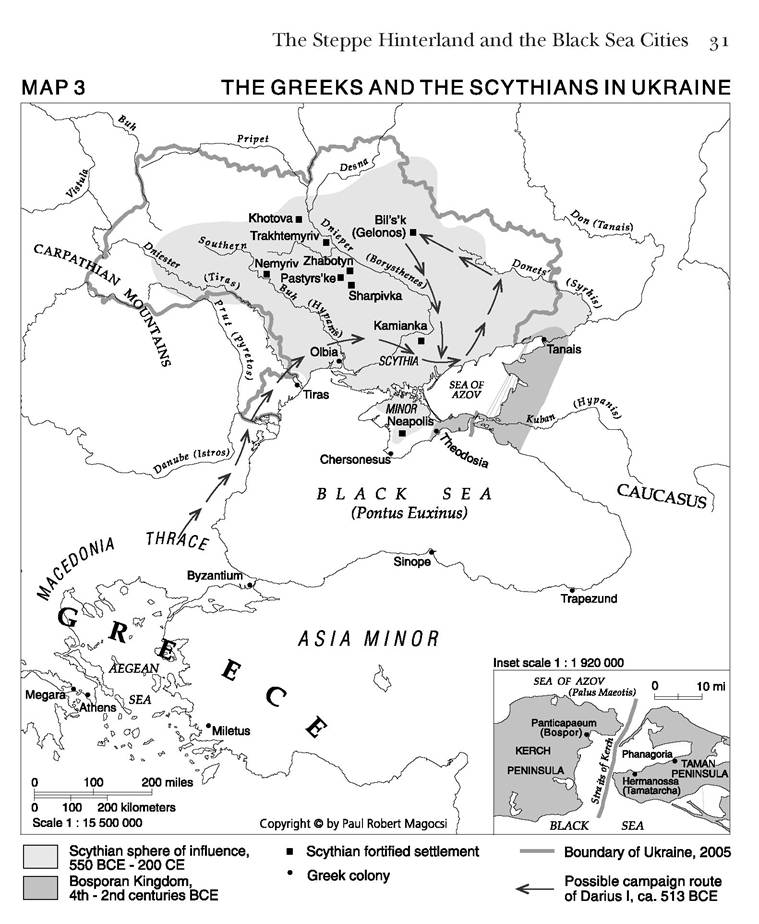
dynamic king Levkon I (reigned ca. 389-348 все) came to control all of the Kerch and Taman Peninsulas as well as the eastern shore of the Sea of Azov as far as the mouth of the Don River, where the city of Tanais was established (ca. 375 все) The Bosporan Kingdom included not only Greek cities, but also the regions around the Sea of Azov inhabited by Scythians and related tribes. Until the second century все, the kingdom flourished as a center of grain trade, fishing, wine-making, and small-scale artisan craftsmanship, especially metalworking. The following century was to witness a period of political instability and the consequent loss of Bosporan independence. Finally, in 63 все, the Bosporan Kingdom together with other Hellenic states around the Black Sea came under the control of the Roman Empire.
The Pax Scythica, the Sarmatians, and the Pax Romana
During the nearly five centuries from 700 to 250 bce, the Greek cities along the Black Sea littoral, in the southern Crimean Peninsula, and in the Bosporan Kingdom all developed a kind of symbiotic relationship with the Scythian hinterland. By about 250 bce, the center of Scythian power had come to be based in the region known as Scythia Minor (Mala Skifiia), between the lower Dnieper River and the Black Sea, as well as in the northern portion of the Crimean Peninsula (beyond the mountains), where the fortified center of Neapolis was located. The symbiotic relationship had three elements: (1) the Scythian-controlled Ukrainian steppe, (2) the Black Sea Greek cities, and (3) the Greek city-states along the Aegean Sea.
Bread and fish were the staples of ancient Greece, and the increasing demand for these foodstuffs was met by markets in the Black Sea Greek cities. These and other food products came from Ukrainian lands, which already in ancient times had a reputation for natural wealth. In the fourth book of his History, the Greek historian Herodotus, who had lived for a while in Olbia, wrote the following description of the Dnieper River, or, as he called it, “the fourth of the Scythian rivers, the Borysthenes”: “It has upon its banks the loveliest and most excellent pasturages for cattle; it contains an abundance of the most delicious fish;.. the richest harvests spring up along its course, and where the ground is not sown, the heaviest crops of grass; while salt forms in great plenty about its mouth without human aid.”1 In this region, the Scythians exacted grain and fish from the sedentary populations under their control and traded these commodities in the Greek coastal cities along with cattle, hides, furs, wax, honey, and slaves. These products were then processed and sent to Greece. In turn, the Scythians bought from the Greeks textiles, wines, olive oil, art works, and other luxury items to satisfy their taste for opulence.
As a result of these economic interrelations, the Greeks brought to the world the earliest and still the primary information about the Scythians. Herodotus, in particular, left a detailed description of the geography, way of life, and often cruel customs of the Scythians and of the lands under their control. The other source of information about the Scythians, which corroborates much of what Herodotus wrote, concerns their numerous royal burial mounds, spread throughout southcentral Ukraine and uncovered in the course of excavations that have been going on systematically since the late nineteenth century. These burial mounds (known as kurhany, or barrows) have preserved for posterity that for which the Scythians are most famous: their small-scale decorative art, which consisted primarily of finely balanced renderings of a host of animal forms in gold and bronze.
It is not certain whether this art was produced by the Scythians for themselves, or, more likely, commissioned from Greek artisans living in the cities. Nevertheless, its themes reflect the violent world inhabited by Scythians, and its forms show the high level of technology their civilization was able to foster and appreciate. Also associated with the Scythian and subsequent Sarmatian eras are more modest grave-markers, which took the form of stone statues of standing or sitting females ranging from one to four meters (three to twelve feet) in height. Hundreds of these stone statues, popularly known as skifs’ki baby (Scythian older women), have
Scythian Customs
Among the various customs practiced by the Scythians, those associated with their reputation as fierce warriors made an especially strong impression on the classical Greek world. In the fourth book of his History, Herodotus writes:
The Scythian soldier drinks the blood of the first man he overthrows in battle. Whatever number he slays, he cuts off all their heads, and carries them to the king; since he is thus entitled to a share of the booty, whereto he forfeits all claim if he does not produce a head. In order to strip the skull of its covering, he makes a cut round the head above the ears, and, laying hold of the scalp, shakes the skull out; then with the rib of an ox he scrapes the scalp clean of flesh, and softening it by rubbing between the hands, uses it thenceforth as a napkin. The Scythian is proud of these scalps, and hangs them from his bridle-rein; the greater the number of such napkins that a man can show, the more highly is he esteemed among them. Many make themselves cloaks, like the capotes of our peasants, by sewing a quantity of these scalps together. Others flay the right arms of their dead enemies, and make of the skin, which is stripped off with the nails hanging to it, a covering for their quivers. Now the skin of a man is thick and glossy, and would in whiteness surpass almost all other hides. Some even flay the entire body of their enemy, and stretching it upon a frame carry it about with them wherever they ride.
The skulls of their enemies, not indeed of all, but of those whom they most detest, they treat as follows. Having sawn off the portion below the eyebrows, and cleaned out the inside, they cover the outside with leather. When a man is poor, this is all that he does; but if he is rich, he also lines the inside with gold: in either case the skull is used as a drinking-cup. They do the same with the skulls of their own kith and kin if they have been at feud with them, and have vanquished them in the presence of the king. When strangers whom they deem of any account come to visit them, these skulls are handed round, and the host tells how that these were his relations who made war upon him, and how that he got the better of them; all this being looked upon as proof of bravery.
source: Herodotus, The History, translated by George Rawlinson, Great Books of the Western World, Vol. VI (Chicago, London, and Toronto 1952), pp. 134-135.
been uncovered throughout the southern Ukrainian steppe from the Dniester River eastward to the Donets’ and well beyond.
The Scythians brought a period of peace and stability to Ukrainian territories which lasted for about 500 years and which has come to be known as the Pax Scythica, or Scythian Order. During the Pax Scythica, the Scythians promoted trade and commerce with the Greek cities along the Black Sea, which in turn supplied Greece with needed foodstuffs and raw materials. The Scythians also successfully fought off other nomadic peoples from the east, and they even defeated the powerful king of ancient Persia Darius I (“the Great,” reigned 522-486 bce). After adding Thrace to his realm, Darius launched a campaign northward against the Scythians in an attempt persianize their land, which he considered to be “outer Iran” and part of his own patrimony. His efforts against the Scythians were unsuccessful, but the incursion of Darius, which began in 513 bce and which covered most of the Black Sea steppe and area east of the Dnieper River as far as Gelonos/ Helon (perhaps Bil’s’k) became the first major historical event involving Ukrainian territory recorded in written documents.
It would be some time before long-term stability like that created by the Pax Scythica was reestablished in Ukraine. Around 250 bce, nomads related to the Scythians and known as Sarmatians appeared in the Ukrainian steppe. The Sarmatians were typical of the civilizations under discussion in that they were not a homogeneous people, but rather made up of several tribes, each of which led an independent existence. Those most directly associated with developments in Ukraine were the Roxolani and, in particular, the Alans.
At least during the first two centuries of the Sarmatian presence, that is, from 250 to 50 bce, the relative stability and resultant economic prosperity that had previously existed between the Scythian hinterland and the Greek cities of the coast was disrupted. Pressed by the Sarmatians in the steppe, the Scythian leaders fled to the Crimea, where they were forced to consolidate their rule over a smaller region that included the Crimean Peninsula north of the mountains and the lands just to the north between the peninsula and the lower Dnieper River. This new political entity, which, with its capital at Neapolis (modern-day Simferopol’), was known as Scythia Minor (Mala Skifiia), lasted from about 250 bce to 200 ce. Initially, the Scythian leadership in Neapolis tried to continue its traditional practice of exacting tribute and goods from the Greeks. But because they no longer controlled the resources of the steppes, they had little to give the Greeks in return. The result was frequent conflict between the Scythians of the Crimea and the Greek cities along the coast and in the Bosporan Kingdom.
This era of instability, which affected not only the Sarmatian-controlled hinterland but also the Black Sea cities, came to an end along the coastal region after 63 bce. Beginning in that year, the Roman Empire succeeded in extending its sphere of influence over the independent Greek cities as well as over those within the Bosporan Kingdom. With the presence of Roman legions and administrators in the region, peace and stability were restored. The new Pax Romana reduced the friction between the Scythians and the Greeks in the Crimea, and the Sarmatian tribes in the hinterland also realized the advantages to be accrued from some kind of cooperation with the Roman world. Reacting to the stabilizing presence of the Romans, one Sarmatian tribe, the Alans, renewed the Scythian tradition of trade with the Greco-Roman cities. Before long, a Greek-Scythian-Sarmatian hybrid civilization evolved within the Bosporan Kingdom, which itself was revived, this time under the protection of Rome. The resultant trade and commerce between the steppe hinterland and the Mediterranean world brought a renewed prosperity to the Bosporan Kingdom that lasted for over two centuries.
The third century ce, however, ushered in a new era of instability, especially in the steppe hinterland, that was to last until the seventh century. During these four centuries, Ukrainian territory was subjected to the invasions of several new nomadic warrior tribes who were bent on destruction and plunder of the classical world as represented by the Black Sea and Bosporan coastal cities. With few exceptions, the nomads were not interested - as the Scythians and even the Sarmatians had been before them - in settling down and exploiting by peaceful means the symbiotic relationship of the steppe hinterland and coastal cities. Between about 250 and 650 ce, several nomadic groups - the Goths, Huns, Kutrigurs, Utrigurs, Avars, Bulgars - came and went across parts of Ukrainian territory. It was not until the arrival of the Khazars in the seventh century that stability was restored north of the Black Sea.
The four centuries of strife between 250 and 650 ce began not with the arrival of nomads from Central Asia, but rather with the arrival in the mid-third century of Alans from the region just north of the Caucasus, and Germanic tribes known as Goths from northern Europe. The Alans were a Sarmatian tribal group who moved into the Crimea. There they settled both in the mountainous region, where they were among the first inhabitants in the hilltop town of Kirk Yer (later Qufut- Kale), as well as along the Black Sea coast, where they are considered by some scholars to have founded in 212 ce the town of Sugdeia (today’s Sudak). They engaged in agriculture, cattle-breeding, and handicrafts. After arriving in the Crimea the Alans adopted Christianity; this was one of the reasons they were able to assimilate easily with other Christian inhabitants, resulting within a few centuries in their disappearance as a distinct people in the peninsula.
The Goths were originally from what is today Sweden, but about 50 bce they moved to the southern shores of the Baltic Sea (i.e., modern day Poland). It was from there that toward the end of the second century ce they moved south into Ukraine, where they broke the Sarmatian dominance of the steppe hinterland and came into contact with the Roman world along the northern shores of the Black Sea. The Goths had by this time split into two branches. Those that remained in Ukraine becoming known as Ostrogoths, or East Goths. After 250 ce, they captured Olbia and Tiras from the Romans, with the result that during the following century the remaining Greco-Roman cities as well as the Bosporan Kingdom were drawn, together with the steppe hinterland, into the sphere of the Ostrogothic Kingdom.
Ostrogothic rule in southern Ukraine and the Crimea reached its apogee under King Ermanaric (reigned 350-375). It was toward the end of Ermanaric’s reign, ca. 370, that a new nomadic people, this time from Central Asia, arrived in the steppes of Ukraine. These were the Huns, who easily subjected the Ostrogoths and for about a century dominated the entire steppe region from Central Asia to the heart of Europe. Under their talented leader Attila, the Huns moved westward, and from their base in the plains of Pannonia (modern-day Hungary) they attacked in the 430s and 440s various cities in the Roman Empire, including Constantinople and Rome. After their defeat and the death of Attila in 453, the “Hunnic empire” rapidly disintegrated. Some of the Huns remained in Pannonia as did most of the Ostrogoths whom they had brought with them. Other Hunnic tribes returned to the steppes of Ukraine, including the Utrigurs who made their new home the steppeland in the northern Crimea. Those Ostrogoths who were not taken by the Huns westward to Pannonia remained in the Crimea, where they were concentrated in the mountainous back country away from the coast.
The Crimean Goths, as they came to be known, were anxious to maintain good relations with the Eastern Roman, or Byzantine Empire, represented by officials in its administrative and trading center at the port city of Chersonesus in the far southwestern corner of the Crimean peninsula. To assure that their allies could protect the coastal regions from further nomadic attacks out of the north, Byzantine engineers assisted the Crimean Goths and Alans in fortifying several “cave towns’ on the top of mountain cliffs and promontories, which in some cases rose up to 200 meters (600 feet) above the surrounding valleys. Despite the popular designation given to them, the inhabitants of these naturally fortified sites did not live in caves but rather in structures built from wood and stone on the top of the caves (usually used for storage or as a part of the defense system) and along the table-top promontories that in some cases covered tens of acres of territory. It was only somewhat later that true cave dwellings came into being in the form of monasteries built by Orthodox Christian monks along the sheer faces of mountain cliffs. Among the largest of the hill-top “cave towns” were Mangup, Kirk Yer, and Eski Kermen located in the back country east of Chersonesus; the best known cavemonasteries were at Kayi-Kalyon, Kalamita/Inkerman and the Dormition monastery (still functioning) near Bakhchysarai. The Crimean Gothic center was a place called Doros/Dory, most likely at what later became known as Mangup, located about halfway between Chersonesus and the Scythian center at Neapolis.
In the course of the fourth century, the Ostrogoths accepted Christianity according to the Eastern Byzantine rite, although they adopted the teaching of Arius (who denied Christ’s divinity in favor of his humanity). The Goths of Crimea were to remain Arians even after that sect was declared heretical. More important was the fact that the Christian connection cemented Crimean Gothic relations with the Byzantine Empire. By the outset of the fifth century (ca. 400 ce), their center of Doros was made the seat of the Eparchy of Gothia. Gothia’s first bishop was appointed by the Patriarch of Constantinople, who at the time was the influential church father, St John Chrysostom. The Crimean Goths had, therefore, become part of the Byzantine political and cultural sphere, and for the next five centuries they functioned as a protective shield for the Greco-Byzantine cities along the coast against further invasions by nomads from the north.
Meanwhile, the Ukrainian steppe hinterland north of the Crimean peninsula and Black Sea continued to be subjected to a series of invaders: the Hunnic Kutrigurs and Utrigurs in the fifth century, the Avars in the sixth century, and the Bulgars in the seventh century. More often than not, the presence of these groups in steppe Ukraine was short-lived. This was because they were in search of the richer sources of booty to be found along the borders of the Roman Empire in central Europe (the Pannonian Plain) or along the trade routes between the Black and Caspian Seas. During periods when one nomadic group had departed and another had not yet arrived, the power vacuum was sometimes filled by the local population. One such case was that of the Antae, a tribe of Sarmatian (Alanic) and possibly Gothic elements which by the third century had organized the sedentary agricultural population of south-central and southwestern Ukraine into a powerful military force that stood up to the Goths, the Byzantine Empire, and the Huns.
Because this sedentary population, which the Antae led and to which they gave their name, was probably composed of Slavs, the group is of particular interest with respect to subsequent developments in Ukraine (see chapter 4).
The Byzantines and the Khazars
While the Ukrainian steppe and hinterland were experiencing frequent disruptions between 250 and 650 ce, the coastal region along the Black Sea and Sea of Azov was undergoing another revival. This time the stabilizing factor was the Eastern Roman, or Byzantine Empire, which reached its greatest territorial extent and political influence during the sixth-century reign of Emperor Justinian (reigned 527-565). Under Justinian, the Black Sea coastal cities received Byzantine garrisons, their walls were fortified, and Chersonesus became the region’s Byzantine administrative center. Byzantine Greek culture in the form of Eastern Christianity also was strengthened, with the result that Chersonesus, with its ten churches and chapels (including St Peter’s basilica) and a fortress and monastery built in caves in the face of cliffs at nearby Kalamita (today Inkerman), was to become an important center from which Christian influence was subsequently to radiate throughout Ukrainian territory and among the East Slavs. Byzantine influence was also strong at the eastern end of the Crimea, where the Bosporan Kingdom was revived, this time as a colony of Byzantium.
While it is true that direct Byzantine political control over the Crimean cities and the Bosporan Kingdom was frequently interrupted, economic, social, and cultural ties in the form of Byzantine Orthodox Christianity were to last until at least the thirteenth century. It was during the era of Roman and Byzantine control of the Bosporan Kingdom, moreover, that Hellenic Jews settled in the region’s coastal cities. And it is from these cities that Jewish contacts across the Straits of Kerch were, by the seventh century, to reach the realm of the Khazars, a new nomadic civilization that was beginning to make its presence felt.
Not long after the rise of Byzantine influence along the coast, which began in earnest during the late sixth century, a group of nomads arrived from the east whose presence was to have a profound impact on the region both north and east of the Black Sea. These were the Khazars, a Turkic group who originally inhabited the westernmost part of the Inner Asian Turk Empire. Unlike most of their predecessors during the preceding three centuries, the Khazars preferred diplomacy to war. Soon after their arrival along the Black Sea, they signed a treaty (626) with the Byzantine Empire. The Byzantines, ever anxious about their own eastern frontier with the Persians and about potential invaders from the east who might threaten their Black Sea possessions, welcomed the seeming willingness of the Khazars to fit into the plans of Byzantium’s northern diplomacy.
The appearance of the Khazars in the seventh century proved to be of great significance for developments in eastern Europe in general and in Ukraine in particular. The Khazars continued the tradition established by the Scythians (750250 все) and continued by the Sarmatians (50 все to ce 250) whereby nomads from the east would gain control over the sedentary population of the steppe hin-
terland, keep in line recalcitrant nomadic tribes, protect trade routes, and foster commercial contacts with the Greco-Roman-Byzantine cities along the Black Sea coast. The age-old symbiotic relationship between the coast and the steppe hinterland was to be restored under the hegemony of the Khazars. The resultant Khazar Order, or Pax Chazarica, which lasted approximately from the mid-seventh to the mid-ninth century, did in fact cushion Ukrainian lands from further nomadic invasions from the steppes of Central Asia in the east as well as from incursions by the Persians and, later, the Arabs from the south. Because of the Khazars’ role in protecting the eastern and southern frontiers of the European continent, some writers have compared them to Charles Martel and the Franks in western Europe. The Pax Chazarica also provided at least two centuries of peace and stability during which sedentary peoples living within the Khazar sphere of influence were allowed to develop. Among those peoples, within and just beyond the northwestern edge of the Khazar sphere, were the Slavs.