20 Ukrainian Lands During the Period of Ruin, 1657-1686
In his efforts to force the Polish-Lithuanian Commonwealth to make structural changes that would accord a special place for the Cossacks, Bohdan Khmelnyts’kyi hoped to form a grand coalition of foreign powers that would include Orthodox Muscovy and Moldavia, the Moslem Ottoman Empire and Crimean Khanate, and Protestant Transylvania together with certain Lithuanian Protestant princes.
In the end, no effective foreign coalition came into being, and the only long lasting result of Khmelnyts’kyi’s foreign ventures was an alliance with the Tsardom of Muscovy.Soon after his two victories over Poland-Lithuania’s armies in May 1648, Khmel’nyts’kyi, following the urging of Orthodox Church prelates, sought an alliance with Muscovy. It was another five years, however, before Muscovy’s Tsar Aleksei (r. 1645-1676) felt confident enough to take under his rule Polish subjects, the Cossacks of Ukraine. In Muscovy as in Ukraine, the Orthodox Church proved to be a crucial factor in Cossack-Muscovite political negotiations. In fact, it was the new Orthodox Patriarch of Moscow, Nikon (r. 1652-1681), who was most instrumental in urging the tsar to accept Khmelnyts’kyi’s entreaties. Finally, in 1654, the first stage in a series of negotiations was completed; these collectively came to be known as the Agreement of Pereiaslav.
According to the Pereiaslav accords, Khmel’nyts’kyi’s Cossack state, together with Zaporozhia, accepted the suzerainty of the Moscovite tsar. At the same time the tsar recognized certain traditional Cossack privileges and, considering himself absolute ruler of these new territories, changed his title to read: Tsar of All Great and Little [Ukrainian] Rus’. A second stage in the incorporation of the Orthodox Rus’ population of Poland-Lithuania under Muscovite control came two years later. In 1656, following a successful military incursion into the Belarusan-inhabited lands of Lithuania as well as a peasant uprising, the tsar amended his title once again, this time to read: Tsar of All Great and Little and White [Belarusan] Rus’.

20.1 Khmel’nyts’kyi meeting Muscovy’s envoys in the presence of Orthodox prelates at Pereiaslav, as depicted in a 19th-century line-drawing.
MAP 20 UKRAINIAN LANDS AFTER 1667

Not unexpectedly, the Pereiaslav Agreement led to immediate military conflict between Poland-Lithuania and Muscovy. And such developments could not have come at a worse time for Poland, which in 1655 was invaded from the north by Sweden and from the west by Brandenburg. From that time until 1686 much of Poland-Lithuania and Cossack Ukraine witnessed an almost complete breakdown of order. It is for this reason that these years are characterized in Polish history as the Deluge (Potop, 1655-1661) and in Ukrainian history as the Period of Ruin (Ruina, 1657-1686).

20.2 The 1654 decree (gramota) of the Tsar Aleksei of Muscovy acknowledging the Cossack oath of allegiance at Pereiaslav.
From the very outset Khmel’nyts’kyi and his Cossack successors viewed Pereiaslav as a voluntary political agreement open to further negotiation, whereas the Muscovite tsar viewed Pereiaslav as an act of subordination and for all intents and purposes territorial annexation. Despite such conflicting perceptions, until his death in 1657 Khmelnyts’kyi continued to follow an independent foreign policy that at times complemented and at times contradicted Muscovite interests. Some hetmans who came after Khmelnyts’kyi (especially Ivan Vyhovs’kyi and Petro Doroshenko) even tried to reach a political accommodation with Muscovy’s enemies, either Poland or the Ottoman Empire.

20.3 Ivan Vyhovs’kyi (d. 1664) Khmel’nyts’kyi’s immediate successor as hetman from 1657 to 1659, who favored creating a Cossack-based Rus’ state within Poland.
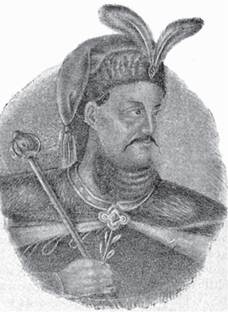
20.4 Petro Doroshenko (1627-1698), hetman of the Right Bank from 1665 to 1676, who favored a Cossack state under the protection of the Ottoman Empire.
The seemingly contradictory policies of Ukraine’s leaders reflected long-standing divisions within Cossack society. The Zaporozhian Cossacks had always distrusted the registered Cossacks and their officer elite (starshyna) that formed the backbone of Khmel’nyts’kyi’s state. Whereas Khmel’nyts’kyi himself had gained the respect of both factions, after his death the divisions were exacerbated. The Zaporozhian Cossacks and their peasant supporters remained loyal to Muscovy’s Orthodox tsar, while the hetman and starshyna elite in the Cossack state sought alliances with whatever power—Muscovy, Poland, or the Ottoman Empire—that seemed willing and able to provide them with the most advantageous political and social status.
In the wake of a large-scale Muscovite invasion and the defeat of its army by a combined Polish-Cossack force at Konotop in July 1659 (see Map 18), the relationship between Muscovy and Poland reached a stalemate. The Cossack hetmans tried to maintain the territorial integrity of their state, but in practice it became divided more or less along the Dnieper River. The western Right Bank of the Dnieper became part of a Polish sphere of influence, the eastern Left Bank, including the city of Kiev and surrounding area as well as Zaporozhia farther south, fell under the Muscovite sphere. This division was formally confirmed in a treaty signed at Andrusovo in 1667 and renewed in 1682. Although the original treaty stipulated that Kiev and its surrounding area would be placed under Muscovite suzerainty for only two years, this time period was subsequently extended until it became permanent.
According to the territorial division outlined at Andrusovo, the Cossacks now had two “states” and two hetmans, one for the Polish Right Bank and one for the Muscovite Left Bank.
On occasion the rival hetmans led Cossack armies that fought against each other in the ranks of their respective sovereigns; on other occasions, one hetman may have tried to unite both halves of the Cossack state with the help of the Ottoman Empire. In 1672, after being drawn into Cossack politics, the Ottomans defeated the Poles and annexed a large part of the Right Bank, including the Bratslav, Podolia, and southern Kiev palatinates.
20.5 Saint Dymytrii Tuptalo (1651-1709), theologian and from 1702 until his death metropolitan of Rostov.
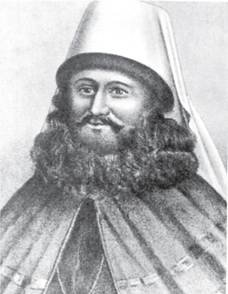
20.6 Stefan Iavors’kyi (1658-1722), theologian, poet, philosopher, from 1701 exarch in Moscow of the Russian Orthodox Church, and from 1721 president of the newly-established Holy Synod.
Despite its territorial losses to the Ottomans, by the 1680s Poland-Lithuania had regained its strength. The commonwealth was ruled at the time by Jan III Sobieski (r.1674-1696), who was renowned throughout Europe as a great military commander. As part of his plans for a general anti-Ottoman coalition in alliance with central Europe’s Christian powers, Sobieski decided first to secure his eastern flank by reaching a new agreement with the tsar of Muscovy. In 1686 both rulers made permanent what had been agreed at Andrusovo nearly two decades before. According to the socalled Eternal Peace of 1686, Poland renounced all claims to the Left Bank Ukraine as well as to Kiev and other contested cities farther north (such as Starodub and Smolensk). Poland also recognized Muscovite suzerainty over the Cossacks of Zaporozhia. Consequently, as the Period of Ruin came to an end, Khmelnyts’kyi’s Cossack state was split into two parts, and Ukrainian lands as a whole were divided between Muscovy, Poland, and the Ottoman Empire, with the southern steppe and Crimea continuing to be part of the Crimean Khanate.
During the first decades of the seventeenth century, significant changes took place in those Ukrainian lands that had recently become part of Muscovy. Of particular importance for the long term was the fact that these lands, while still retaining a significant degree of political autonomy, were at the same time becoming increasingly integrated with the rest of the Tsardom of Muscovy in terms of cultural developments and the church. The Orthodox Church in western Rus’ (present-day Ukraine and Belarus) was under the jurisdiction of the ecumenical patriarch of Constantinople. After 1686, however, the most important hierarch in the region, the metropolitan of Kiev, was consecrated in Moscow. This meant in effect that from now on the Orthodox Church in Ukraine and Belarus (including parts of those territories still within Poland-Lithuania) became part of the Russian Orthodox Church headed by its patriarch in Moscow.

20.7 Teofan Prokopovych (1681-1736), theologian and writer, from 1720 archbishop of Pskov, then Novgorod, and from 1721 vice-president of the Holy Synod of the Russian Orthodox Church.
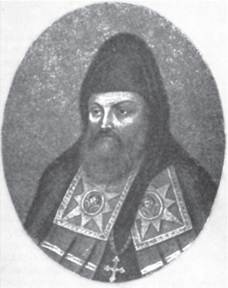
20.8 Innokentii Gizel (1600-1683), philosopher and from 1656 until his death archimandrite of the Kievan Cave Monastery.
Adapting to the new jurisdictional situation, from the last decades of the seventeenth century several distinguished churchmen and scholars connected with Kievan Academy—Dymytryi Tuptalo, Stefan Iavors’kyi, and Teofan Prokopovych among others—moved north, where they took up leading positions in the Russian Orthodox Church and the cultural life of Muscovy. In fact, it was another churchman and scholar from the Kievan Academy, Innokentii Gizel (a German Protestant from Prussia who converted to Orthodoxy), who was particularly instrumental in helping to raise the prestige of the Tsardom of Muscovy. To Gizel is attributed the text of the Sinopsis (1674), an extremely influential history textbook used in Muscovite and Russian imperial schools for nearly two centuries, which presented Muscovy as the successor state of Kievan Rus’. In other words, it was scholars and Orthodox churchmen from Ukraine who formulated and propagated the view that Muscovy was justified in carrying out a political policy aimed at acquiring all lands that had once been part of medieval Kievan Rus’.

20.9 Title page of the 1674 edition of the Sinopsis, history textbook reprinted another 29 times until 1836.