21 Mazepa and the Cossack Hetmanate
Within a year of the signing of the 1686 Eternal Peace between Muscovy and Poland, Cossack Ukraine entered a period of relative stability that was to last at least until the outset of the eighteenth century.
The changes associated with this period were in large measure the result of policies adopted by the new hetman of Left Bank Ukraine, Ivan Mazepa (r. 1687-1708), whose success was dependent on the very favorable relations he maintained with the Cossack state’s ultimate sovereign, Tsar Peter I (r. 1689-1725) of Muscovy.Next to Khmel’nyts’kyi, Ivan Mazepa was the most influential of all Ukraine’s Cossack leaders. Mazepa’s early career reflected the rapidly changing political climate during the Period of Ruin. He began in the service of the Polish king, then served the Poland’s Right Bank hetman who eventually allied with the Ottomans, and finally he allied himself with Muscovy, which arranged in 1687 to have him appointed hetman of the Cossack state in the Left Bank of the Dnieper River, which was now known as the Hetmanate.
The first thirteen years of Mazepa’s rule from 1687 to 1700 were marked by social stability, some economic growth, and extensive support for cultural activity, including the construction or reconstruction of several Orthodox churches and monastery complexes in a style that came to be known as the Ukrainian Cossack Baroque. The only real problem during this first stage of Mazepa’s hetmancy was that posed by the Zaporozhian Cossacks, who on several occasions revolted against him. Nonetheless, the hetman was backed by his Muscovite sovereign and protector, Tsar Peter I, and was therefore able to withstand the Zaporozhian revolts and all other attempts to unseat him.

21.1 Ivan Mazepa (ca. 1640-1709), hetman of Ukraine from 1687 to 1709.
MAP 21 UKRAINE, circa 1740

The situation began to change with the outbreak of the Great Northern War in 1700. Sweden had not yet given up its interests in controlling all the lands around the Baltic Sea. Under their dynamic young king, Charles XII (r. 1697-1718), the Swedes launched a successful attack against Muscovy and then invaded Poland, capturing its capital Warsaw in 1702. Muscovy came to the aid of its former rival, Poland, and Tsar Peter I impressed Mazepa and his Left Bank Cossack forces to assist in these operations. Mazepa served loyally in Muscovy’s Polish campaigns against Sweden and he brought much of Right Bank Ukraine under Cossack control for a few years (1705-1706). But the costs in men and materiel were mounting, and Cossack discontent with Muscovite policies continued to increase.

21.2 The 11th-century St. Sophia Cathedral in Kiev, refashioned between 1609 and 1707 in the Ukrainian Cossack Baroque style.
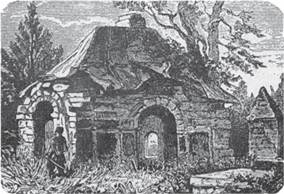
21.3 The remains of Mazepa’s residence in Baturyn following the attack by Muscovite forces.
In early 1708 Sweden’s Charles XII launched a major invasion toward Moscow, but in the summer of that year he suddenly turned south toward Ukraine. Instead of joining Muscovite forces in a counter-attack, Mazepa, with less than four thousand Cossacks, defected to the Swedes. Expecting that Sweden would be the dominant power throughout all of eastern Europe, Mazepa extracted from Charles XII guarantees for the creation of an independent Cossack state in both Left Bank and Right Bank Ukraine. Tsar Peter I was shocked by Mazepa’s “treacherous” act and he responded by dispatching Muscovite troops against the Hetmanate, destroying its capital Baturyn and executing hundreds of Cossack officers suspected of treason.
When in the spring of 1709 the Zaporozhian Cossacks unexpectedly defected to the Swedes, Peter I retaliated by attacking their stronghold, the Stara Sich, and destroying it.Mazepa’s confidence in Sweden’s power proved to be misplaced. On July 8, 1709 the Swedish forces led by Charles XII himself together with Mazepa and the Zaporozhian Cossacks were soundly defeated by the Muscovite army and its Cossack allies in the very heart of Hetmanate at the Battle of Poltava. The Swedish king managed to escape as did Mazepa, who died a few months later in exile under Ottoman protection. Despite Poltava, the Great Northern War was to continue for another decade until 1721, after which Sweden gave up permanently its interests in eastern Europe. Symbolic of the dominant place now assured to Muscovy in the region was the fact that in that very same year Peter I proclaimed himself emperor of what was henceforth known as the Russian Empire.

21.4 A triumphant Tsar Peter I at the Battle of Poltava, one of the greatest military turning points in European history, which took place on July 28, 1709 near that city in Left Bank Ukraine, as depicted in a contemporary engraving.
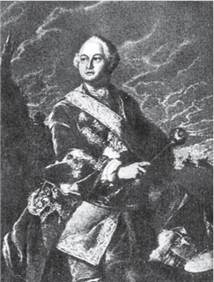
21.5 Prince Kyrylo Rozumovs’kyi (1728-1803), hetman of the Cossack state from 1750 to 1764.
For the Cossack Hetmanate, however, the immediate aftermath of Poltava was disastrous. Peter and his successors set out to remove all forms of autonomy, although their policy varied depending on which of the three separate Cossack entities they were dealing with: the Hetmanate, Zaporozhia (see Chapter 23), or Sloboda Ukraine (see Chapter 22).
The limitations upon—and eventual abolition of—the Hetmanate took the longest to achieve. A new hetman was already appointed to succeed Mazepa in 1708, but Tsar Peter I refused to reaffirm the Agreement of Pereiaslav (as had been done previously on the occasion of each new hetman appointment) and instead confirmed certain rights only at his prerogative.
The Hetmanate’s capital was transferred from Baturyn to Hlukhiv near the Muscovite border, regimental colonels were appointed directly by the tsarist government, and large land grants were given to Muscovite generals, mostly of German origin.Following the close of the Great Northern War, Peter I proceeded with further structural changes. In 1722 the Russian imperial governmental branch responsible for the Hetmanate was changed from the College (Department) of Foreign Affairs to the Senate, which was concerned with the empire’s internal affairs. That same year a Little Russian Collegium composed of six Russian military officers stationed in the Hetmanate was set up as a parallel government in the region. In the absence of a hetman (the one chosen by the Cossacks in 1723 was not confirmed by the imperial government), the Little Russian Collegium became the de facto governing body in the Hetmanate.

21.6 Reconstructed model of the palace of the hetmans in Baturyn, commissioned during the reign of Hetman Rozumovs’kyi but not built until 1799-1803.
For the next half century imperial Russia’s policies toward the Hetmanate were to waver between allowing some autonomy through the appointment of hetmans and restoring centralized control through restoration of the Little Russian Collegium. The last of the hetmans was Kyrylo Rozumovs’kyi, who, while in office from 1750 to 1764, tried with some success to refashion the Hetmanate into an autonomist if not independent state. He reformed the Hetmanate’s administrative structure and legal system, he enhanced the political rights of the Cossack elite (starshyna) or incipient nobility, and he returned the capital to Baturyn, where he began construction of monumental palace for himself and his successors that would appropriately represent their status as heads of state. At the same time, the Russian imperial government revealed its authoritative presence by constructing impressive architectural monuments, such as the Mariïns’kyi Palace and the Saint Andrew’s Church in Kiev, both designed in rococo style by the Italian architect Bartolomeo Rastrelli.
The Russian imperial presence, however, was not expressed only through architecture. One after another, Ukraine’s Cossack territories were to lose all vestiges of autonomy and become fully incorporated into the Russian Empire—first Sloboda Ukraine, then Zaporozhia, and finally the Hetmanate.
21.7 The Mariïns’kyi Palace in Kiev (1747-55) designed by Bartolomeo Rastrelli at the request of Empress Elizabeth I as a residence for visiting members of the imperial family; renovated in 1870 to its present form, it has served since 1991 as the ceremonial palace for the president of independent Ukraine.
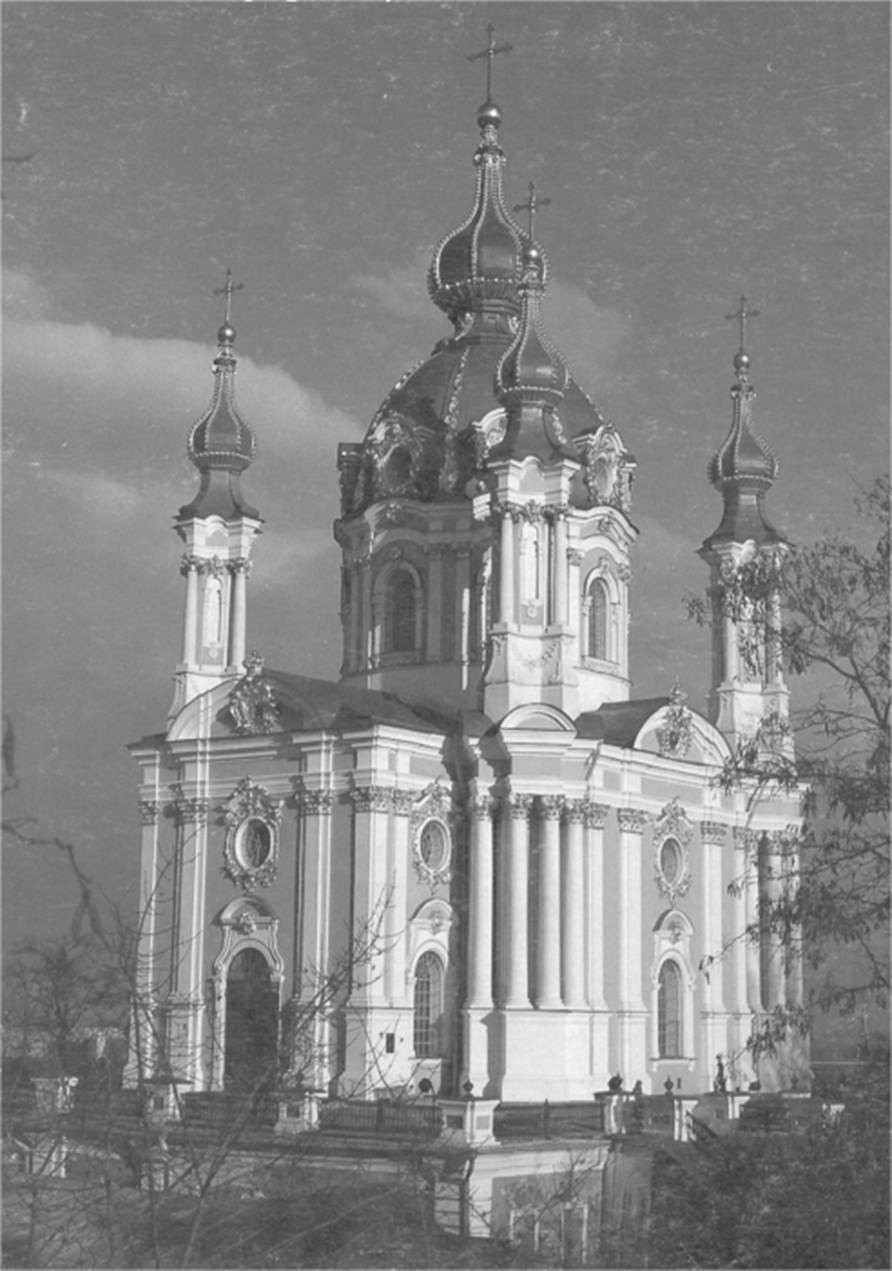
21.8 Saint Andrew’s Church in Kiev (1747-53), designed for Empress Elizabeth I by Bartolomeo Rastrelli.
MAP 22 SLOBODA UKRAINE

More on the topic 21 Mazepa and the Cossack Hetmanate:
- The Turning Point
- The Formation of the Cossack Myth
- SECTION C THE COSSACK GENERAL ASSEMBLY
- Selected Readings in English
- INDEX
- Index
- Index
- Notes
- THE TSAR S MANHUNT FOR THE MAZEPISTS
- Bibliography