33 War, Social Upheaval, and Anarchy in Dnieper Ukraine, 1919-1920
With the departure of the German Army and the collapse of the Hetmanate, Dnieper Ukraine entered the third phase of its revolutionary era, which lasted from January 1919 to October 1920.
Throughout this entire period the Ukrainian National Republic and the Ukrainian Soviet Republic continued to compete for control of the country. Their struggle was further complicated, however, by foreign intervention—by White Russian armies, the Entente, and Poland—as well as by a virtually uninterrupted series of spontaneous and organized peasant revolts which created chaotic conditions throughout the rural countryside. For these reasons, this third phase of the Ukrainian revolutionary era may be described as the period of war, social upheaval, and anarchy.The governing Directory of the restored Ukrainian National Republic (UNR) was headed throughout most of its existence by Symon Petliura. During the entire period of 1919-1920, the UNR never had control over the entire territory it claimed, and at best could enforce its autonomy only over the particular city or region in which its administration and armed forces happened to be located. In comparison with the territorial extent of the UNR recognized by the Treaty of Brest-Litovsk (see Map 32), the state’s boundaries actually increased in size—at least on paper. This is because on January 22, 1919 (exactly one year after Ukraine’s independence was first declared), the Ukrainian National Republic joined with the West Ukrainian National Republic (Zakhidno-Ukrai’n’ska Narodna Respublika—ZUNR; see Map 33) to form a united Greater Ukraine (Soborna Ukraïna). In practice neither the eastern nor western Ukrainian national republics ever had full control over the territories that each claimed. As for the Petliura-led Ukrainian National Republic, during most of 1919 it had at best tenuous authority over northwestern Dnieper Ukraine (Podolia and Volhynia) as its seat of government moved from Kiev to Vinnytsia, Rivne, Kamianets’-Podil’s’kyi, and after November as a government-in-exile initially based in Poland.

33.1 Symon Petliura (1879-1926), socialist-oriented politician who served from November 1918 as supreme military commander and from February 1919 as president of the Directory of the Ukrainian National Republic.
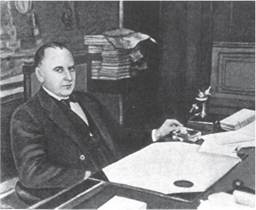
33.2 Khristian Rakovskii (1873-1941), Bulgarian socialist revolutionary and member of the “internationalist” faction of the Bolshevik party in Russia, for much of the period 1919 to 1923 head of the government of the Ukrainian Soviet Socialist Republic.
Within two weeks of the January 22, 1919 solemn declaration of unity between the eastern and western republics, the Ukrainian National Republic was driven out of Kiev, which for the second time was taken over by the Bolshevik-led Soviet Ukrainian Republic. In April 1918 a distinct Communist party (Bolshevik) of Ukraine (CP(b)U) had been established, but within its ranks were serious divisions over matters of principle and tactics. The left-wing “independentists,” who were mostly from Kiev, favored a separate party that would govern a largely autonomous if not independent Ukraine; the right-wing “internationalists,” who were still anticipating a world proletarian revolution that would eliminate states and national distinctions altogether, preferred in the meantime subordination to the all-Russian Communist party based in Bolshevik Russia’s new capital, Moscow.

33.3 The Directory of Ukrainian National Republic at its temporary seat in Kamianets’-Podil’s’kyi; its head Symon Petliura is seated in the middle.
Not waiting for instructions from Moscow, the left-wing “independentists” had formed a provisional Soviet Ukrainian government in November 1918 at Kursk near the northeastern border of Ukraine. With the assistance of Red Army troops, joined by commanders (otamany) of irregular peasant forces, the Bolsheviks launched an attack on the Directory.
They reached Kiev by February 1919, where they renamed their provisional government the Ukrainian Soviet Socialist Republic (Ukraïns’ka Radians’ka Sotsialistychna Respublika). Under the leadership of Khristian Rakovskii, the Soviet Ukrainian Republic was able to hold Kiev and other urban areas of northeastern Ukraine until the summer of 1919.
33.4 Nestor Makhno (1889-1934), anarchist revolutionary leader, from July 1918 to August 1921 commander (otaman) of an irregular army that fought against the Hetmanate, the Whites, and eventually the Bolsheviks in southern Ukraine.
No sooner had the Bolsheviks installed their Soviet Ukrainian government in Kiev than they were abandoned by the peasant forces that had helped them gain power. Already in 1918 peasant uprisings had become a common feature throughout much of Dnieper Ukraine. The peasants fought against the grain confiscation and land policies of the Hetmanate and its German military supporters, and eventually they backed the Directory in its effort to take over power. When the Directory seemed incapable of fulfilling their needs, the discontented peasants switched to the Bolsheviks until before long they became alienated from them as well. Consequently, by the spring of 1919 large-scale peasant armies led by commanders (otamany) like Matvii Hryhoriïv and Nestor Makhno controlled most of the southern steppe Ukraine. The often unruly armed bands of Hryhoriïv, Makhno, and other self-styled otamany, who saw themselves as descendants of the Zaporozhian Cossacks and haidamaks, set out “to liberate the people” from all whom they considered their oppressors. That meant large landowners, well-to-do farmers (regardless of ethnic background), Jews, Russian nationalists, Ukrainian nationalists, and eventually the Bolsheviks. It was precisely during this time (1919 and 1920) that more than a thousand pogroms took place against Jews in over 500 localities, that well-to-do German and Mennonite farmers were killed or driven to emigrate (reducing their numbers by two-fifths), and that many Polish gentry were forced to flee from their Right-Bank estates.
Much subsequent literature blames the Ukrainian National Republic’s leader Petliura for these developments, even though he had little or no control over the independent-minded military forces who dominated the areas where most of the destruction took place.
33.5 Troops of Makhno’s anarchist movement in southern Ukraine.

33.6 Reciting prayers over the victims of a pogrom in Proskuriv (today Khmel’nyts’kyi), February 1919.
By the summer of 1919 Dnieper Ukraine was roughly divided into three spheres: Petliura’s Ukrainian National Republic together with the armies of the West Ukrainian National Republic were in the northwest (Podolia and Volhynia), the Ukrainian Soviet Socialist Republic in the center and northeast (Chernihiv, Poltava, and Kharkiv); and Hryhoriïv and Makhno’s peasant armies in the south. Into this complex setting entered the White Russians, that is, armies led by generals of the former imperial army who were determined to drive out the Bolsheviks and create a “democratic” Russia, one that might even welcome the return of the tsar. The Whites were not only opposed to the Bolshevik Reds, they also favored maintaining the territorial integrity of imperial Russia; therefore, they rejected any kind of separatism, such as that advocated by the Ukrainian National Republic.

33.7 Anton Denikin (1872-1947), Russian general, from April 1918 to April 1920 commander of the anti-Bolshevik White armies in southern Russia and Ukraine.
The White Russian military campaign against the Bolshevik government in Moscow unfolded on several fronts. The campaign on the southern front, based in the Don Cossack Lands, was under the direction of General Anton Denikin, head of the Volunteer Army.
Denikin’s forces pushed the Bolsheviks out of Kiev in August 1918, and until the end of that year the White Volunteer Army held much of central and northeastern Ukraine. Denikin and the White armies on the other fronts established governments that victorious Allies (Great Britain, France, the United States, and Italy) recognized as the legitimate representatives of Russia. Like the Whites, the Allied Powers supported the territorial integrity of Russia and, therefore, were unequivocally opposed to the aspirations of Dnieper Ukrainians for independent statehood. The Allies even sent interventionist forces to various parts of the Russian Empire, at first to keep munitions from falling into the hands of Germans and then to intervene on the side of the Whites against the Bolsheviks.
33.8 White Russian troops of General Anton Denikin entering Kiev, August 1919.
Among the interventionists was a small French expeditionary force, joined by troops from Greece, that arrived in Odessa at the end of 1918. Together with local Whites the French and Greek forces controlled a strip of land along Dnieper Ukraine’s Black Sea coast between the Dniester and lower Dnieper rivers. Considering the Allies’ general commitment to the idea of a “unified Russia,” it is not surprising that all attempts by Petliura’s Ukrainian National Republic to gain diplomatic recognition and to receive military assistance from the French forces stationed in southwestern Ukraine were rejected.
Nevertheless, despite their apparent military strength and diplomatic advantages, the Whites were unable to defeat the Bolsheviks. By the end of 1919 the Red Army drove Denikin’s White Volunteer Army out of Dnieper Ukraine, forcing it to make a last stand in the Crimea. In February 1920 the Bolsheviks took Kiev for the third time and their Ukrainian Soviet Socialist Republic gradually extended its control over most of central and eastern Ukraine.
Meanwhile, the forces of the Ukrainian National Republic, from their ever changing bases in Podolia and Volhynia, were fighting against Denikin’s retreating Whites and against the returning Red Army. In an attempt to improve the UNR’s precarious situation, Petliura reached a series of agreements with the restored state of Poland, which had already conquered all of Galicia (July 1919) and pushed further into Volhynia and Podolia. According to a treaty signed in Warsaw (April 1920), the Ukrainian National Republic and Poland became allies. Petliura recognized Poland’s control of Galicia (including that province’s Ukrainianinhabited eastern half), and he joined Polish forces in their full-scale attack against the Red Army.
33.9 Symon Petliura, president and supreme military commander of the Ukrainian National Republic, and Jozef Pilsudski, supreme military commander and chief-of-state of Poland, meet as allies in Vinnytsia during the Polish offensive against Soviet Russia.
During the first phase of the Polish-Soviet war, the Poles together with Petliura’s forces rapidly reached Kiev (May 1920). But within a month they were driven out of the city, and by August they were pushed out of Dnieper Ukraine entirely. The government and armed forces that remained loyal to Petliura’s Ukrainian National Republic were forced into permanent exile, and in October 1920 Poland and Soviet Russia signed an armistice. Within a few weeks the last of all the White forces in European Russia were driven out of the Crimea and into permanent exile.
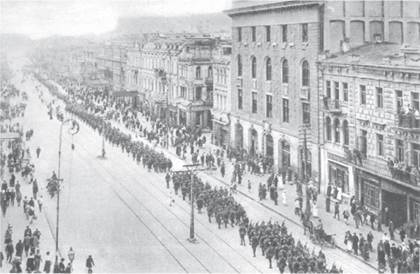
33.10 Polish troops marching triumphantly on the main street (Khreshchatyk) of Kiev, May 1920.
Thus, by October 1920 the third and last phase of the Ukrainian revolutionary era had come to an end. While it is true that large parts of the southern Ukrainian steppelands were still in the hands of the peasant-led armies of Nestor Makhno and that forces loyal to the Ukrainian National Republic were still active in Volhynia until 1921, most of Dnieper Ukraine lay exhausted after years of changing governments, civil war, and foreign invasions. The only faction left capable of establishing order was the Bolshevik-led Ukrainian Soviet Socialist Republic backed by the Red Army. And in their desire to reject symbols connected with the past, Ukraine’s Bolshevik rulers chose not Kiev but rather the eastern city of Kharkiv near the border with Soviet Russia to become the capital of Soviet Ukraine.
MAP 34 THE WEST UKRAINIAN NATIONAL REPUBLIC, 1918-1919


34.1 Poster on the streets of L’viv proclaiming the formation of an independent Ukrainian state.
More on the topic 33 War, Social Upheaval, and Anarchy in Dnieper Ukraine, 1919-1920:
- War isnot a chess game, but a vast social phenomenon with an infinitely greater and ever-expanding number of variables, some of which elude analysis.
- Social Media and Propaganda in Ukraine
- Magocsi Paul Robert. Ukraine: An Illustrated History. University of Toronto Press,2007. — 336 p., 2007
- 1919: Divergences
- Polarization and Collapse
- The Greek and the unGreek, 1830–1920
- Chapter 3 Vikings on the Dnieper
- The War in Ukraine: Phase One