34 Western Ukrainian Lands, 1918-1919
The fate of Dnieper Ukraine was determined by the 1917 revolutions and their aftermath in the Russian Empire. Western Ukrainian lands, by contrast, were dependent on the outcome of World War I and the future of the Austro-Hungarian Empire of which they were a part.
Although Galician Ukrainian deputies in the Austrian parliament were displeased with the government’s reluctance to create a separate province of East Galicia, Ukrainians in general remained loyal to the Habsburg monarchy until its very end. Even after the empire’s collapse, some Ukrainians still hoped it might be possible to create an independent Galician kingdom ruled by a member of the House of Habsburg in the person of Wilhelm Habsburg-Lothringen (Vasyf Vyshyvanyi), an avid supporter of the Ukrainian national movement.It was in response, therefore, to the Habsburg emperor’s call of October 16, 1918, to transform Austria-Hungary into a federal state that two days later Galician and Bukovinian political and religious leaders formed in L’viv the Ukrainian National Council (Ukraïns’ka Narodna Rada). Under the presidency of Ievhen Petrushevych, the council proclaimed the existence of a state to encompass all Ukrainian-inhabited lands of Austria-Hungary—eastern Galicia, northern Bukovina, and Transcarpathia, together with the Presov Region and the Lemko Region (see the shading on Map 34). Thus, the Ukrainians were acting within the legal guidelines set by the Habsburg authorities.

34.2 Greek Catholic Metropolitan of Galicia, Andrei Sheptyts’kyi, and Prince Wilhelm of Habsburg-Lothringen (1895-1949), member of the Habsburg imperial family and commander of Austro-Hungarian army units in southern Ukraine (1918) during the last days of the Habsburg Monarchy.
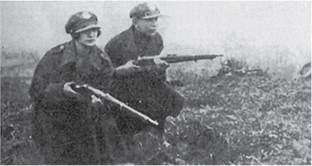
34.3 Polish high school and university male and female students, part of a citizen militia that fought to drive the West Ukrainian National Republic out of L’viv, were subsequently immortalized in Polish lore as the eaglets (Polish: orleta) who helped make possible the “Defence of Lwow.”
When, however, the last Habsburg emperor, Charles I, abdicated on October 30, the Ukrainians felt they had to act on their own.
On November 1, 1918, they occupied the Habsburg administrative offices in L’viv and proclaimed the independence of what came to be called the West Ukrainian National Republic (Zakhidno-Ukrai’ns’ka Narodna Respublika—ZUNR). The Ukrainian Sich Riflemen, who had fought in the ranks of the Austro-Hungarian Army, arrived from Bukovina and formed the core of what within a few months became the Galician Ukrainian Army.On the very day that independence was declared (November 1) fighting broke out with the local Polish armed forces, with the result that three weeks later (on November 21) the Ukrainian government and its supporters were driven out of L’viv (Polish: Lwow). For its entire existence, the West Ukrainian National Republic (ZUNR), based in L’viv, then Ternopil’, and finally Stanyslaviv, was engaged in a war for its survival. The government made plans for elections to a parliament (which because of the Polish-Ukrainian war never took place), and on January 22, 1919, it proclaimed the unification of the West Ukrainian National Republic with the Ukrainian National Republic based, at that moment, in Kiev. In theory, the West Ukrainian National Republic became only the “western province (oblast)” of the Ukrainian National Republic; in practice, however, the two republics followed separate political and military courses that in the end turned out to be in direct conflict with one another.

34.4 Polish troops under General Jozef Haller after driving the West Ukrainian National Republic out of Ternopil’ (Polish: Tarnopol).
After the demise of Habsburg rule, the West Ukrainian National Republic placed its hopes in the victorious Allied and Associated Powers, who in January 1919 convened the Paris Peace Conference. The Republic’s leaders believed that their political demands would be legitimized by peacemakers ostensibly guided by the principle of national self-determination as proclaimed by U.S.
President Woodrow Wilson. But the Allies were more concerned with strengthening Poland and its eastern frontier against territorial expansion from Bolshevik Russia and with stopping the latter’s intention to bring revolution to the rest of central and western Europe than with defending the little-known cause of Ukrainian independence. Assuming—and rightly so—that the peacemakers in Paris would back their cause, the government of the restored state of Poland based in Warsaw dispatched a large army (originally intended to fight Bolshevik Russia) to Galicia in April 1919. Within two months the Poles defeated the Galician Ukrainian Army and drove the West Ukrainian government beyond the Zbruch River into the Dnieper Ukraine. The Polish action was authorized after the fact on June 25 by order of the Allied and Associated Powers.
34.5 Kost’ Levyts’kyi (1859-1941), prominent Ukrainian political leader in Austrian Galicia and president of the State Secretariat of the West Ukrainian National Republic.
By July 1919 the Galician Ukrainian Army and the West Ukrainian government, headed by Ievhen Petrushevych, found themselves on the territory of Petliura’s Ukrainian National Republic. But instead of cooperating against Ukraine’s numerous enemies, the leaders of Ukraine’s two non-Soviet republics clashed as a result of their profound political differences. Petliura was already negotiating and eventually reached an accord with Poland, the enemy of Galician Ukrainians. For their part, leaders in the Galician Ukrainian Army favored an alliance with, and eventually some fought alongside Denikin’s White Russian Army, Petlura’s enemy. In the end, the remaining Galician Ukrainian forces were swept up in the anarchic whirlpool that engulfed Dnieper Ukraine in 1919-1920, while both Petrushevych and Petliura fled into exile abroad.

34.6 Ievhen Petrushevych (1863-1940), Galician-Ukrainian political leader, from November 1918 president of the West Ukrainian National Republic and from March 1923 dictator of its government-in-exile.
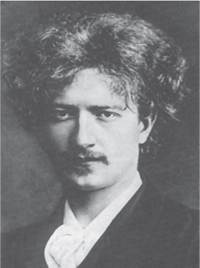
34.7 Ignacy Jan Paderewski (1860-1910), pianist, composer, Polish statesman, and native of Right Bank Ukraine, who subsequently campaigned at the Paris Peace Conference to keep all of Galicia under Polish control and to block recognition of any Ukrainian state.
The other two former Austro-Hungarian lands, Bukovina and Transcarpathia, were claimed by the West Ukrainian National Republic, but in practice they never came under its authority. Instead, each territory followed a distinctly different path. In Bukovina, Ukrainian civic and political activists formed a Ukrainian Regional Committee in Chernivtsi on October 25, 1918. Ukrainian Sich Riflemen units were stationed in Bukovina at the time, but they heeded the call of the Ukrainian National Council in L’viv and left to help in the defense of Galicia against Poles. This meant that Bukovina’s Ukrainians had no military force of their own to call upon, if necessary, for their own defense.
Bukovina’s Ukrainian Regional Committee in Chernivtsi managed to cooperate with a handful of local Romanian leaders, and together they accepted the surrender of Habsburg officials on November 6. But most Bukovinian Romanian leaders had other plans. They had already formed a Romanian National Council (October 27), and upon the Habsburg surrender they called on Romania to send troops. On November 11, 1918, a Romanian army did arrive, and facing no resistance from Ukrainians or any other group, preceded to take all of Bukovina which was subsequently annexed to Romania.

34.8 Omelian Popovych (1856-1930), Bukovinian-Ukrainian educator and civic activist, from October 1918 head of the short-lived Ukrainian Regional Committee in Chernivtsi that was allied to the West Ukrainian National Republic.
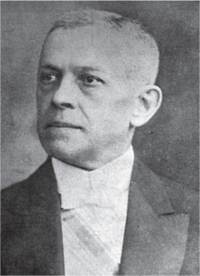
34.9 Iancu Flondor (1865-1924), Bukovinian-Romanian political leader, president of the Romanian National Council in Chernivtsi, and leading proponent of Bukovina’s incorporation into Romania.
In Transcarpathia, which was part of the Kingdom of Hungary, developments were far more complex. Following the collapse of the Habsburg monarchy, the Hungarians established an independent republic (November 12, 1918). Hoping to retain the former kingdom’s boundaries, the Hungarian republic’s government offered autonomy to its various non-Magyar nationalities. In December 1918 an autonomous province called the Rusyn Land (Rus’ka Kraina) was carved out of the Rusyn-inhabited parts of four counties in northeastern Hungary, and there were even elections to a provincial diet (soim). But the postwar Hungarian option for the Rusyns of Transcarpathia was to be short-lived. Ever since the spring of 1918 Rusyn immigrants in the United States had been discussing future political options for their homeland and meeting with other immigrant groups and the American government. At the suggestion of President Woodrow Wilson, Rusyn leaders reached an agreement with the visiting Czech leader (and future president of Czechoslovakia), Tomas G. Masaryk, to support the idea of joining their European homeland with the new state of Czechoslovakia. Consequently, Czechoslovak troops moved into the area in early 1919 and drove out the Hungarian authorities. On May 8 a Rusyn National Council convened in Uzhhorod to proclaim the union of all Rusyns living south of the Carpathians (i.e., Transcarpathia in present-day Ukraine and the Presov Region in Slovakia) with Czechoslovakia.

34.10 Gregory Zhatkovych (1886-1967), American lawyer of Transcarpathian origin, who negotiated on behalf of Rusyn-American immigrants for the unification of their homeland with Czechoslovakia.
MAP 35 UKRAINIAN LANDS, 1923

More on the topic 34 Western Ukrainian Lands, 1918-1919:
- Polish-Ukrainian war and the Ukrainian Galician Army, 1918-1919
- Theme 11. The Ukrainian Lands in the First World War between 1914 and 1918. The Ukrainian National Revolution between 1917 and 1921
- 42 World War II and Western Ukrainian Lands, 1939-1941
- Since the fall of Kiev in 1240, the western lands of Galicia and Volhynia had served as the stage for major developments in Ukrainian history.
- Ukrainian Declaration of Independence (1918)
- during the russian-ukrainian war, which began in early 2014 and was somewhat misrepresented in Western media as a kind of Ukrainian “civil war,” rather than a Russian invasion, there emerged a number of supposedly new images of Ukrainian warriors.
- 40 Ukrainian Lands in Interwar Romania and Czechoslovakia
- 35 Ukrainian Lands after World War I
- 39 Ukrainian Lands in Interwar Poland
- 4 The Ukrainian Movements in Poland, Romania, and Czechoslovakia, 1918-1939
- Ukrainian Lands in Interwar Poland
- Ukrainian Lands in Interwar Poland
- 14 Socioeconomic Relations in Ukrainian Lands, 1569-1648