AIDS case definitions and staging of HIV disease
Case definitions of AIDS for epidemiological surveillance
For epidemiological surveillance, a practical case definition of severe HIV-related disease is needed. The Centers for Disease Control (CDC) AIDS surveillance case definition is used in many industrialised countries (see chapter 1), but cannot be used in most developing countries because it requires access to sophisticated laboratory investigations.
For this reason, the World Health Organisation (WHO) introduced a clinical case definition that could be used in settings where laboratory facilities are inaccessible (Box 10.1). In 1994, this definition was expanded to incorporate HIV serology (thus increasing specificity) and to take account of revisions of the CDC case definition (Box 10.2). If serological testing is unavailable or inaccessible, the clinical case definition should be used; if serological testing is available, the expanded case definition should be used.Diagnosis and clinical staging of HIV disease in resource poor settings
Although advanced HIV disease may be easy to diagnose clinically, it is desirable to have HIV serology on patients with suspected HIV disease, particularly since HIV negative tuberculosis may be clinically indistinguishable from advanced HIV disease.
The case definitions in Boxes 10.1 and 10.2 were developed for epidemiological surveillance, and are not intended to be used for clinical staging of patients, for which they are neither sensitive nor specific. In order to estimate prognosis in individual patients, a clinical staging system is more useful than a case definition. Box 10.3 overleaf outlines the WHO proposed staging system for HIV infection and disease, using clinical and laboratory data, which can be used in developing countries. This system categorises patients into four stages based on clinical features of prognostic significance.
The stages are interpreted as:Stage 1: asymptomatic infection.
Stage 2: early (mild) disease.
Stage 3: intermediate (moderate) disease.
Stage 4: late (severe) disease.
The system can be refined using a laboratory axis: the CD4 count is the most useful laboratory marker for clinical staging, but is rarely available in developing countries. The total lymphocyte count can be used as a surrogate, although this is not ideal. Manifestations of HIV disease are rare at CD4 counts above 500 ? 106/l and severe illness and death are rare in patients with counts above 200 ? 106/l. Tuberculosis and pneumococcal disease may occur at higher as well as lower CD4 counts. Once patients in developing countries have developed advanced HIV disease, they die with higher CD4 levels than in industrialised countries because of lack of access to high quality medical care; nonetheless, most patients die at the stage of advanced immunodeficiency.
Box l0.1 WHO AIDS case definition for AIDS surveillance
For the purposes of AIDS surveillance an adult or adolescent (>12 years of age) is considered to have AIDS if at least two of the following major signs are present in combination with at least one of the minor signs listed below, and if these signs are not known to be due to a condition unrelated to HIV infection. Major signs
• Weight loss 10% of body weight
• Chronic diarrhoea for > 1 month
• Prolonged fever for > 1 month (intermittent or constant) Minor signs
• Persistent cough for > 1 month*
• Generalised pruritic dermatitis
• History of herpes zoster
• Oropharyngeal candidiasis
• Chronic progressive or disseminated herpes simplex infection
• Generalised lymphadenopathy
The presence of either generalised Kaposi's sarcoma or cryptococcal meningitis is sufficient for the diagnosis of AIDS for surveillance purposes.
*For patients with tuberculosis, persistent cough for >1 month should not be considered as a minor sign.
Box 10.2 Expanded WHO case definition for AIDS surveillance
For the purposes of AIDS surveillance an adult or adolescent (>12 years of age) is considered to have AIDS if a test for HIV antibody gives a positive result, and one or more of the following conditions are present:
• 10% body weight loss or cachexia, with diarrhoea or fever, or both, inter mittent or constant, for at least 1 month, not known to be due to a condition unrelated to HIV infection
• Cryptococcal meningitis
• Pulmonary or extrapulmonary tuberculosis
• Kaposi's sarcoma
• Neurological impairment that is sufficient to prevent independent daily activities, not known to be due to a condition unrelated to HIV infection (for example, trauma or cerebrovascular accident)
• Candidiasis of the oesophagus (which may be presumptively diagnosed based on the presence of oral candidiasis accompanied by dysphagia)
• Clinically diagnosed life-threatening or recurrent episodes of pneumonia, with or without aetiological confirmation
• Invasive cervical cancer
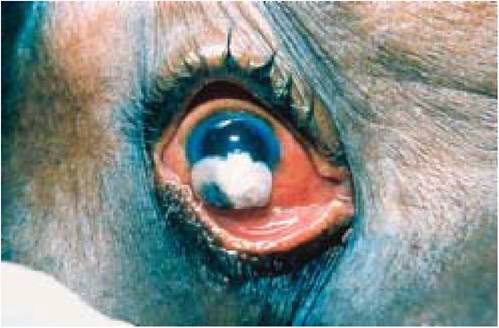
Figure 10.10 Squamous cell carcinoma of the conjunctiva: an unusual cancer, strongly associated with HIV infection. Its incidence has increased markedly in Uganda and Rwanda (courtesy of Dr Keith Waddell)
Box 10.3 Proposed WHO staging system for HIV infection and disease
Clinical staging
Patients with HIV infection who are aged 13 years are clinically staged on the basis of the presence of the clinical condition, or performance score, belonging to the highest level
• Clinical stage 1: asymptomatic or persistent generalised lymphadenopathy; performance scale 1 (asymptomatic, normal activity)
• Clinical stage 2: weight loss 10% body weight, unexplained chronic diarrhoea > 1 month, unexplained chronic fever > 1 month, oral candidiasis, oral hairy leukoplakia, pulmonary tuberculosis within the past year, severe bacterial infections; performance scale 3 (bedridden < 50% of day during the last month)
• Clinical stage 4: most other CDC AIDS-defining diseases (but not pulmonary tuberculosis); performance scale 4 (bedridden > 50% of day during the last month)
Clinical/laboratory classification
| Laboratory axis | Clinical axis | ||||||
| 1 Asymptomatic | 2 Early | 3 Intermediate | 4 Late | ||||
| Lymphocytes or (? 106∕l) | CD4 (? 106∕l) | ||||||
| A | >2000 | >500 | 1A | 2A | 3A | 4A | |
| B | 1000-2000 | 200-500 | 1B | 2B | 3B | 4B | |
| C | organizations has been crucial to a successful response. Key requirements of programmes are prevention of new infections, as listed in Box 10.4: youth (both in- and out-of-school), especially young women, are an important target group for HIV awareness and life-skills training. Preventing mother-to-child transmission is also important: antiretroviral drugs are most cost effective when used for this purpose, and effective and safe strategies for the reduction of transmission via breast feeding are also needed. Other important areas include prevention of discrimination and assurance of confidentiality for HIV-infected people, integration of sexually transmitted diseases control into HIV/AIDS prevention activities, and provision of services for HIV/AIDS care. Because of the close interrelationship between HIV/AIDS and tuberculosis, some countries have integrated tuberculosis and HIV/AIDS control activities. Box 10.4 Essential components of HIV/AIDS programmes Prevention of new infections • Reduce sexual transmission Awareness and life-skills education, especially youth Condom promotion STD control, including for commercial sex workers Partner notification • Blood safety HIV testing of transfused blood Avoid non-essential blood transfusion Recruitment of safe donor pool • Interventions to reduce transmission among injecting drug users (where necessary) • Reduce mother-child transmission antiretroviral therapy avoidance of breast feeding (where safe): consider replacement feeding, or early weaning Surveillance for HIV infections and AIDS Voluntary counselling and testing Mitigation of HIV-related disease Rational approach to care for HIV-related disease, especially tuberculosis Appropriate preventive therapies Mitigating social impact Minimising stigma: respect for confidentiality, protection against discrimination Care for AIDS orphans 11
More medical literature on Medic.Studio
More on the topic AIDS case definitions and staging of HIV disease:
-
Infectious diseases -
Internal diseases -
Obstetrics and Gynaecology -
Pediatrics -
Veterinary medicine -
-
Conflictology -
Ecology -
Economy -
Finance -
History -
Law -
Medicine -
Philosophy -
Religious studies -
| ||||||