Antiretroviral Therapy and Metabolic Disorders
The introduction of HAART in recent years has significantly modified the course of HIV disease, prolonging survival and improving patients’ quality of life. However, early data have raised concern that HAART regimens, especially those including protease inhibitors (PIs), except atazanavir, are associated with an increased incidence of metabolic (hyperlipidemia, insulin resistance) and somatic (lipodystrophy/lipoatrophy) changes that in the general population are associated with an increased risk for cardiovascular disease (coronary and peripheral artery disease and stroke), producing an intriguing clinical scenario [54].
HIV-associated lipodystrophy/lipoatrophy, first described in 1998 [55], is characterized by prominence of the dorsocervical fat pad (“buffalo hump”), increased abdominal girth and breast size, lipoatrophy of subcutaneous fat of the face, buttocks, and limbs, and prominence of the veins on the limbs [55]. The overall prevalence of at least one physical abnormality is about 50% in otherwise healthy outpatients. The differences between these prevalence rates (which ranged from 18 to 83%) may also have been confounded by patient sex and age, the type and duration of antiretroviral therapy, and the lack of an objective and validated case definition. Metabolic features significantly associated with lipodystrophy include dyslipidemia (about 70% of patients), insulin resistance (elevated C-peptide and insulin), type 2 diabetes mellitus (8-10% of the patients), lactic acidemia, and elevated hepatic transaminases (non-alcoholic steatohepatitis) [56]. These metabolic abnormalities are more profound in those with more severe physician-assessed lipodystrophy and are associated with an increased risk in cardiovascular events (about 1.4 cardiac events per 1,000 years of therapy according to the Framingham score) [56].
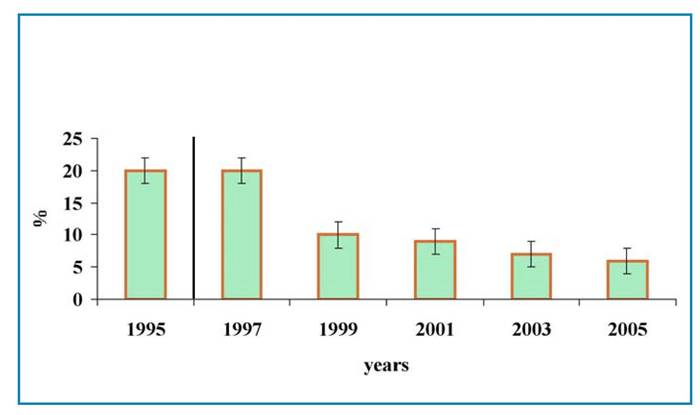
Fig.
12 Prevalence of cardiac involvement of AIDS-associated tumors (Kaposi’s sarcoma and non-Hodgkin’s lymphoma) in the years 1995- 2005. The vertical line indicates the introduction of HAART in the treatment of HIV infectionA detailed description of HAART-associ- ated metabolic syndrome and coagulation disorders, and of HAART-associated coronary and peripheral artery disease and stroke is provided by J. Capeau, L. Drouet, F. Boccara, P. Mercie, and A. Moulignier in separate chapters in this volume.
References
1. Barbaro G, Di Lorenzo G, Grisorio B, Barbarini G and the Gruppo Italiano per lo Studio Cardio- logico dei pazienti affetti da AIDS Investigators (1998) Cardiac involvement in the acquired immunodeficiency syndrome: a multicenter clinical-pathological study. AIDS Res Hum Retroviruses 14:1071-1077
2. Temesgen Z (1999) Overview of HIV infection. Ann Allergy Asthma Immunol 83:1-5
3. Barbaro G (2002) Cardiovascular manifestations of HIV infection. Circulation 106:1420-1425
4. Barbarini G, Barbaro G (2003) Incidence of the involvement of the cardiovascular system in HIV infection. AIDS 17:S46-S50
5. Holmberg SD, Moorman AC, Williamson JM et al (2002) Protease inhibitors and cardiovascular out- c ome s in p ati ent s wit h HIV- 1. L ance t 360:1747-1748
6. Bozzette SA, Ake CF,Tam HK et al (2003) Cardiovascular and cerebrovascular events in patients treated for human immunodeficiency virus infection. N Engl J Med 348:702-710
7. Friis-Moller N,Weber R, Reiss P et al (2003) Cardiovascular risk factors in HIV patients: association with antiretroviral therapy: results from DAD study. AIDS 17:1179-1193
8. Klein D, Hurley LB, Quesenberry Jr CP, Sidney S (2002) Do protease inhibitors increase the risk for coronary heart disease in patients with HIV-1 infection? J AIDS 30:471-477
9. Coplan PM, Nikas A, Japour A et al (2003) Incidence of myocardial infarction in randomized trials of protease inhibitor-based antiretroviral therapy: an analysis of four different protease inhibitors.
AIDS Res Hum Retroviruses 19:449-45510. Mary-Krause M, Cotte L, Simon A et al and the Clinical Epidemiology Group from the French Hospital Database (2003) Increased risk of myocardial infarction with duration of protease inhibitor therapy in HIV-infected men. AIDS 17:2479-2486
11. Barbaro G, Di Lorenzo G, Cirelli A et al (2003) An open-label, prospective, observational study of the incidence of coronary artery disease in patients with HIV receiving highly active antiretroviral therapy. Clin Ther 25:2405-2418
12. The Data Collection on Adverse Events of AntiHIV Drugs (DAD) Study Group (2003) Combination antiretroviral therapy and the risk of myocardial infarction. N Engl J Med 349:1993-2003
13. The Data Collection on Adverse Events of AntiHIV Drugs (DAD) Study Group (2007). Class of antiretroviral drugs and the risk of myocardial infarction. N Engl J Med 356:1723-1735
14. Stein KM, Haronian H, Mensah GA et al (1990) Ventricular tachycardia and Torsades de pointes complicating pentamidine therapy of Pneumocystis carinii pneumonia in the acquired immunodeficiency syndrome. Am J Cardiol 66:888-889
15. Aoun S, Ramos E (2000) Hypertension in the HIV- infected patient. Curr Hypertens Rep 2:478-481
16. Sattler FR, Qian D, Louie S et al (2001) Elevated blood pressure in subjects with lipodystrophy. AIDS 15:2001-2010
17. Gazzaruso C, Bruno R, Garzaniti A et al (2003). Hypertension among HIV patients: prevalence and relationship to insulin resistance and metabolic syndrome. J Hypertens 21:1377-1382
18. Crane H,Van Rompaey S, Kitahata M (2006) Antiretroviral medications associated with elevated blood pressure among patients receiving highly active antiretroviral therapy. AIDS 20:1019-1026
19. Heidenreich PA, Eisenberg MJ, Kee LL et al (1995) Pericardial effusion in AIDS: incidence and survival. Circulation 92:3229-3234
20. Barbaro G, Fisher SD, Lipshultz SE (2001) Pathogenesis of HIV-associated cardiovascular complications. Lancet Infect Dis 1:115-124
21.
Barbaro G, Di Lorenzo G, Grisorio B, Barbarini G and the Gruppo Italiano per lo Studio Cardio- logico dei pazienti affetti da AIDS investigators (1998) Cardiac involvement in the acquired immunodeficiency syndrome: a multicenter clinical-pathological study. AIDS Res Hum Retroviruses 14:1071-107722. Lai WW, Lipshultz SE, Easley KA et al (1998) Prevalence of congenital cardiovascular malformations in children of human immunodeficiency virus-infected women: the prospective P2C2 HIV Multicenter Study. P2C2 HIV Study Group, National Heart, Lung, and Blood Institute, Bethesda, Maryland. J Am Coll Cardiol 32:1749-1755
23. Barbaro G, Di Lorenzo G, Soldini M et al (1999) Intensity of myocardial expression of inducible nitric oxide synthase influences the clinical course of human immunodeficiency virus-associated cardiomyopathy. Circulation 100:933-939
24. Pugliese A, Isnardi D, Saini A et al (2000) Impact of highly active antiretroviral therapy in HIV-positive patients with cardiac involvement. J Infect 40:282-284
25. Bijl M, Dieleman JP, Simoons M, Van Der Ende ME (2001) Low prevalence of cardiac abnormalities in an HIV-seropositive population on antiretroviral combination therapy. J AIDS 27:318-320
26. Nzuobontane D, Blackett KN, Kuaban C (2002) Cardiac involvement in HIV-infected people in Yaounde, Cameroon. Postgrad Med J 78:678-681
27. Shannon RP, Simon MA, Mathier MA et al (2000) Dilated cardiomyopathy associated with simian AIDS in nonhuman primates. Circulation 101:185-193
28. Barbaro G (2003) Pathogenesis of HIV-associated heart disease. AIDS 17:S12-S20
29. Currie PF, Goldman JH, Caforio AL et al (1998) Cardiac autoimmunity in HIV-related heart muscle disease. Heart 79:599-604
30. Lipshultz SE, Easley KA, Orav EJ et al (2000) Cardiac dysfunction and mortality in HIV-infected children: the Prospective P2C2 HIV Multicenter study. Circulation 102:1542-1548
31. Freeman GL, Colston JT, Zabalgoitia M, Chan- drasekar B (1998) Contractile depression and expression of proinflammatory cytokines and iNOS in viral myocarditis.
Am J Physiol 274:249-25832. Lipshultz SE, Easley KA, Orav EJ et al (1998) Left ventricular structure and function in children infected with human immunodeficiency virus: the prospective P2C2 HIV multicenter study. Circulation 97:1246-1256
33. Cooper ER, Hanson C, Diaz C et al (1998) Encephalopathy and progression of human immunodeficiency virus disease in a cohort of children with perinatally acquired human immunodeficiency virus infection. J Pediatr 132:808-812
34. Miller TL, Orav EJ, Colan SD, Lipshultz SE (1997) Nutritional status and cardiac mass and function in children infected with the human immunodeficiency virus. Am J Clin Nutr 66:660-664
35. Miller TL (1998) Cardiac complications of nutritional disorders. In: Lipshultz SE (ed) Cardiology in AIDS. Chapman and Hall, New York, pp 307-316
36. Hoffman M, Lipshultz SE, Miller TL (1999) Malnutrition and cardiac abnormalities in the HIV-infected patients. In: Miller TL, Gorbach S (eds) Nutritional aspects of HIV infection. Arnold, London, pp 33-39
37. Lewis W, Simpson JF, Meyer RR (1994) Cardiac mitochondrial DNA polymerase gamma is inhibited competitively and noncompetitively by phosphorylated zidovudine. Circ Res 74:344-348
38. Lewis W, Grupp IL, Grupp G et al (2000) Cardiac dysfunction in the HIV-1 transgenic mouse treated with zidovudine. Lab Invest 80:187-197
39. Lipshultz SE, Easley KA, Orav EJ et al (2000) Absence of cardiac toxicity of zidovudine in infants. N Engl J Med 343:759-766
40. Barbaro G, Klatt EC (2002) HIV infection and the cardiovascular system. AIDS Rev 4:93-103
41. Nahass RG, Weinstein MP, Bartels J, Gocke DJ (1990) Infective endocarditis in intravenous drug users: a comparison of human immunodeficiency virus type 1-negative and -positive patients. J Infect Dis 162:967-970
42. Johnson RM, Little JR, Storch GA (2001) Kawasaki-like syndromes associated with human immon- odeficiency virus infection. Clin Infect Dis 32:1628-1634
43. Shingadia D, Das L, Klein-Gitelman M, Chadwick E (1999) Takayasu’s arteritis in a human immunodeficiency virus-infected adolescent.
Clin Infect Dis 29:458-45944. Gisselbrecht M (1999) Vasculitis during human acquired immunodeficiency virus infection. Pathol Biol (Paris) 47:245-247
45. Chi D, Henry J, Kelley J et al (2000) The effects of HIV infection on endothelial function. Endothelium 7:223-242
46. Berger O, Gan X, Gujuluva C et al (1999) CXC and CC chemokine receptors on coronary and brain endothelia. Mol Med 5:795-805
47. Twu C, Liu QN, Popik W et al (2002) Cardiomyocytes undergo apoptosis in human immunodeficiency virus cardiomyopathy through mitochondrion and death receptor-controlled pathways. Proc Natl Acad Sci USA 99:14386-14391
48. Grahame-Clarke C, Alber DG, Lucas SB et al (2001) Association between Kaposi’s sarcoma and atherosclerosis: implications for gammaherpesviruses and vascular disease. AIDS 15:1902-1905
49. Barbaro G, Barbarini G, Pellicelli AM (2001) HIV- associated coronary arteritis in a patient with fatal myocardial infarction. N Engl J Med 344:1799-1800
50. Arsura EL, Ismail Y, Freeman S, Karunakav AR (1994) Amphotericin B-induced dilated cardiomyopathy. Am J Med 97:560-562
51. Cohen AJ, Weiser B, Afzal Q, Fuhrer J (1990) Ventricular tachycardia in two patients with AIDS receiving ganciclovir (DHPG). AIDS 4:807-809
52. Lopez JA, Harold JG, Rosenthal MC et al (1987) QT prolongation and Torsades de pointes after administration of trimethoprim-sulfamethoxazole. Am J Cardiol 59:376-377
53. Dal Maso L, Serraino D, Franceschi S (2001) Epidemiology of HIV-associated malignancies. Cancer Treat Res 104:1-18
54. Barbaro G, Klatt EC (2003) Highly active antiretroviral therapy and cardiovascular complications in HIV-infected patients. Curr Pharm Des 9:1475-1481
55. Carr A, Samaras K, Burton S et al (1998) A syndrome of peripheral lipodystrophy, hyperlipi- daemia and insulin resistance in patients receiving HIV protease inhibitors. AIDS 12:F51-F58
56. Carr A (2003) HIV lipodystrophy: risk factors, pathogenesis, diagnosis and management. AIDS 17:S141-S148
More on the topic Antiretroviral Therapy and Metabolic Disorders:
- Metabolic Disorders
- Barbaro Giuseppe, Boccara Franc (eds.). Cardiovascular Disease in AIDS. 2nd edition. — Springer,2009. — 169 p., 2009
- Antiretroviral Therapy Today
- Conclusion
- GENETIC, METABOLIC, AND OTHER DISORDERS