IN HIV-1 INFECTION
Elevated CD8+ T Cell Apoptosis In Vivo
An increase in the number of apoptotic CD8+ T cells has been observed in lymph nodes from chronically infected HIV+ subjects, and has been related to the state of activation of the lymph nodes149 and the reduction in Bcl-2 expression.150 Importantly, in one study, apoptosis was found to mostly involve uninfected T cells.151 These results suggest that activation of CD8+ T cells during HIV-1 infection predisposes the CD8+ T cells to an indirect apoptotic effect in vivo.
In acute SIV infection, increased apoptosis of T cells in lymphoid tissue has been observed.125’152’153 In one of these studies, much greater lymphocyte apoptosis was observed very early in infection with pathogenic virus compared with infection with nonpathogenic virus strain.152 In another study, a greater ratio of apoptotic to cycling (Ki-67+) lymphocytes in the T cell areas of lymph nodes was observed in macaques that went on to progress rapidly, compared with a lower ratio of apoptotic cells to cycling cells in the lymph nodes of macaques that subsequently progressed more slowly.125 Unfortunately, no further phenotyping of the apoptotic cells was possible.
These results suggest that early apoptosis may influence later pathogenesis, particularly if antiviral CD8+ T lymphocytes inappropriately die. It is important to consider that HIV-1 infection is most active in lymphoid tissues, and CD8+ T cells undergoing programmed cell death in these tissues will be rapidly phagocytosed154 and will not return to the circulation. Therefore, investigation of CD8+ T cell apoptosis in lymphoid tissues may be important, even though most studies have examined the propensity of peripheral blood CD8+ T cells to undergo apoptosis in ex vivo culture.
Increased Rate of Spontaneous Apoptosis Ex Vivo
Several early studies described abnormal levels of apoptosis in cultures of CD4+ and CD8+ T cells from HIV-1-infected individuals in vitro.116’155-161 In particular, increased spontaneous cell death was associated with decreased expression of Bcl-2,162’163 as previously reported for spontaneous apoptosis of CD8+ T cells during acute EBV infection.10 Furthermore, incubation of cells with IL-2162 or IL-15164’165 simultaneously increased intracellular Bcl-2 levels and led to reduced spontaneous apoptosis.
The phenotype of the cells undergoing apoptosis showed that they were highly activated ex vivo.161’163’166 Similarly, during acute HIV-1 infection, incubation with IL-2 or IL-15 increased Bcl-2 expression and reduced spontaneous apoptosis of highly activated CD8+ T cells.167 Furthermore, in this study, decreased Bcl-2 levels were associated with decreased expression of the IL-7 receptor, and both changes were observed in Ki-67+ CD8+ T cells.167 A recent study directly addressed the question of whether antigen-specific CD8+ T lymphocytes undergo spontaneous apoptosis ex vivo.168 It was found that Bcl-2 was decreased in antigen-specific CD8+ T cells, which was associated with relatively increased spontaneous apoptosis—this could be inhibited by incubation with IL-15, which also induced an increase in intracellular Bcl-2.
Interestingly, a recent study showed an increase in the intracellular concentration of the proap- optotic molecules Bim and Bak in T cells from SIV+ macaques.169 In previous studies, it was found that proapoptotic Bax was not significantly increased in circulating T cells from HIV-infected individuals.170’171 The decrease in Bcl-2, combined with an increase in Bim and its association with spontaneous apoptosis,169 is consistent with studies showing the nonredundant role of Bim in the decrease of effector CD8+ T cells after viral infection.43 Disruption to mitochondrial membrane potential, where Bim and Bak have their effects,49 was widely reported in PBMC during chronic HIV-1172’173 and SIV infection169 and during acute HIV-1 infection.174
Taken together, these results suggest that spontaneous apoptosis is primarily related to cytokine regulation of Bcl-2 family members and involves the intrinsic mitochondrial pathway, which is consistent with the cytokine control of antigen-specific effector and memory CD8+ T cell numbers observed in murine models.62 However, the observation that forced expression of Bcl-2 in transgenic mice did not prevent apoptosis of effector CD8+ T cells40,41 does not fit this hypothesis.
It is possible that Mcl-1 expression44 may be more important than Bcl-2, although this has not yet been studied.The continued spontaneous apoptosis after resolution of acute infection seems to reflect continued activation of CD8+ T cells, which is characteristic of untreated HIV-1 infection but is not observed after acute EBV infection.126 It is not clear whether the spontaneous apoptosis observed in vitro is an exact correlate of the apoptosis observed in lymph nodes, but it is clearly related to the increased activation of CD8+ T cells, which is, in turn, clearly associated with CD4+ T cell decline (see above).
Apoptosis in Nonpathogenic HIV-1 and SIV Infections and after HAART
The level of spontaneous apoptosis and mitochondrial dysfunction of CD4+ and CD8+ T cells is lower in HIV+ long-term nonprogressors than in subjects with rapidly progressive disease.173,175 Similarly, spontaneous apoptosis of CD8+ T cells in nonpathogenic SIV infection in sooty mangabeys or HIV-1 infection in chimpanzees is not significantly different compared with uninfected controls.116,117,152,176
Similarly, initiation of HAART leads to a reduction in the level of spontaneous apoptosis as well as CD95-induced apoptosis (see below).177-179 These results are consistent with the observed decrease in activation of CD8+ T cells observed after antiretroviral therapy86,87 and is associated with increases in Bcl-2 expression.171
Role of CD95/CD95L Interactions in Elevated Apoptosis of CD8+ T Cells
in HIV-1 Infection
Many studies have demonstrated an increased expression of CD95 on the surface of circulating CD8+ T cells during HIV-1 infection and have demonstrated that these cells are highly sensitive to treatment with anti-CD95 antibodies and readily undergo apoptosis, compared to cells from uninfected controls.180-183 However, memory CD8+ T cells in uninfected controls also express CD95 and, therefore, some additional change must account for the increased sensitivity during HIV-1 infection.
A possible candidate is FLICE inhibitory protein (FLIP), which is believed to inhibit CD95-induced apoptosis,28 but it has been reported that there is no difference in its expression between HIV+ subjects and uninfected controls.169,184Several studies have suggested that, as with spontaneous apoptosis, increased sensitivity to CD95 ligation is related to decreased intracellular Bcl-2 and can be counteracted by incubation with IL-2185 or IL-15.186 IL-12 prevents Fas-mediated apoptosis of CD4+ T cells from HIV-infected persons,181 but IL-10 prevents Fas-mediated apoptosis of CD8+ T cells from HIV-infected persons and has no preventive effect on CD4 T cell death.185 These observations are reminiscent of previous studies that show that IL-10 can rescue CD8+ T cells from apoptotic cell death.187,188 Altogether, these results are consistent with the suggestion that the intrinsic and extrinsic pathways cooperate in terminating immune responses.49
The signaling cascades activated by IL-2 and IL-15 differ from that used by IL-10. IL-2 and IL-15 receptors share a common γ-chain and use a common JAK3/STAT5 signaling pathway.189 Moreover, the activation of STAT5 by IL-2 has been reported to be involved in T cell proliferation and activation-induced cell death (AICD), whereas the IL-2Rβ chain has been reported to be involved in the activation of the protein kinase Akt and Bcl-2 production.55 The binding of IL-10 to its receptor complex activates the JAK1 and Tyk2 kinases and involves STAT3 and STAT1, similar to interferon receptors.190-192
Serum levels of soluble CD95L are elevated in HIV-1 infection compared to uninfected con- trols,193 but it is not known if this translates into increased apoptosis of CD95+ CD8+ T cells in vivo.194 Soluble CD95L is less able to induce apoptosis than the membrane-bound form,195 and this may simply reflect increased expression of CD95L in HIV-1 and SIV infection.169,196 HIV- and SIV-infected cells reportedly have increased expression of CD95L,169,197-199 and this may be important in protecting infected cells from lysis by CD95+ CD8+ CTL.
However, back-killing of CTLs has not yet been reported, but new methods of determining CTL function by using flow cytometric detection of intracellular caspase activation200 may be informative.Role of TNF/TNFR Interactions and TRAIL in Apoptosis
of CD8+ T Lymphocytes in HIV-1 Infection
In HIV-infected individuals, it has been found that the addition of TNF-α does not enhance spontaneous cell death.185 A recent report described increased apoptosis of CD8+ T cells from HIV+ subjects mediated by antibodies to TNFR1 and TNFR2.201 Decreased levels of intracellular Bcl-2 and increased levels of activated caspases were also associated with this activity.
Some reports also suggest a role for TRAIL,202-204 although this has not been observed in all studies.205
The level of TNF-α in serum is characteristically increased in HIV-1 infection206 and is implicated in viral replication.207 Furthermore, decreasing CD4+ T cell counts are most closely correlated with plasma TNFR2 levels, which are correlated with CD8+ T cell activation.208 Therefore, TNF-α seems to play a central part in HIV-1 pathogenesis, although treatment with inhibitors of TNF-α activity did not show any effect on plasma HIV RNA,209 and an effect on apoptosis was not reported in this study.
Role of AICD in Apoptosis of CD8+ T Lymphocytes in HIV-1 Infection
The original studies of apoptosis in HIV-1 infection demonstrated increased AICD,116,156,160 possibly resulting from upregulation of CD95L expression.59 Whereas CD95 ligation-mediated CD8 T cell death can be prevented by pretreatment with synthetic peptide inhibitors caspases, AICD mediated by TCR stimulation was not found to be prevented by an antagonistic Fas mAb or by a pan caspase inhibitor, zVAD-fmk,185,210 suggesting that TCR-mediated CD8 T cell death occurs through Fas- and caspase-independent pathways.
Moreover, the addition of antibodies to IL-10 or the addition of IL-12 has a preventive effect on abnormal programmed cell death induction in response to in vitro stimulation in PBMC from HIV-infected subjects.159,181It was recently found that stimulation through the TCR leads to increased expression of proapoptotic Bim,211 which may be responsible for the ensuing apoptosis.49 Therefore, it seems that AICD may be regulated by exogenous cytokines and the intrinsic mitochondrial pathway, consistent with a role for Bcl-2 in regulation of AICD in murine models.41
Role of HIV-1 Proteins in Elevated Apoptosis of CD8+ T Cells
in HIV-1 Infection
The envelope glycoprotein complex (Env) seems to be one of the dominant apoptosis-inducing molecules encoded by the HIV-1 genome. Incubation of resting PBMCs from healthy donors with HIV, even in the presence of an inhibitor of the viral replication, has been sufficient to prime both CD4+ and CD8+ T cells to die by apoptosis in response to Fas ligation.212-214 Therefore, as most of the HIV particles produced are noninfectious, the simple fixation or penetration of viruses, without integration, may be sufficient to prime T cells for Fas-mediated apoptosis in quiescent T cells. Furthermore, virions also contain host membrane proteins with immunomodulatory activity.215 However, it has been reported that increased Fas sensitivity of CD8+ T cells from HIV-infected individuals and SIV-infected macaques did not correlate with plasma viral load.169,216
HIV Env binding to CXCR4 has been reported to induce apoptosis of uninfected CD8+ T cells in vitro,217 and infected macrophages have been reported to be capable of inducing CD8+ T cell apoptosis through a pathway involving TNF/TNFR.218 However, the binding to a co-receptor by Env glycoproteins from clinical isolates is rarely CD4 independent.219 Also, most HIV quasispecies, especially during the early phases of infection, use CCR5 as co-receptor.104,220 Therefore, a significant direct effect of Env on CD8+ T cells in vivo, particularly during acute infection, may not be plausible. It must be remembered, though, that a feature of activated effector CD8+ T cells during primary HIV-1 infection is upregulation of CCR5, and these are the cells that undergo spontaneous apoptosis in vitro.167
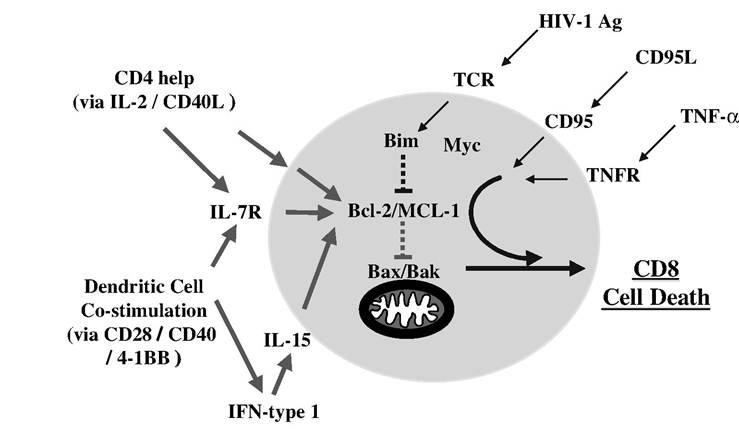
FIGURE 14.1 Proposed model for elevated apoptosis of CD8+ T lymphocytes in HIV-1 infection. Apoptosis is regulated by the balance between the anti-apoptotic effect of γ-chain cytokines and co-stimulation of upregulation of antiapoptotic Bcl-2 family members versus the pro-apoptotic effect of antigen-driven up-regulation of Bim and Myc and down-regulation of Bcl-2. Chronic antigenic stimulation also down-regulates the IL-7R and up-regulates CD95, CD95L, TNFR1, and TNF-α. Processes that increased during HIV-1 infection (HIV-1 Ag, CD95L, TNF-α, Bim, Myc, CD95, and TNFR) are shown in the upper right quadrant of the figure, whereas processes are shown in left half of the figure.
Other HIV-Related Mechanisms
Most reported effects of HIV-1 proteins on apoptosis apply to infected cells, and CD8+ T cells do not seem to be significantly infected in vivo,221 presumably due to lack of CD4 expression. However, there may be upregulation of CD4 after activation of CD8+ T cells in vitro222; in vivo, it was shown that CD8+ T cells, which also express CD4, are infected early in the course of infection.223
Exogenous Tat reportedly increases apoptosis of bystander cells224,225 but at relatively high concentrations.224 However, at such concentrations, Tat also was reported to have antiapoptotic effects.226 Therefore, the overall effect of Tat remains to be defined (Figure 14.1).
summary
Survival of CD8+ T cells under the normal conditions of homeostasis is primarily regulated by the effect of common γ-chain cytokines on expression of Bcl-2 family members, especially Bcl-2 itself. Antigenic activation in HIV-1 infection seems to upregulate Bim and decrease both IL-7R and Bcl-2, leading to a state in which CD8+ T cells are particularly sensitive to proapoptotic signals. A feature of chronic HIV-1 infection is an increase in plasma levels of soluble forms of CD95, CD95L, TNF- α, TNFR2, and IFN-γ, all of which may also be involved in feedback control of immune responses.
The resulting increased rate of apoptosis is directly related to increased turnover of activated, proliferating cells, which is also seen in other viral infections at acute stages but usually resolves as the virus is cleared. HIV antigen-driven chronic activation and proliferation occurs in an environment of greatly reduced CD4+ T cell help, as well as decreased dendritic cell numbers and function. Because longevity of memory CD8+ T cells is determined during the activation phase, HIV-specific CD8+ T cells may be programmed to contain lower amounts of antiapoptotic Bcl-2 family members and proceed rapidly toward senescence and apoptosis. Loss of effector CD8+ T cells with antiviral activity probably contributes significantly to disease progression.
ACKNOWLEDGMENTS
JC holds a Canada Research Chair in Medical Genomics. This research is supported by the San Diego Center for AIDS Research and the Veterans Medical Research Foundation.
REFERENCES
1. McMichael, A.J. and Rowland-Jones, S.L., Cellular immune responses to HIV, Nature, 410 (6831), 980-987, 2001.
2. Klein, M.R., van Baalen, C.A., Holwerda, A.M., Kerkhof Garde, S.R., Bende, R.J., Keet, I.P.M., Eeftinck-Schattenkerk, J.-K.M., Osterhaus, A.D.M.E., Schuitemaker, H., and Miedema, F., Kinetics of Gag-specific cytotoxic T lymphocyte responses during the clinical course of HIV-1 infection: a longitudinal analysis of rapid progressors and long-term asymptomatics, J. Exp. Med., 181 (4), 1365-1372, 1995.
3. Pantaleo, G. and Fauci, A.S., Immunopathogenesis of HIV infection, Annu. Rev. Microbiol., 50 (18), 825-854, 1996.
4. Pantaleo, G., Soudeyns, H., Demarest, J.F., Vaccarezza, M., Graziosi, C., Paolucci, S., Daucher, M., Cohen, O.J., Denis, F., Biddison, W.E., Sekaly, R.P., and Fauci, A.S., Evidence for rapid disappearance of initially expanded HIV-specific CD8+ T cell clones during primary HIV infection, Proc. Natl. Acad. Sci. U.S.A., 94 (18), 9848-9853, 1997.
5. Tenner-Racz, K., Racz, P., Thome, C., Meyer, C.G., Anderson, PJ., Schlossman, S.F., and Letvin, N.L., Cytotoxic effector cell granules recognized by the monoclonal antibody TIA-1 are present in CD8+ lymphocytes in lymph nodes of human immunodeficiency virus-1-infected patients, Am. J. Pathol., 142 (6), 1750-1758, 1993.
6. Appay, V., Nixon, D.F., Donahoe, S.M., Gillespie, G.M., Dong, T., King, A., Ogg, G.S., Spiegel, H.M., Conlon, C., Spina, C.A., Havlir, D.V., Richman, D.D., Waters, A., Easterbrook, P., McMichael, A.J., and Rowland-Jones, S.L., HIV-specific CD8(+) T cells produce antiviral cytokines but are impaired in cytolytic function, J. Exp. Med., 192 (1), 63-75, 2000.
7. Lieberman, J., Shankar, P., Manjunath, N., and Andersson, J., Dressed to kill? A review of why antiviral CD8 T lymphocytes fail to prevent progressive immunodeficiency in HIV-1 infection, Blood, 98 (6), 1667-1677, 2001.
8. Landay, A.L., Mackewicz, C.E., and Levy, J.A., An activated CD8+ T cell phenotype correlates with anti-HIV activity and asymptomatic clinical status, Clin. Immunol. and Immunopathol., 69 (1), 106-116, 1993.
9. Uehara, T., Miyawaki, T., Ohta, K., Tamaru, Y., Yokoi, T., Nakamura, S., and Taniguchi, N., Apoptotic cell death of primed CD45RO+ T lymphocytes in Epstein-Barr virus-induced infectious mononucleosis, Blood, 80 (2), 452-458, 1992.
10. Akbar, A.N., Borthwick, N., Salmon, M., Gombert, W., Bofill, M., Shamsadeen, N., Pilling, D., Pett, S., Grundy, J.E., and Janossy, G., The significance of low Bcl-2 expression by CD45RO T cells in normal individuals and patients with acute viral infections. The role of apoptosis in T cell memory,
J. Exp. Med., 178 (2), 427-438, 1993.
11. Callan, M.F., Fazou, C., Yang, H., Rostron, T., Poon, K., Hatton, C., and McMichael, A.J., CD8(+) T-cell selection, function, and death in the primary immune response in vivo, J. Clin. Invest., 106 (10), 1251-1261, 2000.
12. Butz, E.A. and Bevan, M.J., Massive expansion of antigen-specific CD8+ T cells during an acute virus infection, Immunity, 8 (2), 167-175, 1998.
13. Murali-Krishna, K., Altman, J.D., Suresh, M., Sourdive, D.J., Zajac, A.J., Miller, J.D., Slansky, J., and Ahmed, R., Counting antigen-specific CD8 T cells: a reevaluation of bystander activation during viral infection, Immunity, 8 (2), 177-187, 1998.
14. Masopust, D., Vezys, V., Marzo, A.L., and Lefrancois, L., Preferential localization of effector memory cells in nonlymphoid tissue, Science, 291 (5512), 2413-2417, 2001.
15. Marshall, D.R., Turner, S.J., Belz, G.T., Wingo, S., Andreansky, S., Sangster, M.Y., Riberdy, J.M., Liu, T., Tan, M., and Doherty, P.C., Measuring the diaspora for virus-specific CD8+ T cells, Proc. Natl. Acad. Sci. U.S.A., 98 (11), 6313-6318, 2001.
16. Roberts, A.D. and Woodland, D.L., Cutting edge: effector memory CD8+ T cells play a prominent role in recall responses to secondary viral infection in the lung, J. Immunol., 172 (11), 6533-6537, 2004.
17. Huang, L., Soldevila, G., Leeker, M., Flavell, R., and Crispe, I.N., The liver eliminates T cells undergoing antigen-triggered apoptosis in vivo, Immunity, 1 (9), 741-749, 1994.
18. Lauvau, G., Vijh, S., Kong, P., Horng, T., Kerksiek, K., Serbina, N., Tuma, R.A., and Pamer, E.G., Priming of memory but not effector CD8 T cells by a killed bacterial vaccine, Science, 294 (5547), 1735-1739, 2001.
19. Sun, J.C. and Bevan, M.J., Defective CD8 T cell memory following acute infection without CD4 T cell help, Science, 300 (5617), 339-342, 2003.
20. Shedlock, D.J. and Shen, H., Requirement for CD4 T cell help in generating functional CD8 T cell memory, Science, 300 (5617), 337-339, 2003.
21. Cooper, D., Bansal-Pakala, P., and Croft, M., 4-1BB (CD137) controls the clonal expansion and survival of CD8 T cells in vivo but does not contribute to the development of cytotoxicity, Eur. J. Immunol., 32 (2), 521-529, 2002.
22. Schluns, K.S., Williams, K., Ma, A., Zheng, X.X., and Lefrancois, L., Cutting edge: requirement for IL-15 in the generation of primary and memory antigen-specific CD8 T cells, J. Immunol., 168 (10), 4827-4831, 2002.
23. Wherry, E.J., Teichgraber, V., Becker, T.C., Masopust, D., Kaech, S.M., Antia, R., von Andrian, U.H., and Ahmed, R., Lineage relationship and protective immunity of memory CD8 T cell subsets, Nat. Immunol., 4 (3), 225-234, 2003.
24. Sprent, J. and Surh, C.D., T cell memory, Annu. Rev. Immunol., 20, 551-579, 2002.
25. Selin, L.K., Lin, M.Y., Kraemer, K.A., Pardoll, D.M., Schneck, J.P., Varga, S.M., Santolucito, P.A., Pinto, A.K., and Welsh, R.M., Attrition of T cell memory: selective loss of LCMV epitope-specific memory CD8 T cells following infections with heterologous viruses, Immunity, 11 (6), 733-742, 1999.
26. McNally, J.M., Zarozinski, C.C., Lin, M.Y., Brehm, M.A., Chen, H.D., and Welsh, R.M., Attrition of bystander CD8 T cells during virus-induced T-cell and interferon responses, J. Virol., 75 (13), 5965-5976, 2001.
27. Freitas, A.A. and Rocha, B., Population biology of lymphocytes: the flight for survival, Annu. Rev. Immunol., 18, 83-111, 2000.
28. Wallach, D., Varfolomeev, E.E., Malinin, N.L., Goltsev, Y.V., Kovalenko, A.V., and Boldin, M.P., Tumor necrosis factor receptor and Fas signaling mechanisms, Annu. Rev. Immunol., 17, 331-367,
1999.
29. Reich, A., Korner, H., Sedgwick, J.D., and Pircher, H., Immune down-regulation and peripheral deletion of CD8 T cells does not require TNF receptor-ligand interactions nor CD95 (Fas, APO-1), Eur. J. Immunol., 30 (2), 678-682, 2000.
30. Nguyen, L.T., McKall-Faienza, K., Zakarian, A., Speiser, D.E., Mak, T.W., and Ohashi, P.S., TNF receptor 1 (TNFR1) and CD95 are not required for T cell deletion after virus infection but contribute to peptide-induced deletion under limited conditions, Eur. J. Immunol., 30 (2), 683-688, 2000.
31. Sytwu, H.K., Liblau, R.S., and McDevitt, H.O., The roles of Fas/APO-1 (CD95) and TNF in antigen- induced programmed cell death in T cell receptor transgenic mice, Immunity, 5 (1), 17-30, 1996.
32. Turner, S.J., La Gruta, N.L., Stambas, J., Diaz, G., and Doherty, P.C., Differential tumor necrosis factor receptor 2-mediated editing of virus-specific CD8+ effector T cells, Proc. Natl. Acad. Sci. U.S.A., 101 (10), 3545-3550, 2004.
33. Fisher, G.H., Rosenberg, F.J., Straus, S.E., Dale, J.K., Middleton, L.A., Lin, A.Y., Strober, W., Lenardo, M.J., and Puck, J.M., Dominant interfering Fas gene mutations impair apoptosis in a human autoimmune lymphoproliferative syndrome, Cell, 81 (6), 935-946, 1995.
34. Chun, H.J., Zheng, L., Ahmad, M., Wang, J., Speirs, C.K., Siegel, R.M., Dale, J.K., Puck, J., Davis,
J., Hall, C.G., Skoda-Smith, S., Atkinson, T.P., Straus, S.E., and Lenardo, M.J., Pleiotropic defects in lymphocyte activation caused by caspase-8 mutations lead to human immunodeficiency, Nature, 419 (6905), 395-399, 2002.
35. Grayson, J.M., Zajac, A.J., Altman, J.D., and Ahmed, R., Cutting edge: increased expression of Bcl- 2 in antigen-specific memory CD8+ T cells, J. Immunol., 164 (8), 3950-3954, 2000.
36. Grayson, J.M., Murali-Krishna, K., Altman, J.D., and Ahmed, R., Gene expression in antigen-specific CD8+ T cells during viral infection, J. Immunol., 166 (2), 795-799, 2001.
37. Kaech, S.M., Tan, J.T., Wherry, E.J., Konieczny, B.T., Surh, C.D., and Ahmed, R., Selective expression of the interleukin 7 receptor identifies effector CD8 T cells that give rise to long-lived memory cells, Nat. Immunol., 4 (12), 1191-1198, 2003.
38. von Freeden-Jeffry, U., Solvason, N., Howard, M., and Murray, R., The earliest T lineage-committed cells depend on IL-7 for Bcl-2 expression and normal cell cycle progression, Immunity, 7 (1), 147-154, 1997.
39. Strasser, A., O'Connor, L., and Dixit, V.M., Apoptosis signaling, Annu. Rev. Biochem., 69, 217-245,
2000.
40. Razvi, E.S., Jiang, Z., Woda, B.A., and Welsh, R.M., Lymphocyte apoptosis during the silencing of the immune response to acute viral infections in normal, Lpr, and Bcl-2-transgenic mice, Am. J. Pathol., 147 (1), 79-91, 1995.
41. Petschner, F., Zimmerman, C., Strasser, A., Grillot, D., Nunez, G., and Pircher, H., Constitutive expression of Bcl-xL or Bcl-2 prevents peptide antigen-induced T cell deletion but does not influence T cell homeostasis after a viral infection, Eur. J. Immunol., 28 (2), 560-569, 1998.
42. O'Connor, L., Strasser, A., O'Reilly, L.A., Hausmann, G., Adams, J.M., Cory, S., and Huang, D.C., Bim: a novel member of the Bcl-2 family that promotes apoptosis, EMBO J., 17 (2), 384-395, 1998.
43. Pellegrini, M., Belz, G., Bouillet, P., and Strasser, A., Shutdown of an acute T cell immune response to viral infection is mediated by the proapoptotic Bcl-2 homology 3-only protein Bim, Proc. Natl. Acad. Sci. U.S.A., 100 (24), 14175-14180, 2003.
44. Opferman, J.T., Letai, A., Beard, C., Sorcinelli, M.D., Ong, C.C., and Korsmeyer, S.J., Development and maintenance of B and T lymphocytes requires antiapoptotic MCL-1, Nature, 426 (6967), 671-676, 2003.
45. Leu, J.I., Dumont, P., Hafey, M., Murphy, M.E., and George, D.L., Mitochondrial p53 activates Bak and causes disruption of a Bak-Mcl1 complex, Nat. Cell. Biol., 6 (5), 443-450, 2004.
46. Lindsten, T., Ross, A.J., King, A., Zong, W.X., Rathmell, J.C., Shiels, H.A., Ulrich, E., Waymire,
K.G., Mahar, P., Frauwirth, K., Chen, Y., Wei, M., Eng, V.M., Adelman, D.M., Simon, M.C., Ma, A., Golden, J.A., Evan, G., Korsmeyer, S.J., MacGregor, G.R., and Thompson, C.B., The combined functions of proapoptotic Bcl-2 family members Bak and Bax are essential for normal development of multiple tissues, Mol. Cell, 6 (6), 1389-1399, 2000.
47. Wei, M.C., Zong, W.X., Cheng, E.H., Lindsten, T., Panoutsakopoulou, V., Ross, A.J., Roth, K.A., MacGregor, G.R., Thompson, C.B., and Korsmeyer, S.J., Proapoptotic BAX and BAK: a requisite gateway to mitochondrial dysfunction and death, Science, 292 (5517), 727-730, 2001.
48. Cory, S., Huang, D.C., and Adams, J.M., The Bcl-2 family: roles in cell survival and oncogenesis, Oncogene, 22 (53), 8590-8607, 2003.
49. Marsden, V.S. and Strasser, A., Control of apoptosis in the immune system: Bcl-2, BH3-only proteins and more, Annu. Rev. Immunol., 21, 71-105, 2003.
50. Evan, G. and Littlewood, T., A matter of life and cell death, Science, 281 (5381), 1317-1322, 1998.
51. Bouchard, C., Staller, P., and Eilers, M., Control of cell proliferation by Myc, Trends Cell Biol., 8 (5), 202-206, 1998.
52. Smith, K.A., Interleukin 2, Annu. Rev. Immunol., 2, 319-333, 1984.
53. D'Souza, W.N., Schluns, K.S., Masopust, D., and Lefrancois, L., Essential role for IL-2 in the regulation of antiviral extralymphoid CD8 T cell responses, J. Immunol., 168 (11), 5566-5572, 2002.
54. D'Souza, W.N. and Lefrancois, L., IL-2 is not required for the initiation of CD8 T cell cycling but sustains expansion, J. Immunol., 171 (11), 5727-5735, 2003.
55. Van Parijs, L., Refaeli, Y., Lord, J.D., Nelson, B.H., Abbas, A.K., and Baltimore, D., Uncoupling IL-2 signals that regulate T cell proliferation, survival, and Fas-mediated activation-induced cell death, Immunity, 11 (3), 281-288, 1999.
56. Ku, C.C., Murakami, M., Sakamoto, A., Kappler, J., and Marrack, P., Control of homeostasis of CD8+ memory T cells by opposing cytokines, Science, 288 (5466), 675-678, 2000.
57. Sadlack, B., Merz, H., Schorle, H., Schimpl, A., Feller, A.C., and Horak, I., Ulcerative colitis-like disease in mice with a disrupted interleukin-2 gene, Cell, 75 (2), 253-261, 1993.
58. Willerford, D.M., Chen, J., Ferry, J.A., Davidson, L., Ma, A., and Alt, F.W., Interleukin-2 receptor chain regulates the size and content of the peripheral lymphoid compartment, Immunity, 3 (4), 521-530, 1995.
59. Lenardo, M., Chan, K.M., Hornung, F., McFarland, H., Siegel, R., Wang, J., and Zheng, L., Mature T lymphocyte apoptosis — immune regulation in a dynamic and unpredictable antigenic environment, Annu. Rev. Immunol., 17, 221-253, 1999.
60. Shevach, E.M., CD4+ CD25+ suppressor T cells: more questions than answers, Nat. Rev. Immunol., 2 (6), 389-400, 2002.
61. Schluns, K.S. and Lefrancois, L., Cytokine control of memory T-cell development and survival, Nat. Rev. Immunol., 3 (4), 269-279, 2003.
62. Marrack, P. and Kappler, J., Control of T cell viability, Annu. Rev. Immunol., 22, 765-787, 2004.
63. Vella, A.T., Dow, S., Potter, T.A., Kappler, J., and Marrack, P., Cytokine-induced survival of activated T cells in vitro and in vivo, Proc. Natl. Acad. Sci. U.S.A., 95 (7), 3810-3815, 1998.
64. Lodolce, J.P., Boone, D.L., Chai, S., Swain, R.E., Dassopoulos, T., Trettin, S., and Ma, A., IL-15 receptor maintains lymphoid homeostasis by supporting lymphocyte homing and proliferation, Immunity, 9 (5), 669-676, 1998.
65. Kennedy, M.K., Glaccum, M., Brown, S.N., Butz, E.A., Viney, J.L., Embers, M., Matsuki, N., Charrier,
K., Sedger, L., Willis, C.R., Brasel, K., Morrissey, PJ., Stocking, K., Schuh, J.C., Joyce, S., and Peschon, J.J., Reversible defects in natural killer and memory CD8 T cell lineages in interleukin 15-deficient mice, J. Exp. Med., 191 (5), 771-780, 2000.
66. Li, X.C., Demirci, G., Ferrari-Lacraz, S., Groves, C., Coyle, A., Malek, T.R., and Strom, T.B., IL-15 and IL-2: a matter of life and death for T cells in vivo, Nat. Med., 7 (1), 114-118, 2001.
67. Wu, T.S., Lee, J.M., Lai, Y.G., Hsu, J.C., Tsai, C.Y., Lee, Y.H., and Liao, N.S., Reduced expression of Bcl-2 in CD8+ T cells deficient in the IL-15 receptor -chain, J. Immunol., 168 (2), 705-712, 2002.
68. Zhang, X., Sun, S., Hwang, I., Tough, D.F., and Sprent, J., Potent and selective stimulation of memoryphenotype CD8+ T cells in vivo by IL-15, Immunity, 8 (5), 591-599, 1998.
69. Goldrath, A.W., Sivakumar, P.V., Glaccum, M., Kennedy, M.K., Bevan, M.J., Benoist, C., Mathis, D., and Butz, E.A., Cytokine requirements for acute and basal homeostatic proliferation of naive and memory CD8+ T cells, J. Exp. Med., 195 (12), 1515-1522, 2002.
70. Tough, D.F., Borrow, P., and Sprent, J., Induction of bystander T cell proliferation by viruses and type 1 interferon in vivo, Science, 272, 1947-1950, 1996.
71. Siegal, F.P., Kadowaki, N., Shodell, M., Fitzgerald-Bocarsly, P.A., Shah, K., Ho, S., Antonenko, S., and Liu, Y.J., The nature of the principal type 1 interferon-producing cells in human blood, Science, 284 (5421), 1835-1837, 1999.
72. Marrack, P., Kappler, J., and Mitchell, T., Type I interferons keep activated T cells alive, J. Exp. Med., 189 (3), 521-530, 1999.
73. Pilling, D., Akbar, A.N., Girdlestone, J., Orteu, C.H., Borthwick, N.J., Amft, N., Scheel-Toellner, D., Buckley, C.D., and Salmon, M., Interferon- mediates stromal cell rescue of T cells from apoptosis, Eur. J. Immunol., 29 (3), 1041-1050, 1999.
74. Scheel-Toellner, D., Pilling, D., Akbar, A.N., Hardie, D., Lombardi, G., Salmon, M., and Lord, J.M., Inhibition of T cell apoptosis by IFN- rapidly reverses nuclear translocation of protein kinase C-, Eur. J. Immunol., 29 (8), 2603-2612, 1999.
75. Shimoda, K., Kamesaki, K., Numata, A., Aoki, K., Matsuda, T., Oritani, K., Tamiya, S., Kato, K., Takase, K., Imamura, R., Yamamoto, T., Miyamoto, T., Nagafuji, K., Gondo, H., Nagafuchi, S., Nakayama, K., and Harada, M., Cutting edge: Tyk2 is required for the induction and nuclear translocation of Daxx which regulates IFN-induced suppression of B lymphocyte formation, J. Immunol., 169 (9), 4707-4711, 2002.
76. Chen, Q., Gong, B., Mahmoud-Ahmed, A.S., Zhou, A., Hsi, E.D., Hussein, M., and Almasan, A., Apo2L∕TRAIL and Bcl-2-related proteins regulate type I interferon-induced apoptosis in multiple myeloma, Blood, 98 (7), 2183-2192, 2001.
77. Badovinac, V.P., Tvinnereim, A.R., and Harty, J.T., Regulation of antigen-specific CD8+ T cell homeostasis by perforin and interferon-, Science, 290 (5495), 1354-1358, 2000.
78. Badovinac, V.P., Hamilton, S.E., and Harty, J.T., Viral infection results in massive CD8+ T cell expansion and mortality in vaccinated perforin-deficient mice, Immunity, 18 (4), 463-474, 2003.
79. Dalton, D.K., Haynes, L., Chu, C.Q., Swain, S.L., and Wittmer, S., Interferon eliminates responding CD4 T cells during mycobacterial infection by inducing apoptosis of activated CD4 T cells, J. Exp. Med., 192 (1), 117-122, 2000.
80. Tesselaar, K., Arens, R., van Schijndel, G.M., Baars, P.A., van der Valk, M.A., Borst, J., van Oers, M.H., and van Lier, R.A., Lethal T cell immunodeficiency induced by chronic costimulation via CD27-CD70 interactions, Nat. Immunol., 4 (1), 49-54, 2003.
81. Margolick, J.B., Munoz, A., Donnenberg, A.D., Park, L.P., Galai, N., Giorgi, J.V., Gorman, M.R.G., and Ferbas, J., for the Multicenter AIDS cohort study, Failure of T-cell homeostasis preceding AIDS in HIV-1 infection, Nat. Med., 1 (7), 674-680, 1995.
82. Hellerstein, M., Hanley, M.B., Cesar, D., Siler, S., Papageorgopoulos, C., Wieder, E., Schmidt, D., Hoh, R., Neese, R., Macallan, D., Deeks, S., and McCune, J.M., Directly measured kinetics of circulating T lymphocytes in normal and HIV-1-infected humans, Nat. Med., 5 (1), 83-89, 1999.
83. Lempicki, R.A., Kovacs, J.A., Baseler, M.W., Adelsberger, J.W., Dewar, R.L., Natarajan, V., Bosche, M.C., Metcalf, J.A., Stevens, R.A., Lambert, L.A., Alvord, W.G., Polis, M.A., Davey, R.T., Dimitrov, D.S., and Lane, H.C., Impact of HIV-1 infection and highly active antiretroviral therapy on the kinetics of CD4+ and CD8+ T cell turnover in HIV-infected patients, Proc. Natl. Acad. Sci. U.S.A., 97 (25), 13778-13783, 2000.
84. Sachsenberg, N., Perelson, A.S., Yerly, S., Schockmel, G.A., Leduc, D., Hirschel, B., and Perrin, L., Turnover of CD4+ and CD8+ T lymphocytes in HIV-1 infection as measured by Ki-67 antigen, J. Exp. Med., 187 (8), 1295-1303, 1998.
85. Giorgi, J.V. and Detels, R., T-cell subset alterations in HIV-infected homosexual men: NIAID Multicenter AIDS Cohort Study, Clin. Immunol. Immunopathol., 52 (1), 10-18, 1989.
86. Kelleher, A.D., Carr, A., Zaunders, J., and Cooper, D.A., Alterations in the immune response of human immunodeficiency virus (HIV)-infected subjects treated with an HIV-specific protease inhibitor, ritonavir, J. Infect. Dis., 173 (2), 321-329, 1996.
87. Gray, C.M., Schapiro, J.M., Winters, M.A., and Merigan, T.C., Changes in CD4+ and CD8+ T cell subsets in response to highly active antiretroviral therapy in HIV type 1-infected patients with prior protease inhibitor experience, AIDS Res. Hum. Retroviruses, 14 (7), 561-569, 1998.
88. Hazenberg, M.D., Stuart, J.W., Otto, S.A., Borleffs, J.C., Boucher, C.A., de Boer, R.J., Miedema, F., and Hamann, D., T-cell division in human immunodeficiency virus (HIV)-1 infection is mainly due to immune activation: a longitudinal analysis in patients before and during highly active antiretroviral therapy (HAART), Blood, 95 (1), 249-255, 2000.
89. Mohri, H., Perelson, A.S., Tung, K., Ribeiro, R.M., Ramratnam, B., Markowitz, M., Kost, R., Hurley,
A., Weinberger, L., Cesar, D., Hellerstein, M.K., and Ho, D.D., Increased turnover of T lymphocytes in HIV-1 infection and its reduction by antiretroviral therapy, J. Exp. Med., 194 (9), 1277-1287, 2001.
90. Bouscarat, F., Levacher-Clergeot, M., Dazza, M.-C., Strauss, K.W., Girard, P.-M., Ruggeri, C., and Sinet, M., Correlation of CD8 lymphocyte activation with cellular viremia and plasma HIV RNA levels in asymptomatic patients infected by human immunodeficiency virus type 1, AIDS Res. Hum. Retroviruses, 12 (1), 17-24, 1996.
91. Zaunders, J.J., Cunningham, P.H., Kelleher, A.D., Kaufmann, G.R., Jaramillo, A.B., Wright, R., Smith, D., Grey, P., Vizzard, J., Carr, A., and Cooper, D.A., Potent antiretroviral therapy of primary human immunodeficiency virus type 1 (HIV-1) infection: partial normalization of T lymphocyte subsets and limited reduction of HIV-1 DNA despite clearance of plasma viremia, J. Infect. Dis., 180 (2), 320-329, 1999.
92. Liu, Z., Cumberland, W.G., Hultin, L.E., Kaplan, A.H., Detels, R., and Giorgi, J.V., CD8+ T-lymphocyte activation in HIV-1 disease reflects an aspect of pathogenesis distinct from viral burden and immunodeficiency, J. Acquir. Immune Defic. Syndr. Hum. Retrovirol., 18 (4), 332-340, 1998.
93. Kovacs, J.A., Lempicki, R.A., Sidorov, I.A., Adelsberger, J.W., Herpin, B., Metcalf, J.A., Sereti, I., Polis, M.A., Davey, R.T., Tavel, J., Falloon, J., Stevens, R., Lambert, L., Dewar, R., Schwartzentruber, D.J., Anver, M.R., Baseler, M.W., Masur, H., Dimitrov, D.S., and Lane, H.C., Identification of dynamically distinct subpopulations of T lymphocytes that are differentially affected by HIV, J. Exp. Med., 194 (12), 1731-1741, 2001.
94. Callan, M.F., Tan, L., Annels, N., Ogg, G.S., Wilson, J.D., O’Callaghan, C.A., Steven, N., McMichael,
A. J., and Rickinson, A.B., Direct visualization of antigen-specific CD8+ T cells during the primary immune response to Epstein-Barr virus in vivo, J. Exp. Med., 187 (9), 1395-1402, 1998.
95. Ho, H.-N., Hutlin, L.E., Mitsuyasu, R.T., Matud, J.L., Hausner, M.A., Bockstoce, D., Chou, C.-C., O’Rourke, S., Taylor, J.M.G., and Giorgi, J.V., Circulating HIV-specific CD8+ cytotoxic T cells express CD38 and HLA-DR antigens, J. Immunol., 150 (7), 3070-3079, 1993.
96. Ogg, G.S., Jin, X., Bonhoeffer, S., Moss, P., Nowak, M.A., Monard, S., Segal, J.P., Cao, Y., Rowland- Jones, S.L., Hurley, A., Markowitz, M., Ho, D.D., McMichael, A.J., and Nixon, D.F., Decay kinetics of human immunodeficiency virus-specific effector cytotoxic T lymphocytes after combination antiretroviral therapy, J. Virol., 73, 797-800, 1999.
97. Betts, M.R., Ambrozak, D.R., Douek, D.C., Bonhoeffer, S., Brenchley, J.M., Casazza, J.P., Koup, R.A., and Picker, L.J., Analysis of total human immunodeficiency virus (HIV)-specific CD4(+) and CD8(+) T-cell responses: relationship to viral load in untreated HIV infection, J. Virol., 75 (24), 11983-11991, 2001.
98. Addo, M.M., Yu, X.G., Rathod, A., Cohen, D., Eldridge, R.L., Strick, D., Johnston, M.N., Corcoran,
C., Wurcel, A.G., Fitzpatrick, C.A., Feeney, M.E., Rodriguez, W.R., Basgoz, N., Draenert, R., Stone,
D. R., Brander, C., Goulder, PJ., Rosenberg, E.S., Altfeld, M., and Walker, B.D., Comprehensive epitope analysis of human immunodeficiency virus type 1 (HIV-1)-specific T-cell responses directed against the entire expressed HIV-1 genome demonstrate broadly directed responses, but no correlation to viral load, J. Virol., 77 (3), 2081-2092, 2003.
99. Allen, T.M., O'Connor, D.H., Jing, P., Dzuris, J.L., Mothe, B.R., Vogel, T.U., Dunphy, E., Liebl, M.E., Emerson, C., Wilson, N., Kunstman, K.J., Wang, X., Allison, D.B., Hughes, A.L., Desrosiers, R.C., Altman, J.D., Wolinsky, S.M., Sette, A., and Watkins, D.I., Tat-specific cytotoxic T lymphocytes select for SIV escape variants during resolution of primary viraemia, Nature, 407 (6802), 386-390, 2000.
100. Altfeld, M., Addo, M.M., Shankarappa, R., Lee, P.K., Allen, T.M., Yu, X.G., Rathod, A., Harlow, J., O'Sullivan, K., Johnston, M.N., Goulder, PJ., Mullins, J.I., Rosenberg, E.S., Brander, C., Korber, B., and Walker, B.D., Enhanced detection of human immunodeficiency virus type 1-specific T-cell responses to highly variable regions by using peptides based on autologous virus sequences, J. Virol., 77 (13), 7330-7340, 2003.
101. Cardinaud, S., Moris, A., Fevrier, M., Rohrlich, P.S., Weiss, L., Langlade-Demoyen, P., Lemonnier, F.A., Schwartz, O., and Habel, A., Identification of cryptic MHC I-restricted epitopes encoded by HIV-1 alternative reading frames, J. Exp. Med., 199 (8), 1053-1063, 2004.
102. Roederer, M., Brenchley, J.M., Betts, M.R., and De Rosa, S.C., Flow cytometric analysis of vaccine responses: how many colors are enough? Clin. Immunol., 110 (3), 199-205, 2004.
103. Lichterfeld, M., Yu, X.G., Waring, M.T., Mui, S.K., Johnston, M., Cohen, D., Addo, M.M., Zaunders, J., Alter, G., Pae, E., Strick, D., Allen, T.M., Rosenberg, E.S., Walker, B.D., and Altfeld, M., HIV-1- specific cytotoxicity is preferentially mediated by a subset of CD8+ T cells producing both interferon- and tumor-necrosis factor-, Blood, April 1 (vol 104 (2), 487-494), 2004.
104. Shankarappa, R., Margolick, J.B., Gange, S.J., Rodrigo, A.G., Upchurch, D., Farzadegan, H., Gupta, P., Rinaldo, C.R., Learn, G.H., He, X., Huang, X.L., and Mullins, J.I., Consistent viral evolutionary changes associated with the progression of human immunodeficiency virus type 1 infection, J. Virol., 73 (12), 10489-10502, 1999.
105. Wei, X., Decker, J.M., Wang, S., Hui, H., Kappes, J.C., Wu, X., Salazar-Gonzalez, J.F., Salazar, M.G., Kilby, J.M., Saag, M.S., Komarova, N.L., Nowak, M.A., Hahn, B.H., Kwong, P.D., and Shaw, G.M., Antibody neutralization and escape by HIV-1, Nature, 422 (6929), 307-312, 2003.
106. Abel, K., Alegria-Hartman, M.J., Rothaeusler, K., Marthas, M., and Miller, C.J., The relationship between simian immunodeficiency virus RNA levels and the mRNA levels of / interferons (IFN-/) and IFN-∕-inducible Mx in lymphoid tissues of rhesus macaques during acute and chronic infection, J. Virol., 76 (16), 8433-8445, 2002.
107. Lore, K., Sonnerborg, A., Brostrom, C., Goh, L.E., Perrin, L., McDade, H., Stellbrink, H.J., Gazzard,
B., Weber, R., Napolitano, L.A., van Kooyk, Y., and Andersson, J., Accumulation of DC-SIGN+CD40+ dendritic cells with reduced CD80 and CD86 expression in lymphoid tissue during acute HIV-1 infection, AIDS, 16 (5), 683-692, 2002.
108. Kacani, L., Stoiber, H., and Dierich, M.P., Role of IL-15 in HIV-1-associated hypergammaglobuli- naemia, Clin. Exp. Immunol., 108 (1), 14-18, 1997.
109. Amicosante, M., Poccia, F., Gioia, C., Montesano, C., Topino, S., Martini, F., Narciso, P., Pucillo,
L. P., and D'Offizi, G., Levels of interleukin-15 in plasma may predict a favorable outcome of structured treatment interruption in patients with chronic human immunodeficiency virus infection, J. Infect. Dis., 188 (5), 661-665, 2003.
110. d'Ettorre, G., Forcina, G., Lichtner, M., Mengoni, F., D'Agostino, C., Massetti, A.P., Mastroianni,
C. M., and Vullo, V., Interleukin-15 in HIV infection: immunological and virological interactions in antiretroviral-naive and -treated patients, AIDS, 16 (2), 181-188, 2002.
111. Ahmad, R., Sindhu, S.T., Toma, E., Morisset, R., and Ahmad, A., Studies on the production of IL-15 in HIV-infected/AIDS patients, J. Clin. Immunol., 23 (2), 81-90, 2003.
112. Donaghy, H., Pozniak, A., Gazzard, B., Qazi, N., Gilmour, J., Gotch, F., and Patterson, S., Loss of blood CD11c(+) myeloid and CD11c(-) plasmacytoid dendritic cells in patients with HIV-1 infection correlates with HIV-1 RNA virus load, Blood, 98 (8), 2574-2576, 2001.
113. Giorgi, J.V., Ho, N.-H., Hirji, K., Chou, C.-C., Hultin, L.E., O'Rourke, S., Park, L., Margolick, J.B., Ferbas, J., Phair, J.P., and The Multicenter AIDS Cohort Study Group, CD8+ lymphocyte activation at human immunodeficiency virus type 1 seroconversion: development of HLA-DR+CD38-CD8+ cells is associated with subsequent stable CD4+ cell levels, J. Infect. Dis., 170 (4), 775-781, 1994.
114. Zaunders, J.J., Geczy, A.F., Dyer, W.B., McIntyre, L.B., Cooley, M.A., Ashton, L.J., Raynes-Greenow, C.H., Learmont, J., Cooper, D.A., and Sullivan, J.S., Effect of long-term infection with Nef-defective attenuated HIV type 1 on CD4+ and CD8+ T lymphocytes: increased CD45RO+CD4+ T lymphocytes and limited activation of CD8+ T lymphocytes, AIDS Res. Hum. Retroviruses, 15 (17), 1519-1527, 1999.
115. Sousa, A.E., Carneiro, J., Meier-Schellersheim, M., Grossman, Z., and Victorino, R.M., CD4 T cell depletion is linked directly to immune activation in the pathogenesis of HIV-1 and HIV-2 but only indirectly to the viral load, J. Immunol., 169 (6), 3400-3406, 2002.
116. Gougeon, M.L., Garcia, S., Heeney, J., Tschopp, R., Lecoeur, H., Guetard, D., Rame, V., Dauguet, C., and Montagnier, L., Programmed cell death in AIDS-related HIV and SIV infections, AIDS Res. Hum. Retroviruses, 9 (6), 553-563, 1993.
117. Silvestri, G., Sodora, D.L., Koup, R.A., Paiardini, M., O'Neil, S.P., McClure, H.M., Staprans, S.I., and Feinberg, M.B., Nonpathogenic SIV infection of sooty mangabeys is characterized by limited bystander immunopathology despite chronic high-level viremia, Immunity, 18 (3), 441-452, 2003.
118. Monceaux, V., Ho Tsong Fang, R., Cumont, M.C., Hurtrel, B., and Estaquier, J., Distinct cycling CD4(+)- and CD8(+)-T-cell profiles during the asymptomatic phase of simian immunodeficiency virus SIVmac251 infection in rhesus macaques, J. Virol., 77 (18), 10047-10059, 2003.
119. Chakrabarti, L.A., Lewin, S.R., Zhang, L., Gettie, A., Luckay, A., Martin, L.N., Skulsky, E., Ho, D.D., Cheng-Mayer, C., and Marx, P.A., Normal T-cell turnover in sooty mangabeys harboring active simian immunodeficiency virus infection, J. Virol., 74 (3), 1209-1223, 2000.
120. Tindall, B. and Cooper, D.A., Primary HIV infection: host responses and intervention strategies, AIDS, 5 (1), 1-14, 1991.
121. Mackay, C.R., Marston, W., and Dudler, L., Altered patterns of T cell migration through lymph nodes and skin following antigen challenge, Eur. J. Immunol., 22 (9), 2205-2210, 1992.
122. Kaufmann, G.R., Cunningham, P., Zaunders, J., Law, M., Carr, A., Cooper, D.A., and Group, T.S.P.H.I.S., Impact of early HIV-1 RNA and T-lymphocyte dynamics during primary HIV-1 infection on the subsequent course of HIV-1 RNA and CD4+ T-lymphocyte counts in the first year of HIV-1 infection, J. Acquir Immun. Defic. Syndr., 22 (5), 437-444, 1999.
123. Roederer, M., Dubs, J.G., Anderson, M.T., Raju, P.A., Herzenberg, L.A., and Herzenberg, L.A., CD8 naive T cell counts decrease progressively in HIV-infected adults, J. Clin. Invest., 95 (5), 2061-2066, 1995.
124. Onanga, R., Kornfeld, C., Pandrea, I., Estaquier, J., Souquiere, S., Rouquet, P., Mavoungou, V.P., Bourry, O., M'Boup, S., Barre-Sinoussi, F., Simon, F., Apetrei, C., Roques, P., and Muller-Trutwin,
M.C., High levels of viral replication contrast with only transient changes in CD4(+) and CD8(+) cell numbers during the early phase of experimental infection with simian immunodeficiency virus SIVmnd-1 in Mandrillus sphinx, J. Virol., 76 (20), 10256-10263, 2002.
125. Monceaux, V., Estaquier, J., Fevrier, M., Cumont, M.C., Riviere, Y., Aubertin, A.M., Ameisen, J.C., and Hurtrel, B., Extensive apoptosis in lymphoid organs during primary SIV infection predicts rapid progression towards AIDS, AIDS, 17 (11), 1585-1596, 2003.
126. Lynne, J.E., Schmid, I., Matud, J.L., Hirji, K., Buessow, S., Shlian, D.M., and Giorgi, J.V., Major expansions of select CD8+ subsets in acute Epstein-Barr virus infection: comparison with chronic human immunodeficiency virus disease, J. Infect. Dis., 177 (4), 1083-1087, 1998.
127. Roos, M.T., van Lier, R.A., Hamann, D., Knol, G.J., Verhoofstad, I., van Baarle, D., Miedema, F., and Schellekens, P.T., Changes in the composition of circulating CD8+ T cell subsets during acute Epstein-Barr and human immunodeficiency virus infections in humans, J. Infect. Dis., 182 (2), 451-458, 2000.
128. Zaunders, J.J., Kaufmann, G.R., Cunningham, P.H., Smith, D., Grey, P., Suzuki, K., Carr, A., Goh,
L. E., and Cooper, D.A., Increased turnover of CCR5+ and redistribution of CCR5 CD4 T lymphocytes during primary human immunodeficiency virus type 1 infection, J. Infect. Dis., 183 (5), 736-743, 2001.
129. Altfeld, M., Rosenberg, E.S., Shankarappa, R., Mukherjee, J.S., Hecht, F.M., Eldridge, R.L., Addo,
M.M., Poon, S.H., Phillips, M.N., Robbins, G.K., Sax, P.E., Boswell, S., Kahn, J.O., Brander, C., Goulder, PJ., Levy, J.A., Mullins, J.I., and Walker, B.D., Cellular immune responses and viral diversity in individuals treated during acute and early HIV-1 infection, J. Exp. Med., 193 (2), 169-180, 2001.
130. Alter, G., Merchant, A., Tsoukas, C.M., Rouleau, D., LeBlanc, R.P., Cote, P., Baril, J.G., Thomas, R., Nguyen, V.K., Sekaly, R.P., Routy, J.P., and Bernard, N.F., Human immunodeficiency virus (HIV)- specific effector CD8 T cell activity in patients with primary HIV infection, J. Infect. Dis., 185 (6), 755-765, 2002.
131. Rosenberg, E.S., Altfeld, M., Poon, S.H., Phillips, M.N., Wilkes, B.M., Eldridge, R.L., Robbins, G.K., D’Aquila, R.T., Goulder, PJ., and Walker, B.D., Immune control of HIV-1 after early treatment of acute infection, Nature, 407 (6803), 523-526, 2000.
132. Koup, R.A., Safrit, J.T., Cao, Y., Andrews, C.A., McLeod, G., Borkowsky, W., Farthing, C., and Ho,
D. D., Temporal association of cellular immune responses with the initial control of viremia in primary human immunodeficiency virus type 1 syndrome, J. Virol., 68 (7), 4650-4655, 1994.
133. Borrow, P., Lewicki, H., Hahn, B.H., Shaw, G.M., and Oldstone, M.B.A., Virus-specific CD8+ cytotoxic T-lymphocyte activity associated with control of viremia in primary human immunodeficiency virus type 1 infection, J. Virol., 68 (9), 6103-6110, 1994.
134. Schmitz, J.E., Kuroda, M.J., Santra, S., Sasseville, V.G., Simon, M.A., Lifton, M.A., Racz, P., Tenner- Racz, K., Dalesandro, M., Scallon, B.J., Ghrayeb, J., Forman, M.A., Montefiori, D.C., Rieber, E.P., Letvin, N.L., and Reimann, K.A., Control of viremia in simian immunodeficiency virus infection by CD8+ lymphocytes, Science, 283 (5304), 857-860, 1999.
135. Appay, V., Dunbar, P.R., Callan, M., Klenerman, P., Gillespie, G.M., Papagno, L., Ogg, G.S., King, A., Lechner, F., Spina, C.A., Little, S., Havlir, D.V., Richman, D.D., Gruener, N., Pape, G., Waters, A., Easterbrook, P., Salio, M., Cerundolo, V., McMichael, A.J., and Rowland-Jones, S.L., Memory CD8+ T cells vary in differentiation phenotype in different persistent virus infections, Nat. Med., 8 (4), 379-385, 2002.
136. Champagne, P., Ogg, G.S., King, A.S., Knabenhans, C., Ellefsen, K., Nobile, M., Appay, V., Rizzardi, G.P., Fleury, S., Lipp, M., Forster, R., Rowland-Jones, S., Sekaly, R.P., McMichael, A.J., and Pantaleo, G., Skewed maturation of memory HIV-specific CD8 T lymphocytes, Nature, 410 (6824), 106-111, 2001.
137. Clerici, M. and Shearer, G.M., TH-1 to TH2 switch is a critical step in the etiology of HIV infection, Immunol. Today, 14 (3), 107-111, 1993.
138. Younes, S.A., Yassine-Diab, B., Dumont, A.R., Boulassel, M.R., Grossman, Z., Routy, J.P., and Sekaly,
R. P., HIV-1 viremia prevents the establishment of interleukin 2-producing HIV-specific memory CD4+ T cells endowed with proliferative capacity, J. Exp. Med., 198 (12), 1909-1922, 2003.
139. Iyasere, C., Tilton, J.C., Johnson, A.J., Younes, S., Yassine-Diab, B., Sekaly, R.P., Kwok, W.W., Migueles, S.A., Laborico, A.C., Shupert, W.L., Hallahan, C.W., Davey, R.T., Jr., Dybul, M., Vogel,
S., Metcalf, J., and Connors, M., Diminished proliferation of human immunodeficiency virus-specific CD4+ T cells is associated with diminished interleukin-2 (IL-2) production and is recovered by exogenous IL-2, J. Virol., 77 (20), 10900-10909, 2003.
140. Zhou, J., Zhang, J., Lichtenheld, M.G., and Meadows, G.G., A role for NF-B activation in perforin expression of NK cells upon IL-2 receptor signaling, J. Immunol., 169 (3), 1319-1325, 2002.
141. Picker, L.J. and Maino, V.C., The CD4(+) T cell response to HIV-1, Curr. Opin. Immunol., 12 (4), 381-386, 2000.
142. Migueles, S.A., Laborico, A.C., Shupert, W.L., Sabbaghian, M.S., Rabin, R., Hallahan, C.W., Van Baarle, D., Kostense, S., Miedema, F., McLaughlin, M., Ehler, L., Metcalf, J., Liu, S., and Connors, M., HIV-specific CD8+ T cell proliferation is coupled to perforin expression and is maintained in nonprogressors, Nat. Immunol., 3 (11), 1061-1068, 2002.
143. Kelleher, A.D., Roggensack, M., Emery, S., Carr, A., French, M.A., and Cooper, D.A., Effects of IL-2 therapy in asymptomatic HIV-infected individuals on proliferative responses to mitogens, recall antigens and HIV-related antigens, Clin. Exp. Immunol., 113 (1), 85-91, 1998.
144. Sereti, I., Anthony, K.B., Martinez-Wilson, H., Lempicki, R., Adelsberger, J., Metcalf, J.A., Hallahan, C.W., Follmann, D., Davey, R.T., Kovacs, J.A., and Lane, H.C., IL-2 induced CD4+ T cell expansion in HIV-infected patients is associated with long-term decreases in T cell proliferation, Blood, 104 (3), 775-780, 2004.
145. Effros, R.B., Allsopp, R., Chiu, C.P., Hausner, M.A., Hirji, K., Wang, L., Harley, C.B., Villeponteau,
B., West, M.D., and Giorgi, J.V., Shortened telomeres in the expanded CD28-CD8+ cell subset in HIV disease implicate replicative senescence in HIV pathogenesis, AIDS, 10 (8), F17-F22, 1996.
146. Papagno, L., Spina, C.A., Marchant, A., Salio, M., Rufer, N., Little, S., Dong, T., Chesney, G., Waters, A., Easterbrook, P., Dunbar, P.R., Shepherd, D., Cerundolo, V., Emery, V., Griffiths, P., Conlon, C., McMichael, A.J., Richman, D.D., Rowland-Jones, S.L., and Appay, V., Immune activation and CD8(+) T-cell differentiation towards senescence in HIV-1 infection, PLoS Biol., 2 (2), E20, 2004.
147. Lieberman, J., Trimble, L.A., Friedman, R.S., Lisziewicz, J., Lori, F., Shankar, P., and Jessen, H., Expansion of CD57 and CD62L-CD45RA+ CD8 T lymphocytes correlates with reduced viral plasma RNA after primary HIV infection, AIDS, 13 (8), 891-899, 1999.
148. Brenchley, J.M., Karandikar, N.J., Betts, M.R., Ambrozak, D.R., Hill, B.J., Crotty, L.E., Casazza, J.P., Kuruppu, J., Migueles, S.A., Connors, M., Roederer, M., Douek, D.C., and Koup, R.A., Expression of CD57 defines replicative senescence and antigen-induced apoptotic death of CD8+ T cells, Blood, 101 (7), 2711-2720, 2003.
149. Muro-Cacho, C.A., Pantaleo, G., and Fauci, A.S., Analysis of apoptosis in lymph nodes of HIV- infected persons. Intensity of apoptosis correlates with the general state of activation of the lymphoid tissue and not with stage of disease or viral burden, J. Immunol., 154 (10), 5555-5566, 1995.
150. Bofill, M., Gombert, W., Borthwick, N.J., Akbar, A.N., McLaughlin, J.E., Lee, C.A., Johnson, M.A., Pinching, A.J., and Janossy, G., Presence of CD3+CD8+Bcl-2(low) lymphocytes undergoing apoptosis and activated macrophages in lymph nodes of HIV-1+ patients, Am. J. Pathol., 146 (6), 1542-1555, 1995.
151. Finkel, T.H., Tudor-Williams, G., Banda, N.K., Cotton, M.F., Curiel, T., Monks, C., Baba, T.W., Ruprecht, R.M., and Kupfer, A., Apoptosis occurs predominantly in bystander cells and not in productively infected cells of HIV- and SIV-infected lymph nodes, Nat. Med., 1 (2), 129-134, 1995.
152. Iida, T., Ichimura, H., Ui, M., Shimada, T., Akahata, W., Igarashi, T., Kuwata, T., Ido, E., Yonehara, S., Imanishi, J., and Hayami, M., Sequential analysis of apoptosis induction in peripheral blood mononuclear cells and lymph nodes in the early phase of pathogenic and nonpathogenic SIVmac infection, AIDS Res. Hum. Retroviruses, 15 (8), 721-729, 1999.
153. Wallace, M., Waterman, P.M., Mitchen, J.L., Djavani, M., Brown, C., Trivedi, P., Horejsh, D., Dykhui- zen, M., Kitabwalla, M., and Pauza, C.D., Lymphocyte activation during acute simian/human immunodeficiency virus SHIV(89.6PD) infection in macaques, J. Virol., 73 (12), 10236-10244, 1999.
154. Savill, J., Dransfield, I., Gregory, C., and Haslett, C., A blast from the past: clearance of apoptotic cells regulates immune responses, Nat. Rev. Immunol., 2 (12), 965-975, 2002.
155. Ameisen, J.C., Estaquier, J., and Idziorek, T., From AIDS to parasite infection: pathogen-mediated subversion of programmed cell death as a mechanism for immune dysregulation, Immunol. Rev., 142, 9-51, 1994.
156. Meyaard, L., Otto, S.A., Jonker, R.R., Mijnster, M.J., Keet, R.P., and Miedema, F., Programmed death of T cells in HIV-1 infection, Science, 257 (5067), 217-219, 1992.
157. Sarin, A., Clerici, M., Blatt, S.P., Hendrix, C.W., Shearer, G.M., and Henkart, P.A., Inhibition of activation-induced programmed cell death and restoration of defective immune responses of HIV+ donors by cysteine protease inhibitors, J. Immunol., 153 (2), 862-872, 1994.
158. Oyaizu, N., McCloskey, T.W., Coronesi, M., Chirmule, N., Kalyanaraman, V.S., and Pahwa, S., Accelerated apoptosis in peripheral blood mononuclear cells (PBMCs) from human immunodeficiency virus type-1 infected patients and in CD4 cross-linked PBMCs from normal individuals, Blood, 82 (11), 3392-3400, 1993.
159. Clerici, M., Sarin, A., Coffman, R.L., Wynn, T.A., Blatt, S.P., Hendrix, C.W., Wolf, S.F., Shearer, G.M., and Henkart, P.A., Type 1/type 2 cytokine modulation of T-cell programmed cell death as a model for human immunodeficiency virus pathogenesis, Proc. Natl. Acad. Sci. U.S.A., 91 (25), 11811-11815, 1994.
160. Estaquier, J., Idziorek, T., de Bels, F., Barre-Sinoussi, F., Hurtrel, B., Aubertin, A.M., Venet, A., Mehtali, M., Muchmore, E., Michel, P., Mouton, Y., Girard, M., and Ameisen, J.C., Programmed cell death and AIDS: significance of T-cell apoptosis in pathogenic and nonpathogenic primate lentiviral infections, Proc. Natl. Acad. Sci. U.S.A., 91 (20), 9431-9435, 1994.
161. Lewis, D.E., Tang, D.S., Adu-Oppong, A., Schober, W., and Rodgers, J.R., Anergy and apoptosis in CD8+ T cells from HIV-infected persons, J. Immunol., 153 (1), 412-420, 1994.
162. Adachi, Y., Oyaizu, N., Than, S., McCloskey, T.W., and Pahwa, S., IL-2 rescues in vitro lymphocyte apoptosis in patients with HIV infection: correlation with its ability to block culture-induced downmodulation of Bcl-2, J. Immunol., 157, 4184-4193, 1996.
163. Boudet, F., Lecoeur, H., and Gougeon, M.L., Apoptosis associated with ex vivo down-regulation of Bcl-2 and up-regulation of Fas in potential cytotoxic CD8+ T lymphocytes during HIV infection, J. Immunol., 156 (6), 2282-2293, 1996.
164. Chehimi, J., Marshall, J.D., Salvucci, O., Frank, I., Chehimi, S., Kawecki, S., Bacheller, D., Rifat, S., and Chouaib, S., IL-15 enhances immune functions during HIV infection, J. Immunol., 158 (12), 5978-5987, 1997.
165. Naora, H. and Gougeon, M.L., Interleukin-15 is a potent survival factor in the prevention of spontaneous but not CD95-induced apoptosis in CD4 and CD8 T lymphocytes of HIV-infected individuals. Correlation with its ability to increase BCL-2 expression, Cell Death Differ., 6 (10), 1002-1011, 1999.
166. McCloskey, T.W., Bakshi, S., Than, S., Arman, P., and Pahwa, S., Immunophenotypic analysis of peripheral blood mononuclear cells undergoing in vitro apoptosis after isolation from human immunodeficiency virus-infected children, Blood, 92 (11), 4230-4237, 1998.
167. Zaunders, J.J., Moutouh-de Parseval, L., Kitada, S., Reed, J.C., Rought, S., Genini, D., Leoni, L., Kelleher, A., Cooper, D.A., Smith, D.E., Grey, P., Estaquier, J., Little, S., Richman, D.D., and Corbeil, J., Polyclonal proliferation and apoptosis of CCR5+ T lymphocytes during primary human immunodeficiency virus type 1 infection: regulation by interleukin (IL)-2, IL-15, and Bcl-2, J. Infect. Dis., 187 (11), 1735-1747, 2003.
168. Petrovas, C., Mueller, Y.M., Dimitriou, I.D., Bojczuk, P.M., Mounzer, K.C., Witek, J., Altman, J.D., and Katsikis, P.D., HIV-specific CD8(+) T cells exhibit markedly reduced levels of Bcl-2 and Bcl-x(L), J. Immunol., 172 (7), 4444-4453, 2004.
169. Arnoult, D., Petit, F., Lelievie, J.D., Lecossier, D., Hance, A., Monceaux, V., Ho Tsong Fang, R., Huntrel, B., Ameisen, J.C., and Estaquier, J., Caspase-dependent and -independent T-cell death pathways in pathogenic simian immunodeficiency virus infection: relationship to disease progression, Cell Death Differ., 10 (11), 1240-1252, 2003.
170. Borthwick, N.J., Bofill, M., Hassan, I., Panayiotidis, P., Janossy, G., Salmon, M., and Akbar, A.N., Factors that influence activated CD8+ T-cell apoptosis in patients with acute herpesvirus infections: loss of costimulatory molecules CD28, CD5 and CD6 but relative maintenance of Bax and Bcl-X expression, Immunology, 88 (4), 508-515, 1996.
171. Regamey, N., Harr, T., Battegay, M., and Erb, P., Downregulation of Bcl-2, but not of Bax or Bcl-x, is associated with T lymphocyte apoptosis in HIV infection and restored by antiretroviral therapy or by interleukin 2, AIDS Res. Hum. Retroviruses, 15 (9), 803-810, 1999.
172. Macho, A., Castedo, M., Marchetti, P., Aguilar, J.J., Decaudin, D., Zamzami, N., Girard, P.M., Uriel, J., and Kroemer, G., Mitochondrial dysfunctions in circulating T lymphocytes from human immunodeficiency virus-1 carriers, Blood, 86 (7), 2481-2487, 1995.
173. Moretti, S., Marcellini, S., Boschini, A., Famularo, G., Santini, G., Alesse, E., Steinberg, S.M., Cifone, M.G., Kroemer, G., and De Simone, C., Apoptosis and apoptosis-associated perturbations of peripheral blood lymphocytes during HIV infection: comparison between AIDS patients and asymptomatic longterm non-progressors, Clin. Exp. Immunol., 122 (3), 364-373, 2000.
174. Cossarizza, A., Mussini, C., Mongiardo, N., Borghi, V., Sabbatini, A., De Rienzo, B., and Franceschi,
C., Mitochondria alterations and dramatic tendency to undergo apoptosis in peripheral blood lymphocytes during acute HIV syndrome, AIDS, 11 (1), 19-26, 1997.
175. Liegler, T.J., Yonemoto, W., Elbeik, T., Vittinghoff, E., Buchbinder, S.P., and Greene, W.C., Diminished spontaneous apoptosis in lymphocytes from human immunodeficiency virus-infected long-term non- progressors, J. Infect. Dis., 178 (3), 669-679, 1998.
176. Davis, I.C., Girard, M., and Fultz, P.N., Loss of CD4+ T cells in human immunodeficiency virus type 1-infected chimpanzees is associated with increased lymphocyte apoptosis, J. Virol., 72 (6), 4623-4632, 1998.
177. Badley, A.D., Dockrell, D.H., Algeciras, A., Ziesmer, S., Landay, A., Lederman, M.M., Connick, E., Kessler, H., Kuritzkes, D., Lynch, D.H., Roche, P., Yagita, H., and Paya, C.V., In vivo analysis of Fas/FasL interactions in HIV-infected patients, J. Clin. Invest., 102 (1), 79-87, 1998.
178. Gougeon, M.L., Lecoeur, H., and Sasaki, Y., Apoptosis and the CD95 system in HIV disease: impact of highly active anti-retroviral therapy (HAART), Immunol. Lett., 66 (1-3), 97-103, 1999.
179. Badley, A.D., Pilon, A.A., Landay, A., and Lynch, D.H., Mechanisms of HIV-associated lymphocyte apoptosis, Blood, 96 (9), 2951-2964, 2000.
180. Katsikis, P.D., Wunderlich, E.S., Smith, C.A., and Herzenberg, L.A., Fas antigen stimulation induces marked apoptosis of T lymphocytes in human immunodeficiency virus-infected individuals, J. Exp. Med., 181 (6), 2029-2036, 1995.
181. Estaquier, J., Idziorek, T., Zou, W., Emilie, D., Farber, C.M., Bourez, J.M., and Ameisen, J.C., T helper type 1/T helper type 2 cytokines and T cell death: preventive effect of interleukin 12 on activation-induced and CD95 (FAS∕APO-1)-mediated apoptosis of CD4+ T cells from human immunodeficiency virus-infected persons, J. Exp. Med., 182 (6), 1759-1767, 1995.
182. Sloand, E.M., Young, N.S., Kumar, P., Weichold, F.F., Sato, T., and Maciejewski, J.P., Role of Fas ligand and receptor in the mechanism of T-cell depletion in acquired immunodeficiency syndrome: effect on CD4+ lymphocyte depletion and human immunodeficiency virus replication, Blood, 89 (4), 1357-1363, 1997.
183. Gehri, R., Hahn, S., Rothen, M., Steuerwald, M., Nuesch, R., and Erb, P., The Fas receptor in HIV infection: expression on peripheral blood lymphocytes and role in the depletion of T cells, AIDS, 10 (1), 9-16, 1996.
184. Badley, A.D., Parato, K., Cameron, D.W., Kravcik, S., Phenix, B.N., Ashby, D., Kumar, A., Lynch,
D. H., Tschopp, J., and Angel, J.B., Dynamic correlation of apoptosis and immune activation during treatment of HIV infection, Cell Death Differ., 6 (5), 420-432, 1999.
185. Estaquier, J., Tanaka, M., Suda, T., Nagata, S., Golstein, P., and Ameisen, J.C., Fas-mediated apoptosis of CD4+ and CD8+ T cells from human immunodeficiency virus-infected persons: differential in vitro preventive effect of cytokines and protease antagonists, Blood, 87 (12), 4959-4966, 1996.
186. Mueller, Y.M., Bojczuk, P.M., Halstead, E.S., Kim, A.H., Witek, J., Altman, J.D., and Katsikis, P.D., IL-15 enhances survival and function of HIV-specific CD8+ T cells, Blood, 101 (3), 1024-1029, 2003.
187. Cohen, S.B., Crawley, J.B., Kahan, M.C., Feldmann, M., and Foxwell, B.M., Interleukin-10 rescues T cells from apoptotic cell death: association with an upregulation of Bcl-2, Immunology, 92 (1), 1-5, 1997.
188. Taga, K., Cherney, B., and Tosato, G., IL-10 inhibits apoptotic cell death in human T cells starved of IL-2, Int. Immunol., 5 (12), 1599-1608, 1993.
189. Waldmann, T., Tagaya, Y., and Bamford, R., Interleukin-2, interleukin-15, and their receptors, Int. Rev. Immunol., 16 (3-4), 205-226, 1998.
190. Tan, J.C., Indelicato, S.R., Narula, S.K., Zavodny, PJ., and Chou, C.C., Characterization of interleukin- 10 receptors on human and mouse cells, J. Biol. Chem., 268 (28), 21053-21059, 1993.
191. Kotenko, S.V., Krause, C.D., Izotova, L.S., Pollack, B.P., Wu, W., and Pestka, S., Identification and functional characterization of a second chain of the interleukin-10 receptor complex, EMBO J., 16 (19), 5894-5903, 1997.
192. Ho, A.S., Liu, Y., Khan, T.A., Hsu, D.H., Bazan, J.F., and Moore, K.W., A receptor for interleukin 10 is related to interferon receptors, Proc. Natl. Acad. Sci. U.S.A., 90 (23), 11267-11271, 1993.
193. Hosaka, N., Oyaizu, N., Kaplan, M.H., Yagita, H., and Pahwa, S., Membrane and soluble forms of Fas (CD95) and Fas ligand in peripheral blood mononuclear cells and in plasma from human immunodeficiency virus-infected persons, J. Infect. Dis., 178 (4), 1030-1039, 1998.
194. Kaplan, D. and Sieg, S., Role of the Fas/Fas ligand apoptotic pathway in human immunodeficiency virus type 1 disease, J. Virol., 72 (8), 6279-6282, 1998.
195. Jang, S., Krammer, P.H., and Salgame, P., Lack of proapoptotic activity of soluble CD95 ligand is due to its failure to induce CD95 oligomers, J. Interferon Cytokine Res., 23 (8), 441-447, 2003.
196. Dockrell, D.H., Badley, A.D., Algeciras-Schimnich, A., Simpson, M., Schut, R., Lynch, D.H., and Paya, C.V., Activation-induced CD4+ T cell death in HIV-positive individuals correlates with Fas susceptibility, CD4+ T cell count, and HIV plasma viral copy number, AIDS Res. Hum. Retroviruses, 15 (17), 1509-1518, 1999.
197. Badley, A.D., McElhinny, J.A., Leibson, PJ., Lynch, D.H., Alderson, M.R., and Paya, C.V., Upregulation of Fas ligand expression by human immunodeficiency virus in human macrophages mediates apoptosis of uninfected T lymphocytes, J. Virol., 70 (1), 199-206, 1996.
198. Mitra, D., Steiner, M., Lynch, D.H., Staiano-Coico, L., and Laurence, J., HIV-1 upregulates Fas ligand expression in CD4+ T cells in vitro and in vivo: association with Fas-mediated apoptosis and modulation by aurintricarboxylic acid, Immunology, 87 (4), 581-585, 1996.
199. Xu, X.-N., Screaton, G.R., Gotch, F.M., Dong, T., Tan, R., Almond, N., Walker, B., Stebbings, R., Kent, K., Nagata, S., Stott, J.E., and McMichael, A.J., Evasion of cytotoxic T lymphocyte (CTL) responses by Nef-dependent induction of Fas ligand (CD95L) expression on simian immunodeficiency virus-infected cells, J. Exp. Med., 186 (1), 7-16, 1997.
200. Chahroudi, A., Silvestri, G., and Feinberg, M.B., Measuring T cell-mediated cytotoxicity using fluorogenic caspase substrates, Methods, 31 (2), 120-126, 2003.
201. de Oliveira Pinto, L.M., Garcia, S., Lecoeur, H., Rapp, C., and Gougeon, M.L., Increased sensitivity of T lymphocytes to tumor necrosis factor receptor 1 (TNFR1)- and TNFR2-mediated apoptosis in HIV infection: relation to expression of Bcl-2 and active caspase-8 and caspase-3, Blood, 99 (5), 1666-1675, 2002.
202. Katsikis, P.D., Garcia-Ojeda, M.E., Torres-Roca, J.F., Tijoe, I.M., Smith, C.A., and Herzenberg, L.A., Interleukin-1 converting enzyme-like protease involvement in Fas-induced and activation-induced peripheral blood T cell apoptosis in HIV infection. TNF-related apoptosis-inducing ligand can mediate activation-induced T cell death in HIV infection, J. Exp. Med., 186 (8), 1365-1372, 1997.
203. Jeremias, I., Herr, I., Boehler, T., and Debatin, K.M., TRAIL/Apo-2-ligand-induced apoptosis in human T cells, Eur. J. Immunol., 28 (1), 143-152, 1998.
204. Miura, Y., Misawa, N., Maeda, N., Inagaki, Y., Tanaka, Y., Ito, M., Kayagaki, N., Yamamoto, N., Yagita, H., Mizusawa, H., and Koyanagi, Y., Critical contribution of tumor necrosis factor-related apoptosis-inducing ligand (TRAIL) to apoptosis of human CD4+ T cells in HIV-1-infected hu-PBL- NOD-SCID mice, J. Exp. Med., 193 (5), 651-660, 2001.
205. Lecossier, D., Bouchonnet, F., Schneider, P., Clavel, F., and Hance, A.J., Discordant increases in CD4+ T cells in human immunodeficiency virus-infected patients experiencing virologic treatment failure: role of changes in thymic output and T cell death, J. Infect. Dis., 183 (7), 1009-1016, 2001.
206. von Sydow, M., Sonnerborg, A., Gaines, H., and Strannegard, O., Interferon- and tumor necrosis factor- in serum of patients in various stages of HIV-1 infection, AIDS Res. Hum. Retroviruses, 7 (4), 375-380, 1991.
207. Poli, G., Kinter, A., Justement, J.S., Kehrl, J.H., Bressler, P., Stanley, S., and Fauci, A.S., Tumor necrosis factor functions in an autocrine manner in the induction of human immunodeficiency virus expression, Proc. Natl. Acad. Sci. U.S.A., 87 (2), 782-785, 1990.
208. Lederman, M.M., Kalish, L.A., Asmuth, D., Fiebig, E., Mileno, M., and Busch, M.P., “Modeling” relationships among HIV-1 replication, immune activation and CD4+ T-cell losses using adjusted correlative analyses, AIDS, 14 (8), 951-958, 2000.
209. Wallis, R.S., Kyambadde, P., Johnson, J.L., Horter, L., Kittle, R., Pohle, M., Ducar, C., Millard,
M., Mayanja-Kizza, H., Whalen, C., and Okwera, A., A study of the safety, immunology, virology, and microbiology of adjunctive etanercept in HIV-1-associated tuberculosis, AIDS, 18 (2), 257-264, 2004.
210. Katsikis, P.D., Garcia-Ojeda, M.E., Wunderlich, E.S., Smith, C.A., Yagita, H., Okumura, K., Kayagaki,
N., Alderson, M., and Herzenberg, L.A., Activation-induced peripheral blood T cell apoptosis is Fas independent in HIV-infected individuals, Int. Immunol., 8 (8), 1311-1317, 1996.
211. Sandalova, E., Wei, C.H., Masucci, M.G., and Levitsky, V., Regulation of expression of Bcl-2 protein family member Bim by T cell receptor triggering, Proc. Natl. Acad. Sci. U.S.A., 101 (9), 3011-3016, 2004.
212. Petit, F., Corbeil, J., Lelievre, J.D., Parseval, L.M., Pinon, G., Green, D.R., Ameisen, J.C., and Estaquier, J., Role of CD95-activated caspase-1 processing of IL-1 in TCR-mediated proliferation of HIV-infected CD4(+) T cells, Eur. J. Immunol., 31 (12), 3513-3524, 2001.
213. Estaquier, J., Lelievre, J.D., Petit, F., Brunner, T., Moutouh-De Parseval, L., Richman, D.D., Ameisen, J.C., and Corbeil, J., Effects of antiretroviral drugs on human immunodeficiency virus type 1-induced CD4(+) T-cell death, J. Virol., 76 (12), 5966-5973, 2002.
214. Esser, M.T., Bess, J.W., Jr., Suryanarayana, K., Chertova, E., Marti, D., Carrington, M., Arthur, L.O., and Lifson, J.D., Partial activation and induction of apoptosis in CD4(+) and CD8(+) T lymphocytes by conformationally authentic noninfectious human immunodeficiency virus type 1, J. Virol., 75 (3), 1152-1164, 2001.
215. Tremblay, M.J., Fortin, J.F., and Cantin, R., The acquisition of host-encoded proteins by nascent HIV- 1, Immunol. Today, 19 (8), 346-351, 1998.
216. Mueller, Y.M., De Rosa, S.C., Hutton, J.A., Witek, J., Roederer, M., Altman, J.D., and Katsikis, P.D., Increased CD95/Fas-induced apoptosis of HIV-specific CD8(+) T cells, Immunity, 15 (6), 871-882, 2001.
217. Vlahakis, S.R., Algeciras-Schimnich, A., Bou, G., Heppelmann, C.J., Villasis-Keever, A., Collman, R.C., and Paya, C.V., Chemokine-receptor activation by Env determines the mechanism of death in HIV-infected and uninfected T lymphocytes, J. Clin. Invest., 107 (2), 207-215, 2001.
218. Herbein, G., Van Lint, C., Lovett, J.L., and Verdin, E., Distinct mechanisms trigger apoptosis in human immunodeficiency virus type 1-infected and in uninfected bystander T lymphocytes, J. Virol., 72 (1), 660-670, 1998.
219. Berger, E.A., Murphy, P.M., and Farber, J.M., Chemokine receptors as HIV-1 coreceptors: roles in viral entry, tropism, and disease, Annu. Rev. Immunol., 17, 657-700, 1999.
220. Connor, R.I., Sheridan, K.E., Ceradini, D., Choe, S., and Landau, N.R., Change in coreceptor use correlates with disease progression in HIV-1-infected individuals, J. Exp. Med., 185 (4), 621-628, 1997.
221. Brenchley, J.M., Hill, B.J., Ambrozak, D.R., Price, D.A., Guenaga, F.J., Casazza, J.P., Kuruppu, J., Yazdani, J., Migueles, S.A., Connors, M., Roederer, M., Douek, D.C., and Koup, R.A., T-cell subsets that harbor human immunodeficiency virus (HIV) in vivo: implications for HIV pathogenesis, J. Virol., 78 (3), 1160-1168, 2004.
222. Kitchen, S.G., Korin, Y.D., Roth, M.D., Landay, A., and Zack, J.A., Costimulation of naive CD8(+) lymphocytes induces CD4 expression and allows human immunodeficiency virus type 1 infection, J. Virol., 72 (11), 9054-9060, 1998.
223. Khatissian, E., Monceaux, V., Cumont, M.C., Ho Tsong Fang, R., Estaquier, J., and Hurtrel, B., Simian immunodeficiency virus infection of CD4+CD8+ T cells in a macaque with an unusually high peripheral CD4+CD8+ T lymphocyte count, AIDS Res. Hum. Retroviruses, 19 (4), 267-274, 2003.
224. Westendorp, M.O., Frank, R., Oschenbauer, C., Stricker, K., Dheln, J., Walczak, H., Debatin, K.-M., and Krammer, P.H., Sensitisation of T cells to CD95-mediated apoptosis by HIV-1 Tat and gp120, Nature, 375, 497-500, 1995.
225. Li, C.J., Friedman, D.J., Wang, C., Metelev, V., and Pardee, A.B., Induction of apoptosis in uninfected lymphocytes by HIV-1 Tat protein, Science, 268 (5209), 429-431, 1995.
226. Li, C.J., Wang, C., Friedman, D.J., and Pardee, A.B., Reciprocal modulations between p53 and Tat of human immunodeficiency virus type 1. Proc. Natl. Acad. Sci. USA, 92 (12), 5461-5464, 1995.