HMGB1 Induces HIV-1 Expression from Latently Infected Cells
To investigate the effect of soluble HMGB1 on latently infected cells, we used two different sources of HMGB1 protein [71]. A native form of HMGB1 was obtained from necrotic HeLa cells, whereas a highly purified recombinant protein was produced in Escherichia coli.
As shown before (Fig. 5), many precautions were taken to exclude contaminant from bacterial origin, including LPS and nucleic acids.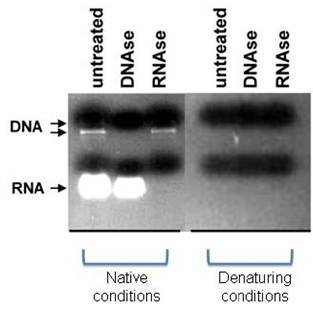
Figure 5: HMGB1 co-purifies with DNA and RNA in E.coli. Recombinant human HMGB1 was purified from E. coli under native or denaturing conditions. Following purification, 10μg of recombinant protein was subjected to DNA or RNA extraction. As illustrated, native HMGB1 was associated with large amounts of nucleic acids from bacterial origin.
Several models of viral persistence were used for this study, including two well characterized cell lines, ACH- 2 and U1 cells. These cells have been widely used in other laboratories to investigate post-integration latency in T lymphocytes and monocytic cells respectively, since they both exhibit a low level of basal retroviral expression that can be increased by chemical or biological agents. A strong dose-dependant increase in viral expression was observed in both cell lines when they were exposed to HMGB1 concentrations ranging from 100 ng/ml to 10 μg∕ml. Nowak and colleagues did also report that HMGB1 reactivated HIV-1 in U1 but, surprisingly, not in ACH-2 cells [72]. This discrepancy could be largely explained by the high basal level of HIV-1 expression in the ACH-2 clone used in their study compared to U1 cells.
Then, we delineated the mechanisms of HMGB1-mediated increase of viral expression in great details, confirming that (1) HIV-1 reactivation was transcriptional, (2) it did not required de novo protein synthesis and (3) it relied on the interaction between HMGB1 and RAGE.
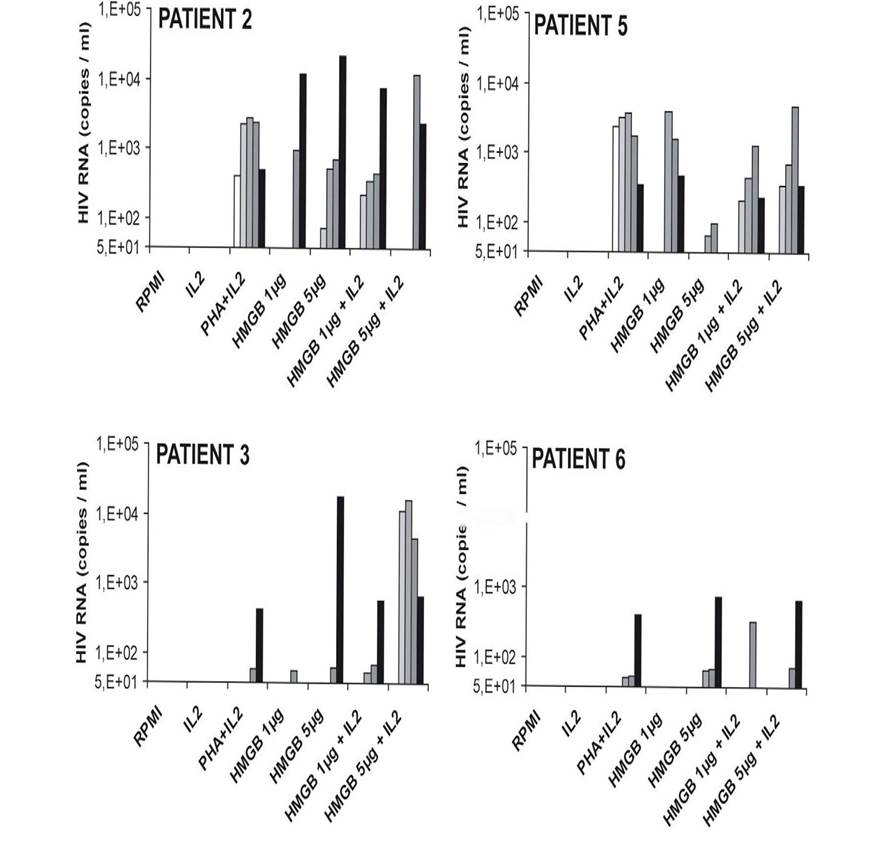
Finally, intracellular signaling was proved to be mediated by MAP kinases p38 and ERK activation that finally resulted in the binding of NFkB to the nucleosome nuc-1, a region of the 5’ LTR that plays a pivotal role in HIV-1 expression. We prolonged these results in the highly relevant context of the HIV-1 persistency in infected patients, aviraemic under highly active antiretroviral therapy (HAART). We randomly choose six HIV-1-infected volunteers, efficiently controlled by HAART for more than 4 years (viral load below 50 copies/ml, median CD4 cell count: 723 c∕μl [minimum 419-maximum 961]) and collected their PBMCs for ex vivo reactivation experiments. Long-termHIV-1 cultures were performed from 2x10⁶ CD8 depleted PBMC in the presence or in the absence of recombinant human HMGB1 (Fig. 6). One culture from one patient could not be analyzed since it displayed a moderate HIV-1 production without any induction. For the other five patients, HMGB1 was at least as efficient as phyto-hemagglutinine A (PHA) in reactivating HIV-1 since it induced virus outgrowth for 4 out of 5 PBMC cultures, with a viral production similar (patients 5 and 6) or even higher (patients 2 and 3) than observed for PHA-treated cells. In this experiment, HMGB1 did also reactivate HIV-1 in the absence of IL-2, confirming its strong ability to reactivate the virus from these controlled patients. Although this was not formerly proved in vivo, this work strongly suggests that HMGB1 could positively influence HIV1 reactivation from latently infected cells when necrosis or immune activation occurs (Fig. 7). This may be especially relevant during AIDS, where cell injury is frequent in organs targeted by opportunistic diseases. Interestingly, recent data confirmed that virus-induced cell toxicity might indeed induce HMGB1 release [73,74]. Furthermore, HIV itself could participate to cell injury since both necrosis and apoptosis were observed during HIV-mediated cell killing [75,76].
» 1,E+04 -
Figure 6: Ex vivo HIV-1 recovery induced by HMGB1. CD8 depleted PBMC, obtained from aviraemic patients controlled by HAART, were cultured for 35 days in the presence of IL-2, PHA and/or HMGB1 at various concentrations. HIV-1 outgrowth was evaluated by quantification of viral RNA in the cell culture supernatants. Adapted from [71].
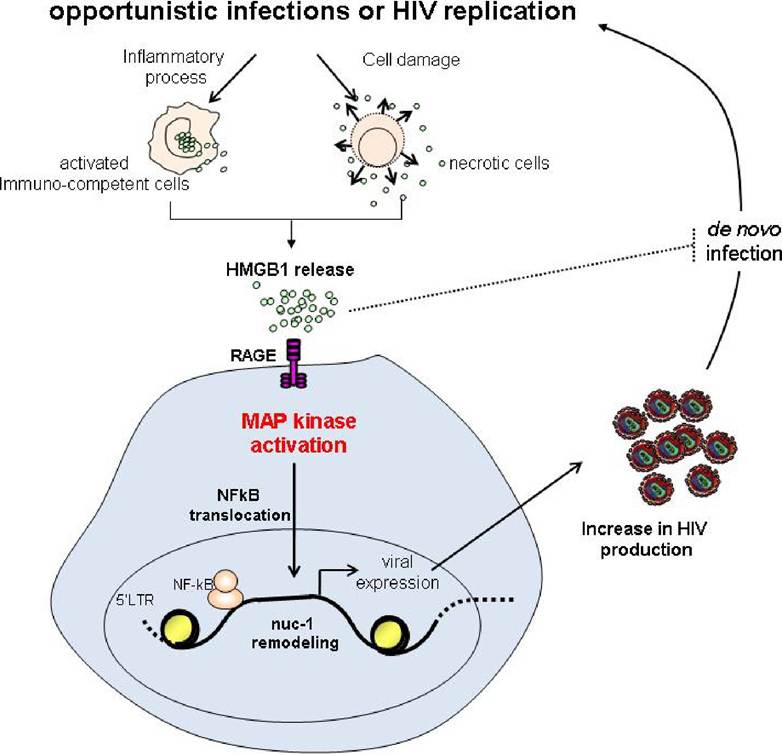
Figure 7: Potential impact of HMGB1 on HIV viral cycle. Extracellular HMGB1, released through cell damage or immune activation, inhibits HIV-1 de novo infection but increases HIV-1 production by persistently infected cells.
Two independent works demonstrated that HMGB1 might influence very differently the process of de novo infection [72,77]. In both instances, necrotic and recombinant HMGB1 were shown to decrease viral expression when primary monocyte-derived macrophages (MDM) were infected by the R5-tropic isolate BaL. The mechanism of this inhibition still remains controversial.
Nowak et al. explained this result by the ability of HMGB1 to induce the secretion of RANTES, MIP-1α and MIP-1β, a series of chemokines that bind to the CCR5 co-receptor and therefore inhibit HIV infection.
However, Cassetta and colleagues did not observe any increase of these chemokines in their study. Rather, the authors suggested that HMGB1 might interfere with viral entry by decreasing CCR5 expression at the surface of MDM.
This result is quite reminiscent of a recent work from our lab, which also demonstrated a decrease in HIV-1 co-receptors expression at the surface of dendritic cells when the cells were incubated in the presence of AGEs, another ligand of RAGE (N. Nasreddine, manuscript submitted for publication).
Cassetta and colleagues also observed a restriction in the replication of X4-tropic strains in some U937 monocytic clones. In that case, the reduced infection was not explained by a reduction of the surface expression of the CXCR4 co-receptor.
Whatever the mechanisms involved, the dual impact of HMGB1 on HIV replication in monocytic cells is strikingly reminiscent of what has already been reported for other soluble factors such as TNF-α [78]or IFN-γ [79]∙
More on the topic HMGB1 Induces HIV-1 Expression from Latently Infected Cells:
- HMGB1 Induces HIV-1 Expression from Latently Infected Cells
- HMGB1 AND HIV-1
- HMGB1: AN OVERVIEW
- Stroke in HIV-1-Infected Children
- KILLING OF UNINFECTED (BYSTANDER) T CELLS BY HIV
- Important precautions
- DETECTION OF DNA FRAGMENTATION