HMGB1 STRUCTURE AND NUCLEAR FUNCTIONS
HMGB1 gene is highly conserved, with a 99% homology between humans and rodents. It encodes for a 215 amino-acids protein in human that is organized into two DNA-binding domains (named A- and B-boxes) followed by an acidic tail that confers a globally negative charge at the C-terminus of the protein (Fig.
1). Two nuclear localization signals (NLS1 and NLS2) control the nuclear translocation of HMGB1 [1]. They both contain a cluster of lysine residues whose acetylation is thought to modulate the intra-cellular dynamics of HMGB1 [2].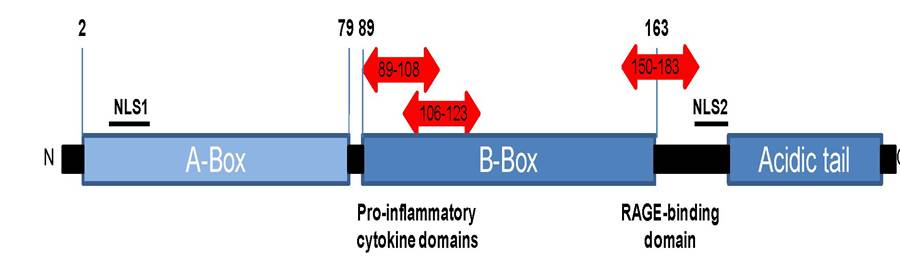
Figure 1: Structural and functional regions of HMGB1. HMGB1 is composed of 3 domains: two positively charged domains (A and B-boxes) involved in DNA binding and a carboxy-terminal acidic tail. Two NLS (nuclear localization signal) have been identified.
Biochemical investigations demonstrated that HMGB1 exhibited a moderated affinity for B-form doublestranded DNA with no sequence specificity, but had a higher affinity for sharply bent structures such as cruciform, cis-platinated and hemicatenated DNA [3-5]. Both the A- and B- boxes exhibit a triple helix conformation and bind to the minor groove of the double-stranded DNA. In turn, HMGB1 promotes the bending of the DNA to which it binds, a property that may help other proteins to gain access and to bind DNA. Its ability to interact with histones and various DNA binding factors progressively led to the notion that HMGB1 could act as a general architectural protein with multiple roles in transcription, replication, recombination and DNA repair. Surprisingly, although HMGB1 inactivation is lethal in knockout mice, it does not impair cell growth [6].
More on the topic HMGB1 STRUCTURE AND NUCLEAR FUNCTIONS:
- HMGB1 and HIV-1 Expression
- HMGB1: AN OVERVIEW
- THE SOLAR-NUCLEAR CORRESPONDENCE
- HMGB1 AND HIV-1
- 3 Burning of crop residues
- When and why did Ukraine give up its nuclear arsenal?
- DETECTION OF DNA FRAGMENTATION
- Black boxes