Myelodysplastic Syndrome
Epidemiology and Etiology
Myelodysplastic syndromes (MDS) comprise a heterogeneous group of myeloid neoplasms that are broadly characterized by ineffective clonal hematopoiesis, cytopenias and an increased risk of leukemic transformation.
Age-related clonal hematopoiesis and clonal cytopenias of undetermined significance commonly precede development of MDS by years, with age being one of the strongest risk factors for MDS (median age at diagnosis 65 years). Environmental factors, prior radiation and/or chemotherapy, as well as certain genetic syndromes and benign hematologic disorders (paroxysmal nocturnal hemoglobinuria) have been associated with increased risk of MDS.Pathology
Bone marrow biopsy is characterized by dysplasia in at least one hematopoietic cell line, with or without increased blasts. Chromosome abnormalities occur in up to 80% of cases, often resulting from the accumulation of multiple genetic lesions related to RNA splicing, DNA methylation, histone modification, transcription regulation, DNA repair, and intracellular signaling. Numerous cytogenetic abnormalities occur in MDS, but commonly include del(5q) (15%), monosomy 7 or del(7q) (10%), and trisomy 8. The most common recurrently mutated genes include ASXL1, DNMT3A, RUNX1, SF3B1, SRSF2, and TET2.
Clinical Presentation
Symptoms are typically related to bone marrow failure and cytopenias, including fatigue and dyspnea due to anemia, fever/infection due to leukopenia, and/or easy bruising/bleeding due to thrombocytopenia. Macrocytosis is common.
Diagnostic Testing
Complete blood counts with cytopenias in at least one cell one must be present. Obtaining a bone marrow aspirate and core biopsy is necessary and will frequently reveal a dysplastic and hypercellular bone marrow. Cytogenetics and FISH are required to identify chromosomal abnormalities. Further molecular profiling, typically with next generation sequencing, is increasingly used to aid in risk stratification, prognostication, and treatment planning.
Risk Classification
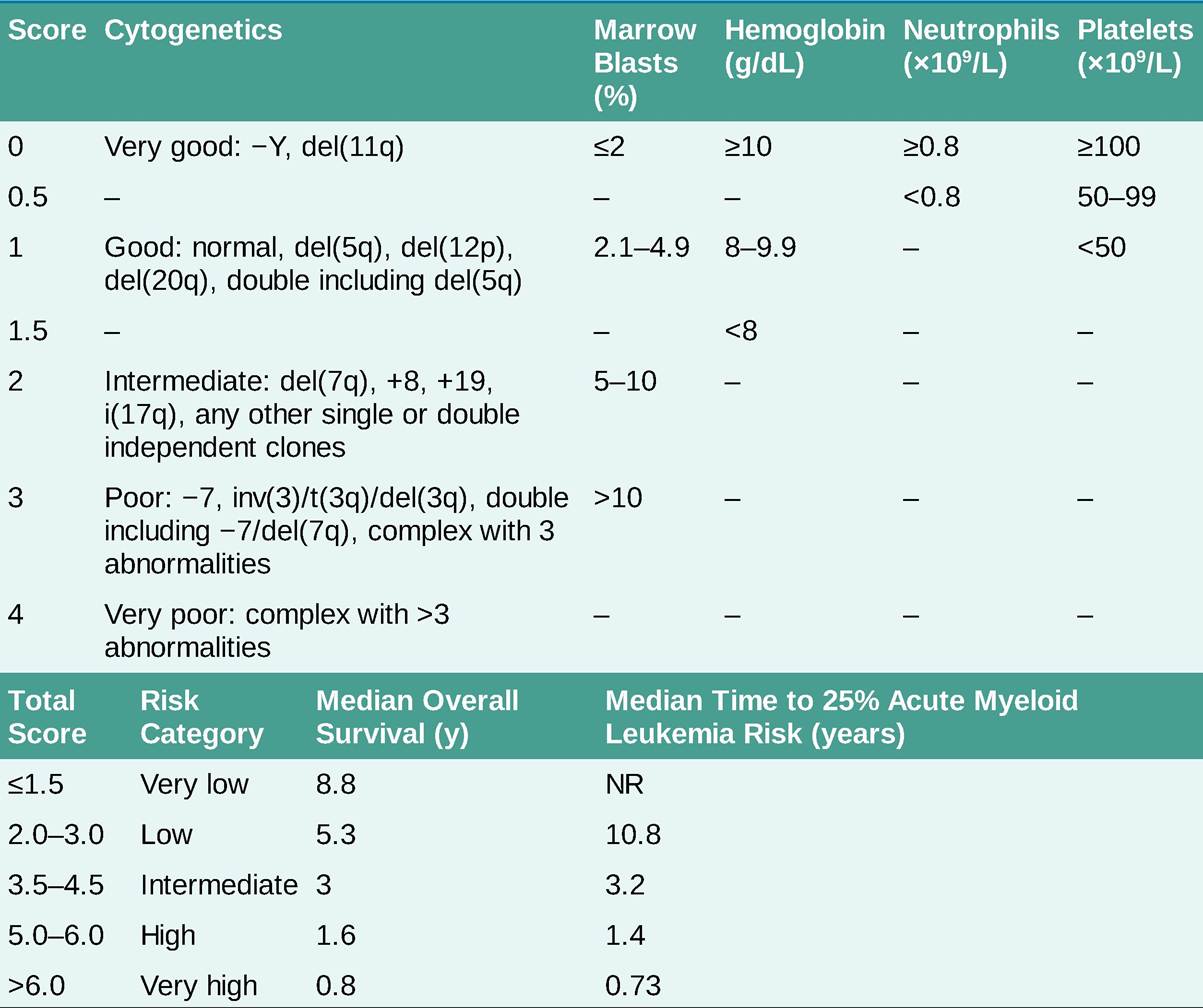
The current WHO classification system includes MDS with unilineage dysplasia (anemia, neutropenia, or thrombocytopenia); MDS with multilineage dysplasia; MDS with ring sideroblasts; MDS with excess blasts (5%-19%); MDS with isolated deletion of 5q; and MDS unclassifiable.32 The Revised International Prognostic Scoring System (IPSS-R) assigns points for patients' cytogenetics, bone marrow blast %, hemoglobin level, neutrophil count, and platelet count, with the total score used to determine patient risk category and treatment approach (Table 22-5).
TABLE 22-5
REVISED INTERNATIONAL PROGNOSTIC SCORING SYSTEM (IPSS-R) FOR MYELODYSPLASTIC SYNDROMES
TREATMENT
Asymptomatic patients with IPSS-R low-risk disease can be followed with supportive care (transfusions, iron chelation, etc.) but otherwise without specific therapy. Patients with very-low-risk or low-risk MDS and symptomatic anemia with a low erythropoietin level (lt;500 mU/mL) can be treated with erythropoiesis-stimulating agents. Treatment with immunosuppressive agents such as antithymocyte globulin and cyclosporine can be considered in patients who have hypoplastic MDS and/or demonstrate a concomitant paroxysmal nocturnal hemoglobinuria clone. Treatment with hypomethylating agents such as 5-azacytidine or decitabine should be considered in patients with intermediate- or high-risk MDS. Additionally, patients with high- and very-high-risk MDS may be considered for allogeneic stem cell transplantation. MDS with del(5q) is associated with a good prognosis and higher probability of response to treatment with lenalidomide. Patients with MDS with ring sideroblasts may benefit from treatment with luspatercept. Patients with an IDH1/2 mutation may benefit from treatment with an IDH inhibitor (ivosidenib or enasidenib).32