Adding Factivity: Mkrtychev Models
Things change with the factivity axiom.
t:F → F
Atomic and justification evaluations are no longer sufficient to define a model. Consider the simplest justification logic with factivity,
JT = J + (t:F → F).
Theorem 3.18 BM(JT(0)) is the class of basic J-models in which the following/activity condition holds:
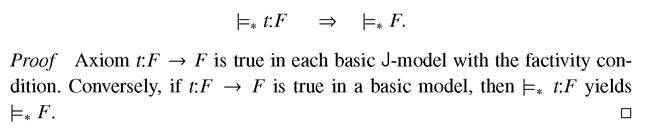
Corollary 3.19 Basic models for JT(CS), that is, members of the family BM(JT(CS)), are the basic CS-models for JT(CS) is sound and com
plete with respect to BM(JT(CS)).
So, to be a JT-model evaluations should satisfy factivity, and this adds a potentially infinite number of things to check in order to determine whether t:F indeed yields F in order to certify that a given evaluation is indeed a model. A modification of the truth condition for justification assertions t:F, first suggested by Mkrtychev in Mkrtychev (1997), eliminates this problem.
Definition 3.20 An Mkrtychev model is an evaluation * satisfying the closure conditions for basic models but with a different truth assignment for justification assertions

The advantage of Mkrtychev models is that they allow the extension of any atomic and justification assignment to all formulas in an inductive way: the truth value of t:F is assigned after F gets its truth value.
Theorem 3.21 Each basic JT-model is an Mkrtychev model. For every Mkr- tychev model * there is a basic JT-model ∙ such that for each formula F, 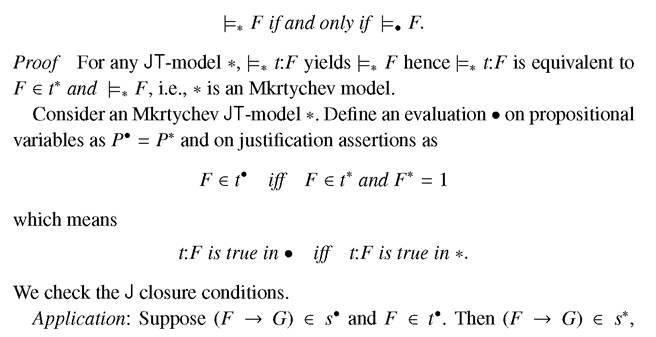
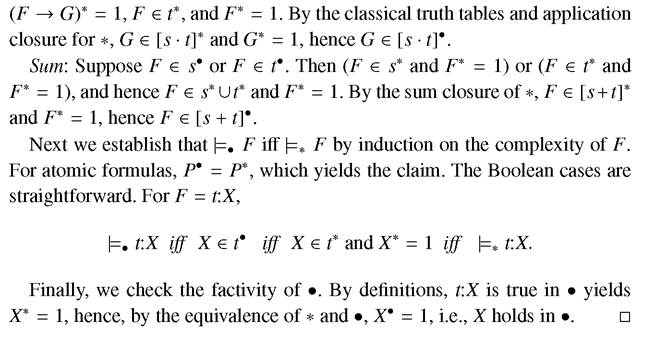
Mkrtychev models offer a practical semantic tool for justification logic with factivity. Let us consider an example comparing basic and Mkrtychev models.
Example 3.22 Take as a base logic a version of JT with an axiomatically appropriate constant specification CS over a language with propositional variables P, Q, and R and two justification variables x and y. We assume that P is false, Q and R are true, and x and y are justifications for P and Q respectively, and for nothing else. Proposition R though true is left without justification. This is a reasonable epistemic scenario with factive and nonfactive justifications, known and unknown truths, etc.
The natural Mkrtychev model * for this story has

In addition, we assume the “minimal” closure conditions:

The Mkrtychev model is now completely defined.
To define an equivalent basic model ∙ we have to specify ∙ on all justification terms. This requires an additional induction on formulas with the justification assertion steps corresponding to Definition 3.20. However, this essentially is a redundant technical step that does not enhance our understanding of the model • beyond what we know from the Mkrtychev model *. In this case, as well as in many other cases, the natural format of specifying a model is Mkrtychev's.
3.5