Basic Models for Positive and Negative Introspection
Basic models handle justification logics whose postulates are conditions on justification operations, such as J, J4, J45, etc. For such models justification term evaluation conditions can be expressed as closure conditions, and then any propositional atom valuation and any justification term valuation can be extended inductively to all formulas.
In this section we sketch basic models for J4 and J45.Recall, J4 is J with an additional “proof checking” axiom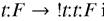 in the
extended language of J with a new unary operation ! on justifications. We begin with the empty constant specification, and then full generality is immediate. We remind the reader of Definitions 3.5 and 3.10.
Theorem 3.14 BM(J4(0)) is the class of basic models for J0 with the following closure condition for !
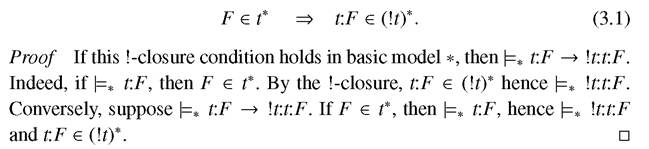
Corollary 3.15 Let CS be an arbitrary constant specification. Basic models for J4(CS), that is BM(J4(CS)), are the basic CS-models for J4. J4(CS) is sound and complete with respect to BM(J4(CS)).
The justification logic J45 is J4 with an additional “negative proof checking” axiom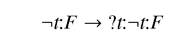
in the extension of the language of J4 with a new unary operation ? on justifications.
Theorem 3.16 BM(J45(0)) is the class of basic models for J4(0) with the ?-condition
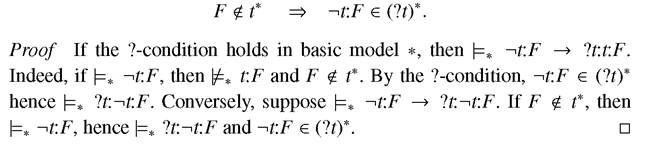
Corollary 3.17 Let CS be an arbitrary constant specification. Basic models for J45(CS), BM(J45(CS)), are the basic CS-models for J45. J45(CS) is sound and complete with respect to BM(J45(CS)).
3.4
More on the topic Basic Models for Positive and Negative Introspection:
- Artemov S., Fitting M.. Justification Logic: Reasoning with Reasons. Cambridge: Cambridge University Press,2019. — 271 p., 2019
- Consequences of nonlinear functional responses
- What Made Humans Really Human? Cooperation and “Collective” Action at the Dawn of Humanity
- Adaptive movements and their effects on competition
- 1.2 CURRENT APPROACHES: INSIGHTS AND LIMITATIONS
- Some empirical caveats
- Quantum-wave nature of the social phenomenon
- Constitutional change
- Methodological approach to comprehension of the social organism
- Chapter 5 How a Turkish Empress Became a Champion of Ukraine