ARGUMENT FORMS AND FORMAL VALIDITY
But how are we to tell whether a given argument is valid? Must we determine this on a case-by-case basis, or are there some general forms of reasoning that are good or bad? One way to tell whether a piece of reasoning is valid is to examine another argument of the same form.
Thus an argument of the same form as the “Jack Layton” argument at the beginning of the section is this:None of the Founding Fathers of the US is still alive today.
Groucho Marx is not still alive today.
This is a more subtle definition than it might at first appear, and there are many traps for the unwary. The first point to notice is that a particular argument is not formally valid simply because it happens to have true premises and does not have a false conclusion. What is required is that no argument of the same form have true premises and a false conclusion. For example, the following argument has all true premises and a true conclusion:  That all sounds good, but the argument is invalid! The problem is with the reasoning, with the form of the argument. It is possible to think of an argument having the same form as this one which has true premises and a false conclusion. For example:
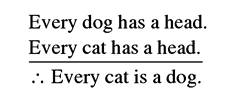
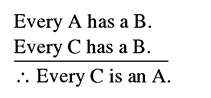
From this we can conclude that the following argument form is invalid'.
This is to be contrasted with Sir Bedevere5 s argument above. Although it was thoroughly unsound (because the premises were patently false), it had the valid form:
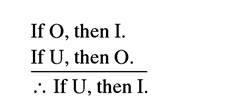
We say that the “Sir Bedevere55 argument is an instance of this form, and that any argument that is an instance of this form is formally valid.
From this you may see that we cannot in general tell whether a given argument is valid by looking at the truth or falsity of its premises and conclusion. Instead we must concentrate on its form: if it has a valid form, then it is a formally valid argument. If it is formally invalid, then it must be possible to find another argument of the same form that has true premises and a false conclusion.This definition of formal invalidity relates to the overall definition of validity as follows. In the previous section we defined a valid argument as one for which the denial of its conclusion is incompatible with the truth of all its premises. In applying this to argument forms we interpret this incompatibility purely in terms of the truth and falsity of premises and conclusion: that is, a form is valid if and only if there is no instance of this form with all its premises true and the conclusion false.
But what exactly is an argument form? So far we have proceeded intuitively, identifying arguments as having the same form when they appear to us to have the same elements repeated in the same order. In the Sir Bedevere example, the repeated elements are statements'. O := “She is made of wood,” I := “She is a witch,” and U := “She weighs the same as a duck.” (In this book I use the notation := to indicate the assignment of a symbol.) In the “Every A has a B” argument form, by contrast, the A and B stand for categories of things, whereas in arguments of the “Jack Layton” and “Groucho Marx” form, they stand for classes of people. Both these latter types can be construed as concerning individuals of which certain predicates may or may not hold—“is a Founding Father,” “is leader of the NDP,” etc. One of the things we shall be doing in this book is learning how to identify various valid forms, as well as developing techniques for proving these forms valid. Arguments of the first kind above, whose form depends on the way constituent statements are joined together, are the subject of Statement Logic, and will occupy us in the first part of this book; whereas ones whose forms depend on the way predicates are joined together, are the subject of Predicate Logic, which we’ll get to in the second part.
So we shall develop a much clearer idea of argument form as we proceed. Nevertheless, before we leave the subject, there is a subtle point concerning argument forms that is important to remember. This is that an argument may be considered to have a different form depending on how we analyze it. This can be seen through the above examples. “Every dog has a head” is a statement, and so are “Every cat has a head” and “Every cat is a dog.” So if we labelled these statements A, B, and C respectively, the form of that argument construed as an argument in statement logic would be:

The same applies to the Sir Bedevere example, where we could have had A, B, and C standing for “If she’s made of wood, she’s a witch,” “If she weighs the same as a duck, she’s made of wood,” and “If she weighs the same as a duck, she’s a witch,” respectively. This argument would then have the same form as the one just given, and it is not a valid one. [Why not? Can you think of an interpretation of A, B, and C that proves the form invalid?] What this shows is that a given argument may be an instance of more than one form. Consequently, if we want to prove a given argument invalid, it is not enough to show that the argument has an invalid form. For it may also be an instance of a valid
form, like the Sir Bedevere example, and according to our definition any argument with a valid form is valid. In other words, if we have an argument that is an instance of an invalid form, we are only entitled to say that it is invalid if it is not also an instance of a valid form. So having a valid form proves validity; having an invalid form does not automatically prove invalidity. (Don’t worry if this seems confusing at this point; we shall be returning to the issue in chapter 10, by which time you should be a good deal more familiar with argument forms and validity.)
For now it is much more important to remember the following: there can be invalid arguments with premises true and conclusion false, with premises true and conclusions true, with premises false and conclusion true, or with premises false and conclusion false.
Similarly, there can be valid arguments with premises true and conclusions true, with premises false and conclusion true, or with premises false and conclusion false. There is only one combination that is ruled out: it is impossible for a formally valid argument to have true premises and a false conclusion.SUMMARY ________________________________________________________________
• An argument is formally valid if it has a valid argument form.
• An argument form is valid if and only if there can be no argument of that form which has all true premises and a false conclusion.
• A given argument may be an instance of more than one form. Thus a formally valid argument may also be an instance of a (different) invalid argument form. This shows that being an instance of an invalid form does not necessarily make an argument formally invalid.
EXERCISES 2.2
6. Invent an argument of the same form as each of the following which has true premises and false conclusion. What does this prove about the form in question?
(a) If the Big Bang Theory is correct, there will be micro wave radiation corresponding to a temperature of about 3oK in whichever direction in space you choose to look. Since there is such radiation, the theory is obviously correct.
(b) “J.-J.,” I replied, “if it was any of your business, I would have invited you. It is not, and so I did not.”—Paul Erdman, The Crash of ,79
(c) No electrons are quarks. No quarks are composite particles. So no electrons are composite particles.
(d) If the orbit is an ellipse, the force law is as the inverse square of the distance. Ergo, if the force law is as the inverse square of the distance, the orbit is an ellipse.
(e) If the money supply increases at less than 5%, the rate of inflation will decrease. Thus, since the money supply is not increasing at less than 5%, inflation will not come down.
Example:
(d) This has the form: If p then q, so if q thenp. If we replace p by “All birds can fly,” and q by “Swallows can fly,” the premise becomes the true statement “If all birds can fly then swallows can fly,” but the conclusion becomes “If swallows can fly then all birds can fly.” This is false: not all birds can fly.
So the argument form is invalid.7. Identify whether each of the following statements is true or false:
(a) An argument is formally valid if it has a valid argument form.
(b) An argument is formally invalid if it is an instance of an invalid argument form.
(c) Every argument with a valid argument form has all its premises true.
(d) If an argument is an instance of a valid argument form, it cannot be an instance of an invalid argument form.
(e) No valid argument can be an instance of an invalid argument form.
8. Identify which of the following symbolically expressed argument forms is valid according to our criterion of validity, where A and B stand for any statements:
(a) A. Therefore A.
(b) A and B. Therefore A.
(c) A. Therefore B.
(d) It’s not the case that A. Therefore B.
(e) It’s not the case that A. Therefore A.
2.3