EVALUATING NATURAL ARGUMENTS
According to our definition of validity above,
An argument or inference is valid if and only if denying its conclusion is incompatible with accepting all its premises. Otherwise it is invalid.
This applies equally to all arguments, including everyday ones, not just the artificial ones cooked up for logic textbooks. In evaluating such natural arguments, however, there are several wrinkles we need to take into account. The first of the wrinkles is that in an extended argument there is usually more than one inference involved. In such a case, in order for the argument as a whole to be valid, the whole chain of inferences involved in getting to the conclusion must be valid. We may elaborate this by reference to the arguments of the last section of chapter 1. Thus in argument (ii) of that section,
(ii) (1) Drug use is wrong because (2) it is immoral, and it is immoral because (3) it enslaves the mind and destroys the soul.—James Q. Wilson, Newsweek, Januery 9,1989
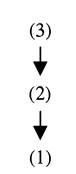
each ‘because’ denotes an inference. Thus both inferences need to be valid for the argument to be valid. Argument (iii), on the other hand, involves two independent inferences:
(iii) (1) Universities must expect further cuts because (2) they have suffered less than other sectors of education. But even if that were not so, (1) they should expect further cuts because (3) they are not sufficiently vocationally oriented.
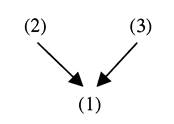
According to our definition of validity, this argument will be valid either if (2) validly entails (1), or if (3) validly entails (1), or both.
The second wrinkle is that in evaluating the validity of each inference we will generally need to apply the Principle of Charity to see if any implicit premises need to be supplied', but this is a matter of some delicacy.
It will require us to ask, for each inference: What must the reasoner obviously be supposing if the inference is to be a good one? Might there be some premise that the proposer of the argument is implicitly assuming, which, if accepted, would make the inference valid? For example, in order for the inference in argument (i) of 1.3 to be valid, we would, it seems, have to grant as an implicit premise “Only male philosophers desire other males (of the same species).” This would make the argument valid, but only at the expense of allowing a premise that no one could accept. Either way, the argument would be unsound. So we see that in evaluating natural arguments it may be a matter of judgement whether we regard an inference as invalid or an implicit premise as unacceptable. But in supplying the implicit premise we can offer a more substantial judgement on the argument: instead of just saying that the inference is invalid, we can say that the argument would be persuasive only if the premise “Only male philosophers desire other males” were accepted as true.Thirdly, in evaluating validity we will usually need to make a judgement about what standards of evidence are appropriate to the case. For if we take the criterion that the truth of the premises must be incompatible with the falsity of the conclusion to mean that it must be logically inconsistent with it, very few arguments indeed will come out as valid, even some of the strongest scientific arguments. Take, for instance, Cotes’s argument based on Newton’s rules of reasoning given above:
Now, since all terrestrial and celestial bodies on which we can make any experiments or observations are heavy, it must be acknowledged without exception that gravity belongs to all bodies universally.
Here the denial of the conclusion that gravity belongs to all bodies universally is certainly compatible with the premise: there may well be mass-less (and therefore gravity-less) bodies on which physicists of Newton’s time simply had not yet made experiments or observations.[9] So Cotes’s argument cannot have been valid in the strict sense that the denial of the conclusion was absolutely incompatible with the premises.
Yet it seems that to deny that it was a good argument would be to set the standards of evidence appealed to here impossibly high. Where would we be if we rejected all inferences drawn from our experience?Let’s re-express the point as follows. We have called any argument that is valid in the formal sense that the denial of the conclusion is logically inconsistent with the premises formally valid. But if we used this standard of logical incompatibility to judge validity in all cases, then virtually none of our knowledge gleaned from facts known through experience could be said to be validly derived. Many philosophers have thought that this shows the need for a separate branch of logic, inductive logic, according to which arguments that are not formally valid could be assessed on a scale from weak to strong. Others, including myself, regard the quest for an inductive logic as a hopeless quest. I believe we should bite the bullet and accept that there is a vast array of arguments which are not formally valid, but whose conclusions seem impossible to deny given the premises and appropriate standards of evidence. For each such argument we need to ask ourselves:
What evidence would convince me of the conclusion ? If the given premises seem insufficient, what else is needed?
Once we ask ourselves these questions, it will usually be possible to identify what further assumption might need to be granted in order for the argument to be valid. If it seems reasonable to assume that all parties would regard it as too obvious to need stating explicitly, it should be added as a further implicit premise.[10]
Thus, returning to Cotes’s argument above, it seems the best assessment would be that the argument is valid, given appropriate standards of evidence.
SUMMARY ________________________________________________________________
• Our definition of argument validity applies equally to natural arguments, that is, the usually extended arguments involving several inferences that we encounter in everyday reasoning.
• An argument involving several inferences will be valid only if all the inferences leading from the premises to the conclusion are valid. An exception to this is the case of arguments where more than one inference independently leads to the same conclusion: then it is enough if one of the inferences is valid.
• In evaluating the validity of each inference we will generally need to apply the Principle of Charity to see if any implicit premises need to be supplied.
• In evaluating validity we will usually need to make a judgement about what standards of evidence are appropriate to the case. For formal validity, we require that the denial of the conclusion be logically inconsistent with the premises. If we used this standard of logical incompatibility to judge validity in all cases, then virtually none of our knowledge gleaned from arguments from experience could be said to be validly derived. Such arguments should be judged according to whether it is impossible to deny their conclusion given the premises and appropriate standards of evidence.
EXERCISES 2.3
Evaluate the arguments below as follows. Identify the main conclusion, examine the premises, and ask yourself whether these premises (if you accepted them as true) would be adequate to persuade you of the conclusion. If not, what further premises would be necessary? (You are not asked to evaluate the truth of the premises.)
9. Matter is divisible, and is therefore destructible, for whatever is divided is destroyed.—Gottfried Leibniz, “Notes on Science and Metaphysics” (1676)
of Real Arguments (Cambridge: Cambridge UP, 1988). As we shall see in chapter 5, Fisher claims that judgements about the validity of all natural arguments are amenable to what he calls the Assertibility Question: “What argument or evidence Wouldjustify me in asserting the conclusion?” (p. 27). Another approach to the question of what constitutes a good argument is through the notion of cogency', see the thorough treatment of argument interpretation and evaluation in terms of this concept in Mark Vorobej, A Theory of Natural Argument (Cambridge: Cambridge UP, 2006).
10. Etemity is simultaneously whole. But time has a before and an after. Therefore time and eternity are not the same thing.—Thomas Aquinas, Summa Theologica
11. As force is always on the side of the governed, the governors have nothing to support them but opinion. It is therefore on opinion only that government is founded.—David Hume, First Principles OfGovernment
12. Each element, such as hydrogen and iron, has a set of gaps—wavelengths that it absorbs rather than radiates. So if those wavelengths are missing from the spectrum, you know that that element is present in the star you are observing.—Rick Gore, “Eyes of Science”
13. Nothing is demonstrable unless the contrary implies a contradiction. Nothing that is distinctly conceivable implies a contradiction. Whatever we conceive as existent, we can also conceive as non-existent. There is no being, therefore, whose non-existence implies a contradiction. Consequently there is no being whose existence is demonstrable.—David Hume, Dialogues Concerning Natural Religion (1779), Part IX