ARGUMENTS BEYOND THE SCOPE OF TRADITIONAL LOGIC
Notoriously, Aristotelian logic could not deal with arguments of the following form:
(A4) ADULTERY is a SIN. Therefore anyone who COMMITS2 adultery commits a sin.
We have all the means at our disposal to deal with such arguments.
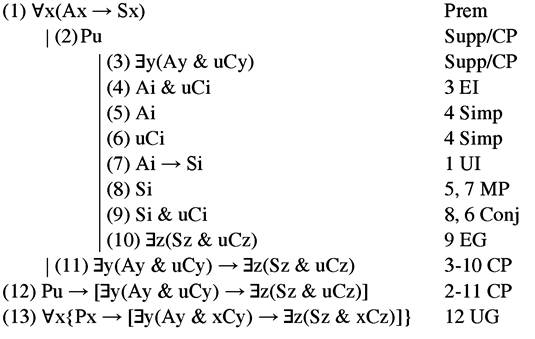
With Px := x is a person, this would be symbolized:
In “Loglish,” the conclusion says: For any person x, if there is some adultery у such that X commits it, then there is a sin z such that x commits it. A proof would go as follows:
Here is another example. Groucho Marx said famously:
(S7) I would never JOIN2 any CLUB that would HAVE2 me as member.
Here if we symbolize Cx := x is a club, yjχ := y joins x, xHy := x has y as member, and g := Groucho, this would be symbolized:

The joke turns on the fact that Groucho recognizes that any club that would accept him would be disreputable. But then since a club has someone as member if and only if he or she joins the club—an implicit premise here—we infer that no club will have Groucho as member! The symbolization of the implicit premise “a club has someone as member if and only if he or she joins the club” is:

where again Px := x is a person. We also have the implicit premise that “Groucho is a person” (just about!). So we have the argument
(A5) Groucho would never JOIN2 any CLUB that would HAVE2 him as member. Since a club has someone as member only if he or she joins the club, and Groucho is a person, it follows that no club will have Groucho as member! 
Proof:
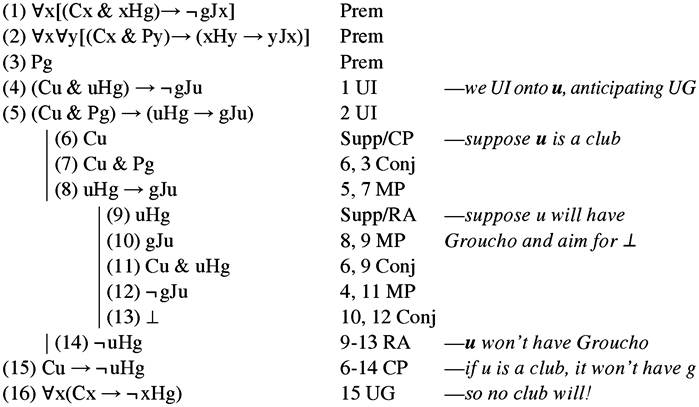
Two rather artificial features of this proof are our having to assume that Groucho is a person, and having to suppose that u is a club, when x only ranges over individuals that are clubs.
It would clearly be simpler if we split the UD accordingly, letting x range over clubs and у over people. This will save us from having to have the predicates C and P, and simplify both the symbolization and the proof. Doing this is a version of the restricting of the UD we encountered earlier, except that we are doing a different restriction for each of the variables. The technique will often simplify proofs, but you have to make it explicit that you are doing this. So with [UD for x: clubs; UD for y: people; g := Groucho, yjχ := у joins club x, xHy := X has y as member] we get the following as a symbolization of the argument: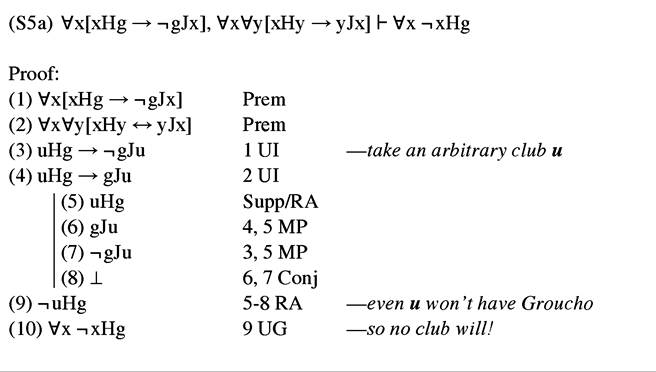
22.2.2