AMBIGUITIES AND THE QUANTIFIER SHIFT FALLACY
One of the most interesting applications of the analysis of relational statements is to reveal certain fallacies. These range from humorous examples concerning ambiguous terms to some quite subtle and historically important examples turning on a mistake concerning quantifier scope.
First let’s look at some examples involving ambiguous terms (such an argument is technically called an amphiboly). Here’s one from Lewis Carroll’s Through the Looking Glass
“I see nobody on the road,” said Alice. “I only wish I had such eyes,” the King remarked in a fretful tone. “To be able to see Nobody! And at the distance too! Why, it’s as much as I can do to see real people, by this light!”2
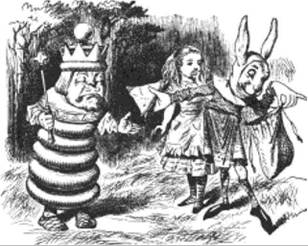
Illustration by Sir John Tenniel (1820-1914) from Through the Looking Glass.
The faulty inference made by the King is roughly this:
(A6) Alice can see Nobody. I cannot see anybody. So Alice can see someone I cannot see.
This has the same grammatical form as
(A7) Alice can see Noel. I cannot see anybody. So Alice can see someone I cannot see. [UD: people; a := Alice, n := Noel, к := T,’ the King, xSy := x can see y]
This is symbolized:
2
Through the Looking Glass, Lewis Carroll, ch. 7: The Lion and the Unicorn; quotation and illustration taken from the website.
But since ‘nobody’ is not a proper name, the correct symbolization of (A6) is  and this is clearly an invalid inference. A similar (apocryphal) example (not very popular with logic students) is:
(A8) Logic is better than nothing. Nothing is better than sex. Therefore logic is better than sex!
Again, this amphiboly trades on treating “nothing” as if it were a proper name.
Turning now to the history of logic, there is an argument form much beloved of the Stoics, of which the following argument invented by Zeno of Citium[87] is an instance:
(A9) What is rational is better than what is not rational. Nothing is better than the cosmos. Therefore the cosmos is rational.
At first sight it may appear as though this is a similar kind of amphiboly, since few people these days would believe (as the Stoics did) that the cosmos (ordered universe) was animate, and therefore could be rational. When we subject this to logical analysis, though, the results are quite surprising. Using Rx := x is rational, xBy := x is better than y, and c := the cosmos, we get

It turns out that this is a penevalid argument. When we include as an implicit premise that there is at least something that is rational—surely an innocuous addition—we can prove the validity of this argument as follows:
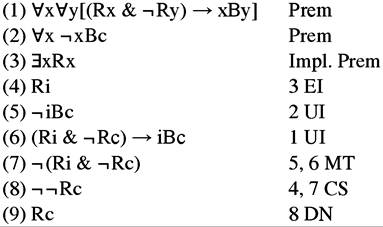
I think it is genuinely surprising that this argument comes out valid. If we do not accept the conclusion, which premise should we reject? One candidate is “Nothing is better than the cosmos,” especially if we believe in a Creator-God. But then it would seem natural to substitute ‘God’ for the cosmos in this argument. Whether this was the reasoning of St. Anselm of Canterbury, one of the early Christian fathers, I do not profess to know. But Anselm’s argument is sufficiently similar to Zeno’s to suggest some kind of influence (whether or not he was aware of it):
(AlO) What exists is better than what does not exist. Nothing is better than God. Therefore God exists.
If we allow ‘x exists’ as a predicate, then this argument has precisely the same (valid!) form as Zeno’s, and it is perhaps even harder to deny the premises. (Those who reject it claim there is an ambiguity: the sense in which existence is ‘better’ than non-existence does not seem to be the same as the sense in which God is ‘best.’ Later criticisms of the argument thus focussed on whether ‘existence’ can be regarded as a perfection.)
A second famous argument for the existence of God was given by another philosophical saint, this time St.
Thomas Aquinas:(All) That which is contingent is not in existence at some time. Therefore, since there could not have been a time when nothing was in existence, not everything can be contingent.
It follows, reasons Aquinas, that there must be something non-contingent, i.e., not dependent for its existence on anything else, and this being is identified with God.
The same argument is alluded to by John Locke, when he reasons
Bare nothing cannot produce any real being. Whence it follows with mathematical evidence that something existed from all eternity.[88]
But there is a logical slippage in this argument, ably pointed out by Gottfried Leibniz in his rejoinder to Locke’s book:
I find an ambiguity here. If it means that there has never been a time when nothing existed, then I agree with it... But... it does not follow that if there has always been something then one particular thing has always been, i.e., that there is an eternal being. (Leibniz, New Essays, 436)
What Leibniz is pointing out is that if one of Locke’s and Aquinas’ premises is that “there has never been a time when nothing existed,” then all that validly follows from this is that at any time one thing or another is in existence, not that there is a thing that is in existence at every time. Letting xEy := x exists at time y, UD for x: things, UD for y: times, we have:

But from Vy?x xEy you cannot validly infer ΞxVy xEy: as we saw above, the order of the quantifiers is all-important. This would be the same as inferring from the fact that every -

universal and existential quantifiers is known as the Quantifier Shift Fallacy. It illicitly changes the scope of both quantifiers.
SUMMARY ________________________________________________________________
• Relational logic is competent to handle numerous arguments that traditional logic could not, for instance: “ADULTERY is a SIN.
Therefore anyone who COM- MITS2 adultery commits a sin.”• One of the most interesting applications of relational logic is to reveal certain fallacies. Some of these are arguments involving a term being used ambiguously, such as “nobody” being treated as a proper noun in the expression “I can see nobody.” Such a fallacious argument involving the ambiguous use of a term is called an amphiboly.
• Another type of fallacy revealed by relational logic is the quantifier shift fallacy. This consists in the inversion of the order of existential and universal quantifiers in an expression, thus illicitly changing their scope; for example, fallaciously inferring from “Everyone has a mother”—true if it means that “for each person there 
13. In an episode of The Simpsons, Principal Seymour Skinner is accused by the school superintendent Chalmers of having had sexual relations with the teacher Edna Krab- appel, but is adamant that he is a virgin. Chalmers replies: “ Well, Seymour, it is clear you have been falsely accused, because no one anywhere ever would pretend to be a 44-year-old virgin.” Symbolize and prove the validity of this paraphrased version of the argument:
No one who is FORTY-FOUR and is not a VIRGIN would CLAIM to be one. No one who is a virgin has had SEX2 with anyone. Seymour is forty-four and claims to be a virgin. Therefore he has not had sex with Edna. [UD: people]
14. R.D. Laing has a poem that begins:
I don’t RESPECt2 myself.
I can’t respect anyone who respects me.
Prove that the first line follows from the second. [UD: people; m := I, me, myself]
15. In his ballad “Like a Rolling Stone” Bob Dylan sings: “When you got nothing, you got nothing to lose.” Prove that this follows from the truism that “You can LOSE2 something only if you have GOT it.” [UD for x: people; UD for y: things; xLy := x loses y, xGy := x has got y]
16.
The following is a penevalid argument. Supply the implicit premise and prove the validity of the resulting argument:PLATYPUSES are MAMMALS that LAY2 EGGS. Therefore some eggs are laid by mammals.
17. Thefollowing argument is an amphiboly. Explain what ambiguity or ambiguities the fallacy depends on.
No cat has eight lives. Therefore, since any cat has one more life than no cat, any cat must have nine lives.
18. In a Dilbert cartoon, Dilbert has the following conversation with a female friend:
She: “I believe there is one true soul mate for every person.” He replies: “He must be very busy.” She: “I meant one per person.”
Explain the quantifier scope confusion that the joke trades on, symbolizing both the intended interpretation and the mistaken one.
19. Prove the validity of Leibniz ’s modified version of Aquinas’ argument (using “exists at a time” as a relational predicate):
There is never a time when nothing exists. So at all times, there is something in existence. [xEy := x exists at time y; UD for x: things; UD for y: times]