TRUTH TREE RULES FROM STATEMENT LOGIC
In introducing truth trees for statement logic, we used the following rules:
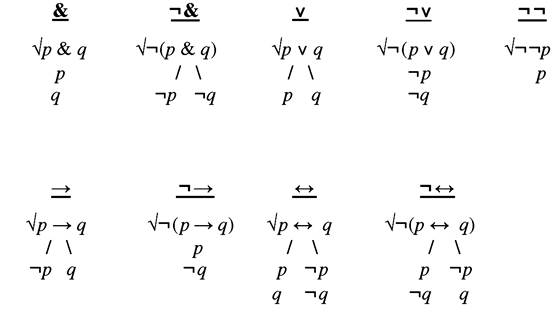
These rules may also be used to determine the validity of certain arguments in Predicate Logic.
Let’s have a look at one to refresh our memories of how the method works. Recall that we state the premises and the negation of the conclusion, drawing a line under this part. Then we apply these rules, trying to use non-branching rules first (the non-branching rules are to break the statements down into their components.
 Every time we decompose a compound statement, we put a check mark by it. If the tree has already branched when we decompose a compound premise by a branching rule, then the results must be written in on every branch. A path becomes closed when a statement is directly contradicted by another statement above it on the same path. The tree is complete either when all the paths close (this is a complete closed tree); or when, on at least one path, every compound statement has been decomposed leaving only literals (this is a complete open path). A complete tree with all its paths closed proves that the negation of the conclusion contradicts the conjunction of the premises, so that the argument is VALID. Otherwise—i.e., if one or more paths are still open and complete—the argument is INVALID.
As an example of an argument in Predicate Logic that can be treated with these rules alone, consider, for instance, this variation of the “Gorbachev-Brezhnev” argument we considered above:
If Gorbachev was TELLING the truth about Stalin’s purges, then Brezhnev DECEIVED the Soviet people. But if Gorbachev was not telling the truth, then he himself deceived the Sovietpeople. Thus either Gorbachev or Brezhnev deceived the Soviet people.
This is symbolized as follows: A truth tree analysis
gives:
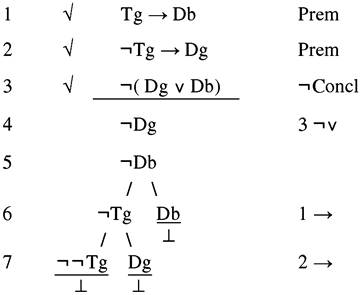
The tree is complete, because all the paths result in contradictions, and are therefore closed. So the argument is, as expected, valid. Now let’s proceed to examples that require new rules.
23.1.2