ADDITIONAL TRUTH TREE RULES FOR QUANTIFICATIONS
As things stand, we have no rules for decomposing universal or existential quantifications. This motivates our first two rules, which correspond to the rules of inference UI and EI:
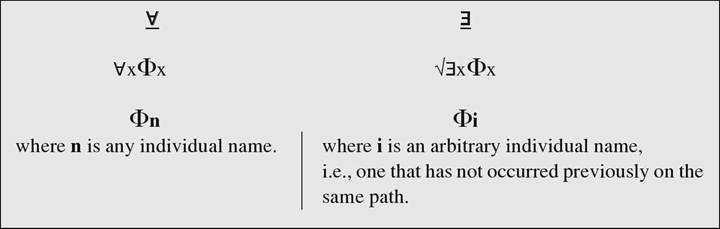
As before, here X stands for any variable, x, y, or z.
Points to note:
• When the V rule is applied to decompose a universal quantification, that statement does not get checked off. The reason is that a universal quantification entails any instance, not just an instance involving one name. So in principle V can be applied over and over, just as was UI in the original rule-of-inference proof of the Gorbachev-Brezhnev argument (see example in chapter 19, pp. 309-10).
• When the 3 rule is applied to decompose an existential quantification, we check it off, since we know only that there is at least one individual instance of it. The name n will be i, j, or k, as before; if i occurs previously on the same path, use j; if that is taken, use k, and so on.
• The 3 rule must be applied before the V rule, for the same reason that EI had to be applied before UI in proofs: in order to guarantee that the i is indeed arbitrary.
These rules will allow us to determine the validity of arguments like the “moral God” argument considered in chapter 16, p. 261:
No PERFECT being is immoral. No MORAL being would punish AGNOSTICISM. It follows that if God is perfect, he will not punish agnosticism. [UD: beings] 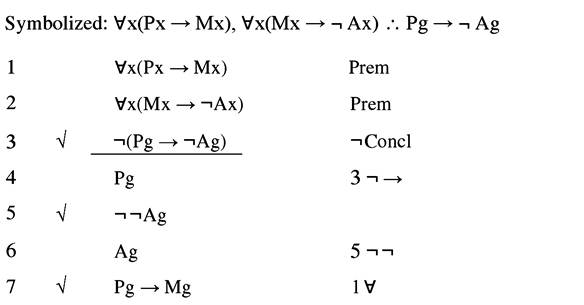
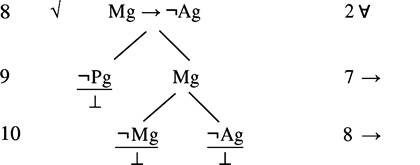
The argument is valid, since its tree is complete with all its paths closed. Now an example involving 3:
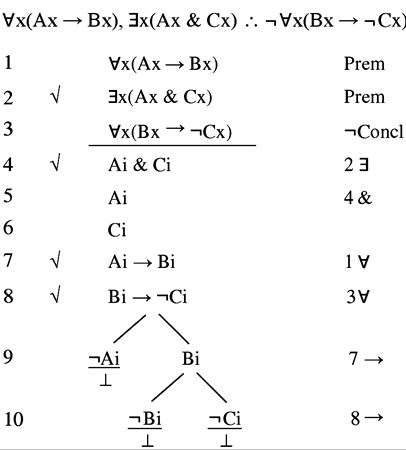
Here note that, just as in our proofs, we must treat the existential statement first, i.e., apply Ξ before Note also that the universal quantifications do not get checked off when
  is applied.
23.1.3