CAT 2006
Answer Questions 1-5 on the basis of the information given below:
Mathematicians are assigned a number called Erdos number (named after the famous mathematician, Paul Erdos). Only Paul Erdos himself has an Erdos number of zero.
Any mathematician who has written a research paper with Erdos has an Erdos number of 1. For other mathematicians, the calculation of his/her Erdos number is illustrated below: Suppose that a mathematician A has co-authored papers with several other mathematicians. Tromamong them, mathematician Ehas the smallest Erdos number. Let the Erdos number of У bey. ThenA has an Erdos number of у + 1. Hence any mathematician with no co-authorship chain connected to Erdos has an Erdos number of infinity.In a seven day long mini-conference organised in memory of Paul Erdos, a close group of eight mathematicians, call them∠4, B, C, D, E, F, G and H, discussed some research problems. At the beginning of the conference, A was the only participant who had an infinite Erdos number. Nobody had an Erdos number less than that of F.
On the third day of the conference, F co-authored a paper jointly with and C. This reduced the average Erdos number of the group of eight mathematicians to 3. The Erdos numbers of B, D, E, G and H remained unchanged with the writing of this paper. Further, no other co-authorship among any three members would have reduced the average Erdos number of the group of eight to as low as 3.
• At the end of the third day, five members of this group had identical Erdos numbers while the other three had Erdos numbers distinct from each other.
• On the fifth day, E co-authored a paper with F which reduced the group’s average Erdos number by 0.5. The Erdos numbers of the remaining six were unchanged with the writing of this paper.
• No other paper was written during the conference.
1. The person having the largest Erdos number at the end of the conference must have had an Erdos number (at that time):
(a) 5 (b) 7
(c) 9 (d) 14
(e)15
2.
How many participants in the conference did not change their Erdos number during the conference?(a) 2 (b) 3
(c) 4 (d) 5
(e) Cannot be determined
3. The Erdos number of C at the end of the conference was:
(a) 1 (b) 2
(c) 3 (d) 4
(e)5
4. The Erdos number of E at the beginning of the conference was:
(a) 2 (b) 5
(c) 6 (d) 7
(e)8
5. How many participants had the same Erdos number at the beginning of the conference?
(a) 2 (b) 3
(c) 4 (d) 5
(e) Cannot be determined
Answer Questions 6-10 on the basis of the information given below:
Two traders, Chetan and Michael, were involved in the buying and selling of MCS shares over five trading days. At the beginning of the first day, the MCS share was priced at' 100, while at the end of the fifth day it was priced at' 110. At the end of each day, the MCS share price either went up by ' 10, or else, it came down by' 10. Both Chetan and Michael took buying and selling decisions at the end of each trading day. The beginning price of MCS share on a given day was the same as the ending price of the previous day. Chetan and Michael started with the same number of shares and amount of cash, and had enough of both. Below are some additional facts about how Chetan and Michael traded over the five trading days.
• Each day if the price went up, Chetan sold 10 shares of MCS at the closing price. On the other hand, each day if the price went down, he bought 10 shares at the closing price.
• If on any day, the closing price was above '110, then Michael sold 10 shares of MCS, while if it was below ' 90, he bought 10 shares, all at the closing price.
6. If Chetan sold 10 shares of MCS on three consecutive days, while Michael sold 10 shares only once during the five days, what was the price of MCS at the end of day 3?
(a)' 90 (b)' 100
(c)'110 (d)'120
(e)' 130
7. IfMichael ended up with' 100 less cash than Chetan at the end of day 5, what was the difference in the number of shares possessed by Michael and Chetan (at the end of day 5)?
(a) Michael had 10 less shares than Chetan.
(b) Michael had 10 more shares than Chetan.
(c) Chetanhad 10 more shares than Michael.
(d) Chetan had 20 more shares than Michael.
(e) Both had the same number of shares.
8. If Chetan ended up with '1300 more cash than Michael at the end of day 5, what was the price of MCS share at the end of day 4?
(a)' 90 (b)' 100
(c)'110 (d)'120
(e) Not uniquely determinable
9. What could have been the maximum possible increase in combined cash balance of Chetan and Michael at the end of the fifth day?
(a)' 3700 (b)' 4000
(c)' 4700 (d)' 5000
(e)' 6000
10. IfMichael ended up with 20 more shares than Chetan at the end of day 5, what was the price of the share at the end of day 3?
(a)' 90 (b)' 100
(c)'110 (d)'120
(e)' 130
Answer Questions 11-15 on the basis of the information given below:
A significant amount of traffic flows from point S to point T in the one-way street network shown below. Points A, B, C and D are junctions in the network, and the arrows mark the direction of traffic flow. The fuel cost in rupees for travelling along a street is indicated by the number adjacent to the arrow representing the street.
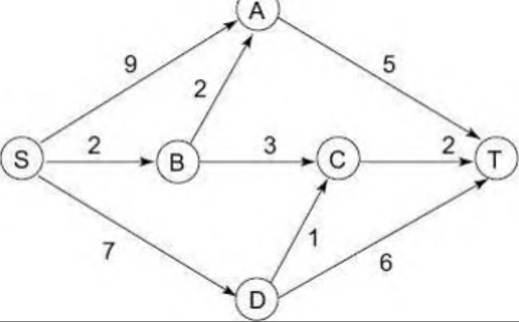
Motorists travelling from point S to point T would obviously take the route for which the total cost of traveling is the minimum If two or more routes have the same least travel cost, then motorists are indifferent between them. Hence, the traffic gets evenly distributed among all the least cost routes.
The government can control the flow of traffic only by levying appropriate toll at each junction. For example, if a motorist takes the route S-A-T (using junction A alone), then the total cost of travel would be ' 14 (i.e.,' 9 + ' 5) plus the toll charged at junction^.
11. If the government wants to ensure that all motorists travelling from S to T pay the same amount (fuel costs and toll combined) regardless of the route they choose and the street from B to C is under repairs (and hence unusable), then a feasible set of toll charged (in rupees) at junctions A, B, C and D respectively to achieve this goal is:
(a) 2, 5, 3, 2 (b) 0, 5, 3, 1
(c) 1, 5, 3, 2 (d) 2, 3, 5, 1
(e) 1, 3, 5, 1
12.
If the government wants to ensure that no traffic flows on the street from D to T, while equal amount of traffic flows through junctions A and C, then a feasible set of toll charged (in rupees) at junctions A, B, C and D respectively to achieve this goal is:(a) 1,5, 3,3 (b)l,4,4,3
(c) 1,5, 4, 2 (d)0,5,2,3
(e) 0, 5, 2, 2
13. If the government wants to ensure that all routes from S to T get the same amount of traffic, then a feasible set of toll charged (in rupees) at junctions A, B, C, and D respectively to achieve this goal is:
(a) 0, 5, 2,2 (b) 0, 5, 4, 1
(c) 1,5, 3,3 (d)l,5,3,l
(e) 1, 5, 3, 2
14. If the government wants to ensure that the traffic at S gets evenly distributed along streets from S to A, from S to B, and from S to D, then a feasible set of toll charged (in rupees) at junctions A, B, C and D respectively to achieve this goal is:
(a) 0, 5, 4, 1 (b) 0, 5, 2, 2
(c) 1,5, 3,3 (d) 1,5, 3,2
(e) 0, 4, 3, 2
15. The government wants to devise a toll policy such that the total cost to the commuters per trip is minimised. The policy should also ensure that not more than 70 per cent of the total traffic passes through junction B. The cost incurred by the commuter travelling from point S to point T under this policy will be:
(a) '7 (b)' 9
(c)' 10 (d)' 13
(e)' 14
Answer Questions 16-20 on the basis of the information given below:
K, L, M, N, P, Q, R, S, U and W are the only ten members in a department. There is a proposal to form a team from within the members of the department, subject to the following conditions:
• A team must include exactly one among P, R and S.
• A team must include either M or Q, but not both.
• If a team includes K, then it must also include L, and vice versa.
• If a team includes one amongst S, U and W, then it must also include the other
two.
• L and N cannot be members of the same team.
• L and U cannot be members of the same team.
The size of a team is defined as the number of members in the team.
16. What could be the size of a team that includes ΚΊ
(a) 2 or 3 (b) 2 or 4
(c) 3 or 4 (d) Only 2
(e) Only 4
17. In how many ways a team can be constituted so that the team includes TV?
(a) 2 (b) 3
(c) 4 (d) 5
(e)6
18. What would be the size of the largest possible team?
(a) 8 (b) 7
(c) 6 (d) 5
(e) Cannot be determined
19. Who can be a member of a team of size 5?
(a) K (b) L
(c) M (d) P
(e)R
20. Who cannot be a member of a team of size 3?
(a) L (b) M
(c) N (d) P
(e)Q
Directions for Questions 21 to 25: Each question has a set of four sequentially ordered statements. Each statement can be classified as one of the following:
Facts, which deal with pieces of information that one has heard, seen or read, and which are open to discovery or verification (the answer option indicates such a statement with an ‘F’).
Inferences, which are conclusions drawn about the unknown, on the basis of the known (the answer option indicates such a statement with an T).
Judgements which are opinions that imply approval or disapproval of persons, objects, situations and occurrences in the past, the present or the future (the answer option indicates such a statement with a J).
Select the answer option that best describes the set of four statements.
21.
1. So much of our day-to-day focus seems to be on getting things done, trudging our way through the tasks of living; it can feel like a treadmill that gets you nowhere; where is the Childlikejoy?
2. We are not doing the things that make us happy; that which brings us joy; the things that we cannot wait to do because we enjoy them so much.
3. This is the stuff that joyful living is made of—identifying your calling and committing yourself wholeheartedly to it.
4. When this happens, each moment becomes a celebration of you; there is a rush of energy that comes with feeling completely immersed in doing what you love most.
(a) IIIJ (b) IFIJ
(c) JFJJ (d) JJJJ
(e) JFII
22.
1. Given the poor quality of service in the public sector, the HIV/AIDS affected should be switching to private initiatives that supply anti-retroviral drugs (ARVs) at a low cost.
2. The government has been supplying free drugs since 2004, and up to now 35000 have benefited, though the size of the affected population is 150 times this number.
3. The recent initiatives of networks and companies like AIDS Care Network, Emcure, Reliance-Cipla-CII, would lead to availability of much-needed drugs to a larger number of affected people.
4. But how ironic it is that we should face a perennial shortage of drugs when India is one of the world’s largest suppliers of generic drugs to the developing world.
(a) JFIJ (b) JIIJ
(c) IFIJ (d) IFFJ
(e) JFII
23.
1. According to all statistical indications, the Sarva Shiksha Abhiyan has managed to keep pace with its ambitious goals.
2. The Mid-day Meal Scheme has been a significant incentive for the poor to send their little ones to school, thus establishing the vital link between healthy bodies and healthy minds.
3. Only about 13 million children in the age group of 6 to 14 years are out of school.
4. The goal of Universalisation of elementary education has to be a prerequisite for the evolution and development of our country.
(a) IIFJ (b) JIIJ
(c) IJFJ (d) IJFI
(e) JIFT
24.
1. We should not be hopelessly addicted to an erroneous belief that corruption in India is caused by the crookedness of Indians.
2. The truth is that we have more red tape—we take eighty-nine days to start a small business, Australians take two.
3. Red tape leads to corruption and distorts people’s character.
4. Every red tape procedure is a point of contact with an official, and such contacts have the potential to become opportunities for money to change hands.
(a) JFIF (b) JFJJ
(c) JIJF (d) IFJF
(e) JFJI
25.
1. Inequitable distribution of all kinds of resources is certainly one of the
strongest and most sinister sources of conflict.
2. Even without war, we know that conflicts continue to trouble us—they only change in character.
3. Extensive disarmament is the only insurance for our future; imagine the amount of resources that can be released and redeployed.
4. The economies of the industrialised western world derive 20% of their income from the sale of all kinds of arms.
(a) IJJI (b) JIM
(c) IIJF (d) JIIF
(e) IJIF
Directions for Questions 26-30: Each of the following questions has a paragraph from which the last sentence has been deleted. From the given options, choose the one that completes the paragraph in the most appropriate way.
26. I am sometimes attacked for imposing ‘rules’. Nothing could be further from the truth: I hate rules. All I do is report on how consumers react to different stimuli. I may say to a copywriter, ‘Research shows that commercials with celebrities are below average in persuading people to buy products. Are you sure you want to use a celebrity?’ Call that a rule? Or I may say to an art director, ‘Research suggests that if you set the copy in black type on a white background, more people will read it than if you set it in white type on a black background. ’
(a) Guidance based on applied research can hardly qualify as ‘rules’.
(b) Thus, all my so called ‘rules’ are rooted in applied research.
(c) A suggestion perhaps, but scarcely a rule.
(d) Such principles are unavoidable if one wants to be systematic about consumer behaviour.
(e) Fundamentally it is about consumer behaviour —not about celebrities or type settings.
27. Relations between the factory and the dealer are distant and usually strained as the factory tries to force cars on the dealers to smooth out production. Relations between the dealer and the customer are equally strained because dealers continuously adjust prices, make deals, to adjust demand with supply while maximising profits. This becomes a system marked by ‘a lack of long-term commitment’ on either side, which maximises feelings of mistrust. In order to maximise their bargaining positions, everyone holds back information—the dealer about the product and the consumer about his true desires.
(a) As a result, ‘deal making’ becomes rampant, without concern for customer satisfaction.
(b) As a result, inefficiencies creep into the supply chain.
(c) As a result, everyone treats the other as an adversary, rather than as an ally.
(d) As a result, fundamental innovations are becoming scarce in the automobile industry.
(e) As a result, everyone loses in the long run.
28. In the evolving world order, the comparative advantage of the United States lies in its military force: Diplomacy and international law have always been regarded as annoying encumbrances, unless they can be used to advantage against an enemy. Every active player in world affairs professes to seek only peace and prefers negotiation to violence and coercion.
(a) However, diplomacy has often been used as a mask by nations which intended to use force.
(b) However, when the veil is lifted, we commonly see that diplomacy is understood as a disguise for the rule of force.
(c) However, history has shown that many of these nations do not practice what they profess.
(d) However, history tells us that peace is professed by those who intend to use violence.
(e) However, when unmasked, such nations reveal a penchant for the use of force.
29. Age has a curvilinear relationship with the exploitation of opportunity. Initially, age will increase the likelihood that a person will exploit an entrepreneurial opportunity because people gather much of the knowledge necessary to exploit opportunities over the course of their lives, and because age provides credibility in transmitting that information to others. However, as people become older, their willingness to bear risks declines, their opportunity costs rise, and they become less receptive to new information.
(a) As a result, people transmit more information rather than experiment with new ideas as they reach an advanced age.
(b) As a result, people are reluctant to experiment with new ideas as they reach an advanced age.
(c) As a result, only people with lower opportunity costs exploit opportunity when they reach an advanced age.
(d) As a result, people become reluctant to exploit entrepreneurial opportunities when they reach an advanced age.
(e) As a result, people depend on credibility rather than on novelty as they reach an advanced age.
30. We can usefully think of theoretical models as maps, which help us navigate unfamiliar territory. The most accurate map that it is possible to construct would be of no practical use whatsoever, for it would be an exact replica, on exactly the same scale, of the place where we were. Good maps pull out the most important features and throw away a huge amount of much less valuable information. Of course, maps can be bad as well as good-witness the attempts by medieval Europe to produce a map of the world. In the same way, a bad theory, no matter how impressive it may seem in principle, does little or nothing to help us understand a problem.
(a) But good theories, just like good maps, are invaluable, even if they are simplified.
(b) But good theories, just like good maps, will never represent unfamiliar concepts in detail.
(c) But good theories, just like good maps, need to balance detail and feasibility of representation.
(d) But good theories, just like good maps, are accurate only at a certain level of abstraction.
(e) But good theories, just like good maps, are useful in the hands of a user who knows their limitations.
31. A group of 630 children is arranged in rows for a group photograph session. Each row contains three fewer children than the row in front of it. What number of rows is not possible?
(a) 3 (b) 4
(c) 5 (d) 6
(e)7
32. A survey was conducted of 100 people to find out whether they had read recent issues of Golmal, a monthly magazine. The summarised information regarding readership in 3 months is given below:
OnlySeptember: 18;
September but not August: 23;
September and July: 8;
September 28;
July: 48;
JulyandAugust: 10;
none of the three months: 24.
What is the number of surveyed people who have read exactly two consecutive issues (out of the three)?
(a) 7 (b) 9
(c) 12 (d) 14
(e)17
Answer Questions 33 and 34 on the basis of the information given below:
An airline has a certain free luggage allowance and charges for excess luggage at a fixed rate per kg. Two passengers, Raja and Praja have 60 kg of luggage between them, and are charged ' 1200 and ' 2400 respectively for excess luggage. Had the entire luggage belonged to one of them, the excess luggage charge would have been' 5400.
33. What is the weight of Praj a’s luggage?
(a) 20 kg (b) 25 kg
(c) 30 kg (d) 35 kg
(e) 40 kg
34. What is the free luggage allowance?
(a) 10 kg (b)15kg
(c) 20 kg (d) 25kg
(e) 30kg
Answer Key
| l.(b) | 2. (d) | 3.(b) | 4. (c) |
| 5. (b) | 6. (c) | 7. (e) | 8. (b) |
| 9. (d) | 10. (a) | ll.(b)∕(c) | 12.(e) |
| 13.(e) | 14. (a) | 15. (c) | 16. (e) |
| 17. (e) | 18. (d) | 19. (c) | 20. (a) |
| 21∙(d) | 22. (a) | 23. (c) | 24. (c) |
25. (b) 26. (с) 27. (е) 28. (b)
29. (d) 30. (a) 31.(d) 32. (Ь)
33. (d) 34. (Ь)
Solutions:
Solutions for Questions 1-5:
In order to solve this question (and in fact most questions of this nature where you have a long data/info filled passage), the key is to be able to decode the language step by step. So instead of getting bogged down by the surfeit of information which you have, focus on reacting to the language of the information sentence by sentence.
So let us now go through the information sentence by sentence and see how one should react in this question:
Mathematicians are assigned a number called Erdos number (named after the famous mathematician, Paul Erdos). [Reaction: The question is introducing a variable called ‘Erdos Number’]. Only Paul Erdos himself has an Erdos number of zero. Any mathematician who has written a research paper with Erdos has an Erdos number of 1. For other mathematicians, the calculation of his/her Erdos number is illustrated below: Suppose that a mathematician A has co-authored papers with several other mathematicians. Tromamong them, mathematician Thas the smallest Erdos number. Let the Erdos number of Y bey. ThenA has an Erdos number of у + 1. Hence any mathematician with no co-authorship chain connected to Erdos has an Erdos number of infinity. [Reaction: We now have a process for assigning the value of the Erdos number —from the co-authors of an individual whose Erdos number you want to find, choose the co-author with the smallest Erdos number. The required Erdos number can be computed by adding 1 to this least number. A-ha point: If an individual x has a coauthor list with the following Erdos numbers—2, 4, 6, 3, 8, then x would have an Erdos number of 2 + 1 — 3, since 2 is the least value in his list of co authors.]
In a seven day long mini-conference organised in memory of Paul Erdos [Reaction: Paul Erdos is dead, he would not be a part of the group.], a close group of eight mathematicians, call them∠4, B, C, D, E, F, G and H, discussed some research problems. At the beginning of the conference, A was the only participant who had an infinite Erdos number. Nobody had an Erdos number less than that of F.
Reaction:

Note here that /’ is the least value but not necessarily the single such least value., i.e., there can be more than 1 person having the same number. At this point of time the only conclusion we can make is that there is nobody else with an Erdos number less thanf, but that does not guarantee the fact that there cannot be anybody with a number equal to f.
On the third day of the conference F co-authored a paper jointly with and C.
Reactions:
A,s Erdos number would come down to/+ 1.
For C’s Erdos there could be three specific cases:
CASE 1: C’s number would come down to f + 1 from a higher number. Obviously this would happen if C had a higher Erdos number earlier).
CASE 2: C’s Erdos number was f + 1 earlier. In such a case his number would not change and would remain/+ 1 again.
CASE 3: C’s Erdos number was f earlier. In such a case his number would not change and remain at f.

This reduced the average Erdos number of the group of eight mathematicians to 3. The Erdos numbers of B, D, E, G and //remained unchanged with the writing of this paper.
Reaction:
The sum of the eight numbers must be 8 ¥ 3 = 24.
Further, no other co-authorship among any three members would have reduced the average Erdos number of the group of eight to as low as 3.
Reaction: Since the effect of∠4 and C co-authoring with F is to bring the average of the group to the lowest possible, this clearly means that C’s starting Erdos number must have been the second highest amongst all the values (After A). This can be understood further by the fact that if someone other than C (say H) had the second highest Erdos number in the group initially, then the least possible average would have been got by co-authoring F with A and H.
Thus we can conclude that C must have had the second highest Erdos number in the group, in which case we can also reject Case 3 above and conclude that C’s new Erdos number must be/+ 1. We also know that C’s number must have fallen to/ + 1. It could not have been/+ 1 earlier since, C’s new number must represent the largest drop apart from∠4,s drop in value.
Thus the table would evolve to:

• At the end of the third day, five members of this group had identical Erdos numbers while the other three had Erdos numbers distinct from each other.
Reaction:
Since we know that A and C both have f + 1 as their values, it is clear from this statement that there must be 5 people having/ + 1 as their Erdos numbers. For the other 3 there should be unique values for each of them. One of them being/ the other two should be distinct values (say m and n).
Thus, we can create the equation:
The issue now is to try to fix the value of/ If we take the value of/ as 2, then the following would happen to the equation above:

We now realise that the sum of m and n (i.e., m + и) would be equal to 7. Also, since J + 1 is 3, the least values of m and n can be 4 and 5 respectively. This is not possible in this situation.
It is also easily seen that if we change the value of/ (from 2) we cannot take it further up as that would only worsen the situation. Thus, the only possibility left would be the value of/as 1.
Then the equation
5(f + l)+∕+m+π = 24, would transform to 5 ¥ 2 + 1 + m + n = 24 giving us the sum of m and n as 13.

(i) 3 + 10,
(ii) 4 + 9,
(iii) 5 + 8 or
(iv) 6 + 7.
Thus the table would evolve to: 
and we also know that amongst b, d, e, g and h three have to be equal to 2 and the remaining two would be taking the values of m and n. At this point, however, we do not know which one is which.
• On the fifth day, E co-authored a paper with F which reduced the group’s average Erdos number by 0.5. The Erdos numbers of the remaining six were unchanged with the writing of this paper.
Reactions:
If F co-authors with F, F’s value would reduce to 2. Also, since the average is reducing by 0.5, it would mean that there is a drop in the total by 4. (0.5 ¥8 = 4). Thus, F’s value right through in each of the above tables would have been 6 and would go down to 2 after the fifth day. Thus, the value for m + n which would fit would be possibility iv above.
Thus the table would evolve to:

Out of b, d, g and h three would have a value of 2 and one would have a value of 7.
• No other paper was written during the conference.
We are now ready to answer the questions which were asked.
1. Obviously 7. Hence option (b).
2. It would be better to look at how many changed their numbers. We know that A, C and E have changed their numbers and also that the others have not changed. Hence, the option (d) is correct.
3. C’s number at the end of the conference would be 2. Hence, option (b) is correct.
4. C’s number at the beginning of the conference would be 6. Hence, option (c) is correct.
5. After A and C’s Erdos number went down to 2, there were 5 people with the same Erdos number. Hence, before that only 3 people must have had the same Erdos number.
Let us now go through the inferences for the next question set- for questions 11 to 15.
Solutions Questions 6-10:
Two traders, Chetan and Michael, were involved in the buying and selling of MCS shares over five trading days. At the beginning of the first day, the MCS share was priced at' 100, while at the end of the fifth day it was priced at' 110. At the end of each day, the MCS share price either went up by' 10, or else, it came down by' 10.
Reaction: This clearly means that there must have been 3 increases of Rs. 10 each and two drops of Rs. 10 each. At this point, of course we are in no condition to comment on the order they are going to take but a little bit of permutation and combination thinking would give you that there can be 5C3 = 10 ways of ordering the increases and the decreases.
Both Chetan and Michael took buying and selling decisions at the end of each trading day. The beginning price of MCS share on a given day was the same as the ending price of the previous day. Chetan and Michael started with the same number of shares and amount of cash, (Reaction: Take a note of this at this point.) and had enough of both. Below are some additional facts about how Chetan and Michael traded over the five trading days.
• Each day if the price went up, Chetan sold 10 shares of MCS at the closing price. On the other hand, each day if the price went down, he bought 10 shares at the closing price.
Reaction: Chetan must have sold 10 shares thrice and bought 10 shares twice during this period. It means that he must have been a net seller of 10 shares during this period. Obviously, this would have a positive effect on his cash balance and it would go up by around 1000 to 1200 rupees due to offloading 10 of his shares. Of course, he might gain or lose some value due to the profit/loss he might have made in other buying and selling transactions he might have made.
• If on any day, the closing price was above '110, then Michael sold 10 shares of MCS, while if it was below ' 90, he bought 10 shares, all at the closing price.
Reaction:
Michael’s buying trigger - price of 80
Michael’s selling trigger - Price of 120 or 130.
It is obvious at this point that if we consider Michael’s activity, it is not possible for him to both buy and sell under any conditions. This is because, if the price hits 120 on any of the 5 days, it cannot have gone to 80 during the 5 days under consideration as we have only 2 decreases of' 10 each in price. So from 120 the minimum level the price can reach is 100. Similarly, if the price had hit 80, it could not have gone up to 120 in the same 5 day cycle as only a maximum of 3 increases of' 10 each are possible giving an upper limit of price reaching to 100 if it had hit 80 during the time under consideration.
Thus, if during a 5 day cycle a sell trigger is activated for Michael, then a buy trigger cannot occur in that cycle and vice versa.
Obvioulsy, we have to move directly into the questions and react to what has been written there in terms of the conditions mentioned.
6. If Chetan sold 10 shares of MCS on three consecutive days, (Reaction: Since Chetan sells everytime there is a price increase, this obviously means that the price must have increased on three consecutive days, i.e., the three price rises on the five days must have happened on consecutive days. These can happen in three cases:
Case 1: Price goes up on first three days and falls on fourth and fifth days—110, 120, 130, 120, 110
Case 2: Price goes up on second to fourth days and falls on the first and fifth days—90, 100, HO, 120, HO.
Case 3: Price goes up on the last three days and falls on the first two days—90, 80, 90, 100, 110) while Michael sold 10 shares only once during the five days (Reaction: Michael’s selling trigger of' 120 must have got activated only once in the five days under consideration. From the above reaction, it can be easily seen that this condition is fulfilled only by Case 2), what was the price of MCS at the end of day 3 (Reaction: In Case 2, price at the end of day 3 is 110)? Option (c) is the correct answer.
7. If Michael ended up with' 100 less cash than Chetan at the end of day 5, (Reaction: We know that Chetan is a net seller of 10 shares, so obviously we expect his cash balance to have gone up from his initial level. Now, if we further know that Michael ended up with just' 100 cash difference from Chetan, then his cash balance would also have gone up by almost the same amount as Chetan’s. This can only happen if Michael is also a net seller of overall 10 shares.) what was the difference in the number of shares possessed by Michael and Chetan (at the end of day 5) (Reaction: Obviously the number of shares possessed by both of them at the end of day 5 would be equal—as they started with equal amount of shares and cash at the start of the 5 day period)?
Option (e) is the correct answer. Note that this is a 100% safe thought logic to arrive at this answer. In case, you do not get it I would suggest that you try to see the cash and share balance of both under each of the 10 possible conditions of price rise and fall. You would discover that whenever there is a difference in the number of shares, the cash balance would also vary distinctly.
8. If Chetan ended up with' 1300 more cash than Michael at the end of day 5, (Reaction: Since Chetan is a net seller of 10 shares, Michael must not have sold or bought any shares. If you make Michael buy shares, the difference in the number of shares would be 20 and the difference in cash balance would be around ' 2000. On the other hand if Michael had sold shares, there would not be such a gap in the cash balance.) What was the price of MCS share at the end of day 4 (Reaction: Michael neither sells nor buys. So the price does not hit either 80 or 120. So on day 4, the price can only be ' 100—as if the price was 120, Michael’s sell trigger would have occurred.)?
Option (b) is the correct answer. If you are not confident of your answer, try it out.
The pricing would have been:
90, 100, 110, 100, 110 (in order for Michael not to have a sell or buy trigger).
In such a case, the cash balance of Chetan would get affected thus:
Day 1: price 90, buy 10 shares, cash balance -900.
Day 2: price 100, sell 10 shares, cash balance +100,
Day 3: Price 110, sell 10 shares, cash balance +1200,
Day 4: Price 100, buy 10 shares, cash balance +200, Day 5: Price 110, buy 10 shares, cash balance +1300.
Goes to confirm the line of thought I was talking about in the reactions to this question.
9. For maximum possible increase in cash balance, the condition that should be met is that the maximum number of shares should be sold. Since, Chetan’s transactions are largely fixed in that we know definitely that he has sold 10 shares net, Michael should have sold the maximum number of shares. For this to happen the price must have been over 110 for the maximum time. This happens in the case of:
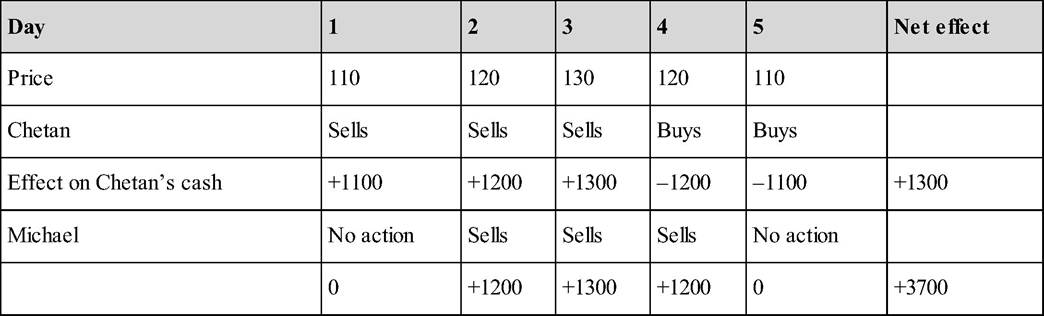
So the combined increase in cash balance is ' 5000.
10. If Michael ended up with 20 more shares than Chetan at the end of day 5, (Reaction: Share wise, we know that Chetan is -10, so obviously Michael must be +10 shares in order for him to have 20 more shares than Chetan. This means that Michael must have bought once. For that to happen the price of the share must have gone down to ' 80. The only way that occurs is if we take the price down on the first two days. Thus, the price string would be 90, 80, 90, 100, 110) what was the price of the share at the end of day 3 (Reaction: Obviously 90)? Hence, option (a) is correct.
Solutions for Questions 11-15:
A significant amount of traffic flows from point S to point T in the one-way street network shown below. Points A, B, C and D are junctions in the network, and the arrows mark the direction of traffic flow. The fuel cost in rupees for travelling along a street is indicated by the number adjacent to the arrow representing the street.
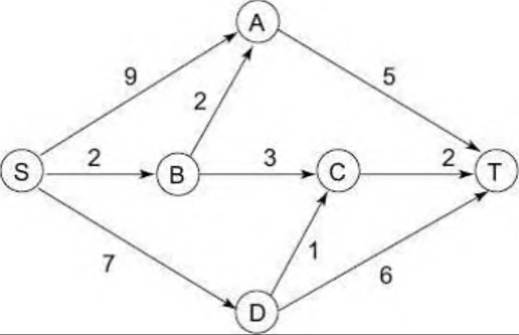
Motorists travelling from point S to point T would obviously take the route for which the total cost of travelling is the minimum. If two or more routes have the same least travel cost, then motorists are indifferent between them. Hence, the traffic gets evenly distributed among all the least cost routes.
The government can control the flow of traffic only by levying appropriate toll at each junction. For example, if a motorist takes the route S-A-T (using junction A alone), then the total cost of travel would be ' 14 (i.e.,' 9 + ' 5) plus the toll charged at junction^.
Reaction: Routes possible are:
1. SAT—Cost 14 +A
2. SBAT-Cost 9 + A + B
3. SBCT-Cost 7 + B + C
4. SDCT-Costl0 + C + D
5. SDT- Cost 13+D
9. If the government wants to ensure that all motorists travelling from S to T pay the same amount (fuel costs and toll combined) (Reaction: The question is asking us to fix toll charges in such a way that the total cost on all feasible routes is equal.) regardless of the route they choose and the street from B to C is under repairs (and hence unusable) (Reaction: Route SBCT is closed), then a feasible set of toll charged (in rupees) at junctions A, B, C and D respectively to achieve this goal is:
Reaction: To equate SDCT cost with SDT cost, C should be 3. This leaves only options (b) and (c). Checking option (b), SAT = 14, SBAT = 14, SDCT = 14 and SDT =14 (feasible as all 4 routes’ cost is equated).
Checking option (c), SAT = 15, SBAT = 15, SDCT = 15 and SDT = 15 (feasible again as all 4 routes’ cost is equated). This question gives 2 answers. Mark either one and move ahead. [Note: This question was neglected from the final score calculations].
10. If the government wants to ensure that no traffic flows on the street from D to T, (Reaction: SDT has to be made infeasible) while equal amount of traffic flows through junctions A and C, (Reaction: There are 2 routes each through A and C. In order to make an equal amount of traffic flow through each junction A and C respectively, we need to ensure either of two things: 1. All four routes SAT, SBAT, SBCT and SDCT should be the same least cost, OR 2. One route through A and one route through C should be the least cost. At the same time SDT should not be the least cost route.) then a feasible set of toll charged (in rupees) at junctions A, B, C and D respectively to achieve this goal is:
Reaction: Looking at the options, 4 of the five options give the value of B as 5. We can clearly see that if B is 5, SAT and SBAT give the same cost. In such a case, the two routes through C should also give the same least cost. Also for SBCT to be equal to SBAT, C should exceed A by 2. This occurrs in option (a) and (e). From this point checking for option (a) and (e) it is evident that option (e) is the correct solution as SAT = SBAT = SDCT = SBCT = 14.
11. If the government wants to ensure that all routes from S to T get the same amount of traffic, then a feasible set of toll charged (in rupees) at junctions A, B, C and D respectively to achieve this goal is:
Reaction: We need to equate all 5 routes. Thus, looking at the equations for the total cost on each route we see the following:
For SAT = SBAT, B should be 5, (All options have this)
For SAT = SDT, D should be 1 more than A (Only options (b) and (e) have this) For SDT = SDCT, C should be 3. Only option (e) has this.
12. If the government wants to ensure that the traffic at S gets evenly distributed along streets from S to A, from S to B, and from S to D, then a feasible set of toll charged (in rupees) at junctions A, B, C and D respectively to achieve this goal is:
Reaction: Since SA has only 1 route going through it, there should be exactly 3 least cost routes—1 each through SA, SB and SD. Further, SAT has to be one of the least cost routes. In Options (a), (b) and (e), SAT would cost 14 while in options (c) and (d), SAT would cost 15. On checking Option (a) gives:
SAT = SBAT = SDT = 14 while SBCT (16) and SDT (15) would not be least cost routes. The traffic would get evenly distributed between SAT, SBAT and SDT as required by the question.
13. The government wants to devise a toll policy such that the total cost to the commuters per trip is minimised. The policy should also ensure that not more than 70 per cent of the total traffic passes through junction B. (Reaction: There should be at least 1 least cost route which is not passing through 5.) The cost incurred by the commuter travelling from point S to point T under this policy will be:
Reaction: The minimum cost on a route not passing through B is 10, hence options (a) and (b) are not feasible. The issue to look out for is whether we can create a total cost of 10 and have the 70% condition met.
Looking at the cost equations, it is clear that if we want SDCT to cost 10 totally, C and D should be toll free. Then SBCT should also cost 10 at least to share the least cost route with SDCT. Thus the toll at B should be 3. In such a case, SDCT= 10 = SBCT and the other routes cost more than 10. Hence, the traffic would get divided 50-50 between SDCT and SBCT and 10 would represent the least cost you would need to get the value required.
Solutions for Questions 16-20:
K, L, M, N, P, Q, R, S, U and W are the only ten members in a department. There is a proposal to form a team from within the members of the department, subject to the following conditions:
• A team must include exactly one among P, R and S. (Reaction: One amongst P/R/S is compulsorily selected in every team.)
• A team must include either M or Q, but not both. (Reaction: One amongst M or Q is compulsory in every team)
• If a team includes K, then it must also include L, and vice versa. (Reaction: K and L go together; So both or neither)
• If a team includes one amongst S, U and W, then it must also include the other two. (5, U and W go together or they do not go at all.)
• L and N cannot be members of the same team. (Reaction L ¥ N)
• L and U cannot be members of the same team. (Reaction Z ¥ ¢7)
The size of a team is defined as the number of members in the team.
16. What could be the size of a team that includes KJ (Reaction: IfK is taken, L should be taken, so N and U are not taken. If U is not taken, S and W are also rejected. Also, one IfomAf or Q and one IfomFfR have to be taken. So team size can be 4. Option (e) is correct.)
17. In how many ways a team can be constituted so that the team includes TV? (Reaction: IfAis taken, L is rejected. So K is also rejected. Then, one amongst P/RJS has to be taken. This can be done in 3 ways as if we take S, U and W would automatically be selected and if we take either P or P then S, U and W automatically get rejected. Also one amongst MIQ has to be taken compulsorily. This means that there are 3 ¥ 2 = 6 ways of making the team)
18. What would be the size of the largest possible team? (Reaction: One IfomAf/(2, S, U and W, and N gives us 5 members. Note: If we select U then L and K cannot be part of the team. Option (d) is correct.)
19. Who can be a member of a team of size 5? (Reaction: From the previous question, it is evident that only Af can be a member of a team of size 5.)
20. Who cannot be a member of a team of size 3? (Reaction: In a team of size 3, we cannot include either K or L as they would increase the minimum team size to 4. Thus, option (a) is correct.)
Solutions for Questions 21-25:
21. 1 is clearly a judgement as it uses unclear subject like ‘we’, ‘our’, etc and has generalised feelings so in absence of a clear subject it is a judgement. 2. This is also a judgement on the basis of the above mentioned points which are applicable to statements 3 and 4.
So the correct option is [ЛЛ]. Option (d) is correct.
22. Any kind of advice which is general is a judgement, so the 1st statement is a J. The 2nd statement is a fact as it only talks about numbers and data which can be checked. The 3rd statement is an inference as it is a future projection about something on factual basis. The 4th statement is a judgement as it again is generalised without a clear subject.
The answer is option (a) [JFIJ]
23. The 1st statement is in present continuous, indicating something that is going on and is not finished and is thus an inference. The 2nd statement is a clear judgement as it is a generalisation from a proverb which is not clearly
verifiable. The 3rd statement is a fact as it has clear verifiable numbers and data. The 4th statement is a judgement as it mentions a universal goal, again a generalisation.
The answer is option (c) [IJFI].
14. The 1st statement is a judgement, the generalisation and the judgemental nature of the sentence ‘crookedness of Indians’. The 2nd statement is a fact, clearly verifiable. The 3rd statement is again general and is a judgement. The 4th statement is an inference because it is a projection about a situation with no generalisation.
The answer is option (c) [JIJF]
15. The 1st statement is a judgement due to the ‘wrong’ mentioned. The two words ‘most sinister’ contributes to it. The usage of ‘continuation of conflict’ makes statement 2 an inference. The phrase’ the only insurance’ makes the sentence 3 a judgement. The statement 4 is based on data and is thus a fact.
Option (b) [JIJF] is correct.
Solutions to Questions 26-30:
16. The author is defining his style not as a rule but mostly in the suggestive sense. So option (c) is correct.
17. The paragraph here shows a chain of negativity which is creating a situation of loss for everyone. Thus option (e) is correct.
18. The whole paragraph is in a present continuous form and so option (b) is the most accurate.
19. The focus here is about the exploitation of entrepreneurial opportunity at a later stage in life. Thus option (d) is the answer as it logically provides a conclusion for the paragraph.
20. The paragraph emphasises on the importance of simplicity in theories and maps so that they can be adjusted and applied to various situations, and yet their importance is not undermined. So option (a) is the most suitable conclusion.
21. Thought Process:
The number of people in the respective rows will form an AP with a common difference of-3.
In this case, we have to find which number of rows is not possible. For this take it option by option.
Use the principle that for an AP the sum is given by n x average.
For 3 rows: The average of the AP would be 210. And this would also be the value of the middle term (as when there are 3 rows the average of the AP is given by the middle term). We can thus form an AP of 3 terms with middle term 210 and common difference -3. Thus it is possible to arrange the children in 3 rows.
For 4 rows: The average would be 630/4 = 157.5. Since, there will be two middle terms in this case— the AP can be easily formed with the middle terms as 159 and 156 (so that they average 157.5 with a common difference of-3). Thus it is possible to arrange the children in 4 rows.
For 5 rows: The average of the AP would be 630/5 = 126. And this would also be the value of the middle term (as when there are 5 rows the average of the AP is given by the middle term). We can thus form an AP of 5 terms with middle term 126 and common difference -3. Thus it is possible to arrange the children in 5 rows.
For 6 rows: The average would be 630/6 = 105. Since, there will be two middle terms in this case—the AP would have to be formed with the two middle terms as 106.5 and 103.5 (so that they average 105 with a common difference of -3). Thus it is not possible to arrange the children in 6 rows as the value of the terms in the AP would not be in integers.
Maximum solution time: 45-60 seconds in case you know the principle of middle terms of an AP.
22. Thought process:
Totalnumberofpeoplesurveyed: 100
OnlySeptember: 18;
September but not August: 23;
September and July: 8;
September 28;
July: 48;
JulyandAugust: 10;
None of the three months: 24.
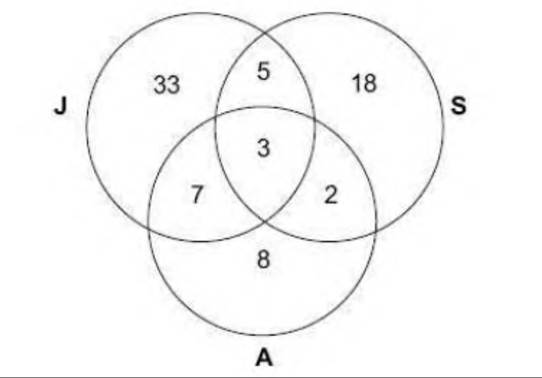
The number of people who would have read exactly two consecutive issues would be given by the numbers who read July and August only (7) and August and September only (2). 7 + 2 = 9.
Solutions for Questions 33 and 34:
Start from the second question. From the given information, it is clear that the extra luggage for Praja is twice the extra luggage for Raja. This means that when the two of them take their luggage separately, after reducing the free luggage from 60 kg, whatever remains has to be divided into three parts and two of them have to be carried by Praja and one by Raja.
This is because, if Raja and Praja were to both carry their luggage separately, the total free luggage would be twice the free luggage of one of them.
Also, when only one person carried the luggage, the amount of extra luggage should be 50% higher than the extra luggage when both are carrying their luggage separately.
From the options, it is clear that:
Option (a) is not possible as when both carry their luggage separately, extra luggage = 40. However, when only 1 carries all the luggage the extra luggage would be 50. But from 40 to 50 we do not have a 50% increase. Hence, the option can be rejected.
Repeat the same thought process for Option (b). 30 to 45 is a 50% increase.
Option (c): 20 to 40 not a 50% increase.
Option (d): 10 to 35 not a 50% increase.
Option (e): 0 to 30 not a 50% increase.
Obviously option (b) is correct for Question 34.
If we solve the question through equation, we get: 1.5(60 - 2x) = 60-xτzE2x = 30 and thus x = 15.
With a free luggage allowance of 15 kgs, Raja should have had 15 + у and Praja 15 + 2y
giving a total of the two as 60. Thus, 30 + 3y = 60 gives us j = 10. Hence, Praja = 35 kgs. Hence, option (d) is correct.