CAT 2005
1. Three Englishmen and three Frenchmen work for the same company. Each of them knows a secret not known to others. They need to exchange these secrets over person-to-person phone calls so that eventually each person knows all six secrets.
None of the Frenchmen knows English, and only one Englishman knows French. What is the minimum number of phone calls needed for the above purpose?(a) 5 (b) 10
(c) 9 (d)15
2. A rectangular floor is fully covered with square tiles of identical size. The tiles on the edges are white and the tiles in the interior are red. The number of white tiles is the same as the number of red tiles. A possible value of the number of tiles along one edge of the floor is
(a) 10 (b) 12
(c) 14 (d) 16
Answer Questions 3-6 on the basis of the information given below:
In the table below is the listing of players, seeded from highest (#1) to lowest (#32), who are due to play in an Association of Tennis Players (ATP) tournament for women. This tournament has four knockout rounds before the final, i.e., first round, second round, quarter finals, and semi-finals. In the first round, the highest seeded player plays the lowest seeded player (seed # 32) which is designated match No. 1 of first round; the 2nd seeded player plays the 31st seeded player which is designated match No. 2 of the first round, and so on. Thus, for instance, match No. 16 of the first round is to be played between the 16th seeded player and the 17th seeded player. In the second round, the winner of match No. 1 of the first round plays the winner of match No. 16 of first round and is designated match No. 1 of the second round. Similarly, the winner of match No. 2 of first round plays the winner of match No. 15 of first round, and is designated match No. 2 of second round. Thus, for instance, match No. 8 of the second round is to be played between the winner of match No.
8 of the first round and the winner of match No. 9 of the first round. The same pattern is followed for later rounds as well.| Seed# | Name OfPlayer | Seed# | Name OfPlayer | Seed# | Name OfPlayer |
| 1 | Maria Sharapova | 12 | Mary Pierce | 23 | Silvia Farina Elia |
| 2 | Lindsay Davenport | 13 | Anastasia Myskina | 24 | Tatiana Golovin |
| 3 | Amelie Mauresmo | 14 | Alicia Molik | 25 | Shinobu Asagoe |
| 4 | Kim Clijsters | 15 | Nathalie Dechy | 26 | Francesca Schiavone |
| 5 | Svetlana Kuznetsova | 16 | Elena Bovina | 27 | Nicole Vaidisova |
| 6 | Elena Dementieva | 17 | Jelena Jankovic | 28 | Gisela Dulko |
| 7 | Justine Henin | 18 | Ana Ivanovic | 29 | Flavia Pennetta |
| 8 | Serena Williams | 19 | Vera Zvonareva | 30 | Anna Chakvetadze |
| 9 | Nadia Petrova | 20 | Elena Likhovtseva | 31 | Ai Sugiyama |
| 10 | Venus Williams | 21 | Daniela Hantuchova | 32 | Anna-Lena Groenefeld |
| 11 | Patty Schynder | 22 | Dinara Safina |
3.
If there are no upsets (a lower seeded player beating a higher seeded player) in the first round, and only match Nos. 6, 7, and 8 of the second round result in upsets, then who would meet Lindsay Davenport in the quarter finals, in case Davenport reaches the quarter finals?(a) Justine Henin (b) Nadia Petrova
(c) Patty Schnyder (d) Venus Williams
4. If Elena Dementieva and Serena Williams lose in the second round, while Justine Henin and Nadia Petrova make it to the semi-finals, then who would play Maria Sharapova in the quarter finals, in the event Sharapova reaches the quarter finals?
(a) Dinara Safina (b) Justine Henin
(c) Nadia Petrova (d) Patty Schnyder
5. If, in the first round, all even numbered matches (and none of the odd numbered ones) result in upsets, and there are no upsets in the second round, then who could be the lowest seeded player facing Maria Sharapova in the semi-finals?
(a) Anastasia Myskina (b) Flavia Pennetta
(c) Nadia Petrova (d) Svetlana Kuznetsova
6. If the top eight seeds make it to the quarter finals, then who, amongst the players listed below, would definitely not play against Maria Sharapova in the final, in case Sharapova reaches the final?
(a) Amelie Mauresmo (b) Elena Dementieva
(c) Kim Clij sters (d) Lindsay Davenport
Answer Questions 7-10 on the basis of the information given below:
Venkat, a stockbroker, invested a part of his money in the stock of four companies—A, B, C and D. Each of these companies belonged to different industries, viz., Cement, Information Technology (IT), Auto, and Steel, in no particular order. At the time of investment, the price of each stock was ' 100. Venkat purchased only one stock of each of these companies. He was expecting returns of 20%, 10%, 30% and 40% from the stock of companies A, B, C and D, respectively. Returns are defined as the change in the value of the stock after one year, expressed as a percentage of the initial value. During the year, two of these companies announced extraordinarily good results.
One of these two companies belonged to the Cement or the IT industry, while the other one belonged to either the Steel or the Auto industry. As a result, the returns on the stocks of these two companies were higher than the initially expected returns. For the company belonging to the Cement or the IT industry with extraordinarily good results, the returns were twice that of the initially expected returns. For the company belonging to the Steel or the Auto industry, the returns on announcement of extraordinarily good results were only one and a half times that of the initially expected returns. For the remaining two companies, which did not announce extraordinarily good results, the returns realised during the year were the same as initially expected.7. What is the minimum average return Venkat would have earned during the year?
(a) 30% (b)31¼%
(c) 32 ½ % (d) Cannot be determined
8. IfVenkat earned a 35% return on average during the year, then which of these statements would necessarily be true?
I. Company A belonged either to the Auto or the Steel Industry.
II. Company B did not announce extraordinarily good results.
III. Company A announced extraordinarily good results.
IV. Company D did not announce extraordinarily good results.
(a) I and II only
(b) II and III only
(c) III and IV only
(d) II and ΓV only
9. IfVenkat earned a 38.75% return on average during the year, then which of these statements) would necessarily be true?
I. Company C belonged either to Auto or to Steel Industry.
II. Company D belonged either to Auto or to Steel Industry.
III. Company A announced extraordinarily good results.
ΓV. Company B did not announce extraordinarily good results.
(a) I and II only (b) II and III only
(c) I and IV only (d) II and IV only
10. If Company C belonged to the Cement or the IT industry and did announce extraordinarily good results, then which of these statements) would necessarily be true?
I.
Venkat earned not more than 36.25% return on average.II. Venkat earned not less than 33.75% return on average.
III. If Venkat earned 33.75% return on average, Company A announced extraordinarily good results.
ΓV. IfVenkat earned 33.75% return on average; Company B belonged either to Auto or to Steel Industry.
(a) I and II only
(b) II and ΓV only
(c) II and III only
(d) III and IV only
Answer Questions 11-14 on the basis of the information given below: The year is 2089. Beijing, London, New York and Paris are in contention to host the 2096 Olympics. The eventual winner is determined through several rounds of voting by members of the IOC with each member representing a different city. All the four cities in contention are also represented in IOC.
• In any round of voting, the city receiving the lowest number of votes in that round gets eliminated. The survivor after the last round of voting gets to host the event.
• A member is allowed to cast votes for at most two different cities in all rounds of voting combined. (Hence, a member becomes ineligible to cast a vote in a given round if both the cities (s)he voted for in earlier rounds are out of contention in that round of voting.)
• A member is also ineligible to cast a vote in a round if the city (s)he represents is in contention in that round of voting.
• As long as the member is eligible, (s)he must vote and vote for only one candidate city in any round of voting.
The following incomplete table shows the information on cities that received the maximum and minimum votes in different rounds, the number of votes cast in their favor, and the total votes that were cast in those rounds.
| Round | Total Votes Cast | MaximumVotes Cast | Eliminated | ||
| City | No. ofVotes | City | No. ofVotes | ||
| 1 | London | 30 | New York | 12 | |
| 2 | 83 | Paris | 32 | Beijing | 21 |
| 3 | 75 | ||||
It is also known that:
• All those who voted for London and Paris in round 1, continued to vote for the same cities in subsequent rounds as long as these cities were in contention. 75% of those who voted for Beijing in round 1, voted for Beijing in round 2 as well.
• Those who voted for New York in round 1, voted either for Beijing or Paris in round 2.
• The difference in votes cast for the two contending cities in the last round was 1.
• 50% of those who voted for Beijing in round 1, voted for Paris in round 3.
11. What percentage of members from among those who voted for New York in round 1, voted for Beijing in round 2?
(а) 33.33 (b) 50
(с) 66.67 (d) 75
12. What is the number of votes cast for Paris in round 1?
(a) 16 (b) 18
(c) 22 (d) 24
13. What percentage of members from among those who voted for Beijing in round 2 and were eligible to vote in round 3, voted for London?
(a) 33.33 (b) 38.10
(c) 50 (d) 66.67
14. Which of the following statements must be true?
I. IOC member from New York must have voted for Paris in round 2.
II. IOC member from Beijing voted for London in round 3.
(a) Only I (b) Only II
(c) Both I and II (d) Neither I nor II
Answer Questions 15-18 on the basis of the information given below:
Help Distress (HD) is an NGO involved in providing assistance to people suffering from natural disasters. Currently, it has 37 volunteers. They are involved in three projects: Tsunami Relief (TR) in Tamil Nadu, Flood Relief (FR) in Maharashtra, and Earthquake Relief (ER) in Gujarat. Each volunteer working with Help Distress has to be involved in at least one relief work project.
• A Maximum number of volunteers are involved in the FR project. Among them, the number of volunteers involved in FR project alone is equal to the volunteers having additional involvement in the ER project.
• The number of volunteers involved in the ER project alone is double the number of volunteers involved in all the three projects.
• 17 volunteers are involved in the TR project.
• The number of volunteers involved in the TR project alone is one less than the number of volunteers involved in ER project alone.
• Ten volunteers involved in the TR project are also involved in at least one more project.
15. Based on the information given above, the minimum number of volunteers involved in both FR and TR projects, but not in the ER project is:
(а) 1 (b) З
(с) 4 (d) 5
16. Which of the following additional information would enable to find the exact number of volunteers involved in various projects?
(a) Twenty volunteers are involved in FR.
(b) Four volunteers are involved in all the three projects.
(c) Twenty three volunteers are involved in exactly one project.
(d) No need for any additional information.
17. After some time, the volunteers who were involved in all the three projects were asked to withdraw from one project. As a result, one of the volunteers opted out of the TR project, and one opted out of the ER project, while the remaining ones involved in all the three projects opted out of the FR project. Which of the following statements, then, necessarily follows?
(a) The lowest number of volunteers is now in TR project.
(b) More volunteers are now in FR project as compared to ER project.
(c) More volunteers are now in TR project as compared to ER project.
(d) None of the above.
18. After the withdrawal of volunteers, as indicated in Question 17, some new volunteers joined the NGO. Each one of them was allotted only one project in a manner such that, the number of volunteers working in one project alone for each of the three projects became identical. At that point, it was also found that the number of volunteers involved in FR and ER projects was the same as the number of volunteers involved in TR and ER projects. Which of the projects now has the highest number of volunteers?
(a) ER (b) FR
(c) TR (d) Cannot be determined
Answer Key
| l.(c) | 2. (b) | 3.(d) | 4. (c) |
| 5. (a) | 6. (c) | 7. (c) | 8. (b) |
| 9. (c) | 10. (b) | ll.(d) | 12. (d) |

1. Let the Englishmen be A, B and C. Out of these let C know French. Also, the French can be assumed to be D, E and F. First A and B call C so that C knows all three secrets with the Englishmen. Also D and E call F so that F knows all three secrets with the French. Then let C call F to exchange all secrets. At this point C and F would know all 6 secrets. They then need to transmit it to A, B and D, E respectively. So C must call A and he must also call B. Also F must call D and also call E. Thus there will be a total of 2 + 2 + 1+ 2 + 2- 9 calls.
2. You would need to solve this using options. Suppose there are 10 tiles along an edge of the rectangle—then all these edge tiles would be white. So, the number of white tiles would be 10 + 10 + x + x (where x is the number of unique tiles on the other edge of the rectangle).
Withx - 1, the number of white tiles - 22 and the number of total tiles - 10 ¥ 3 - 30. This cannot be the answer as the number of red tiles would only be 8, which is less than required.
Next, take X as 2. In this case, White tiles - 24 and total tiles - 10 ¥ 4 - 40. This cannot be the answer as the number of red tiles would only be 16, which is less than required.
Next, take X as 3. In this case, White tiles - 26 and total tiles - 10 ¥ 5 - 50. This cannot be the answer as the number of red tiles would only be 24, which is less than required.
Next, take X as 4. In this case, White tiles - 28 and total tiles - 10 ¥ 6 - 40. This cannot be the answer as the number of red tiles would be 32 which is more than required. Thus we can reject 10 as the answer as increasingx would only increase the number of red tiles further.
We then check for option (b) whereby there could be 12 tiles on an edge of the rectangle.
Again, the number of white tiles would be 12 + 12+x + x.
Forx - 1 white tiles - 26 and total of 12 ¥ 3 - 36 tiles. This cannot be the answer as the number of red tiles would only be 10, which is less than required.
Forx - 2, white tiles - 28 and total of 12 ¥ 4 - 48 tiles. This cannot be the answer as the number of red tiles would only be 20, which is less than required.
For X - 3, white tiles - 30 and total of 12 ¥ 5 - 60 tiles. In this case we see that the number of red tiles would also be equal to 30. Thus, 12 tiles along an edge is possible as an answer.
Thus option (b) is correct.
Solutions for Questions 3-6:
The first thing you should realise in this question, is that the tournament consists of the following rounds with the respective match ups based on the seedings of the players expected to reach that particular round.
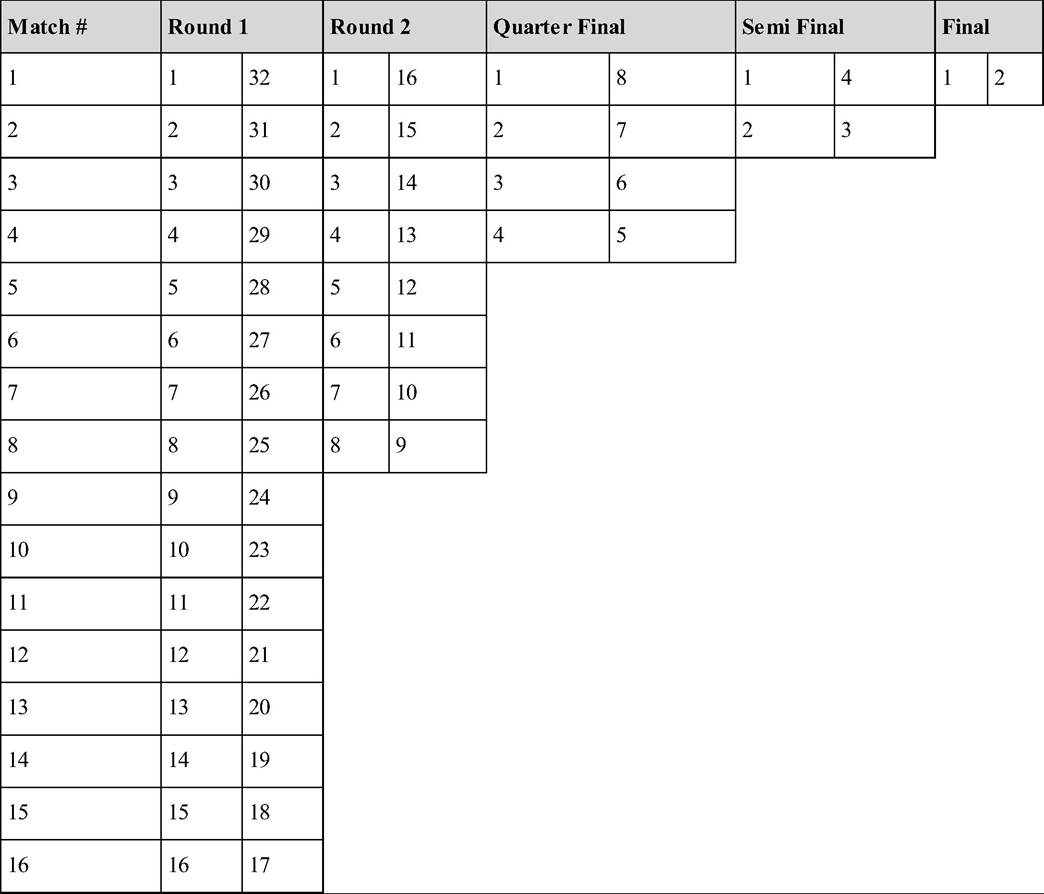
With this basic structure of the tournament you are ready to move to the questions:
3. If there are no upsets in the first round, the second round would have the top 16 players reaching it. Now, in order to find the opponent of Lindsay Davenport in the quarter final, we need to see the opponent of seed no. 2 in match no. 2 in the quarter finals. It is expected to be the 7th seed. But the question also says that matches 6, 7 and 8 of the second round ended in upsets. This means that the 7th seed would lose to the IOth seed in the second round. Hence, the IOth seed would be the required opponent. Fromthe original table we can see that the IOth seed is Venus Williams, hence option (d) is correct.
4. The scheduled opponent of Maria Sharapova (seed no. 1) in the quarter final is Seed no. 8 (Serena Williams). However we know that she loses in the first round which must be against the 25th ranked player. For Maria Sharapova’s opponent we then need to see what would happen in the second round match between 9 and 25. 9 being Nadia Petrova and knowing that she reaches the semi final, we know that 9 must have won this match. Hence, Sharapova’s quarter final opponent would be Nadia Petrova.
5. If there are upsets in all even numbered matches in the first round, it means that only all the odd numbered players would reach the second round. For Maria Sharapova’s semi final opponent we need to track the path of seed no. 4. We can arrive at the answer based on the following deductions.
In the first round 4 loses to 29, and hence in the second round the match up would be between 13 and 29. No upsets in the second round means 13 would win this match. Scheduled opponent for 13 in the third round (Quarter final) would be 5, and 5 would lose neither in the first nor the second round. Hence, the quarter final between 5 and 13 would determine the opponent for Sharapova in the semi finals. Either of them can win this match, as we have not been given any details of the quarter final results. Hence, the lowest seeded player Sharapova would face Seed # 13—Anastasia Myskina in the semi finals.
6. Kim Clijsters, being the fourth seed would face Sharapova in the semi finals and hence cannot play her in the finals.
Solutions for Questions 7-10:
A synopsis of the information would give us the following:
Venkat has invested ' 100 each in the stock of 4 companies viz: A, B, C and D expecting returns of 20%, 10%, 30% and 40% respectively. The four companies are randomly distributed across Cement, IT, Steel and Auto industries. For one company from cement or IT industry, the returns were twice the expected returns (¥2), while for one company from Steel or Auto industry the returns were ¥1.5 times the expected returns.
At this point of time you should realise that the minimum return Venkat is expecting would amount to (20 + 10 + 30 + 40 = 100). This value would go up on the basis of which of these numbers we choose to multiply by 1.5 and which by 2.
Naturally, multiplication by 2 should be for the largest value and by 1.5 should be for the second largest value if we are expecting a maximisation of return.
Conversely, multiplication by 2 should be for the minimum value and by 1.5 for the second lowest value if we are looking to minimise the return.
7. For the minimum average return the growth in return should be minimised.
This can be done as Total return = 2 ¥ 10 + 1.5 ¥ 20 + 30 + 40 =130. So average return = 130/4 = 32.5
8. An average return of 35% means a total return of 35 ¥ 4 = 140. To achive this think of how the value of 100 would increase based on which numbers you choose to multiply. We have a slack (or elbow room) of an increase by 40 and we need to adjust the ¥2 and the ¥1.5 in such a way that the increase is exactly 40. Think about this as below:
| B | A | C | D |
| 10 | 20 | 30 | 40 |
If we multiply 40% by 2, the increase in value would be by 40 and we would not have any slack left to use the multiplication by 1.5. Hence, this is not possible.
If we use the ¥2 for 30, we will get +30 leaving a slack of 10. Then the ¥1.5 can be used on 20 to get +10. We would get a total of +40.
Similarly, ¥2 for 20 and ¥1.5 for 40 would give us 20+20 and ¥2 for 10, would not allow us to reach 40 as we need to cover a slack of 30 when we use ¥1.5— which is not possible because even if we maximise ¥1.5 by using it on 40, we would still add only 20 to it.
| B | A | C | D | |
| 10 | 20 | 30 | 40 | |
| Possibility 1 | ¥1.5 | ¥2 | ||
| Possibility 2 | x2 | ¥1.5 |
From the above table it is clear that, both statements I and II are true because in both possibilities Company A announced extraordinarily good results while Company B did not.
9. 38.75% return on average means a total return of 155. An increase of+55:
| B | A | C | D |
| 10 | 20 | 30 | 40 |
| ¥1.5 | ¥2 |
It is obvious that a +55 can only be done by using +40 (by multiplying 40 by 2) and +15 (by multiplying C by 1.5).
Hence, C belongs to Auto or Steel and D belongs to Cement or IT. Statements I and IV are correct.
10. If C belongs to Cement or IT, and announces extraordinarily good results it is clear that we have at least a +30 for it return wise. Further, the minimum increase due to the ¥1.5 would be +5 (if we use it on 10). Thus, a minimum total return of 135 and a minimum average return of 135/4= 33.75.
In this case, it must also be true that Company B belonged to Auto or Steel Industry.
Thus, statements II and IV are correct.
Solutions for Questions 11-14:
When you read the initial set of instructions, you should realise that there are essentially two rules which are operating here in order to change the eligibility of a country’s representative from voting.
From the language “A member is allowed to cast a vote for at most two different cities in all rounds of voting combined”, we can infer the following rule:
Rule 1: Making an eligible member ineligible: This would occur when a member votes for 1 city in the first round, and another in the second round and both these cities have been eliminated before the third round. Looking at the table—an eligible member would become ineligible to vote only in case he has voted for New York in the first round and Beijing in the second round. This is the only way of making an eligible member ineligible to vote and hence would only occur for some of those 2 voters who voted for New York in the first round (those who shifted their votes to Beijing in the second round).
This rule, when it applies would naturally reduce the number of voters who voted in a particular round from the number who voted in the previous round. Also the third round is the first time this rule would apply.
Rule 2: Making an ineligible member eligible: This rule can be inferred from the language “A member is also ineligible....... in that round of voting.” This obviously
means that if I am a member whose city is in contention, then I cannot vote. However, if my city gets eliminated from the fray, then I would become eligible to vote.
This rule would obviously apply only to the member from New York in the second round (i.e., he would become eligible to vote in the second round) and to the member from Beijing in the third round as these are the only two cities that earlier became ineligible and later became eligible.
Based on these deductions we can start looking at the table:
| Round | TotalVotes Cast | MaximumVotes Cast | Eliminated | ||||
| City | No. ofvotes | City | No. ofvotes | ||||
| 1 | 82 | London | 30 | New York | 12 | Paris | Beijing |
| 2 | 83 | Paris | 32 | Beijing | 21 | London (30) | |
| 3 | 75 | ||||||
The following deductions can be drawn:
In the first round, the number of votes cast must be 82 (as in the second round the member IfomNew Yorkhas become eligible to vote).
This means that Paris + Beijing must be 40 (in the first round).
Now, from the first clue we realise that since 75% of the Beijing voters continued to vote for Beijing in the second round, the inference is that Beijing’s number in the first round must be a multiple of 4. (Otherwise 75% would not be an integer).
This gives us the following possibilities for Paris and Beijing in the first round:
| Paris | Beijing | |
| Possibility 1 | 24 | 16 |
| Possibility 2 | 20 | 20 |
| Possibility 3 | 16 | 24 |
At this point of time you should also realise that the change from 83 votes cast in the second round and 75 votes cast in the third round would be due to two things:
The member from Beijing becoming eligible (thus increasing the number of eligible voters to 84) and the members who shifted out of New York to Beijing becoming ineligible to vote in the third round. 83 + 1 -X = 75. Thus, 9 New York voters must have shifted to Beijing in the second round.
We also know that the London voters continued to vote for London—so London must have found no new voters. This means that Paris must have got 3 of the New York voters from the first round, voting for it in the second round.
We need to now try to fit in one of the above three possibilities to see which of them gives us the correct situation.
We also know that 75% of Beijing’s first round voters continued to vote for Beijing in the second round, thus 25% of Beijing’s first round voters must have shifted out of
Beijing.
In the second round there are a total of 12 New York voters, 1 member IfomNew York and 25% of Beijing’s first round voters who are free to vote.
Since, Beijing got 21 votes the only way this could have happened would be if Possibility 1 was correct in the above case. In such a case the following numbers would work out:
London—30 voters in first round who all carry over to the second round
Beijing—16 voters in the first round, of which 75% (12) voted again for them + 9 voters who voted for New York in the first round shifted to Beijing in the second round = A total of 21 votes in the second round.
Paris—24 votes in the first round + 4 voters who voted for Beijing in the first round voted for Paris in the second + 3 voters who voted for New York in the first round voted for Paris in the second + 1 member from New York who was not eligible to vote in the first round and became eligible to vote in the second round = A total of 32 votes in the second round.
In the third round, since there are 75 votes and the difference between the votes cast for the two cities was 1 it must be that the two cities got 38 and 37 votes respectively. What we need to see is which city had how many votes.
For this purpose, we first need to understand the number of free votes that there are. An analysis of the second round would give us that:
Out of the 21 voters for Beijing in the second round, 9 have become ineligible to vote. So there must be 12 free votes from there.
Also the member from Beijing would be eligible to vote in the third round.
Thus there would be a total of 13 free votes in the third round.
We need to match this deduction with the clues we are left with.
For this purpose we have the last clue—50% of those who voted for Beijing in the first round voted for Paris in Round 3.
This means that Paris must have got an additional 4 voters from Beijing (as it already got 4 voters in the second round and those 4 cannot move to London as they have already voted for 2 cities in the first two rounds).
Thus, out of the 12 free votes available from Beijing’s voters, 4 have gone to Paris and 8 must have shifted to London. Thus, London reaches 38 and consequently Paris must have got the member from Beijing to vote for it.
So, London = 30 votes in round 2 + 8 Beijing voters = 38 votes
Paris = 32 votes in round 2 + 4 Beijing voters + 1 member from Beijing = 37 votes Hence, the answers are:
11. 9 out of 12 = 75%
12. 24
13. 8 out of 12-66.66%
14. A is true but B is not. Hence, Option (a) is correct.
Solutions for Questions 15-18:
The figure has been made on the following deductions and facts which can be deduced based on the following clues:
• The number of volunteers involved in the ER project alone is double the number of volunteers involved in all the three projects.
• 17 volunteers are involved in the TR project.
• The number of volunteers involved in the TR project alone is one less than the number of volunteers involved in ER project alone.
• Ten volunteers involved in the TR project are also involved in at least one more project.
1. TR is given as 17 (overall) out of which 10 are involved in at least 1 more project apart from TR. Hence, only TR would be 7.
2. ER alone is 1 more than TR alone. So ER alone would be 8. Also volunteers in all three projects is half of ER alone so all three should be 4.
At this point of analysis we have the figure as shown below:
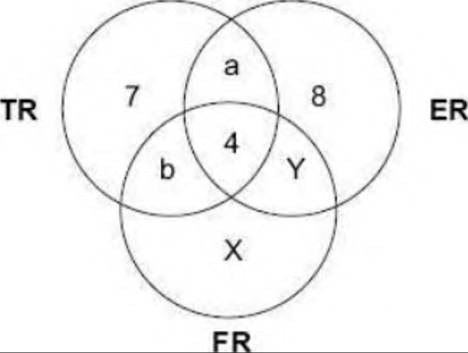
At this point we also know,
X + j = 12 and a + b = 6
At this point of our analysis the only clue we need to further interpret is the first one—
• A Maximum number of volunteers are involved in the FR project. Among them, the number of volunteers involved in FR project alone is equal to the volunteers
having additional involvement in the ER project.
From the second statement in this clue we can deduce that, since FR only has to be equal to the number having additional involvement in ER—X must be 8 and Y must be 4.
Note: There was an interpretation based confusion which test takers had while thinking about this clue in the exam. The confusion was—what does additional involvement in ER mean? Does it mean FR and ER only or does it include both the areas, viz: FR and ER only as well as FR, ER and TR.
A little bit of clear thinking would tell you that when we say—FR with additional involvement of ER, we are not referring to any third (or for that matter fourth) category. Hence, the 4 people in all three would also be counted in this category.
Thus the new figure evolves to:
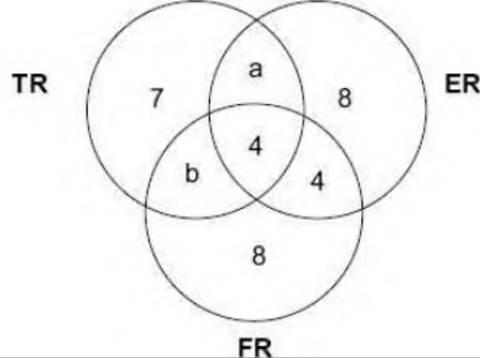
Now we know that a + b = 6.
This leads to the following possibility matrix:
| TR | FR (A Maximum) 16 +b | ER 16 + « | |||
| Possibility 1 | a = 6, b = 0 | 17 | 16 | 22 | Not possible |
| Possibility 2 | a = 5, b = 1 | 17 | 17 | 21 | Not possible |
| Possibility 3 | a = 4, b = 2 | 17 | 18 | 20 | Not possible |
| Possibility 4 | a = 3, b = 3 | 17 | 19 | 19 | Possible |
| Possibility 5 | a = 2, b = 4 | 17 | 20 | 18 | Possible |
| Possibility 6 | a = 1, b = 5 | 17 | 21 | 17 | Possible |
| Possibility 7 | a = 0, b = 6 | 17 | 22 | 16 | Possible |
Note here: There was huge confusion in the minds of test takers as must be in yours as you read this. FR is given as “A Maximum”. So does this condition allow us to take a = 3 and b = 3 as a possible distribution of 6 between a and b (as shown in possibility 4 above).
As you can see, at these values we get FR = ER =19 [and FR is not a unique maximum]. And that is exactly what you perhaps need to understand. The language used in the question “A maximum” means literally “one of the maximums”, i.e., it allows for more than one maximum simultaneously. Hence, interpreting that FR is a unique maximum in this situation is an error.
Based on the above tabular analysis we can get the answers to the question asked:
15. The minimum value of b is asked for. From the table it is 3. Option (b) is correct.
16. The first option is the correct answer as: if we know that FR = 20, then we know the value of b = 4 and we get all the values in the given situation. Notice that the information carried in statements of options (b) and (c) are already known to us. For 17 and 18, the following changes would take place:
| TR (one person opted out of TR) | FR = 14 + b | ER = 15 + « | |||
| Possibility 1 | a = 3, b = 3 | 16 | 17 | 18 | Possible |
| Possibility 2 | a = 2, b = 4 | 16 | 18 | 17 | Possible |
| Possibility 3 | a = 1, b = 5 | 16 | 19 | 16 | Possible |
| Possibility 4 | a = 0, b = 6 | 16 | 20 | 15 | Possible |
We have deleted the values of a = 4, 5 and 6 as we had ruled those values out from the previous questions’ analysis.
17. It can be seen that option (a) is not true (rejected by possibility 4 where ER has the least number of volunteers).
Option (b) can be rejected as possibility 1 has ER>FR.
Option (c) is rejected due to possibilities 1, 2 and 3.
Hence, the correct answer is none of these.
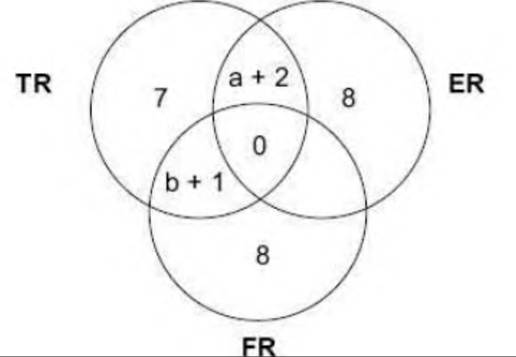
18. For FR & ER to be same as TR + ER it means a + 2 = 5. Hence, a = 3 and b = 3. Then the numbers become:
TR = 16 + m + 1 = 17 + m
ER = 18 + m
FR = 17 + m
where m is the number of volunteers inducted into ER alone and FR alone (m + 1 being the number inducted into TR alone).
Clearly ER would have the highest number of volunteers.
More on the topic CAT 2005:
- References
- Hyperplasia of the pancreas
- References
- References
- References
- References
- References
- Intergroup Communication Theories and Strategies
- Endocrine pancreas