CAT 2004
Directions for Questions 1-4: Each question is followed by two statements, A and B. Answer each question using the following instructions:
Choose 1 if the question can be answered by using one of the statements alone but not by using the other statement alone.
Choose 2 if the question can be answered by using either of the statements alone.
Choose 3 if the question can be answered by using both statements together but not by either statement alone.
Choose 4 if the question cannot be answered on the basis of the two statements.
1. Tarak is standing 2 steps to the left of a red mark and 3 steps to the right of a blue mark. He tosses a coin. If it comes up heads, he moves one step to the right; otherwise he moves one step to the left. He keeps doing this until he reaches at one of the two marks, and then he stops. At which mark does he stop?
(a) He stops after 21 coin tosses.
(b) He obtains three more tails than heads.
2. Four candidates for an award obtain distinct scores in a test. Each of the four casts a vote to choose the winner of the award. The candidate who gets the largest number of votes wins the award. In case of a tie in the voting process, the candidate with the highest score wins the award. Who wins the award?
(a) The candidates with top three scores each vote for the top scorer amongst the other three.
(b) The candidate with the lowest score votes for the player with the second highest score.
3. Nandini paid for an article using currency notes of denominations ' 1,' 2,' 5, and ' 10 using at least one note of each denomination. The total number of five and ten rupee notes used was one more than the total number of one and two rupee notes used. What was the price of the article?
(a) Nandini used a total of 13 currency notes.
(b) The price of the article was a multiple of' 10
4. In a class of 30 students, Rashmi secured third rank among the girls, while her brother Kumar studying in the same class secured sixth rank in the whole class.
Between the two, who had a better overall rank?(a) Kumar was among the top 25% of the boys merit list in the class in which 60% were boys.
(b) There were three boys among the top five rank holders, and three girls among the top ten rank holders.
Directions for Questions 5-8: Answer the questions on the basis of the information given below.
Twenty one participants from four continents (Africa, Americas, Australasia and Europe) attended a United Nations conference. Each participant was an expert in one of four fields, labour, health, population studies, and refugee relocation. The following five facts about the participants are given.
(a) The number of labour experts in the camp was exactly half the number of experts in each of the three other categories.
(b) Africa did not send any labour expert. Otherwise, every continent, including Africa, sent at least one expert for each category.
(c) None of the continents sent more than three experts in any category.
(d) If there had been one less Australasian expert, then the Americas would have had twice as many experts as each of the other continents.
(e) Mike and Alfanso are leading experts of population studies who attended the conference. They are from Australasia.
5. If Ramos is the lone American expert in population studies, which of the following is NOT true about the number of experts in the conference from the four continents?
(a) There is one expert in health from Africa.
(b) There is one expert in refugee relocation from Africa.
(c) There are two experts in health from the Americas.
(d) There are three experts in refugee relocation from the Americas.
6. Alex, an American expert in refugee relocation, was the first keynote speaker in the conference. What can be inferred about the number of American experts in refugee relocation in the conference, excluding Alex?
(i). Atleastone (ii). At most two
(a) Only (i) and not (ii)
(b) Only (ii) and not (i)
(c) Both (i) and (ii)
(d) Neither (i) nor (ii)
7.
Which of the following numbers cannot be determined from the information given?(a) Number of labour experts from the Americas
(b) Number ofhealth experts from Europe
(c) Number ofhealth experts from Australasia
(d) Number of experts in refugee relocation from Africa
8. Which of the following combinations is NOT possible?
(a) 2 experts in population studies from the Americas and 2 health experts from Africa attended the conference.
(b) 2 experts in population studies from the Americas and 1 health experts from Africa attended the conference.
(c) 3 experts in population studies from the Americas and 1 health experts from Africa attended the conference.
(d) Africa and America each had 1 expert in population studies attending the conference.
Directions for Questions 9-12: Answer the questions on the basis of the information given below.
The year was 2006. All six teams in Pool A of World Cup hockey play each other exactly once. Each win earns a team three points, a draw earns one point and a loss earns zero points. The two teams with the highest points qualify for the semi finals. In case of a tie, the team with the highest goal difference (Goals For - Goals Against) qualifies.
In the opening match, Spain lost to Germany. After the second round (after each team played two matches), the pool table looked as shown below.
| Teams | Games played | Won | Drawn | Lost | Goals For | Goals Against | Points |
| Germany | 2 | 2 | 0 | 0 | 3 | 1 | 6 |
| Argentina | 2 | 2 | 0 | 0 | 2 | 0 | 6 |
| Spam | 2 | 1 | 0 | 1 | 5 | 2 | 3 |
| Pakistan | 2 | 1 | 0 | 1 | 2 | 1 | 3 |
| New Zealand | 2 | 0 | 0 | 2 | 1 | 6 | 0 |
| South Africa | 2 | 0 | 0 | 2 | 1 | 4 | 0 |
In the third round, Spain played Pakistan, Argentina played Germany, and New Zealand played South Africa.
All the third round matches resulted in a draw. The following are some results from the fourth and fifth round matches:(a) Spain won both the fourth and fifth round matches.
(b) Both Argentina and Germany won their fifth round matches by 3 goals to 0.
(c) Pakistan won both the fourth and fifth round matches by 1 goal to 0.
9. Which one of the following statements is true about matches played in the first two rounds?
(a) Pakistan beat South Africa by 2 goals to 1.
(b) Argentina beat Pakistan by 1 goal to 0.
(c) Germany beat Pakistan by 2 goals to 1.
(d) Germany beat Spain by 2 goals to 1.
10. Which one of the following statements is true about matches played in the first two rounds?
(a) Germany beat New Zealand by 1 goal to 0.
(b) Spain beat New Zealand by 4 goals to 0.
(c) Germany beat Pakistan by 2 goals to 1.
(d) Germany beat Spain by 2 goals to 1.
11. Which team finished at the top of the pool after five rounds of matches?
(a) Argentina
(b) Germany
(c) Spain
(d) Cannot be determined
12. IfPakistan qualified as one of the two teams from Pool A, which was the other team that qualified?
(a) Argentina
(b) Germany
(c) Spain
(d) Cannot be determined
Directions for Questions 13 and 14: Answer the questions independently of each other.
In an examination there are hundred questions divided into 3 groups A, B and C, such that each group contains at least 1 question. Each question in Group A carries 1 mark, each question in Group B carries 2 marks, each question in Group C carries 3 marks. It is known that the questions in Group A together carry at least 60% of the total marks.
13. If Group B contains 23 questions, then how many questions are there in Group
(a) 1 (b) 2
(c) 3 (d) Cannot be determined
14. If Group C contains 8 questions and Group B carries at least 20% of the total marks, which of the following best describes the number of questions in Group BB
(a) 11 or 12 (b) 12 or 13
(c) 13 or 14 (d) 14 or 15
Answer Key
l.(b)
5.
(c)9. (b)
13. (a)
2. (a)
6. (c)
10. (d)
14. (c)
3.(d)
7. (d)
11. (c)
4. (a)
8. (d)
12. (d)
Solutions:
Solutions for Data Sufficiency (Questions 1-14)
1. The given situation is using even-odd logic. Statement A alone is sufficient as it can be seen that if he stops after 21 tosses, he must have stopped at the blue mark only.
Statement B alone is also sufficient since if we know that he obtains 3 more tails than heads, the number of tosses must have been odd. Hence, he could only be at the odd place.
2. Assume the four candidates as∠4, B, C, D such that >B >C >D. From statement A alone we can conclude that A must have voted for B, while B and C must have both voted for A. Thus A gets 2 votes and B gets 1 vote. Even though we do not know from this statement which way D voted, we can conclude that A must have won the award as even if D voted for B, there would be a tie in between A and B and the result would favour A (as he scored higher).
Thus Statement A alone is sufficient.
Statement B alone is not sufficient as it gives information only about the vote of 1 person.
Hence, we choose option (a) as the answer.
3. The question of getting the price of the article using only one of the two statements does not arise at all. Even after using both statements together there are too many possibilities for the article’s price. Hence, we choose option (d) as the correct answer.
4. From Statement A alone, we can just conclude that there were 18 boys and 12 girls and Kumar’s rank among the boys must have been in the top 4.
From Statement B alone, we just know that there were 3 boys and 2 girls in the top 5. Also since Kumar is in sixth place (from the basic information available), his sister Rashmi must have come in after him (as she is the third girl).
Solutions for Questions 5-8:
Since there are 21 experts in all from the first clue we get that if number of labour experts is x, then the number of experts in each of the other areas would be 2x each.
Thus we get Ιx = 21 and x = 3.Also from the fourth clue (d), we get Americas (2x) + Australia (x + 1) + Europe (x) + Africa (x) = 21 gives the respective number of experts from each of these continents as 8, 5, 4 and 4.
We can then start off with the basic table as follows (Adding the information in the second clue (b)):
| Labour (3) | Health (6) | Population Studies (6) | Reftigee Relocation (6) | Slack | |
| Americas (8) | 1 | At least 1 | At least 1 | At least 1 | 4 |
| Australasia (5) | 1 | At least 1 | At least 1 | At least 1 | 1 |
| Europe (4) | 1 | At least 1 | At least 1 | At least 1 | 0 |
| Africa (4) | 0 | At least 1 | At least 1 | At least 1 | 1 |
| Slack | 0 | 2 | 2 | 2 |
Analysis of the slacks (means how much freedom we have in placing more people in the row or the column) will give us the following definite values. We have also used the fifth clue (which says that there are 2 experts in population studies from Australasia) in order to make this table:
| Labour (3) | Health (6) | Population Studies (6) | Reftigee Relocation (6) | Slack | |
| Americas (8) | 1 | At least 1 | At least 1 | At least 1 | 4 |
| Australasia (5) | 1 | 1 | 2 | 1 | O |
| Europe (4) | 1 | 1 | 1 | 1 | O |
| Africa (4) | O | At least 1 | At least 1 | At least 1 | 1 |
| Slack | O | 2 | 1 | 2 |
This leaves us with the requirement to place 4 experts from the Americas between Health, Population Studies and Refugee Relocation.
This leaves us with the requirement to place 1 expert from Africa between Health, Population Studies and Refugee Relocation.
This leaves us with the requirement to place 2 more experts in the health column, 1 more expert in the Population Studies column and 2 more experts in the Refugee Relocation column.
At this stage we can move over to the questions and solve them on the basis of what we know till now:
5. IfRamos is the lone American expert in population studies, we are left with the need to place 4 extra American experts between Health and Refugee Relocation; and we have the constraint of not more than 3 experts in any area came from one particular continent. Hence, the 4 experts (slack) can only be distributed as 2 and 2. This means that there must be 3 American experts in Health and Refugee Relocation respectively. Hence, Option (c) is not true.
6. For this question, we will disregard the additional information contained in the previous question. Thus we have a situation, where we need to use up the slack of 4 (of the Americas) amongst Health (slack available 2), Population Studies (slack available 1) and Refugee Relocation (slack available 2). This means that we have to put in at least 1 extra expert in Refugee Relocation and at most 2 more experts in Refugee Relocation apart from Alex.
7. Looking at the options we know:
(a) Number of labour experts from the Americas = 1
(b) Number ofhealth experts IfomEurope = 1
(c) Number ofhealth experts from Australasia = 1
(d) Number OfRefiigee Relocation experts from Africa = 1 or 2.
Hence, option (d) is the correct answer.
8. Option (d) is not possible as if we were to put 1 expert in population studies from each of Americas and Africa, then the slack of 1 for Population Studies remains unused.
Solutions for Questions 9-12:
The solution of the questions in this set depends upon the ability to interpret the table and find out the appropriate linkages. Let us look at the table and create our interpretations. From here onward goals for will denoted as G.E and goals against as G.A.
| Teams | Games played | Won | Drawn | Lost | Goals For | Goals Against | Points |
| Germany | 2 | 2 | 0 | 0 | 3 | 1 | 6 |
| Argentina | 2 | 2 | 0 | 0 | 2 | 0 | 6 |
| Spain | 2 | 1 | 0 | 1 | 5 | 2 | 3 |
| Pakistan | 2 | 1 | 0 | 1 | 2 | 1 | 3 |
| New Zealand | 2 | 0 | 0 | 2 | 1 | 6 | 0 |
| South Africa | 2 | 0 | 0 | 2 | 1 | 4 | 0 |
Let us first analyse the given goals for & goals against columns. We will conclude that Germany has played a total of two games and has lost none, i.e., we can deduce that its two wins can be in one of the two combinations which can be given as Won 1-0/2-1 or Won 2-1/1-0 (no other combinations are possible because it has to maintain 3-1 G.F./G.A. situation) against two teams which are Spain and either Pakistan(PAK) or New Zealand(NZ) or SouthAffica(SA).
The above deductions give us an insight into the situation of Team Spain in the table where if Germany wins by 2-1 then Spain wins its other match by 4-0 or if 1-0 then Spain wins by 5-1 according to G.F./G.A. column. Now look into the goals against Columnwhere only New Zealand and SouthAffica have greater than or equal to 4 goals. Refer to the Team South Affica row, South Affica has conceded 4 goals against itself hence it lost in both rounds. This results into the deduction that Spain played its second round against New Zealand and if this deduction is true then no other team can play NZ in round two.
Hence we can draw the following possibilities Ifomthe above deductions:
(a) TeamGermany: Round 1: vs. Spain AE Won 2-1/ 1-0.
Round 2: vs. P AK/SA AE Won2-1 or 1-0.
Round 3: vs. Argentina AE Draw
(b) Team Spain: Round 1: vs. Germany AE Lost 0-1/ 2-1.
Round 2: vs. NZ AE Won 5-1/4-0.
Round 3: vs. PAK /F Draw
(c) TeamNZ: Round 1: vs. Arg/P AK AE Lost 1-0/1-2.
Round 2: vs. SpainAi Lost 1-5/0-4.
Round 3: vs. South Africa AE Draw.
Look into the G.F./G.A. columns, now we can draw conclusions from deductions made as:
(i) PAKwonround 1 by 2-0 and lost second by 0-1 (G.F./G.A. AE 2/1).
(ii) Since NZ played Round 1 against PAK/Arg it could not have lost 1- 2(because if PAK had won 2-1 against NZ in Round 1, its second round would be a draw and Arg has conceded two goals so it cannot win against NZ by 2-1). Hence NZ won rd.l against Arg by 0-1 and lost Rd. 2 by 1-5 against Spain.
Now we Canvisualize the complete scenario as:
(a) TeamGermany: Round 1: vs. Spain AE Won 1-0.
Round 2: vs. SA AE won 2-1 (since Pakcannot loose 2-1)
(b) Team Spain: Round 1: vs. Germany AE Lost 0-1.
Round 2: vs. NZ AE Won 5-1.
(c) TeamNZ: Round 1: vs. Arg AE Lost 0-1.
Round 2: vs. Spain AE Lost 1-5.
(d) TeamPAK: Round 1: vs. SAAE Won 2-0.
Round 2: vs. Arg AE Lost 0-1.
The first three rounds are as under:
Round 1 matches:
Germanybeat Spain 1-0.
Argentina beat PAK 1-0.
PAK beat SA 2-0.
Round 2 matches:
SpainbeatNZ 5-1.
Argentina beat PAK 1-0.
Germany beat SA 2-1.
Round 3 matches:
Germany drew with Argentina.
Spain drew with Pakistan.
NZ drew with SA.
According to the information for the fourth and fifth round matches following deductions can be made:
Germany- Pakistan, Loss(O-I) & NZ won (3-0).
Argentina- Spain, loss by ix, goals & SA won by iy, goals.
Spain- Argentina won by ix, goals & SA won by iy, goals.
Pakistan- Germany won (1 -0) & NZ won (1-0).
NZ- Germany loss (0-3) & PAK lost (0-1).
SA- Argentina lost (0-3) & Spain lost by iy, goals.
Goal differences for the teams:
Germany +1 + 1+ 0-1+3=+4
Argentina +1 + 1+ 0-X+ 3 = 5-x = Max. 4 or less.
Spain -l+4+0+x+y=3+x+y= Min. 5 or more.
Pakistan + 2-1+0+1 + 1= +3.
New Zealand -1-4 + 0- 3 -y = -6-y
Now, looking into the questions given:
9. Argentina beat Pakistan 1-0 is true. Hence, option (b) is correct.
10. Germany beat SA 2-1 is true. Hence, option (d) is correct.
11. Spain will finish on top after 5 rounds. Hence, option (c) is correct.
12. This cannot happen since at last Spain and Germany will have a higher goal difference than Pakistan.
13. It can be seen that if Group C has 2 questions, the at least 60% marks criteria for Group A cannot be fulfilled. The scenario works out as:
Group B = 23 questions, 46 marks, Group C = 2 questions, 6 marks, Group A 75 questions, 75 marks. Percentage of marks in Group A = 75/127 < 60.
However, if we take C having 1 question the condition is fulfilled.
Group B = 23 questions, 46 marks, Group C=I question, 3 marks, Group A 76 questions, 76 marks. Percentage of marks in Group A = 76/125 > 60.
14. The following scenarios can get worked out. First test for 12 questions in group
в.
| Number of questions | Number of marks | % of marks | |||
| Group A | 80 | 80 | >60 | ||
| Group B | 12 | 24 | bgcolor=white>Number of questions | Number of marks | % of marks |
| Group A | 79 | 79 | >60 | ||
| Group B | 13 | 26 | =20 | ||
| Group C | 8 | 24 | |||
| Total | 100 | 129 |
Hence, the third option is correct.
It can be reasoned that for 15 questions in Group B, the Group A marks condition (at least 60% marks in group A) is rejected.
CAT 2003 Repeat
1. An intelligence agency forms a code of two distinct digits selected from
0,1,2,......... 9, such that the first digit of the code is non-zero. The code,
handwritten on a slip, can however potentially create confusion when read upside down. For example, the code 91 may appear as 16. How many codes are there for which no such confusion can arise?
(a) 80 (b) 78
(c) 71 (d)69
2. A survey on a sample of 25 new cars being sold at a local auto dealer was conducted to see which of the three popular options (air-conditioning, radio and power windows) were already installed. The survey found:
15 had air-conditioning;
2 had air-conditioning and power windows but no radios;
12 had radio;
6 had air-conditioning and radio but no power windows;
11 had power windows;
4 had radio and power windows;
3 had all three options.
What is the number of cars that had none of the options?
(a) 4 (b) 3
(C) 1 (d) 2
Directions for Question 3 and 4: Answer the questions on the basis of the information given below.
A string of three English letters is formed as per the following rules:
(a) The first letter is any vowel.
(b) The second letter is m, n or p.
(c) If the second letter is m then the third letter is any vowel which is different from the first letter.
(d) If the second letter is n then the third letter is e or u.
(e) If the second letter is p then the third letter is the same as the first letter.
3. How many strings of letters can possibly be formed using the above rules?
(a) 40 (b) 45
(c) 30 (d) 35
4. How many strings of letters can possibly be formed using the above rules such that the third letter of the string is β?
(a) 8 (b) 9
(c) 10 (d)ll
5. Using only 2, 5, 10, 25 and 50 paise coins, what will be the minimum number of coins required to pay exactly 78 paise, 69 paise, and Re. 1.01 to three different persons?
(a) 19 (b) 20
(c) 17 (d) 18
Directions for Questions 6-9: Answer the questions on the basis of the following information.
Four families decided to attend the marriage ceremony of one of their colleagues. One family has no kids, while the others have at least one kid each. Each family with kids has at least one kid attending the marriage. Given below is some information about the families, and who reached when to attend the marriage.
The family with 2 kids came just before the family with no kids.
Shanthi who does not have any kids reached just before Sridevi ,s family.
Sunil and his wife reached last with their only kid.
Anil is not the husband of Joya.
Anil and Raj are fathers.
Sridevi’s and Anita’s daughters go to the same school.
Joya came before Shanthi and met Anita when she reached the venue. Raman stays the farthest from the venue.
Raj said his son could not come because of his exams.
6. Which woman arrived third?
(a) Shanthi (b) Sridevi
(c) Anita (d) Joya
7. Name the correct pair of husband and wife?
(a) Raj and Shanthi (b) Sunil and Sridevi
(c) Anil and Sridevi (d) Raj and Anita
8. Of the following pairs, whose daughters go to the same school?
(a) Anil and Raman (b) Sunil and Raman
(c) Sunil and Anil (d) Raj and Anil
9. Whose family is known to have more than one kid for certain?
(a) Raman’s (b) Raj ’ s
(c) Anil’s
(d) Sunil’s
Directions for Questions 10-13: Answer the questions on the basis of the following information.
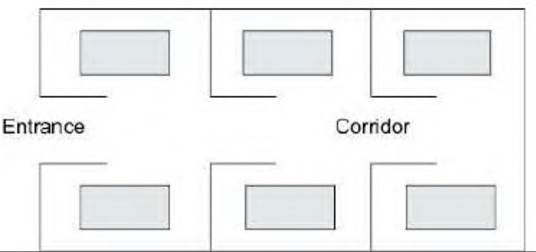
The plan above shows an office block for six officers, A, B, C, D, E and F. Both B and C occupy offices to the right of the corridor (as one enters the office block) andff occupies an office to the left of the corridor. E and F occupy offices on opposite sides of the corridor but their offices do not face each other. The offices of C and D face each other. E does not have a corner office. F’s office is further down the corridor than ff’s, but on the same side.
10. IfF sits in his office and faces the corridor, whose office is to his left?
(a) A (b) В
(с) C (d) D
11. Whose office faces A’s office?
(a) B (b) C
(c) D (d) E
12. Who is/are F’s neighbour(s)?
(a) A only (b) A and D
(c) C only (d) Band C
13. D was heard telling someone to go further down the corridor to the last office on the right. To whose room was he trying to direct that person?
(a) A (b) B
(c) C (d) F
Directions for Questions 14-17: Answer the questions on the basis of the following information.
Seven faculty members at a management institute frequent a lounge for strong coffee and stimulating conversation. On being asked about their visit to the lounge last Friday, we got the following responses.
JC: I came in first, and the next two persons to enter were SS and SM. When I left the lounge, JP and VR were present in the lounge. DG left with me.
JP: When I entered the lounge with VR, JC was sitting there. There was someone else, but I cannot remember who it was.
SM: I went to the lounge for a short while, and met JC, SS and DG in the lounge that day.
SS: I left immediately after SM left.
DG: I met JC, SS, SM, JP, and VR during my first visit to the lounge. I went back to my office with JC. When I went to the lounge the second time, JP and VR were there.
PK: I had some urgent work, so I did not sit in the lounge that day, but just collected my coffee and left. JP and DG were the only people in the lounge while I was there.
VR: No comments.
14. Based on the responses, which of the two, JP or DG, entered the lounge first?
(a) JP
(b) DG
(c) Both entered together.
(d) Cannot be deduced.
15. Who was sitting with JC when JP entered the lounge?
(a) SS (b) SM
(c) DG (d) PK
16. How many of the seven members did VR meet on Friday in the lounge?
(a) 2 (b) 3
(c) 4 (d) 5
17. Who were the last two faculty members to leave the lounge?
(a) JC and DG (b) PK and DG
(c) JP and PK (d) JP and DG
Directions for Questions 18 and 19: Each question is followed by two statements, A and B. Answer each question using the following instructions:
Choose (a) if the question can be answered by using statement A alone but not by using B alone.
Choose (b) if the question can be answered by using statement B alone but not by using A alone.
Choose (c) if the question can be answered by using either statement alone.
Choose (d) if the question can be answered by using both the statements together but not by either Statement alone.
18. In a cricket match, the ‘man of the match’ award is given to the player scoring the highest number of runs. In case of a tie, the player (out of those locked in the tie) who has taken the higher number of catches is chosen. Even thereafter if there is a tie, the player (out of those locked in the tie) who has dropped fewer catches is selected. Aakash, Biplab and Chirag, who were contenders for the award dropped at least one catch each. Biplab dropped 2 catches more than Aakash did, scored 50, and took 2 catches. Chirag got two chances to catch and dropped both. Who was the ‘man of the match’?
A. Chirag made 15 runs less than both Aakash and Biplab.
B. The catches dropped by Biplab are 1 more than the catches taken by Aakash.
19. Four friends, A, B, C and D got the top four ranks in a competitive examination, but A did not get the first, B did not get the second, C did not get the third, and D
did not get the fourth rank. Who secured which rank?
A. Neither A nor D were among the first 2.
B. Neither B nor C was third or fourth.
Directions for Questions 20-24: Answer the questions on the basis of the following information.
Recently, the answers of a test held nationwide were leaked to a group of unscrupulous people. The investigative agency has arrested the mastermind and nine other people A, B, C, D, E, F, G, H, and I in this matter. Interrogating them, the following facts have been obtained regarding their operation. Initially the mastermind obtains the correct answer key. All the others create their answer keys in the following manner. They obtain the answer key from one or two people who already possess the same. These people are called his/her ‘sources’. If the person has two sources, then he/she compares the answer keys obtained Ifomboth sources. If the key to a question Ifomboth sources is identical, it is copied, otherwise it is left blank. If the person has only one source, he/she copies the source’s answers into his/her copy. Finally, each person compulsorily replaces one of the answers (not a blank one) with a wrong answer in his/her answer key.
The paper contained 200 questions; so the investigative agency has ruled out the possibility of two or more of them introducing wrong answers to the same question. The investigative agency has a copy of the correct answer key and has tabulated the following data. These data represent question numbers.
| Name | Wrong Answer(s) | Blank Answe r(s) |
| A | 46 | — |
| B | 96 | 46, 90, 25 |
| C | 27, 56 | 17,46, 90 |
| D | 17 | — |
| E | 46, 90 | — |
| F | 14, 46 | 92, 90 |
| G | 25 | — |
| H | 46, 92 | — |
| I | 27 | 17,46, 90 |
20. Which one among the following must have two sources?
(a) A (b) B
(c) C (d) D
21. How many people (excluding the mastermind) needed to make answer keys before C could make his answer key?
(a) 2 (b) 3
(c) 4 (d) 5
22. Both G and H were sources to
(a) F (b) B
(c) I (d) none of the nine
23. Which of the following statements is true?
(a) C introduced the wrong answer to question 27.
(b) E introduced the wrong answer to question 46.
(c) F introduced the wrong answer to question 14.
(d) H introduced the wrong answer to question 46.
24. Which of the following two groups of people had identical sources?
(I) A, D and G (II) E and H
(a) Only (I) (b) Only (II)
(c) Neither (I) nor (II) (d) Both (I) and (II)
Directions for Question 25: Answer the question on the basis of the following information.
25. Seventy per cent of the employees in a multinational corporation have VCD players, 75 per cent have microwave ovens, 80 per cent have ACs and 85 per cent have washing machines. At least what percentage of employees have all four gadgets?
(a) 15 (b) 5
(c) 10 (d) Cannotbe determined
Directions for Questions 26 and 27: Answer the questions on the basis of the following information.
Shownbelow is the layout of major streets in a city.
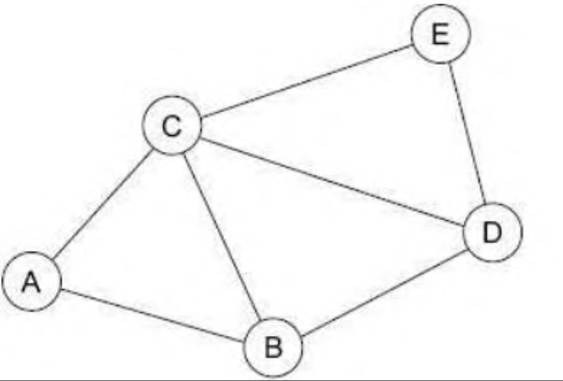
Two days (Thursday and Friday) are left for campaigning before a major election, and the city administration has received requests from five political parties for taking out their processions along the following routes.
Congress: A-C-D-E BJP: A-B-D-E SP: A-B-C-E
BSP: BCE CPM: ACD
Street B-D cannot be used for a political procession on Thursday due to a religious procession. The district administration has a policy of not allowing more than one procession to pass along the same street on the same day. However, the administration must allow all parties to take out their processions during these two days.
26. Congress procession can be allowed
(a) only on Thursday.
(b) OnlyonFriday.
(c) on either day.
(d) only if the religious procession is cancelled.
27. Which of the following is NOT true?
(a) Congress and SP can take out their processions on the same day.
(b) The CPM procession cannot be allowed on Thursday.
(c) The BJP procession can only take place on Friday.
(d) Congress and BSP can take out their processions on the same day.
Answer Key
l.(b)
5. (a)
2. (d)
6. (a)
3.(d)
7. (b)
4. (c)
8. (c)
| 9. (b) | 10. (c) | H. (c) | 12. (a) |
| 13.(b) | 14. (b) | 15. (c) | 16. (b) |
| 17. (d) | 18. (d) | 19. (c) | 20. (b) |
| 21. (c) | 22. (d) | 23. (c) | 24. (d) |
| 25. (c) | 26. (a) | 27. (d) |
Solutions to CAT2003 Retest
1. The codes which will create a confusion would be:
16 and 91, 18 and 81, 19 and 61, 66 and 99, 68 and 89, 86 and 98: Atotal of 12 codes which will have confusion. Hence out of 90 two digit codes 78 would have no confusion.
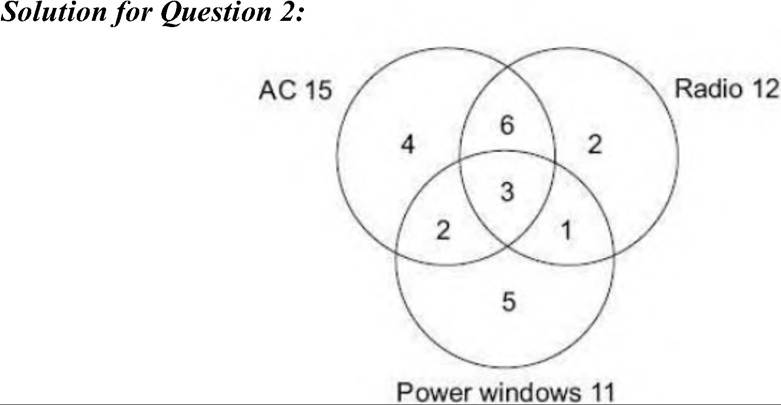
From the figure it is clear that there would be a total of 23 cars which had one or more of АС/Radio/ Power Steering. Hence, 2 cars had none of the three. Option (d) is correct.
Solutions for Questions 3 and 4:
First of all make a structure of what are the possible combinations:
With m as the middle letter—(vowel) m (another vowel)
With n as the middle letter—(vowel) n (e or u)
Withp as the middle letter—(vowel) p (same vowel)
3. The number of possible letter strings are—
Withm: 5 ¥4-20, withn-5¥2- 10
Withp: 5¥ 1 = 5
Thus a total of 35 possible strings.
4. With /я: 4, n∖ 5,p: 1. Thus a total of 10 strings.
5. 78 — 50 + 10 +10 + 2 + 2 + 2 + 2 ∕E 7 coins
69 = 50+ 10 + 5 + 2 + 2 JE 5 coins
Re 1.01 — 50 + 25 + 10+ 10 + 2 + 2 + 2√zE7 coins Thus a total 19 coins would be required.
Solutions for Questions 6-9:
The basic Informationmaybe summarised as:
| Order ofcoming | 1st | 2nd | 3rd | Last |
| Husband name | Sunil | |||
| Wife name | ||||
| Children details | Ikid |
This is about the only direct clue in the question. Thus, we need to focus on the indirect clues to move further.
The first thing we should do perhaps is to collate the 4 names of men and women.
The four men are: Anil, Raj, Sunil and Raman.
The four women are: Shanthi, Sridevi, Joya and Anita.
From the second and the 7th clues together we get the information of the order of arrival of the women.
Shanthi who does not have any kids reached just before Sridevi AND Joya came before Shanthi and met Anita when she reached the venue.
Anita-Joya- Shanthi-Sridevi.
The table now becomes:
| Order ofcoming | 1st | 2nd | 3rd | Last |
| Husband name | Sunil | |||
| Wife name | Anita | Joya | Shanthi | Sridevi |
| Children details | No kids | Ikid |
After this we start looking at the other clues to see which of those fit directly into the given situation.
Using the first and the sixth clues:
The table now becomes:
| Order ofcoming | 1st | 2nd | 3rd | Last |
| Husband name | Sunil | |||
| Wife name | Anita | Joya | Shanthi | Sridevi |
| Children details | At least 1 daughter | 2 kids | No kids | 1 kid (daughter) |
Also given that Anil and Raj are fathers, and Anil is not the husband of Joya we further transform the table:
| Order ofcoming | 1st | 2nd | 3rd | Last |
| Husband name | Anil | Raj | Raman | Sunil |
| Wife name | Anita | Joya | Shanthi | Sridevi |
| Children details | At least 1 daughter | 2 kids | No kids | 1 kid (daughter) |
The answers can be read off the table:
6. Shanthi
7. Sunil and Sridevi
8. Sunil and Anil
9. Raj’s
Solutions for Questions 10-13:
The table for the given situation can be constructed in the following order of logic. (The numberings in the table represent the order in which the respective deductions have been made.)
| Left of corridor (2.A) 3.D opposite of C)(4.F Same side as A) | 8. D (C and D have to face each other) | 9. A | 7. F (not opposite E and further down the corridor than A) |
| Corridor | Corridor | Corridor | Corridor |
| Right of corridor (1.B, C) (5.E, Opposite side to F) | 8. C | 6. E (Not a comer office) | 10.B |
The answers can be read off from the above table:
10. C
11. E
12. A only
13. в
Solutions for Questions 14-17:
The 7 faculty members are:
JC, JP, SM, SS, DG, PK and VR.
Based on the clues we can make the following structure for the coming and going of the
7 faculty members.
| Entry | JC | SS | SM | DG | JP & VR | DG | PK | ||||||
| Exit | SM | SS | DG and JC | VR | PK | JP and DG | |||||||
| Deduction from statement of | JC | JC | JC | SM and DG | SM | SS | JP and DG | JC and DG | DG |
The answers can be read off from the table.
14. DG
15. DG
16. VR met JP, JC and DG. He did not meet SS, SM and PK.
17. JPandDG
18. In order to solve this question, we are first bothered about the number of runs scored by each. From the basic information in the question, we know that Aakash scored 50 runs.
We can make a mental table of each player’s performance based on the available information:
| Aakash | Biplab | Chirag | |
| Runs scored | 50 | ? | ? |
| Catches taken | 2 | 0 | |
| Catches dropped | n | n + 2 | 2 |
Minimum value of n = 1.
The above table is the summary of the basic information provided in the question.
Checking for sufficiency of information based on Statement A:
We get that Chirag and Biplab scored 35 and 50 runs respectively. Since Aakash also has the same number of runs as Biplab one of them should be the man of the match and this has to be decided on the basis of who amongst them took the higher number of catches. This information is not available for us; hence statement A is not sufficient to answer the question asked.
From Statement B alone we again do not have enough information to answer the question asked because we do not know the runs scored by each if we are to consider only this statement.
From Both statements we first know the number of runs scored by each and we also know that Biplab drops 3 catches, and Aakash drops 1 catch. However we still do not know how many Biplab has taken. Thus, the question cannot be answered.
19. The basic information can be summarised as:
| Rank | Ruled Out | Possible |
| First | A | B, C, D |
| Second | B | A, C, D |
| Third | C | A, B, D |
| Fourth | D | A, B, C |
From statement A, we see that
| Rank | bgcolor=white>Ruled OutPossible | |
| First | A | Deduction 2: B |
| Second | B | Deduction 1: C |
| Third | C | Deduction 4: D |
| Fourth | D | Deduction 3: A |
We get the information about all the ranks and this statement alone is sufficient to answer the question.
From statement B, we see that
| Rank | Ruled Out | Possible |
| First | A | Deduction 4: B |
| Second | B | Deduction 3: C |
| Third | C | Deduction 2: D |
Fourth
Deduction 1: A
We get the information about all the ranks and this statement alone is sufficient to answer the question.
Solutions for Questions 20-24:
The first thing you should get a hang of while trying this question is that there are essentially two ways of forming an answer key:
1. If you have 1 source: All you do is carry forward that source’s answer key and introduce 1 error from your own side in it. Thus, if the mastermind is your key then you would have 1 error in your answer key, which you would have introduced yourself. (Note this is the only way of someone having an answer key with no blanks and 1 wrong answer only).
Similarly, if a person had a source who had 1 wrong answer in his answer key, you would have 2 wrong answers—1 carried over and another one introduced by you.
Thus, in essence you would carry forward the entire answer key of your source (blanks and wrongs as it is) and add one wrong answer of your own.
2. If you had 2 sources:
(a) Blank introduced if you have two different answers for the same question in the answer keys of the two sources. This means that if for one answer, one of the two sources had a right answer and the other had a wrong answer, then a blank would be introduced. Even if one of them had a blank and the other one had a correct or a wrong answer, it would still be a blank.
(b) Wrong answer carried forward: If both sources had the same wrong answer, that wrong answer would be carried forward.
And according to the basic situation of the question, one new wrong answer of his own would also be carried forward.
The following table shows the first set of deductions:
| Name | Wrong Answe r(s) | Blank Answe r(s) | Deduction about source | Deduction about wrong answer introduced |
| A | 46 | — | Mastermind | 46 |
| B | 96 | 46, 90, 25 | ||
| C | 27, 56 | 17, 46, 90 | ||
| D | 17 | — | Mastermind | 17 |
| E | 46, 90 | — | Single Source A | 90 |
| F | 14, 46 | 92, 90 | ||
| G | 25 | — | Mastermind | 25 |
| H | 46, 92 | — | Single Source A | 92 |
| I | 27 | 17, 46, 90 |
We now need to think of the remaining people in the group:
B—His answer key is possible if his sources are E and G. In such a case he would get blanks for 25, 46 and 90 (since the answers would be different for these questions in both the sources).
New wrong answer introduced would be 96.
F—His answer key is possible if his sources are E and H. This would give us blank answers as 90 and 92, the wrong answer 46 would be carried forward and 14 would be the new wrong answer introduced by him.
The table would now look like:
| Name | Wrong Answe r(s) | Blank Answe r(s) | Deduction about source | Deduction about wrong answer introduced |
| A | 46 | — | Mastermind | 46 |
| B | 96 | 46, 90, 25 | Two Sources: E and G | |
| C | 27, 56 | 17, 46, 90 | ||
| D | 17 | — | Mastermind | 17 |
| E | 46, 90 | — | Single Source A | 90 |
| F | 14, 46 | 92, 90 | Two Sources E and H | |
| G | 25 | — | Mastermind | 25 |
| H | 46, 92 | — | Single Source A | 92 |
| I | 27 | 17, 46, 90 |
We now need to think about C and I.
Looking at C and Γs answer keys it is evident that C would have I as a source. Ts answer key can be explained as: Two sources D and E.
| Name | Wrong Answe r(s) | Blank Answe r(s) | Deduction about source | Deduction about wrong answer introduced |
| A | 46 | — | Mastermind | 46 |
| B | 96 | 46, 90, 25 | Two Sources: E and G | 96 |
| C | 27, 56 | 17, 46, 90 | Single source I | 56 |
| D | 17 | — | Mastermind | 17 |
| E | 46, 90 | — | Single Source A | 90 |
| F | 14, 46 | 92, 90 | Two Sources E and H | 14 |
| G | bgcolor=white>25— | Mastermind | 25 | |
| H | 46, 92 | — | Single Source A | 92 |
| I | 27 | 17, 46, 90 | D and E | 27 |
The answers would be read off the table:
20. B
21. For C to make his answer key, I has to make his answer key. For I, D and E have to make his answer key. For E to make his answer key, A should make his answer key before that. Thus, A, D, E and I should make their answer keys before C makes his. Thus, option (c) is correct.
22. None of the nine.
23. F introduced the wrong answer to question 14.
24. A, D and G had the same source—the mastermind. E and H had the same source —A. Thus option (d) is correct.
25. The least percentage of people with all 4 gadgets would happen if all the employees who are not having any one of the four objects is mutually exclusive. Thus, 100 - 30 - 25 - 20 - 15 = 10
Solutions for Questions 26 and 27:
According to the situation in the problem, we should realise that there is a clash in the routes of:
Congress and BJP (as both use DE route);
BJP and SP (as they use the AB route);
SP and BSP (as they use the CE route);
Congress and CPM (as they use the AC route)
Also, BJP cannot take out the procession on Thursday as they are using the BD route which is not available on Thursday Thus they would need to be accommodated on Friday So, Congress would be given a date on Thursday and consequently CPM would get Friday Also since BJP is on Friday, SP would be on Thursday and hence BSP would go on Friday.
The answers are:
26. (a)
27. (d)
More on the topic CAT 2004:
- The male dog is known as a dog: the male cat is known as a tomcat.
- References
- Cornea
- When studying any aspect of biology it is important to have a basic understanding of the classification system used to group animals.
- Acute pancreatitis
- References
- Mast cell tumor
- CONTENTS
- References
- Introduction