CAT 2003 Cancelled
1. A test has 50 questions. A student scores 1 mark for a correct answer, -1/3 for a wrong answer, and -1/6 for not attempting a question. If the net score of a student is 32, the number of questions answered wrongly by that student cannot be less than:
(a) 6 (b) 12
(c) 3.3 (d) 9
2.
A leather factory produces two kinds of bags, standard and deluxe bags. Theprofit margin is ' 20 on a standard bag and ' 30 on a deluxe bag. Every bag must
be processed on machine A and on machine B. The processing time per bag on
the two machines are as follows:
Time required (Hours/bags)
| Machine A | Machine B | |
| Standard Bag | 4 | 6 |
| Deluxe Bag | 5 | 10 |
The total time available on machine A is 700 hours and on machine B is 1250 hours. Among the following production plans, which one meets the machine availability constraints and maximises the profit?
(a) Standard 75 bags, Deluxe 80 bags
(b) Standard 100 bags Deluxe 60 bags
(c) Standard 50 bags, Deluxe 100 bags
(d) Standard 60 bags, Deluxe 90 bags
Directions for Questions 3 and 4: Answer the questions on the basis of the information given below.
New Age Consultants have three consultants Gyani, Medha and Buddhi. The sum of the number of projects handled by Gyani and Buddhi individually is equal to the number of projects in which Medha is involved. All three consultants are involved together in 6 projects. Gyani works with Medha in 14 projects. Buddhi has 2 projects with Medha but without Gyani, and 3 projects with Gyani but without Medha. The total number of projects for New Age Consultants is one less than twice the number of projects in which more than one consultant is involved.
3. What is the number of projects in which Gyani alone is involved?
(a) Uniquely equal to zero
(b) Uniquely equal to 1
(c) Uniquely equal to 4
(d) Cannot be determined uniquely
4. What is the number of projects in which Medha alone is involved?
(a) Uniquely equal to zero
(b) Uniquely equal to 1
(c) Uniquely equal to 4
(d) Cannot be determined
Directions for Questions 5 and 6: Answer the questions on the basis of the information given below.
A certain perfume is available at a duty-free shop at the Bangkok international airport. It is priced in the Thai currency Baht but other currencies are also acceptable. In particular, the shop accepts Euro and US Dollar at the following rates of exchange:
US Dollar 1=41 Bahts; Euro 1 = 46 Bahts
The perfume is priced at 520 Bahts per bottle. After one bottle is purchased, subsequent bottles are available at a discount of 30%. Three friends S, R and M together purchase three bottles of the perfume, agreeing to share the cost equally. R pays 2 Euros. M pays 4 Euros and 27 Thai Bahts and S pays the remaining amount in US Dollars.
5. How much does R owe to S in Thai Baht?
(a) 428 (b)416
(c) 334 (d) 324
6. How much does M owe to S in US Dollars?
(а) З
(с)5
(b) 4
(d) 6
Directions for Questions 7 to 9: Answer the questions on the basis of the information given below.
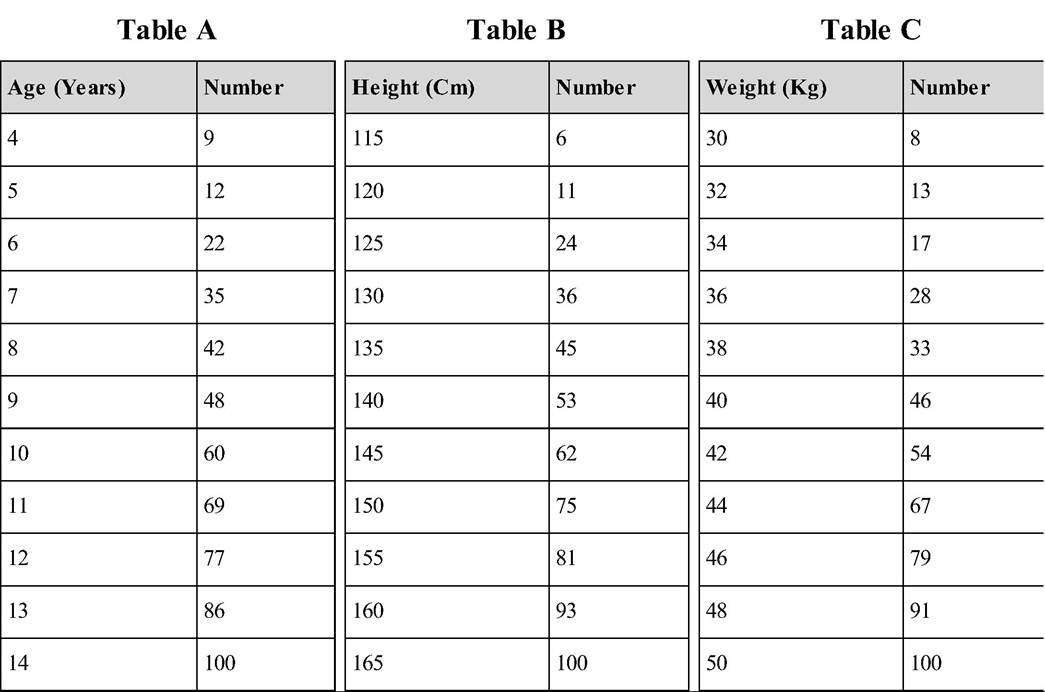
Table A below provides data about ages of children in a school. For the age given in the first column, the second column gives the number of children not exceeding that age. For example, first entry indicates that there are 9 children aged 4 years or less. Tables B and C provide data on the heights and weights respectively of the same group of children in a similar format. Assuming that an older child is always taller and weighs more than a younger child, answer the following questions.
7. What is the number of children of age 9 years or less whose height does not exceed 135 cm?
(a) 48 (b) 45
(c) 3 (d) Cannot be determined.
8. How many children of age more than 10 years are taller than 150 cm and do not
weigh more than 48 kg?
(a) 16 (b) 40
(c) 9 (d) Cannot be Determined.
9. Among the children older than 6 years but not exceeding 12 years, how many weigh more than 38 kg?
(a) 34 (b) 52
(c) 44 (d) Cannot be Determined
Directions for Questions 10 and 11: Answer the questions on the basis of the information given below.
The Head of a newly formed government desires to appoint five of the six elected members A, B, C, D, E and F the portfolios of Home, Power, Defence, Telecom and Finance. F does not want any portfolio if D gets one of the five. C wants either Home or Finance or no portfolio. B says that if D gets either Power or Telecomthen she must get the other one. E insists on a portfolio if A gets one.
10. Which is a valid assignment?
(a) A-Home, В-Power, C-Defence, D-Telecom, E-Finance.
(b) C-Home, D-Power, А-Defence, B-Telecom, E-Finance.
(c) A-Home, В-Power, E-Defence, D-Telecom, F-Finance.
(d) В-Home, F-Power, E-Defence, C-Telecom, A-Finance.
11. IfA gets Home and C gets Finance, then which is NOT a valid assignment for Defence and Telecom?
(a) D-Defence, B-Telecom.
(b) F-Defence, B-Telecom
(c) В-Defence, E-Telecom
(d) В-Defence, D-Telecom.
Directions for Questions 12-14: In each question there are two statements A and B.
Choose (a) if the question can be answered by one of the statements alone but not by the other.
Choose (b) if the question can be answered by using either statement alone.
Choose (c) if the question can be answered by using both the statements together but cannot be answered using either statement alone.
Choose (d) if the question cannot be answered even by using both the statements A and B.
12. F and M are father and mother of S, respectively. S has four uncles and three aunts. F has two siblings. The siblings of F and M are unmarried. How many brothers does M have?
(a) F has two brothers.
(b) M has five siblings.
13. A game consists of tossing a coin successively. There is an entry fee of' 10 and an additional fee of' 1 for each toss of the coin. The game is considered to have ended normally when the coin turns heads on two consecutive throws. In this case the player is paid ' 100. Alternatively, the player can choose to terminate the game prematurely after any of the tosses. Ram has incurred a loss of' 50 by playing this game. How many times did he toss the coin?
A. The game ended normally.
B. The total number of tails obtained in the game was 138.
14. Each packet of soap costs ' 10. Inside each packet is a gift coupon labelled with one of the letters S, O, A and P. If a customer submits four such coupons that make up the word Soap, the customer gets a free Soap packet. Ms. X kept buying packet after packet of Soap till she could get one set of coupons that formed the world Soap. How many coupons with label P did she get in the above process?
(a) The last label obtained by her was S and the total amount spent was '210.
(b) The total number of vowels obtained was 18.
Directions for Questions 15-17: Answer the questions on the basis of the information given below.
A, B, C, D, E and F are a group of friends. There are two housewives, one professor, one engineer, one accountant and one lawyer in the group. There are only two married couples in the group. The lawyer is married to D, who is a housewife. No woman in the group is either an engineer or an accountant. C, the accountant, is married to F, who is a professor. A is married to a housewife. E is not a housewife.
15. Which of the following is one of the married couples?
(а) А & B (b) В & E
(c) D & E (d) А & D
16. What is E’s profession?
(a) Engineer (b) Lawyer
(c) Professor (d) Accountant
17. How many members of the group are males?
(а) 2
(с) З
(b) 2
(d) Can not be determined
Directions for Questions 18 and 19: Answer the questions on the basis of the information given below.
Some children were taking free throws at the basketball court in school during lunch break. Below are some facts about how many baskets these children shot.
(i) Ganesh shot 8 baskets less than Ashish.
(ii) Dhanraj and Ramesh together shot 37 baskets.
(iii) Jugraj shot 8 baskets more than Dhanraj.
(iv) Ashish and Ganesh together shot 40 baskets.
(v) Ashish shot 5 baskets more than Dhanraj.
18. Which of the following statements is true?
(a) Ramesh shot 18 baskets and Dhanraj shot 19 baskets.
(b) Ganesh shot 24 baskets and Ashish shot 16 baskets.
(c) Jugraj shot 19 baskets and Dhanraj shot 27 baskets.
(d) Dhanraj shot 11 baskets and Ashish shot 16 baskets.
19. Which of the following statements is true?
(a) Dhanraj and Jugraj shot 46 baskets.
(b) Ganesh shot 18 baskets and Ramesh shot 21 baskets.
(c) Dhanraj shot 3 more baskets than Ramesh.
(d) Ramesh and Jugraj together shot 29 baskets.
Directions for Questions 20-22: Answer the questions on the basis of the information given below.
Seven varsity basketball players (A, B, C, D, E, F and G) are to be honored at a special luncheon. The players will be seated on the dais in a row. A and G have to leave the luncheon early and so must be seated at the extreme right. B will receive the most valuable player’s trophy and so must be in the centre to facilitate presentation. C and D are bitter rivals and therefore must be seated as far apart as possible.
20. Which of the following cannot be seated at either end?
(a) C (b) D
(c) F (d) G
21. Which of the following pairs cannot be seated together?
(а) В & D (b) C & F
(с) D & G (d) E & А
22. Which of the following pairs cannot occupy the seats on either side of B?
(a) F & D (b) D & E
(c) E & G (d) C & F
Directions for Questions 23-25: Answer the questions on the basis of the information given below.
Five women decided to go shopping to M.G. Road, Bangalore.
They arrived at the designated meeting place in the following order:
1.
Archana, 2. Chellamma, 3. Dhenuka, 4. Helen, and 5. Shahnaz.Each woman spent at least' 1000. Below are some additional facts about how much they spent during their shopping spree.
The woman who spent' 2234 arrived before the lady who spent' 1193.
One woman spent' 1340 and she was not Dhenuka.
One woman spent '1378 more than Chellamma.
One woman spent '2517 and she was not Archana.
Helen spent more than Dhenuka.
Shahnaz spent the largest amount and Chellamma the smallest.
23. The woman who spent' 1193 is
(a) Archana (b) Chellamma
(c) Dhenuka (d) Helen
24. What was the amount spent by Helen?
(a)'1193 (b)'1340
(c)'2234 (d)'2517
25. Which of the following amounts was spent by one of them?
(a)'1139 (b)'1378
(c)'2571 (d)'2718
Directions for Questions 26-28: Answer the questions on the basis of the information given below.
Five friends meet every morning at Sree Sagar restaurant for an idli-vada breakfast. Each consumes a different number of idlis and vadas. The number of idlis consumed are 1, 4, 5, 6 and 8, while the number of vadas consumed are 0, 1,2, 4, and 6. Below are some more facts about who eats what and how much.
(i) The number of vadas eaten by Ignesh is three times the number of vadas consumed by the person who eats four idlis.
(ii) Three persons, including the one who eats four vadas, eat without chutney.
(iii) Sandeep does not take any chutney.
(iv) The one who eats one idli a day does not eat any vadas or chutney. Further, he is not Mukesh.
(v) Daljit eats idli with chutney and also eats vada.
(vi) Mukesh, who does not take chutney, eats half as many vadas as the person who eats twice as many idlis as he does.
(vii) Bimal eats two more idlis than Ignesh, but Ignesh eats two more vadas than Bimal.
26. Which of the following statements is true?
(a) Sandeep eats 2 vadas.
(b) Mukesh eats 4 vadas.
(c) Ignesh eats 6 vadas.
(d) Bimal eats 4 vadas.
27. Which one of the following statements is true?
(a) Daljit eats 5 idlis.
(b) Ignesh eats 8 idlis.
(c) Bimal eats 1 idli.
(d) Bimal eats 6 idlis.
28. Which of the following statements is true?
(a) Mukesh eats 8 idlis and 4 vadas but no chutney.
(b) The person who eats 5 idlis and 1 vada does not take chutney.
(c) The person who eats equal number of vadas and idlis also takes chutney.
(d) The person who eats 4 idlis and 2 vadas also takes chutney.
Answer Key
l.(c)
5. (d)
2. (a)
6. (c)
3.(d)
7. (b)
4. (b)
8. (a)
| 9. (c) | 10. (b) | ll.(d) | 12. (a) |
| 13. (a) | 14. (c) | 15. (d) | 16. (a) |
| 17.(c) | 18. (a) | 19. (a) | 20. (c) |
| 21∙(d) | 22. (c) | 23. (c) | 24. (b) |
| 25. (a) | 26. (c) | 27. (a) | 28. (c) |
| Solutions: | |||
1 It is possible to score 32 marks net with 35 corrects, 3 wrongs and 12 not attempted questions. Since, all other options are above 3, only option (c) can be the correct answer.
2. Checking the options, it is not possible to produce the number of bags in options (c) and (d) in the given time. Between options (a) and (b), option (a) is more profitable and hence is the correct answer.
Solutions for Questions 3 and 4:
The following figure can be drawn based on the information provided in the question.
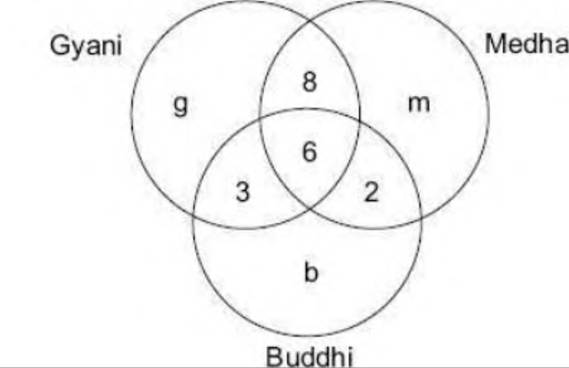
From the figure and the information given in the problem we know that total number of projects = 37. Hence, g + m + ά = 18 and g + 6 = 16 + m.
3 Gyani alone is defined by b and m, which cannot be determined uniquely.
4. Solving the above two expressions for m, we get 18 - m = 16 + m JE m = 1
Solutions for Questions 5 and 6:
The total cost of the three bottles would be 520 + 364 + 364 = 1248. Hence, the cost per person would be 416 bahts.
5. Since R has paid only 2 Euros (an equivalent of 92 bahts), he would have to further pay 324 bahts more. Option (d) is correct.
6. M has paid 4 Euros + 27 bahts which adds up to 211 bahts. So he has to pay 205 bahts to S. This would convert to 5 US Dollars.
Solutions for Questions 7-9:
In order to solve this set of questions, you need to understand what the data in the tables mean. The basic interpretation of the table is that there are 6 children of height 115 cms or less and 11 children of height 120 cms or less. This also gives us that there are 5 children who have a height of above 115 cms but below 120 cms. Similarly there are 13 children having a height between 120 cms to 125 cms.
The other thing you need to understand about this situation is that since an older child is always taller and weighs more than a younger child, you would first fit all the least heights and weights with the youngest children.
Based on this understanding of the data in the table, we can move into the questions:
7. There are a total of 48 children aged below 9 years. Also there are a total of 45 children having a height less than 135 cms. Thus, all these 45 children would have been below 9 years of age. Hence 45 is the correct answer.
8. There are 40 children above 10 years of age. But there are only 25 children having a height greater than 150 cms. Thus, there would be 25 children who would have a height of over 150 cms and an age of over 10 years. We now need to see how many of these 25 also satisfy the criteria of less than 48 kg of weight. There are 9 children above 48 kg of weight. These should also be amongst the 25 we have earmarked above 10 years and 150 cms. Thus, there would be 16 children left in the category defined. Thus, option (a) is correct.
9. There are 55 students who are aged between 6 and 12. Also, there are 23 children who are above 12 years of age. Naturally these 23 would be in the highest weight categories from the top. So looking down the weights column, there are 33 children who are below 38 kgs and do not come under this category. So out of 67 children who are above 38 kgs, 23 would not be between 6 to 12 years. Thus, there would be 44 children in the category being defined.
Solutions for Questions 10 and 11:
The following constraints operate in the question-
(a) We have to take only one of D and F. This also consequently means that each of A, B, C and E should be selected for a portfolio.
(b) C has to be given Home or Finance.
(c) B’s condition is more open than C’s and is dependent on what (and whether D gets anything.) So if D is power or telecom- then B is the other of these two portfolios, i.e if D get telecom, B must be given Power and vice versa. However, if D is not getting either of these two portfolios then B has no constraint.
(d) A and E must be part of the ministry.
10. In order to find the correct answer, we need to see each of the options for any rules they might be violating.
(a) Is rejected because C has to be given Home or Finance only - but in this case C is getting defence. So that condition is violated here.
(b) Does not contravene any condition.
(c) D and F are selected together. Hence, the option is not valid.
(d) C is not getting Home or finance.
Thus Option (b) is correct as it meets all conditions.
1. Option (d) is clearly not valid as D is given telecom but B is not getting Power.
Solutions for Questions 12-14:
12. From the first statement alone, we can answer the question asked as once we know that F has 2 brothers, we can deduce that M must also have 2 brothers.
From the second statement we cannot answer the question asked. Thus we should mark option (a).
13. A loss of' 50 could mean two things: 1) If the game ended normally or if the game was terminated by the player. In both cases the number of coin tosses would be different. Since statement 1 defines how the game ended, we can define the number of tosses the player must have made uniquely.
From the second statement alone we cannot decipher how many heads must have occurred. Thus, only statement 1 is sufficient to answer the question asked.
14. We do not getting enough information from statement 1 above or statement 2 alone. If we try to use statement 1 alone, we get that she bought 21 packets, out of which the last packet contained the first S. The remaining 20 packets must have had Os, As and Ps. There is no way to tell how many Ps these 20 contained. Thus, Statement 1 alone is not sufficient to answer the question.
If we use statement 2 alone we just know that there were 18 Os and A’s combined. We do not know the total number of packets she bought and also how many S’s she got.
Using both statements 1 and 2 together, we get that there was 1 S, and 18 Os and As combined. Thus there must have been 2 P’s exactly.
Solutions for Questions 15-17:
First of all collate the information of all the clues together.
D—Housewife married to lawyer
Engineer and Accountant are men. C—Accountant (man) married to F (Professor— woman)
A (man) married to a housewife.
Deduction 1: Since, there are 2 housewives and F the professor is also a woman; there are at least 3 women in the group.
Deduction 2: Engineers and Accountant being men and also the lawyer must be a man.
Combining the two deductions, we know that there are 3 men and 3 women in the group.
| Men | Women |
| A (married to housewife) | D (Housewife—married to the Lawyer) |
| C Accountant | F (Professor) |
| E (since E is not a housewife, and there is only 1 slot left in the women—that of a housewife, E must be a man.) | Since E is a man, B is a housewife. |
At this point we also know that there are only 2 married couples in the group. One of these couples is C-F, and the other couple is the lawyer and D. Since A is married to a housewife, A must be the lawyer.
The table now becomes much more clearer:
| Men | |
| A (Lawyer) - D Housewife | Couple 1 |
| C Accountant - F professor | Couple 2 |
| E man Engineer | |
| B woman Housewife—but her husband does not belong to the group |
15. AandDareamarriedcouple.
16. Eisanengineer.
17. There are 3 males, as already deduced.
Solutions for Questions 18 and 19:
We know the following equations:
G = A-S
(1)
(2)
D + R = 37
J = D + ⅛
(3)
(4)
(5)
J + G = 40
A = D + 5
From 1 and 4, we get A = 24 and G = 16.
So, D =19, J= 27 and Я = 18
18. Option (a) is correct.
19. D + J = 46. Thus, Option (a) is correct.
Solutions for Questions 20—22:
Fromthe clues we can make the following structure:
| A/G | G/A | C/D | B | D/C |
Note the following:
While creating this seating arrangement, right is seen from the seated player’s perspective and not Ifomthe audience’s perspective. Once we block seats for A, B and G, to keep C and D as far apart as possible, the shown arrangement is the only way of placing C and D.
Fromthis figure we can answer the questions that follow:
20. Either end cannot be occupied by F.
21. B & D is possible to be seated together. So also are C and F, and D and G. The only option of two people who can not be placed together is E and A. Hence option (d) is correct.
22. One of the seats (to the right of B) has to be taken by either C or D. The left side of B has to be taken by one of E and F. Thus, options (a), (b) and (d) are possible for people seated adjacent to B. But, we cannot place the pair of E and G on either side of B at the same time. Hence option (c) is correct.
Solutions for Questions 23—25:
Fromthe clues we can make the following deductions:
1. Somebody spent 2234 and someone else spent 1193. (Also, 2234 arrived before 1193).
2. Someone spent 1340 (not Dhenuka).
3. Someone spent 2517 (not Archana).
4. Chellamma + 1378 was another spending amount.
5. Shahnaz spent the largest amount and Chellamma the least.
From the foregoing, it is clear that we know 4 amounts precisely—
2517
2234
1340
1193
This gives rise to two possibilities, considering the fact that there is a difference of 1378 between Chellamma and someone else. Also, before we look at those possibilities, we should also realise that the span between the highest and the lowest numbers in the table above is less than 1378; hence this difference of 1378 must be between the least and the highest numbers. Thus, Chellamma + 1378 = Shahnaz.
Possibility 1:
If 1193 is the least spending:
| 2571 (got by 1193+1378) | Shahnaz | Fixed |
| 2517 | A/D/H | Default possibility before using any clues |
| 2234 | A/D/H | |
| 1340 | A/D/H | |
| 1193 | Chellamma | Fixed |
Using 1340 is not Dhenuka and 2517 is not Archana. Also using the information that 2234 came before 1193 (which means that 2234 must be Archana as Chellamma has spent 1193) in this case, we get
| 2571 (got by 1193+1378) | Shahnaz |
| 2517 | D |
| 2234 | A |
| 1340 | H |
| 1193 | Chellamma |
But this contradicts the clue that Helen spent more than Dhenuka as in this case Helen (1340) < Dhenuka (2517).
Thus we reject this possibility and go to the second possibility.
Possibility 2:
If 2517 is the highest spending then we get the following table:
| 2517 | Shahnaz | Fixed |
| 2234 | A/D/H | Default possibility before using any clues |
| 1340 | A/D/H | |
| 1193 | A/D/H | |
| 1139 (got by 2517-1378) | Chellamma | Fixed |
Using 1340 is not Dhenuka and 2517 is not Archana:
| 2517 | Shahnaz |
| 2234 | A/D/H |
| 1340 | A/H |
| 1193 | A/D/H |
| 1139 (got by 2517-1378) | Chellamma |
Further, since Helen spent more than Dhenuka, Dhenuka cannot be put at 2234. At this point we realise that A and H are shared between 2234 and 1340. Thus, D becomes equal to 1193 and since 2234 comes before 1193, it must be the case that 2234 is Archana.
| 2517 | Shahnaz |
| 2234 | Archana |
| 1340 | Helen |
| 1193 | Dhenuka |
| 1139 (got by 2517-1378) | Chellamma |
In this situation we can see that there is no contradiction. We can then mark the answers to the questions asked.
23. Dhenuka
24. 1340. Hence option (b) is correct.
25. 1139
Solutions for Questions 26-28:
In order to solve this set of questions, first of all use the basic information in order to get the following starting table where nothing is matched with each other:
| Person | Vadas | Idlis |
| Sandeep (S) | 1 | O |
| Ignesh (I) | 4 | 1 |
| Mukesh (M) | 5 | 2 |
| Daljit (D) | 6 | 4 |
| Bimal (B) | 8 | 6 |
Looking at the clues we can make the following deductions:
1. Fromthe first clue /F Ignesh = 6 Vadas and someone ate 2 Vadas and 4 idlis.
2. From the third clue /F Somebody ate O Vadas and 1 idli and no chutney.
3. Fromclue 7√zE Bimal eats 4 Vadas.
Putting these deductions into the table we get:
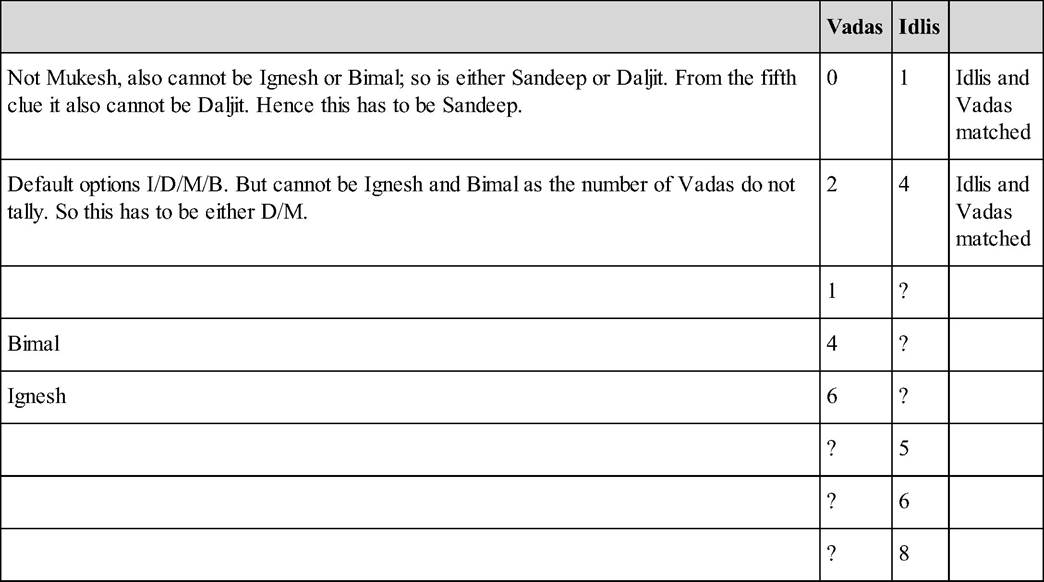
At this point if you use the 7th clue you would realise that the only way this can be fit into the current table is to use 4-8 for Bimal and 6-6 for Ignesh. Also, using the 6th clue we would get that 2-4 would be possible only for Mukesh.
The table would then become:
Vadas
Idlis
| Sandeep (no chutney) | 0 | 1 |
| Mukesh (no chutney) | 2 | 4 |
| Daljit | 1 | 5 |
| Bimal (no chutney) | 4 | 8 |
| Ignesh | 6 | 6 |
The answers can be read off the table now:
26. Option (c) is correct.
27. Option (a) is correct.
28. Option (c) is correct.