CAT 2002
Directions for Questions 1-4: Each item is followed by two statements, A and B. Answer each questions using the following instructions.
Choose A if the question can be answered by one of the statements alone but not by the other.
Choose B if the question can be answered by using either statement alone.
Choose C if the question can be answered by using both the statements together, but cannot be answered by using either statement alone.
Choose D if the question cannot be answered by either of the statements.
1. In a hockey match, the Indian team was behind by 2 goals with 5 minutes remaining. Did they win the match?
A. Deepak Thakur, the Indian striker, scored 3 goals in the last five minutes of the match.
B. Korea scored a total of 3 goals in the match.
(a)l
(c)3
(b) 2
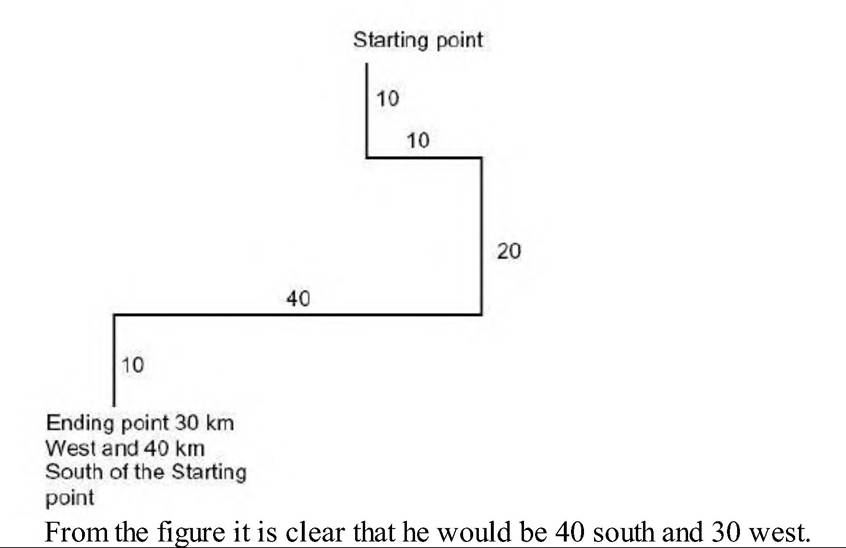
(d)4
2. Four students were added to a dance class. Would the teacher be able to divide her students evenly into a dance team (or teams) of 8?
A. If 12 students were added, the teacher could put everyone in teams of 8 without any leftovers.
B. The number of students in the class is currently not divisible by 8.
(a)l
(b) 2
(C) з (d) 4
3. People in a club either speak French or Russian or both. Find the number of people in the club who speak only French.
A. There are 300 people in the club and the number of people who speak both French and Russian is 196.
B. The number of people who speak only Russian is 58.
(a) 1 (b) 2
(b) 3 (d) 4
4. A sum of' 38,500 was divided among Jagdish, Punit and Girish. Who received the minimum amount?
A. Jagdish received 2/9 of what Punit and Girish together received.
B. Punit received 3/11 of what Jagdish and Girish together received.
(a) 1 (b) 2
(b) 3 (d) 4
Directions for Questions 5-10: Answer the questions independent of each other.
5. Four students (Ashish, Dhanraj, Felix and Sameer) sat for the Common Entrance Exam for Management (CEEM).
One student got admission offers from three National Institutes of Management (NIM), another in two NIMs, the third in one NIM, while the fourth got none. Below are some of the facts about who got admission offers from how many NIMs and what is their educational background.
(i) The one who is an engineer didn’t get as many admissions as Ashish.
(ii) The one who got offer for admissions in two NIMs isn’t Dhanraj nor is he a chartered accountant.
(iii) Sameer is an economist.
(iv) Dhanraj isn’t an engineer and received more admission offers than Ashish.
(v) The medical doctor got the most number of admission offers.
Which one of the following statements is necessarily true?
(a) Ashish is a chartered accountant and got offer for admission in three NIMs.
(b) Dhanraj is a medical doctor and got admission offer in one NIM.
(c) Sameer is an economist who got admission offers in two NIMs.
(d) Felix who is not an engineer did not get any offer for admission.
6. Five boys went to a store to buy sweets. One boy had ' 40. Another boy had ' 30. Two other boys had ' 20 each. The remaining boy had ' 10. Below are some more facts about the initial and final cash positions.
(i) Alam started with more money than Jugraj.
(ii) Sandeep spent' 1.50 more than Daljeet.
(iii) Ganesh started with more money than only one other person.
(iv) Daljeet started with 2/3 of what Sandeep started with.
(v) Alam spent the most, but did not end with the least.
(vi) Jugraj spent the least and ended with more than Alam or Daljeet.
(viii) Alam spent 10 times more than what Ganesh did.
In the choices given below, all statements except one are false. Which one of the following statements can be true?
(a) Alam started with' 40 and ended with' 9.50.
(b) Sandeep started with' 30 and ended with' 1.00.
(c) Ganesh started with' 20 and ended with' 4.00.
(d) Jugraj started with' 10 and ended with' 7.00.
7. In a hospital there were 200 Diabetes, 150 Hyperglycemia and 150 Gastroenteritis patients.
Of these, 80 patients were treated for both Diabetic and Hyperglycemia. Sixty patients were treated for Gastroenteritis and Hyperglycemia, while 70 were treated for Diabetes and Gastroenteritis. Some of these patients have all the three diseases. Doctor Dennis treats patients with only Diabetes. Doctor Hormis treats patients with only Hyperglycemia and Doctor Gerard treats patients with only Gastroenteritis. Doctor Paul is a generalist. Therefore, he can treat patients with multiple diseases. Patients always prefer a specialist for their disease. If Dr. Dennis had 80 patients, the other three doctors can be arranged in terms of the number of patients treated as:(a) Paul > Gerard > Hormis
(b) Paul > Hormis > Gerard
(c) Gerard > Paul > Hormis
(d) none of these
8. Three children won the prizes in the Bournvita Quiz contest. They are from the schools: Loyola, Convent, Little Flowers, which are located in different cities. Below are some of the facts about the schools, the children and the city they are from.
* One of the children is Bipin.
* Loyola School’s contestant did not come first.
* Little Flower’s contestant was named Riaz.
* Convent School is not in Hyderabad.
* The contestant from Pune took third place.
* The contestant from Pune is not from Loyola School.
* The contestant from Bangalore did not come first.
* Convent School’s contestant’s name is not Balbir.
Which of the following statements is true?
(a) 1st prize: Riaz (Little Flowers), 2nd prize: Bipin (Convent), 3rd prize: Balbir (Loyola).
(b) 1st prize: Bipin (Convent), 2nd prize: Riaz (Little Flowers), 3rd prize: Balbir (Loyola).
(c) 1st prize: Riaz (Little Flowers), 2nd prize: Balbir (Loyola), 3rd prize: Bipin (Convent).
(d) 1st prize: Bipin (Convent), 2nd prize: Balbir (Loyola), 3rd prize: Riaz (Little Flowers).
9. Two boys are playing on a ground. Both the boys are less than 10 years old. Age of the younger boy is equal to the cube root of the product of the age of the two boys.
If we place the digit representing the age of the younger boy to the left of the digit representing the age of the elder boy, we get the age of the father of the younger boy. Similarly, if we place the digit representing the age of the elder boy to the left of the digit representing the age of the younger boy and divide the figure by 2, we get the age of the mother of the younger boy. The mother of the younger boy is younger than his father by 3 years. Then what is the age of the younger boy?(a) 3 (b) 4
(c) 2 (d) none of these.
10. Flights A and B are scheduled from an airport within the next one hour. All the
booked passengers of the two flights are waiting in the boarding hall after check-in. The hall has a seating capacity of 200 out of which 10% remained vacant. 40% of the waiting passengers are ladies. When boarding announcements came, passengers of flights A left the hall and boarded the flight. Seating capacity of each flight is two third of the passengers who waited in the waiting hall for both the flights put together. Half the passengers who boarded flight A are women. After boarding for flight A, 60% of the waiting hall seats became empty. For every twenty of those who are still waiting in the hall for flight B, there is one airhostess in flight A. Then, what is the ratio of empty seats ^fl^g⅛ι∣ B to the number o^iξh(pstesses in flight A?
(c)20:l (d) 1:1
Directions for Questions 11-14: Answer these questions based on the information given below.
A country has the following types of traffic signals.
3 red lights = stop;
2 red lights = turn left;
1 red light = turn right;
3 green lights = go at 100 kmph speed;
2 green lights = go at 40 kmph speed;
1 green light = go at 20 kmph speed.
A motorist starts at a point on a road and follows all traffic signals literally. His car is heading towards the north. He encounters the following signals (the time mentioned in each case below is applicable after crossing the previous signal).
Starting Point - 1 green light;
After half an hour, 1st signal - 2 red & 2 green lights;
After 15 minutes, 2nd signal - 1 red light;
After half an hour, 3rd signal - 1 red & 3 green lights;
After 24 minutes, 4th signal - 2 red & 2 green lights;
After 15 minutes, 5th signal - 3 red lights;
11. The total distance travelled by the motorist from the starting point till the last signal is:
(a) 90 km (b) 100 km
12. What is the position (radial distance) of the motorist when he reaches the last signal?
(a) 45 km directly north of the Starting Point.
(b) 30 km directly to the east of the Starting Point.
(c) 50 km away to the northeast of the Starting Point.
(d) 45 km away to the northwest of the Starting Point.
13. After the starting point if the 1st signal were 1 red and 2 green lights, what would be the final position of the motorist?
(a) 30 km to the west and 20 km to the south.
(b) 30 km to the west and 40 km to the north.
(c) 50 km to the east and 40 km to the north.
(d) Directly 30 km to the east.
14. If at the starting point, the car was heading towards south, what would be the final position of the motorist?
(a) 30 km to the east and 40 km to the south.
(b) 50 km to the east and 40 km to the south.
(c) 30 km to the west and 40 km to the south.
(d) 50 km to the west and 20 km to the north.
Directions for Questions 15 to 17: Answer these questions based on the table given below.
The table below gives information about four different crops, their different quality categories and the regions where they are cultivated. Based on the information given in the table answer the questions below:
| Type of Crop | Quality | Region |
| Crop 1 | High | Rl, R2, R3, R4, R5 |
| Medium | R6, R7, R8 | |
| Low | R9,R1O,R11 | |
| Crop 2 | High | R5, R8, R12 |
| Medium | R9, R13 | |
| Low | R6 | |
| Crop 3 | High | R2, R6, R7, R13 |
| Medium | R3,R9,R11 | |
| Low | Rl, R4 | |
| Crop 4 | High | R3,R1O,R11 |
| Medium | Rl, R2, R4 | |
| Low | R5,R9 |
15.
How many regions produce medium qualities of Crop-I or Crop-2 and also produce low quality of Crop-3 or Crop-4?(a) Zero (b) One
(c) Two (d) Three
16. Which of the following statements is true?
(a) All medium quality Crop-2 producing regions are also high quality Crop-3 producing regions.
(b) All high quality Crop-1 producing regions are also medium and low Crop-4 producing regions.
(c) There are exactly four Crop-3 producing regions, which also produce Crop- 4 but not Crop-2.
(d) Some Crop-3 producing regions produce Crop-1, but not high quality Crop-
2.
17. How many low quality Crop-I producing regions are either high quality Crop-4 producing regions or medium quality Crop-3 producing regions?
(a) One (b) Two
(c) Three (d) Zero
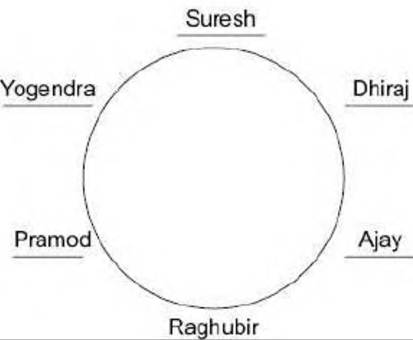
18. Six persons are playing a card game. Suresh is facing Raghubir who is to the left of Ajay and to the right of Pramod. Ajay is to the left of Dhiraj. Yogendra is to the left of Pramod. If Dhiraj exchanges his seat with Yogendra and Pramod exchanges with Raghubir, who will be sitting to the left of Dhiraj?
(a) Yogendra (b) Raghubir
(c) Suresh (d) Ajay
19. 10 straight lines, no two of which are parallel and no three of which pass through any common point, are drawn on a plane. The total number of regions (including finite and infinite regions) into which the plane would be divided by the lines is
(a) 56 (b) 255
(c) 1024 (d) not unique
20. Shyam visited Ram on vacation. In the mornings, they both would go for yoga. In the evenings they would play tennis. To have more fun, they indulged only in one activity per day, i.e., either they went for yoga or played tennis each day. There were days when they were lazy and stayed home all day long. There were 24 mornings when they did nothing, 14 evenings when they stayed at home, and a total of 22 days when they did yoga or played tennis. For how many days did Shyam stay with Ram?
(a) 32 (b) 24
(c) 30 (d) none of these
Directions for Questions 21 and 22: Answer these questions based on the information given below.
A boy is asked to put in a basket one mango when ordered One’, one orange when ordered ‘Two’, one apple when ordered ‘Three’ and is asked to take out from the basket one mango and an orange when ordered ‘Four’. A sequence of orders is given as:
12332142314223314113234
21. How many total oranges were in the basket at the end of the above sequence?
(a) 1 (b) 4
(c) 3 (d) 2
22. How many total fruits will be in the basket at the end of the above order sequence?
(a) 9 (b) 8
(c)ll (d) 10
23. Davji Shop sells samosas inboxes of different sizes. The samosas are priced at ' 2 per samosa up to 200 samosas. For every additional 20 samosas, the price of the whole lot goes down by 10 paise per samosa. What should be the maximum size of the box that would maximise the revenue?
(a) 240 (b) 300
(с) 400 (d) none of these
24. Three travellers are sitting around a fire, and are about to eat a meal. One of them has five small loaves of bread; the second has three small loaves of bread. The third has no food, but has eight coins. He offers to pay for some bread. They agree to share the eight loaves equally among the three travellers, and the third traveller will pay eight coins for his share of the eight loaves. All loaves were the same size. The second traveller (who had three loaves) suggests that he be paid three coins and that the first traveller be paid five coins. The first traveller says that he should get more than five coins. How much should the first traveler get?
(a) 5 (b) 7
(c) 1 (d) none of these
25. The owner of a local jewellery store hired 3 watchmen to guard his diamonds, but a thief still got in and stole some diamonds. On the way out, the thief met each watchman, one at a time. To each he gave ½ of the diamonds he had then, and 2 more besides. He escaped with one diamond. How many did he steal originally?
(a) 40 (b) 36
(c) 25 (d) none of these
Answer Key
| l.(d) | 2. (a) | 3.(c) | 4. (c) |
| 5. (c) | 6. (d) | 7. (a) | 8. (c) |
| 9. (c) | 10. (a) | 11-(a) | 12.(c) |
| 13. (a) | 14. (c) | 15.(b) | 16. (d) |
| 17.(c) | 18. (c) | 19. (d) | 20. (c) |
| 21∙(d) | 22. (c) | 23.(b) | 24. (b) |
| 25. (b) | |||
| Solutions: | |||
1. Since there is a lower incidence of south, look first for cities in the south and then see whether they lie between 10 to 40 East. There are four such cities; hence 20%.
2. Check for North and then Consonant (in that order it would be easier to check)- there are 10 such cities. Then from the options, check for South and consonants (8). Option (b) is correct.
3. 4:2
Solutions for Questions 1-4:
Theory Point: The beauty of DS questions is that you do not need to solve to get an answer. All you need to see is whether you are getting a unique answer to the question asked or not. The standard process of solving a DS question involves checking individual data sets to see whether you have a unique answer to the question asked.
In a typical DS question, you would need to check three separate data sets— Data Set 1: Includes the information given in the question statement Plus the information in the first Statement.
Data Set 2: Includes the information given in the question statement Plus the information in the second Statement.
Data Set 3: Includes the information given in the question statement Plus the information in both Statements.
Whenever you are checking for any data set and it’s sufficiency, look at whether the information you are checking for is sufficient to answer the question asked, i.e., whether it gives a unique answer to the question asked. A unique answer here means that as far as we are considering the same set of data, we should get only 1 answer to the question asked.
1. From the first statement we cannot determine the answer as we do not know whether Korea scored any goals. From the second statement alone, the data is again insufficient. Even if we use both A and B we get that there could be two scenarios. IfKorea was leading 2-0 the match would be a draw. IfKorea was leading 3-1 India would win. Hence, we cannot say for sure whether India won the match or not.
2. A alone is sufficient to answer the question asked—as if adding 12 gives a number divisible by 8, then adding 4 should also do so. B alone is not sufficient to answer the question because the number you get could be or could not be divisible by 8.
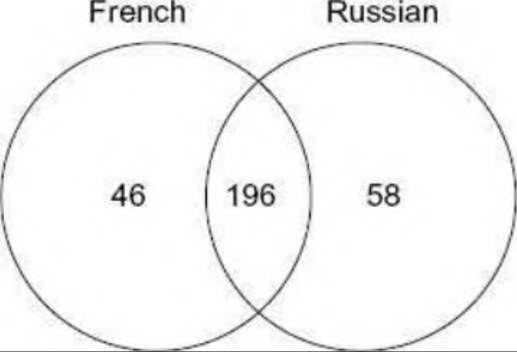
3. Using both the statements we would get that there are 46 people who speak only French. (Refer to figure below)
4. Using both the statements we have three unknowns and three unique equations as:
J + P + G = 38500, J = 2/9 (P + G) and P = 3/11 (J + G). Solving you can get all the three values.
5. Make the following table to analyse this:
| Name | Background | Number of offers |
| Ashish | Engine er∕ C A/Ec onomist/Doctor | 0/1/2/3 |
| Dhanraj | Engine er∕ C A/Ec onomist/Doctor | 0/1/2/3 |
| Felix | Engine er∕ C A/Ec onomist/Doctor | 0/1/2/3 |
| Sameer | Engine er∕ C A/Ec onomist/Doctor | 0/1/2/3 |
Using the clues given to eliminate possibilities the following table can be easily arrived at:
| Name | Background | Number of offers |
| Ashish | CA | 3 |
| Dhanraj | Doctor | 0/1 |
| Felix | Engineer | 0/1 |
| Sameer | Economist | 2 |
At this point we can see that the answer is (c).
6. From the given clues (third and fourth) we can clearly see that Ganesh and Daljeet have ' 20 each and Sandeep had ' 30. Also, since Jugraj has less than
Alam, we get the following table:
| Alam | Sandeep | Daljeet | Ganesh | Jugraj |
| 40 | 30 | 20 | 20 | 10 |
Now, the first three statements are not possible and must be false because:
1. If Alam ended with 9.5, he must have spent 30.5. Given that he has spent ten times more than Ganesh, he must have spent 11 times what Ganesh Spent—which is an impossible decimal value.
2. If Sandeep spends '29, then Daljeet must have spent '27.5 which is not possible.
3. If Ganesh Spent' 16, Alam would spend more than he had to start off with. Only Option (d) is possible.
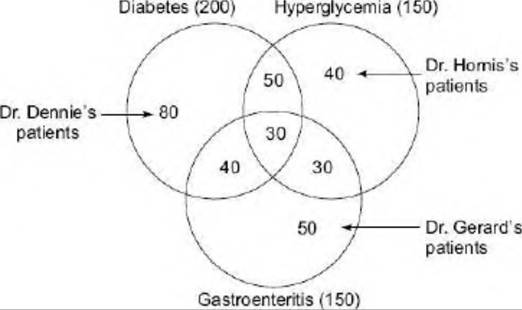
6. From the figure it is clear that Paul would have 150, Gerard 50 and Hornis 40 patients. Hence, option (a) is correct.
7. The following tabular structure would help you in getting the best possible route to solve this question. The initial table would look like this:
| Position | City | Name | School |
| 1 | |||
| 2 | |||
| 3 | Pune |
The sequence of deductions is as follows:
(i) Loyola not first, Pune third place and Pune not Loyola /ELoyoIa second place.
(ii) Bangalore not first /E Bangalore Second.
(iii) Convent School not in Hyderabad √zE Convent school in Pune and Hyderabad first place √zE Also gives us that Riaz and Little Flower both belong to Hyderabad and must come in the first position row.
(iv) Convent School not Balbir √zEBalbir from Bangalore and Loyola School and Bipin from Pune.
The final table after these deductions would look like:
| Position | City | Name | School |
| 1 | Hyderabad | Riaz | Little flower |
| 2 | Bangalore | Balbir | Loyola School |
| 3 | Pune | Bipin | Convent School |
Option (c) is correct.
8. The only two pairs of single digit numbers that give their product as a perfect cube are the:
9 ¥ 3 and 4 ¥ 2. 9 and 3 are not in the options, so we start off our trials based on
2 and 4. Then according to the given situation, the father’s age would be 24 and the mother’s age would be half of 42 √zE 21. The difference between their ages would be 3 years as required by the problem. Thus, we see that the younger boy’s age must be 2 years.
9. The following series of deductions would give us the answer:
(a) Number of passengers waiting initially √zE 90% of 200 =180, with 72 women.
(b) Seating capacity of people in each flight = 2∕3rd of 180 =120.
(c) After boarding flight A, number of people in the hall = 80 (as 60% of the seats are vacant) /E Thus, 100 people must have boarded flight A out of which there must have been 50 women (as half the passengers who boarded flight A were women).
(d) Thus, there are 80 people waiting in the hall for flight B—thus the number of air hostesses in flight A = 4.
(e) Vacant Seats in Flight B = 40.
Required ratio 40:4 = 10:1. Option (a) is correct.
Solutions for Questions 11-14:
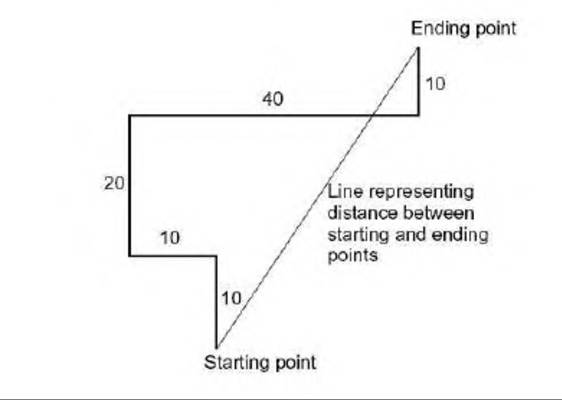
11. 90 kms
12. The end point makes a pythagoras triplet with the starting point, with two legs equal to 30 and 40. So the hypotenuse gives the required distance as 50 km and the direction is north east (as is evident Iromthe figure).
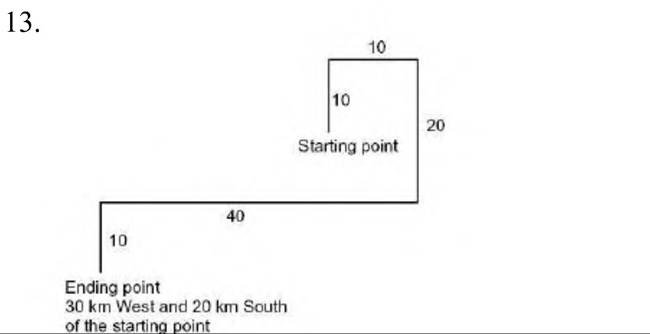
The revised figure would look as above and hence the answer would be 1 (30 west and 20 south).
14.
Solutions for Questions 15 to 17:
15. Of R6,R7,R8,R9 and Rl 3 (the regions which produce medium quality of Crop 1 or 2), only R9 produces low quality Crop 3 or 4. Hence, there is only 1 region.
16. Some crop-3 producing regions like Rl, R2 etc, produce Crop-I too but not high quality crop-2.
17. All the three low quality crop-1 producing regions produce either high quality crop-4 or medium quality crop-3.
18. The following figures would make the answer clear:
Initial arrangement:
Final arrangement:
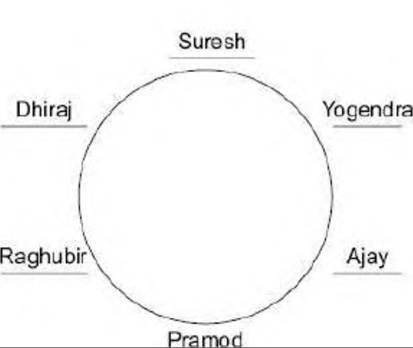
Hence, Suresh is sitting to the left of Dhiraj.
19. There can be many possibilities and this can be tested by drawing 4 lines on a plane and seeing how many areas are made—you can easily see that the number of distinct areas into which the plane is divided can differ and is not unique.
20. Solve this question using options. If you try option (c) i.e. 30 days, you would get that they did yoga for six mornings and played tennis for 16 evenings. Thus on 8 days they did neither yoga nor played tennis. Hence, option (c) is correct.
21. There are six 2,s and four 4,s is sequence. Thus, these would be 2 oranges in the basket.
22. 19 ¥ 1 - 4 ¥ 2 = 11. Option (c) is correct.
23. It can be easily seen that the revenues at different values would be:
200 ¥ 2, 220 ¥ 1.9, 240 ¥ 1.8, 260 ¥ 1.7, 280 ¥ 1.6, 300 ¥ 1.5 and 320 ¥ 1.4. The value goes up till 300 ¥ 1.5 and then reduces. Hence, option (b) is correct.
24. The price per piece of bread would be 3 coins as the third traveller is paying 8 coins for his 2.66 loaves. Also the contribution of the first traveller is 2.33 loaves, while that of the second is only 0.33 loaves. Hence, the first traveller should get 2.33 ¥ 3 = 7.
25. Since he is left with 1 diamond at the end, to the third watchman he must have reached with 6 diamonds, given him half (3) and two more (total 5) and be left with 1 diamond. With the same thought pattern you can solve the remaining part of the question.
The thought process would go as this:
1 JE 6 JE 16 /E 36.
More on the topic CAT 2002:
- CAT 2002
- Contents
- Introduction to an Introduction
- Notes
- REFERENCES
- Dicrocoelium dendriticum (lancet fluke)
- In human medicine, certain systemic drugs used to treat diseases can have profound negative effects on hearing and balance.
- Conclusion
- Bibliography
- EXERCISE