EXERCISE
Directions for Questions 1 and 2: Refer to the data below and answer the questions that follow:
In the Indian athletic squad sent to the Olympics, 21 athletes were in the triathlon team; 26 were in the pentathlon team; and 29 were in the marathon team.
14 athletes can take part in triathlon and pentathlon; 12 can take part in marathon and triathlon; 15 can take part in pentathlon and marathon; and 8 can take part in all the three games.1. How many players are there in all?
(a) 35 (b) 43
(c) 49 (d) none of these
2. How many were in the marathon team only?
(a) 10 (b) 14
(c) 18 (d) 15
Directions for Questions 3 and 4: Refer to the data below and answer the questions that follow.
In a test in which 120 students appeared, 90 passed in History, 65 passed in Sociology and 75 passed in Political Science. 30 students passed in only one subject and 55 students in only two. 5 students passed no subjects.
3. How many students passed in all the three subjects?
(a) 25 (b) 30
(с) 35 (d) Data insufficient
4. Find the number of students who passed in at least two subjects.
(a) 85 (b) 95
(c) 90 (d) Data insufficient
Directions for Questions 5 to 8: Refer to the data below and answer the questions that follow.
5% of the passengers who boarded Guwahati- New Delhi Rajdhani Express on 20th February, 2002 do not like coffee, tea and ice cream and 10% like all the three. 20% like coffee and tea, 25% like ice cream and coffee and 25% like ice cream and tea. 55% like coffee, 50% like tea and 50 % like ice cream.
5. The number of passengers who like only coffee is greater than the passengers who like only ice cream by
(a) 50% (b) 100%
(c) 25% (d) 0
6. The percentage of passengers who like both tea and ice cream but not coffee is
(a) 15 (b) 5
(c) 10 (d) 25
7. The percentage of passengers who like at least 2 of the 3 products is
(a) 40 (b) 45
(c) 50 (d) 60
8.
If the number of passengers is 180, then the number of passengers who like ice cream only is(a) 10 (b) 18
(c) 27 (d) 36
Directions for Questions 9 to 15: Refer to the data below and answer the questions that follow.
In a survey among students at all the IIMs, it was found that 48% preferred coffee, 54% liked tea and 64% smoked. Of the total, 28% liked coffee and tea, 32% smoked and drank tea and 30% smoked and drank coffee. Only 6% did none of these. If the total number of students is 2000 then find
9. The ratio of the number of students who like only coffee to the number who like
only tea is
(a) 5:3 (b) 8:9
(c)2:3 (d) 3:2
10. Number of students who like coffee and smoking but not tea is
(a) 600 (b) 240
(c) 280 (d) 360
11. The percentage of those who like coffee or tea but not smoking among those who
like at least one of these is
(a) more than 30 (b) less than 30
(c) less than 25 (d) none of these
12. The percentage of those who like at least one of these is
(a) 100 (b) 90
(c) Nil (d) 94
13. The two items having the ratio 1:2 are
(a) Tea only and tea and smoking only.
(b) Coffee and smoking only and tea only.
(c) Coffee and tea but not smoking and smoking but not coffee and tea.
(d) None of these
14. The number of persons who like coffee and smoking only and the number who like tea only bear a ratio
(a) 1:2 (b) 1:1
(c)5:l (d)2:l
15. Percentage of those who like tea and smoking but not coffee is
(a) 14 (b) 14.9
(c) less than 14 (d) more than 15
16. 30 monkeys went to a picnic. 25 monkeys chose to irritate cows while 20 chose to irritate buffaloes. How many chose to irritate both buffaloes and cows?
(a) 10 (b) 15
(c) 5 (d) 20
Directions for Questions 17 to 20: Refer to the data below and answer the questions that follow.
In the CBSE Board Exams last year, 53% passed in Biology, 61% passed in English, 60% in Social Studies, 24% in Biology & English, 35% in English & Social Studies, 27% in Biology and Social Studies and 5% in none.
17. Percentage of passes in all subjects is
(a) Nil (b) 12
(c) 7 (d) 10
18. If the number of students in the class is 200, how many passed in only one subject?
(a) 48 (b) 46
(c) more than 50 (d) less than 40
19. If the number of students in the class is 300, what will be the % change in the number of passes in only two subjects, if the original number of students is 200?
(a) More than 50% (b) Less than 50%
(c) 50% (d) None of these
20. What is the ratio of percentage of passes in Biology and Social Studies but not English in relation to the percentage of passes in Social Studies and English but not Biology?
(a) 5:7 (b) 7:5
(c) 4:5 (d) None of these
Directions for Questions 21 to 25: Refer to the data below and answer the questions that follow.
In the McGraw Hill Mindworkzz Quiz held last year, participants were free to choose their respective areas from which they were asked questions. Out of 880 participants, 224 chose Mythology, 240 chose Science and 336 chose Sports, 64 chose both Sports and Science, 80 chose Mythology and Sports, 40 chose Mythology and Science and 24 chose all the three areas.
21. The percentage of participants who did not choose any area is
(a) 23.59% (b) 30.25%
(c) 37.46% (d) 27.27%
22. Of those participating, the percentage who choose only one area is
(а) 60% (b) more than 60%
(c) less than 60% (d) more than 75%
23. Number of participants who chose at least two areas is
(a) 112 (b)24
(c) 136 (d) None of these
24. Which of the following areas shows a ratio of 1:8?
(a) Mythology & Science but not Sports: Mythology only
(b) Mythology & Sports but not Science: Science only
(c) Science: Sports
(d) None of these
25. The ratio of students choosing Sports & Science but not Mythology to Science but not Mythology & Sports is
(a) 2:5 (b) 1:4
(c) 1:5 (d) 1:2
Directions for Questions 26 to 30: Refer to the data below and answer the questions that follow.
The table here gives the distribution of students according to professional courses.
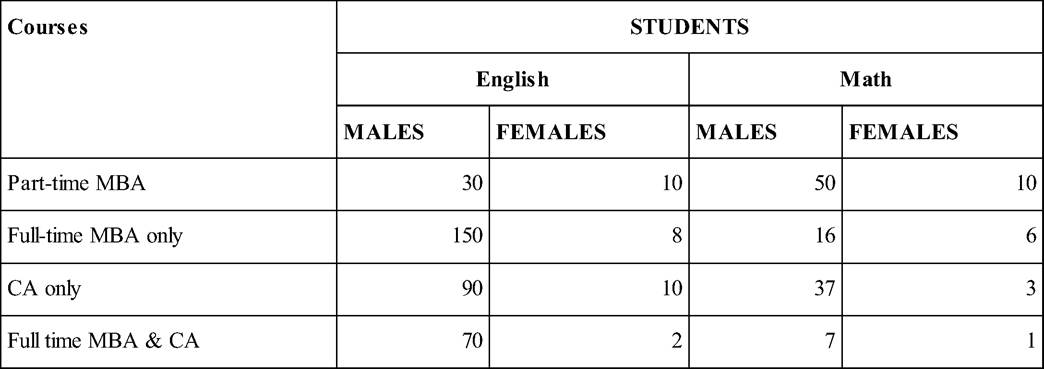
26. What is the percentage of Math students over English students?
(a) 50.4 (b)61.4
(c) 49.4 (d) None of these
27. The average number of females in all the courses is (count people doing full-
time MBA and CA as a separate course)
(a) less than 12 (b) greater than 12
(c) 12 (d) None of these
28. The ratio of the number of girls to the number of boys is
(a) 5:36 (b) 1:9
(c) 1:7.2 (d) None of these
29. The percentage increase in students of full-time MBA only over CA only is
(a) less than 20 (b) less than 25
(c) less than 30 (d) more than 30
30. The number of students doing full-time MBA or CA is
(a) 320 (b) 80
(c) 160 (d) None of these.
Directions for Questions 31 to 34: Refer to the data below and answer the questions that follow:
A newspaper agent sells The TOI, The HT and The IN in equal numbers to 302 persons. Seven get HT & IN, twelve get The TOI & IN, nine get The TOI & HT and three get all the three newspapers. The details are given in the Venn diagram:
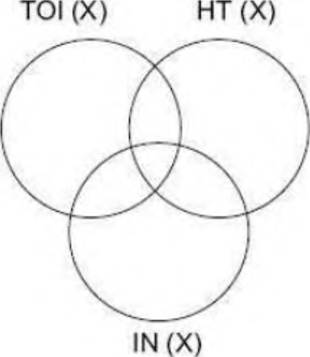
31. How many get only one paper?
(a) 280 (b) 327
(c) 109 (d) None of these
32. What percent get The TOI and The HT but not The IN
(a) more than 65% (b) less than 60%
(c) @ 64% (d) None of these.
33. The number of persons buying The TOI and The HT only, The TOI and The IN only and The HT and The IN only are in the ratio of
(a) 6:4:9 (b) 6:9:4
(c) 4:9:6 (d) None of these
34. The difference between the number reading The HT and The IN only and The HT only is
(a) 77 (b) 78
(c) 83 (d) None of these.
35. A group of 78 people watch Zee Tλζ Star Plus or Sony. Of these, 36 watch Zee TY 48 watch Star Plus and 32 watch Sony.
If 14 people watch both Zee TV and Star Plus, 20 people watch both Star Plus and Sony, and 12 people watch both Sony and Zee TV find the ratio of the number of people who watch only Zee TV to the number of people who watch only Sony.(a) 9:4 (b) 3:2
(c) 5:3 (d) 7:4
Directions for Questions 36 to 37: Answer the questions based on the following information.
The following data was observed from a study of car complaints received from 180 respondents at Colonel Verma’s car care workshop, viz., engine problem, transmission problem or mileage problem. Of those surveyed, there was no one who faced exactly two of these problems. There were 90 respondents who faced engine problems, 120 who faced transmission problems and 150 who faced mileage problems.
36. How many of them faced all the three problems?
(a) 45 (b) 60
(c) 90 (d) 20
37. How many of them faced either transmission problems or engine problems?
(a) 30 (b) 60
(c) 90 (d) 40
Direction for Questions 38 to 42: given below are five diagrams one of which describes the relationship among the three classes given in each of the five questions that follow. You have to decide which of the diagrams is the most suitable for a particular set of classes. The number of the diagram is your answer.
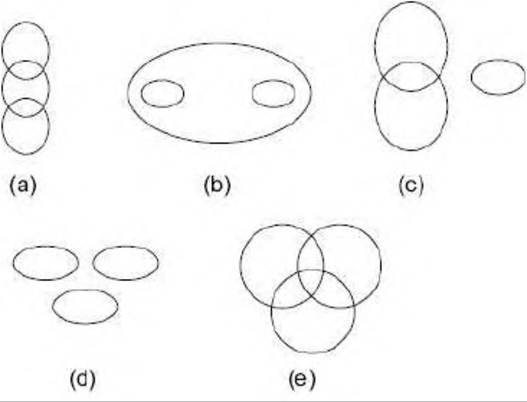
38. Elephants, tigers, animals
39. Administrators, Doctors, Authors
40. Platinum, Copper, Gold
41. Gold, Platinum, Ornaments
42. Television, Radio, Mediums OfEntertainment
Direction for Questions 43 to 45: In the ancient game of “placing the numbers on a tree branch” a sequence of numbers is provided to an individual participant and he is then asked to place the numbers in the branches of a hanging tree with the first number forming the top most node of the tree (and this node is called the root of the tree) and the subsequent numbers are placed in the left sub tree if the number is smaller than the number at the root or in the right sub tree, if the number is greater than the number in the root.
A node is denoted by an oval and has to include a number in it. Each node at a level can be viewed as a tree itself and the same rule applies to it as well. For every node, if a number is greater than the number at the node, then it must be in the nodes to its right and if the number be smaller than the number at the node, then it must be in the nodes to its left. New numbers must obey the rule of all nodes above itself.Numbers shall not repeat themselves in the nodes and in case a number appears which has already appeared earlier in the tree it has to be placed on the right most of its possible positions.
E.g, 36, 28, 60, 92, 8, 44
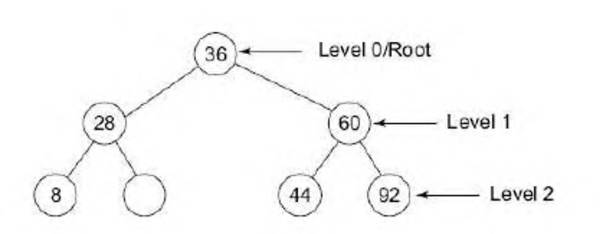
Given is a sequence of numbers and an empty tree. Fill the numbers in the appropriate nodes. The sequence is given in order and starts from 56
56, 60, 16, 36, 28, 72, 12, 20, 64, 16, 80, 68, 36, 56, 20
43. What are the numbers at level 2?
(a) 12, 20, 28 (b) 12, 36, 72
(c) 12,36,56,72 (d) 16, 36,64, 80
44. What is the sum of the numbers at the level 3?
(a) 172 (b) 128
(c) 76 (d) 208
45. How many nodes are at the 4th level?
(a) 7 (b) 3
(c) 9 (d) 2
46. Seventy percent of the employees in a multinational corporation have VCD players, 75 percent have microwave ovens, 80 percent have ACs and 85 percent have washing machines. At least what percentage of employees has all four gadgets?
(a) 15 (b) 5
(c) 10 (d) Cannotbe determined
Answer Key
| l.(b) | 2. (a) | 3.(b) | 4. (a) |
| 5. (b) | 6. (a) | 7. (c) | 8. (b) |
| 9. (c) | 10. (b) | H-(a) | 12. (d) |
| 13.(c) | 14. (b) | 15. (a) | 16. (b) |
| 17.(c) | 18. (c) | 19. (c) | 20. (a) |
| 21∙(d) | 22. (c) | 23. (c) | 24. (a) |
| 25. (b) | 26. (d) | 27. (b) | 28. (b) |
| 29. (c) | 30. (a) | 31. (a) | 32. (c) |
| 33.(b) | 34. (d) | 35. (a) | 36. (c) |
| 37. (b) | 38. (b) | 39. (b) | 40. (d) |
| 41. (a) | 42.(b) | 43.(c) | 44. (d) |
| 45. (d) | 46. (c) |
More on the topic EXERCISE:
- EXERCISE ON RANKINGS
- GENERAL PRINCIPLES OF LIABILITY
- The Drafting Situation
- Conclusion: Bringing Asia into the global conversation
- SERIES BASED ON ALPHABETS
- The Cypriot Advisory Model
- CONCLUSION
- Conclusions
- Conclusion
- Why Draft a Constitution?