CAT 2001
1. Three friends, returning from a movie, stopped to eat at a restaurant. After dinner, they paid their bill and noticed a bowl of mints at the front counter. Sita took !/3rd of the mint, but returned four because she had a momentary pang of guilt.
Fatima then took l∕4th of what was left but returned three for similar reasons. Eswari then took half of the remainder but threw two back into the bowl. The bowl had only 17 mints left when the raid was over. How many mints were originally in the bowl?(a) 38 (b)31
(c) 41 (d) None of these
2. Shyama and Vyomwalkup an escalator (moving stairway). The escalator moves at a constant speed. Shyama takes three steps for every two of Vyom’s steps. Shyama gets to the top of the escalator after having taken 25 steps, while Vyom (because her slower pace lets the escalator do a little more of the work) takes only 20 steps to reach the top. If the escalator were turned off, how many steps would they have to take to walk up?
(a) 40 (b) 50
(c) 60 (d) 80
3. Ashish is given' 158 in one rupee denominations. He has been asked to allocate them into a number of bags such that any amount required between' 1 and ' 158 can be given by handing out a certain number of bags without opening them What is the minimum number of bags required?
(а) 11 (b)12
(с) 13 (d) None of these
4. December 9, 2001 is Sunday. What was the day on December 9, 1971?
(a) Thursday (b) Wednesday
(c) Saturday (d) Sunday
Directions for Questions 5-11: Answer each of the questions independent of each other.
5. Four friends Ashok, Bashir, Chirag and Deepak are out shopping. Ashok has less money than three times the amount that Bashir has. Chirag has more money than Bashir. Deepak has an amount equal to the difference of amounts with Bashir and Chirag. Ashok has three times the money with Deepak. They each have to buy at least one shirt, or one shawl, or one sweater, or one jacket, that are priced ' 200,' 400,' 600 and ' 1000 a piece, respectively.
Chirag borrows ' 300 IfomAshok and buys a jacket. Bashir buys a sweater after borrowing ' 100 from Ashok and is left with no money. Ashok buys three shirts. What is the costliest item that Deepak could buy with his own money?(a) A Shirt (b) A Shawl
(c) A Sweater (d) A Jacket
6. In a family gathering there are two males who are grandfathers and four males who are fathers. In the same gathering there are two females who are grandmothers and four females who are mothers. There is at least one grandson or a granddaughter present in this gathering. There are two husband wife pairs in this group. These can either be a grandfather and a grandmother, or a father and a mother. The single grandfather (whose wife is not present) has two grandsons and a son present. The single grandmother (whose husband is not present) has two grand daughters and a daughter present. A grandfather or a grandmother present with their spouses does not have any grandson or granddaughter present. What is the minimum number of people present in this gathering?
(a) 10 (b) 12
(c) 14 (d) 16
7. Eight people carrying food baskets are going for a picnic on motorcycles. Their names are A, B, C, D, E, F, G and H. They have four motorcycles Ml, М2, М3 and M4 among them They also have four food baskets O, P, Q and R of different size and shapes and each can be carried only on motorcycles Ml, М2, М3 or M4 respectively. No more than two persons can travel on a motorcycle and no
more than one basket can be carried on a motorcycle. There are two husbandwife pairs in this group of eight people and each pair will ride on a motorcycle together. C cannot travel with A or B. E cannot travel with B or F. G cannot travel with F, H or D. The husband-wife pairs must carry baskets O and P. Q is with A and P is with D. F travels on Ml and E travels on М2 motorcycles. G is with Q, and B cannot go with R. Who is travelling with H?
(a) A (b) B
(c) C (d) D
8. I have a total of' 1000. ItemA costs ' 110, item B costs ' 90, item C costs ' 70, item D costs ' 40 and item E costs ' 45.
For every item D that I purchase, I must also buy two of item B. For every item A, I must buy one of item C. For every item E, I must also buy two of item D and one of item B. For every item purchased I earn 1000 points and for every rupee not spent I earn a penalty of 1500 points. My objective is to maximise the points I can earn. What is the number of items that I must purchase to maximise my points?(a) 13 (b) 14
(c) 15 (d) 16
9. On her walk through the park, Sheetal collected 50 coloured leaves, all either maple or oak. She sorted them by category when she got home, and found the following:
(a) The number of red oak leaves with spots is even and positive.
(b) The number of red oak leaves without any spot equals the number of red maple leaves without spots.
(c) All non-red oak leaves have spots, and there are five times as many of them as there are red spotted oak leaves.
(d) There are no spotted maple leaves that are not red.
5. There are exactly 6 red spotted maple leaves.
6. There are exactly 22 maple leaves that are neither spotted nor red.
How many oak leaves did she collect?
(a) 22 (b) 17
(c)25 (d) 18
10. A King has unflinching loyalty from eight of his ministers Ml to M8, but he has to select only four to make a cabinet committee. He decides to choose these four such that each selected person shares a liking with at least one of the other three selected. The selected persons must also hate at least one of the likings of any of the other three persons selected.
Ml likes fishing and smoking, but hates gambling.
М2 likes smoking and drinking, but hates fishing.
М3 likes gambling, but hates smoking.
M4 likes mountaineering, but hates drinking.
M5 likes drinking, but hates smoking and mountaineering.
M6 likes fishing, but hates smoking and mountaineering.
M7 likes gambling and mountaineering, but hates fishing, and
M8 likes smoking and gambling, but hates mountaineering.
Who are the four people selected by the king?
(a) Ml, М2, M5, M6 (b) М3, M4, M5, M6
(c) M4, M5, M6, M8 (d) Ml, М2, M4, M7
11.
In a ‘keep-fit’ gymnasium class there are fifteen females enrolled in a weightloss program. They all have been grouped in any one of the five weight-groups Wl, W2, W3, W4 or W5. One instructor is assigned to one weight-group only. Sonali, Shalini, Shubhra and Shahira belong to the same weight-group. Sonali and Rupa are in one weight-group, Rupali and Renuka are also in one weight- group. Rupa, Radha, Renuka, Ruchika and Ritu belong to different weight- groups. Somya cannot be with Ritu, and Tara cannot be with Radha. Komal cannot be with Radha, Somya or Ritu. Shahira is in Wl and Somya is in W4 with Ruchika. Sweta and Jyotika cannot be with Rupali, but are in a weight- group with total membership of four. No weight-group can have more than five or less than one member. Amita, Babita, Chandrika, Deepika and Elina are instructors of weight-groups with membership sizes 5, 4, 3, 2 and 1, respectively. Who is the instructor of Radha?(a) Babita (b) Elina
(c) Chandrika (d) Deepika
Directions for Questions 12-14: Answer the following questions based on the passage below.
A group of three or four has to be selected from seven persons. Among the seven are two women, Fiza and Kavita, and five men: Ram, Shyam, David, Peter and Rahim Ram would not like to be in the group if Shyam is also selected. Shyam and Rahim want to be selected together in the group. Kavita would like to be in the group only if David is also there. David, if selected, would not like Peter in the group. Ram would like to be in the group only if Peter is also there. David insists that Fiza be selected in case he is there in the group.
11. Which of the following statements is true?
(a) Kavita and Ram can be part of a group of four.
(b) A group of four can have two women.
(c) A group of four can have all four men.
(d) None of the above
12. Which of the following is a feasible group of four?
(a) Ram, Peter, Fiza, Rahim
(b) Shyam, Rahim, Kavita, David
(c) Shyam, Rahim, Fiza, David
(d) Fiza, David, Ram, Peter
13.
Which of the following is a feasible group of three?(a) David, Ram, Rahim
(b) Peter, Shyam, Rahim
(c) Kavita, David, Shyam
(d) Fiza, David, Ram
Directions for Questions 15 and 16: Answer the following questions based on the information given below:
Elle is three times older than Yogesh, Zaheer is half the age of Wahida. Yogesh is older than Zaheer.
14. Which of the following information will be sufficient to estimate Elie’s age?
(a) Zaheer is 10 years old.
(b) Both Yogesh and Wahida are older than Zaheer by the same number of years.
(c) Both (a)and (b) above
(d) None of the above.
15. Which of the following can be inferred?
(a) Yogesh is older than Wahida.
(b) Elle is older than Wahida.
(c) Elle may be younger than Wahida.
(d) None of the above.
Directions for Questions 17-20: A and B are two sets (e.g., A - mothers, B - women). The elements that could belong to both sets (e.g., women who are mothers) is given by set C - A.B. The elements which could belong to either A or B, or both, is indicated by set D - A » B. A set that does not contain any elements is known as a null set, represented by @ (for example, if none of the women in set B is a mother, then C - A.B. is a null set, or C = @). Let ‘V’ signify the set of all vertebrates; ‘M’ the set of all mammals; ‘D’ dogs; ‘F’ fish; ‘A’ Alsatianand ‘P’ a dog named Pluto.
17. If P.A. - @ and P » A = D, then which of the following is true?
(a) Pluto and Alsatians are dogs
(b) Pluto is an Alsatian
(c) Pluto is not a Alsatian
(d) D is a null set.
18. Ify = F » (D.V) is not a null set, it implies that
(a) All fish are vertebrates
(b) All dogs are vertebrates.
(c) Some fish are dogs.
(d) None of the above.
19. IfZ = (P.D)>>M, then
(a) The elements of Z consist of Pluto the dog or any other mammal.
(b) Z implies any dog or mammal.
(c) Z implies Pluto or any dog that is a mammal.
(d) Z is a null set.
20. Given that X - M.D is such that X-D, which of the following is true?
(a) All dogs are mammals.
(b) Some dogs are mammals.
(c) X = @
(d) All mammals are dogs.
Directions for Question 21-24: Answer the questions independent of each other.
21. At a village mela, the following six nautankis (plays) are scheduled as shown in the table below. 
| A. | Sati Savitri | 1 hour | 9.00 am and 2.00 p.m. |
| B. | Joru ka Gulam | 1 hour | 10.30 am and 11.30 |
| a.m | |||
| C. | Sunder Kand | 30 minutes | 10.00 a.m and 11.00 |
| a.m | |||
| D. | Veer | 1 hour | 10.00 a.m and 11.00 |
| Abhimanyu | a.m | ||
| E. | Reshma aur | 1 hour | 9.30 am, 12.00 noon |
| Shera | and 2.00 p.m. | ||
| F. | Jhansi ki Rani | 30 minutes | 11.00 a.m. and 1.30 |
p.m.
You wish to see all the six nautankis. Further you wish to ensure that you get a Iunchbreakfrom 12:30 p.m. to 1.30 p.m.
Which of the following ways can you do this?
(a) Sati Savitri is viewed first; Sunder Kand is viewed third and Jhansi Ki Rani is viewed last
(b) Sati Savitri is viewed last; Veer Abhimanyu is viewed third and Reshma aur Shera is viewed first.
(c) Sati Savitri is viewed first; Sunder Kandis viewed third and Joru ka Gulam is viewed fourth
(d) Veer Abhimanyu is viewed third; Reshma aur Shera is viewed fourth and Jhansi Ki Raniis viewed fifth.
16. While Balbir had his back turned, a dog ran into his butcher shop, snatched a piece of meat off the counter and ran out. Balbir was mad when he realised what had happened. He asked three other shopkeepers, who had seen the dog, to describe it. The shopkeepers really didn’t want to help Balbir. So each of them made a statement which contained one truth and one lie.
A. Shopkeeper Number 1 said: “The dog had black hair and a long tail.”
B. Shopkeeper Number 2 said: “The dog had a short tail and wore a collar.”
C. Shopkeeper Number 3 said: “The dog had white hair and no collar.”
Based on the above statements, which of the following could be a correct description?
(a) The dog had white hair, short tail and no collar.
(b) The dog had white hair, long tail and a collar.
(c) The dog had black hair, long tail and a collar.
(d) The dog had black hair, long tail and no collar.
17. The Bannerjees, the Sharmas and the Pattabhiramans each have a tradition of eating Sunday lunch as a family. Each family serves a special meal at a certain time of day. Each family has a particular set of chinaware used only for this meal. Use the clues below to answer the following question.
A. The Sharma family eats at noon.
B. The family that serves fried brinjal uses blue chinaware.
C. The Bannerjee family eats at 2 о 0clock.
D. The family that serves sambhar does not use red chinaware.
E. The family that eats at 1 o0 clock serves fried brinjal.
F. The Pattabhiraman family does not use white chinaware.
G. The family that eats last likes makki-ki-roti.
Which one of the following statements is true?
(a) The Bannerjees eat makki-ki-roti at 2 о ¢, clock, the Sharmas eat fried brinjal at 12 o0 clock and the Pattabhiramans eat sambhar from red chinaware.
(b) The Sharmas eat sambhar served in white chinaware, the Pattabhiramans eat fried brinjal at 1 о ¢, clock and the Bannerjees eat makki-ki-roti in blue chinaware.
(c) The Sharmas eat sambhar at noon, the Pattabhirmanas eat fried brinjal served in blue chinaware and the Bannerjees eat makki-ki-roti served in red chinaware.
(d) The Bannerjees eat makki-ki-roti served in white chinaware, the Sharmas eat fried brinjal at 12 о ¢, clock and the Pattabhiramans eat sambhar from red chinaware.
18. Mrs. Ranga has three children and has difficulty remembering their ages and the months of their birth. The clues below may help her remember.
A. The boy, who was born in June, is 7 years old.
B. One of the children is 4 years old, but is not Anshuman.
C. Vaibhav is older than Supriya.
D. One of the children was born in September but it was not Vaibhav.
E. Supriya’s birthday is in April.
F. The youngest child is only 2 years old.
Based on the above clues, which one of the following statements is true?
(a) Vaibhav is the oldest, followed by Anshuman who was born in September, and the youngest is Supriya who was born in April.
(b) Anshuman is the oldest being born in June, followed by Supriya who is 4 years old, and the youngest is Vaibhav who is 2 years old.
(c) Vaibhav is the oldest being 7 years old, followed by Supriya who was born in April, and the youngest is Anshuman who was born in September.
(d) Supriya is the oldest, who was born in April, followed by Vaibhav who was born in June, and Anshuman who was born in September.
Directions for Question 25-27: Answer these questions based on the pipeline diagram below.
The following sketch shows the pipelines carrying material from one location to another. Each location has a demand for material. The demand at Vaishali is 400, at Mathura is 400, at Jhampur is 700 and at Vidisha is 200. Each arrow indicates the direction of material flow through the pipeline. The flow from Vaishali to Mathura is 300. The quantity of material flow is such that the demands at all these locations are exactly met. The Capacityofeachpipeline is 1000.
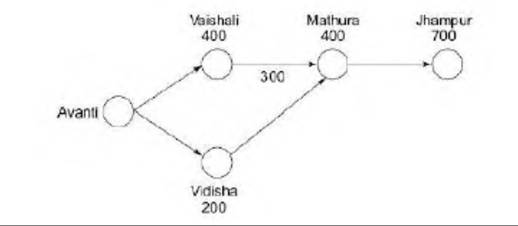
| 25. | What is the free capacity available in the Avanti-Vidihsa Pipeline? | |
| (a) 300 | (b) 200 | |
| (c) 100 | (d)0 | |
| 26. | What is the free capacity available from Avanti to Vaishali? | |
| (a)0 | (b) 100 | |
| (c) 200 | (d) 300 | |
| 27. | The quantity moved from Avanti to Vidisha is | |
| (a) 200 | (b) 800 | |
| (c) 700 | (d) 1000 | |
Answer Key
| l.(d) | 2. (b) | 3∙(d) | 4. (a) |
| 5. (a) | 6. (b) | 7. (c) | 8. (b) |
| 9. (b) | 10. (d) | ll.(b) | 12. (d) |
| 13.(c) | 14. (b) | 15. (c) | 16. (b) |
| 17.(c) | 18. (c) | 19. (a) | 20. (a) |
| 21. (c) | 22. (b) | 23. (c) | 24. (c) |
| 25. (d) | 26. (d) | 27. (d) | |
| Solutions: |
1. Such questions have to be solved using reverse thinking. So start thinking about the last person, Eswari must have seen 30 mints (only in such a case would you get 17 mints left after taking half and then returning 2 to the bowl.) For Eswari to see 30 mints, it must be the case that after Fatima took l∕4th of what she saw, there must have been 27 mints left and when she put 3 back, Eswari would have seen 30 mints.
Further, for Fatima to see 36 mints, Sita must have seen 48 chips to start with - as to leave 40 after taking l∕4th of the chips she sees and then giving back 4 the only starting point possible is 48.
2. This question has to be seen from the perspective of the work done by the escalator. Since the ratio of speeds of walking of Shyama and Vyom is 3:2, when Shyama takes 25 steps, Vyom would take 16.66 steps. Let us say that the escalator would do x steps of work in this time. The value of x would be such that 25 + X would be equal to the number of steps. We also know that when Vyomwalks up the escalator he does 20 steps. Hence, in the time Vyom does 20 steps, the escalator should do 1.2x steps. So 20 + 1.2x should also give us the same value for the number of steps. This means that the work done by the escalator should be 20% higher when Vyom reaches the top than the work that was done when Shyama reached the top. From this point you can go in two ways:
(i) By equating 25 + x = 20 + 1.2x √E x = 25. Hence, the escalator has 50 steps.
(ii) By going through options, we can easily see that if the escalator had 50 steps, then there would be a coverage of 25 steps for Shyama and 30 for Vyom—Whichrepresents the required increase of 20%.
3. In order to do this he should allocate an independent power of 2 in every bag. Thus, the first bag should contain 1 ',the second 2 ', the third 4 ', 8, 16, 32, 64. Using these he can form any value from 1 to 127. The last bag should contain the remaining' 31 as we can add any combination of the above to 31 to get all values between 128 to 158.
4. In a normal year for the same date the day of the week is advanced by 1, while for leap years the same is advanced by 2 days. Calculating backwards, we get +30 + 8 = 38. Gives 38/7 = +3 giving us a Thursday.
Solutions for Questions 5-11:
5. From the given conditions we can make the following table:
| Chirag (c) | 700 (since he takes 300 from Ashok to buy a jacket) |
| Bashir (b) | 500 (Since he has to borrow ' 100 from Ashok to buy a Shawl) |
| Deepak (d) = c - b | 200 |
| Ashok = 3d | 600 |
It is clear from the numbers, that the costliest item Deepak can buy is a shirt.
6. The distribution of males and females that would give us the minimum number of people in the family would be as follows. Note: In the table M# represents a Male and F# represents a female.
| Explanation | |||||
| Generation 1 | Ml (single grandfather whose wife is not present) | M2-F1 (Couple) | F2 (Single grandmother whose husband is not present) | We have 2 grandfathers and 2 grandmothers out of which we are constrained to have at least 1 single grandfather and one single grandmother | |
| Generation 2 | bgcolor=white>M3-F3 (Couple) F4 | M4 | There are a total of 4 fathers and 4 mothers which means that after the two grandfathers and 2 grandmothers there must be another two fathers and two mothers. Thus we have to introduce М3, M4 and F3 and F4. | ||
| Generation 3 | M5,M6 | F5, F6 | The single grandmother has two granddaughters and the single grandfather has two grandsons- thus we need to introduce F5, F6 and M5, M6 respectively. Also note that the son of the single grandfather is М3 and the daughter of the single grandmother is F4 |
From the logic of the above table, we see that we can do the required conditional match by using 6 men and 6 women. Thus, we require a total of 12 people—the minimum number that can be present in the gathering.
7. The following table would get formed based on the deductions:
Starting table—based on the initial direct information, viz:
‘Four food baskets O, P, Q and R of different size and shapes and each can be carried only on motorcycles Ml, М2, М3 or M4 respectively.’
‘Q is with A and P is with D.’
‘F travels on Ml and E travels on М2 motorcycles.’
‘G is with Q,.
| Motorcyle | Ml | М2 | М3 | M4 |
| Basket | O | P | Q | R |
| Person 1 | F | E | A | |
| Person 2 | D | G |
Now at this point, if we use the fact that B cannot go with R, it means that B must be placed with Basket O on Ml. Consequently, on M4 with basket R, C and H would travel together. Thus, option (c) is correct.
8. In order to solve this question, you need to understand that the requirement is to buy the maximum number of items. The least cost per item would occur if we buy IE, 2D,s and 4B,s. In this case 7 items cost ' 485 and hence 14 would cost' 970. Hence, option (b) is correct.
9. We can construct the following table based on the information given:
| Species | Color | Spotted/ Non Spotted | Number |
| Oak | Red | Spotted | у (even and positive) |
| Oak | Red | Non-Spotted | X |
| Oak | Non-Red | Spotted | 5y |
| Oak | Non-Red | Non-Spotted | O |
| Maple | Red | Spotted | 6 |
| Maple | Red | Non-Spotted | X |
| Maple | Non-Red | Spotted | O |
| Maple | Non-Red | Non-Spotted | 22 |
| TOTAL | 50 |
Solving we get: 6y + 2x = 22. Since, у is even and positive it can only be 2 and x would then be 5. Hence the number of oak leaves would be 6y + x = 17.
10. Solve this question through options.
Check option (a) through the following process: (Note: Since all likes and dislikes start with different letters we can just use the first letter to denote the likes and dislikes.
| Minister | Likes | Dislikes |
| Ml | F, S | G |
| М2 | S, D | F |
| M5 | D | S, M |
| M6 | F | S, M |
It can be observed that Ml does not hate any of the likings of the other three and hence this option is wrong.
For option (d) it can be seen that each of the 4 selected ministers likes one of the likes of at least one of the other three and the hate criteria is also fulfilled.
| Minister | Likes | Dislikes |
| Ml | F, S | G |
| М2 | S, D | F |
| M4 | M | D |
| M7 | G,M | F |
Hence, Option (d) is correct.
11. The conditions given can be summarised as follows:
Sonali, Shalini, Shubhra, Shahira, Rupa together. Rupali, Renuka together.
In separate groups are:
Rupa,
Radha, (not with Tara) (not with Komal)
Renuka, Rupali
Ruchika,
Ritu (not with Sowmya)
Komal (not with Radha, Somya or Ritu)
Shweta, Jyotika,_______,__ (not with Rupali and Renuka)
| Who cannot be there | ||
| Wl (5) | Sonali, Shalini, Shubhra, Shahira, Rupa | |
| Group of (4) | Shweta, Jyotika,_, _ | |
| Group of (3) or (2) | Rupali, Renuka | |
| W4 Group of (2) or (3) | Somya, Ruchika | Komat Ritu |
| Group of (1) |
At this point it is clear that:
Ritu and Somya are separate and hence Komal must also be separate.
Also the three groups from the second to the fourth row in the table above must be of 2, 3 or 4 members.
This leaves us with only Tara, Komal, Radha, Ritu to place.
Thus, Radha and Ritu must be in group of 4 or 1 (since Renuka and Ruchika must be in the groups of 2 and 3 in some order and Rupa has already been placed in a group of 5.)
If you were to place Ritu in the group of 1, then Radha must go to the group of 4. In such a case, either Komal or Tara would have to be placed in Radha’s group. This contravenes the basic conditions. Hence, Ritu cannot be alone and must be in the group of 4.
Consequently, Radha must belong to the group of 1—which means that she must be instructed by Elina.
Solutions for Questions 12-14:
First of all summarise the basic information as follows:
Women: Fiza, Kavita
Men: Ram, Shyam, David, Peter and Rahim.
Ram not Shyam
Shyam + Rahim
Kavita only if David
David does not want Peter
Ram only if Peter
David only if Fiza.
After this go through each question through options meeting all the conditions:
12. Option (a) cannot be true since if Kavita and Ram are selected, David and Peter must also be selected and David wants Fiza as a part of his group. Thus we would not be able to create a group of 4.
Option (b): If Fiza and Kavita are selected, then David has to be part of the group. The fourth person has to be selected from amongst the four men left. However, Ram, Shyam and Rahim have to be selected with at least one more of the 4 males. Also since David is selected, Peter cannot be. Thus there is no way to select exactly 4 people in the group.
Option (c): This is also not possible as David wants Fiza so he cannot be selected amongst a selection of 4 males. This means that we must take all the other 4, but Ram does not want to be in a group with Shyam.
Hence, None of these is true.
13. Only the third group can be seen to be feasible.
14. Option (a) is rejected as it selects David without Fiza.
Option (c) is rejected for the same reason.
Option (d) is rejected as it selects Ramwithout Peter. Only Option (c) obeys all conditions.
Solutions for Questions 15 and 16:
15. If we know both 1 and 2 we can easily find that if Zaheer is 10, Yogesh and Wahida are 20 and hence Elle is 60.
16. Option (b) is the clear answer since Elle is three times older than Yogesh, who is elder than Zaheer. Also, Wahida is only double Zaheer ,s age. Hence Option
(b) is correct.
Solutions for Questions 17-20:
17. Since P. A is a null set, Pluto must not be an Alsation
18. FU (D. V) not being a null set means that some fish are dogs.
19. Since Z is the union of Pluto who is a dog and mammals, option (a) is correct.
20. Since X = M.D and X = D it must be the case that all dogs are mammals.
Solutions for Questions 21-24:
21. The correct order would be:
Sati Savitri (9 to 10), Veer Abhimanyu (10 to 11), Sunder Kand (11 to 11:30), Joru Ka Ghulam (11:30 to 12:30), Jhansi Ki Rani (1:30 to 2) mA Reshma and Shera (2 to 3).
Option (c) matches with this order.
22. Create the following truth table we can get 2 cases:
Case 1: If we take the second statement of the first shopkeeper to be true we get case 1 as follows:
| Shopkeeper Number | First Statement | Second Statement |
| 1 | F | T |
| 2 | F | T |
| 3 | T | F |
This means that the dog had white hair, a long tail and wore a collar. Option (b) matches this as a possibility.
Note: This is just a possibility and not a definite truth—as there could be another case if we take the first statement of the first shopkeeper as true. However, we do not need to solve any further as the question is just asking us to identify a possibility. Hence, we do not need to make a table for case 2.
23. The following table can be prepared based on the information given:
| Family | Time | Dish | Chinaware color |
| Sharma | 12 | Sambhar | White |
| Bannerjee | 2 | Makki Ki Roti | Red |
| Pattabhiramans | 1 | Fried Brinjal | Blue |
Option (c) is correct.
24. From the information we can create the following starting table:
| Age | Month | Name |
| 7 | June (boy) | V aibhavZAshuman |
| 4 | AprilZSeptember | SupriyaZV aibhav |
| 2 | SeptemberZApril | SupriyaZV aibhavZAnshuman |
Also from the information about birth months it is clear that:
Since Supriya is in April and Vaibhav is not in September, he must be in June and Anshuman should be in September.
The table would evolve to:
| Age | Month | Name |
| 7 | June (boy) | Vaibhav |
| 4 | April | Supriya |
| 2 | September | Anshuman |
Option (c) can be seen to be correct.
Solutions for Questions 25 to 27:
Since 700 is required at Jhampur, the requirement at Mathura must be 1100, which has to be supplied from the two pipelines coming into Mathura.
It is clear that since Vaishali to Mathura is only 300, the Vidisha Mathura pipeline should carry 800. Hence, Avanti Vidisha should have 1000.
25. There is no free capacity in the Avanti Vidisha Pipeline
26. Avanti Vaishali flow should be 700 and hence the free capacity is 300.
27. 1000
More on the topic CAT 2001:
- References
- REFERENCESAND I RECOMMENDED READING
- References
- References
- References
- References
- References
- Endocrine pancreas
- Cytology of the uterus
- References