CONDITIONAL PROOF AND SUPPOSITION
In the previous section we said that “unless p, q” can be symbolized either by or by P V q.
(8) Unless you are going to PAY for lunch, I will need my WALLET.
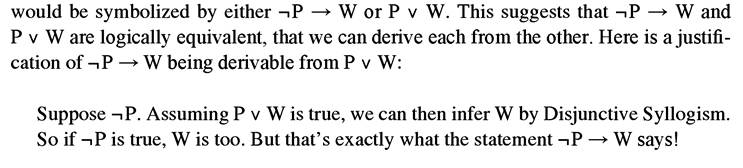
This argument has the form:
Suppose p. But then, given the other premises, q follows. Therefore p → q.
That this is a valid argument form, I hope the above discussion has made intuitively apparent. It is an extremely useful one too, and we shall set it up as a rule of inference. The first thing to notice, though, is that it begins by making a supposition: p is not actually given as a premise, it is simply assumed for the sake of argument. We see what follows from it, given the other premises. Whatever follows from it—say q—is then made on that supposition, i.e., follows provided the supposition is true. The concluding step of the argument simply states this: q is true, provided p is, or, if p, then q. The rule of Conditional Proof can then be described as follows:
Conditional Proof(CP)
To prove a conditional statement, suppose the antecedent as a statement on a separate line, With justification Supp/CP. If from this supposition, together with other premises, you can derive the consequent, then infer the conditional, discharging the supposition.
In symbols:
From a derivation of q from the supposition of p, infer p → q.
This is how we set the above argument out as a proof:
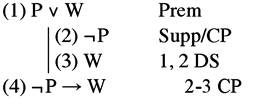
There are some important things to note here.
• We have a new kind Ofjustification in line 2: we are supposing P to begin a conditional proof, and we denote this by “Supp/CP.”
• All the lines that are derived using that supposition are indented or “pushed in,” with a vertical bar to the left, to show that they only follow on that supposition.
• Line 4, however, does not depend on the supposition; instead, it summarizes what has gone on in lines 2-3: (given the premise P v W) then, supposing -∣P, W. Otherwise put: (given the premise P v W), if P then W. What was supposed is now the antecedent. Since it no longer depends on the supposition, we “pop out” or outdent (if that’s the opposite of “indent”).
• Note the justification for line 4: since it summarizes the derivation beginn ing in line 2 and ending in line 3, it is written 2-3 CP (i.e., lines 2 through 3) to indicate this.
• It should be noted when we make a supposition, we are still entitled to use the premises of the argument—or anything derived from them. On the other hand,
• once we have discharged the supposition—in the proof above, with the step of conditional proof—we cannot thereafter use any premises that still depend on the supposition. Thus we could NOT continue the above proof by inferring W from lines (4) and (2) as follows:
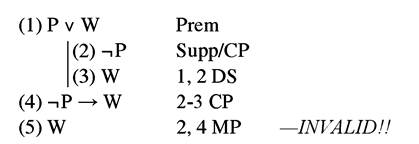
since line (2) is something we have supposed, not something we are given. We can summarize these last two observations in the following rule:
Constraints on Use of the Supposition Rule
A supposition may be made at any point in a proof. After the supposition is made, any premises or statements derived from the premises may be used in applying further rules of inference. But once a supposition has been discharged, neither it nor lines depending on it may be used in the remainder of the proof. Thus
At any line in a proof, rules of inference may be applied to whole statements in any previous lines, provided they have the same indentation, or an indentation to the left.
At any line in a proof, rules of inference may not be applied to whole statements in any previous fines that have an indentation to the right of that line.
A proof is not complete until all suppositions have been discharged—that is, the last line of the proof (containing the conclusion) must have the same indentation, or an indentation to the left of the indentation of the first.
Here’s another example of a proof with the conditional proof strategy, Supp followed by CP:
P → Ю → Ю л IP & Ol → R
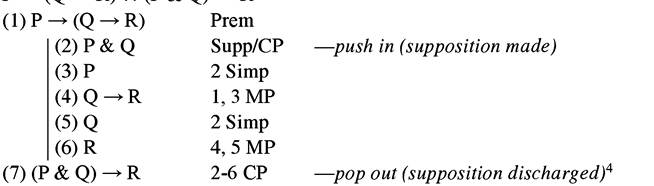
The justification of the formal validity of CP can be achieved as follows.
Granted we have the supposition p and a valid derivation of q from p and other premises {r, s,...}, then q cannot be false if p is true, given the other premises {r, s,... }. But this is the definition of the truth-functional conditional (see chapter 3): a statement of the form p → q is one such that q cannot be false if p is true. It follows that from p and a valid derivation of q fromp and Otherpremises {r, s,...}, p → q follows, given the other premises {r, s,...}.Finally a point that can hardly be stressed too much: a successful proof cannot end with the conclusion on an indented line—a statement on an indented line is not proven, but still depends on a supposition.
7.2.2