THE HYPOTHETICAL SYLLOGISM
Now here’s a proof of the validity of an argument whose form itself embodies a common inference pattern:
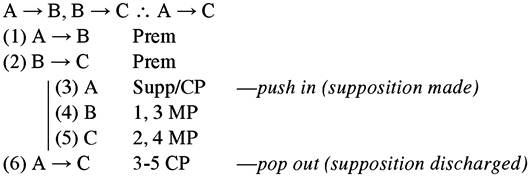
This argument has the valid form: The traditional name for this
argument form is the Hypothetical Syllogism (or the Chain Rule).
Now that we have derived it, we can use it as a rule of inference in any proofs. It runs as follows:4
I owe the “push in/pop out” terminology to Douglas Hofstadter, Go del, Escher, Bach: The Eternal Golden Braid (New York: Basic Books, 1999).
Hypothetical Syllogism (HS)
From two conditionals, the first of which has as consequent the same statement the second has as antecedent, derive the conditional whose antecedent is the antecedent of the first, and whose consequent is the consequent of the second.
In symbols:
From p → q and q → r (stated separately), infer p → r.
As an example of its use, let’s prove valid the inference we imputed to Cicero in chapter 5:
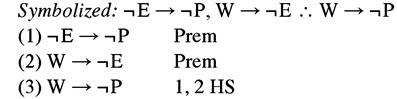
If there is a motion WITHOUT a cause, not every PROPOSITION will be true or false. For what will not have EFFECTIVE causes will be neither true nor false, and if there is a motion without a cause, there is something that does not have an effective cause.
This is a simple substitution instance of the Hypothetical Syllogism, with W for p, I forq,
Here’s a more complicated example of a conditional proof, involving two suppositions and making use of CP twice:
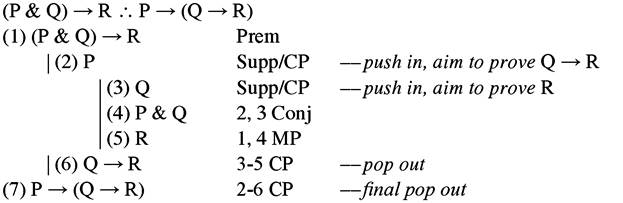
It is worth reminding you here of the restriction on the supposition rule that only the lines above that have the same indentation or an indentation to the left may be used at any given line.
For example, on line (6) lines (3) to (5) cannot now be used. You cannot, for example, derive R from lines (3) and (6), as in this faulty proof of P → R from the same premises:

SUMMARY
• The rule of inference Conditional Proof (CP) is
From a derivation of any statement q from the supposition of p, infer p → q.
• The line on which the supposition is made is justified Supp/CP, and this line and all lines depending on the supposition are indented; the line on which the conditional is derived is undented, because the application of CP discharges the supposition.
• The validity of this argument form follows from our definitions of formal validity and of a truth-functional conditional: it is impossible for p → q to be false if q cannot be false when p is true.
• The rule of inference Hypothetical Syllogism (HS) is
From p → q and q→ r (stated separately), infer p → r:
From two conditionals such that the consequent of the first is identical to the antecedent of the second, infer the conditional with antecedent of the first and consequent of the second.
• The validity of this argument form was proved using CP once and MP twice.
EXERCISES 7.2
5. Prove the logical equivalence of p → q and -∣g → -∣p by constructing proofs of the validity of the following two abstract arguments:

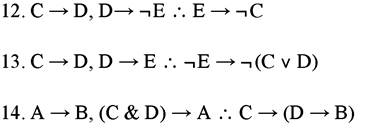
Prove the validity of the following abstract arguments: 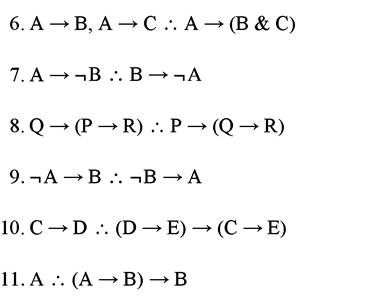
Identify the errors in the following proofs.—Here an error is a mistake in applying a rule of inference; although any subsequent lines depending on a line derived by an incorrect application of a rule may also not follow, this does not count as a separate mistake.
A correct application of a rule of inference must be a substitution instance of the rule; and the justification must also be given properly: 1, 3 MT, etc.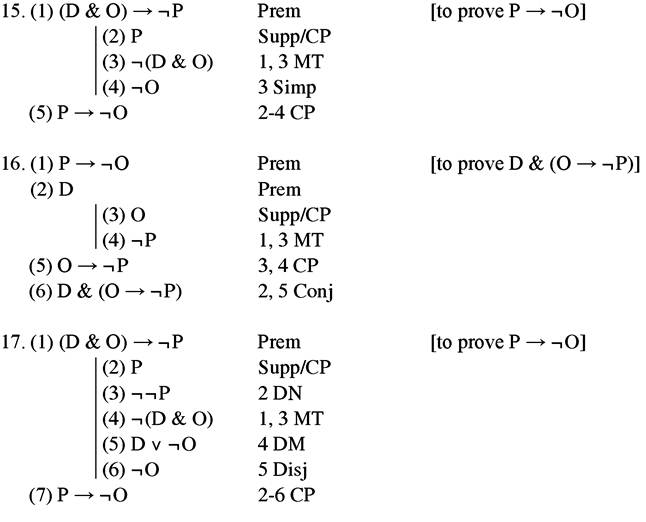
18. (a) Whatfallacy is committed in the following faulty proof?
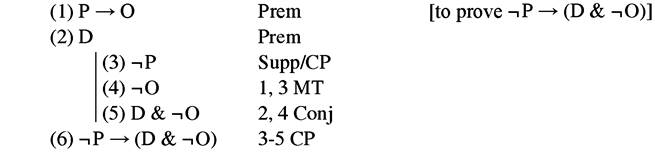
(b) Is it possible to prove this inference valid? Give a reason for your answer.
19. A spokesman for the lobster fishermen of Nova Scotia, objecting to the court’s decision to uphold the treaty rights of the Mi’kmaq native people, quoted on CBC radio, September 23,1999: “As long as status INDIANS are out there fishing there are going to be NON-status Indians fishing too; and as long as there are non-status Indians there are going to be WHITES out there fishing. And if all these people are fishing the lobster conservation programme is in JEOPARDY.” His implicit conclusion: [Therefore if status Indians are allowed to fish lobster out of season, the entire conservation program is in jeopardy.]
(a) Symbolize and (b) prove the validity of this argument.
20. Summarizing Spinoza’s opinion, Frederick Copleston writes: “If God were DISTINCT from Nature and if there were substances OTHER than God, God would not be INFINITE. Conversely, if God is infinite, there cannot be other substances.”—A History of Philosophy, vol. IV, 217
(a) Symbolize both statements, and prove that the first follows from the second.
(b) Prove that the second follows from the first if one grants the extra premise that.
21. (CHALLENGE) Prove that Q follows from the premise
Q, of course, could be anything; and the premise is self-contradictory. So (if you can do it) you will have proved that from a contradiction, anything follows.
7.3