SUPPOSITION IN NATURAL ARGUMENT
Suppositional arguments are quite common in natural reasoning. We make suppositions in an argument for a variety of reasons, but they boil down to essentially two:
(1) we suppose something for the sake of example, that is, for the sake of giving specific content to some general principle or observation or method.
or
(2) we suppose something for the sake of argument, that is, in order to show what follows from this particular premise if one adopted it.
Here is an example of each:
Suppose that a college dormitory has 200 students. Those who watch an hour or more of television on any given day always watch for less than an hour the next day. One fourth of those who watch television for less than an hour one day will watch an hour or more the next day. Half of the students watched television for an hour or more today. Therefore 25 students will watch television for an hour or more tomorrow.[30]
Clearly the conclusion still depends on the supposition: if there were 80 students in the dorm, say, then (retaining all the other premises) we would conclude that 10 students will watch television for an hour or more tomorrow. The supposition gives us a definite number to work with; we are supposing that the dorm has 200 students for the sake of being able to do a specific calculation. Compare this with the following argument:
Suppose that the wall had been left in place after the final renovation. The obstruction would have made it impossible for the spectator’s eye to see through the house and outside. This would cause the axis of the structure to be nearly completely undetectable to those within, which in turn would lead to an oppressive feeling of claustrophobia.[31]
Here the consequence deduced in the conclusion is not a desired feature of architectural design. But, it is being argued, this is what would follow if we had left the wall in place.
So this is an argument justifying not having left the wall in place. The supposition is made not to assert that the wall should have been left in place, but in order to assert that it should not. The supposition was made for the sake of argument, in order to be subsequently refuted.How then should we treat such arguments? The supposition is not being asserted as true; so the argument will not be unsound if it should turn out that the supposition is false. Nevertheless, everything that is concluded from it is concluded only on that supposition, or, under that hypothesis. So every conclusion that depends upon it is also unasserted. In marking up an argument, we shall denote all such unasserted statements with a superscript prefix ςu, for “unasserted,” uthus. All statements so designated in an argument will be analogous to the indented lines in a Conditional Proof. In addition, we shall treat the word “Suppose...,” or equivalent expressions such as “supposing that...,” “Let us assume for the sake of argument that...,” etc., as supposition indicators. Otherwise we shall proceed as normal, numbering the other statements, indicating, conclusions, etc.
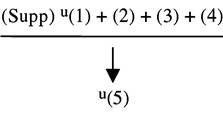
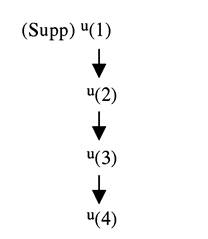
In constructing a diagram of the inference structure, we shall flag the original supposition or suppositions with the prefix (Supp), to show they are not given premises. All subsequent statements depending on the supposition will be designated with a superscript prefix before the line number, thus: u(3).
The two examples above will then come out as follows:
(Suppose that) u(l). (2) (3) (4) pΓherefore ∣ u(5) 25 students will watch television for an hour or more tomorrow.
Diagram:
(Suppose that) u(l) u(2) u(3)∣This would cause∣, u(4) which (in turn) would lead to an oppressive feeling of claustrophobia.
Diagram:
Here clearly we could supply extra premises that could be regarded as implicit, such as (la), (2a), and (За). These have the effect of making every inference valid, and leaving the spotlight on the truth or falsity of these added premises. For to doubt the inference from
(2) to (3) is simply to doubt the truth of (2a), and so with the other inferences. So adding these premises does not alter the soundness of the argument.
A better candidate for an element of the argument left implicit might be a final inference which we are left to make for ourselves, namely to the conditional if (1), then (4) by Conditional Proof: if the wall had been left in place after the final renovation, this would lead to an oppressive feeling of claustrophobia. We diagram this as follows:
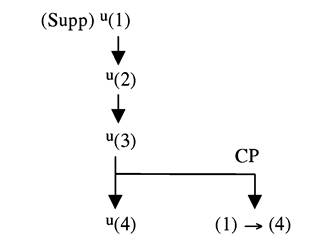
Here the extra “leg” of the diagram represents the inference from the reasoning from the supposition (1) to (4), explicitly summarizing it as a conditional. This is simply a different representation of the same thing we already saw in formal proofs: from the derivation of (4) on the supposition of (1) we infer (1) → (4).
Now let us compare that with the first argument above, about the college dorm. We could interpret this also as a conditional proof: that, given premises (2), (3), and (4), then (1) → (5): “if a college dormitory has 200 students, then 25 students will watch television for an hour or more tomorrow.” But it doesn’t seem very natural to end there. The number 200 was chosen for the sake of definiteness; any other multiple of 8 would have worked just as well. In fact, we would expect a conclusion generalizing from such specific individual numbers to some variable: say that “if a college dormitory has Sn students, then n students will watch television for an hour or more tomorrow (where и is a positive integer).” Provided the number 200 was suitably arbitrary with respect to the other premises, a generalization like this will be acceptable.
We shall return to such reasoning in looking at Universal Generalization in Predicate Logic below.Finally, concerning the wall argument, we note that we could have added one final element that is more or less implicit: “Since an oppressive feeling of claustrophobia is undesirable, it is better that the wall not be left in place in the final renovation.” This consists in another premise, (4a), and a new final conclusion, (4b) it is better that the wall not be left in place in the final renovation. Clearly (4b) follows from (4) together with (4a). But in chapter 10 we will outline a more natural way of dealing with arguments designed to refute their starting supposition: the reductio ad absurdum.
EXERCISES 7.3
Instructions for numbers 22-25: (i) mark up the argument: bracket the (supposition indicators), box any !inference indicators!, set the premises in, underline the conclusions, and double-underline the main conclusion; (ii) identify unasserted statements with a prefix superscript u, and (iii) diagram the inference structure, supplying the conditional proof step where it has been left implicit.
22. Just for the sake of argument, suppose (1) David Duke is elected President of the United States. Then (2) our great country would fall fifty years back in her quest for equality for all her people.—Boston Herald, March 14, 1992, p. 34
23. (1) Suppose that only good researchers can be effective college teachers. In that case it follows that (2) a faculty member will be an effective teacher only if he or she is a good teacher. (3) From this it follows that if a faculty member is an effective teacher, then he or she must be a good researcher. (4) Therefore every effective college teacher must be a good researcher. (5) So, if only good researchers can be effective college teachers then every effective college teacher must be a good researcher. (6) Therefore we could ensure that the university will excel in research by basing tenure decisions solely on teaching effectiveness.—Stephen Thomas, Practical Reasoning in Natural Language (2nd ed.)
24.
(1) Suppose the government imposes a tax of $1 per paperback novel. (2) Buyers perceive no change in their willingness to purchase, so (3) they view their demand for paperback books as being stable. However, (4) publishers view demand as having decreased because (5) the after-tax prices they receive are reduced by $1 for each novel sold. Therefore, (6) an increase in taxes causes a decrease in demand.—Ralph T. Byers and Gerald W. Stone, eds., Macroeconomics (London: Scott, Foresman and Co., 1989), p. 5025. Suppose, (1) at full throttle, the escaping CO2 gas exerts a constant force of IOO N on the wagon. (2) A constant frictional force which opposes the motion is 50 N. The masses relevant to the problem are: (3) the mass of the wagon [is] 30 kg., and (4) the mass of the driver [is] 70 kg. Since (5) the net force is equal to the product of mass times acceleration, and (6) velocity is equal to the product of acceleration and time, (7) the time it takes the wagon to go from rest to a speed of 5 m/s at full throttle is 10 s.—Robert Prigo, Physics class handout, Middlebury College, 1992
26. (CHALLENGE) Richard Dawkins describes a model of an evolutionary strategy as follows:
Another kind of war game that Maynard Smith has considered is the ‘war of attrition.’ This can be thought of as arising in a species that never engages in dangerous combat, perhaps a well-armoured species in which injury is very unlikely. All disputes in this species are settled by conventional posturing. A contest always ends in one rival or the other backing down. To win, all you have to do is stand your ground and glare at the opponent until he finally turns tail. Obviously no animal can afford to expend infinite time threatening; there are important things to be done elsewhere. The resource he is competing for may be valuable, but it is not infinitely valuable. It is only worth so much time and, as at an auction sale, each individual is prepared to spend only so much on it. Time is the currency of the two-bidder auction.
Dawkins then proposes the argument:
Suppose (1) all such individuals worked out in advance exactly how much time they thought a particular kind of resource, say a female, was worth. (2) A mutant individual who was prepared to go on just a little bit longer would always win. (3) So the strategy of maintaining a fixed bidding limit is unstable.[32] Supplying any premises you take to be implicit, i.e., necessary for the validity of an inference and likely to be regarded as too obvious to be worth stating, mark up and diagram the argument as above.
27. (CHALLENGE) In 1705 at the age of 30 Samuel Clarke published his A Demonstration of the Being and Attributes of God, which included the following argument: Since the persons I am discoursing to cannot but own that the supposition of the being of God is in itself most desirable and for the benefit of the world that it should be true, they must of necessity grant further that, supposing the being and attributes of God to be things not indeed demonstrable to be true but only possible and such as cannot be demonstrated to be false, as most certainly they cannot; and, much more, supposing them once made to appear probable and but more likely to be true than the contrary opinion; nothing is more evident, even upon these suppositions only, than that men ought in all reason to live piously and virtuously in the world and that vice and immorality are, upon all accounts and under all hypotheses, the most absurd and inexcusable things in nature.[33]
Re-expressed in modern English, with inessential elements pared away: Since (1) the persons I am discoursing with cannot help admitting that to suppose God exists is most desirable and beneficial for the world, [they must of necessity grant further that], supposing (2) the being and attributes of God are things not indeed demonstrable to be true but only possible and such as cannot be demonstrated to be false; and moreover, supposing (3) that once they are made to appear probable and only more likely to be true than the contrary opinion; then nothing is more evident, even upon these suppositions only, than that (4) men ought in all reason to live piously and virtuously in the world and that vice and immorality are, upon all accounts and under all hypotheses, the most absurd and inexcusable things in nature.
Supplying any premises you take to be implicit, i.e., necessary for the validity of an inference and likely to be regarded as too obvious to be worth stating, mark up and diagram the argument as above.
More on the topic SUPPOSITION IN NATURAL ARGUMENT:
- SUPPOSITION IN NATURAL ARGUMENT
- Preface for Instructors
- DERIVED RULES
- PROPERTIES OF IDENTITY
- Asyllogistic proofs: qn
- C What Is a Hypothesis?
- AN EPISTEMOLOGICAL CLAIM
- Exploitation as the Failure of Reciprocity
- The Realm of Science
- Motivating the Market