PROPERTIES OF IDENTITY
Now, it is intuitively obvious that identity is an equivalence relation: that is, it is reflexive, symmetric, and transitive.
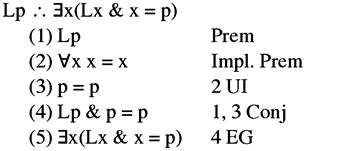
The first of these properties, the reflexivity of identity, is something we will simply assume as an implicit premise wherever it’s necessary for the validity of an argument.
This is consistent with what we did in some of the relational arguments of the previous chapter where, if the validity of an argument depends on a certain property, that property can just be assumed as an implicit premise. Thus if we need the reflexivity of identity in a proof, we make Vx x = x an implicit premise. Here’s an example:The Pope is speaking LATIN. Therefore there is someone speaking Latin and he is the Pope.
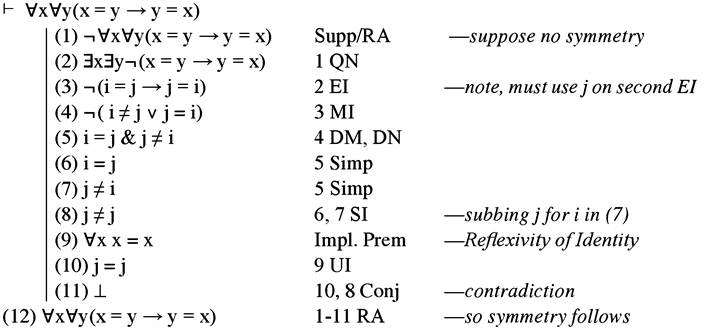
Interestingly, though, we do not have to posit the symmetry and transitivity of the identity relation, since these can be proven by application of SL Here is a proof of symmetry:
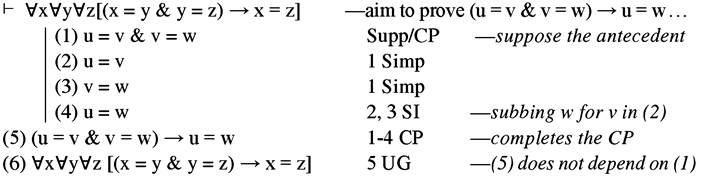
Now here’s a proof of transitivity. This time we will use the UG strategy, being careful to make sure that the statement in u, v, and w that we UG from does not depend on an undischarged supposition in u, v, or w:
SUMMARY
• The rule of inference Substitution of Identicals (SI) is:
If two individuals і and к are identical, then к can be substituted for і in any statement involving i.
From і = к, Φi, infer Φk—e.g., from
• The identity relation is an equivalence relation: i.e., it is symmetric, transitive, and reflexive. Its symmetry and transitivity are derivable; its reflexivity may be assumed as an implicit premise: Vx x = x.
• If the validity of an argument depends on this reflexivity property, included as an additional implicit premise.
EXERCISES 21.2
Symbolize and prove valid the following arguments:
17. The only EVEN prime is two. Therefore there is an even prime. [UD: prime numbers; Ex := X is even]
18. Hesperus is the EVENING star. Phosphorus is the MORNING star. But the Moming Star is identical with the Evening Star. Therefore Phosphoms and Hespems are one and the same heavenly body. [UD: heavenly bodies]
19. Karl Marx was a REVOLUTIONARY. Harpo Marx was one of the Marx BROTHERS. None of the Marx brothers was a revolutionary. So Karl is not the same person as Harpo Marx. [UD: people]
20. The FOUNDER of Marxism was GERMAN. Chico Marx was not German, so he did not found Marxism. [UD: people; Fx := x founds Marxism]
21. God HELPS2 all those who do not help themselves. This entails that God helps him- or herself. [UD: beings]
22. God HELPS2 only those who do not help themselves. This entails that God does not help him- or herself. [UD: beings]
23. Rasputin is not the devil. The devil is the most EVIL2 of beings. Hence there is a being more evil than Rasputin. [UD: beings; Exy := x is more evil than y]
24. The PRINCE of Wales is BALDING. So Charles must be balding, as he is Prince of Wales.
25. Descartes can’t be a SOLIPSIST, because he’s not me. I am one, and there is only one solipsist. [UD: people; Sx := x is a solipsist, m := me, I (the speaker)]
26. (CHALLENGE) The actress who played DOROTHY in The Wizard of Oz is not Liza Minelli; that role was played by her MOTHER2, and no one is her own mother. [UD: actresses; Dx := x played Dorothy in The Wizard of Oz, Mxy := x is the mother of y]
21.3
More on the topic PROPERTIES OF IDENTITY:
- Properties
- THE RULE OF INFERENCE SI
- Index
- SECOND ORDER LOGIC
- Corporeity and Person
- The Nature of Power
- Resisting the Historical Objections: The Selective Strategy
- Goal Assessment
- Introduction
- ORDERING RELATIONS